
Fluoropolymer Tubing Market Size and Share
Market Overview
| Study Period | 2022 - 2032 |
|---|---|
| Market Size (2027) | USD 747.95 Million |
| Market Size (2032) | USD 980.78 Million |
| Growth Rate (2027 - 2032) | 5.57 % |
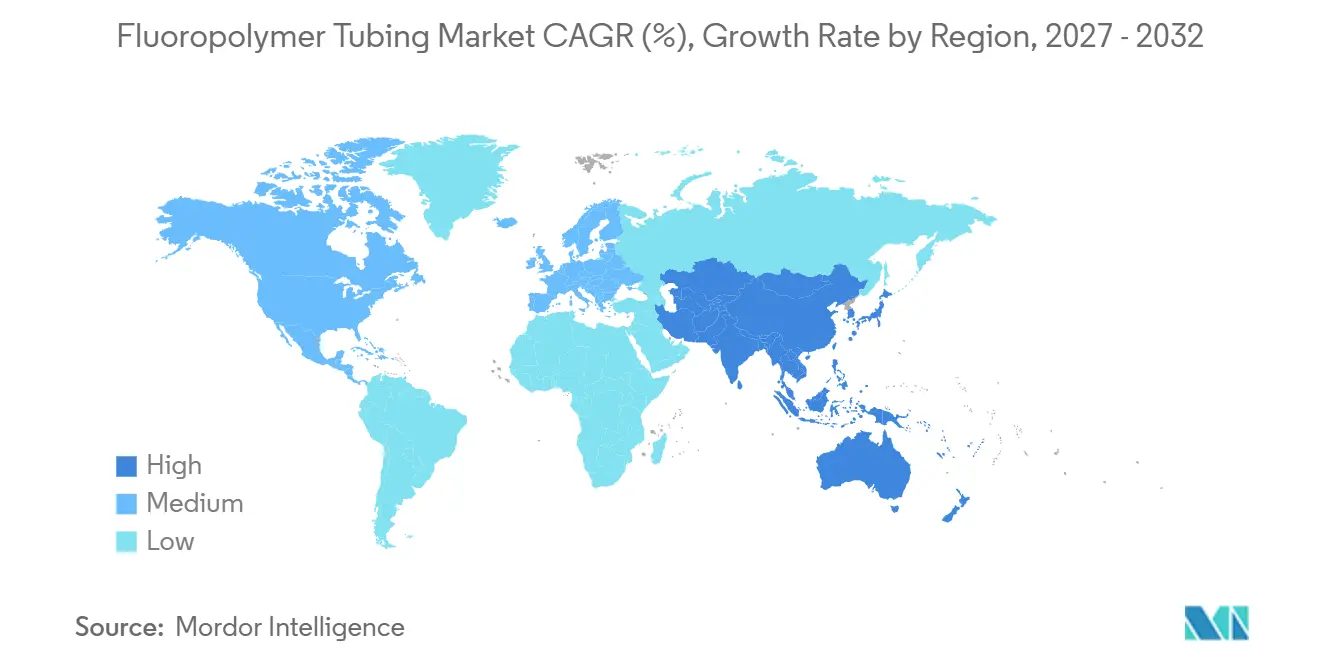
| Fastest Growing Market | Asia-Pacific |
| Largest Market | North America |
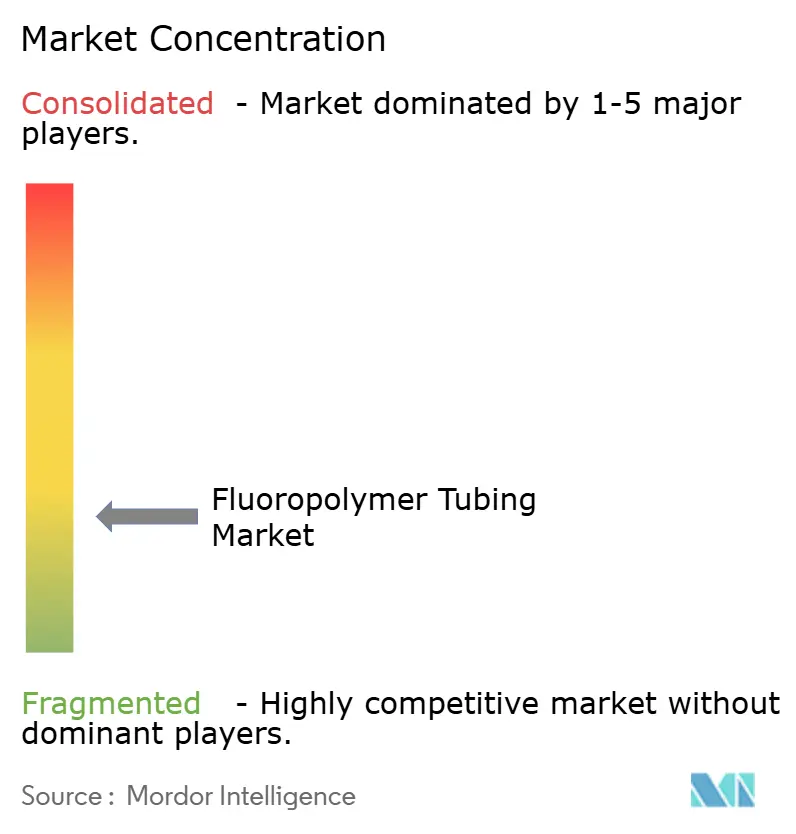
| Market Concentration | Low |
Major Players *Disclaimer: Major Players sorted in no particular order Image © Mordor Intelligence. Reuse requires attribution under CC BY 4.0. | |
Fluoropolymer Tubing Market Analysis by Mordor Intelligence
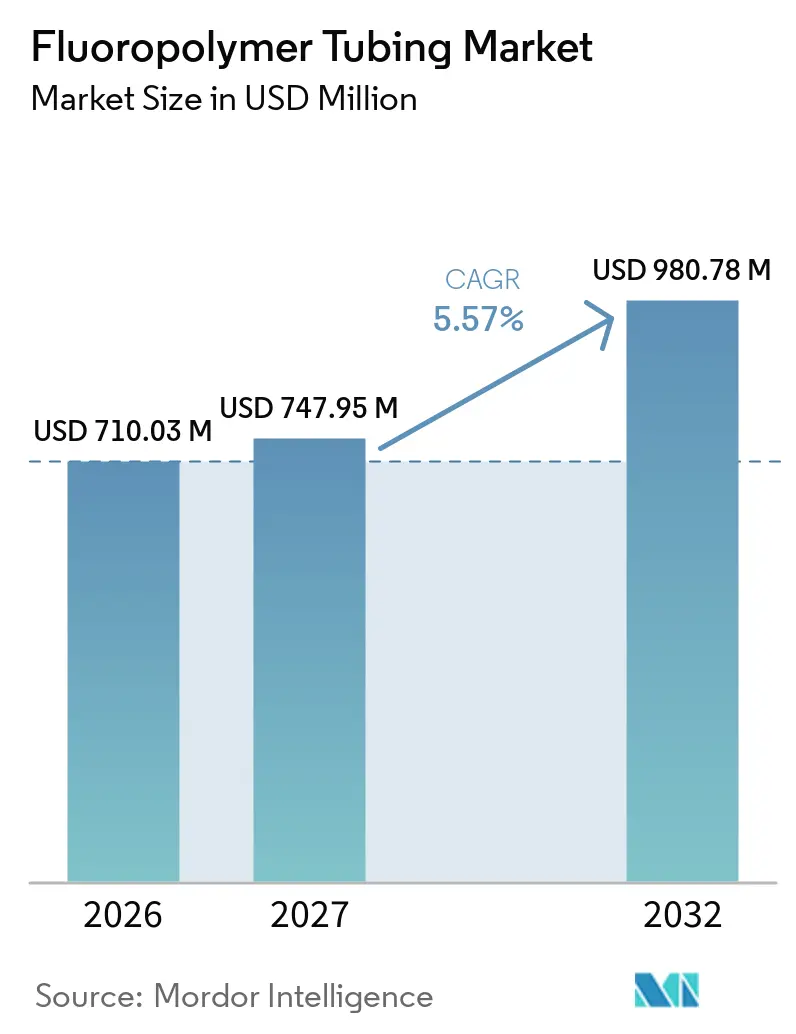
The Fluoropolymer Tubing Market size was valued at USD 710.03 million in 2026 and is estimated to grow from USD 747.95 million in 2027 to reach USD 980.78 million by 2032, at a CAGR of 5.57% during the forecast period (2027-2032). The fluoropolymer tubing market is supported by demand from semiconductor manufacturing, minimally invasive medical devices, and hydrogen-related fluid systems. Demand is moving toward products that meet tighter wall thickness, tensile consistency, and extractables requirements. Suppliers with qualified products for medical, semiconductor, and aerospace uses can strengthen their positions with longer customer programs. The replacement of metallic fluid lines in high-purity facilities also supports demand beyond new plant construction. European perfluoroalkyl and polyfluoroalkyl substances policy remains an important consideration because it could change compliance requirements for manufacturers and users.
Key Report Takeaways
- By form factor, single lumen held 43.12% of the fluoropolymer tubing market share in 2026, while multi-lumen is forecast to advance at a 5.96% CAGR through 2032.
- By material, polytetrafluoroethylene (PTFE) held 38.63% of the fluoropolymer tubing market share in 2026, while polyvinylidene fluoride (PVDF) is forecast to advance at a 6.07% CAGR through 2032.
- By application, medical held 31.56% of the fluoropolymer tubing market share in 2026 and is forecast to advance at a 6.52% CAGR through 2032.
- By geography, North America held 42.49% of the fluoropolymer tubing market share in 2026, while Asia-Pacific is forecast to advance at a 6.38% CAGR through 2032.
Note: Market numbers in this report are based on Mordor Intelligence's proprietary estimation framework, which combines nine months of actuals with Q4 projections for base year 2026.
Market Trends and Insights
Drivers Impact Analysis of Fluoropolymer Tubing Market*
| Driver | (~) % Impact on CAGR Forecast | Geographic Relevance | Impact Timeline |
|---|---|---|---|
| Expansion of Semiconductor Cleanroom Capacity | +1.4% | APAC (Taiwan, South Korea, China, Japan), North America (Arizona, Texas, Ohio) | Medium term (2–4 years) |
| Growth of Minimally Invasive and Single-Use Medical Devices | +1.2% | North America & Europe, with fast adoption in APAC | Medium term (2–4 years) |
| Electrification, Hydrogen, and Fuel-Cell Fluid Management | +0.9% | Europe, North America, APAC (Japan, South Korea, China) | Long term (≥ 4 years) |
| Replacement of Metallic Lines in Corrosive and High-Purity Service | +0.7% | North America, Europe, APAC | Medium term (2–4 years) |
| Double-Containment Tubing for Chemical Leak Prevention | +0.4% | North America & Europe (regulated chemical processing zones) | Short term (≤ 2 years) |
| Source: Mordor Intelligence | |||
Expansion of Semiconductor Cleanroom Capacity
Semiconductor cleanroom expansion is a direct demand driver for high-purity fluoropolymer tubing. The fluoropolymer tubing market benefits when fabs require tubing for wet chemical delivery, rinse circuits, sub-fabrication exhaust systems, and other fluid paths that must remain clean during operation. Advanced process nodes require stronger control of particles and extractables. This requirement can lead existing facilities to update qualified tubing before additional capacity starts production. NICHIAS Corporation developed NAFLON PFA-UG tubing for extreme ultraviolet lithography environments where contamination from tube walls can impair yields. The product direction shows why the fluoropolymer tubing market is increasingly shaped by material purity and traceability requirements, because the tubing itself can affect the contamination profile of a process environment.
Growth of Minimally Invasive and Single-Use Medical Devices
The Food and Drug Administration stated that it had not found evidence that fluoropolymers in medical devices cause patient health concerns[1]. This position supports the continued development of catheter and implant programs that use fluoropolymer components, while giving device manufacturers more certainty when they select materials for long qualification cycles. These devices use fluoropolymers for lubricity, biostability, and electrical insulation. Structural heart, neurovascular, and electrophysiology procedures require thin walls, precise tolerances, and multi-lumen designs. A 2025 peer-reviewed review described medical uses ranging from drug delivery to sensors and identified polytetrafluoroethylene and polyvinylidene fluoride as widely used materials. Single-use systems also raise tubing consumption per procedure because disposable assemblies are not sterilized for reuse, which means consumption can increase even when the number of procedures is unchanged.
Electrification, Hydrogen, and Fuel-Cell Fluid Management
Hydrogen systems are creating a separate source of demand for fluoropolymer tubing, particularly products made with polyvinylidene fluoride and polytetrafluoroethylene. A 2025 peer-reviewed review reported that polytetrafluoroethylene and fluorinated ethylene propylene have hydrogen permeability below 0.01 cm³·mm/m²·day·bar. These materials are suited to sealing and fluid-lining uses where permeation control is important, particularly in storage and transport systems that must manage the small molecular size of hydrogen. Arkema identifies its Kynar polyvinylidene fluoride materials for hydrogen mobility and related fluid-management needs. Suppliers familiar with ultra-high-purity semiconductor qualification requirements can apply relevant process knowledge to hydrogen systems, particularly where fluid cleanliness, chemical resistance, and documented material performance are all required. This overlap gives established producers an advantage when customers qualify new fluid-management designs, as they can draw on existing experience in demanding applications instead of developing their approach from a general industrial base.
Replacement of Metallic Lines in Corrosive and High-Purity Service
High-purity and corrosive processes are increasingly using fluoropolymer tubing instead of metallic lines. Entegris describes clean chemical delivery solutions that use ultra-clean fluoropolymer fluid paths for semiconductor applications. Metallic components can introduce trace contamination that becomes unacceptable in sensitive lithography and wet-etch processes. Chemical and pharmaceutical facilities also need materials that withstand aggressive acids and limit corrosion-related interruptions, especially where the process line must protect product quality as well as equipment uptime. The change from metal lines creates replacement demand as facilities update existing systems, rather than limiting purchases to greenfield plants and capacity additions. The fluoropolymer tubing market also gains when changes in resin grades or extractables requirements lead customers to requalify tubing runs.
Restraints Impact Analysis of Fluoropolymer Tubing Market*
| Restraint | (~) % Impact on CAGR Forecast | Geographic Relevance | Impact Timeline |
|---|---|---|---|
| Fluoropolymer Resin and Processing Cost Premium | -1.2% | Global, with acute impact in cost-sensitive APAC end markets | Medium term (2–4 years) |
| Environmental Scrutiny of Fluoropolymer Production and Disposal | -0.8% | Europe (REACH), North America (EPA PFAS framework) | Long term (≥ 4 years) |
| Qualification Risk from Resin, Additive, and Extractables Variability | -0.5% | Global, highest in semiconductor and medical segments | Short term (≤ 2 years) |
| Source: Mordor Intelligence | |||
Fluoropolymer Resin and Processing Cost Premium
Fluoropolymer resins, especially perfluoroalkoxy alkane and polyvinylidene fluoride, cost more than common engineering thermoplastics. This difference increases substitution pressure in applications with less demanding chemical-resistance or extractables requirements, where users may determine that lower-cost materials provide sufficient performance for the service condition. The pressure is particularly relevant in cost-sensitive manufacturing settings. Production also requires specialized extrusion equipment, careful temperature control, and, in some cases, cleanroom handling. These requirements increase the capital cost for manufacturers and make it harder for new suppliers to match the process control expected in medical or semiconductor programs. Resin supply concentration can add further pressure because fabricators may have limited ability to absorb material-price changes, particularly when qualified grades cannot be substituted without additional customer review.
Environmental Scrutiny of Fluoropolymer Production and Disposal
The European Union restriction process for perfluoroalkyl and polyfluoroalkyl substances remains a significant long-term issue for the fluoropolymer tubing market. The updated restriction proposal included regulatory options for continued fluoropolymer use under controlled conditions[2]. It also considers separate derogation pathways for fluoropolymer uses, which is relevant to companies that need clarity on whether essential applications can continue under defined controls. Requirements for site-specific management plans could raise administrative obligations for participating companies. Larger vertically integrated extruders may be better able to maintain dedicated regulatory resources, prepare the required site-level documentation, and engage with customers who need continuity of supply during the transition. North American manufacturers also face documentation requirements as the Environmental Protection Agency develops its perfluoroalkyl and polyfluoroalkyl substances reporting and manufacturing framework.
*Our forecasts treat driver/restraint impacts as directional, not additive. The impact forecasts reflect baseline growth, mix effects, and variable interactions.
Fluoropolymer Tubing Market Segment Analysis
By Form Factor:
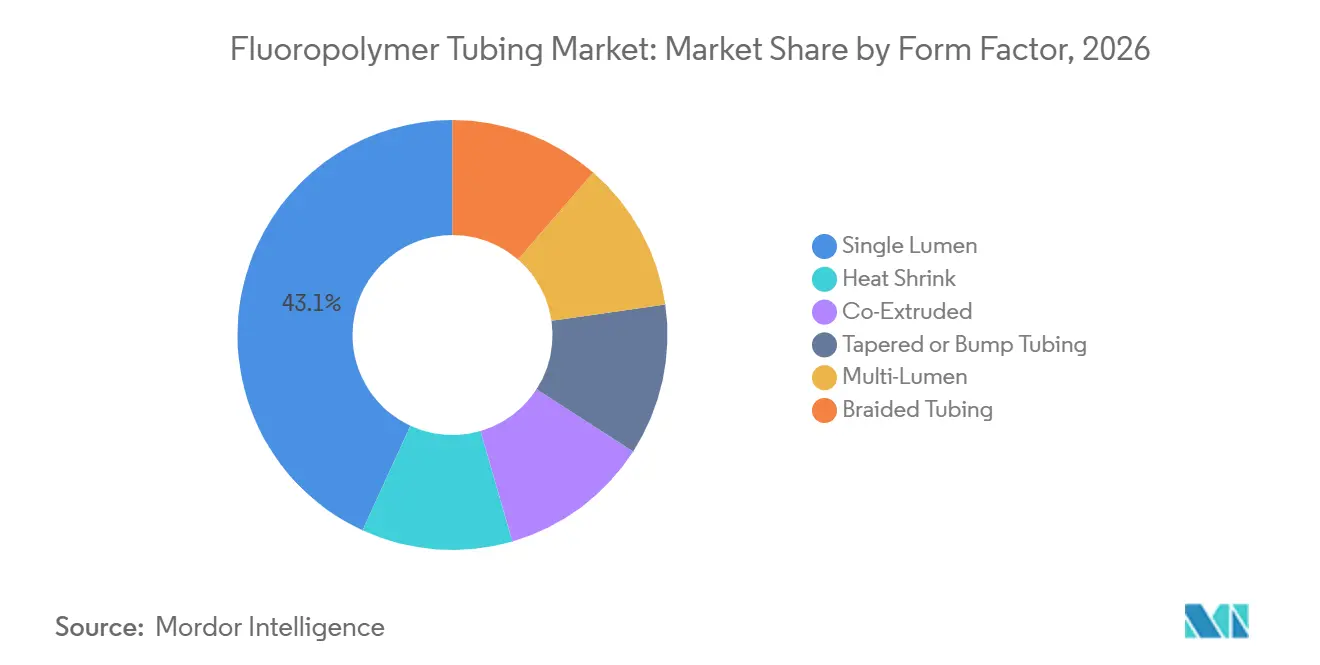
Single Lumen Anchors Revenue as Multi-Lumen Reshapes MarginsSingle lumen held 43.12% of the market share in 2026. Its position reflects the need for straightforward chemical-conveying designs in semiconductor sub-fabrication, industrial fluid handling, and basic medical device shafts, where a single channel meets the functional need without added design complexity. Multi-lumen is projected to advance at a 5.96% CAGR through 2032. Its growth is linked to structural heart, electrophysiology, and neurovascular catheter designs that need separate channels for guidewires, contrast media, and therapeutic payloads, while maintaining a compact catheter profile for clinical use. Junkosha Inc. introduced a thin-walled etched polytetrafluoroethylene liner with walls as thin as 19 µm in 2025. The product enables larger lumens within the same catheter outside diameter, which supports designs that need more internal capacity without increasing the size of the device entering the vessel.
Heat-shrink tubing is used for wire harnessing and connector protection in aerospace and automotive applications. Co-extruded products join different fluoropolymer layers for composite catheter shafts. Braided tubing provides kink resistance for high-pressure interventional catheters. Tapered and bump tubing support controlled stiffness transitions in steerable neurovascular and peripheral devices. Zeus Company LLC introduced StreamLiner NG, a film-cast polytetrafluoroethylene catheter liner, in January 2025. The launch shows that the fluoropolymer tubing market increasingly competes on process capability and dimensional consistency, rather than only on diameter range or material coverage.

By Material:
Polytetrafluoroethylene Retains Dominance While Polyvinylidene Fluoride Accelerates on Energy TailwindsPolytetrafluoroethylene held 38.63% of the market share in 2026. Its use is supported by established qualification histories in medical devices, semiconductor chemical delivery, and corrosive chemical processing. The material offers low friction, continuous service capability to 260 °C, and broad chemical resistance, which together support its continued use in demanding fluid-delivery and device-component applications where performance history is as important as the basic material property set. Fluorinated ethylene propylene is used when optical clarity and melt processability are needed. Perfluoroalkoxy alkane is the reference material for ultra-high-purity semiconductor fluid delivery and complex tubing geometries. Ethylene tetrafluoroethylene has uses in aerospace wire insulation and industrial hose lining, where strength at lower wall thickness is important.
Polyvinylidene fluoride is projected to advance at a 6.07% CAGR through 2032. Its demand is tied to battery electrode binders and to fluid circuits in proton exchange membrane electrolyzers, where the material supports electrochemical applications as well as chemical-resistance needs. The 2025 American Chemical Society (ACS) review notes the electrochemical and piezoelectric properties that support polyvinylidene fluoride in sensor and proton exchange membrane applications. Ethylene tetrafluoroethylene can face substitution in less critical applications because lower-cost alternatives may meet performance needs. Other materials include polychlorotrifluoroethylene, ethylene chlorotrifluoroethylene, and specialty blends used for gas-barrier or radiation-resistance requirements. These applications broaden the fluoropolymer tubing market beyond standard polytetrafluoroethylene and perfluoroalkoxy alkane product lines, allowing suppliers to address needs that focus on a specific barrier, radiation, or mechanical requirement.
By Application:
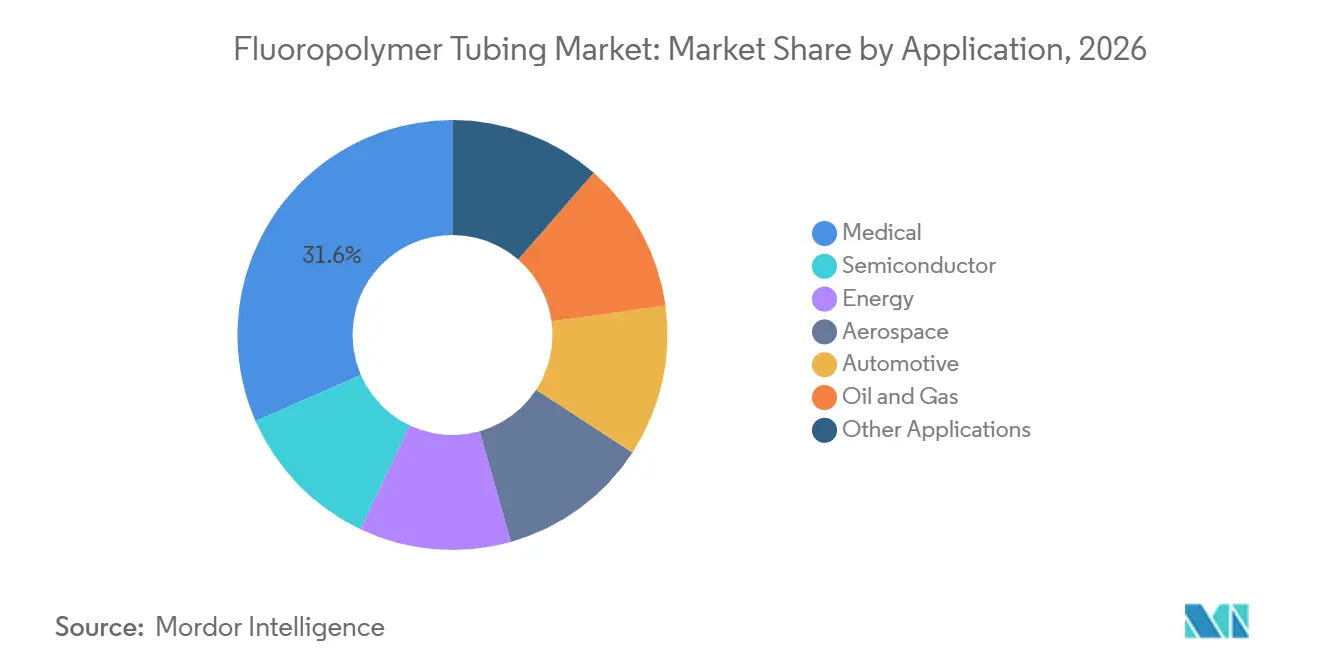
Medical Leads Both Scale and GrowthMedical accounted for 31.56% of the fluoropolymer tubing market size in 2026 and is projected to advance at a 6.52% CAGR through 2032. This performance is supported by demand for catheter configurations that require fluoropolymer extrusion, including designs that need lubricious liners, controlled stiffness, and small internal channels. The Food and Drug Administration identifies applications that include cardiovascular implants, catheter liners, guidewire coatings, and wound dressings. These uses show the breadth of medical programs supported by the fluoropolymer tubing market. Semiconductor uses require ultra-high-purity perfluoroalkoxy alkane tubing that limits metal extractables in photolithography and wet-etch circuits. Small levels of contamination can affect yields, making validated tubing a process-critical component and increasing the importance of defined extractables data, material traceability, and consistent manufacturing conditions.
Energy uses include hydrogen electrolyzers, fuel cells, and battery production lines. Polyvinylidene fluoride is used in electrolyzer balance-of-plant fluid loops, while polytetrafluoroethylene is used in gasket linings and sealing in proton exchange membrane systems. Oil and gas users employ fluoropolymer tubing for chemical injection and downhole instrumentation in corrosive environments. Aerospace programs require a lot of traceability and compliance with Military Specification and Aerospace Standard 9100 quality systems. Automotive uses include fuel lines, brake-fluid circuits, and thermal-management lines in battery electric vehicles. Optinova's 2025 International Organization for Standardization (ISO) 13485 certification activity at its Valley Forge and Jomala facilities reflects the importance of medical quality systems for original equipment manufacturer qualification.
Geography Analysis
North America Fluoropolymer Tubing Market
North America held 42.49% of the market share in 2026. The region benefits from a concentration of medical device producers, semiconductor fabs, pharmaceutical companies, and chemical-processing assets, which creates demand from several end uses within the same regional manufacturing base. Semiconductor construction supports demand for ultra-high-purity perfluoroalkoxy alkane and polytetrafluoroethylene tubing in cleanroom chemical circuits. Medical device clusters in Minnesota, California, and Massachusetts support precision medical-grade extrusion demand. Hydrogen refueling infrastructure also supports demand for fluid-system components. The United States contains manufacturers, including Zeus Company LLC, Entegris, Pexco, Tef-Cap Industries Inc., and Fluorotherm, which support domestic sourcing for qualified programs and provide customers with established local manufacturing options.
APAC Fluoropolymer Tubing Market
Asia-Pacific is projected to advance at a 6.38% CAGR through 2032. China, Japan, and South Korea are the main demand centers, reflecting their semiconductor manufacturing activity and their established roles in regional medical and electronics supply chains. Semiconductor capacity additions in these countries increase requirements for ultra-clean perfluoroalkoxy alkane tubing, because wet chemical delivery and rinse systems need materials that can maintain purity through demanding production cycles. NICHIAS Corporation developed NAFLON PFA-UG tubing for demanding extreme ultraviolet lithography environments. India, South Korea's Association of Southeast Asian Nations-linked supply chains, and Japan's Rapidus program provide additional demand channels. Optinova opened a 2,000 m² cleanroom production hall in Thailand in 2025 to support medical extrusion demand in Southeast Asia.
EMEA and South America Fluoropolymer Tubing Market
In Europe, Germany, the United Kingdom, France, and the Nordic countries are the main markets. Pharmaceutical production, laboratory instruments, automotive thermal management, and hydrogen electrolyzer supply chains support regional demand, while regulatory developments encourage attention to materials, documentation, and product alternatives. South America and the Middle East and Africa represent smaller but stable demand pools for the fluoropolymer tubing market. Brazil and Saudi Arabia support demand through oil and gas chemical-injection applications in challenging downhole settings. European regulatory actions encourage suppliers to consider both fluoropolymer and perfluoroalkyl and polyfluoroalkyl substances alternative product lines.
Competitive Landscape
The fluoropolymer tubing market is highly fragmented, with the top five players including Saint-Gobain, Zeus Company LLC, Teleflex Incorporated, Optinova, and PARKER HANNIFIN CORP. The supplier base becomes more fragmented in regional and specialty application niches, where smaller extruders can compete through focused product designs, local service, or expertise in a defined customer application. Qualification depth is a key competitive factor for long-term original equipment manufacturer supply agreements, since customers must be able to verify the material, process controls, and supporting documentation before approval. Relevant requirements include Food and Drug Administration 510(k)-cleared materials, Semiconductor Equipment and Materials International (SEMI) F57 extractables data, Aerospace Standard 9100-certified aerospace lots, and International Organization for Standardization 13485 cleanroom manufacturing. The fluoropolymer tubing market, therefore, rewards suppliers that pair precision extrusion with consistent documentation.
Zeus Company LLC launched the StreamLiner NG film-cast polytetrafluoroethylene liner in 2025 for minimally invasive device programs. Entegris offers FluoroLine electrostatic discharge and dual-containment perfluoroalkoxy alkane tubing systems for clean chemical delivery applications. Junkosha Inc. introduced its 19 µm thin-walled etched liner to address demanding catheter geometries. Swagelok Company introduced hydrogen-focused fluid-system components rated to 1,050 bar and validated to International Organization for Standardization 19880-3 in 2025. These moves show a focus on products that are difficult for customers to replace after qualification, because a change can require validation work and can introduce operational risk for the customer. They also support a shift toward specialized, application-specific product portfolios.
Chinese domestic suppliers are working to qualify ultra-clean perfluoroalkoxy alkane tubing to Semiconductor Equipment and Materials International F57 requirements for local fabs. This development may reduce reliance on imported products in advanced domestic manufacturing. Suppliers also see opportunities in small-bore multi-lumen products for neurovascular procedures. Continuous-length dual-containment tubing is relevant to chemical-plant retrofit work. Polyvinylidene fluoride fluid-circuit components provide another opportunity in electrolyzer systems. The market remains contestable in precision, specialty, and application-specific product categories.
Fluoropolymer Tubing Industry Leaders
-
Saint-Gobain
-
Zeus Company LLC
-
Teleflex Incorporated
-
Optinova
-
PARKER HANNIFIN CORP
- *Disclaimer: Major Players sorted in no particular order
Fluoropolymer Tubing Market Companies Covered in this Report
- 3M
- Adtech Polymer Engineering Ltd.
- AMETEK, Inc.
- Entegris
- Fluorotherm
- Junkosha Inc.
- NICHIAS Corporation
- Optinova
- PARKER HANNIFIN CORP
- Pexco
- Saint-Gobain
- Swagelok Company
- TE Connectivity
- Tef-Cap Industries Inc.
- Teleflex Incorporated
- Zeus Company LLC
Recent Industry Developments in Fluoropolymer Tubing Market
- September 2026: Guarniflon India Pvt. Ltd. announced a major expansion of its PTFE manufacturing capabilities, introducing new molding and sintering technology to produce large-diameter tubes of up to 3 meters. The investment supports the fluoropolymer tubing market by expanding the availability of PTFE components for demanding industrial and hydrogen infrastructure applications.
- June 2026: APT Advanced Polymer Tubing GmbH, part of Masterflex Group, expanded its strategic licensing partnership with Chemours to use the Teflon brand across additional growth markets, including semiconductors, automotive, analytical laboratories, and chemical processing. The agreement supports the fluoropolymer tubing market by strengthening the commercial reach of branded fluoropolymer tubing and specialty tube solutions.
Global Fluoropolymer Tubing Market Report Scope
Fluoropolymer tubing consists of tubing manufactured from fluorinated polymers that provide chemical resistance, thermal stability, electrical insulation, and low-friction properties. These characteristics make it suitable for demanding operating environments that require reliable fluid transfer and material durability.
The Fluoropolymer Tubing Market is segmented by form factor, material, application, and geography. By form factor, the market is segmented into single lumen, heat shrink, co-extruded, multi-lumen, tapered or bump tubing, and braided tubing. By material, the market is segmented into polytetrafluoroethylene (PTFE), fluorinated ethylene propylene (FEP), perfluoroalkoxy alkane (PFA), ethylene tetrafluoroethylene (ETFE), polyvinylidene fluoride (PVDF), and other materials. By application, the market is segmented into medical, semiconductor, energy, oil and gas, aerospace, automotive, and other applications. The report also covers the market size and forecasts for fluoropolymer tubing across 15 countries. For each segment, the market sizing and forecasts have been done on the basis of value (USD).
Segmentation Overview
| Single Lumen |
| Heat Shrink |
| Co-Extruded |
| Multi-Lumen |
| Tapered or Bump Tubing |
| Braided Tubing |
| Polytetrafluoroethylene (PTFE) |
| Fluorinated Ethylene Propylene (FEP) |
| Perfluoroalkoxy Alkane (PFA) |
| Ethylene Tetrafluoroethylene (ETFE) |
| Polyvinylidene Fluoride (PVDF) |
| Other Materials |
| Medical |
| Semiconductor |
| Energy |
| Oil and Gas |
| Aerospace |
| Automotive |
| Other Applications |
| Asia-Pacific | China |
| India | |
| Japan | |
| South Korea | |
| ASEAN Countries | |
| Rest of Asia-Pacific | |
| North America | United States |
| Canada | |
| Mexico | |
| Europe | Germany |
| United Kingdom | |
| France | |
| Italy | |
| NORDIC Countries | |
| Rest of Europe | |
| South America | Brazil |
| Argentina | |
| Rest of South America | |
| Middle East and Africa | Saudi Arabia |
| South Africa | |
| Rest of Middle East and Africa |
| By Form Factor | Single Lumen | |
| Heat Shrink | ||
| Co-Extruded | ||
| Multi-Lumen | ||
| Tapered or Bump Tubing | ||
| Braided Tubing | ||
| By Material | Polytetrafluoroethylene (PTFE) | |
| Fluorinated Ethylene Propylene (FEP) | ||
| Perfluoroalkoxy Alkane (PFA) | ||
| Ethylene Tetrafluoroethylene (ETFE) | ||
| Polyvinylidene Fluoride (PVDF) | ||
| Other Materials | ||
| By Application | Medical | |
| Semiconductor | ||
| Energy | ||
| Oil and Gas | ||
| Aerospace | ||
| Automotive | ||
| Other Applications | ||
| By Geography | Asia-Pacific | China |
| India | ||
| Japan | ||
| South Korea | ||
| ASEAN Countries | ||
| Rest of Asia-Pacific | ||
| North America | United States | |
| Canada | ||
| Mexico | ||
| Europe | Germany | |
| United Kingdom | ||
| France | ||
| Italy | ||
| NORDIC Countries | ||
| Rest of Europe | ||
| South America | Brazil | |
| Argentina | ||
| Rest of South America | ||
| Middle East and Africa | Saudi Arabia | |
| South Africa | ||
| Rest of Middle East and Africa | ||
Key Questions Answered in the Report
What is the size of the fluoropolymer tubing market?
The fluoropolymer tubing market size was valued at USD 710.03 million in 2026 and is estimated to grow from USD 747.95 million in 2027 to reach USD 980.78 million by 2032, at a CAGR of 5.57% during the forecast period (2027-2032).
Which form factor held the largest share in 2026?
Single lumen tubing led with a 43.12% share in 2026.
Which material is projected to advance fastest through 2032?
Polyvinylidene fluoride (PVDF) is projected to advance at a 6.07% CAGR through 2032.
Why is medical demand important for fluoropolymer tubing?
Medical held a 31.56% share in 2026 and is projected to advance at a 6.52% CAGR through 2032.