
Fluorescent Pigment Market Size and Share
Market Overview
| Study Period | 2021 - 2031 |
|---|---|
| Market Size (2026) | USD 486.97 Million |
| Market Size (2031) | USD 645.86 Million |
| Growth Rate (2026 - 2031) | 5.81 % |
| Fastest Growing Market | Asia-Pacific |
| Largest Market | Asia-Pacific |
| Market Concentration | Low |
Major Players *Disclaimer: Major Players sorted in no particular order Image © Mordor Intelligence. Reuse requires attribution under CC BY 4.0. | |
Fluorescent Pigment Market Analysis by Mordor Intelligence
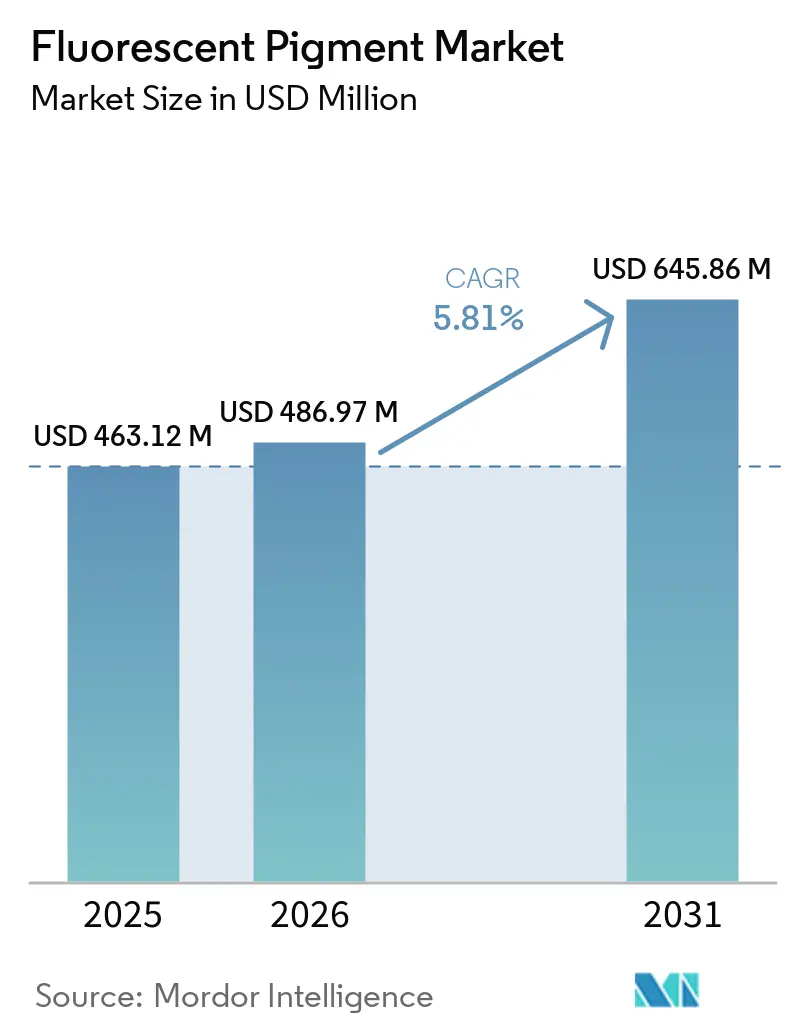
The fluorescent pigment market size was valued at USD 463.12 million in 2025 and is estimated to grow from USD 486.97 million in 2026 to USD 645.86 million by 2031, at a CAGR of 5.81% during the forecast period (2026-2031). The fluorescent pigment market is driven by demand from safety apparel, security printing, and traffic-marking systems, where luminance performance is tied to product specifications and compliance requirements. This demand base gives suppliers exposure to applications that are less dependent on discretionary design choices. Manufacturing expansion in the Asia-Pacific region and tighter safety requirements across several end-use sectors are supporting broader adoption of certified fluorescent colorants. Producers are responding through product certification, water-based formulations, and application-specific grades for printing, plastics, and textiles. However, the fluorescent pigment market faces limitations in permanent exterior applications, as direct sunlight can reduce color stability over time.
Key Report Takeaways
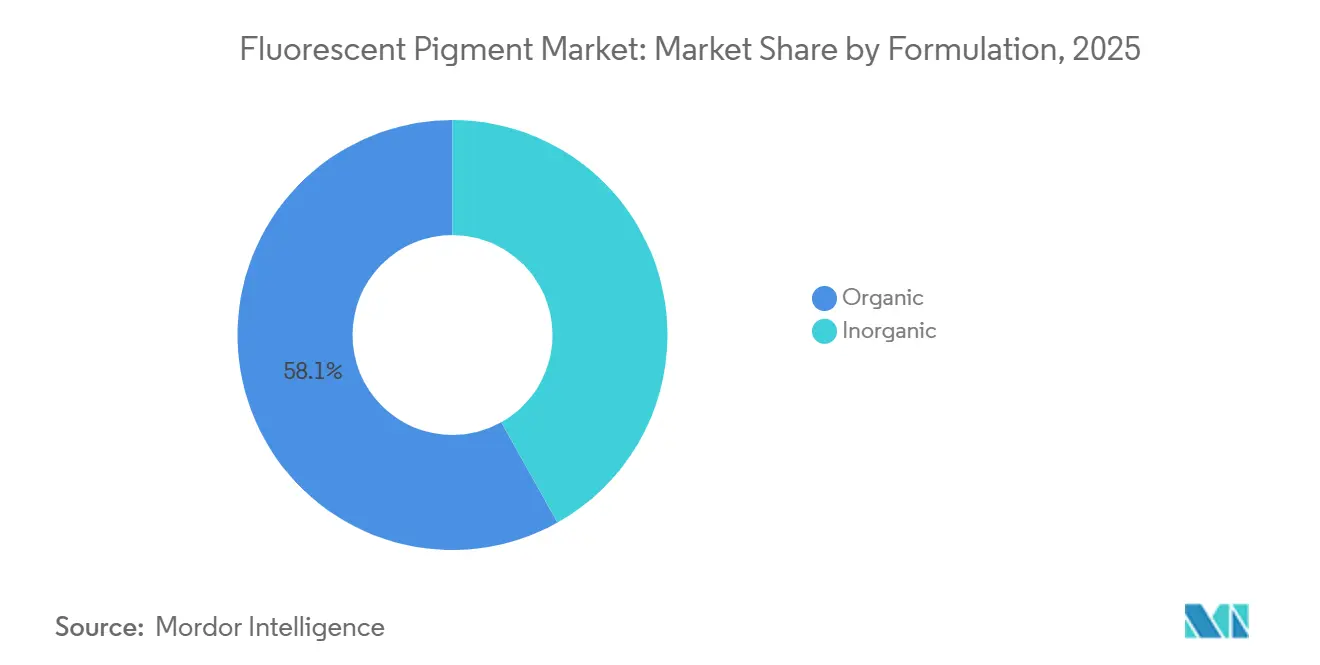
- By formulation, organic pigments held 58.12% of the fluorescent pigment market share in 2025, while the segment is projected to grow at a 6.13% CAGR through 2031.
- By type, daylight fluorescent pigments accounted for 31.26% of the market in 2025 and are expected to expand at a CAGR of 6.32% through 2031.
- By intensity, medium-intensity pigments captured 50.67% of the market in 2025 and are expected to expand at a 6.57% CAGR through 2031.
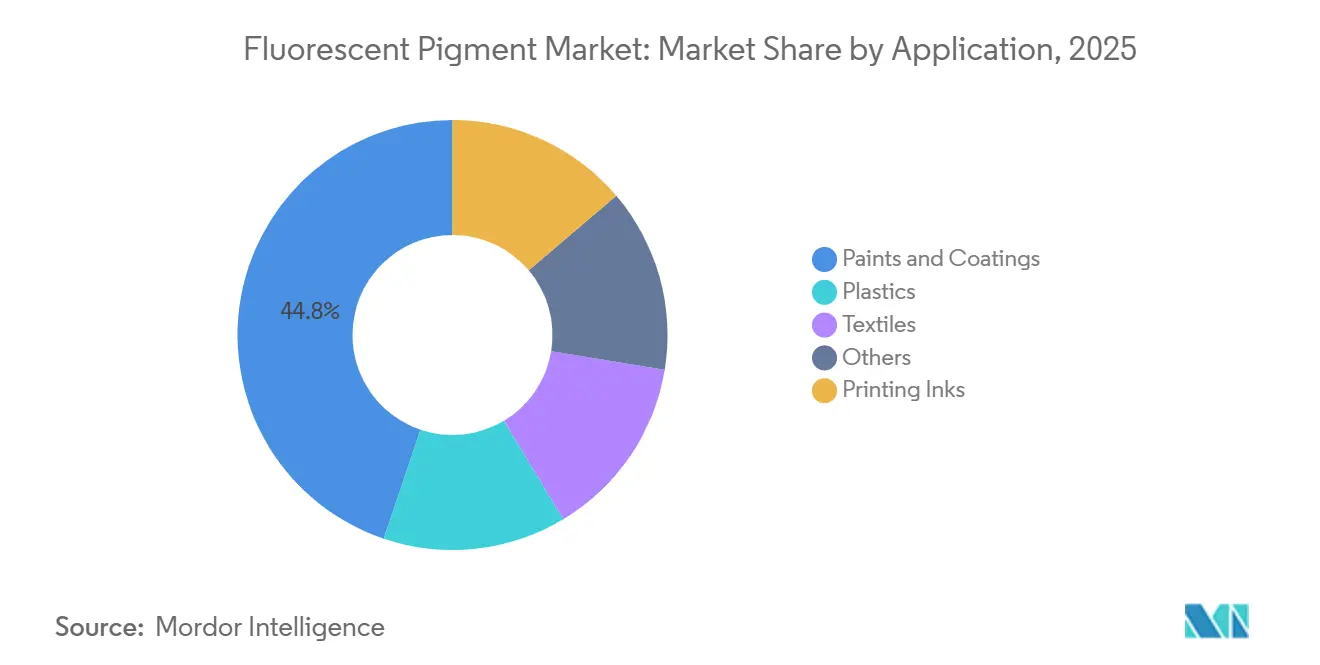
- By application, paints and coatings held 44.81% of the market in 2025, while plastics are forecast to grow at a 6.84% CAGR through 2031.
- By geography, Asia-Pacific accounted for 40.35% of the market value in 2025 and is forecast to grow at a CAGR of 6.25% through 2031.
Note: Market size and forecast figures in this report are generated using Mordor Intelligence’s proprietary estimation framework, updated with the latest available data and insights as of January 2026.
Global Fluorescent Pigment Market Trends and Insights
Drivers Impact Analysis*
| Drivers | (~) % Impact on CAGR Forecast | Geographic Relevance | Impact Timeline |
|---|---|---|---|
| Rising Demand for High-Visibility Safety and Security Solutions | +1.4% | Global, with established demand in North America and Europe, and accelerating demand in Asia-Pacific infrastructure corridors | Short term (≤ 2 years) |
| Expansion in Packaging, Textiles, and Consumer Products | +0.9% | Asia-Pacific core, with spillover to North America, the Middle East, and Africa | Medium term (2-4 years) |
| Growth of Water-Based and Lower-Volatile Organic Compound (VOC) Formulations | +0.8% | North America and Europe, with adoption spreading to the Asia-Pacific and South America | Medium term (2-4 years) |
| Increasing Use in Digital and Specialty Printing | +0.6% | Global, with premium demand concentrated in North America, Europe, and East Asia | Medium term (2-4 years) |
| Demand for Formaldehyde-Free and Low-Migration Certified Grades | +0.5% | Europe and export-oriented Asia-Pacific manufacturing hubs | Long term (≥ 4 years) |
| Source: Mordor Intelligence | |||
Rising Demand for High-Visibility Safety and Security Solutions
Workplace safety regulations that set measurable visibility requirements for apparel and marking products support demand in the fluorescent pigment market. ANSI/ISEA 107-2020 establishes performance requirements for high-visibility safety apparel, while EN ISO 20471 specifies test methods and requirements for high-visibility clothing. These standards make color performance important in roadway construction, rail maintenance, and other work environments where worker visibility is required. Personal protective equipment requirements further support the use of compliant materials in construction settings[1]. Security printing represents a second demand channel, as fluorescent materials can be incorporated as authentication features in documents, stamps, and packaging. DayGlo also supplies a fluorescent colorant for fire-retardant slurry, linking a portion of demand to firefighting applications.
Expansion of Fluorescent Pigments in Packaging, Textiles, and Consumer Products
Fluorescent pigments are gaining applications in packaging, where vivid color helps products stand out in retail and promotional formats. Fluorescent masterbatch formulations are used in beverage, personal care, sports nutrition, and other consumer packaging where visual differentiation is a design priority. In performance apparel, producers are developing fluorescent grades that support UV-reactive and high-visibility textile applications. Digital and short-run transfer printing allows fluorescent color to be used in smaller textile production runs that may not justify conventional screen-print tooling, broadening access to fluorescent effects for specialized apparel and promotional products. The combination of safety-driven textile demand and consumer-focused packaging demand gives suppliers multiple routes to serve the same underlying colorant chemistry.
Growth of Water-Based and Lower-VOC Pigment Formulations
The fluorescent pigment market is adapting to demand for water-based systems in coatings, inks, and textile applications. Water-based dispersions help formulators reduce reliance on solvent-heavy carrier systems while retaining the color performance required for many end uses. DayGlo markets WECO water-based fluorescent dispersions that are manufactured without formaldehyde and include recycled content. These products illustrate how established suppliers are adjusting their portfolios to meet evolving formulation requirements. This shift also affects purchasing decisions, as downstream customers increasingly evaluate documentation, resin chemistry, and suitability for their specific processes. Water-based grades can therefore create opportunities where performance, compliance documentation, and handling requirements are assessed together.
Increasing Use of Fluorescent Pigments in Digital and Specialty Printing
Digital, specialty, and security printing applications represent additional sources of demand in the fluorescent pigment market. Digital printing requires pigment particles and dispersions that remain stable across inkjet, electrophotographic, and UV-cured systems, raising the value of grades designed for consistent dispersion and controlled particle size. Security printing offers a distinct application, as UV-responsive materials can serve as covert authentication layers in identity documents and excise stamps. Food-adjacent printing and packaging applications also require product selection that accounts for applicable regulatory clearances. Suppliers with documented performance and compliance information are positioned to participate in these specialized printing applications.
Restraints Impact Analysis*
| Restraints | (~) % Impact on CAGR Forecast | Geographic Relevance | Impact Timeline |
|---|---|---|---|
| High Production Costs and Limited Economies of Scale | -1.2% | Global, with a stronger effect on producers below the efficient scale in South and Southeast Asia | Short term (≤ 2 years) |
| Outdoor Photodegradation and Limited Long-Term Lightfastness | -0.8% | Global, particularly for exterior architectural coatings and permanent outdoor signage | Long term (≥ 4 years) |
| Formulation Compatibility and Migration Challenges | -0.5% | Global, especially in high-volume plastics compounding in the Asia-Pacific | Medium term (2-4 years) |
| Source: Mordor Intelligence | |||
High Production Costs and Limited Economies of Scale
The fluorescent pigment market requires controlled production processes that encapsulate fluorescent dyes in resin matrices while maintaining consistent particle characteristics. Resin systems and process controls may require specialized equipment, increasing capital and operating costs compared with conventional pigment production. Smaller producers may find it difficult to spread these costs across sufficient certified specialty-grade output, which can limit their ability to invest in product upgrades, documentation, and lower-impact chemistry. Larger producers hold an advantage where customers require consistent quality, application support, or certification for regulated end uses. This market structure places price-focused suppliers in standard grades while technically differentiated suppliers compete in higher-value applications.
Outdoor Photodegradation and Limited Long-Term Lightfastness
The fluorescent pigment market remains constrained in applications requiring color stability during prolonged exposure to direct sunlight. Scientific research has documented changes in daylight fluorescent paints after UV exposure, including transformations that can alter the original color response. This limitation narrows the use of conventional grades in permanent architectural coatings and long-life exterior signage. Improved grades can extend lightfastness, but they do not eliminate the performance difference relative to colorants selected primarily for outdoor durability. Radiant Color NV offers formaldehyde-free GXT pigments for applications that require improved product characteristics and certification support. Suppliers must therefore match fluorescent performance with the expected service life, exposure conditions, and technical requirements of each application.
*Our forecasts treat driver/restraint impacts as directional, not additive. The impact forecasts reflect baseline growth, mix effects, and variable interactions.
Segment Analysis
By Formulation: Organic Chemistry Supports Broad Commercial Use
Organic pigments held 58.12% of the market in 2025, and the organic segment is forecast to grow at a 6.13% CAGR during 2026-2031. This position reflects compatibility with aqueous, solvent-based, and UV-curable carrier systems used in commercial applications. Organic grades are used in printing inks, textile coatings, and water-based paint systems where formulators require strong brightness and practical processing characteristics. Their brightness-to-cost balance makes them suitable for applications that require visible color effects without the specialized function of afterglow materials. This breadth gives organic chemistry a central role in the fluorescent pigment industry across downstream applications. Customers also evaluate dispersion behavior, carrier compatibility, and regulatory documentation when selecting between grades. These factors make formulation support important alongside basic color response. Suppliers can differentiate organic offerings by providing grades tailored to specific resin systems and application methods. The fluorescent pigment market, therefore, relies heavily on organic products for routine commercial formulations.
Inorganic pigments serve a different role, as rare-earth-activated aluminate systems are associated with phosphorescent and long-afterglow uses. Emergency exit signage, safety footwear, and dark-environment visibility markers are among the applications that require this function. Their demand is more closely tied to infrastructure safety needs than to general decorative color demand. Organic products, by contrast, address a wider range of packaging, textile, coating, and printing requirements. Within the organic category, certified formaldehyde-free grades are gaining relevance in premium textile and personal care supply chains. SINLOIHI Co., Ltd. identifies its SX-100 series as a formaldehyde-free acrylic fluorescent pigment, and Radiant Color lists GXT products with certification-related attributes. These credentials can help suppliers compete in export-oriented manufacturing chains where product documentation is reviewed carefully. Differentiation among organic products is increasingly based on compliance, suitability for application, and sustainability-related requirements rather than on color alone. Buyers must also determine whether the material is intended to create a daylight effect, a long-afterglow effect, or a response under selected lighting conditions. This decision can affect resin choice, processing conditions, and the supporting information requested by downstream customers. Suppliers that offer technical guidance can help processors narrow their selection before a formulation is scaled. For manufacturers serving multiple end uses, a wider organic portfolio can reduce the need for separate pigment systems across closely related applications. This commercial flexibility reinforces the importance of organic grades in established fluorescent colorant programs.

By Type: Daylight Fluorescent Grades Serve Visibility-Critical Uses
Daylight fluorescent pigments accounted for 31.26% of the fluorescent pigment market in 2025 and are projected to expand at a 6.32% CAGR through 2031. Their growth is linked to use in safety markings, packaging graphics, and specialty commercial printing. These grades are valued for their color response, which delivers highly visible effects under normal daylight conditions, making them relevant where apparel and marketing products must meet defined visibility expectations. High-visibility standards set a clear performance context for products used in occupational settings. Daylight grades also serve consumer-facing applications where fluorescent effects are selected for packaging and promotional graphics. Their mix of functional and visual uses broadens their customer base. This combination of compliance-driven and design-led demand supports the fluorescent pigment market size for daylight grades.
Phosphorescent pigments address the complementary need for visibility in dark conditions. Nemoto describes its LumiNova strontium aluminate pigments as materials with greater brightness and afterglow performance than conventional zinc sulfide phosphors. These products are used in safety signage and emergency egress applications where stored light emission is required after ambient light is reduced. Other pigment types include UV-fluorescent security materials that are less visible in daylight but respond under specified UV wavelengths. Identity documents, tax stamps, and pharmaceutical packaging can use these effects where authentication is required. This segment is shaped by customer specifications and compliance documentation rather than by price alone. Daylight, phosphorescent, and UV-responsive products therefore serve distinct functional conditions. Their coexistence allows suppliers to address visibility requirements across daylight, low-light, and authentication applications. The type selected depends on the lighting environment in which the product must perform and the end user's visibility requirements. A safety sign used after a power interruption requires a different response from a garment used in daytime road work. A security feature serves a different purpose, as it must provide a controlled response under inspection. These differences support specialized product portfolios rather than a single fluorescent grade for all applications. They also require suppliers to communicate functional limits clearly during product selection.
By Intensity: Medium-Intensity Grades Balance Visibility and Processing
Medium-intensity fluorescent pigments captured 50.67% of the market in 2025 and are the fastest-growing intensity category at a 6.57% CAGR through 2031. This position reflects their role in applications requiring visible color while maintaining practical compatibility with common substrates. Medium-intensity grades are used in packaging inks, interior coatings, textile printing, and consumer plastics. They offer a balance between brightness, cost, handling, and formulation behavior. The fluorescent pigment market selects these grades when maximum luminance is not the primary requirement. This balance suits high-output applications where manufacturers must also consider production consistency. Their broad suitability makes them central to commercial use of fluorescent pigments, positioning the category between highly specialized, maximum-brightness products and grades selected for modest fluorescent effects.
High-intensity grades can provide stronger luminance for compliance-critical or premium-brand uses. Their higher loading requirements can affect substrate properties and may introduce migration concerns in some polymer systems. Low-intensity grades provide greater chemical stability and lightfastness but offer less vivid color. These products are used where a softer fluorescent effect is preferred over high visibility. DayGlo markets GloPrill dust-free pelletized fluorescent pigments for plastics processing, illustrating the importance of handling and dispersion in masterbatch applications. For food-adjacent uses, the resin carrier and supporting documentation can be as important as intensity. The fluorescent pigment industry consequently treats intensity as a practical formulation choice, not only as a measure of brightness. Product selection depends on the required color effect, substrate, processing method, and applicable compliance conditions. A customer selecting high-intensity material may accept additional formulation work when maximum visual impact is central to the finished product. A customer selecting a medium grade may instead prioritize repeatable mixing and a color effect that fits established production settings. Low-intensity material offers another option in which stability takes precedence over a vivid response. These trade-offs show why intensity categories should be considered alongside resin choice, product exposure, and the required service result, and help explain the continued commercial strength of medium-intensity grades across diverse product categories.
By Application: Coatings Lead While Plastics Grow Faster
Paints and coatings held 44.81% of the fluorescent pigment market in 2025, while plastics are projected to grow at a 6.84% CAGR through 2031. Road-marking systems, industrial safety coatings, aerosol decorative paints, and seed-treatment coatings support demand for coatings. These uses combine material quantities with performance requirements to create a higher-value product mix. Road-marking applications require suppliers to consider durability, visibility, and regional performance standards. Industrial safety coatings use fluorescent color to identify hazards, equipment, or work areas. Aerosol paints and decorative products drive demand for coatings in consumer and professional finishing applications. This breadth of applications helps coatings remain the largest use category, reflecting a broad mix of safety, industrial, and decorative demand.
Printing inks represent another important application, as packaging, labels, and promotional materials use fluorescent effects to enhance visual impact. Water-based and UV-curable ink systems are relevant as brand owners seek lower-emission production options. Plastics are growing faster as the use of fluorescent masterbatches expands in packaging films, safety equipment, and consumer goods. Radiant Color offers fluorescent colorants for plastics that it identifies as suitable for food-contact applications. Textiles are supported by demand for high-visibility workwear that must satisfy applicable apparel requirements. Cosmetics remain a smaller, more technically demanding use case where lightfastness and product suitability are important. DayGlo promotes Elara colorants for cosmetics with improved lightfastness characteristics. Across these applications, suppliers must align pigment chemistry with the carrier system, service environment, regulatory requirements, and desired color result. Packaging converters assess whether a pigment disperses evenly in the selected resin, ink, or coating carrier before it reaches a production line. Processors also consider dosage, color consistency, handling, and the requirements of the finished product, particularly where food contact or worker visibility is relevant. These practical decisions turn application development into an ongoing part of supplier relationships rather than a one-time pigment sale. They also explain why a grade that performs well in one carrier system may require adjustment before use in another. The fluorescent pigment market continues to depend on this close link between pigment design and the conditions of the final application.
Geography Analysis
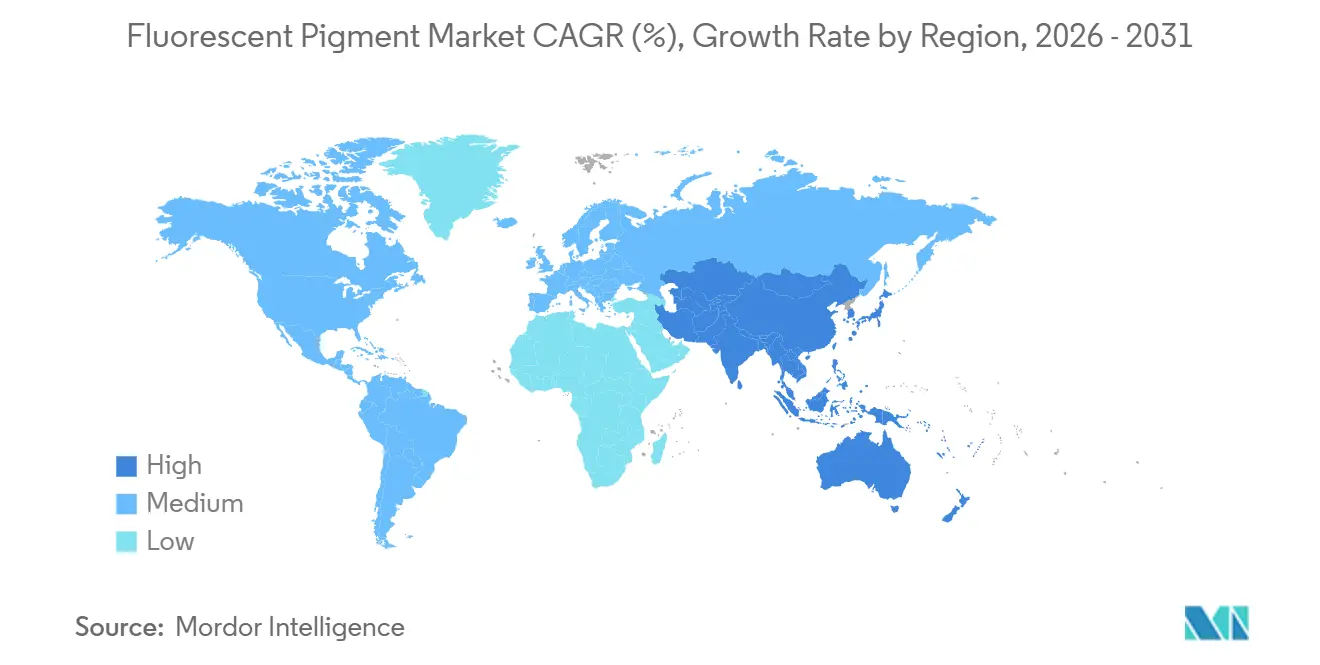
Asia-Pacific held 40.35% of the fluorescent pigment market share in 2025 and is forecast to grow at a 6.25% CAGR through 2031. The region combines large-scale production capability with expanding end-use demand in packaging, textiles, safety products, and consumer goods. China is a major production center, while India supports demand growth through packaging, textiles, and safety-related applications. Vietnam and Indonesia are also relevant import markets as regional safety requirements gain wider adoption. The fluorescent pigment market in this region benefits from manufacturing networks that connect pigment suppliers with processors and finished-goods producers. Suppliers serving Asia-Pacific must balance cost expectations with rising requirements for quality control and documentation. The region's broad manufacturing base gives suppliers access to customers across several applications without relying on a single end-use sector. Processors may also require different grades for water-based coatings, plastics compounding, textiles, and printing. This diversity supports a broad product offering but also increases the importance of local technical service. Suppliers that maintain consistent quality and provide application support can meet both export-oriented and domestic demand.
North America and Europe have sustained demand for certified specialty grades rather than commodity pigment alone. In North America, high-visibility apparel standards and infrastructure activity support purchasing in safety clothing, construction-related applications, specialty printing, and packaging. In Europe, product selection is shaped by customer preference for low-volatile organic compound (VOC) and heavy-metal-free formulations, particularly for regulated or branded applications. OEKO-TEX STANDARD 100 provides a product certification framework relevant to textile supply chains. Germany is a significant European consumption center, with the United Kingdom, France, and Nordic countries also contributing to coatings demand. Documentation related to substance restrictions and polymer suitability functions as an access requirement for many suppliers in these markets, making technical documentation a practical part of customer qualification rather than an administrative task. Suppliers that provide customers with clear material information are more likely to participate in specialized textile, packaging, and safety applications. The resulting demand mix favors value-added grades, in which customers must demonstrate product suitability. It limits the ability of standard products to compete solely on price in applications with stricter purchasing requirements.
South America, the Middle East, and Africa represent smaller but growing centers of demand. Brazil supports South American demand through industrial coatings and printing inks used in consumer-goods packaging, while Argentina contributes mainly through printing applications. Saudi Arabia supports the demand for fluorescent safety coatings and marking systems through construction and petrochemical activity. African demand is smaller but includes coatings and inks used by industrial customers. FP Pigments Oy and Power International DMCC announced a joint venture to establish a fluorescent pigment manufacturing facility in Abu Dhabi's Khalifa Economic Zones Abu Dhabi (KEZAD) zone, with full-scale operations targeted for 2027[2]. The project aims to reduce regional dependence on imports and establish a supply base to meet broader demand across the Middle East and Africa. A regional production site can also shorten supply routes for customers who currently depend on imported specialty pigments, which may be especially relevant for those requiring technical support in adapting materials to regional processing conditions. The commercial outcome of this development will depend on the facility's ability to supply grades that meet the needs of regional customers in coatings, inks, plastics, and other applications.
Competitive Landscape
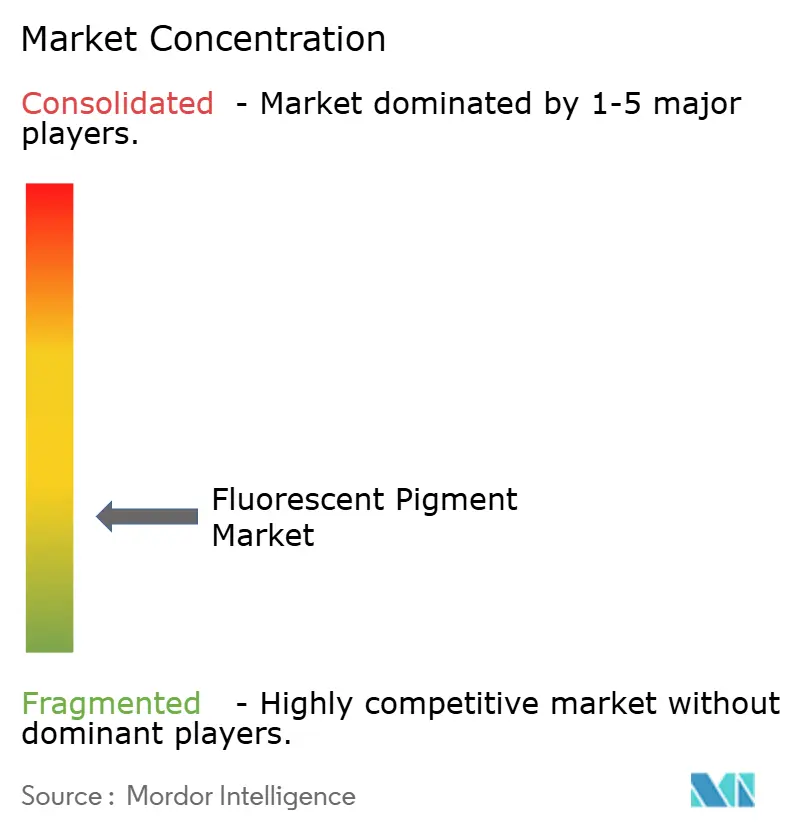
The fluorescent pigment market is fragmented, with technically differentiated global suppliers and a broader group of Asian specialty producers. DayGlo Color Corp and Radiant Color compete through resin chemistry, application certifications, and specialized product families. RPM International includes Radiant Color within its consumer brands portfolio. Asian suppliers, particularly in China and Japan, compete on price and proximity to customers in the plastics and textiles sectors. The competitive position of global suppliers depends on proprietary formulations, technical support, and the ability to serve certified end uses. The market is therefore not defined by price alone, especially where customers require documentation or performance validation. Competitive differences are more pronounced in regulated specialty grades than in standard fluorescent powder products.
Sustainable formulation development is becoming part of product differentiation. DayGlo holds U.S. Patent 12043745 for hybrid pigments that use a natural polyamide substrate, reflecting work on biodegradable, microplastic-free colorant alternatives. Radiant Color's GXT series demonstrates how suppliers offer formaldehyde-free pigments with certification. These product developments address customer requirements in textiles, personal care, and other applications where material selection is scrutinized. Suppliers are also developing products with improved lightfastness for applications that face more demanding exposure conditions. Opportunities exist in biodegradable cosmetic colorants, photostabilized exterior grades, and food-contact-compliant masterbatches. Each opportunity requires performance evidence and documentation acceptable to downstream customers.
Distribution partnerships offer another route to expand customer access without building owned infrastructure in every market. In July 2026, DKSH signed an exclusive agreement with Brilliant Group for daylight fluorescent pigments in six European markets. The agreement expands Brilliant Group's European reach through DKSH's specialty-chemicals distribution and technical-support network. Such arrangements allow pigment suppliers to combine local customer coverage with specialized application support. They are particularly relevant where customers require prompt technical assistance and familiarity with local compliance requirements. This structure supports competition based on application performance, certification readiness, and customer service, rather than a single company controlling available demand.
Fluorescent Pigment Industry Leaders
-
LuminoChem
-
SINLOIHI CO., LTD.
-
Wanlong Chemical
-
RPM International Inc.
-
Aron Universal Limited
- *Disclaimer: Major Players sorted in no particular order
Recent Industry Developments
- July 2026: DKSH signed an exclusive distribution agreement with Brilliant Group, Inc. for daylight fluorescent pigments across Austria, Belgium, Germany, Luxembourg, the Netherlands, and Switzerland. The agreement extends Brilliant Group's European commercial reach through DKSH's specialty chemicals distribution and technical support network.
- February 2026: DayGlo Color Corp launched a line of natural fluorescent pigments using biodegradable rice protein as the carrier matrix. The product delivers vivid neon color for cosmetics without synthetic polymer particle carriers, positioning it as an alternative to conventional organic pigment systems amid increasing regulatory scrutiny.
Global Fluorescent Pigment Market Report Scope
Fluorescent pigment is a specialized colorant that absorbs invisible ultraviolet (UV) or short-wavelength light and immediately re-emits it as visible light. These pigments are widely used across industries such as printing, textiles, coatings, and plastics, where high visibility and color brightness are required.
The fluorescent pigment market is segmented by formulation, type, intensity, application, and geography. By formulation, the market is segmented into organic and inorganic. By type, the market is segmented into daylight fluorescent, phosphorescent, and other pigment types. By intensity, the market is segmented into high intensity, medium intensity, and low intensity. By application, the market is segmented into paints and coatings, printing inks, plastics, textiles, and others. The report also covers market size and forecasts for fluorescent pigment across 15 countries in major regions. The market sizes and forecasts are provided in terms of value (USD).
| Organic |
| Inorganic |
| Daylight Fluorescent |
| Phosphorescent |
| Other Pigment Types |
| High Intensity |
| Medium Intensity |
| Low Intensity |
| Paints and Coatings |
| Printing Inks |
| Plastics |
| Textiles |
| Others |
| Asia-Pacific | China |
| India | |
| Japan | |
| South Korea | |
| ASEAN Countries | |
| Rest of Asia-Pacific | |
| North America | United States |
| Canada | |
| Mexico | |
| Europe | Germany |
| United Kingdom | |
| France | |
| Italy | |
| NORDIC Countries | |
| Rest of Europe | |
| South America | Brazil |
| Argentina | |
| Rest of South America | |
| Middle East and Africa | Saudi Arabia |
| South Africa | |
| Rest of Middle East and Africa |
| By Formulation | Organic | |
| Inorganic | ||
| By Type | Daylight Fluorescent | |
| Phosphorescent | ||
| Other Pigment Types | ||
| By Intensity | High Intensity | |
| Medium Intensity | ||
| Low Intensity | ||
| By Application | Paints and Coatings | |
| Printing Inks | ||
| Plastics | ||
| Textiles | ||
| Others | ||
| By Geography | Asia-Pacific | China |
| India | ||
| Japan | ||
| South Korea | ||
| ASEAN Countries | ||
| Rest of Asia-Pacific | ||
| North America | United States | |
| Canada | ||
| Mexico | ||
| Europe | Germany | |
| United Kingdom | ||
| France | ||
| Italy | ||
| NORDIC Countries | ||
| Rest of Europe | ||
| South America | Brazil | |
| Argentina | ||
| Rest of South America | ||
| Middle East and Africa | Saudi Arabia | |
| South Africa | ||
| Rest of Middle East and Africa | ||
Key Questions Answered in the Report
What is current market size of Fluorescent Pigment Market?
The fluorescent pigment market size was valued at USD 463.12 million in 2025 and is estimated to grow from USD 486.97 million in 2026 to USD 645.86 million by 2031, at a CAGR of 5.81% during the forecast period (2026-2031).
Which formulation holds the largest share of fluorescent pigment demand?
Organic pigments held 58.12% of demand in 2025 and are forecast to expand at a 6.13% CAGR through 2031.
Which fluorescent pigment application is growing fastest?
Plastics are forecast to grow at a 6.84% CAGR through 2031, supported using fluorescent masterbatches in packaging, safety equipment, and consumer goods.
Why are fluorescent pigments used in safety apparel?
High-visibility apparel standards define performance requirements that support the use of fluorescent materials in safety clothing.