
Finishing Chemicals Market Size and Share
Market Overview
| Study Period | 2021 - 2031 |
|---|---|
| Market Size (2026) | USD 40.20 Billion |
| Market Size (2031) | USD 50.97 Billion |
| Growth Rate (2026 - 2031) | 4.86 % |
| Fastest Growing Market | Asia-Pacific |
| Largest Market | Asia-Pacific |
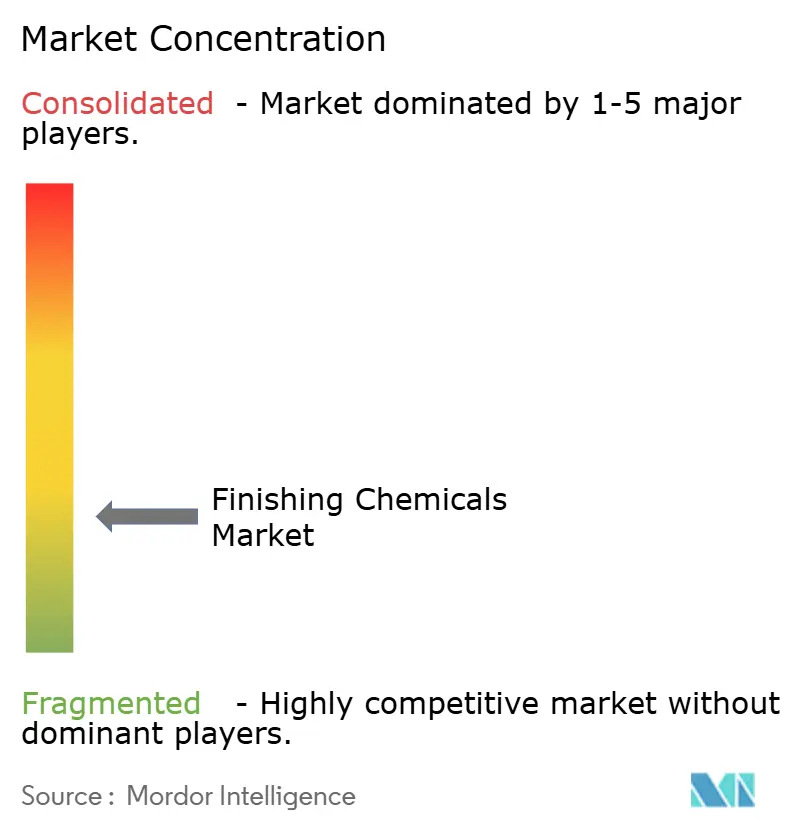
| Market Concentration | Low |
Major Players *Disclaimer: Major Players sorted in no particular order Image © Mordor Intelligence. Reuse requires attribution under CC BY 4.0. | |
Finishing Chemicals Market Analysis by Mordor Intelligence
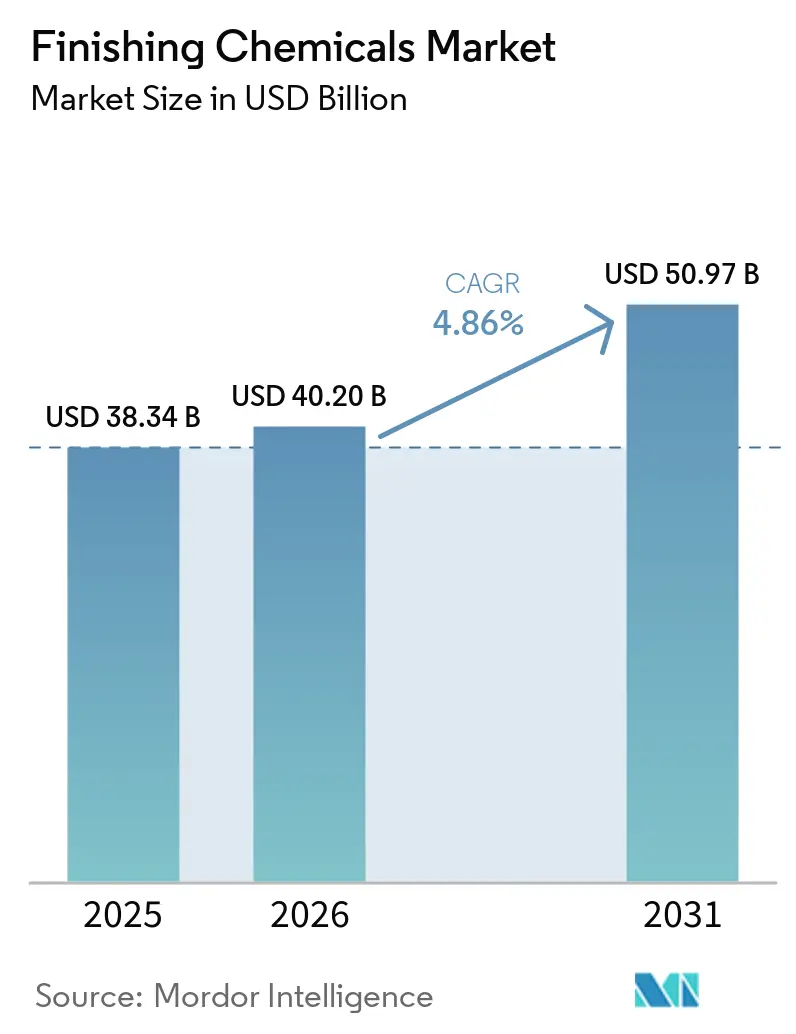
The Finishing Chemicals Market size was valued at USD 38.34 billion in 2025 and is estimated to grow from USD 40.20 billion in 2026 to reach USD 50.97 billion by 2031, at a CAGR of 4.86% during the forecast period (2026-2031). The finishing chemicals market serves textile, metal, wood, leather, and paper substrates, which spread demand across end uses with different performance requirements and regulatory cycles. Formulation changes are being shaped by sustainability rules, tighter product specifications, and wider use in industrial applications. These conditions support higher-value functional products, including finishes for durability, protection, and process efficiency. Across the finishing chemicals market, suppliers are directing investment toward certified formulations, local production, and application support, while the finishing chemicals market increasingly rewards reliable compliance and technical performance. These priorities favor suppliers that combine chemistry, testing, documentation, and technical service for customer production sites across global manufacturing supply chains.
Key Report Takeaways
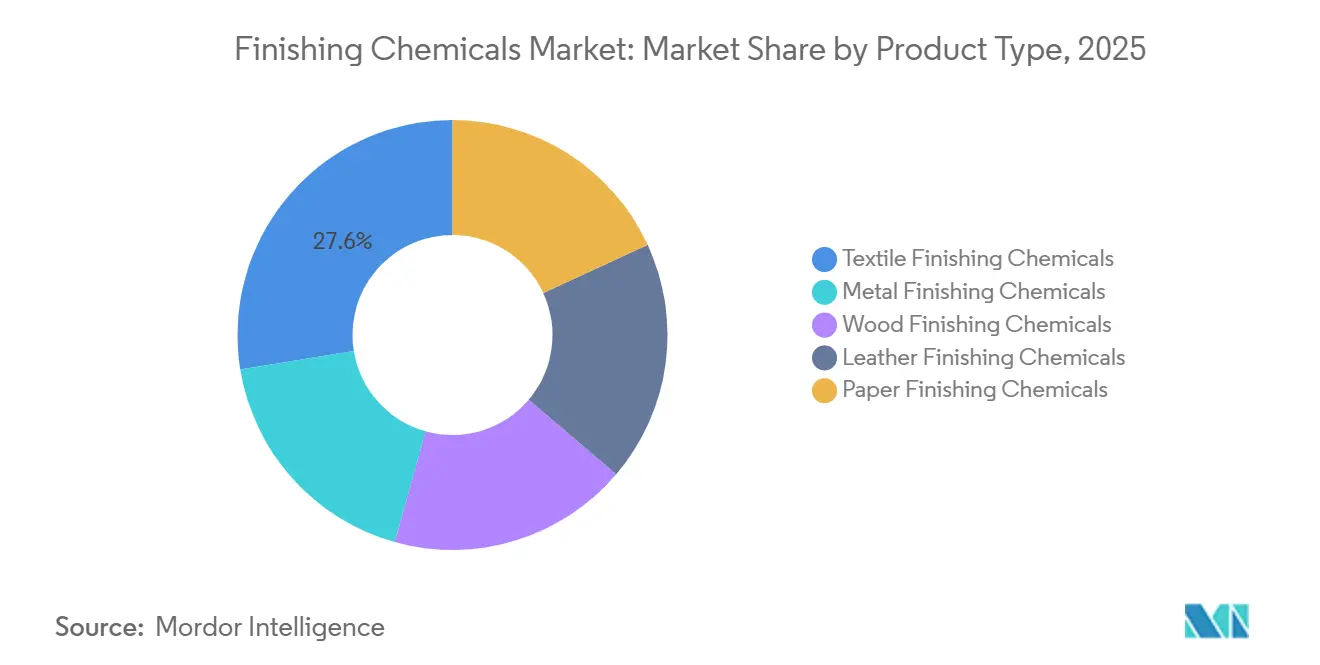
- By product type, textile finishing chemicals held 27.56% of the finishing chemicals market share in 2025 and are projected to advance at a 5.81% CAGR through 2031.
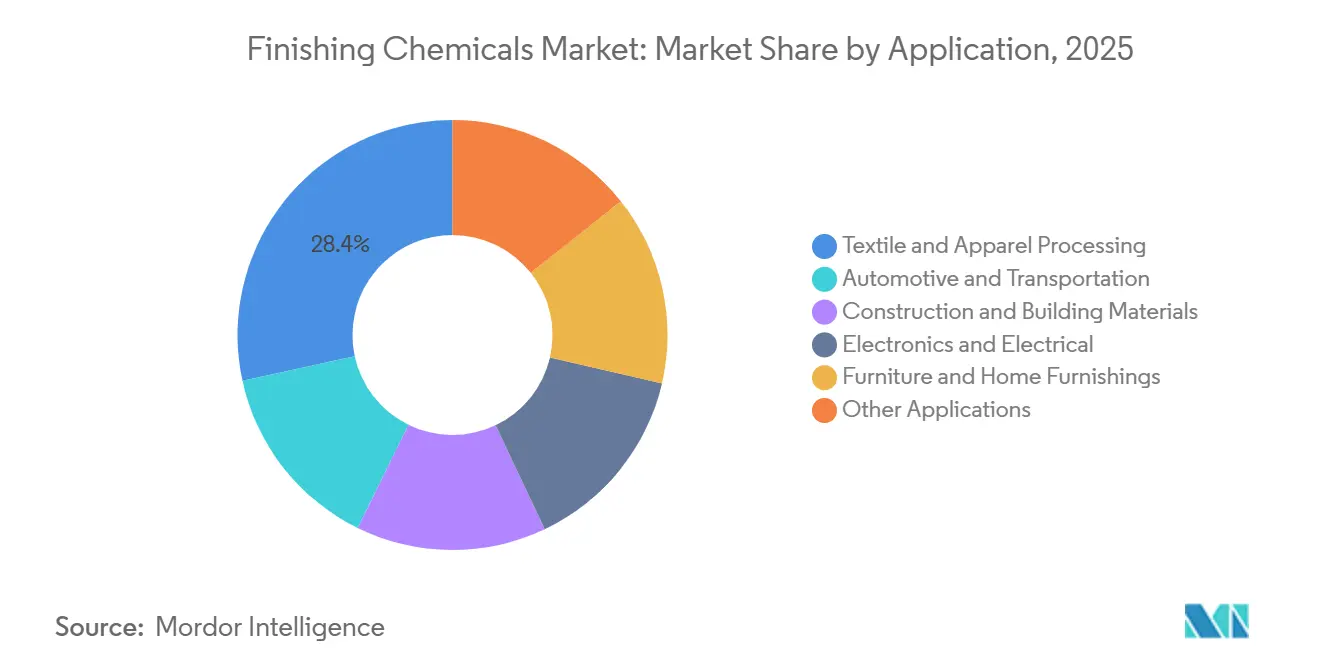
- By application, textile and apparel processing held 28.42% of the finishing chemicals market share in 2025 and is projected to advance at a 5.72% CAGR through 2031.
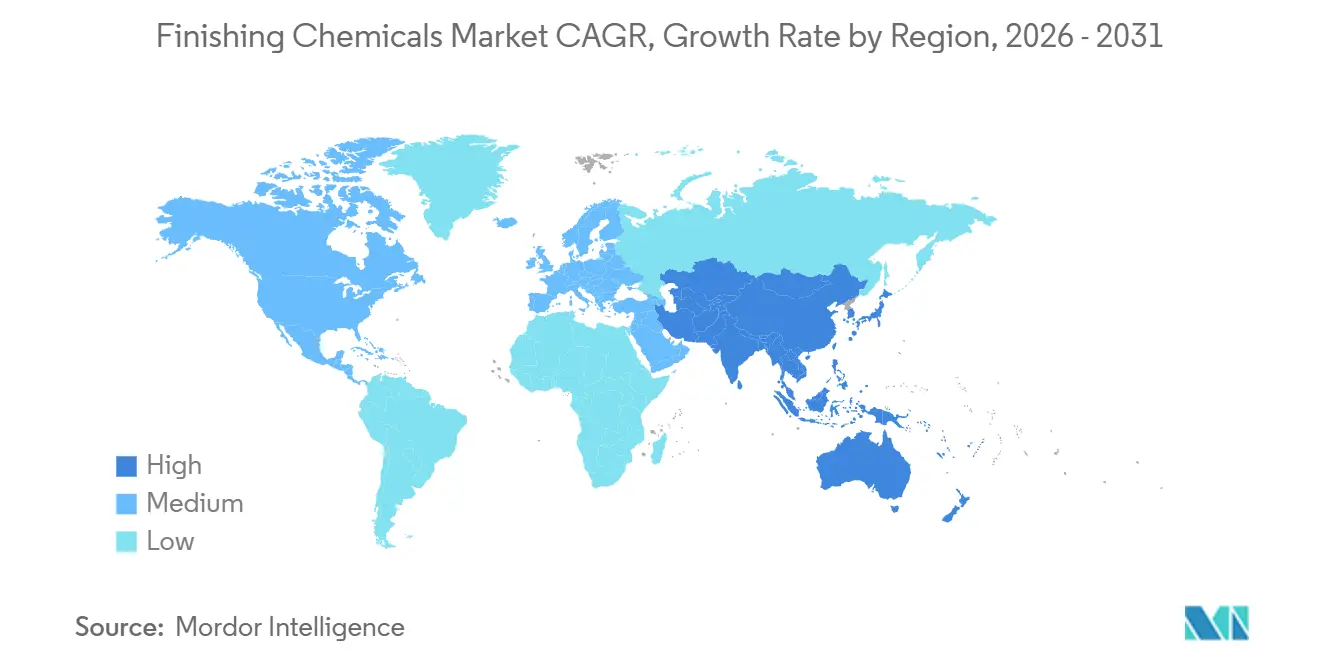
- By geography, Asia-Pacific held 35.18% of the finishing chemicals market share in 2025 and is projected to advance at a 5.34% CAGR through 2031.
Note: Market size and forecast figures in this report are generated using Mordor Intelligence’s proprietary estimation framework, updated with the latest available data and insights as of January 2026.
Market Trends and Insights
Drivers Impact Analysis of Finishing Chemicals Market*
| Driver | (~) % Impact on CAGR Forecast | Geographic Relevance | Impact Timeline |
|---|---|---|---|
| Growth of Technical and Performance Textiles | +1.3% | Global, concentrated in Asia-Pacific, Europe, and North America | Medium term (2-4 years) |
| PFAS-Free and ZDHC-Compliant Formulation Demand | +1.1% | Global, with highest regulatory intensity in the European Union and North America | Short term (≤ 2 years) |
| Packaging, Furniture, Electric Vehicle, and Electronics Demand | +0.9% | Global, with strongest uptake in Asia-Pacific and North America | Medium term (2-4 years) |
| Mill and Tannery Qualification Lock-In | +0.6% | Global, especially Asia-Pacific mills and European tanneries | Long term (≥ 4 years) |
| Digital Dosing and Closed-Loop Processing Economics | +0.4% | Global, with concentration in Asia-Pacific and Europe | Medium term (2-4 years) |
| Source: Mordor Intelligence | |||
Growth of Technical and Performance Textiles
Technical and performance textiles are expanding the finishing chemicals market because they need functions that standard softeners cannot provide. Flame retardancy, ultraviolet protection, antimicrobial performance, and moisture management require specialized formulations. Automotive, healthcare, filtration, and construction fabrics use these functions in demanding operating conditions. When automotive manufacturers specify interior textiles, leather, and connector coatings, suppliers can qualify products across several substrates. Archroma presented its SUPER SYSTEMS+ platform for technical textile manufacturers at Techtextil 2026, with applications in antimicrobial, odor-control, and performance finishing. Archroma also received the International Textile Manufacturers Federation 2025 Sustainability & Innovation Award for its DENIM HALO process, showing how performance and process improvements can support differentiation.
PFAS-Free and ZDHC-Compliant Formulation Demand
The phaseout of per- and polyfluoroalkyl substances (PFAS) is driving a major reformulation cycle in the finishing chemicals market. From January 2025, bluesign extended its PFAS ban to short-chain C6 chemistry for bluesign APPROVED and bluesign PRODUCT items. The European standard EN 17681-1:2025, published in April 2025, introduced an alkaline hydrolysis extraction process for targeted PFAS analysis. California Assembly Bill 1817 prohibited PFAS in new textile articles, while Washington State restricted intentionally added PFAS in leather and textile furniture from January 2026. The Registration, Evaluation, Authorisation and Restriction of Chemicals (REACH), Bluesign, Zero Discharge of Hazardous Chemicals (ZDHC) Manufacturing Restricted Substances List (MRSL), and OEKO-TEX requirements increase the value of pre-certified formulations. ZDHC plans to publish updated PFAS guidance in October 2026, and mills adopting alternatives must validate wash durability and end-use performance before conversion.
Packaging, Furniture, Electric Vehicle, and Electronics Demand
Non-textile substrates are broadening the finishing chemicals market and increasing the need for application-specific chemistry. Electric vehicle production requires copper busbar plating, aluminum conversion coatings, and battery-contact treatments. Electronics production also requires high-purity plating baths and surfactants that meet demanding specifications. Furniture and construction demand support wood and surface finishing products as residential interiors become more specialized in developing Asia-Pacific markets. Paper mills are qualifying water-based and bio-based barrier systems as PFAS-based grease-resistant food-packaging coatings are phased out.
Mill and Tannery Qualification Lock-In
Mill and tannery qualification processes support stable demand in the finishing chemicals market. A textile mill or tannery must validate a formulation against a brand-restricted substances list and a product-performance protocol. Replacing a qualified product requires testing, documentation, and renewed customer approval. European tanneries are reviewing processes as chemical restrictions require closer examination of tanning and finishing inputs. RUDOLF Holding SE & Co. KG, Tanatex Chemicals B.V., and Zschimmer & Schwarz Chemie GmbH & Co. KG benefit when their formulations are embedded in approved recipes and compliance submissions. These requirements make application expertise and consistent technical support important factors in supplier selection.
Restraints Impact Analysis of Finishing Chemicals Market*
| Restraint | (~) % Impact on CAGR Forecast | Geographic Relevance | Impact Timeline |
|---|---|---|---|
| Wastewater, Toxicity, and Substance-Restriction Compliance Costs | -1.3% | Global, with the highest burden in the European Union and North America | Short term (≤ 2 years) |
| Petrochemical Feedstock and Energy Price Volatility | -1.0% | Global, with acute exposure in Asia-Pacific and Europe | Short term (≤ 2 years) |
| Reformulation, Requalification, and Conversion Downtime | -0.7% | Global, particularly relevant for European Union and the Asia-Pacific mills | Medium term (2-4 years) |
| Source: Mordor Intelligence | |||
Wastewater, Toxicity, and Substance-Restriction Compliance Costs
Compliance costs are constraining margins across the finishing chemicals market, especially where discharge and substance restrictions are stringent. The United States Environmental Protection Agency has indicated that it will proceed with effluent limitation guidelines addressing PFAS discharges from metal finishers. These requirements add to National Pollutant Discharge Elimination System permit obligations for affected facilities. A 2025 review examined the economic effects of PFAS regulations in the United States pulp and paper sector. Germany’s 2025 environmental barometer found that nearly 50% of chemical and manufacturing companies viewed expanding chemical regulations as complex and time-consuming. Smaller formulators face a greater burden because they must fund compliance work while developing PFAS-free products.
Petrochemical Feedstock and Energy Price Volatility
Finishing chemicals depend heavily on petrochemical intermediates, making feedstock costs a material restraint for the finishing chemicals market. In 2026, naphtha Cost and Freight (CFR) Japan prices increased from USD 646 per metric ton to USD 1,140.50 per metric ton in 3 weeks after Strait of Hormuz disruptions affected supply. The price movement increased pressure on naphtha-based intermediates used by Asian and European producers. Higher energy costs added to the cost pressure faced by manufacturers in these regions. Cost volatility makes longer-term customer pricing discussions more difficult. It can also reduce margin visibility for specialty chemical companies with fixed supply commitments.
*Our forecasts treat driver/restraint impacts as directional, not additive. The impact forecasts reflect baseline growth, mix effects, and variable interactions.
Finishing Chemicals Market Segment Analysis
By Product Type:
Textile Chemicals Lead both Market Share and GrowthTextile finishing chemicals held 27.56% of the finishing chemicals market share in 2025 and are projected to advance at a 5.81% CAGR through 2031. The segment combines conventional softeners and repellents with antimicrobial, ultraviolet-protective, and flame-retardant finishes. Functional products are becoming more important as technical textiles are adopted in automotive interiors, healthcare products, and protective apparel. In February 2025, Archroma and BW Converting demonstrated a digital spray finishing unit at Monforts’ Advanced Technology Center in Mönchengladbach, Germany. The system can reduce water, chemistry, and energy use by up to 50% compared with conventional pad application. These process changes encourage the use of more concentrated, high-value formulations.
Metal finishing chemicals benefit from automotive, electric vehicle, and electronics requirements. Wood finishing chemicals serve residential construction and furniture applications. Leather finishing chemicals are supported by use in luxury goods, automotive interiors, and lifestyle accessories. Paper finishing chemicals are seeing new qualification activity as food packaging shifts away from PFAS-based barrier coatings. The finishing chemicals market size for these categories is supported by water-based silicone and bio-based barrier alternatives, although their adoption depends on mill testing and certification. OEKO-TEX Standard 100, bluesign, and ZDHC MRSL are being applied across more substrate types, which favors suppliers that can provide certified products for several uses.

By Application:
Textile and Apparel Processing Leads both Market Share and GrowthTextile and apparel processing held 28.42% of the finishing chemicals market share in 2025 and is projected to advance at a 5.72% CAGR through 2031. The application reflects the large chemical requirement of garment and home-furnishing production. India’s textile and apparel exports reached USD 37.75 billion in fiscal year 2024-25, according to the Union Textiles Ministry. PM MITRA parks and Production Linked Incentive (PLI) investments support the use of export-compliant and resource-efficient finishing chemistry at mills. Technical fabrics used in healthcare and filtration require more demanding performance treatments than conventional apparel. This supports revenue growth where finishing costs per kilogram are higher.
Automotive and transportation are changing their chemistry mix as electric vehicles use copper busbar plating, aluminum battery-housing conversion coatings, and electromagnetic interference shielding finishes. Construction and building materials continue to consume wood, metal, and stone finishing chemicals as building activity expands in the Asia-Pacific. Electronics and electrical applications require ultra-pure plating baths and PFAS-free surfactants for advanced semiconductor packaging. Furniture and home furnishings also support demand for specialized finishes in developing Asia-Pacific markets. Packaging functional coatings form another application area as paper producers seek compliant barrier systems. Zschimmer & Schwarz Chemie GmbH & Co. KG’s ECOLUTION textile auxiliary range illustrates how specialized suppliers are combining bio-based chemistry with textile-processing expertise.
Geography Analysis
APAC Finishing Chemicals Market
Asia-Pacific held 35.18% of the finishing chemicals market share in 2025 and is projected to advance at a 5.34% CAGR through 2031. The region has large textile-processing, automotive, electronics, and furniture manufacturing bases. China’s Petrochemical Industry Stable Growth Action Plan for 2025-2026 targeted chemical-industry value-added growth of more than 5% annually. India’s textile exports reached USD 37.75 billion in fiscal year 2024-25, and PM MITRA parks support the adoption of ZDHC-compliant chemistry. In June 2026, Quaker Houghton opened a manufacturing site in Zhangjiagang and expanded its Shanghai laboratory, reflecting the need for local metal-finishing supply and technical support.
North America Finishing Chemicals Market
North America represents a major demand center for metal finishing products used in automotive, aerospace, and electric vehicle battery components. The United States Environmental Protection Agency guidelines for PFAS discharges are prompting reformulation of fluorine-free bath chemistries. National Pollutant Discharge Elimination System permits, and California PFAS restrictions are increasing compliance spending throughout the value chain. Mexico is receiving additional demand from automotive parts and electronics assembly capacity linked to nearshoring. The finishing chemicals market in the region benefits from high-value applications but faces significant qualification and environmental compliance requirements.
EMEA and South America Finishing Chemicals Market
Europe is marked by intensive compliance-driven reformulation across textiles, leather, coatings, and metal treatment. The European Commission published its Chemicals Industry Action Plan in July 2025, combining REACH simplification with support for bio-based and circular chemical substitutes[1]. Germany retains formulation research and development capabilities despite rising energy costs. South America has a smaller but growing demand base, with Brazil supporting textile chemicals and Mexico supported by garment and automotive parts exports. The Middle East and Africa also have emerging demand from Saudi Arabian industrial investment, alongside leather and textile activity in South Africa. These regions extend the finishing chemicals market beyond its largest manufacturing centers.
Competitive Landscape
The finishing chemicals market is highly fragmented, with the top five players including BASF, Dow, Archroma, CLARIANT, and Element Solutions Inc. Archroma, RUDOLF Holding SE & Co. KG, Tanatex Chemicals B.V., DyStar Group, and Stahl Holdings B.V. compete through application knowledge and qualified supplier relationships. This mix of large companies and specialists makes scale, certification, and technical service important competitive factors. In February 2026, Henkel AG & Co. KGaA agreed to acquire Stahl Holdings B.V. for EUR 2.1 billion (approximately USD 2.5 billion)[2]. Stahl Holdings B.V. supplies specialty coatings for leather, textiles, and paper packaging, and the transaction is expected to bring its customized chemistry model into Henkel’s Adhesive Technologies platform. The transaction remains subject to regulatory approvals and is expected to close in the second half of 2026.
Companies are expanding regional capacity to improve supply security and local application support. In July 2026, Covestro AG completed its acquisition of former Vencorex sites producing hexamethylene diisocyanate (HDI) derivatives in Thailand and the United States. The sites strengthen their supply position for high-performance polyurethane coatings used in wood, automotive, and marine finishing applications. In April 2026, Evonik Industries AG inaugurated an expanded specialty amine facility in Nanjing, China. The site uses green electricity and produces amine-based additives for polyurethane and epoxy systems. These investments demonstrate the importance of Asia-Pacific manufacturing capacity in the finishing chemicals market.
Suppliers are also focusing on PFAS-free paper barriers, durable water-repellent systems for technical textiles, and chromium-free metal conversion coatings. Quaker Houghton acquired Dipsol Chemicals Co., Ltd. in April 2025 for USD 155.2 million, net of cash acquired, adding surface-treatment and plating solutions in Japan. BASF is completing a USD 1 billion methylene diphenyl diisocyanate (MDI) expansion in Geismar, Louisiana, to double capacity to 600,000 metric tons per year. The finishing chemicals market, therefore, remains competitive around product compliance, local supply, and specific end-use qualifications.
Finishing Chemicals Industry Leaders
-
BASF
-
Dow
-
Archroma
-
CLARIANT
-
Element Solutions Inc
- *Disclaimer: Major Players sorted in no particular order
Finishing Chemicals Market Companies Covered in this Report
- Archroma
- BASF
- CLARIANT
- Covestro AG
- Dow
- DyStar Group
- Element Solutions Inc
- Evonik Industries AG
- Henkel AG & Co. KGaA
- Quaker Houghton
- RUDOLF Holding SE & Co. KG
- Stahl Holdings B.V.
- Tanatex Chemicals B.V.
- Wacker Chemie AG
- Zschimmer & Schwarz Chemie GmbH
Recent Industry Developments in Finishing Chemicals Market
- July 2026: Covestro AG completed the acquisition of two former Vencorex HDI-derivative production sites in Rayong, Thailand, and Freeport, Texas, expanding its regional production capacity. The HDI derivatives are key building blocks for high-performance polyurethane coatings used in automotive, marine, infrastructure, and wood-furniture applications, supporting supply and production capacity for finishing chemicals.
- February 2026: Henkel AG & Co. KGaA agreed to acquire Stahl for EUR 2.1 billion (approximately USD 2.5 billion), adding leather finishing coatings, performance coatings, and high-performance paper packaging and graphics coatings to its portfolio. This strengthens Henkel AG & Co. KGaA’s presence across specialty finishing applications.
Global Finishing Chemicals Market Report Scope
Finishing chemicals are specialized formulations applied during or after manufacturing processes to enhance the surface properties, appearance, durability, and functional performance of materials and finished products. They can improve characteristics such as smoothness, resistance to wear and environmental conditions, texture, and overall product quality.
The Finishing Chemicals Market is segmented by product type, application, and geography. By product type, the market is segmented into textile finishing chemicals, metal finishing chemicals, wood finishing chemicals, leather finishing chemicals, and paper finishing chemicals. By application, the market is segmented into textile and apparel processing, automotive and transportation, construction and building materials, electronics and electrical, furniture and home furnishings, and other applications. The report also covers the market size and forecasts for finishing chemicals in 15 countries across major regions. For each segment, the market sizing and forecasts have been done on the basis of value (USD).
Segmentation Overview
| Textile Finishing Chemicals |
| Metal Finishing Chemicals |
| Wood Finishing Chemicals |
| Leather Finishing Chemicals |
| Paper Finishing Chemicals |
| Textile and Apparel Processing |
| Automotive and Transportation |
| Construction and Building Materials |
| Electronics and Electrical |
| Furniture and Home Furnishings |
| Other Applications |
| Asia-Pacific | China |
| India | |
| Japan | |
| South Korea | |
| Rest of Asia-Pacific | |
| North America | United States |
| Canada | |
| Mexico | |
| Europe | Germany |
| United Kingdom | |
| France | |
| Italy | |
| Rest of Europe | |
| South America | Brazil |
| Argentina | |
| Rest of South America | |
| Middle East and Africa | Saudi Arabia |
| South Africa | |
| Rest of Middle East and Africa |
| By Product Type | Textile Finishing Chemicals | |
| Metal Finishing Chemicals | ||
| Wood Finishing Chemicals | ||
| Leather Finishing Chemicals | ||
| Paper Finishing Chemicals | ||
| By Application | Textile and Apparel Processing | |
| Automotive and Transportation | ||
| Construction and Building Materials | ||
| Electronics and Electrical | ||
| Furniture and Home Furnishings | ||
| Other Applications | ||
| By Geography | Asia-Pacific | China |
| India | ||
| Japan | ||
| South Korea | ||
| Rest of Asia-Pacific | ||
| North America | United States | |
| Canada | ||
| Mexico | ||
| Europe | Germany | |
| United Kingdom | ||
| France | ||
| Italy | ||
| Rest of Europe | ||
| South America | Brazil | |
| Argentina | ||
| Rest of South America | ||
| Middle East and Africa | Saudi Arabia | |
| South Africa | ||
| Rest of Middle East and Africa | ||
Key Questions Answered in the Report
What is the size of the finishing chemicals market?
The finishing chemicals market stands at USD 40.20 billion in 2026 and is projected to reach USD 50.97 billion by 2031.
What is driving demand for finishing chemicals?
Technical textiles, PFAS-free reformulation, and rising use in packaging, furniture, electric vehicles, and electronics support demand.
Which product type led the market revenue in 2025?
Textile finishing chemicals held 27.56% of revenue in 2025.
Which application led the market revenue in 2025?
Textile and apparel processing held 28.42% of revenue in 2025.