
Field Sales Software Market Size and Share
Market Overview
| Study Period | 2020 - 2031 |
|---|---|
| Market Size (2026) | USD 4.85 Billion |
| Market Size (2031) | USD 8.62 Billion |
| Growth Rate (2026 - 2031) | 12.19 % |
| Fastest Growing Market | Asia-Pacific |
| Largest Market | North America |
| Market Concentration | Medium |
Major Players *Disclaimer: Major Players sorted in no particular order Image © Mordor Intelligence. Reuse requires attribution under CC BY 4.0. | |
Field Sales Software Market Analysis by Mordor Intelligence
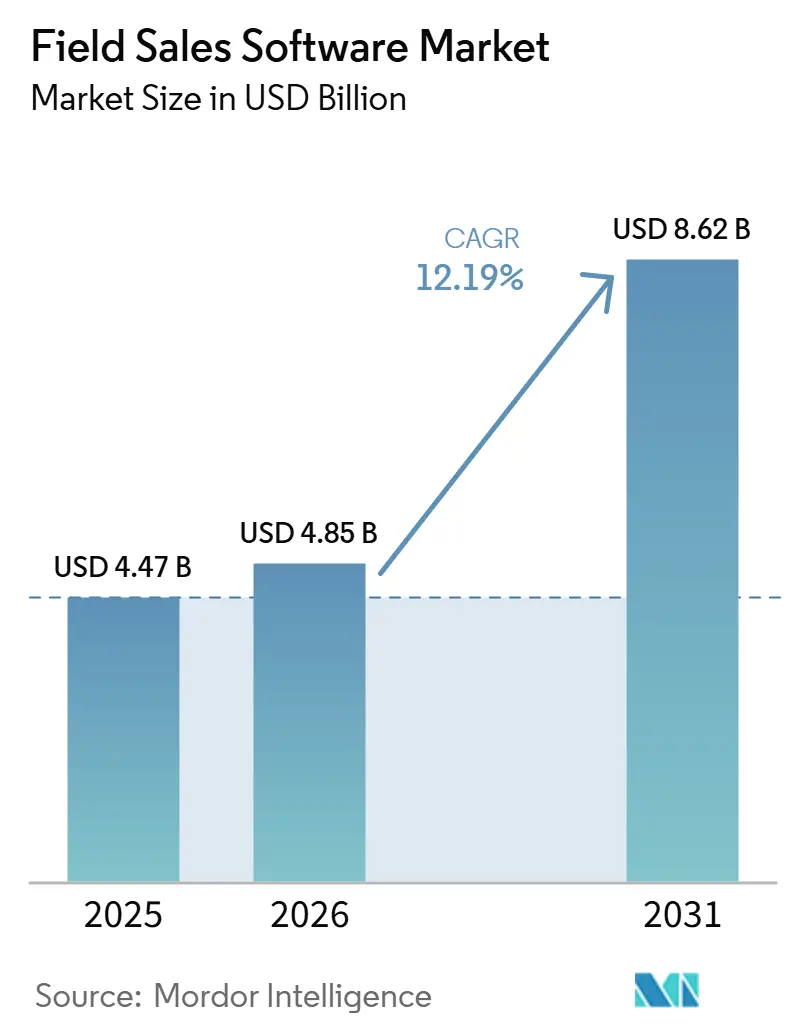
The Field Sales Software Market size is expected to increase from USD 4.47 billion in 2025 to USD 4.85 billion in 2026 and reach USD 8.62 billion by 2031, growing at a CAGR of 12.19% over 2026-2031. Growth reflects a move from basic route management tools toward connected platforms that combine lead prioritization, territory visibility, and data capture during customer visits. Mobile use and predictive tools are changing how sales teams organize work, since representatives can update records and access account information without returning to a desk. Cloud delivery supports this shift by enabling providers to release features continuously and giving users access to current data from different locations. Competition centers on reliable integrations, practical mobile workflows, and deployment options that meet data governance needs. The Field Sales Software Market also has room to expand, particularly among teams that have not yet adopted AI tools or companies that still manage field activity through paper files and spreadsheets.
Key Report Takeaways
- By component, software held 72.41% of the Field Sales Software Market share in 2025, while services are projected to expand at a CAGR of 15.82% through 2031.
- By platform access, mobile-based platforms accounted for 42.36% of revenue in the Field Sales Software Market 2025, while unified mobile and web platforms are projected to grow at a CAGR of 16.43% through 2031.
- By deployment model, cloud held 68.19% of revenue in 2025, while hybrid deployment is projected to expand at a CAGR of 14.69% through 2031.
- By enterprise size, large enterprises accounted for 64.83% of revenue in the Field Sales Software Market 2025, while small and medium-sized enterprises are projected to grow at a CAGR of 17.24% through 2031.
- By end user, retail and e-commerce held 24.18% of revenue in 2025, while healthcare and life sciences are projected to expand at a CAGR of 15.91% through 2031.
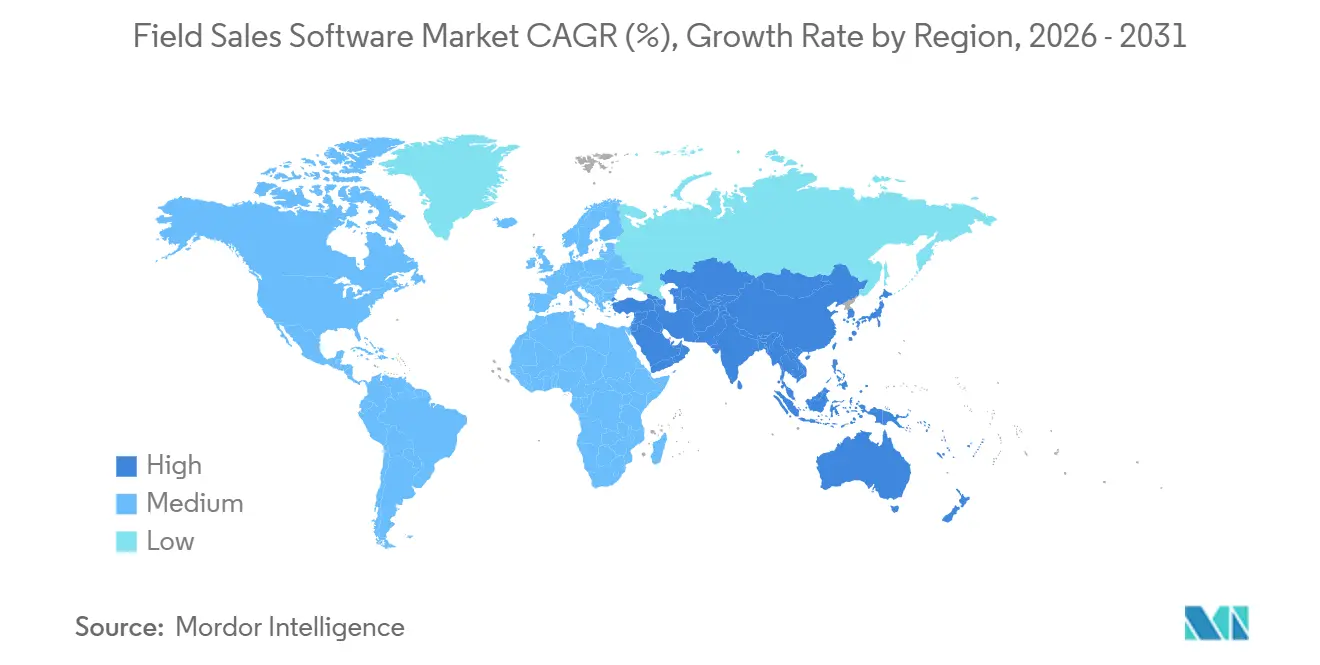
- By geography, North America accounted for 34.62% of revenue in the Field Sales Software Market 2025, while Asia-Pacific is projected to grow at a CAGR of 16.18% through 2031.
Note: Market size and forecast figures in this report are generated using Mordor Intelligence’s proprietary estimation framework, updated with the latest available data and insights as of January 2026.
Global Field Sales Software Market Trends and Insights
Drivers Impact Analysis*
| Driver | (~) % Impact on CAGR Forecast | Geographic Relevance | Impact Timeline |
|---|---|---|---|
| Mobile-First Sales Execution Adoption | +3.2% | Global, with concentration in Asia-Pacific and North America | Short term (≤ 2 years) |
| AI-Enabled Lead Prioritization and Sales Forecasting | +2.8% | Global, with early adoption in North America and Western Europe | Medium term (2-4 years) |
| Cloud Migration and Subscription-Based Purchasing | +2.1% | Global, with high intensity in Asia-Pacific and small and medium-sized enterprises | Short term (≤ 2 years) |
| Demand for Real-Time Territory and Representative Visibility | +1.5% | North America and Europe, with emerging demand in Asia-Pacific | Medium term (2-4 years) |
| Offline-First Workflows for Connectivity-Constrained Territories | +0.9% | Asia-Pacific, with spillover to the Middle East and Africa and South America | Medium term (2-4 years) |
| Field Activity Data as a Revenue Operations Signal | +0.7% | North America and Europe, with early adoption in Asia-Pacific | Long term (≥ 4 years) |
| Source: Mordor Intelligence | |||
Mobile-First Sales Execution Adoption
Mobile-first design has become a standard requirement in the Field Sales Software Market, rather than a feature reserved for a limited group of users. Field representatives need to check in with customers, record activity, review product information, and respond to changes as they move from appointment to appointment. Smartphone use and wider network coverage make these tasks possible without returning to a desktop workflow or delaying an update until the end of the day. In April 2026, introduced DASH, an AI assistant in its mobile application that supports voice-based visit notes, follow-up drafting, and CRM updates between stops.[1]SPOTIO, “SPOTIO Launches DASH, the AI Co-Pilot Purpose-Built for Field Sales Teams,” SPOTIO The release addressed practical field constraints, including weak connectivity, one-handed phone use, and limited time between a customer meeting and the next stop. Providers that reduce manual entry through GPS verification, voice transcription, photo-based forms, and offline synchronization can make the system more useful for representatives and easier for managers to rely on.
AI-Enabled Lead Prioritization and Sales Forecasting
AI is becoming part of the core product rather than an optional addition in the Field Sales Software Market, especially for teams that need to prioritize a large number of accounts. Its main uses include lead scoring, visit prioritization, dynamic forecasts, and suggested next steps that use account activity and sales history. launched Next Best Action in July 2026 to score accounts using activity history, pipeline stage, and account behavior, then recommend a visit, call, text, or email.[2]SPOTIO, “SPOTIO Launches Next Best Action AI Recommendation Engine,” SPOTIO In June 2026, Sanofi deployed Concierge for Field, using Snowflake Cortex AI to prepare representatives for physician visits with prescribing history, prior engagement details, and a visit plan. These tools can reduce preparation time, give managers a clearer view of account priorities, and support a more consistent approach to visit planning. As these functions become more common, buyers are likely to compare providers on recommendation quality, governance, explainability, and the clarity of the action proposed to each representative.[3]Sanofi, “Sanofi Chooses Snowflake to Accelerate Its AI-Powered Drug Development,” Financial Times
Cloud Migration and Subscription-Based Purchasing
Subscription pricing reduces upfront spending, provides regular feature updates, and gives customers a clearer way to scale access as field teams change. It also supports real-time access to customer, territory, and field activity information for users working across many locations. Smaller organizations can use cloud systems without maintaining extensive internal infrastructure or a dedicated team to manage the application. The Field Sales Software Market benefits when providers offer configurable subscriptions, pre-built connectors, remote access, and onboarding support as standard. Some vendors are also providing selective data-residency controls for regulated customers without requiring a full return to on-premises infrastructure.
Demand for Real-Time Territory and Representative Visibility
Managers increasingly expect to see where representatives are working, which accounts they visited, how long each visit lasted, and what follow-up activity occurred. This need is particularly important for large teams covering broad territories and for organizations that cannot monitor every local account directly. Real-time records can help a manager identify coverage gaps, uneven workloads, and under-visited accounts before those issues continue for several months. Field activity data is also becoming an input for territory planning and pipeline reviews, rather than only a record showing where a representative has been. The Field Sales Software Market is therefore rewarding products that connect travel, coverage, customer engagement, visit outcomes, and revenue information in a clear workflow. Providers must still make these features useful to managers and representatives without turning routine field work into an additional reporting burden.
Restraints Impact Analysis*
| Restraint | (~) % Impact on CAGR Forecast | Geographic Relevance | Impact Timeline |
|---|---|---|---|
| Implementation and Integration Costs | -1.8% | Global | Short term (≤ 2 years) |
| Data Privacy and Employee-Tracking Concerns | -1.2% | Europe and North America, with emerging relevance in Asia-Pacific | Medium term (2-4 years) |
| Low Representative Adoption Caused by Administrative Complexity | -0.8% | Global, with higher intensity in small and medium-sized enterprise and emerging-market deployments | Short term (≤ 2 years) |
| Location Accuracy and Consent Limitations in Distributed Markets | -0.5% | Asia-Pacific, the Middle East and Africa, and South America | Medium term (2-4 years) |
| Source: Mordor Intelligence | |||
Implementation and Integration Costs
The cost of deploying the Field Sales Software Market extends beyond a license fee and can include several internal and vendor-led workstreams. Organizations may need CRM integration, ERP data synchronization, mobile device management, user training, data preparation, and ongoing administration. Large deployments can require custom application programming interfaces to connect with Salesforce, SAP, Microsoft Dynamics, and other existing sales systems. These projects can delay purchasing decisions when buyers cannot clearly assess the delivery effort, internal ownership, or the time required to achieve a usable result. Smaller organizations face added exposure because they may depend entirely on vendor professional services and have limited capacity to resolve issues themselves. Providers can reduce this concern with connector libraries, no-code configuration, staged deployment plans, and structured onboarding programs.
Data Privacy and Employee-Tracking Concerns
GPS tracking, activity records, and behavioral analysis can raise employee privacy concerns in the Field Sales Software Market, particularly when a platform is used to monitor individual performance. The EU AI Act established requirements for high-risk AI uses, while Article 35 of the GDPR requires a data protection impact assessment in relevant cases.[4]European Parliament and Council of the European Union, “Regulation (EU) 2024/1689,” Official Journal of the European Union European buyers may require controls for retention periods, consent, data minimization, explainable scoring, and clear rules about who can see location information before a rollout can proceed. The United Kingdom Information Commissioner’s Office also provides guidance on monitoring workers and the use of legitimate interests in workplace monitoring. These requirements can lengthen sales cycles, add configuration work, and require greater involvement from legal, technology, and human-resources teams. Vendors can respond with opt-in settings, employee-accessible records, limited retention periods, and configurable data residency.
*Our forecasts treat driver/restraint impacts as directional, not additive. The impact forecasts reflect baseline growth, mix effects, and variable interactions.
Segment Analysis
By Component: Software Holds the Largest Revenue Position While Services Grow Faster
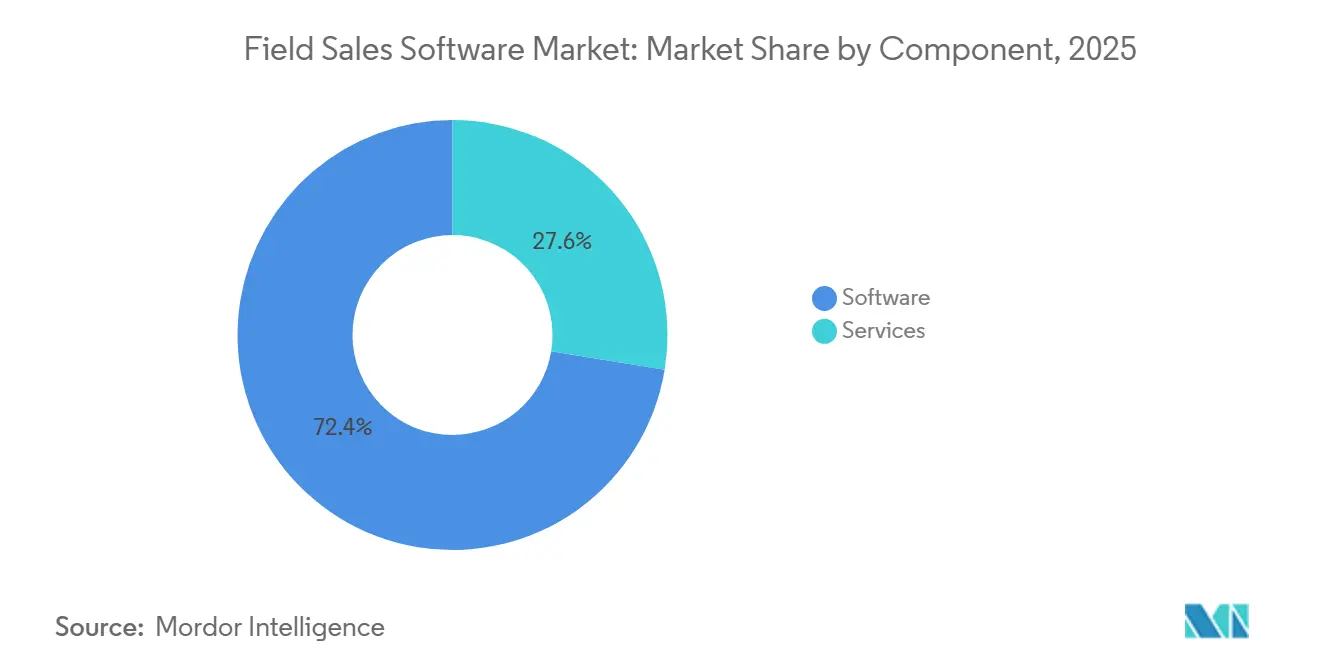
Software held 72.41% of the Field Sales Software Market share in 2025, reflecting enterprise demand for a core execution platform rather than a collection of separate tools. The main product now commonly integrates lead scoring, offline synchronization, GPS-supported visit logging, account records, and territory assignment into a single daily workflow. This wider scope raises the baseline capability buyers expect from a subscription, since representatives need dependable tools before, during, and after a customer visit. It also reduces the need to move data repeatedly between route, activity, and account-management applications. The segment remains central because both representatives and managers depend on the software to plan work, record results, and review coverage.
Services are projected to grow at a CAGR of 15.82% through 2031, making them the faster-growing component category. The category covers implementation, CRM and ERP integration support, user training, configuration work, and managed services after deployment. Large distributed teams may need provider assistance to connect field records to existing data systems and create dashboards that show the relationship between representative activity and revenue outcomes. They can also require support in configuring AI recommendations, access controls, and regional operating rules consistently. This demand suggests that wider product scope and deeper integration needs are increasing faster than self-service deployment can meet every customer requirement.


By Platform Access: Unified Platforms Reduce the Mobile and Desktop Divide
Mobile-based platforms accounted for 42.36% of the Field Sales Software Market revenue in 2025, as representatives use phones during active customer visits. A mobile interface supports check-ins, account reviews, route details, product information, and follow-up records at the place where work is completed. It can also help users capture information before it is lost between appointments or entered later from memory. Web and desktop tools still serve managers who need territory design, reporting, and pipeline review capabilities that often require a wider screen. They also remain relevant where internal security policies require selected data actions on company-managed desktop devices.
Unified mobile and web platforms are projected to grow at a CAGR of 16.43% through 2031. They address the split that can arise when mobile and desktop systems are maintained as separate products with separate interfaces and release schedules. Organizations with dispersed management teams need the same account data, definitions, and workflows regardless of how users access the system. A shared environment can reduce duplicated administration and the risk of different versions of a record appearing across devices. Providers are using progressive web application designs to narrow functional gaps and make unified access a practical operating choice.
By Deployment Model: Cloud Leads Revenue While Hybrid Meets Governance Needs
Cloud commanded 68.19% of the Field Sales Software Market share in 2025, supported by scalable access, current data availability, and a reduced need for customer-managed infrastructure. It can connect teams across territories without requiring local deployment at each sales location or a major installation for every product update. Continuous delivery also allows users to receive new capabilities through a subscription rather than waiting for a full system replacement. These benefits matter to larger enterprises that need consistency and to smaller customers that lack dedicated infrastructure resources. Cloud, therefore, remains the primary deployment model where organizational and national data rules permit it.
Hybrid deployment is projected to expand at a CAGR of 14.69% through 2031. The model permits cloud-based field functions while allowing an organization to retain selected sensitive records in its own environment. It is relevant to regulated sectors and companies operating across countries with different requirements for customer, financial, and medical data. A company can connect field activity data through the cloud while keeping restricted records on premises under internal governance controls. This approach shows that deployment decisions increasingly depend on the sensitivity of each data set, rather than a simple cloud-or-on-premises choice.
By Enterprise Size: Small and Medium-Sized Enterprises Drive Faster Adoption
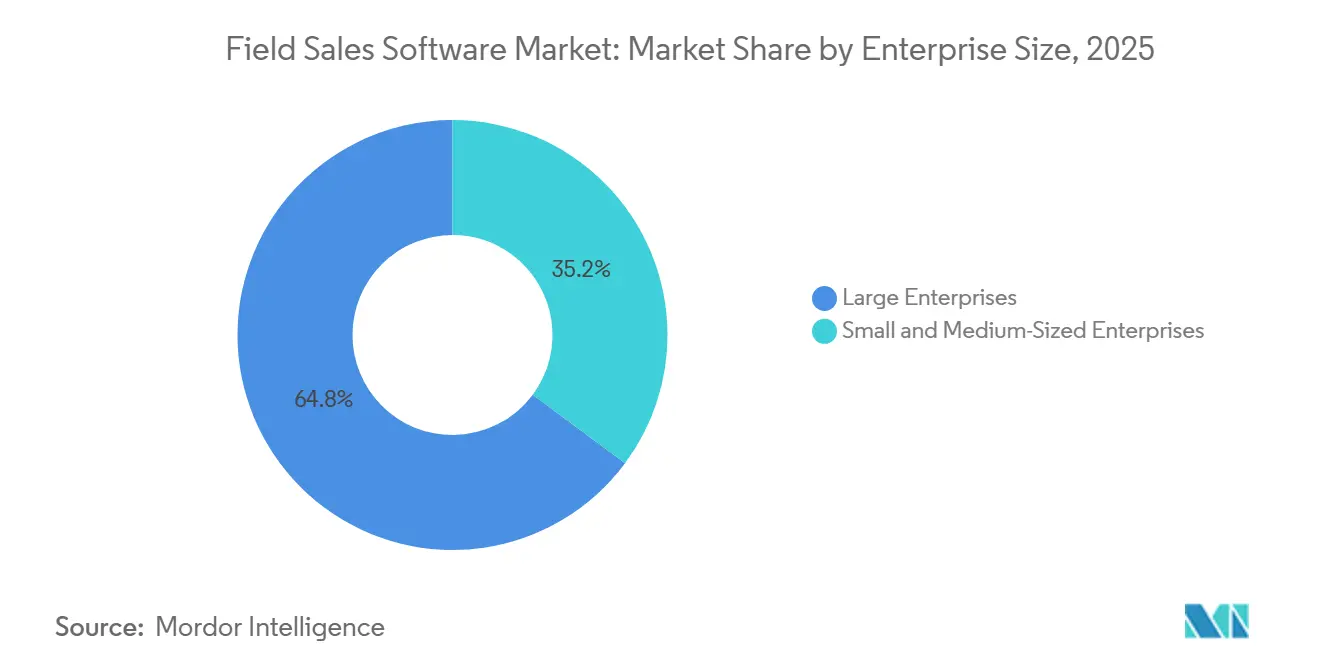
Large enterprises accounted for 64.83% of Field Sales Software Market revenue in 2025, reflecting their earlier adoption of advanced field execution tools, larger representative populations, and stronger information technology capacity. Their deployments may involve multiple CRM, ERP, reporting, and identity-management systems that need to work together. These customers also require territory controls, consistent workflow rules, and reporting across a wide geographic footprint. Vendor service teams become important when a company needs to configure those systems without disrupting an established sales process. The leading position, therefore, reflects both the size of the enterprise field forces and the complexity of their operating environment.
Small and medium-sized enterprises are projected to grow at a CAGR of 17.24% through 2031. Cloud delivery, usage-based pricing, and no-code configuration have reduced the cost and technical barriers that previously limited adoption among these organizations. Providers are responding with simpler onboarding, pre-built CRM connectors, and product tiers designed for teams of 5 to 50 representatives. These offerings can allow a customer to operate a field system without adding a dedicated internal technology team or undertaking a lengthy deployment project. Newer users may also be more open to AI-assisted workflows because they have fewer entrenched legacy processes to replace.
By End User: Retail Supports Current Demand While Healthcare and Life Sciences Grow Faster
Retail and e-commerce accounted for 24.18% of Field Sales Software Market revenue in 2025, supported by regular store visits, promotion checks, shelf-space reviews, and real-time inventory reporting. These activities require information from locations that are difficult to manage through office-based systems alone, especially when representatives cover many outlets in a territory. Mobile execution software creates a consistent record of what a representative observed, checked, and completed at each account. The segment’s Field Sales Software Market size reflects the regular, detailed, and location-based nature of retail field work. It continues to support demand for route planning, promotional compliance, customer records, and account reporting.
Healthcare and life sciences are projected to expand at a CAGR of 15.91% through 2031. Medical representative visit requirements, pre-call preparation needs, customer engagement history, and compliance documentation support demand in this vertical. Sanofi deployed Concierge for Field in June 2026 to prepare representatives for physician visits with prescribing history, past engagement information, and a visit plan. Merck Animal Health selected Salesforce Agentforce Life Sciences for customer engagement in May 2026. IT and telecommunications, BFSI, manufacturing, automotive and transportation, government, education, and energy users also need coordinated field activity, although their purchasing is often tied to a defined operational productivity requirement.
Geography Analysis
North America held 34.62% of the Field Sales Software Market share in 2025, supported by established enterprise software purchasing practices and extensive use of CRM systems. The United States accounted for much of the regional demand through retail, telecommunications, healthcare, and financial services organizations with geographically distributed sales teams. Revenue operations teams are using visit frequency, account engagement, and deal movement together in pipeline reviews, which supports demand for connected analytics. Canada and Mexico add demand, while business-to-business distribution digitization supports activity among manufacturers and wholesalers in Mexico, and North American buyers expect a steady release cycle for AI-supported capabilities, as shown by 2026 DASH and Next Best Action launches.
Asia-Pacific is projected to grow at a CAGR of 16.18% through 2031. India, China, Southeast Asia, and South Korea support the outlook through expanding distribution networks, smartphone adoption, and the adoption of cloud-based business tools. Small and medium-sized businesses in India and Southeast Asia are moving from paper and spreadsheet processes toward mobile systems that can be deployed with less internal technical support. China offers substantial enterprise cloud capacity, although data-residency rules can shape the deployment model selected by a customer. The Field Sales Software Market size across the region is supported by demand for systems that can operate across varied connectivity conditions and meet national operating requirements.
Europe remains an established regional market, with Germany, the United Kingdom, and France representing the largest national demand centers. GDPR and the EU AI Act affect the management of location data, consent, retention periods, and explainable recommendations. Merck KGaA committed to Veeva Vault CRM worldwide in May 2026 to support consistent processes and connected data across healthcare commercial functions. South America is an emerging area led by Brazil, where consumer goods and pharmaceutical distribution networks favor mobile platforms with offline capability. The Middle East and Africa have varied levels of adoption, with Saudi Arabia, the United Arab Emirates, South Africa, and Nigeria providing early demand through retail, pharmaceutical, and financial services distribution.

Competitive Landscape
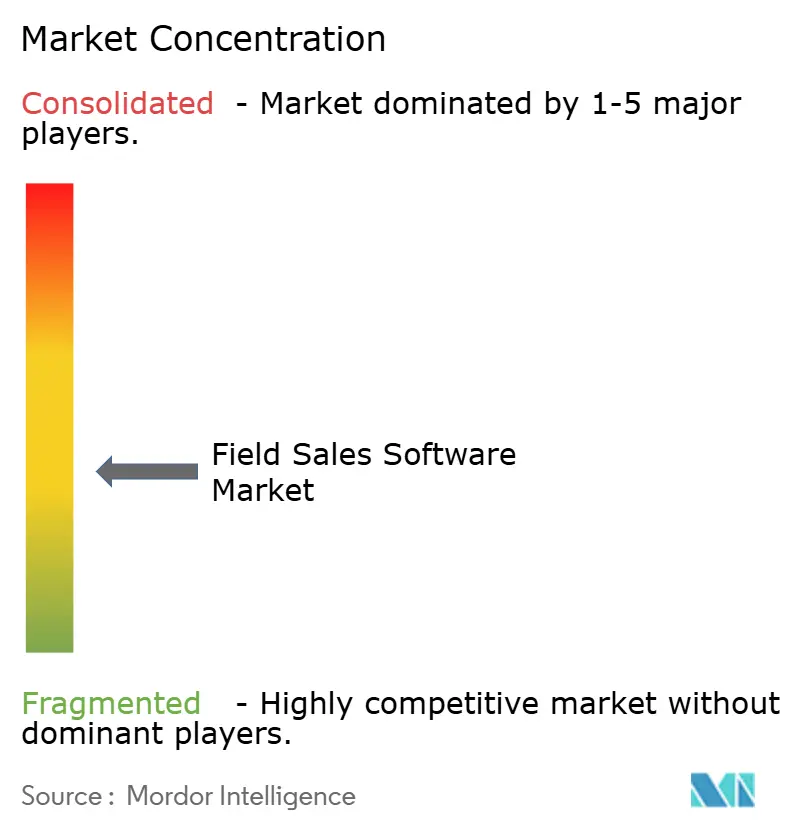
The Field Sales Software Market is moderately fragmented, as providers typically focus on a specific customer group, sales process, or vertical workflow. Repsly and StayinFront serve consumer goods and retail execution users, while Pepperi and Skynamo combine order management, ERP synchronization, and route planning for distribution customers. focus more closely on direct-to-consumer, door-to-door, and canvassing workflows. This specialization limits direct competition across every customer category and makes industry templates an important part of product fit. A provider’s ability to support the daily workflow can therefore matter as much as its broader feature list.
Integration capability is a major basis of competition in the Field Sales Software Market. Buyers need dependable connections to Salesforce, SAP, Microsoft Dynamics, HubSpot, and other systems that contain account and operational data. Certified connectors can reduce delivery work, lower sales-cycle friction, and help customers evaluate a product more quickly. Providers also compete on mobile usability, offline operation, analytics, data controls, and the ability to meet privacy requirements. Midmarket organizations with 50 to 250 representatives remain an opportunity because lightweight products may be too limited, while enterprise systems can be difficult to deploy.
Leadbeam, GeoRep, and Fieldproxy Technologies are smaller providers that use AI-oriented designs to compete against older systems that may have technical debt and slower release cycles. Introduced DASH in April 2026 for voice-led mobile preparation, CRM updates, and follow-up drafting. It followed with Next Best Action in July 2026, which recommends an account action based on activity history and account signals. Merck KGaA selected Veeva Vault CRM worldwide in May 2026 for connected commercial processes, while broader CRM providers are also competing in life sciences, so dedicated vendors need sector-specific compliance settings and workflow templates.
Field Sales Software Industry Leaders
SPOTIO, Inc.
SalesRabbit, Inc.
Repsly, Inc.
Vymo, Inc.
Map My Customers, Inc.
- *Disclaimer: Major Players sorted in no particular order

Recent Industry Developments
- July 2026: SPOTIO launched NBA (Next Best Action), an AI-powered recommendation engine that assigns each sales account a value score based on likelihood of success, urgency, importance, and churn risk, and prescribes specific next actions, visit, call, text, or email, across all workflow surfaces in the platform, extending AI-assisted prioritization into field sales with a functionality tier previously associated with inside sales platforms.
- June 2026: Sanofi deployed "Concierge for Field," an AI agent built on Snowflake Cortex AI, to prepare its global sales representatives for physician and provider visits by surfacing prescribing history, past engagement data, and a complete pre-call plan in seconds, demonstrating the life sciences sector's readiness to deploy agentic AI directly into field sales execution workflows at global enterprise scale.
- May 2026: Merck KGaA, Darmstadt, Germany made a global commitment to Veeva Vault CRM, integrating it into its broader data-driven commercial ecosystem to enable consistent processes and data connectivity across healthcare commercial functions, a development that signals deepening platform consolidation in the pharmaceutical field sales segment and raises the stakes for purpose-built field sales vendors competing in the life sciences vertical.
- May 2026: Merck Animal Health selected Salesforce Agentforce Life Sciences for Customer Engagement to build a unified 360-degree view and support experience for veterinarians, pet owners, and production animal farmers across all channels, incorporating intelligent field sales workflows for account tracking, incentive compensation, and cross-sell opportunity identification.


Global Field Sales Software Market Report Scope
The field sales software market refers to the ecosystem of software solutions and associated services designed to empower and streamline the operations of sales representatives who conduct business outside traditional office environments. This includes tools for route planning and optimization, real-time access to catalogs and inventory, order entry and management, customer relationship management (CRM), and offline data synchronization. Accessible via mobile devices, web/desktop interfaces, or unified platforms, and deployed through cloud, hybrid, or on-premises models, these solutions cater to organizations of varying sizes across diverse industries, including retail, BFSI, manufacturing, and healthcare. By automating administrative tasks, eliminating manual paperwork, and providing field reps with actionable, real-time data, field sales software enables organizations to enhance sales productivity, reduce order processing errors, improve customer engagement, and accelerate the order-to-cash cycle.
The Field Sales Software Market Report is Segmented by Component (Software, and Services), Platform Access (Mobile-Based, Web/Desktop-Based, and Unified Mobile and Web Platform), Deployment Model (Cloud, Hybrid, and On-Premises), Enterprise Size (Large Enterprises, and Small and Medium-Sized Enterprises), End User (IT and Telecommunication, BFSI, Automotive and Transportation, Healthcare and Life Sciences, Retail and E-Commerce, Industrial Manufacturing, Education and Research Institutions, Government and Administration, Energy and Utilities, and Other End-Users), and Geography (North America, South America, Europe, Asia-Pacific, and Middle East and Africa). The Market Forecasts are Provided in Terms of Value (USD).
| Software |
| Services |
| Mobile-Based |
| Web/Desktop-Based |
| Unified Mobile and Web Platform |
| Cloud |
| Hybrid |
| On-Premises |
| Large Enterprises |
| Small and Medium-Sized Enterprises |
| IT and Telecommunication |
| BFSI |
| Automotive and Transportation |
| Healthcare and Life Sciences |
| Retail and E-Commerce |
| Industrial Manufacturing |
| Education and Research Institutions |
| Government and Administration |
| Energy and Utilities |
| Other End Users |
| North America | United States | |
| Canada | ||
| Mexico | ||
| South America | Brazil | |
| Argentina | ||
| Rest of South America | ||
| Europe | Germany | |
| United Kingdom | ||
| France | ||
| Russia | ||
| Spain | ||
| Rest of Europe | ||
| Asia-Pacific | China | |
| Japan | ||
| India | ||
| South Korea | ||
| Southeast Asia | ||
| Rest of Asia-Pacific | ||
| Middle East and Africa | Middle East | Saudi Arabia |
| United Arab Emirates | ||
| Rest of Middle East | ||
| Africa | South Africa | |
| Nigeria | ||
| Rest of Africa | ||
| By Component | Software | ||
| Services | |||
| By Platform Access | Mobile-Based | ||
| Web/Desktop-Based | |||
| Unified Mobile and Web Platform | |||
| By Deployment Model | Cloud | ||
| Hybrid | |||
| On-Premises | |||
| By Enterprise Size | Large Enterprises | ||
| Small and Medium-Sized Enterprises | |||
| By End User | IT and Telecommunication | ||
| BFSI | |||
| Automotive and Transportation | |||
| Healthcare and Life Sciences | |||
| Retail and E-Commerce | |||
| Industrial Manufacturing | |||
| Education and Research Institutions | |||
| Government and Administration | |||
| Energy and Utilities | |||
| Other End Users | |||
| By Geography | North America | United States | |
| Canada | |||
| Mexico | |||
| South America | Brazil | ||
| Argentina | |||
| Rest of South America | |||
| Europe | Germany | ||
| United Kingdom | |||
| France | |||
| Russia | |||
| Spain | |||
| Rest of Europe | |||
| Asia-Pacific | China | ||
| Japan | |||
| India | |||
| South Korea | |||
| Southeast Asia | |||
| Rest of Asia-Pacific | |||
| Middle East and Africa | Middle East | Saudi Arabia | |
| United Arab Emirates | |||
| Rest of Middle East | |||
| Africa | South Africa | ||
| Nigeria | |||
| Rest of Africa | |||


Key Questions Answered in the Report
What is the Field Sales Software Market size?
The Field Sales Software Market is expected to increase from USD 4.47 billion in 2025 to USD 4.85 billion in 2026 and reach USD 8.62 billion by 2031 at a CAGR of 12.19%. Growth is supported by connected mobile workflows, cloud delivery, and more structured account and territory management.
What is driving demand for field sales software?
Mobile workflows, cloud subscriptions, AI-led account prioritization, and real-time territory visibility are supporting adoption. These tools help teams record activity during visits and help managers review coverage more consistently.
Which component has the largest revenue share?
Software held 72.41% of revenue in 2025, while services are projected to grow faster at a CAGR of 15.82% through 2031. Services include implementation, integration, training, and ongoing support that customers may need for more complex deployments.
Which deployment approach is most widely used?
Cloud deployment held 68.19% of revenue in 2025 because it supports scalable access, continuous updates, and remote work. Hybrid use is growing where organizations need cloud functions while retaining sensitive records in their own environment.
Which customer group is growing fastest?
Small and medium-sized enterprises are projected to grow at a CAGR of 17.24% through 2031 as lower-cost cloud tools reduce deployment barriers. Simplified onboarding, no-code configuration, and pre-built CRM connectors make these systems more accessible to smaller teams.
Which region is expected to grow fastest?
Asia-Pacific is projected to grow at a CAGR of 16.18% through 2031, supported by mobile adoption, distribution growth, and cloud use. India, China, Southeast Asia, and South Korea are important markets within the regional outlook, while varying connectivity and data rules influence vendor deployment choices.
Page last updated on:


 Your data is secure and never sold or shared.


