
Fertilizer Processing and Production Equipment Market Size and Share
Market Overview
| Study Period | 2021 - 2031 |
|---|---|
| Market Size (2026) | USD 9.06 Billion |
| Market Size (2031) | USD 11.85 Billion |
| Growth Rate (2026 - 2031) | 5.52 % |
| Fastest Growing Market | Asia-Pacific |
| Largest Market | Asia-Pacific |
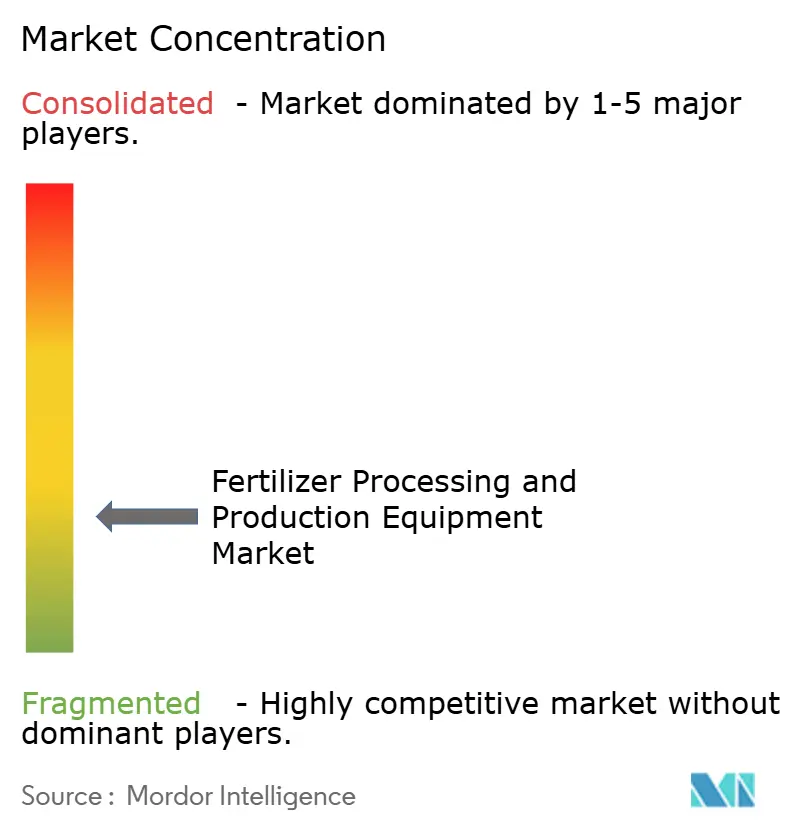
| Market Concentration | Low |
Major Players *Disclaimer: Major Players sorted in no particular order Image © Mordor Intelligence. Reuse requires attribution under CC BY 4.0. | |
Fertilizer Processing and Production Equipment Market Analysis by Mordor Intelligence
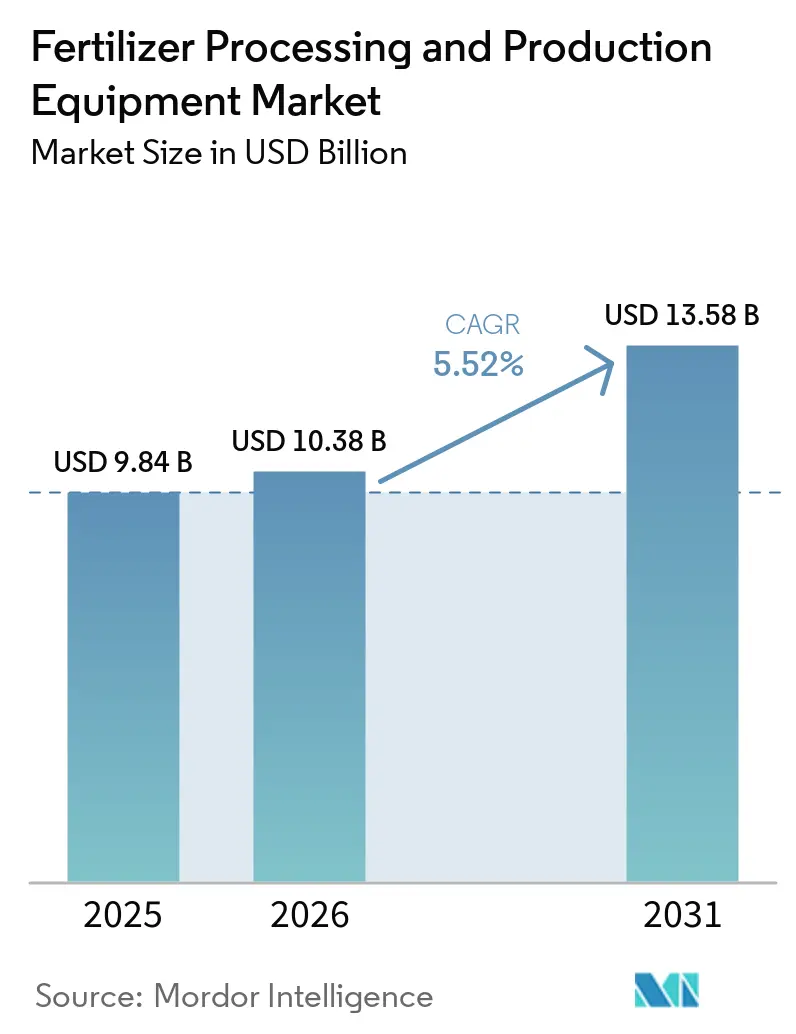
The Fertilizer Processing and Production Equipment Market size is projected to expand from USD 8.63 billion in 2025 and USD 9.06 billion in 2026 to USD 11.85 billion by 2031, a CAGR of 5.52% between 2026 and 2031. New nitrogen capacity, phosphate investments, and lower-carbon production routes are increasing demand for specialized reaction, synthesis, forming, and solidification equipment. India’s National Investment Policy for Urea-2026 supports additional domestic urea capacity and creates a multiyear equipment pipeline for gas-based plants. The fertilizer processing and production equipment market is also being shaped by brownfield upgrades that reduce energy use and extend the working life of existing plants. Equipment suppliers with proprietary technology can benefit from bundled engineering and equipment contracts, while suppliers of conventional mechanical systems face stronger price competition. Feedstock uncertainty and lengthy approvals for process technology can delay final investment decisions and extend procurement schedules.
Key Report Takeaways
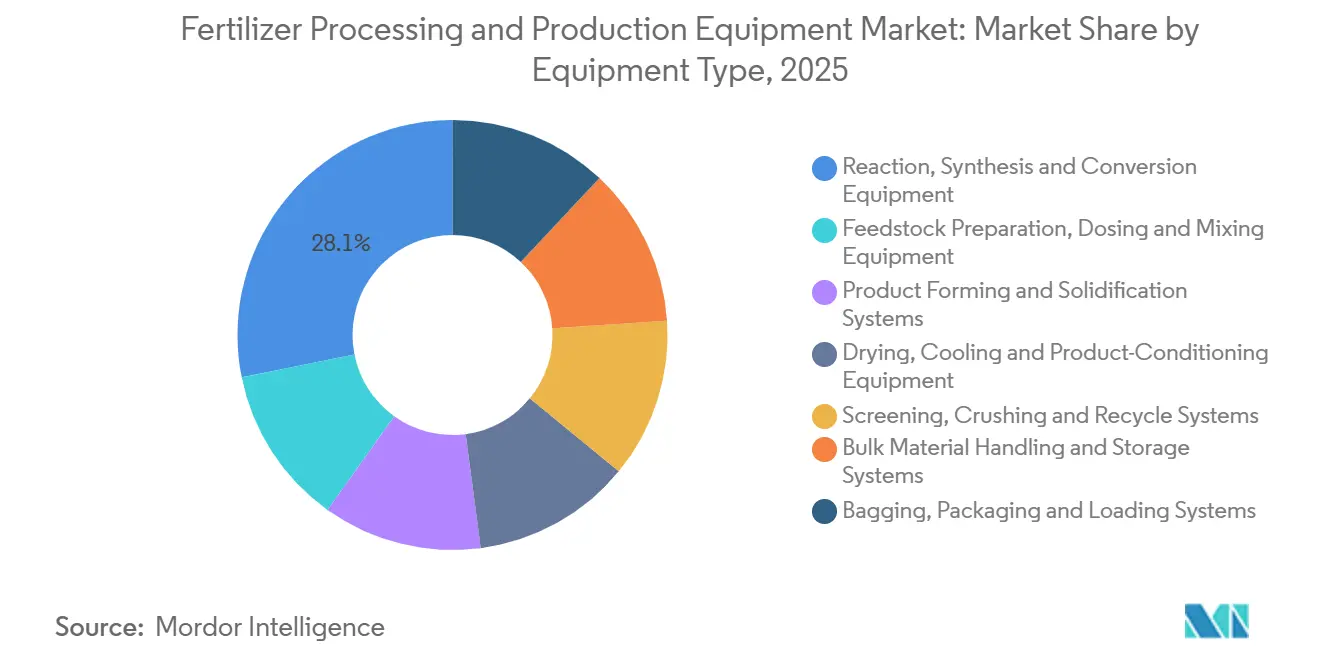
- By equipment type, reaction, synthesis and conversion equipment held 28.14% of the fertilizer processing and production equipment market share in 2025, while product forming and solidification systems are projected to advance at a 6.34% CAGR through 2031.
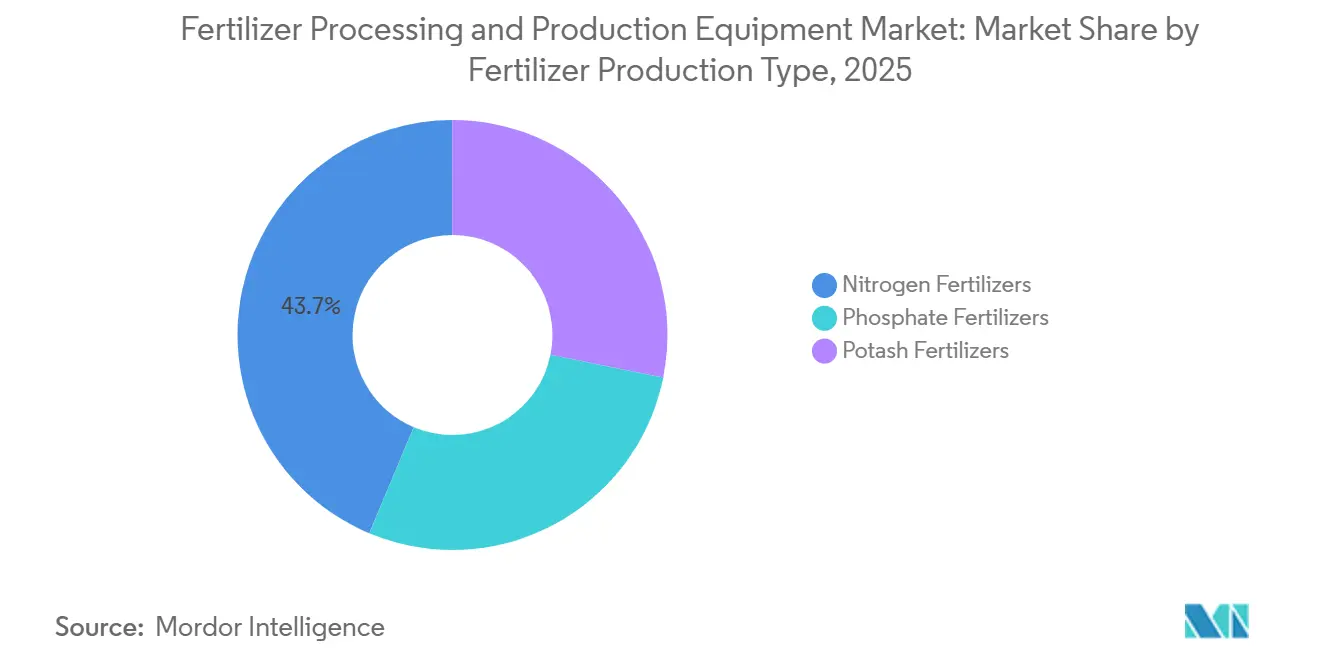
- By fertilizer production type, nitrogen fertilizers held 43.67% of the fertilizer processing and production equipment market share in 2025, while phosphate fertilizers are projected to advance at a 5.98% CAGR through 2031.
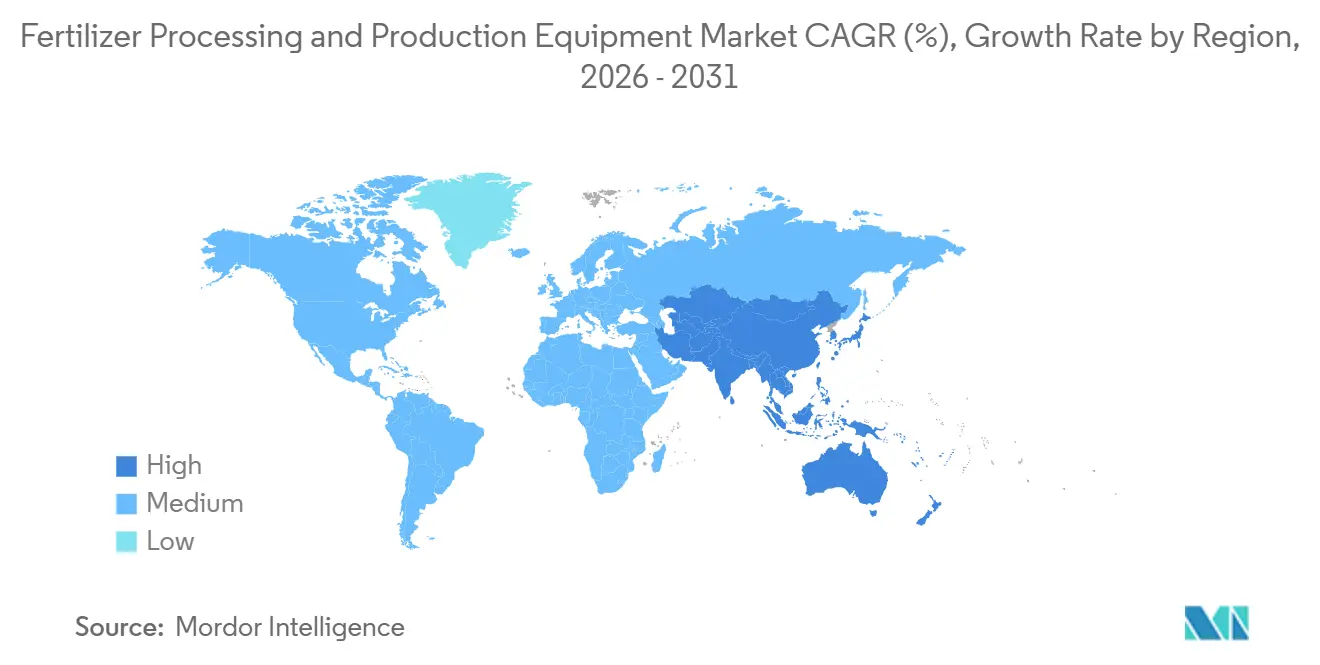
- By geography, Asia-Pacific held 35.06% of the fertilizer processing and production equipment market share in 2025 and is projected to advance at a 6.18% CAGR through 2031.
Note: Market size and forecast figures in this report are generated using Mordor Intelligence’s proprietary estimation framework, updated with the latest available data and insights as of January 2026.
Global Fertilizer Processing and Production Equipment Market Trends and Insights
Drivers Impact Analysis*
| Driver | (~) % Impact on CAGR Forecast | Geographic Relevance | Impact Timeline |
|---|---|---|---|
| Expansion of High-Efficiency Nitrogen Capacity | +1.2% | South Asia core (India), spillover to Southeast Asia, West Africa, and Central America | Medium term (2–4 years) |
| Green Ammonia and Low-Carbon Fertilizer Projects | +1.0% | Global; concentrated in South Asia, Latin America, Middle -East, and Australia | Long term (≥ 4 years) |
| Brownfield Revamps for Energy and Emissions Performance | +0.9% | Global; concentrated in Europe, MENA, and Southeast Asia existing plant base | Short term (≤ 2 years) |
| Rising Demand for Precision Nutrient Formulations | +0.8% | North America and Europe core, spillover to South America and East Asia | Medium term (2–4 years) |
| Automation of Granulation and Quality Control | +0.7% | Global; fastest uptake in China, India, Brazil, and Southeast Asia | Medium term (2–4 years) |
| Modular Plants for Regional Fertilizer Security | +0.5% | Sub-Saharan Africa, ASEAN, Latin America, and Central Asia | Long term (≥ 4 years) |
| Source: Mordor Intelligence | |||
Expansion of High-Efficiency Nitrogen Capacity
India’s National Investment Policy for Urea-2026 targets 10 million metric tons of additional urea capacity through 8–9 gas-based plants. The policy was approved by the Cabinet Committee on Economic Affairs in July 2026 and supports new investment in domestic fertilizer production. Each greenfield unit requires ammonia synthesis, urea conversion, granulation, and product-conditioning systems. This creates demand for reactors, converter cartridges, granulators, and associated controls across the fertilizer processing and production equipment market. The new facilities also create future demand for replacement parts, revamp work, and catalyst supply over their operating lives. Price support and gas-supply measures can reduce project risk and help shorten equipment procurement timelines.
Green Ammonia and Low-Carbon Fertilizer Projects
Green ammonia projects are changing capital requirements in new nitrogen production complexes. Electrolyzers replace steam methane reformers as a central item in the production route, while modular synthesis systems can better suit renewable-power availability. AM Green began construction of a 1.5 million metric ton per year green hydrogen-based ammonia plant in Kakinada, India, in January 2025, with initial production targeted for mid-2027. EIB Global supported a green hydrogen-based fertilizer project in Paraguay with financing of up to USD 95 million in 2026. Smaller, modular synthesis loops can favor suppliers that can provide flexible equipment configurations. This route broadens the fertilizer processing and production equipment market beyond conventional large-scale gas-based projects.
Brownfield Revamps for Energy and Emissions Performance
Brownfield revamps remain an important source of equipment demand where plants need improved energy and emissions performance. PT Pupuk Kalimantan Timur inaugurated its Revamping Ammonia Plant-2 project in January 2026 to replace aging equipment and reduce energy consumption. ThyssenKrupp Uhde and Johnson Matthey completed the modernization of the ammonia converter at İGSAŞ’s Kocaeli plant in June 2026. The project restored 1,200 metric tons per day of nameplate capacity while lowering synthesis loop pressure. Modern converter, catalyst, and heat-integration systems can improve project economics where natural gas costs remain elevated. The fertilizer processing and production equipment market benefits as older plants in Southeast Asia, Turkey, and Egypt seek efficient replacements rather than full plant rebuilds.
Rising Demand for Precision Nutrient Formulations
Precision agriculture is moving demand from standard commodity granules toward controlled-release and micronutrient-blended products. These products require more capable forming, coating, and conditioning equipment. Coromandel International announced an INR 2,000 crore (approximately USD 240 million) investment at its Kakinada facility in 2024, including a 1 million metric ton NPK granulation plant, increasing requirements for granulation and product-conditioning systems. Higher-value formulations can support demand for smaller-batch equipment with closer control of particle size and moisture. Automated quality controls can help producers meet more specific crop and application requirements. This pattern supports product-forming systems across the fertilizer processing and production equipment market, even as conventional commodity lines face different demand conditions.
Restraints Impact Analysis*
| Restraint | (~) % Impact on CAGR Forecast | Geographic Relevance | Impact Timeline |
|---|---|---|---|
| High Energy Intensity of Thermal Processing | -1.2% | Global; most acute in gas-importing regions: South Asia, Southeast Asia, and parts of Europe | Medium term (2–4 years) |
| Feedstock and Project-Finance Volatility | -1.0% | Global; concentration risk in gas-dependent markets: MENA, Central Asia, and Latin America | Short term (≤ 2 years) |
| Long Qualification Cycles for Proprietary Process Equipment | -0.8% | Global; most consequential in first-time markets: Sub-Saharan Africa, Central America, and South Asia new entrants | Long term (≥ 4 years) |
| Dust, Ammonia, and Nitrogen-Oxide Compliance Burden | -0.7% | Europe, North America, and urbanizing APAC production sites (China, India) | Medium term (2–4 years) |
| Source: Mordor Intelligence | |||
High Energy Intensity of Thermal Processing
Ammonia synthesis and thermal drying are energy-intensive parts of fertilizer production. Ammonia plants consumed 32-36 million British thermal units of natural gas per metric ton of product, according to the Food and Agriculture Organization of the United Nations[1]. Higher gas prices can weaken project economics and delay equipment decisions. Rotary dryers and fluidized-bed dryers add to auxiliary energy requirements in urea granulation trains. Suppliers that can document lower energy use can have an advantage when projects are evaluated on lifetime operating costs. MAIRE stated that its NX STAMI Ultra-Low Energy urea design reduced steam consumption by 35% and cooling-water use by 16% compared with conventional processes.
Feedstock and Project-Finance Volatility
Uncertainty in natural gas supply can lengthen financing and procurement cycles for fertilizer projects. Project developers can reconsider equipment scope between front-end engineering design and engineering, procurement, and construction awards. Petrobras approved the resumption of its UFN-III nitrogen plant in Brazil in 2026 after reassessing the project economics across price scenarios. The facility targets 3,600 metric tons per day of urea and represents USD 1 billion of investment. Financing requirements can be particularly difficult in frontier markets where lenders require detailed engineering reviews and strict project conditions. This restraint can affect suppliers that cannot offer long payment terms or vendor-financing support.
*Our forecasts treat driver/restraint impacts as directional, not additive. The impact forecasts reflect baseline growth, mix effects, and variable interactions.
Segment Analysis
By Equipment Type: Reaction, Synthesis and Conversion Equipment Commands Share, While Product Forming and Solidification Systems Surge
The reaction, synthesis and conversion equipment held 28.14% of the fertilizer processing and production equipment market share in 2025 because ammonia converters, reformers, and urea reactors are high-value plant items. These systems form the core of nitrogen production and require specialized process technology. Product forming and solidification systems are projected to advance at a 6.34% CAGR through 2031 as producers seek controlled-release and dust-resistant products. This equipment supports pastillation, fluid-bed granulation, and other methods that produce more consistent granules. IPCO AB introduced the Rotoform XG high-capacity pastillation system in 2026, with a throughput of up to 10 metric tons per hour. The system was designed to handle low-viscosity melts with solid particles, including sulfur bentonite and urea mixes.
Stamicarbon’s urea granulation technology has been used in plants with capacities from 2,000 metric tons per day to more than 3,000 metric tons per day. MAIRE received a EUR 485 million contract in 2026 for technology licensing, process design packages, and proprietary equipment at three fertilizer complexes in West Africa. Feedstock preparation, dosing and mixing equipment and drying, cooling and product-conditioning equipment support flexible processing needs at many facilities. Screening, crushing and recycle systems become more important as integrated complexes increase recycle-loop capacity. Bulk material handling and storage systems serve the movement and storage needs of large plants. Bagging, packaging and loading systems benefit where farmers buy fertilizer in smaller retail bags rather than bulk volumes.

By Fertilizer Production Type: Nitrogen Fertilizers Anchor Demand, Phosphate Fertilizers Accelerate
Nitrogen fertilizers held 43.67% of the fertilizer processing and production equipment market share in 2025. Ammonia is a basic building block for nitrogen fertilizers, and ongoing urea capacity additions support demand for synthesis and granulation equipment. Phosphate fertilizers are projected to advance at a 5.98% CAGR through 2031. Saudi Arabian Mining Company, known as Ma’aden, signed USD 922 million in construction contracts for its third phosphate fertilizer plant in January 2025. The project is intended to add 3 million metric tons per year of phosphate production capacity in phases. This activity increases potential orders for acid-section and granulation equipment.
Indorama Corporation signed a USD 525 million agreement in 2026 to develop a phosphate fertilizer and chemicals complex in Egypt with Misr Phosphate. Daewoo Engineering & Construction signed a USD 784 million contract in 2025 for a mineral fertilizer facility in Turkmenabat, Turkmenistan. Casale provided a Process Design Package for granular single superphosphate and ammonium sulfate facilities at the same location. These projects support demand for dedicated phosphate processing systems in several regions. Potash fertilizers require a different equipment mix because production is primarily linked to mining and beneficiation. Demand in this category centers on compaction, evaporation, and crystallization equipment rather than ammonia synthesis systems.
Geography Analysis
Asia-Pacific held 35.06% of the fertilizer processing and production equipment market share in 2026 and is projected to advance at a 6.18% CAGR through 2031. India’s urea investment policy supports gas-based capacity additions and related fertilizer processing and production equipment market demand. China’s modernization program continues to support demand for higher-efficiency equipment. MAIRE received a contract in 2025 for technology and proprietary equipment for a 2,700 metric ton per day urea plant in Eastern China. Indonesia is also investing in plant upgrades, while the Philippines has examined domestic urea production. These developments reinforce Asia-Pacific’s broad base of both brownfield and greenfield activity.
North America and Europe have a meaningful share of fertilizer processing and production equipment market demand for revamps, technology licensing, and low-carbon integration. Mexico’s Fermaca began construction of a USD 1.5 billion nitrogen fertilizer complex in 2026 using KBR ammonia technology and Stamicarbon urea granulation technology. The project combines conventional processing technology with carbon capture and treated-water systems. In Turkey, thyssenkrupp Uhde and Johnson Matthey completed modernization of the İGSAŞ ammonia converter in 2026[2]. The work showed why mid-life plants can favor converter replacement over full replacement. European green ammonia opportunities are also moving from early planning into engineering work.
South America, and Middle-East and Africa are expanding as destinations for greenfield fertilizer processing and production equipment market orders. Pampa Energía approved a USD 2.7 billion urea complex at Bahía Blanca, Argentina, in 2026, with Tecnimont providing engineering, Stamicarbon supplying urea technology, and KBR supplying ammonia technology. The fertilizer processing and production equipment market in these regions also benefits from projects in Paraguay, Nigeria, and Saudi Arabia. New facilities create demand across reaction equipment, granulation lines, storage systems, and loading infrastructure. Suppliers that provide linked technology and services can address more of the project scope. SABIC Agri-Nutrients received approval in 2026 for a seventh plant at Jubail Industrial City with 1.2 million metric tons per year of ammonia capacity and 2.6 million metric tons per year of urea capacity. MAIRE’s West Africa contract covers six urea granulation units across three complexes.
Competitive Landscape
The fertilizer processing and production equipment market is highly fragmented. KBR, Stamicarbon, Casale, and thyssenkrupp Uhde influence the specification of ammonia and urea process technology. Their process design packages frequently include proprietary equipment and internal components. This model gives licensors influence over major reaction and synthesis equipment orders in the fertilizer processing and production equipment market. MAIRE’s West Africa award covered licensing, process design packages, and critical proprietary equipment across three complexes. The same structure can limit the addressable scope available to independent suppliers of process-critical equipment.
Regional manufacturers supply granulators, dryers, conveyors, storage systems, and packaging equipment. This provides buyers with more supplier choice for equipment outside proprietary synthesis loops. It also creates price pressure for suppliers of standard mechanical products. Modular green ammonia systems are creating another competitive route for providers that can supply smaller, flexible plant designs. Topsoe’s ModuLite platform was designed for smaller units that can be used at distributed and renewable-powered locations.
Compliance requirements for dust, ammonia, and nitrogen oxide emissions are increasing demand for scrubbers and closed-loop granulation systems. Suppliers with established compliance records can command higher prices where operators need to meet tighter operating standards. Equipment suppliers are also developing digital monitoring tools for aging synthesis plants. These tools can support maintenance planning and plant availability without changing the core process technology. The fertilizer processing and production equipment market gives technology licensors a route to extend their role from initial design into plant performance services. The same demand creates opportunities for automation suppliers with credible process engineering capabilities. MAIRE’s low-energy urea technology demonstrates how energy performance can become a key competitive factor. The competitive structure, therefore, differs by equipment category, with technology control strongest in reaction systems and competition broader in downstream machinery.
Fertilizer Processing and Production Equipment Industry Leaders
-
thyssenkrupp Uhde GmbH
-
Casale SA
-
Stamicarbon
-
KBR Inc.
-
Toyo Engineering Corporation
- *Disclaimer: Major Players sorted in no particular order
Recent Industry Developments
- July 2026: Pampa Energía approved a USD 2.7 billion investment for a large fertilizer complex in Bahía Blanca, Argentina, with MAIRE subsidiary Tecnimont handling engineering and construction, Stamicarbon providing urea technology, and KBR supplying ammonia technology. The project is expected to generate demand for fertilizer processing and production equipment, including ammonia synthesis, urea production, material handling, granulation, and related process systems.
- June 2026: ThyssenKrupp Uhde and Johnson Matthey completed the modernization of İGSAŞ’s ammonia converter in Kocaeli, Türkiye, restoring 1,200 metric tons per day of nameplate capacity while increasing production by 13%, reducing synthesis-loop pressure by 7%, and lowering pressure drop by 70%. The upgrade demonstrates demand for ammonia synthesis and process equipment modernization, supporting investment in high-efficiency fertilizer production equipment.
Global Fertilizer Processing and Production Equipment Market Report Scope
Fertilizer processing and production equipment comprises industrial machinery used to convert raw materials into finished fertilizer products through processes such as reaction, mixing, granulation, drying, cooling, screening, and packaging. These systems support efficient fertilizer manufacturing, product consistency, material handling, and large-scale production across major fertilizer types.
The Fertilizer Processing and Production Equipment Market is segmented by equipment type, fertilizer production type, and geography. By equipment type, the market is segmented into reaction, synthesis and conversion equipment, feedstock preparation, dosing and mixing equipment, product forming and solidification systems, drying, cooling and product-conditioning equipment, screening, crushing and recycle systems, bulk material handling and storage systems, and bagging, packaging and loading systems. By fertilizer production type, the market is segmented into nitrogen fertilizers, phosphate fertilizers, and potash fertilizers. The report also covers the market size and forecasts for fertilizer processing and production equipment in 15 countries across major regions. For each segment, the market sizing and forecasts have been done on the basis of value (USD).
| Reaction, Synthesis and Conversion Equipment |
| Feedstock Preparation, Dosing and Mixing Equipment |
| Product Forming and Solidification Systems |
| Drying, Cooling and Product-Conditioning Equipment |
| Screening, Crushing and Recycle Systems |
| Bulk Material Handling and Storage Systems |
| Bagging, Packaging and Loading Systems |
| Nitrogen Fertilizers |
| Phosphate Fertilizers |
| Potash Fertilizers |
| Asia-Pacific | China |
| India | |
| Japan | |
| South Korea | |
| ASEAN Countries | |
| Rest of Asia-Pacific | |
| North America | United States |
| Canada | |
| Mexico | |
| Europe | Germany |
| United Kingdom | |
| France | |
| Italy | |
| NORDIC Countries | |
| Rest of Europe | |
| South America | Brazil |
| Argentina | |
| Rest of South America | |
| Middle-East and Africa | Saudi Arabia |
| South Africa | |
| Rest of Middle-East and Africa |
| By Equipment Type | Reaction, Synthesis and Conversion Equipment | |
| Feedstock Preparation, Dosing and Mixing Equipment | ||
| Product Forming and Solidification Systems | ||
| Drying, Cooling and Product-Conditioning Equipment | ||
| Screening, Crushing and Recycle Systems | ||
| Bulk Material Handling and Storage Systems | ||
| Bagging, Packaging and Loading Systems | ||
| By Fertilizer Production Type | Nitrogen Fertilizers | |
| Phosphate Fertilizers | ||
| Potash Fertilizers | ||
| By Geography | Asia-Pacific | China |
| India | ||
| Japan | ||
| South Korea | ||
| ASEAN Countries | ||
| Rest of Asia-Pacific | ||
| North America | United States | |
| Canada | ||
| Mexico | ||
| Europe | Germany | |
| United Kingdom | ||
| France | ||
| Italy | ||
| NORDIC Countries | ||
| Rest of Europe | ||
| South America | Brazil | |
| Argentina | ||
| Rest of South America | ||
| Middle-East and Africa | Saudi Arabia | |
| South Africa | ||
| Rest of Middle-East and Africa | ||
Key Questions Answered in the Report
What is the size of the fertilizer processing and production equipment market?
The Fertilizer Processing and Production Equipment Market size is projected to expand from USD 8.63 billion in 2025 and USD 9.06 billion in 2026 to USD 11.85 billion by 2031, a CAGR of 5.52% between 2026 and 2031.
What is driving equipment demand in fertilizer production?
New nitrogen capacity, phosphate projects, plant upgrades, and lower-carbon ammonia projects are supporting the fertilizer processing and production equipment market.
Which equipment type held the largest share in 2025?
The reaction, synthesis and conversion equipment held 28.14% of the fertilizer processing and production equipment market share in 2025.
Which equipment category is expected to grow fastest through 2031?
Product forming and solidification systems are projected to advance at a 6.34% CAGR through 2031.