
Feeding Systems Market Size and Share
Market Overview
| Study Period | 2021 - 2031 |
|---|---|
| Market Size (2026) | USD 11.11 Billion |
| Market Size (2031) | USD 15.14 Billion |
| Growth Rate (2026 - 2032) | 6.39 % |
| Fastest Growing Market | Asia-Pacific |
| Largest Market | Europe |
| Market Concentration | Medium |
Major Players *Disclaimer: Major Players sorted in no particular order Image © Mordor Intelligence. Reuse requires attribution under CC BY 4.0. | |
Feeding Systems Market Analysis by Mordor Intelligence
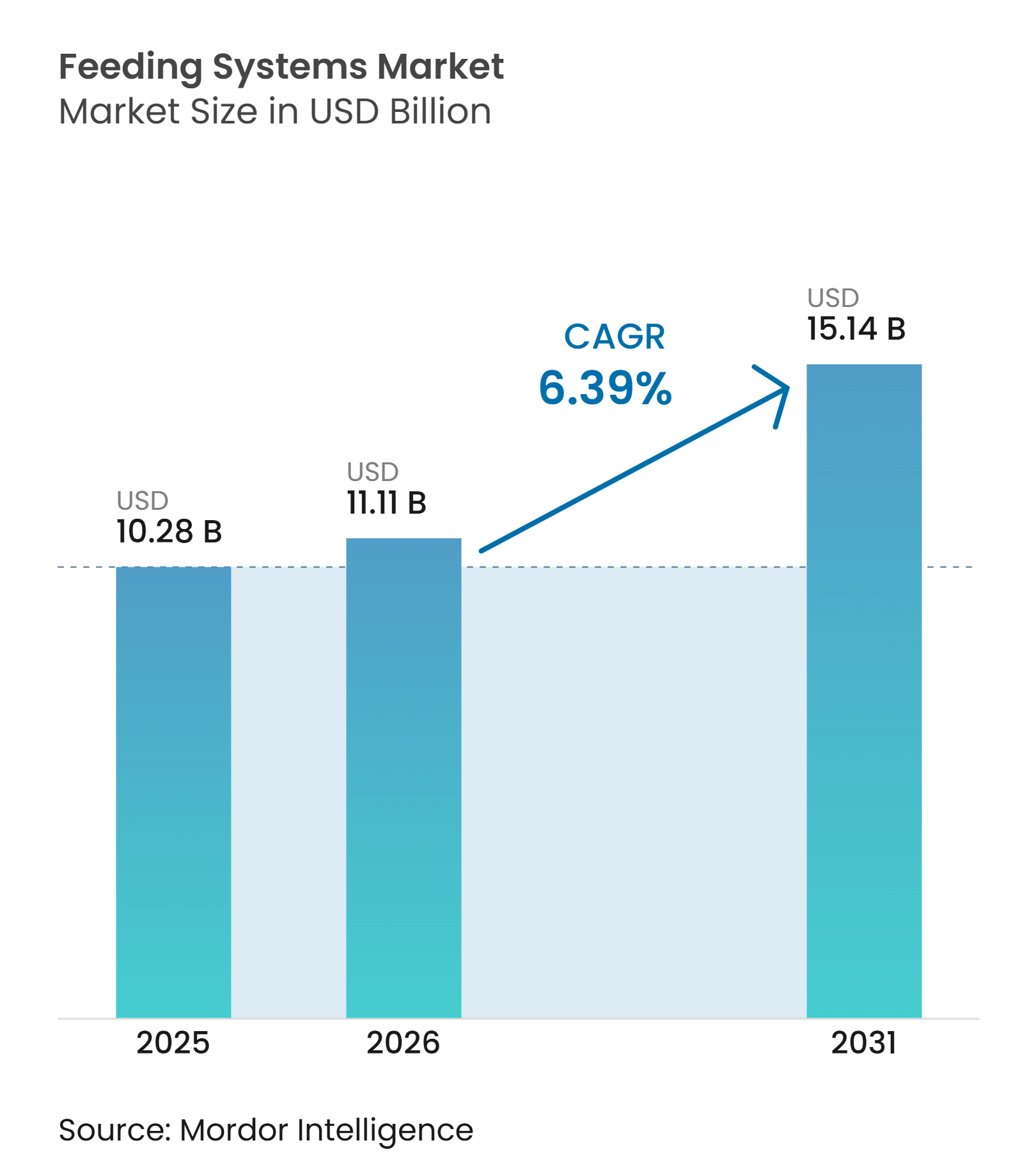
The feeding systems market is estimated to grow from USD 10.28 billion in 2025 and USD 11.11 billion in 2026, to reach USD 15.14 billion by 2031, at an estimated CAGR of 6.39% from 2026 to 2031. This growth is supported by the increasing size and commercialization of livestock farms, which is creating a greater need for reliable and efficient feed handling and delivery equipment. As farm operations expand, labor shortages are encouraging producers to adopt automated feeding systems across dairy, poultry, swine, and beef operations to reduce manual work and maintain consistent feeding schedules. In response, equipment suppliers are increasingly focusing on robotics, connected controls, and precision rationing technologies, helping farmers improve feeding accuracy while monitoring feed use and operating performance. At the same time, suppliers have an opportunity to offer modular and scalable systems that can be integrated into existing farm infrastructure, allowing producers to introduce automation without undertaking a complete barn redesign. The growing focus on sustainability is also supporting adoption, as systems that track feed consumption, conversion ratios, and feeding frequency can help farms identify waste and improve resource utilization.
Key Report Takeaways
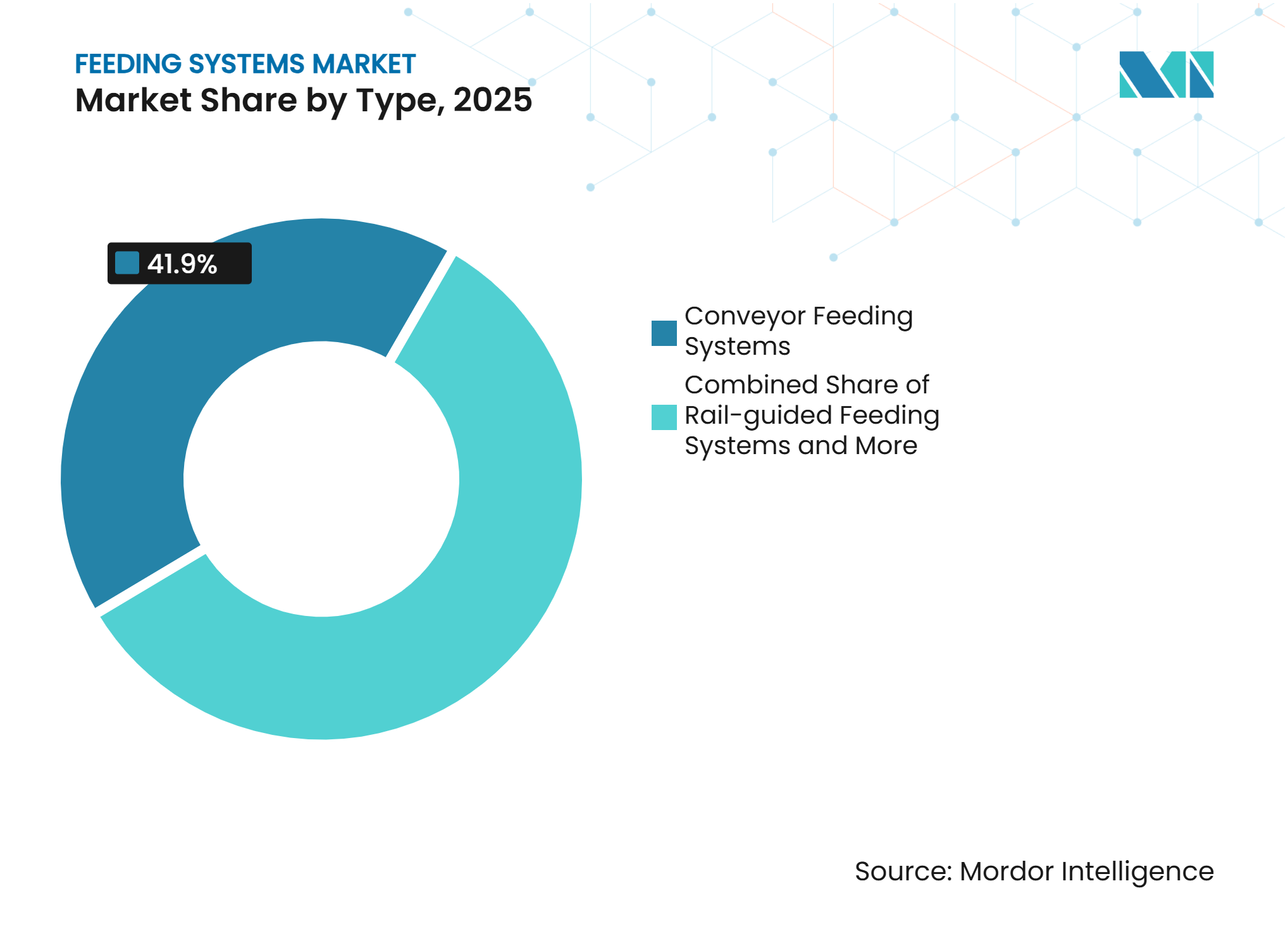
- By type, conveyor feeding systems held 41.9% of the feeding systems market share in 2025, while self-propelled feeding systems are projected to grow at the fastest CAGR of 7.8% from 2026 to 2031.
- By livestock, ruminants held 45.9% of the feeding systems market share in 2025, while poultry is projected to grow at the fastest CAGR of 8.2% from 2026 to 2031.
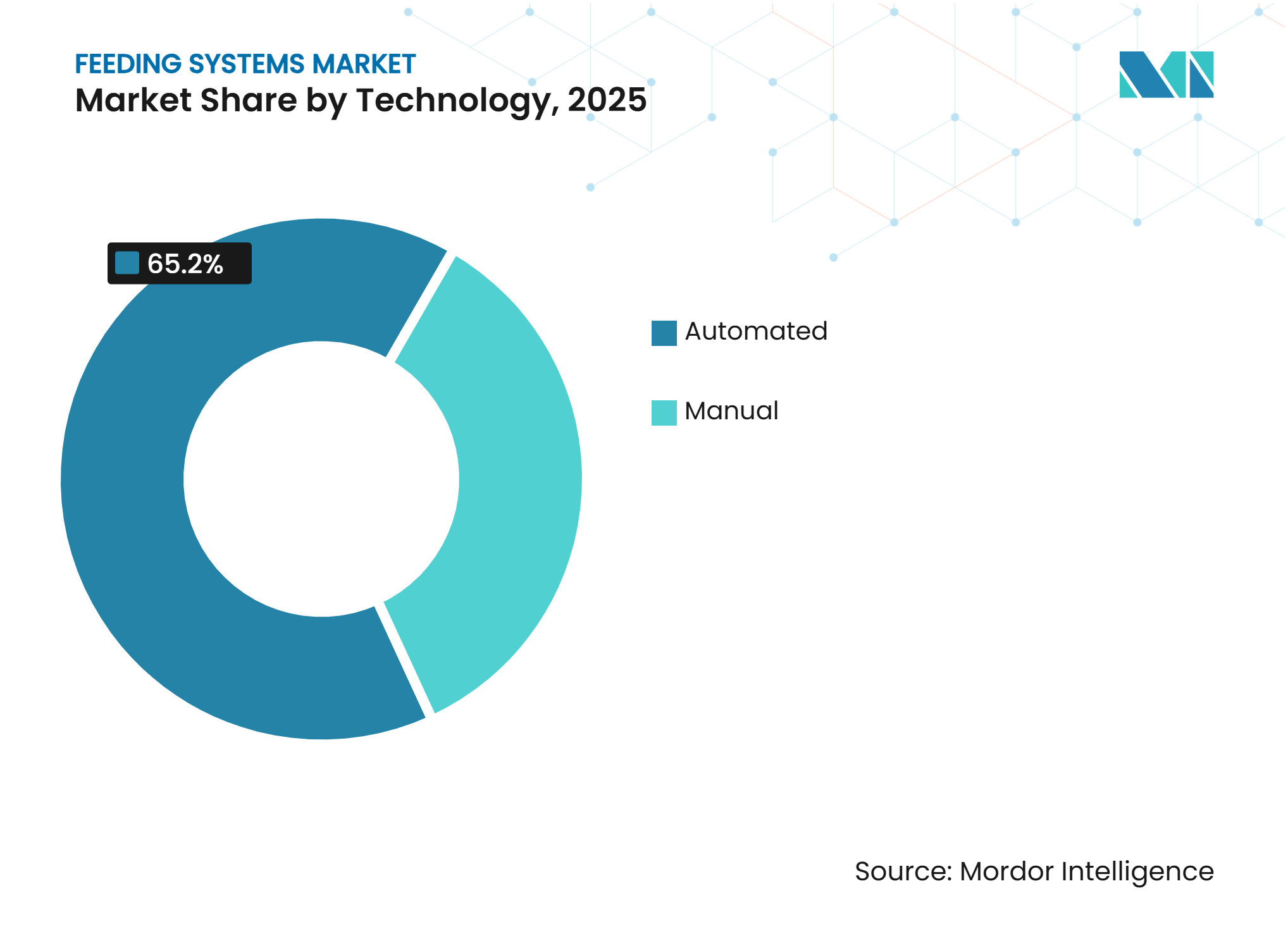
- By technology, automated feeding systems held 65.2% of the feeding systems market size in 2025 and is projected to grow at the fastest CAGR of 7.4% from 2026 to 2031.
- By function, controlling systems accounted for 38.8% of the automated feeding systems market share in 2025, while mixing systems are projected to grow at the fastest CAGR of 7.9% from 2026 to 2031.
- By geography, Europe accounted for 32.9% of the feeding systems market share in 2025, while Asia-Pacific is projected to grow at the fastest CAGR of 8.1% through 2031.
Note: Market size and forecast figures in this report are generated using Mordor Intelligence’s proprietary estimation framework, updated with the latest available data and insights as of January 2026.
Market Trends and Insights
Drivers Impact Analysis of Feeding Systems Market*
| Driver | (~) % Impact on CAGR Forecast | Geographic Relevance | Impact Timeline |
|---|---|---|---|
| Rising livestock production and farm commercialization | +1.50% | Global, highest impact in China, India, Brazil, and Sub-Saharan Africa | Long term (≥ 4 years) |
| Labor shortages and rising farm labor costs | +1.20% | North America, Europe, Japan, Australia, and East Asia | Short term (≤ 2 years) |
| Precision feeding for better feed conversion | +1.00% | Global, led by the United States, Netherlands, China, and Brazil | Medium term (2-4 years) |
| IoT, robotics, and AI integration | +0.80% | North America, Europe, and developed Asia-Pacific markets | Long term (≥ 4 years) |
| Modular retrofit demand from mid-sized farms | +0.70% | Asia-Pacific, South America, Eastern Europe, Middle East, and Africa | Medium term (2-4 years) |
| Carbon-intensity monitoring for livestock production | +0.50% | European Union markets, North America, and New Zealand | Long term (≥ 4 years) |
| Source: Mordor Intelligence | |||
Rising Livestock Production and Farm Commercialization
Commercial livestock expansion is a central source of demand for feeding equipment. Dairy, poultry, swine, and beef farms need more repeatable feed delivery as they move beyond family-scale operations. Manual processes become harder to manage when animal numbers, feeding groups, and daily ration volumes increase. Brazil illustrates this change because chicken meat production is projected to reach 15.8 million tonnes in 2026, while chicken export revenue reached USD 9.8 billion in 2025. A dairy farm with 1,000 cows requires a different feeding layout from a 500-cow operation because feed logistics rise faster than headcount alone[1]. China and India are commercializing ruminant, poultry, and swine production at the same time, which supports new installation and replacement demand. Conveyor, rail-guided, and self-propelled systems can help larger farms maintain feed delivery across several animal groups. This expansion supports the feeding systems market because equipment becomes part of daily production capacity rather than an optional upgrade.
Labor Shortages and Rising Farm Labor Costs
Farm labor constraints are encouraging livestock operators to assess automation more seriously. The European Union lost the equivalent of 3.0 million full-time agricultural workers over the 2010–2025 period, according to the Statistical Office of the European Union. Meanwhile, agricultural wages in the United States rose faster than general inflation during the 2019–2024 period. Automated feeding can reduce the time required for repeated feed preparation and delivery. In 2025, a study by the Department of Animal Science, University of Minnesota, found that herds using automated feeding robots received feed 10.7 times per day, compared with 1–2 times for conventional systems, and recorded 33% lower daily dry-matter variation in feed bunks for automated robot herds. A 2026 field report from Politecnico di Milano found that automation let 2-person Italian dairy teams shift feeding work toward animal health and reproductive management[2]. Japan faces a similar need because an aging rural workforce has not been replaced at the required rate. The feeding systems market benefits when operators view labor savings as necessary to maintain farm operations.
Precision Feeding for Better Feed Conversion
Precision feeding is becoming more important in commercial livestock operations. It uses calibrated rations and feeding schedules for individual animals or defined groups. Feed is the highest operating cost for many livestock farms, so even a small improvement in feed conversion can matter at scale. Sensor-based research published in 2026 found that near-infrared spectroscopy and connected platforms can adjust rations using forage moisture and nutrient data[3]. This can reduce the difference between the ration that is formulated and the ration that reaches the feed bunk. The same equipment can create detailed records that support breeding, health monitoring, and carbon accounting. The Netherlands has a high concentration of commercial precision feeding installations, supported in part by nitrogen-use efficiency requirements. These conditions support the feeding systems market by extending the value of equipment beyond feed handling alone.
Internet of Things, Robotics, and Artificial Intelligence Integration in Feeding Equipment
Connected sensors, robotics, and artificial intelligence are changing the role of feeding equipment on livestock farms. These systems can reduce labor for each feeding cycle while generating data for farm-management decisions. Adaptive controls can use pen occupancy, sorting patterns, milking visits, and other animal-behavior data to adjust feed timing and quantities. A 2026 study published by npj Veterinary Sciences found that animal digital twins can integrate feed composition, intake patterns, body weight, sensor observations, and farm records to identify nutritional imbalances and monitor methane-intensity risks before production losses increase[4]. The research describes digital twins as continuously updated representations that connect biological, behavioral, environmental, and management data to assess animal-level and farm-level outcomes. The near-term application of these tools is likely to be strongest in decision support rather than fully autonomous control. Proprietary control systems can make integration difficult when farms use equipment from several suppliers, raising the value of interoperable platforms and creating adoption barriers for farms that need to connect older feeding, milking, and animal-monitoring infrastructure
Restraints Impact Analysis of Feeding Systems Market*
| Restraint | (~) % Impact on CAGR Forecast | Geographic Relevance | Impact Timeline |
|---|---|---|---|
| High upfront equipment and installation costs | -1.90% | Global, most acute in India, Sub-Saharan Africa, Brazil, and moderate in the United States | Short term (≤ 2 years) |
| Infrastructure integration and interoperability constraints | -1.10% | United States, Germany, China, Brazil, Asia-Pacific, Middle East, and Africa | Medium term (2-4 years) |
| Limited financing and technical support for small farms | -0.90% | India, Nigeria, Brazil, Mexico, Asia-Pacific, Middle East, and Africa | Long term (≥ 4 years) |
| Forage variability and sensor calibration risk | -0.40% | United States, Canada, France, Brazil, and temperate production regions | Medium term (2-4 years) |
| Source: Mordor Intelligence | |||
High Upfront Equipment and Installation Costs
Advanced feeding systems can require robotic units, conveyors, silos, electronic controls, civil work, and commissioning. These requirements make the initial investment difficult for many farm operators to fund. Full-system installations for commercial dairy farms can exceed USD 500,000. Feed costs can represent 60-70% of livestock operating expenses when commodity prices are volatile, which can make capital decisions more cautious. High project costs can concentrate purchasing among the largest farms. This can encourage suppliers to focus designs on large herds and leave mid-sized farms with fewer suitable options. Currency depreciation and limited local financing add to the cost of imported equipment in South Asia and Sub-Saharan Africa. These barriers can slow adoption in the feeding systems market even where labor and production needs favor automation.
Infrastructure Integration and Interoperability Constraints
Older barns and established equipment can make new automation projects difficult to install. Farms may need to connect feeding systems with parlor controls, robotic milking units, climate controls, sensor networks, and existing electrical systems. Germany and China have high baseline mechanization, which can increase the integration burden for farms that already use several technologies. Poor communication between systems can reduce ration accuracy and delay operational alerts. Feeding software from different suppliers may also use incompatible data formats. This limits the ability to create a single management view across farm activities. Open connected-device protocols could reduce these constraints, but proprietary data platforms remain commercially attractive to equipment suppliers. The restraint can delay feeding systems market purchases when the value of a new system depends on connecting it with older assets.
*Our forecasts treat driver/restraint impacts as directional, not additive. The impact forecasts reflect baseline growth, mix effects, and variable interactions.
Feeding Systems Market Segment Analysis
By Type:
Conveyor Systems Lead Installed Demand and Self-Propelled Systems Grow FastestConveyor feeding systems held 41.9% of the feeding systems market size in 2025, making them the largest type category. Their installed base is strongest in large dairy and swine operations with fixed barn layouts. Rail-guided feeding systems followed conveyors among the named system types. Conveyors suit high-throughput feeding across several groups of animals. Farms with more than 500 head can use their continuous delivery capacity to manage large daily feed volumes. Their operating life can extend for 15-20 years with routine maintenance. This long life supports ongoing demand for chains, controls, sensors, and replacement parts. Rail-guided systems remain relevant in purpose-built dairy facilities where repeatability and parlor integration justify higher civil engineering costs.
Self-propelled feeding systems are forecast to grow at a 7.8% CAGR from 2026 to 2031, making them the fastest-growing category among the stated feeding system types. Their growth is supported by increasing adoption among mid-sized farms seeking to move beyond conventional tractor- and mixer-wagon-based feeding practices. Because these systems do not require embedded tracks or extensive barn modifications, they are well suited to modular retrofit projects, allowing farms to introduce automation with fewer infrastructure changes. Supporting this trend, Trioliet B.V. introduced the Triomatic WP 2 600 at EuroTier 2024, designed for farms with 600–800 livestock units, with the system scalable to four robots serving up to 2,500 livestock units. The productivity benefits of automated feeding further strengthen the adoption case, with farms using robotic feeding systems. These benefits, combined with easier installation and scalability, are estimated to support continued adoption of self-propelled feeding systems as mid-sized livestock farms increasingly transition toward automated and precision feeding.



By Livestock:
Ruminants Hold the Largest Share and Poultry Records the Highest GrowthRuminants accounted for 45.9% of the feeding systems market share in 2025, the largest share among livestock categories. Dairy and beef farms need substantial infrastructure for mixing, distribution, and feed pushing. Dairy farms form the main installed base for automated mixing and rail distribution equipment. Feeding frequency and ration consistency have a direct role in daily dairy operations. Europe, North America, and South America have dense cattle production that supports this position. Swine is another established category within the feeding systems market. Electronic sow feeding and phase-specific delivery have been used in swine facilities for longer than in poultry. These farms are generating replacement and upgrade demand as they adopt digital herd management platforms.
Poultry is estimated to expand at an 8.2% CAGR from 2026 to 2031, the fastest disclosed growth rate across livestock categories. Broiler and layer farms are becoming more industrialized in Asia-Pacific, South America, and parts of Sub-Saharan Africa. China, India, Thailand, and Vietnam are shifting from backyard poultry production toward larger integrated operations. This transition supports first-time purchases of pan feeders, chain conveyors, and volumetric distribution systems. Big Dutchman AG introduced the upgraded iDOL 29 feed sensor for broiler pan feeding systems in 2026. It supports contactless configuration through a smartphone. The Others category includes aquaculture, horses, and sheep, where producers are applying precision feeding methods developed in dairy operations.
By Technology:
Automated Systems Maintain a Clear Revenue LeadAutomated feeding systems accounted for 65.2% of the feeding systems market in 2025, making them the dominant technology category. Their strong market position is supported by a broad range of solutions, from semi-automatic conveyor systems with electronic controls to fully autonomous robotic units, allowing farms to select equipment according to their automation requirements and investment capacity. Costs can range from around USD 15,000 for entry-level modular units to more than USD 500,000 for integrated full-barn robotic systems. Product innovation is further supporting adoption, with Lely introducing the Vector MFR Next in March 2025, which increased feed-loading capacity and enabled simultaneous loading of two robots. These developments are estimated to strengthen demand for automated systems as livestock farms increasingly seek scalable solutions that improve feeding efficiency while reducing manual intervention.
Automated feeding systems are projected to grow at the fastest CAGR of 7.4% from 2026 to 2031, supported by rising labor costs and the increasing need for consistent feeding and real-time farm data. Their adoption is estimated to expand as livestock farms seek to reduce manual intervention, improve feeding accuracy, and optimize feed utilization. Greater availability of scalable technologies, improved financing options, and expanding technical support are also expected to encourage adoption, particularly among mid-sized and large commercial farms transitioning from conventional feeding practices. Manual Feeding Systems remain relevant where investment budgets are limited. They also remain important where barn layouts cannot support automated hardware.

By Function:
Controlling System Support Throughput While Mixing, Filling and Screening Gain ImportanceControlling systems accounted for 38.8% of the automated feeding systems market in 2025, making them the leading functional category. Their dominance is supported by the growing use of electronic monitoring and software-based controls to manage feeding schedules, track feed consumption, and maintain consistent ration delivery. As farms become more automated, controlling systems also provide data that can help producers monitor feeding performance and identify operational inefficiencies.
Mixing systems are projected to grow at the fastest CAGR of 7.9% from 2026 to 2031, supported by the increasing need for accurate and consistent ration preparation as livestock farms expand. Modern mixing equipment integrates weighing and load-cell technologies to improve ingredient measurement and achieve more uniform feed batches. Trioliet B.V.'s introduction of its Double Ended Differential Beam load-cell system in July 2026 reflects this shift toward greater weighing precision in mixer-feeders. Its five-point weighing arrangement is designed to compensate for dynamic mixing loads and improve weight registration, supporting more accurate ration preparation. As producers increasingly prioritize feed consistency, reduced formulation errors, and efficient use of ingredients, mixing systems are expected to gain adoption across commercial livestock operations.
Geography Analysis
Europe held the largest share of the feeding systems market, accounting for 32.9% in 2025. Strong demand is supported by the region’s established commercial dairy, beef, and swine farming sectors, particularly across Germany, France, the Netherlands, and Denmark. The region’s mature livestock industry and established equipment base are also supporting continued investment in automated feeding technologies as producers seek to improve feeding consistency, labor efficiency, and operational control.
Asia-Pacific is projected to record the fastest growth, expanding at a 9.3% CAGR from 2026 to 2031. The region’s growth is being driven by the increasing commercialization and modernization of livestock farming, particularly in China, India, and Southeast Asia. The expansion of larger and more integrated livestock operations is encouraging investments in automated feeding equipment, while labor constraints and the need for consistent feed delivery are further supporting adoption.
Across other regions, demand is also being supported by the gradual transition from conventional feeding practices toward automated and precision-based systems. Growing farm sizes, increasing labor requirements, and the need to improve feed utilization are encouraging producers to modernize feeding operations. However, adoption varies by market depending on farm scale, infrastructure availability, investment capacity, and access to technical support, creating opportunities for suppliers offering scalable and adaptable feeding solutions.
Competitive Landscape
Market Concentration
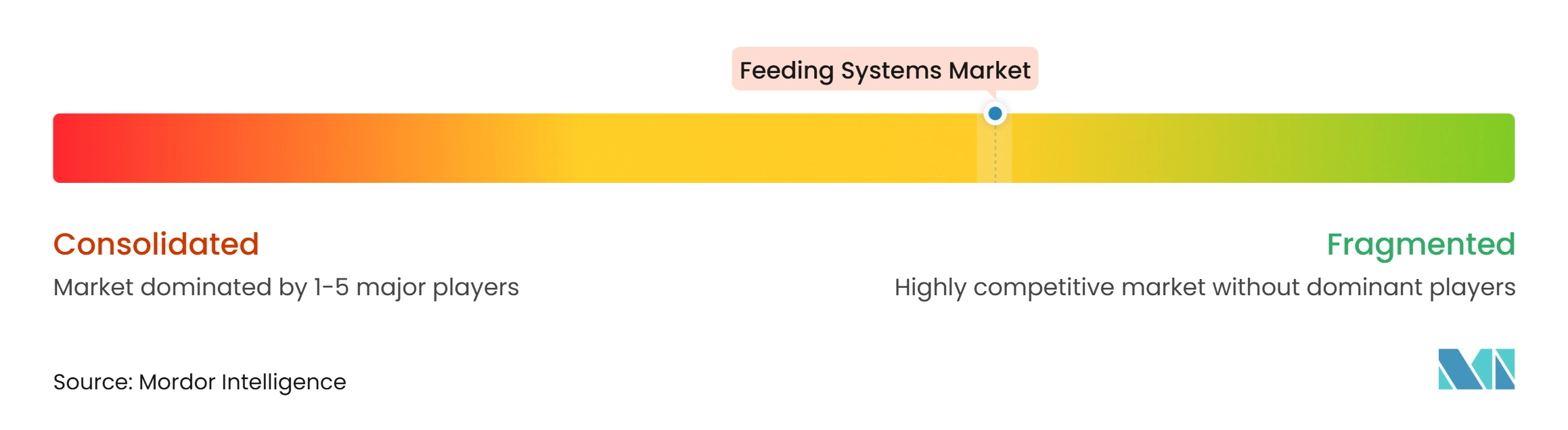
The feeding systems market is moderately fragmented, with the five largest manufacturers collectively accounting for a significant share of the market in 2025. GEA Group Aktiengesellschaft held a leading position through its Farm Technologies division. Tetra Laval Group maintains a strong presence through its DeLaval product portfolio, while Lely is another prominent supplier of automated feeding solutions. The remaining market is served by regional suppliers and livestock-specific manufacturers, including Rovibec Agrisolutions, which operates in North American dairy, BouMatic, which serves robotic dairy operations in Europe and North America, and Valmetal, which supplies mechanical and semi-automated conveyor systems.
Large suppliers are strengthening technology positions rather than focusing only on geographic expansion. Trioliet B.V. introduced the Triomatic WP 2 600 in 2024 and the Double Ended Differential Beam weighing system in 2026. Lely launched the Vector MFR Next in March 2025 with 35% more feed loading capacity. Big Dutchman AG and Schauer Agrotronic GmbH focus on poultry and swine automation. Species-specific controls and biosecurity-compatible materials create a differentiated position in these applications. These strategies reflect demand for more accurate feeding and lower daily labor needs.
Modular retrofit systems below USD 25,000 remain a clear opening for farms with 60-100 head. Aquaculture integration also remains relevant within the Others livestock category. Artificial intelligence-enabled controlling systems can create documented feeding logs across varied barn designs. Patents for connected livestock feeding systems in China in 2025 and 2026 indicate continued interest in sensor calibration and real-time ration adjustment. International Organization for Standardization 11684 and International Organization for Standardization 4254 compliance can favor established suppliers because certification adds time and cost. Equipment suppliers that make integration simpler can address an important adoption barrier. The leading manufacturers maintain a significant presence, but a substantial portion of the market remains distributed among regional suppliers and specialized equipment manufacturers. This broad supplier base limits the dominance of individual companies and creates a relatively balanced market structure across global and regional feeding system providers.
Feeding Systems Industry Leaders
-
GEA Group Aktiengesellschaft
-
Tetra Laval Group
-
Lely
-
Trioliet B.V.
-
Big Dutchman AG
- *Disclaimer: Major Players sorted in no particular order
Feeding Systems Market Companies Covered in this Report
- GEA Group Aktiengesellschaft
- Trioliet B.V.
- Tetra Laval Group
- Lely
- VDL Groep B.V.
- AGCO Corporation
- ScaleAQ
- BouMatic
- Rovibec Agrisolutions
- AKVA Group ASA
- Dairymaster
- Maskinfabrikken Cormall A/S
- Schauer Agrotronic GmbH
- Big Dutchman AG
- Valmetal
Recent Industry Developments in Feeding Systems Market
- July 2026: Trioliet B.V. introduced the new Double Ended Differential Beam load-cell weighing system as standard equipment on all Solomix tandem-axle mixer-feeders. The 5-point arrangement compensates for dynamic mixing loads and provides more accurate feed ration measurement.
- March 2025: Lely introduced the Vector MFR Next mixing and feeding robot. It has a 35% greater feed-loading capacity, supports loads up to 800 kg, and allows 2 robots to load at 1 feed center for farms with more than 800 cows.
- October 2024: Trioliet B.V. introduced the Triomatic WP 2 600 feeding robot at Eurotier 2024 in Hanover, Germany. The system has a 6 m³ capacity and can scale to 4 robots for up to 2,500 livestock units.
Global Feeding Systems Market Report Scope
Feeding systems are equipment and automated or mechanical solutions used to store, handle, mix, transport, distribute, and deliver feed to livestock in a controlled and efficient manner. The feeding systems market report is segmented by type (rail-guided feeding systems, conveyor feeding systems, self-propelled feeding systems), by livestock (ruminants, poultry, swine, and others), by technology (automated and manual), by function (controlling, mixing, filling & screening, and others), and by geography (North America, Europe, Asia-Pacific, South America, Middle East and Africa). The market forecasts are provided in terms of value (USD).
Segmentation Overview
| Rail-guided Feeding Systems |
| Conveyor Feeding Systems |
| Self-propelled Feeding Systems |
| Ruminants |
| Poultry |
| Swine |
| Others |
| Automated |
| Manual |
| Controlling |
| Mixing |
| Filling & Screening |
| Others |
| North America | United States |
| Canada | |
| Mexico | |
| Rest of North America | |
| South America | Brazil |
| Argentina | |
| Rest of South America | |
| Europe | Germany |
| France | |
| Spain | |
| Italy | |
| Russia | |
| Rest of Europe | |
| Asia-Pacific | China |
| India | |
| Japan | |
| Australia | |
| Rest of Asia-Pacific | |
| Middle East | Saudi Arabia |
| United Arab Emirates | |
| Turkey | |
| Rest of Middle East | |
| Africa | South Africa |
| Nigeria | |
| Rest of Africa |
| By Type | Rail-guided Feeding Systems | |
| Conveyor Feeding Systems | ||
| Self-propelled Feeding Systems | ||
| By Livestock | Ruminants | |
| Poultry | ||
| Swine | ||
| Others | ||
| By Technology | Automated | |
| Manual | ||
| By Function | Controlling | |
| Mixing | ||
| Filling & Screening | ||
| Others | ||
| By Geography | North America | United States |
| Canada | ||
| Mexico | ||
| Rest of North America | ||
| South America | Brazil | |
| Argentina | ||
| Rest of South America | ||
| Europe | Germany | |
| France | ||
| Spain | ||
| Italy | ||
| Russia | ||
| Rest of Europe | ||
| Asia-Pacific | China | |
| India | ||
| Japan | ||
| Australia | ||
| Rest of Asia-Pacific | ||
| Middle East | Saudi Arabia | |
| United Arab Emirates | ||
| Turkey | ||
| Rest of Middle East | ||
| Africa | South Africa | |
| Nigeria | ||
| Rest of Africa | ||
Key Questions Answered in the Report
How large is the feeding systems sector in 2026?
The feeding systems market size is USD 11.11 billion in 2026 and is forecast to reach USD 15.14 billion by 2031.
Which feeding system type is growing fastest?
Self-propelled feeding systems are projected to grow at a 7.8% CAGR from 2026 to 2031.
Which livestock category has the strongest growth outlook?
Poultry is projected to grow at the fastest CAGR of 8.2% from 2026 to 2031.
Which region is growing fastest for feeding equipment?
Asia-Pacific is projected to grow at an 8.1% CAGR through 2031, supported by commercial expansion in China, India, and Southeast Asia.