
Extremity Products Market Size and Share
Market Overview
| Study Period | 2020 - 2031 |
|---|---|
| Market Size (2026) | USD 14.58 Billion |
| Market Size (2031) | USD 19.60 Billion |
| Growth Rate (2026 - 2031) | 6.10 % |
| Fastest Growing Market | Asia-Pacific |
| Largest Market | North America |
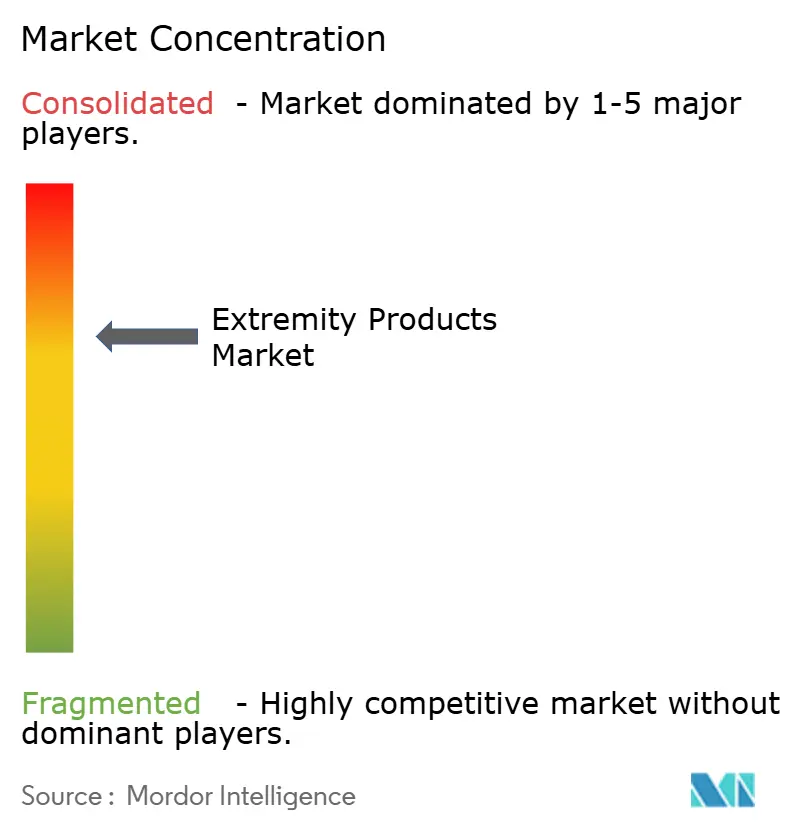
| Market Concentration | Medium |
Major Players *Disclaimer: Major Players sorted in no particular order Image © Mordor Intelligence. Reuse requires attribution under CC BY 4.0. | |
Extremity Products Market Analysis by Mordor Intelligence
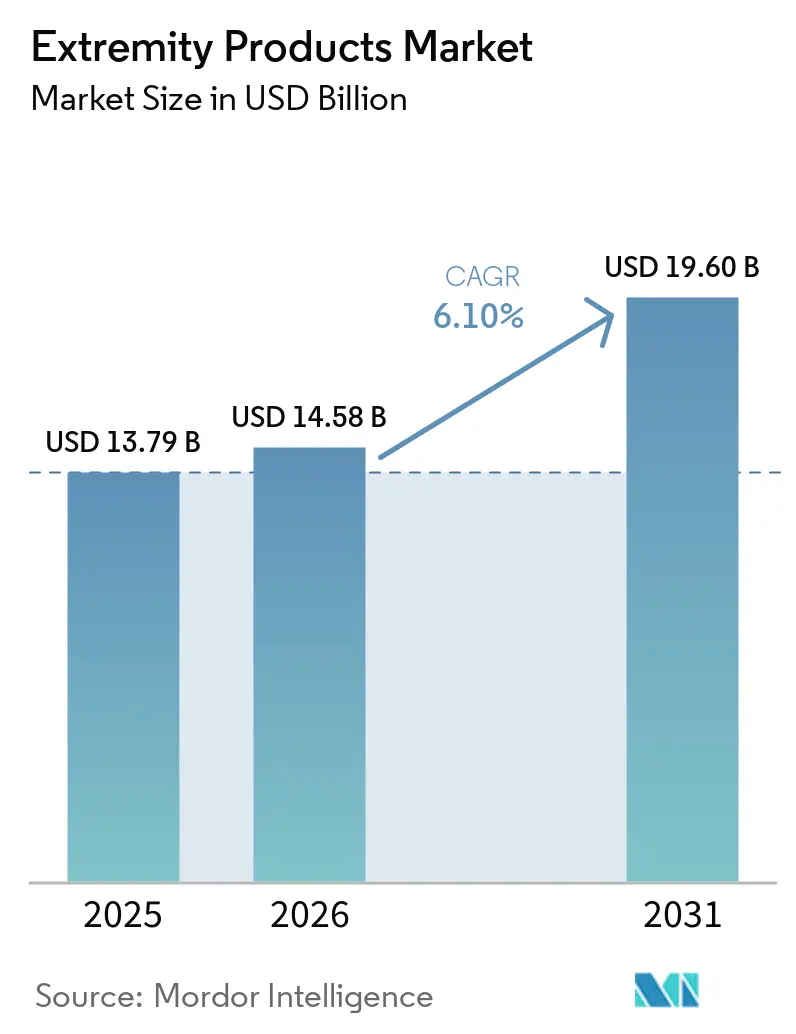
The extremity products market is expected to increase from USD 13.79 billion in 2025 to USD 14.58 billion in 2026 and reach USD 19.60 billion by 2031, growing at a CAGR of 6.10% over 2026-2031. The extremity products market is supported by a growing clinical burden from musculoskeletal conditions, fragility fractures, and sports-related injuries. The World Health Organization reported that 1.71 billion people lived with musculoskeletal conditions, which also accounted for 17% of years lived with disability worldwide. Aging populations and a high fracture burden continue to support demand for reconstruction and fixation procedures. Care is also moving toward outpatient facilities, which changes the type of instrumentation and service support that providers require. Companies are responding through connected surgical technologies, patient-specific solutions, and products designed for more efficient procedures. The extremity products market, therefore, combines established joint reconstruction demand with new opportunities in trauma care, upper-limb procedures, and outpatient delivery.
Key Report Takeaways
- By product type, extremity implants and joint-reconstruction systems held 39.61% of revenue in 2025, while trauma and fixation products are forecasted to grow at a 7.14% CAGR through 2031.
- By anatomy, the lower extremity accounted for 46.25% of revenue in 2025, while the upper extremity is forecasted to grow at an 8.25% CAGR through 2031.
- By application, trauma fracture repair held 38.63% of revenue in 2025, while joint reconstruction and arthroplasty are forecasted to grow at an 8.77% CAGR through 2031.
- By end-user, hospitals and surgical centers held 43.23% of revenue in 2025, while specialty and orthopedic clinics are forecasted to grow at 6.62% CAGR through 2031.
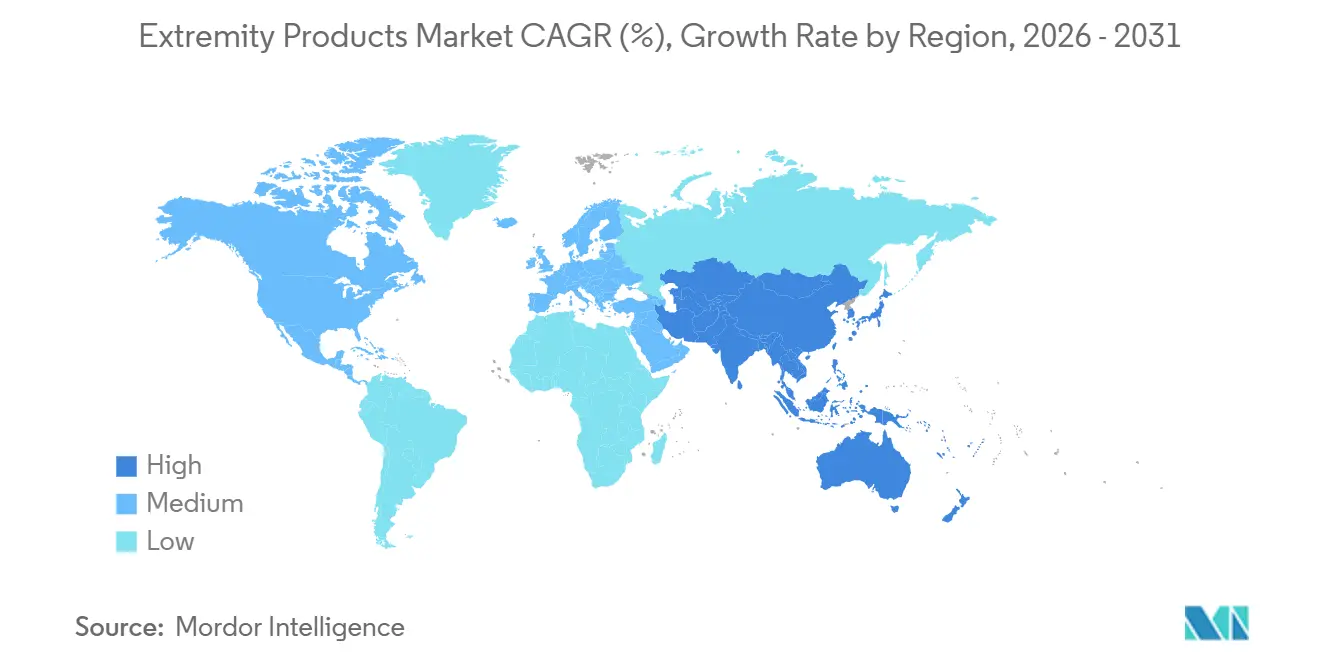
- By geography, North America held 46.42% of revenue in 2025, while Asia-Pacific is forecasted to grow at a 9.13% CAGR through 2031.
Note: Market size and forecast figures in this report are generated using Mordor Intelligence’s proprietary estimation framework, updated with the latest available data and insights as of January 2026.
Market Trends and Insights
Drivers Impact Analysis of Extremity Products Market*
| Driver | (~) % Impact on CAGR Forecast | Geographic Relevance | Impact Timeline |
|---|---|---|---|
| Aging Population and Fragility Fracture Burden | +1.8% | Global, highest in North America, Europe, and East Asia | Long term (≥ 4 years) |
| Rising Orthopedic Disease and Sports Injury Incidence | +1.3% | Global, highest in North America, Asia-Pacific, and Latin America | Medium term (2-4 years) |
| Expansion of Outpatient and Ambulatory Extremity Surgery | +1.1% | North America primary, with spillover to Western Europe and Asia-Pacific | Short term (≤ 2 years) |
| Adoption of Minimally Invasive, Robotic, and Digitally Planned Procedures | +0.9% | North America and Europe, with early adoption in Asia-Pacific premium care | Medium term (2-4 years) |
| Patient-Specific and Additively Manufactured Extremity Implants | +0.6% | Global, led by North America, Germany, China, and South Korea | Long term (≥ 4 years) |
| Sensor-Enabled Constructs and Data-Linked Postoperative Care | +0.4% | North America first, with emerging use in Europe and Asia-Pacific | Long term (≥ 4 years) |
| Source: Mordor Intelligence | |||
Aging Population and the Compounding Fragility Fracture Burden
The extremity products market draws long-term support from population aging and the associated rise in fragility fractures. A 2025 study projected that deaths linked to low bone mineral density fractures among post-menopausal women will increase from 189,025 in 2021 to 397,537 by 2050.[1]The same study projected that the related disability burden will rise to 14.35 million disability-adjusted life years by 2050. These patterns create a sustained need for hip fracture systems, ankle fixation products, and reconstruction procedures.
Lower-extremity and pelvic fractures also give the extremity products market a broad procedure base. A 2025 study recorded 78.05 million new lower-extremity and pelvic fracture cases globally in 2021, representing a 32% increase from 1990.[2] The volume of these cases supports continued use of fixation, nailing, and arthroplasty systems. It also gives providers a reason to expand pathways for fracture care outside major hospital centers.
Rising Orthopedic Disease and Sports Injury Incidence
Musculoskeletal disease remains a central source of demand for the extremity products market. The World Health Organization reported that these conditions affect 1.71 billion people globally and are the leading contributors to disability worldwide. The burden includes conditions that limit mobility, joint function, and the ability to work. The scale of the affected population also increases the importance of preserving function after surgery.
Sports injuries add a separate demand layer for the extremity products industry. A 2026 study found that athletic knee dislocations among adults aged 20-40 increased 16.8% between 1990 and 2021.[3] These patients often return to work and physical activity with high expectations for recovery. This raises demand for ligament augmentation, shoulder stabilization, and ankle replacement solutions that seek to restore joint function. It also raises the importance of biomechanical evidence and the surgeon's confidence in newer products. Companies with clear clinical education and focused product design can compete beyond price alone.
Expansion of Outpatient and Ambulatory Extremity Surgery
Outpatient care is changing how the extremity products market serves orthopedic providers. The outpatient orthopedic volume in the United States was 33 times higher than inpatient volume by late 2023. Product lines for these sites need compact instruments, lower tray counts, and clear workflow support. The shift is therefore relevant to both implant design and commercial service models.
Ambulatory surgery centers also offer a policy-supported route for orthopedic volume. Savings of more than USD 3.6 billion in Medicare fee-for-service spending from musculoskeletal surgeries performed in these facilities from 2019 to 2024. It further notes projected savings of USD 13.5 billion between 2025 and 2034. Hospitals still retain complex trauma and revision work, but outpatient facilities are becoming more important customers for routine extremity procedures.
Adoption of Minimally Invasive, Robotic, and Digitally Planned Procedures
Robotic and digitally planned surgery is becoming more relevant to the extremity products market, especially in joint reconstruction. This broadens the use of one platform across more shoulder procedures. It can also reduce the need for separate robotic systems across procedure types. Adoption depends on capital availability, training, and evidence of practical clinical value.
Digital planning increasingly links imaging, navigation, implants, and postoperative care. A more connected workflow may strengthen a surgeon’s familiarity with a single company’s platform. Sensor-enabled implants may extend follow-up through postoperative data, although uptake remains at an early stage. The extremity products market benefits when these tools make complex reconstruction more reproducible for trained teams.
Restraints Impact Analysis of Extremity Products Market*
| Restraint | (~) % Impact on CAGR Forecast | Geographic Relevance | Impact Timeline |
|---|---|---|---|
| High Procedure and Advanced Implant Costs | -1.4% | Global, sharpest in North America and price-sensitive Asia-Pacific markets | Short term (≤ 2 years) |
| Stringent and Regionally Variable Regulatory Requirements | -1% | Europe, North America, and emerging markets including China, India, and Brazil | Medium term (2-4 years) |
| Surgeon Training Gaps for Complex Extremity Reconstruction | -0.7% | Global, concentrated in tier-2 and tier-3 cities, Asia-Pacific, and the Middle East and Africa | Long term (≥ 4 years) |
| Sustainability and Reprocessing Pressure on Single-Use Instrumentation | -0.4% | Western Europe, with emerging relevance in North America | Medium term (2-4 years) |
| Source: Mordor Intelligence | |||
High Procedure and Advanced Implant Costs
Cost pressure can constrain adoption in the extremity products market, particularly for patient-specific and robotic-adjacent systems. CMS applied an 8% reduction to Medicare reimbursement for orthopedic joint replacement surgeons in 2026. It also states that a proposed 2027 Physician Fee Schedule rule would apply a further 20% reduction to total hip and knee replacement codes. This makes commercial adoption more dependent on demonstrated value rather than technical novelty alone.
The cost barrier is also structural in price-sensitive markets. Domestic manufacturers in India price stainless-steel extremity implants 40-60% below imported titanium systems. Suppliers must balance portfolio breadth with product configurations that fit local budgets. The extremity products market, therefore, requires different pricing and channel approaches across regions.
Stringent and Regionally Variable Regulatory Requirements
Regulatory requirements can add time and cost to product launches in the extremity products market. The European Union Medical Device Regulation removed self-certification for legacy Class IIb and Class III devices. It also notes that a notified-body clinical review can cost USD 100,000-500,000 per product in each market. The result is greater pressure to maintain strong clinical evidence and quality systems.
China’s priority review channels improve approval timing, but local dossiers remain necessary. Larger organizations can distribute compliance resources across more products and countries. Smaller innovators may need to focus on selected procedures or partner with established distributors. These conditions support continued concentration among companies with durable regulatory and clinical capabilities.
*Our forecasts treat driver/restraint impacts as directional, not additive. The impact forecasts reflect baseline growth, mix effects, and variable interactions.
Extremity Products Market Segment Analysis
By Product Type:
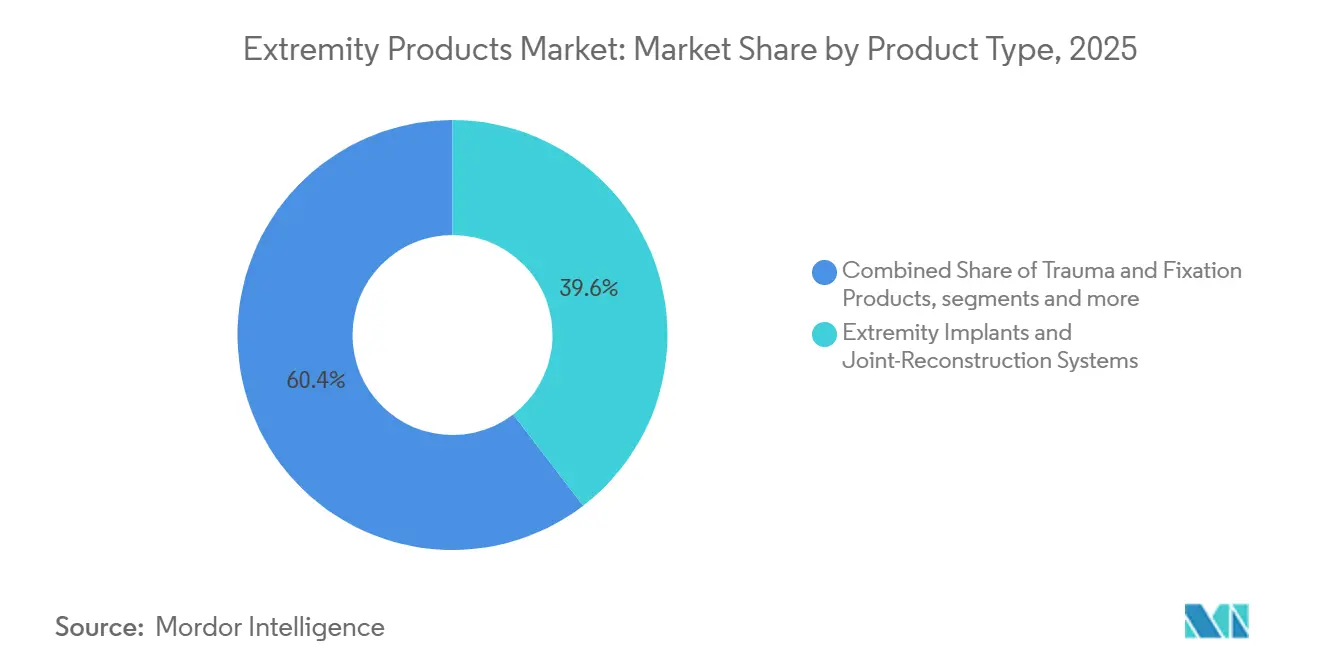
Fixation Innovation Accelerates While Reconstruction Commands ValueExtremity implants and joint-reconstruction systems held 39.61% of the extremity products market share in 2025. The segment benefits from demand for reconstruction in older patients and people with more complex joint disease. Its large revenue contribution makes it a core focus for companies building broad orthopedic portfolios.
Trauma and fixation products are forecasted to grow at a 7.14% CAGR through 2031. This extremity products market segment is supported by fragility fractures, sports injuries, and continued demand for more efficient trauma workflows. Arthrex released the TightRope SB All-Suture Implant for ACL fixation in February 2026. Orthobiologics, bracing, and support products remain related product areas because they can support healing, rehabilitation, and post-acute care.

By Anatomy:
Lower Extremity Commands Volume as Upper Extremity AcceleratesLower extremity held 46.25% of the extremity products market share in 2025. Hip and knee arthroplasty volume, along with fractures of the tibia, fibula, ankle, and hip, underpin this position. Lower-extremity cases include both planned reconstruction and urgent trauma treatment. Providers also need a range of systems for routine fractures, revisions, and complex reconstruction.
The upper extremity is expected to expand at a 8.25% CAGR through 2031. Shoulder arthroplasty is a major contributor, while elbow and wrist reconstruction are becoming more widely available. The upper-extremity procedures in ambulatory surgery centers can offer strong reimbursement efficiency. This supports investment in equipment and inventory for outpatient upper-limb care. Advanced shoulder technologies also support the segment’s development.
By Application:
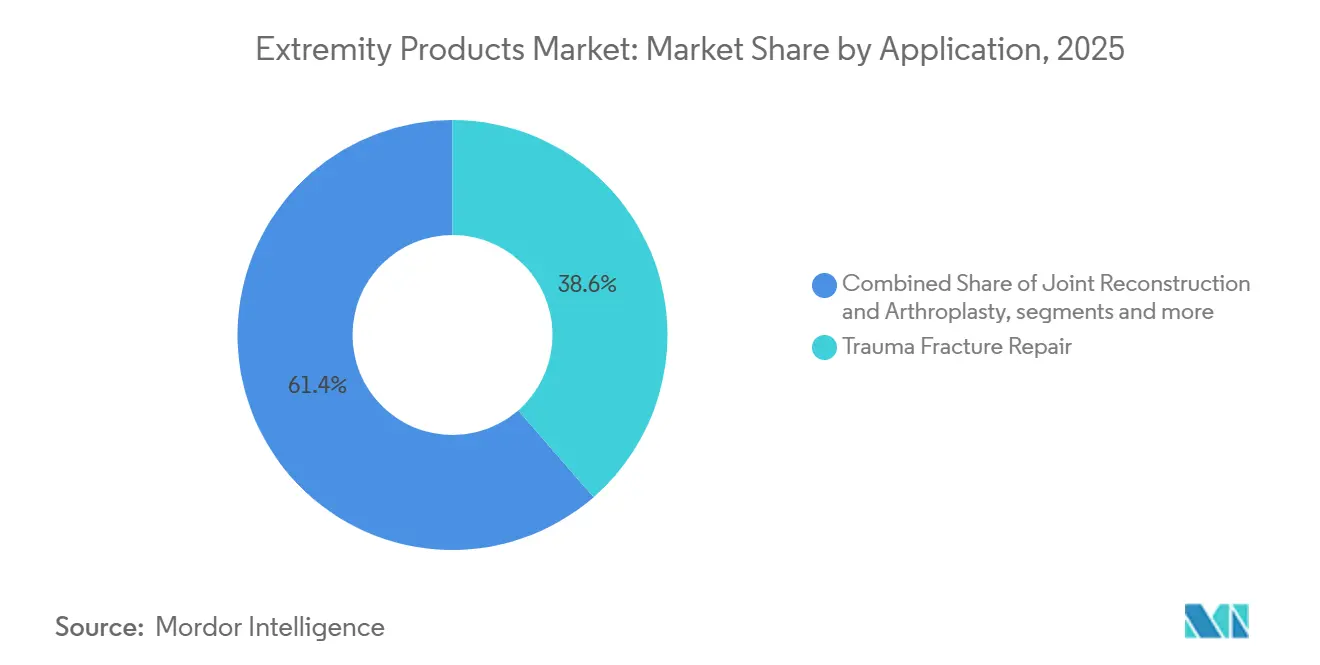
Fracture Repair Leads Volume, Arthroplasty Commands Fastest GrowthTrauma fracture repair held 38.63% of revenue in 2025, making it the largest application in the extremity products market. The segment is supported by the high incidence of fractures among older adults and physically active populations. It includes products for acute fixation across the upper and lower limbs. The large number of lower-extremity and pelvic fractures creates ongoing demand for tibial nailing, ankle fixation, and hip fracture systems.
Joint reconstruction and arthroplasty are projected to grow at an 8.77% CAGR through 2031. The extremity products market for this application benefits from wider use of shoulder reconstruction and growing interest in robotic planning. Patient-specific 3D-printed constructs are relevant to complex revision and oncology-related cases. These applications carry specialized requirements even when their procedure volumes are lower than those of fracture repair.
By End-User:
Hospitals Lead Procurement as Specialty Clinics Capture New Procedure FlowsHospitals and surgical centers held 43.23% of revenue in 2025. These settings continue to manage polytrauma, complex revisions, and patients with significant clinical risk. Hospitals remain important for emergency fracture care and cases that require inpatient oversight. This position will remain important even as selected procedures migrate to outpatient sites.
Specialty and orthopedic clinics are forecasted to grow at a 6.62% CAGR through 2031. Their growth reflects expanding ambulatory surgery center capacity and interest in lower-cost elective care. Prosthetic and rehabilitation clinics, homecare settings, and sports centers have smaller roles but matter for bracing, supports, and rehabilitation-oriented products. Channel strategies need to reflect the distinct procurement needs of hospitals and outpatient providers.
Geography Analysis
North America Extremity Products Market
North America held 46.42% of the extremity products market in 2025. Its position is supported by high procedure reimbursement, established hospital infrastructure, and an advanced ambulatory surgery center landscape. The United States continues to move selected musculoskeletal procedures into outpatient settings in 2026. Canada remains more hospital-centered because of its universal healthcare structure. Mexico’s private hospital sector is an additional route for imported systems, particularly those with digital capabilities. Together, these markets support both premium reconstruction products and efficient outpatient configurations.
Europe Extremity Products Market
Europe forms another important revenue base, with Germany, the United Kingdom, and France supporting procedure volume and innovation adoption. Germany’s Endoprothesenregister Deutschland tracks implant outcomes at the population scale, strengthening the clinical evidence used in procurement decisions. The European Union MDR requirements are leading some smaller suppliers and niche product lines to leave markets where evidence obligations are difficult to support. Italy and Spain are seeing demand for shoulder and ankle reconstruction as populations age and sports participation rises. Reimbursement differences between regions continue to create uneven access and adoption. These factors favor suppliers with well-supported product portfolios and strong regulatory capabilities.
APAC, MEA and South America Extremity Products Market
Asia-Pacific is projected to grow at a 9.13% CAGR through 2031, the fastest rate in the extremity products market. China is expanding trauma infrastructure and uses priority review channels for selected devices, while India is extending insurance coverage for orthopedic care beyond major cities. Japan’s older population supports demand for hip fracture care and day-surgery protocols. South Korea and Australia show interest in robotic orthopedic platforms alongside European and North American markets. South America, the Middle East, and Africa have distinct needs, including private-hospital demand in Brazil, orthopedic center investment in Saudi Arabia, and lower-cost modular fixation systems in parts of Africa.
Competitive Landscape
The extremity products market is moderately consolidated among leading companies and fragmented below them. Stryker held more than 30% of the extremity segment share after its USD 5.4 billion acquisition of Wright Medical in 2020. It also states that Zimmer Biomet held an estimated 14% after completing its Paragon 28 acquisition in April 2025. Larger portfolios can support broader clinical education, distribution, and compliance work. Their scale also helps them maintain products across several anatomies and application areas.
Technology is becoming a significant basis for competition in the extremity products market. Zimmer Biomet expanded the ROSA Shoulder System in May 2026, adding support for glenoid and humeral preparation in anatomic and reverse shoulder procedures. DePuy Synthes entered an agreement in May 2026 to acquire selective rights to miniature radiofrequency tracking technology for its joint reconstruction portfolio. The company also entered a distribution agreement for CGBIO’s NOVOSIS bone graft substitute across the United States, Canada, and Australia. These actions show how robotic navigation, tracking, and biological adjuncts are being incorporated into broader orthopedic offerings.
Focused companies can remain competitive through depth in specific procedures and surgeon education. Arthrex’s February 2026 release of the TightRope SB all-suture implant illustrates a focused approach to ACL fixation. Opportunities remain in systems designed for ambulatory surgery centers, patient-specific constructs for complex cases, and connected solutions in growing Asia-Pacific markets. Regulatory compliance and quality management remain important because newer products must meet demanding evidence requirements. The extremity products market remains competitive because large companies have scale, while focused suppliers can still differentiate through specialized products and training.
Extremity Products Industry Leaders
-
Stryker Corporation
-
Johnson & Johnson MedTech
-
Zimmer Biomet Holdings, Inc.
-
Smith+Nephew plc
-
Arthrex, Inc.
- *Disclaimer: Major Players sorted in no particular order
Extremity Products Market Companies Covered in this Report
- Acumed
- Arthrex
- B. Braun
- Bioventus
- Conmed
- Enovis Corporation
- Exactech
- Extremity Medical LLC
- Globus Medical
- Integra LifeSciences
- Johnson & Johnson MedTech
- Medartis
- Orthofix
- Paragon 28, Inc.
- Skeletal Dynamics LLC
- Smith+Nephew plc
- Stryker
- TriMed, Inc.
- Wright Medical Group
- Zimmer Biomet
Recent Industry Developments in Extremity Products Market
- May 2026: DePuy Synthes entered a definitive agreement to acquire selective development, manufacturing, and commercialization rights to Gemtrack radiofrequency tracking technology from MinMaxMedical for use in navigation and robotic-assisted shoulder, hip, and knee surgery within the VELYS Enabling Technology Portfolio. The deal positions DePuy Synthes to introduce a radiofrequency-based miniature tracker in joint reconstruction.
- May 2026: DePuy Synthes entered an exclusive United States, Canada, and Australia distribution agreement with CGBIO for NOVOSIS, an advanced bone graft substitute containing growth factors. The deal expanded DePuy Synthes’ orthobiologics footprint across trauma, spine, and craniomaxillofacial indications.
- May 2026: Zimmer Biomet received United States Food and Drug Administration 510(k) clearance for the expanded ROSA Shoulder System. The platform supports glenoid and humeral preparation for anatomic and reverse total shoulder arthroplasty and integrates with ZBEdge orthopedic intelligence and mymobility care management.
Global Extremity Products Market Report Scope
According to the report’s scope, the extremity products market includes orthopedic implants and devices designed to treat and reconstruct the upper and lower extremities (shoulder, elbow, wrist, hand, ankle, and foot). These products restore mobility, stability, and function in patients with trauma, degenerative diseases, or congenital deformities.
The extremity products market is segmented into product type, anatomy, application, end-user, and geography. By product type, the market is segmented into extremity implants and joint-reconstruction systems, trauma and fixation products, orthobiologics and bone-growth products, prosthetics, and bracing and supports. By anatomy, the market is segmented into upper extremity, lower extremity, and pelvic and acetabular extremity applications. By application, the market is segmented into trauma fracture repair, joint reconstruction and arthroplasty, deformity correction and fusion, soft-tissue repair and stabilization, limb salvage and revision surgery, and rehabilitation and mobility restoration. By end-user, the market is segmented into hospitals and surgical centers, ambulatory surgical centers, specialty and orthopedic clinics, prosthetic and rehabilitation clinics, and homecare and sports centers. By geography, the market is segmented into North America, Europe, Asia-Pacific, the Middle East and Africa, and South America. The report also covers the estimated market sizes and trends for 17 countries across major regions globally. The report offers values (USD) for all the above segments.
Segmentation Overview
| Extremity Implants and Joint-Reconstruction Systems |
| Trauma and Fixation Products |
| Orthobiologics and Bone-Growth Products |
| Prosthetics |
| Bracing and Supports |
| Upper Extremity |
| Lower Extremity |
| Pelvic and Acetabular Extremity Applications |
| Trauma Fracture Repair |
| Joint Reconstruction and Arthroplasty |
| Deformity Correction and Fusion |
| Soft-Tissue Repair and Stabilization |
| Limb Salvage and Revision Surgery |
| Rehabilitation and Mobility Restoration |
| Hospitals and Surgical Centers |
| Ambulatory Surgical Centers |
| Specialty and Orthopedic Clinics |
| Prosthetic and Rehabilitation Clinics |
| Homecare and Sports Centers |
| North America | United States |
| Canada | |
| Mexico | |
| Europe | Germany |
| United Kingdom | |
| France | |
| Italy | |
| Spain | |
| Rest of Europe | |
| Asia-Pacific | China |
| Japan | |
| India | |
| Australia | |
| South Korea | |
| Rest of Asia-Pacific | |
| Middle East and Africa | GCC |
| South Africa | |
| Rest of Middle East and Africa | |
| South America | Brazil |
| Argentina | |
| Rest of South America |
| By Product Type | Extremity Implants and Joint-Reconstruction Systems | |
| Trauma and Fixation Products | ||
| Orthobiologics and Bone-Growth Products | ||
| Prosthetics | ||
| Bracing and Supports | ||
| By Anatomy | Upper Extremity | |
| Lower Extremity | ||
| Pelvic and Acetabular Extremity Applications | ||
| By Application | Trauma Fracture Repair | |
| Joint Reconstruction and Arthroplasty | ||
| Deformity Correction and Fusion | ||
| Soft-Tissue Repair and Stabilization | ||
| Limb Salvage and Revision Surgery | ||
| Rehabilitation and Mobility Restoration | ||
| By End-User | Hospitals and Surgical Centers | |
| Ambulatory Surgical Centers | ||
| Specialty and Orthopedic Clinics | ||
| Prosthetic and Rehabilitation Clinics | ||
| Homecare and Sports Centers | ||
| By Geography | North America | United States |
| Canada | ||
| Mexico | ||
| Europe | Germany | |
| United Kingdom | ||
| France | ||
| Italy | ||
| Spain | ||
| Rest of Europe | ||
| Asia-Pacific | China | |
| Japan | ||
| India | ||
| Australia | ||
| South Korea | ||
| Rest of Asia-Pacific | ||
| Middle East and Africa | GCC | |
| South Africa | ||
| Rest of Middle East and Africa | ||
| South America | Brazil | |
| Argentina | ||
| Rest of South America | ||
Key Questions Answered in the Report
What is the projected value of the extremity products market by 2031?
The extremity products market is forecasted to reach USD 19.60 billion by 2031 from USD 13.79 billion in 2025 to USD 14.58 billion in 2026, growing at a 6.10% CAGR from 2026.
Which product category holds the largest extremity implants revenue share?
Extremity implants and joint-reconstruction systems held 39.61% of revenue in 2025.
Which anatomy segment is growing fastest?
The upper extremity is forecasted to grow at a 8.25% CAGR through 2031, supported by shoulder, elbow, and wrist reconstruction demand.
Which region is expected to grow fastest through 2031?
Asia-Pacific is projected to grow at a 9.13% CAGR through 2031, supported by infrastructure, insurance expansion, and manufacturing development.