
Europe Winter Tourism Market Size and Share
Market Overview
| Study Period | 2020 - 2031 |
|---|---|
| Forecast Data Period | 2026 - 2031 |
| Base Year Market Size (2025) | USD 179.28 Billion |
| Market Size (2026) | USD 186.99 Billion |
| Market Size (2031) | USD 232.68 Billion |
| Growth Rate (2026 - 2031) | 4.47 % |
| Market Concentration | Medium |
Major Players *Disclaimer: Major Players sorted in no particular order Image © Mordor Intelligence. Reuse requires attribution under CC BY 4.0. | |
Europe Winter Tourism Market Analysis by Mordor Intelligence
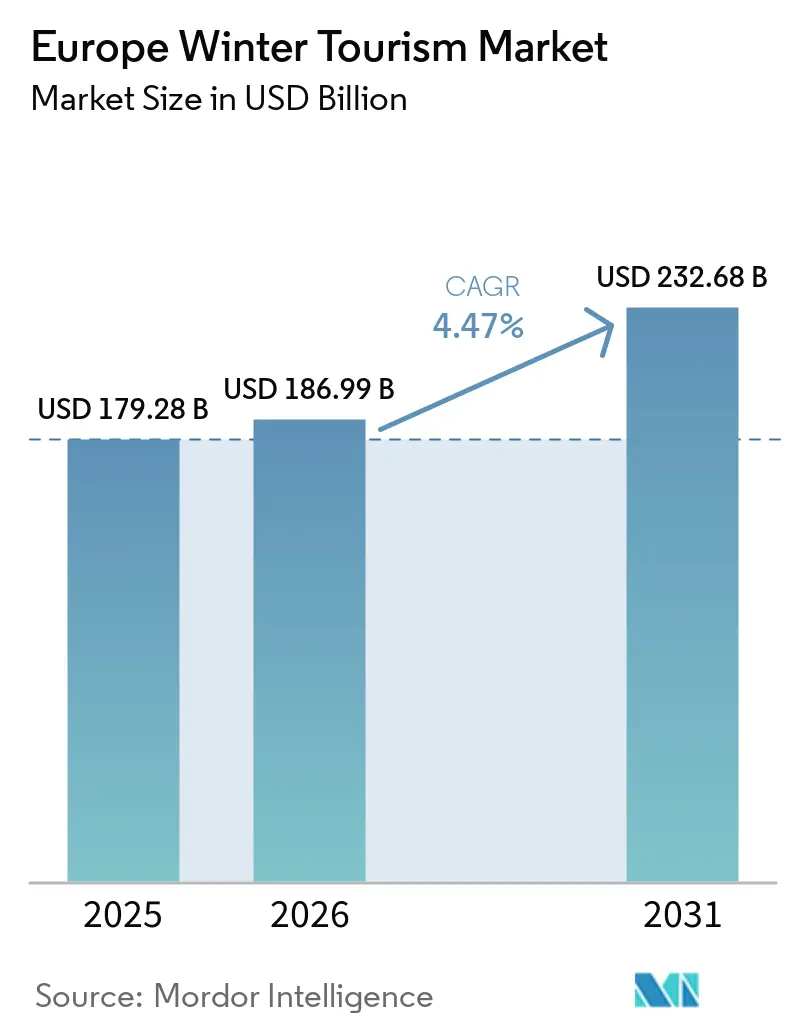
The Europe Winter Tourism Market size is projected to expand from USD 179.28 billion in 2025 and USD 186.99 billion in 2026 to USD 232.68 billion by 2031, registering a CAGR of 4.47% between 2026 and 2031. In Europe, winter tourism is witnessing a structural shift in demand. Post-pandemic, leisure priorities have evolved, and with disposable incomes remaining robust in key source markets, winter travel has expanded beyond just skiing to encompass a wider array of seasonal experiences. By 2025, intra-European air travel made a strong comeback. Notably, from January to November, European Revenue Passenger Kilometers grew, while average load factors stabilized. This trend indicates a solid capacity utilization, moving away from mere one-off discount-driven traffic spikes. Long-haul arrivals to Europe not only grew in 2025 but are also projected to rise further in 2026. Demand from the Asia-Pacific region is outpacing the regional average, bolstering premium winter offerings in both Nordic and Alpine locales. Larger operators are leveraging pricing strategies, hedging, and digital booking tools more adeptly than their smaller counterparts. A consistent domestic traveler base, a growing interest in Arctic and wellness-centric trips, and ongoing investments in transport and resort infrastructure buoy the European winter tourism market. These factors collectively underpin a promising growth outlook through 2031.[1]
Key Report Takeaways
- By activity type, Skiing & Snowboarding led with 33.41% of the Europe winter tourism market share in 2025, while Northern Lights & Arctic Experiences is forecast to expand at a 5.63% CAGR through 2031.
- By accommodation type, Hotels & Resorts accounted for 41.53% of the Europe winter tourism market size in 2025, while Vacation Rentals/Airbnb is projected to have a CAGR of 5.12% through 2031.
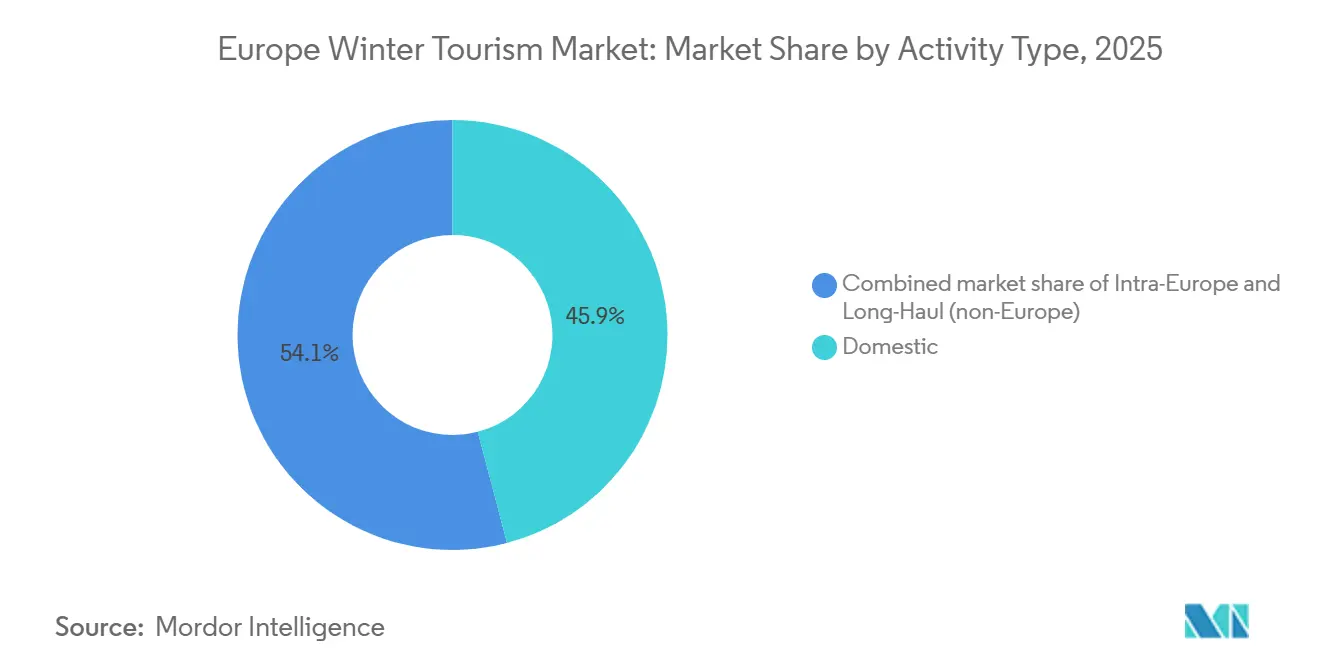
- By traveler origin, Domestic accounted for 45.92% of the Europe winter tourism market share in 2025, while Long-Haul is projected to have a CAGR at 4.98% through 2031.
- By booking channel, Online Travel Agencies held 39.74% of the Europe winter tourism market size in 2025, while Mobile-only Apps are projected to have a CAGR of 5.86% through 2031.
- By destination, Western Europe commanded a 35.28% of the Europe winter tourism market share in 2025, while Northern Europe is forecast to expand at a 6.02% CAGR through 2031.
Note: Market size and forecast figures in this report are generated using Mordor Intelligence’s proprietary estimation framework, updated with the latest available data and insights as of January 2026.
Market Trends and Insights
Drivers Impact Analysis of Europe Winter Tourism Market*
| Drivers | (~) % Impact on CAGR Forecast | Geographic Relevance | Impact Timeline |
|---|---|---|---|
| Recovering Intra-European Air Connectivity | +1.0% | EU core markets including Germany, France, the United Kingdom, and the Netherlands as primary beneficiaries | Short term (≤ 2 years) |
| Growing Popularity Of Multi-Activity Winter Packages | +0.8% | Western and Central Europe, especially the Alps, Pyrenees, and Carpathians | Medium term (2-4 years) |
| Expansion Of Low-Cost Long-Haul Services Into Nordic Hubs | +0.6% | Northern Europe, especially Copenhagen, Stockholm, Oslo, and Helsinki | Medium term (2-4 years) |
| Accelerated Investment In Snow-Independent Attractions | +0.7% | Alpine regions including Austria, France, Switzerland, and Italy | Medium term (2-4 years) |
| Climate-Aligned Resort Certification Gaining Traction | +0.5% | EU-wide, with early adoption in France, Finland, and Austria | Long term (≥ 4 years) |
| Alpine Rail-Link Upgrades Shortening Travel Times | +0.4% | Western and Southern Europe, especially the France-Italy-Austria corridor | Medium term (2-4 years) |
| Source: Mordor Intelligence | |||
Recovering Intra-European Air Connectivity
As intra-European air connectivity rebounds, winter tourism in Europe is seeing a boost. An increased regional seat supply and enhanced access to key gateways bolster this resurgence in winter travel. In 2025, European Revenue Passenger Kilometers (RPKs) rose 5.9%, while load factors remained robust at 83.6% through November. This indicates airlines are filling their planes at healthy commercial levels, steering clear of temporary discounts. In a notable move, SAS ramped up its Copenhagen schedule for the winter of 2025/26, boosting seat capacity by 40% and introducing six new routes. Among these is Kittilä, nestled in Finnish Lapland, which opens doors to sought-after Arctic winter experiences. While Europe as a whole experienced moderate growth, Slovakia saw a marked surge in inbound air traffic in Q4 2025 compared to Q4 2024. This highlights that secondary winter destinations, not just major hubs, are benefiting from renewed airlift. Such expanded air access is pivotal for Europe's winter tourism landscape. It diversifies demand across a wider array of destinations, enhances occupancy rates beyond flagship resorts, and bolsters the commercial appeal of smaller winter tourism hubs.
Growing Popularity of Multi-Activity Winter Packages
As multi-activity winter packages gain traction, Europe's winter tourism market is evolving, capturing more value from each traveler. According to Atout France's 2026 mountain winter barometer, most visitors engaged in at least one snow activity, with many also valuing wellness and social interactions as key travel motivators. Club Med noted a surge in ski bookings for Winter 2026, with its Serre Chevalier location seeing a particularly significant uptick. This underscores the rising appeal of all-inclusive, activity-centric offerings at mountain destinations. Resorts are now enhancing revenue per stay by focusing on wellness, dining, family experiences, and guided outdoor programs, rather than relying solely on lift-ticket sales. Such diversified packages not only bolster the European winter tourism market but also lessen reliance on daily snow conditions, making winter trips more enticing for diverse groups with varied motivations.
Expansion of Low-Cost Long-Haul Services into Nordic Hubs
Low-cost long-haul services are increasingly spotlighting Europe's winter tourism market, particularly its Arctic offerings. Starting October 2025, Norse Atlantic Airways introduced a direct, twice-weekly service from Stockholm to Bangkok, utilizing Boeing 787 Dreamliners.[2] This move enhances Northern Europe's long-haul connectivity amidst a surge in winter demand. Meanwhile, SAS expanded its reach by adding a service from Copenhagen to Mumbai, elevating Copenhagen's status as a premier Nordic intercontinental hub with multiple Asian destinations. Data from the European Travel Commission highlighted a notable uptick in 2025: Chinese overnight stays surged in Norway and Finland, and Japanese arrivals saw a boost in Iceland and Finland. This trend underscores the allure of high-value Asian travelers. Such developments are pivotal for Europe's winter tourism, as long-haul visitors tend to book earlier, extend their stays, and exhibit a pronounced preference for premium Arctic accommodations and guided experiences, distinguishing them from short-haul city-break tourists.
Accelerated Investment in Snow-Independent Attractions
Europe's winter tourism market is diversifying its attractions, moving away from a sole reliance on ski lifts. Les Sybelles, for instance, has partnered with MND to introduce 27 sports and recreational installations, themed around the TREK 12 board-game franchise. This shift underscores operators' efforts to broaden their appeal beyond just skiing. Atout France's findings further emphasize this trend: winter mountain travel is increasingly driven by wellness, social activities, and leisure pursuits, rather than just skiing. Such insights empower resorts to design a wider array of non-ski products. By focusing capital spending on enhancing guest experiences and ancillary services, resorts can more easily monetize these investments, especially in mature settings where new lift infrastructure can be challenging. This diversified attraction mix not only encourages longer stays and appeals to families but also stabilizes demand during shoulder seasons. As a result, Europe's winter tourism market boasts a more resilient revenue model, even when snow conditions fluctuate.
Restraints Impact Analysis of Europe Winter Tourism Market*
| Restraints | (~) % Impact on CAGR Forecast | Geographic Relevance | Impact Timeline |
|---|---|---|---|
| Volatile Energy Prices Inflating Resort OPEX | -0.7% | Western and Central Europe, with sharper exposure in the United Kingdom, Austria, and Switzerland | Short term (≤ 2 years) |
| Rising Insurance Premiums For Adventure Sports Operators | -0.4% | Global, with acute exposure in France, Austria, and Italy for off-piste operators | Short term (≤ 2 years) |
| Snow-Reliability Risk For Low-Altitude Resorts | -0.6% | Central and Eastern Europe, Southern Europe, and mid-altitude Alpine resorts | Long term (≥ 4 years) |
| Growing Anti-Overtourism Regulation In Heritage Cities | -0.5% | Southern and Western Europe, including major heritage destinations | Medium term (2-4 years) |
| Source: Mordor Intelligence | |||
Volatile Energy Prices Inflating Resort OPEX
Volatile energy prices remain a direct pressure point for the Europe winter tourism market because snowmaking, lift systems, heated facilities, and hospitality operations carry a high electricity burden during the winter season. Compagnie des Alpes responded by locking in its French electricity needs at fixed rates for 2026 and 2027, while also hedging a large majority of its 2028 and 2029 requirements, which shows how important scale and treasury capacity have become in winter tourism operations Large groups can use this type of hedging to protect margins. Still, smaller independent operators often have less room to absorb swings in utility costs or pass them on without weakening demand. The result is a widening cost gap between integrated operators and local independents, especially in mountain areas where snow production and transport infrastructure are already capital-intensive. In the European winter tourism market, this restraint works through profitability and pricing pressure rather than through a sudden collapse in demand, making it especially important for operators with older infrastructure and tighter balance sheets.
Rising Insurance Premiums For Adventure Sports Operators
In Europe, rising insurance premiums are squeezing the operating costs of winter tourism businesses, particularly those engaged in high-risk outdoor activities. Off-piste operators, heli-ski providers, alpine guides, and niche activity specialists, with their limited revenue base, feel this pinch the most. As insurance costs climb, businesses face shrinking profit margins, leading to heightened package prices and, in some instances, a reduced array of winter activities. This scenario inadvertently favors larger operators, who can more readily absorb these premium hikes or negotiate expansive coverage across various resorts. Countries like France, Austria, and Italy, with their rich tapestry of guided mountain sports and unique adventure offerings, feel this strain more acutely. Consequently, the European winter tourism landscape might see smaller operators either scale back or pivot to less risky ventures, potentially curtailing the diversity of offerings in the adventure travel domain.
*Our forecasts treat driver/restraint impacts as directional, not additive. The impact forecasts reflect baseline growth, mix effects, and variable interactions.
Europe Winter Tourism Market Segment Analysis
By Activity Type:
Northern Lights Demand Reorders the Activity HierarchySkiing & Snowboarding held a 33.41% share of the activity mix in 2025, maintaining its position as the leading activity category in the Europe winter tourism market. The segment remains supported by Europe’s deep resort base, strong domestic participation, and the continued appeal of premium sub-categories such as freeriding, ski-safari travel, and ski-in and ski-out stays. The category still anchors most resort economics because lift access, rental spend, ski school demand, and mountain lodging remain closely linked in established Alpine corridors. At the same time, value is moving upward within the segment because travelers with higher budgets are more willing to pay for convenience, premium accommodation, and curated multi-day experiences than for standard access alone. This means the Europe winter tourism market is not only sustaining skiing demand but also extracting greater value from the premium segments within that demand base.[3]
Northern Lights & Arctic Experiences is the fastest-growing activity segment, with a projected 5.63% CAGR through 2026 to 2031, reflecting the rapid rise of Nordic winter travel in the Europe winter tourism market. Northern Norway recorded strong tourism growth in 2025 as winter demand strengthened, which supports the growing commercial pull of aurora-led travel and broader Arctic experiences. Winter city breaks and Christmas-market travel add another layer to this activity mix because they draw culturally motivated travelers who are less dependent on mountain snow conditions and more focused on seasonal atmosphere, food, and short-stay convenience. The European winter tourism market is therefore broadening from a ski-centered model into a wider winter experience model that includes Arctic viewing, wellness, soft adventure, and urban seasonal travel.

By Accommodation Type:
Hotels Hold Share While Vacation Rentals AccelerateHotels & Resorts retained the dominant accommodation share at 41.53% in 2025, giving them the largest slice of the market share among lodging formats. Their position remains strong because premium Alpine and Nordic destinations still favor professionally managed hospitality, recognizable service standards, and bundled amenities for travelers who are paying high seasonal rates. At the same time, Vacation Rentals/Airbnb is the fastest-growing accommodation segment, with a 5.12% CAGR through 2031, indicating how much demand is shifting toward flexible, self-catering, and group-friendly formats. European short-term rental supply reached millions of units as of December 2025, up year on year, which confirms that alternative accommodation continues to scale across the region.
Operational performance data also shows that managed rental formats are competing more directly with hotels than before. Auvergne-Rhône-Alpes Tourisme reported that tourism residences achieved high occupancy in winter 2025/26, ahead of hotels and holiday villages, indicating strong demand for branded, service-enhanced rental stock. Premium hotel investment has not slowed, with Ennismore signing Mama Shelter Val Thorens in October 2025 for a 2027 opening, which shows that global hospitality brands still see value in flagship Alpine addresses. The European winter tourism industry is therefore moving toward a mixed lodging model in which hotels, managed residences, chalets, and rental stock each serve different value pools rather than competing on the same terms.
By Traveler Origin:
Domestic Volume Anchors Demand While Long-Haul Redefines Revenue QualityDomestic travelers accounted for 45.92% of the Europe winter tourism market size by origin in 2025, making them the base demand segment. This segment matters because domestic travelers fill shoulder weeks, support repeat visitation, and sustain occupancy when international demand is more uneven. Long-Haul is the fastest-growing origin segment, with a projected 4.98% CAGR through 2031, and the latest travel flow data supports that direction. The European winter tourism market gains disproportionately from this mix because long-haul demand is often tied to premium Arctic stays, bucket-list experiences, and longer trip duration.
The regional composition of that long-haul demand also matters, as the strongest gains are coming from traveler groups with a strong interest in Nordic winter products. In 2025, Chinese overnight stays in Norway rose 84.6%, and in Finland rose 25.3%, while Japanese arrivals to Iceland increased 60.7% and to Finland increased 49.9%. Domestic demand still provides the floor, and Haute-Savoie reported strong average accommodation occupancy during the Christmas and New Year peak in 2025/26, which reflects the strength of core regional demand during the highest-value winter weeks. Intra-Europe travel continues to shape destination competition as well, as British overnight stays in Norway grew robustly in 2025, suggesting that Nordic destinations are taking share from more traditional winter destinations.
By Booking Channel:
OTA Dominance Faces Mobile-Native and AI-Powered DisruptionOnline Travel Agencies captured a 39.74% share of the booking channel in 2025, making them the largest distribution channel in the Europe winter tourism market. Their scale comes from a broad inventory, price visibility, and review systems that reduce booking friction for short breaks and multi-stop trips. Mobile-only Apps are the fastest-growing booking channel, with a 5.86% CAGR through 2031, reflecting how younger travelers now plan and manage holidays almost entirely on smartphones. Booking Holdings said that AI-powered connected transactions grew significantly year on year and already represent a notable share of Booking.com transactions, showing that platforms are moving beyond simple listings and into multi-component trip assembly. For the Europe winter tourism market, this channel shift is important because control of the booking journey increasingly shapes pricing power, cross-sell opportunities, and customer retention.
Direct resort and hotel websites still matter in higher-value trip types where travelers want trust, flexibility, or tailored arrangements. Chalets, longer ski stays, group bookings, and bundled mountain packages continue to support direct sales because these trips are more complex than a short city break or a single-room booking. Traditional travel agents also remain relevant where customers need advice across transport, lodging, and activities, especially for multi-generational or premium winter travel. The Europe winter tourism market is therefore not moving toward a single dominant booking model, but toward a layered system in which OTAs drive scale, apps drive convenience, and direct channels defend margins and service control. In the Europe winter tourism market, the strongest distributors will be those that can keep travelers within a single planning and purchase flow while still supporting more specialized products when needed.
Geography Analysis
Western Europe Winter Tourism Market
Western Europe accounted for 35.28% of the Europe winter tourism market in 2025, making it the largest regional block. Its position rests on strong Alpine infrastructure, deep accommodation capacity, recognized resort brands, and efficient road, rail, and air links that support repeat winter travel from core European source markets. The region also has a strong premium lodging pipeline, which helps it retain higher-value travelers even as alternative winter destinations grow.
Northern Europe Winter Tourism Market
Northern Europe is forecast to grow at a 6.02% CAGR through 2031, which makes it the fastest-expanding regional segment in the Europe winter tourism market. Growth is being supported by aurora-led travel, stronger long-haul connectivity, and rising recognition of Nordic winter experiences among Asian and European travelers. SAS expanded winter seat capacity from Copenhagen by 40% and added routes that improve access to Nordic winter destinations. At the same time, Norse launched long-haul service into Stockholm to support broader intercontinental traffic flows. Finland’s 14.1% growth in international arrivals during 2025 adds to the evidence that Nordic winter demand is moving beyond a niche segment and into a more mainstream premium travel category.
Southern, Central and Eastern Europe Winter Tourism Market
Southern Europe and Central & Eastern Europe do not match the value concentration of the Alps or the growth rate of the Nordics, but they play an important balancing role in the Europe winter tourism market. Southern destinations combine lower-priced mountain offerings with Christmas-market and heritage-city travel, broadening the seasonal customer base. Central and Eastern Europe adds affordability and improves resort infrastructure, which matters as travelers continue to compare total trip costs more closely. This geographic spread helps the European winter tourism market serve luxury, mid-market, and value-led winter demand without depending on a single regional model.
Competitive Landscape
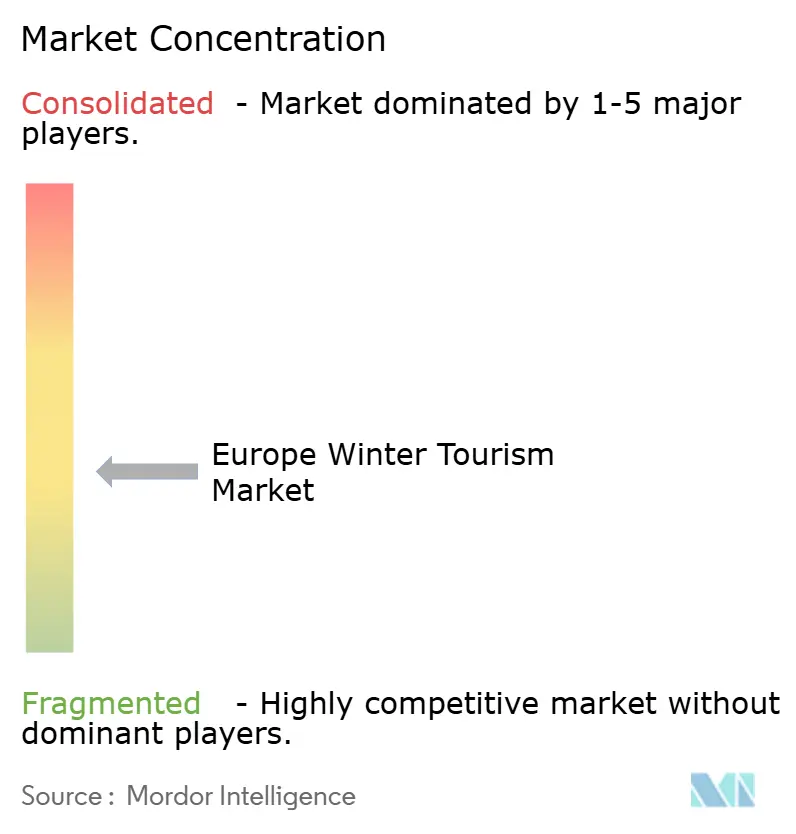
The Europe winter tourism market is moderately fragmented at the broad supply-chain level, but scale is more visible in resort operations, package distribution, and high-value destination management. Compagnie des Alpes remains one of the clearest leaders among pure-play resort operators, managing 14 ski areas across French and Swiss Alpine destinations and reporting H1 2025/26 revenue of EUR 882.7 million (USD 1.02 billion), up 3.9% year on year. SkiStar also showed strong operating traction, with H1 2025/26 net sales rising 8% and operating profit rising 11% across its Swedish and Norwegian mountain portfolio. These companies benefit from direct control over lifts, mountain activities, accommodation linkages, and ancillary spend that smaller local players cannot match. In the European winter tourism market, scale increasingly matters because energy exposure, transport coordination, and product diversification now require stronger balance sheets and better operating systems.
A second layer of competition comes from integrated holiday groups and large digital platforms that control customer acquisition and trip assembly. Club Med reported a 7.5% increase in ski bookings for Winter 2026, confirming that all-inclusive mountain formats continue to perform well in premium travel segments. Booking Holdings reported that connected transactions grew by more than 35% year on year, indicating how quickly platform-led distribution is moving toward bundled trip planning rather than simple hotel listings. Ennismore’s signing of Mama Shelter Val Thorens also shows that international hospitality brands are still expanding into prime mountain destinations where premium lifestyle positioning can command rate strength.
Sustainability credentials are becoming a more visible competitive tool in the European winter tourism market, especially where they support premium positioning and partner confidence. Levi Ski Resort has highlighted its ISO 14001 environmental management status. At the same time, Ruka formalized Green Key certification for its Ski-Inn accommodation operations, providing both resorts with clearer proof points for their responsible tourism claims. These actions matter because winter travelers and institutional partners increasingly want visible and auditable environmental practices, not just broad messaging. The European winter tourism market still offers room for partnerships and selective expansion in underconsolidated Arctic and Central European niches. Still, operators with strong distribution, premium inventory, and diversified year-round offerings are best positioned to defend margins and capture growth.
Europe Winter Tourism Industry Leaders
-
Compagnie des Alpes
-
SkiStar AB
-
Vail Resorts Inc. (European assets)
-
Jet2holidays
-
TUI AG
- *Disclaimer: Major Players sorted in no particular order
Europe Winter Tourism Market Companies Covered in this Report
- Compagnie des Alpes
- SkiStar AB
- TUI AG
- Vail Resorts Inc.
- Jet2holidays
- Crystal Ski Holidays
- Sunweb Group
- Club Med
- Expedia Group
- Booking Holdings
- Accor SA
- Pierre & Vacances-Center Parcs
- Airbnb Inc.
- Alpitour World
- FTI Group
- Thomas Cook (revived brand)
- Balkan Holidays
- Inghams (Hotelplan)
- Lufthansa Holidays
- SnowTrex (TravelTrex GmbH)
Recent Industry Developments in Europe Winter Tourism Market
- March 2026: The European Parliament's Transport and Tourism Committee adopted a new proposal calling for smart overtourism management, redistribution of visitors to rural and mountain destinations, and stricter regulation of short-term rentals in high-pressure urban heritage sites, a measure with material implications for winter city-break and Christmas market destination economics.
- October 2025: Ennismore signed Mama Shelter Val Thorens, the lifestyle brand's first-ever alpine resort, set to open in 2027 at Europe's highest ski destination. The project involves Ennismore, Vista, Financière Galata, and Cogeco, and reflects accelerating luxury hospitality investment at premium Alpine addresses.
- October 2025: Norse Atlantic Airways launched bi-weekly direct Stockholm-Bangkok service on Boeing 787 Dreamliners, strengthening Sweden's position as a long-haul gateway and forming part of Norse Atlantic's Winter Sun program connecting Northern Europe with Asia and Africa.
- September 2025: The Brenner Base Tunnel achieved a historical breakthrough with the completion of blasting excavation in its exploratory tunnel, the first underground cross-border connection between Italy and Austria. At 64 km upon projected 2032 completion, it will be the world's longest railway tunnel, significantly reducing Alpine transit times for winter tourism traffic along the Austria-Italy corridor.
Europe Winter Tourism Market Report Scope
Segmentation Overview
| Skiing & Snowboarding |
| Snowshoeing & Winter Hiking |
| Northern-Lights & Arctic Experiences |
| Winter City Breaks & Christmas Markets |
| Others (Adventure Sports, Religious Travel, Wellness Travel) |
| Hotels & Resorts |
| Chalets & Cabins |
| Vacation Rentals / Airbnb |
| Hostels |
| Others |
| Domestic |
| Intra-Europe |
| Long-Haul (non-Europe) |
| Online Travel Agencies (OTAs) |
| Direct (Resort / Hotel Websites) |
| Traditional Travel Agents |
| Mobile-only Apps |
| Western Europe (United Kingdom,France,Germany,Austria,Switzerland) |
| Northern Europe (Sweden,Norway, Finland, Iceland) |
| Southern Europe (Italy,Spain, Andorra) |
| Central & Eastern Europe (Poland,Slovakia,Czech Republic,Slovenia,Bulgaria) |
| By Activity Type | Skiing & Snowboarding |
| Snowshoeing & Winter Hiking | |
| Northern-Lights & Arctic Experiences | |
| Winter City Breaks & Christmas Markets | |
| Others (Adventure Sports, Religious Travel, Wellness Travel) | |
| By Accommodation Type | Hotels & Resorts |
| Chalets & Cabins | |
| Vacation Rentals / Airbnb | |
| Hostels | |
| Others | |
| By Traveler Origin | Domestic |
| Intra-Europe | |
| Long-Haul (non-Europe) | |
| By Booking Channel | Online Travel Agencies (OTAs) |
| Direct (Resort / Hotel Websites) | |
| Traditional Travel Agents | |
| Mobile-only Apps | |
| By Destination | Western Europe (United Kingdom,France,Germany,Austria,Switzerland) |
| Northern Europe (Sweden,Norway, Finland, Iceland) | |
| Southern Europe (Italy,Spain, Andorra) | |
| Central & Eastern Europe (Poland,Slovakia,Czech Republic,Slovenia,Bulgaria) |
Key Questions Answered in the Report
What is the current size and growth outlook for Europe winter tourism?
The Europe winter tourism market reached USD 179.28 billion in 2025, stands at USD 186.99 billion in 2026, and is projected to reach USD 232.68 billion by 2031 at a 4.47% CAGR.
Which activity category leads winter travel demand in Europe?
Skiing & Snowboarding led the activity mix with a 33.41% share in 2025, while Northern Lights & Arctic Experiences is the fastest-growing segment at a 5.63% CAGR through 2031.
Why are Nordic destinations gaining ground so quickly?
Northern Europe is projected to grow at a 6.02% CAGR because Arctic experiences, stronger long-haul access, and rising Asian travel flows are lifting demand across Norway and Finland.
Which accommodation format is growing fastest in winter destinations?
Hotels & Resorts held the largest share at 41.53% in 2025, but Vacation Rentals/Airbnb is expanding faster at a 5.12% CAGR as travelers seek flexible and group-friendly stays.
How important are domestic travelers to winter travel economics in Europe?
Domestic travelers held a 45.92% share in 2025 and remain the base demand layer that supports occupancy during shoulder weeks and peak holiday periods.
What is changing in winter holiday booking behavior?
OTAs held 39.74% share in 2025, but Mobile-only Apps are growing fastest at a 5.86% CAGR as travelers increasingly plan, book, and manage trips through smartphones.