
Europe Wheat Seed Treatment Market Size and Share
Market Overview
| Study Period | 2021 - 2031 |
|---|---|
| Forecast Data Period | 2026 - 2031 |
| Base Year Market Size (2025) | USD 431.72 Million |
| Market Size (2026) | USD 449.94 Million |
| Market Size (2031) | USD 553.24 Million |
| Growth Rate (2026 - 2031) | 4.22 % |
| Market Concentration | Medium |
Major Players *Disclaimer: Major Players sorted in no particular order Image © Mordor Intelligence. Reuse requires attribution under CC BY 4.0. | |
Europe Wheat Seed Treatment Market Analysis by Mordor Intelligence
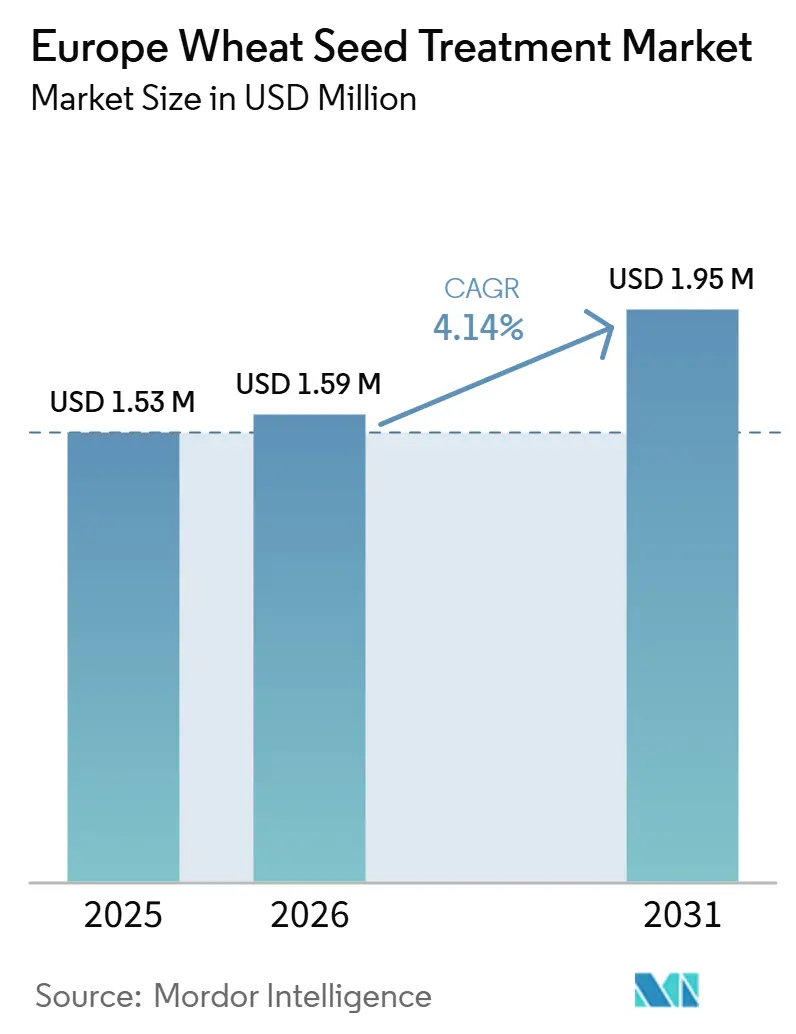
The Europe wheat seed treatment market size is projected to increase from USD 431.72 million in 2025 to USD 449.94 million in 2026 and reach USD 553.24 million by 2031, with a CAGR of 4.22% from 2026 to 2031.
The Europe wheat seed treatment market is being supported by stronger disease pressure in key wheat-growing areas, which is raising the value of early-stage crop protection before foliar spraying begins. The Europe wheat seed treatment market is also being shaped by a steady move toward microbial products, especially where growers and regulators are looking for lower-risk options and a better fit with sustainable farming programs. Regulatory pressure is also changing portfolio choices, particularly following the fludioxonil classification decision and the broader push toward reformulation ahead of tighter coating rules. This is pushing suppliers to invest in new actives, and microplastic-free coating systems rather than rely on older seed treatment lines. Competition remains moderately concentrated because the leading companies still hold the strongest positions in active substance development, formulation know-how, and large-scale commercial treatment channels.
Key Report Takeaways
- By product type, insecticides were the largest, accounting for 50.4% of the Europe wheat seed treatment market share in 2025, while fungicides were the fastest-growing, projected to grow at 4.7% through 2031.
- By geography, Germany was the largest, holding 28.6% of the Europe wheat seed treatment market size in 2025, while France was the fastest and is projected to grow at 6.1% through 2031.
Note: Market size and forecast figures in this report are generated using Mordor Intelligence’s proprietary estimation framework, updated with the latest available data and insights as of January 2026.
Europe Wheat Seed Treatment Market Trends and Insights
Drivers Impact Analysis*
| Driver | (~) % Impact on CAGR Forecast | Geographic Relevance | Impact Timeline |
|---|---|---|---|
| Rising wheat fungal disease pressure | +0.7% | Germany, France, United Kingdom, and Denmark | Short term (≤ 2 years) |
| Regulatory shift away from high-risk chemical actives | +0.8% | European Union 27, with high impact in Germany and France | Medium term (2-4 years) |
| Carbon-linked agronomy incentives for lower-input crop protection | +0.9% | France, Germany, and United Kingdom | Medium term (2-4 years) |
| Seed treatment use in precision seeding and variable-rate farming | +0.6% | Germany, France, Netherlands, and Poland | Long term (≥ 4 years) |
| Increase in area under cultivation of wheat | +0.4% | European Union 27, with early gains in Poland, Italy, and the United Kingdom | Long term (≥ 4 years) |
| Cold-chain and shelf-life advances in seed coatings | +0.5% | Europe, the Middle East, and Africa region | Medium term (2-4 years) |
| Source: Mordor Intelligence | |||
Rising Wheat Fungal Disease Pressure
The Europe wheat seed treatment market is seeing firmer demand because fungal pressure has become harder to manage with standard foliar programs alone. Research published in 2025 showed that warm and moist winter conditions in the 2024 season supported early disease development in winter wheat and changed how growers assessed protection needs at sowing. A second 2025 study also reported resistance-breaking stem rust races across multiple European locations, which raised the value of stronger fungicidal protection before crop emergence. This matters because seed treatment helps limit seed-borne and soil-borne infection before in-season spray timing becomes critical. It also supports demand for broader, multi-active combinations that growers view as more dependable in years with unstable disease pressure.
Regulatory Shift Away From High-Risk Chemical Actives
The Europe wheat seed treatment market is also being pushed forward by regulation, even though the same process creates short-term disruption for existing products. The most important recent example is the November 2024 classification of fludioxonil as an endocrine disruptor, which affected a very large share of cereal seed treatment portfolios and brought attention to replacement needs ahead of the September 2026 approval expiry[1]Source: Landwirtschaftskammer Niedersachsen, “Beizung im Wintergetreide,” pflanzenschutzdienst-niedersachsen.de. Wageningen University and Research showed in 2024 that approval costs carry a heavy weight in investment decisions for new low-risk substances, which means reformulation is easier for large suppliers than for smaller entrants. That pressure is reducing room for older chemistry while raising the commercial value of compliant alternatives. As a result, suppliers are shifting more capital, lower-risk actives, and new coating systems that can stay on the market longer.
Carbon-Linked Agronomy Incentives for Lower-Input Crop Protection
The Europe wheat seed treatment market is also benefiting from carbon-linked farming programs that reward lower-input crop management. The Organization for Economic Co-operation and Development noted that the Carbon Removals and Carbon Farming Regulation created a European framework that can support verified reductions in synthetic pesticide use as part of broader carbon farming activity. A 2025 study in Sustainability showed that Poland’s 2023 to 2027 eco-scheme allocated PLN 2.78 billion (USD 660 million) to carbon farming and nutrient management interventions, including lower-input practices. The Sustainable Wheat Initiative Europe also committed in 2025 to a 30% reduction in wheat supply chain emissions by 2030 versus 2022, which gives buyers and growers a clearer reason to document input choices. This creates a useful commercial link between seed treatment choice, agronomic traceability, and low-carbon grain procurement.
Seed Treatment Use in Precision Seeding and Variable-Rate Farming
The Europe wheat seed treatment market is gaining support from precision seeding systems that place more value on each planted seed. The 4 Growth Horizon Europe project reported wider use of digital and precision farming tools across several European markets in 2024, especially in large arable systems[2]Source: 4Growth Horizon Europe Project, “Precision Farming in Action, The Role of Variable Rate Technologies,” 4growth-project.eu. Research in Precision Agriculture also showed that variable seed and fertilizer management in semiarid rainfed zones made input choice more site-specific and made poor establishment harder to absorb. When seed rates are optimized by zone, growers have less room for stand losses caused by insects or pathogens at emergence. That favors higher-quality formulations and treatment programs with more consistent coverage and early crop response.
Restraints Impact Analysis*
| Restraint | (~) % Impact on CAGR Forecast | Geographic Relevance | Impact Timeline |
|---|---|---|---|
| Tight EU re-approval and residue compliance burden | -0.7% | European Union 27 | Short term (≤ 2 years) |
| Higher cost of advanced treatment formulations and application lines | -0.5% | Eastern Europe and Southern Europe | Medium term (2-4 years) |
| Limited efficacy consistency across variable climates | -0.4% | Northern Europe and continental climate zones | Medium term (2-4 years) |
| Brexit-linked approval fragmentation | -0.3% | Great Britain and Northern Ireland | Short term (≤ 2 years) |
| Source: Mordor Intelligence | |||
Tight EU Re-Approval and Residue Compliance Burden
The Europe wheat seed treatment market still faces a major drag from the time and cost of product re-approval. The fludioxonil decision showed how one regulatory change can affect many cereal seed treatments at the same time and leave growers with fewer short-term substitutes. Wageningen University and Research also found that dossier costs remain one of the largest barriers for new low-risk products, which weighs most heavily on smaller developers. This slows portfolio renewal even when agronomic demand is strong. It also reinforces the advantage of large companies that can spread compliance cost across broader product ranges.
Higher Cost of Advanced Treatment Formulations and Application Lines
The Europe wheat seed treatment market faces limitations due to the higher costs associated with advanced formulations and treatment equipment. Multi-active combinations and blends often require precise dosing, enhanced compatibility controls, and additional operator training compared to older single-active products. This cost disparity is particularly evident among smaller farms and in regions with less developed professional treatment infrastructure. Consequently, some growers postpone upgrades despite the agronomic benefits. Adoption typically progresses first through large commercial treaters before reaching farm-level operations. However, the market is gradually evolving as awareness of the long-term benefits of advanced treatments increases. Government initiatives and subsidies in some regions are also encouraging the adoption of these technologies, particularly among smaller farms. Additionally, advancements in treatment equipment and formulations are projected to reduce costs over time, making these solutions more accessible to a broader range of growers.
*Our forecasts treat driver/restraint impacts as directional, not additive. The impact forecasts reflect baseline growth, mix effects, and variable interactions.
Segment Analysis
By Product Type: Insecticide Dominance Anchored by Commercial Infrastructure
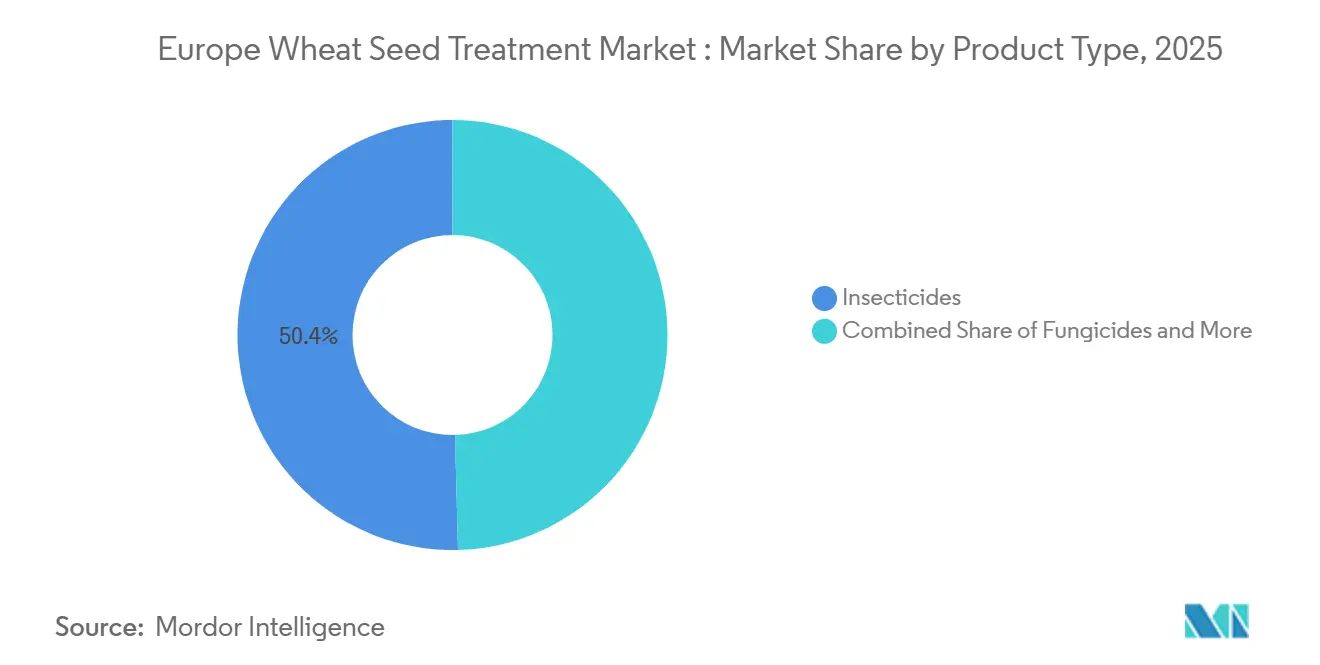
Insecticides were the largest product type in the Europe wheat seed treatment market share, with 50.4% share in 2025. This part of the Europe wheat seed treatment industry remains rooted in long-established commercial routines that target soil insects and virus-carrying pests before emergence. Growers continue to value seed-stage control because it offers a clear application window and protects early stand establishment. Restrictions on some legacy chemistries have not reduced demand, as they have shifted buyers toward higher-value replacement products.
Fungicides are the fastest product type in the Europe wheat seed treatment market size and are projected to grow at 4.7% through 2031. The main reason is the heavier pressure from Fusarium, rust, smut, and related diseases across important wheat belts. The fludioxonil review has added urgency to reformulation work, which is pushing suppliers toward new multi-active combinations and lower-risk options. This part of the Europe wheat seed treatment industry is therefore growing through value mix change as much as through area treated.



Geography Analysis
Germany was the largest country segment in the Europe wheat seed treatment market, with 28.6% share in 2025. The country’s large wheat area and advanced commercial treatment network continue to support high product use and more standardized treatment protocols. Germany is also one of the markets most exposed to portfolio disruption from fludioxonil, because the active substance is embedded in a large number of cereal seed treatment products. This creates near-term pressure, but it also increases the incentive to adopt reformulated and alternative products. The United Kingdom remains important as a separate regulatory market with its own approval timing and launch priorities.
France is the fastest country segment in the Europe wheat seed treatment market and is projected to grow at 6.1% through 2031. France combines high treatment penetration with active work on registrations and new formulation choices. ARVALIS reported that 94% of the French soft wheat area was established with treated seed in 2024, indicating that future growth will come more from product mix and technology content than from new treatment coverage. France also became the first market to authorize TOLTEK for cereal use, which gives suppliers an earlier opening than in many neighboring countries. New efficacy work from ARVALIS in 2025 also showed that alternative fungicide combinations are gaining attention in French wheat programs.
Italy and Spain add meaningful demand under Mediterranean conditions, where growers often value targeted treatment choices over broad standard programs. Spain also stands out in precision seeding work, which supports higher-value seed treatment specifications when planting decisions are made by zone. Russia remains outside the main European Union registration structure, which limits direct alignment with the broader regional product pipeline. The rest of Europe, including Poland, the Czech Republic, Hungary, and Romania, presents mixed conditions, with larger consolidated farms moving faster than smaller price-sensitive operations.
Competitive Landscape
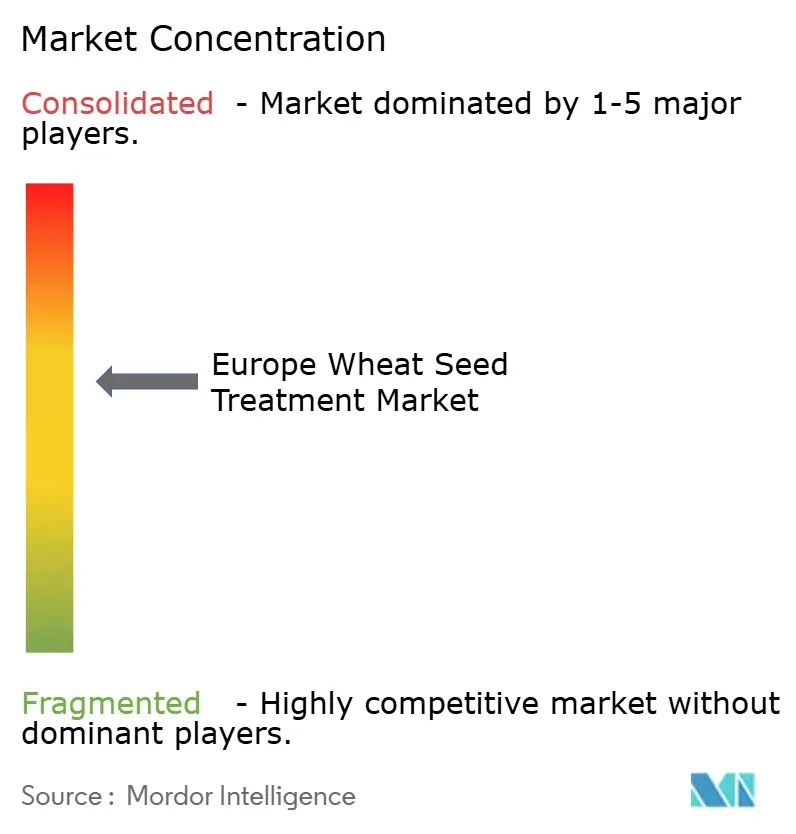
The Europe wheat seed treatment market remains moderately concentrated around Bayer AG, Syngenta Group, UPL Limited, BASF SE, and Corteva Agriscience. These companies hold advantages in active-substance pipelines, formulation development, commercialization relationships, and large-scale regulatory capabilities. That position matters more now because product reformulation and new approvals require capital, data, and time. It also makes the leading group better placed to manage portfolio disruption when major active substances face regulatory pressure.
BASF SE has been especially active in building capacity within the Europe wheat seed treatment market. In May 2026, BASF SE commissioned its fermentation plant in Ludwigshafen with an investment of EUR 80 million to EUR 99 million (USD 87 million to USD 108 million), strengthening in-house production of crop protection products and seed treatment inputs[3]Source: BASF SE, “BASF Agricultural Solutions Successfully Commissions New Fermentation Plant for Crop Protection Products in Ludwigshafen,” basf.com. In March 2026, BASF SE also completed the acquisition of AgBiTech, which widened its crop protection portfolio. In December 2025, BASF SE and ADAMA entered a co-development and commercialization partnership for Gilboa-based fungicide technology for European cereal growers. These moves show how large suppliers are building both product pipelines and manufacturing depth.
The second competitive tier is becoming more important as specialized technologies gain ground. Incotec Group B.V. is strengthening its position through seed-coating innovation, especially with its microplastic-free film-coat technology. Koppert B.V. is expanding its crop protection business, including its 2025 distribution agreement and equity investment with Amoéba SA for a fungicide platform across 18 European countries. Certis Belchim also holds a visible role because TOLTEK gives it an early foothold in cereal seed treatment. Overall, competition is strongest where companies can combine regulatory access, commercial scale, and new coating capabilities.
Europe Wheat Seed Treatment Industry Leaders
Bayer AG
Corteva Agriscience
Syngenta Group
UPL Limited
BASF SE
- *Disclaimer: Major Players sorted in no particular order

Recent Industry Developments
- April 2026: Corteva Agriscience launched Lumiscend LUXE, a four-active fungicide seed treatment for cereal crops that controls Fusarium and Rhizoctonia while improving early crop establishment. The launch supports the Europe wheat seed treatment market by addressing key wheat diseases.
- April 2026: Incotec Group B.V. launched Disco Red L-1140, a high-performance microplastic-free film coating for cereal seeds, enabling seed companies to comply with the EU's 2028 microplastics regulation while maintaining coating performance. The launch expands Incotec's portfolio of microplastic-free seed coating solutions for field crops and supports the transition toward sustainable seed technologies in Europe.
- December 2025: BASF SE and ADAMA announced a strategic co-development and commercialization partnership for ADAMA's Gilboa fungicide technology to expand resistance-management solutions for European cereal growers. Subject to regulatory approvals, Gilboa-based formulations for wheat are planned for launch in Great Britain in 2027, followed by broader commercialization across Europe in 2029.


Europe Wheat Seed Treatment Market Report Scope
Seed treatment is the practice of coating seeds with crop protection chemicals, primarily fungicides and insecticides. Seed treatment products are physical and chemical agents and techniques applied to seeds to protect and improve the establishment of healthy crops. The Europe wheat seed treatment market report is segmented by product type (insecticides, fungicides, nematicides, and more) and by geography (Germany, the United Kingdom, France, Italy, Spain, Russia, and the rest of Europe). The market forecasts are provided in terms of value (USD).
| Insecticides |
| Fungicides |
| Nematicides |
| Other Types |
| Germany |
| United Kingdom |
| France |
| Italy |
| Spain |
| Russia |
| Rest of Europe |
| By Product Type | Insecticides |
| Fungicides | |
| Nematicides | |
| Other Types | |
| Europe | Germany |
| United Kingdom | |
| France | |
| Italy | |
| Spain | |
| Russia | |
| Rest of Europe |


Key Questions Answered in the Report
What is the 2026 size of the Europe wheat seed treatment space?
The Europe wheat seed treatment market size is estimated at USD 449.94 million in 2026 and is forecast to reach USD 553.24 million by 2031, growing at a CAGR of 4.22% from 2026 to 2031.
Which product type leads seed treatment demand in European wheat?
Insecticides were the largest product type in 2025 with 50.4% share, while fungicides are the fastest-growing product type through 2031.
Why are fungicide seed treatments gaining importance in Europe?
Heavier disease pressure, early infection risk, and resistance concerns in rust and related pathogens are increasing the value of seed-stage fungicidal protection.
Which country offers the strongest growth outlook?
France is the fastest-growing country at an 6.1% CAGR through 2031, supported by high treatment penetration and early registration activity.
Page last updated on:





