
Market Overview
| Study Period | 2021 - 2031 |
|---|---|
| Forecast Data Period | 2026 - 2031 |
| Base Year Market Size (2025) | USD 0.90 Billion |
| Market Size (2026) | USD 0.95 Billion |
| Market Size (2031) | USD 1.25 Billion |
| Growth Rate (2026 - 2031) | 5.59 % |
| Market Concentration | Medium |
Major Players *Disclaimer: Major Players sorted in no particular order Image © Mordor Intelligence. Reuse requires attribution under CC BY 4.0. | |
Europe Sourdough Market Analysis by Mordor Intelligence
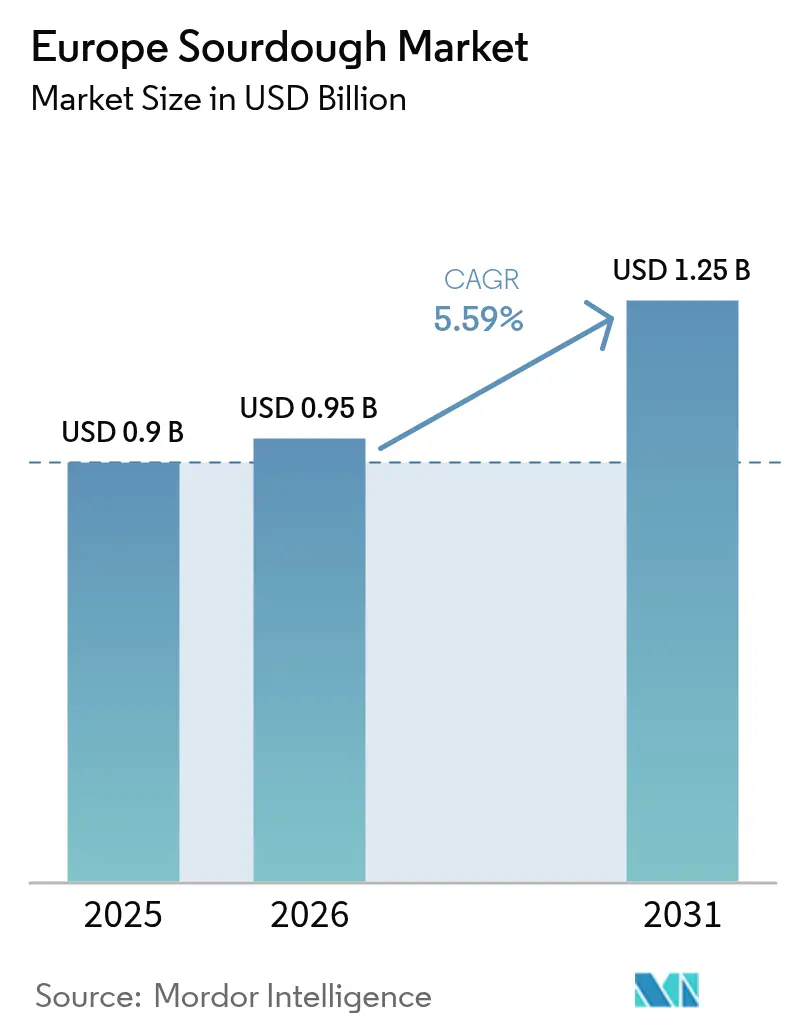
The European sourdough market size was valued at USD 0.90 billion in 2025 and estimated to grow from USD 0.95 billion in 2026 to reach USD 1.25 billion by 2031, at a CAGR of 5.59% during the forecast period (2026-2031). The market expansion reflects increased consumer interest in traditional fermentation methods, driven by health awareness and demand for artisanal products. Belgium has emerged as a key player in the sourdough renaissance, with European manufacturers combining traditional methods with industrial production capabilities. The industry's shift toward scaled production has created opportunities for technological advancement, as demonstrated by Puratos' Sourdough Institute launch in Belgium in 2024 and Aryzta's USD 12 million investment in a stone oven facility at its Eisleben location. Market growth is primarily driven by demand for clean-label products, protein enrichment trends, and accessible home baking solutions. However, the market faces challenges including price competition with conventional bread products and production limitations among artisanal bakers in smaller markets. Raw material price fluctuations, particularly for specialty and rye flours, continue to impact profit margins, with German bakery prices rising by 33% between 2019 and 2023, as reported by the Federal Statistical Office (FinanzNachrichten.de). These factors highlight the market's progression from specialized artisanal production to mainstream manufacturing, supported by technological advancements and strategic investments.
Key Report Takeaways
- By form, dry mix and premix solutions led with 61.74% of the European sourdough market share in 2025, while ready-to-use liquid solutions recorded the highest projected CAGR at 6.48% through 2031.
- By application, bread and buns accounted for 67.98% of the European sourdough market size in 2025, while pizza crusts and bases recorded the highest projected CAGR at 7.54% through 2031.
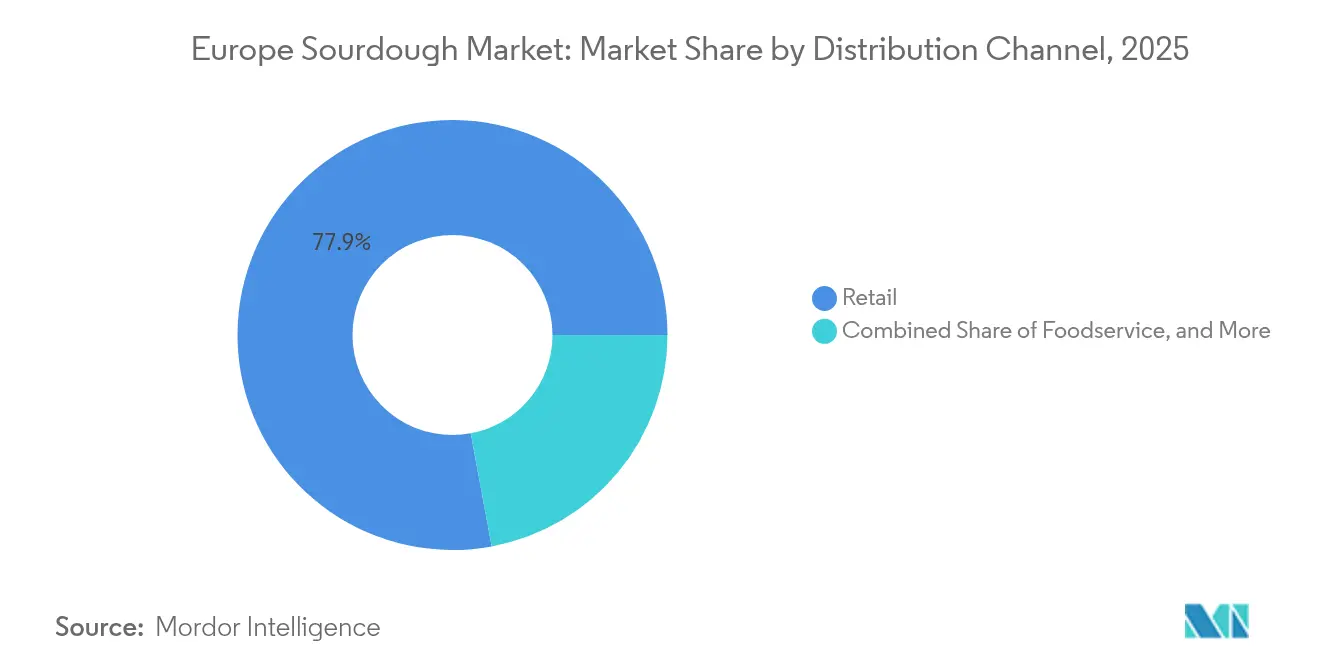
- By distribution channel, the retail segment commanded 77.92% of the European sourdough market size in 2025, and foodservice is advancing at a 6.87% CAGR to 2031.
- By geography, Germany held 22.63% of Europe's sourdough market share in 2025, while the United Kingdom is forecast to expand at an 7.91% CAGR through 2031.
Note: Market size and forecast figures in this report are generated using Mordor Intelligence’s proprietary estimation framework, updated with the latest available data and insights as of 2026.
Market Trends and Insights
Drivers Impact Analysis of Europe Sourdough Market*
| Driver | (~) % Impact on CAGR Forecast | Geographic Relevance | Impact Timeline |
|---|---|---|---|
| Rising demand for artisanal and traditional baking methods | +1.2% | Germany, Italy, France, Belgium | Medium term (2-4 years) |
| Growing demand for clean-label breads with longer shelf life | +1.1% | Global, with strongest uptake in UK, Netherlands | Short term (≤ 2 years) |
| Expansion of convenient formats and home baking solutions | +0.9% | North America and EU, particularly urban centers | Medium term (2-4 years) |
| Industrialised liquid and dried starters enabling scale | +0.8% | Germany, France, Netherlands, Belgium | Long term (≥ 4 years) |
| Regenerative and ancient-grain flour sourcing agreements | +0.7% | EU core markets, spill-over to Eastern Europe | Long term (≥ 4 years) |
| Increasing protein and nutrient fortification trends | +0.6% | UK, Germany, Nordics with health-focused consumers | Medium term (2-4 years) |
| Source: Mordor Intelligence | |||
Rising Demand for Artisanal and Traditional Baking Methods
According to Puratos' tracking of Google trends data, searches for sourdough surged fivefold during the pandemic, underscoring a decisive shift in consumer preferences toward authentic fermentation processes[1]. This heightened demand isn't limited to home bakers; commercial foodservice operators are now actively seeking out differentiated bread offerings that can command premium prices. In response to this trend, major industrial players are channeling investments into initiatives aimed at preserving culinary heritage. A prime example is Puratos, which maintains a library in Belgium housing 84 distinct sourdough cultures, alongside documentation of over 700 wild yeast strains and 1,500 lactic acid bacteria strains. By blending artisanal methods with industrial processes, suppliers gain a competitive edge, delivering consistent quality without compromising on traditional flavor profiles. In the UK, the Federation of Bakers has introduced a sourdough code of practice, offering regulatory clarity that not only sets quality standards for commercial production but also bolsters market expansion. This framework empowers smaller producers to compete on a level playing field, all while reinforcing consumer trust in the authenticity of the products.
Growing Demand for Clean-Label Breads with Longer Shelf Life
Driven by consumer scrutiny of ingredient lists and a demand for recognizable components, clean-label positioning has become essential for market access. Sourdough's natural fermentation process offers preservation benefits through organic acid production, which not only reduces the need for synthetic additives but also extends shelf life. In 2024, Kerry launched Biobake Fibre specifically for rye bread applications, showcasing how ingredient suppliers are meeting clean-label demands while fulfilling functional needs[2]. The European Union mandates comprehensive disclosure of processing aids and additives, creating a competitive edge for naturally fermented products that need fewer ingredient declarations. Corbion introduced natural mold inhibition solutions in April 2025, highlighting industry innovation in tackling shelf-life challenges while maintaining clean-label integrity[3]. This trend is especially advantageous for retail channels, as the extended shelf life of sourdough products not only reduces waste but also enhances distribution economics, allowing them to compete more effectively against conventional breads.
Expansion of Convenient Formats and Home Baking Solutions
Beyond pandemic-induced surges, the home baking segment has seen steady growth, driven by consumers' desire for convenient formats that yield artisanal results without demanding extensive time. Dry mix and premix formats, commanding a 62.38% market share, enable consistent home production while preserving the distinctive flavor development of sourdough. In response, industrial suppliers have crafted starter systems that streamline fermentation without compromising authentic taste. Addressing this demand, IREKS expanded its MONDO LIEVITO MADRE product line in 2025, offering standardized sourdough solutions for both commercial and home use. This trend of convenience isn't limited to home bakers; foodservice operators also seek dependable sourdough solutions that cut down prep time without sacrificing quality. Furthermore, collaborations between ingredient suppliers and grocery chains have broadened the reach of home baking solutions. These partnerships are bolstered by educational content, instilling confidence in consumers regarding sourdough preparation techniques.
Industrialized Liquid and Dried Starters Enabling Scale
Industrial-scale starter production has shifted sourdough from a niche craft to a mass-manufactured product, ensuring uniform quality even at large volumes. In September 2024, Lesaffre introduced Tradizy Durum, showcasing breakthroughs in starter stabilization technology that preserve microbial activity during storage and transit. Liquid starter systems streamline operations with less handling and better fermentation oversight, whereas dried formats boast a longer shelf life and easier logistics. The European Food Safety Authority has eased regulatory hurdles for small bakeries, promoting the use of starter-based production systems[4]. Cutting-edge fermentation monitoring tools allow for meticulous control over pH, temperature, and microbial activity, guaranteeing product consistency even as production scales up. Such advancements have piqued the interest of private equity firms, leading to a wave of mergers and acquisitions in Europe's bakery sector, as they aim to merge fragmented artisanal operations into unified, scalable entities.
Restraints Impact Analysis of Europe Sourdough Market*
| Restraint | (~) % Impact on CAGR Forecast | Geographic Relevance | Impact Timeline |
|---|---|---|---|
| Price elasticity versus conventional white breads | -1.8% | Eastern Europe, price-sensitive segments across EU | Short term (≤ 2 years) |
| Limited artisanal baker capacity in secondary cities | -1.4% | Secondary cities across Germany, France, Italy | Medium term (2-4 years) |
| Regulatory and labeling constraints | -0.9% | EU-wide, particularly affecting cross-border trade | Long term (≥ 4 years) |
| Volatile rye and speciality-flour costs | -1.2% | Northern Europe, particularly Germany, Netherlands | Short term (≤ 2 years) |
| Source: Mordor Intelligence | |||
Price Elasticity Versus Conventional White Breads
Sourdough products often carry a 20-40% price premium over regular breads, creating affordability challenges that hinder their appeal to budget-conscious consumers. Between 2019 and 2023, German bakery prices surged by about 33%, with specialty breads facing a steeper inflation, leading to a dip in demand elasticity, as reported by FinanzNachrichten.de. In Eastern Europe, economic constraints limit the uptake of premium breads, as households prioritize essential foods over artisanal options. The widening price gap stems from rising ingredient costs for specialty flours and longer fermentation processes, outpacing inflation for standard bread inputs. In response, retail chains have introduced private-label sourdoughs, aiming to bridge the price gap without compromising on quality, yet these products yield slimmer margins compared to their conventional counterparts. While consumer education on the nutritional and digestibility benefits of sourdoughs helps rationalize the premium pricing, broader market growth hinges on further cost reductions via industrial scaling and enhanced supply chain efficiencies.
Limited Artisanal Baker Capacity in Secondary Cities
Over the past decade, Germany has seen a significant contraction in its bakery sector, losing about 30% of its establishments and resulting in the loss of roughly 20,000 jobs. Meanwhile, France has witnessed a similar trend, with around 25% of its artisanal bakeries vanishing. Labor shortages have exacerbated these capacity challenges; in the Netherlands, nearly half of all bakeries report unfilled vacancies, and over 75% of their staff indicate heightened workloads. Secondary cities face unique challenges in sustaining artisanal bakeries, grappling with lower population densities and diminished demand for premium products, leading to noticeable gaps in sourdough availability. In Germany, the number of bakery apprenticeships has plummeted by half in the last decade, curtailing the influx of skilled artisans essential for sourdough production. Given the intricate nature of sourdough fermentation, which demands specialized knowledge and resists automation, there's a pronounced bottleneck in expanding production capacity. In response, industrial suppliers have rolled out technical support initiatives and streamlined production systems, aiming to lessen skill demands without compromising on product quality.
*Our forecasts treat driver/restraint impacts as directional, not additive. The impact forecasts reflect baseline growth, mix effects, and variable interactions.
Europe Sourdough Market Segment Analysis
By Form:
Dry Solutions Drive Industrial AdoptionIn 2025, dry mix and premix formats dominate the market with a commanding 61.74% share, thanks to their convenience and scalability. Their extended shelf life not only minimizes inventory risks for distributors but also allows for wider geographic distribution without the need for cold chain logistics. Industrial bakeries prefer dry formats due to their consistent fermentation performance and simpler handling, unlike liquid starters that demand temperature control and precise timing. Meanwhile, ready-to-use liquids are on a growth trajectory, boasting a 6.48% CAGR through 2031. These liquid starters are particularly valued in artisanal settings, where their immediate fermentation and flavor depth are crucial. This is especially true for smaller bakeries aiming for authentic sourdough without the hassle of extensive starter upkeep.
Technological advancements in stabilization techniques have bolstered the segment's growth, ensuring microbial viability during dehydration and storage. This consistency in fermentation performance, regardless of environmental conditions, is a boon for manufacturers. Lesaffre's September 2024 launch of Tradizy Durum underscores this trend, introducing an innovative durum-based sourdough system that marries traditional fermentation with industrial reliability. Regulatory factors lean in favor of dry formats, which demand less stringent cold chain oversight and pose reduced microbiological transport risks. Furthermore, the European Food Safety Authority's safety framework, which eases regulatory hurdles for established microbial strains in dried starter production, further propels market expansion.


By Application:
Pizza Innovation Accelerates GrowthIn 2025, bread and buns applications command a dominant 67.98% market share, underscoring sourdough's deep-rooted ties to artisanal bread-making and the public's affinity for fermented bread products. Yet, it's the pizza crusts and bases that are witnessing the most rapid ascent, boasting a 7.54% CAGR through 2031. This surge is largely attributed to foodservice operators, who are on the hunt for unique offerings that can command a premium in the fiercely competitive restaurant landscape. Sourdough's advantages in pizza applications are manifold: it boasts better dough handling, richer flavor development, and longer holding times, all of which help minimize waste in bustling commercial kitchens. Specialty bakeries, eyeing the premium dessert market, continue to see steady demand for cakes and pastries. Meanwhile, flatbreads and other specialty baked goods are carving out niche spaces, appealing to both ethnic tastes and health-conscious consumers.
The pizza segment's rapid growth mirrors a larger movement in casual and fast-casual dining, where there's a pronounced emphasis on artisanal ingredients and genuine preparation techniques. Sourdough pizza crusts come with operational perks: they boast better freeze-thaw stability and a tolerance for extended fermentation. This means restaurants can prep their bases ahead of time without compromising on quality. Puratos' Sapore product line is making waves, specifically catering to the pizza segment with its high-temperature baking and flavor-enhancing formulations. The surge in this application is further bolstered by the public's perception of sourdough as a healthier choice compared to traditional pizza dough, allowing it to command a premium in health-centric markets. Moreover, in Italy and select European nations, regulatory frameworks championing traditional preparation methods pave the way for genuine sourdough pizza offerings, especially those meeting protected designation standards.
By Distribution Channel:
Foodservice Momentum BuildsIn 2025, retail channels dominate with a 77.92% market share, underscoring sourdough's robust foothold in supermarket bakeries and specialty food outlets. These outlets cater to health-conscious consumers gravitating towards artisanal choices. Retailers favor sourdough not just for its longer shelf life compared to regular bread, but also for its premium positioning, which boosts their profit margins. Supermarkets and hypermarkets leverage their scale in sourcing and distribution, allowing them to offer competitive prices without compromising on quality, thanks to their established cold chain logistics. Meanwhile, specialty stores focus on premium segments, offering curated sourdough selections and educational insights that foster consumer loyalty. Online retail is also on the rise, appealing to consumers who prioritize convenience and seek direct delivery of artisanal products.
Foodservice is emerging as the fastest-growing distribution channel, boasting a 6.87% CAGR through 2031. This surge is largely attributed to restaurants incorporating sourdough bases, enhancing both their menu diversity and operational efficiency. Sourdough's advantages in commercial kitchens—like longer holding times, better freeze-thaw stability, and richer flavor profiles—bolster its premium pricing. Ingredient suppliers are increasingly turning to sourdough-based solutions, especially for baked goods that demand longevity and consistent quality in large batches. Major producers, represented by the Belgian Federation of Industrial Bakeries, are supplying standardized sourdough products to both retail and foodservice sectors, ensuring they meet commercial standards. Partnerships, like Ulrick & Short's collaboration with Nordmann in early 2025, are broadening the market reach for specialized sourdough ingredients across various channels.
Geography Analysis
Germany Sourdough Market
In 2025, Germany solidifies its status as Europe's leading sourdough market, commanding a 22.63% share. This dominance is bolstered by a robust consumer affinity for traditionally fermented breads and a significant industrial presence, notably in Saxony-Anhalt, home to one of Europe's largest bake-off facilities operated by Aryzta. The market thrives on well-established distribution channels and a cultural penchant for dense, flavorful breads, a hallmark of sourdough. Yet, Germany's sourdough landscape grapples with challenges: a decade-long 30% drop in bakery operations and pronounced labor shortages hindering artisanal production. Aryzta's commitment to the German market is underscored by its USD 12 million investment in a state-of-the-art stone oven facility in Eisleben, set to be fully operational by H2 2025, even amidst sector consolidation pressures. While prices surged by about 33% from 2019 to 2023, tightening demand elasticity, especially among price-sensitive consumers, the market still sees a viable premium segment for distinct sourdough offerings.
United Kingdom Sourdough Market
The United Kingdom stands out as the fastest-growing sourdough market in Europe, boasting an 7.91% CAGR projected through 2031. This growth is fueled by a surge in health consciousness and the Federation of Bakers' sourdough code of practice, which has brought much-needed regulatory clarity. Adjustments in the supply chain post-Brexit have not only bolstered domestic sourdough production but also diminished competition from EU imports, now facing new trade barriers. Strong retail collaborations further bolster the UK market, highlighted by Promise Gluten Free's partnerships with retail giants like Tesco, Sainsbury's, Morrisons, Aldi, and Lidl. In a move signaling consolidation trends, Mayfair, via its Ceres Group holding company, has proposed acquiring Pat the Baker and Irish Pride, a decision brought to the attention of Ireland's Competition and Consumer Protection Commission in December 2024. With the UK set to mandate folic acid fortification in December 2026, there's a burgeoning market for fortified sourdough products that align with these nutritional directives.
Broader European Markets
Italy, France, and Spain, with their deep-rooted cultural ties to traditional fermentation, are witnessing tempered growth rates as they mature and face heightened competition. Italy's dedication to its artisanal bread heritage is evident, with the Ministry of Agriculture highlighting 23 traditional flatbreads, including 2 Protected Geographical Indications and 20 Traditional Agri-food Products, bolstering the sourdough market's evolution. France, despite a robust consumer appetite for traditional products, grapples with a 25% decline in artisanal bakeries, constraining market expansion. Belgium, anchored by Puratos' Sourdough Library and research facilities in Saint-Vith, emerges as a pivotal innovation hub, shaping European sourdough trends. Meanwhile, the Netherlands, Poland, and Sweden present burgeoning opportunities, driven by health-conscious consumers and a rising appetite for premium bakery products, though they necessitate further investment in distribution and consumer education.
Regulatory Landscape
The European sourdough market operates under EU food law covering food safety, additive use, and consumer information. In practice, sourdough is typically handled as a compound ingredient under Regulation (EU) No 1169/2011, so ingredient declarations must clearly reflect substrates (such as flour and water) and starter cultures where used. Any additives used alongside sourdough in bakery applications also need to comply with the Union list under Regulation (EC) No 1333/2008 (Annex II), which affects formulation choices for shelf life, texture, and processing performance.
For most traditional sourdough breads made through natural fermentation without isolated or specially produced microorganisms, the product is not treated as a Novel Food under Regulation (EU) 2015/2283, given sourdough's history of significant consumption in the EU prior to 15 May 1997. On the premarket authorization side, EFSA updated its Scientific Guidance on Food Additives on 20 January 2026, applying to applications submitted from 20 July 2026 onward, which raises the bar for dossiers when suppliers seek approvals for new additive uses or novel functional systems around sourdough. At the same time, cross-border labeling still requires attention, as some member states apply national definitions or codes of practice for “sourdough” and “sourdough bread,” which can influence product naming and labeling in specific markets.
Value Chain Analysis
The European sourdough value chain starts with grain sourcing and milling (wheat, rye, and specialty flours), followed by ingredient processing into dried mixes/premixes and ready-to-use liquid starters supplied by culture specialists and bakery-ingredient manufacturers. Key upstream and midstream players include Puratos, Lesaffre, Lallemand, IREKS, Backaldrin, and Ernst Bocker, alongside blenders and functional-ingredient suppliers (including enzymes and preservation systems) that help bakers maintain consistent fermentation, flavor, and shelf life.
In the downstream segment, sales move through direct B2B sales to industrial bakeries and bake-off operators, with wholesalers and regional distributors also providing technical support, training, and troubleshooting for fermentation control. Bottlenecks typically come from long fermentation cycles, maintaining starter consistency at scale, and climate control needs, which supports the shift toward standardized starter systems and formats that simplify handling and logistics. Channel expansion depends heavily on distribution partnerships that bring sourdough inputs to craft and mid-sized bakers, such as AB Mauri signing an exclusive wholesale distribution partnership with BAKO Group in the UK in June 2026 for two Aromaferm sourdough lines (Fermora Wheat and Rye Ferment 200), improving reach and service coverage.
Competitive Landscape
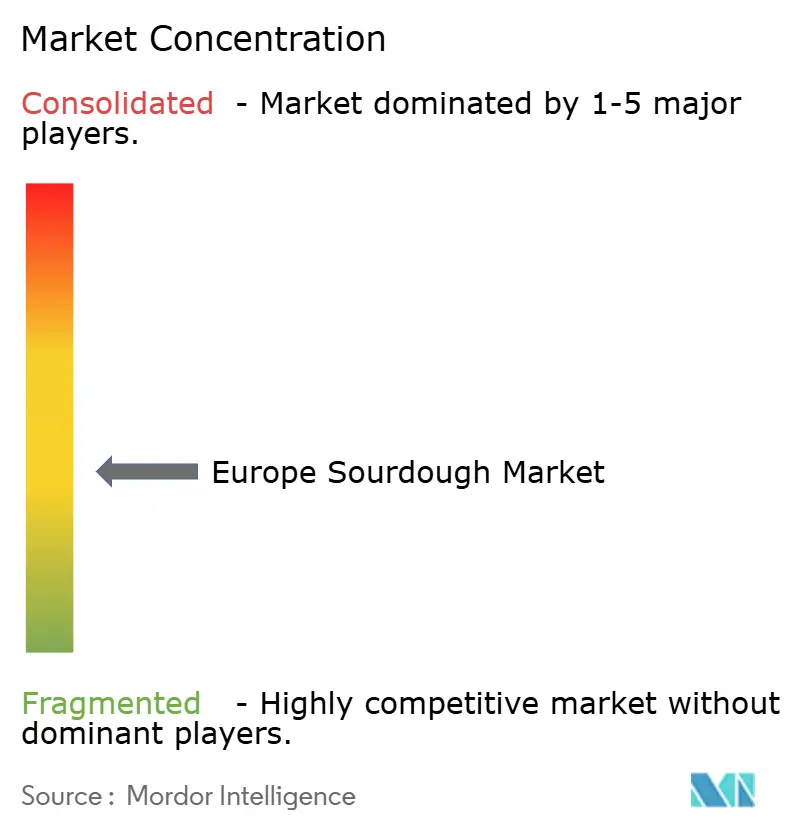
In the European sourdough market, moderate fragmentation presents opportunities for both established players and emerging specialists to carve out market share through unique positioning and technological advancements. Leaders like Puratos Group, Aryzta AG, and Lesaffre focus on scaling industrial capabilities, offering technical support, and ensuring product consistency. In contrast, regional artisanal producers leverage their authentic positioning and deep local market insights for a competitive edge.
This competitive landscape illustrates a shift from craft production to industrial scalability. Success hinges on harmonizing traditional fermentation techniques with contemporary manufacturing efficiencies and stringent quality controls. Notable strategic moves include Puratos inaugurating its Sourdough Institute in Belgium in 2024 and curating the world's largest sourdough culture library, boasting 84 unique strains. Meanwhile, Aryzta's USD 12 million plunge into stone oven technology at its Eisleben site underscores how industry stalwarts meld capital investments with artisanal quality, as highlighted by Snack Food & Wholesale Bakery.
Smaller players eyeing the market can find untapped potential in niche areas like gluten-free sourdough, protein-enriched variants, and user-friendly home baking solutions, establishing footholds before larger entities roll out rival products. Mayfair's strategic acquisitions via its Ceres Group underscore the sector's allure, spotlighting its growth trajectory and the allure of consolidation amidst its fragmentation. Companies boasting stringent quality systems and adept regulatory compliance gain an edge, thanks to European Union food safety regulations. At the same time, smaller artisanal producers find favor with the European Food Safety Authority's lenient stance on traditional fermentation methods.
Europe Sourdough Industry Leaders
-
Puratos Group
-
Aryzta AG
-
Lesaffre
-
IREKS GmbH
-
Ernst Böcker GmbH & Co. KG
- *Disclaimer: Major Players sorted in no particular order
Europe Sourdough Market Companies Covered in this Report
- Puratos Group
- Aryzta AG
- Lesaffre
- IREKS GmbH
- Ernst Böcker GmbH & Co. KG
- Lallemand Inc.
- Backaldrin International
- Délifrance SA
- Lotus Bakeries
- AB Mauri
- DSM-Firmenich
- Novozymes
- MGP Ingredients (Europe)
- Puratos Sourdough Library
- GoodMills Group
- Hoorebeke Sourdough
- Cavendish Flour Mill
- Bake Plus
- Puratos Belgium
- DSF Sourdough Solutions
Market Opportunities and Future Outlook
Product development opportunities are building around clean-label performance and nutrition-led sourdough formulations that still fit EU labeling and additive rules. Puratos has already tied R&D to this direction, publishing research (October 2025, with the Free University of Bozen-Bolzano) on pulse-based sourdough using faba bean and yellow pea, reporting a 45% increase in protein content and improved digestibility, and pointing toward new B2B starter systems and recipes for protein-enriched breads and bases. R&D capabilities at major suppliers are also being showcased, including Lesaffre presenting its METAPATH multi-omic approach in February 2026 to decode fermentation pathways and optimize starter cultures, supporting the shift toward predictable flavor and process control across bread, buns, and pizza bases.
On the supply side, the core opportunity is scaling fermentation capacity and tightening regional logistics for bakery ingredients as labor constraints and consistency requirements push more bakers toward standardized inputs. EUROGERM inaugurated a 4,000 m2 bio-fermentation plant in Saint-Apollinaire, France in October 2024 (400 tons initial annual capacity, targeting 1,000 tons). Separately, FERM FOOD acquired the former Orkla site in Skovlund, Denmark in April 2026 to scale fermented-ingredient capacity by up to 20,000 tonnes per year, which improves industrial supply availability for sourdough-adjacent fermented solutions. Distribution and service infrastructure is also expanding in parts of Eastern Europe, with IREKS acquiring a 13,000 sqm plot in Chitila, Romania in March 2026 to develop an administrative headquarters and logistics warehouse for baking ingredients including sourdoughs, supporting faster fulfillment and more consistent technical support for regional bakeries.
Recent Industry Developments in Europe Sourdough Market
- June 2026: Puratos highlighted its "beyond clean label" ingredient approach at IDDBA 2026, showcasing Sapore sourdoughs and fermentation-led solutions positioned for simpler labels and functional performance. The update reinforces competitive differentiation around natural fermentation systems that can replace some additive-driven functionality in retail and foodservice bakery applications.
- January 2026: Aryzta announced plans for a new EUR 40 million bun bakery in Portugal to expand industrial baking capacity and support growth across its European platform. This investment strengthens large-scale production capability and supports higher demand for standardized sourdough and fermentation-based ingredient systems used to deliver consistent quality at scale.
- June 2025: Puratos launched Sapore Lavida, a traceable active sourdough produced in Belgium using 100% wholewheat flour sourced from regenerative agriculture. The launch expands sourdough offerings tied to traceability and sustainability claims, aligning sourdough positioning with retailer and consumer scrutiny of sourcing and production practices.
Europe Sourdough Market Report Scope and Research Methodology
Market Definition and Coverage
For this work, the Europe sourdough market is defined as the value of sourdough ingredients and sourdough bases sold for use in naturally leavened bakery products across Europe, counted at the point of sale from ingredient and starter suppliers to end users.
Scope exclusions: We exclude finished non-sourdough bakery items that use only commercial baker's yeast and no sourdough culture or starter process.
Segments Covered in This Report
- By Form
- Ready-to-Use Liquid
- Dry Mix / Premix
- By Application
- Bread and Buns
- Pizza Crusts and Bases
- Cakes, and Pastries
- Other Applications
- By Distribution Channel
- Food Processing
- Foodservice
- Retail
- Supermarkets / Hypermarkets
- Specialty Stores
- Online Retail
- Other Off-Trade Channels
- By Geography
- Germany
- United Kingdom
- Italy
- France
- Spain
- Netherlands
- Poland
- Belgium
- Sweden
- Rest of Europe
Data Sources, Market Sizing, and Validation
Desk Research
Desk research helped us set the market frame and build the first set of inputs that can be checked across countries. For Europe, we leaned on public and official information such as Eurostat food manufacturing indicators, FAOSTAT agricultural and grain supply series, UN Comtrade trade flows for relevant food preparations, and European Commission publications on food labeling and safety rules. We also used sources such as national bakery federations, published standards, and peer-reviewed food science papers to understand typical sourdough usage patterns and processing norms.
To size and sanity check the model, we reviewed company annual reports, investor presentations, and reputable press coverage for new capacity, product launches, and pricing direction. Where it helped, paid subscriptions were used only for company financials and news screening, and for patent searches that indicate fermentation and starter technology activity. The sources listed here are illustrative, and many other public documents were also used for data collection, validation, and clarification.
Primary Interviews and Surveys
Primary work was used to convert the desk view into realistic market math, especially where public data does not clearly separate sourdough from broader bakery ingredients. We spoke with ingredient suppliers, bakery premix distributors, industrial bakers, retail bakery operators, and foodservice buyers, and then checked the inputs across major European demand hubs as well as smaller markets, so assumptions did not get anchored to one country.
These conversations helped confirm typical use rates by application, the share of dry mixes versus liquid starters, channel mix shifts during the year, and how pricing is negotiated across contracts and spot buying.
Distribution of primary research fieldwork respondents
| Company type | Respondent position |
|---|---|
| Top tier: 37% | CXOs: 15% |
| Mid tier: 45% | Functional/Unit leaders: 37% |
| Smaller Players: 18% | Managers: 48% |
Market-Sizing & Forecasting
The core sizing is built using a top-down method where bakery production signals and application-level adoption rates are used to reconstruct the sourdough ingredient demand pool by country, then rolled up to Europe. Once that first view is formed, we validate it with selective bottom-up checks such as supplier revenue splits, sampled price points for dry mixes and liquid starters, and volume cues gathered from channel discussions, then used to adjust outliers.
A few inputs that mattered most in this market included industrial bakery output trends, penetration of sourdough recipes in bread and buns and in pizza bases, the split between dry mix or premix and ready-to-use liquid formats, foodservice recovery patterns, and average selling price movement linked to grain and fermentation input costs. Where direct splits were not disclosed, gaps were handled by using country comparables and applying conservative ranges, then re-tested with interview feedback.
For the forecast, we used scenario analysis anchored to expected bakery volume growth and gradual sourdough adoption changes by channel, followed by pricing progression that reflects cost inflation pass-through behavior. The final curve is a blend of quantified indicators and what industry experts said they see in their order books and product pipelines, so the end result stays practical to update each year.
Data Validation & Update Cycle
Validation is done through repeated cross-checks, not a single pass. We compare outputs against independent signals like bakery production direction, trade movement for relevant ingredient categories, and the implied price per kilogram from interview quotes, then rework any large variance until it can be explained.
Before sign off, the model goes through multi-step analyst review where assumptions are questioned, and respondents are re-contacted if a number sits outside a realistic operating range. Reports are refreshed annually, and interim updates are made when material events occur, such as large capacity additions or sudden input cost shocks. Right before delivery, an analyst performs a final refresh pass so clients receive the latest updated view.
Mordor Intelligence's Europe Sourdough Market Size Versus Other Published Estimates
Published market sizes for Europe sourdough do not always line up because teams make different choices on what is being counted and at what point in the value chain the revenue is recorded. Differences also show up when one estimate is built from consumer bread sales, while another is built from ingredient shipments or from partial country coverage.
Some external figures widen the scope by mixing finished sourdough bread retail sales with bakery mixes and starters. In Mordor Intelligence, the value is limited to sourdough ingredients and bases sold to industrial bakeries, foodservice, and retail bakery channels across Europe, and the numbers are refreshed using base year pricing and adoption checks from interviews.
Benchmark comparison
| Source | Market Size | Gaps in Research Methodology |
|---|---|---|
| Mordor Intelligence | USD 0.90 B (2025) | |
| Trade Journal A | USD 0.70 B (2025) | Uses a narrower country set and relies on reported bakery ingredient revenues, which can miss private label premix volumes and understate smaller markets. |
| Regional Consultancy B | USD 1.20 B (2025) | Appears to include value of finished sourdough bread in retail along with mixes, which lifts totals when consumer packaged bread prices are used instead of ingredient level pricing. |
The spread across the table is mainly explained by scope and the revenue point that is counted, followed by country coverage and price progression choices. By tying the model to application level adoption, format mix, and observable pricing ranges, we can keep the estimate traceable and easier to replicate when conditions change.
Key Questions Answered in the Report
What is the current size and growth outlook for Europe’s sourdough sector?
The sector is valued at USD 0.95 billion in 2026 and is set to reach USD 1.25 billion by 2031, reflecting a 5.59% CAGR.
Which European country buys the most sourdough baked goods today?
Germany leads with 22.63% share of regional sales thanks to strong consumer preference for fermented rye and robust industrial capacity.
Where is demand expanding fastest over the next five years?
The United Kingdom shows the quickest growth, projected to advance at an 7.91% CAGR through 2031 on the back of health-driven consumption and clear labeling rules.
Why do dry mixes dominate commercial sourdough production?
Dry mixes hold 61.74% share because they offer long shelf life, easy transport without cold chain, and consistent fermentation control for large bakeries.
What is the key driver behind pizza-crust adoption of sourdough?
Foodservice operators favor sourdough crusts for richer flavor and extended holding times, pushing pizza applications to a 7.54% CAGR through 2031.