
Market Overview
| Study Period | 2019 - 2031 |
|---|---|
| Forecast Data Period | 2026 - 2031 |
| Historical Data Period | 2019 - 2024 |
| Market Size (2026) | USD 102.36 Billion |
| Market Size (2031) | USD 134.47 Billion |
| Growth Rate (2026 - 2031) | 5.63 % |
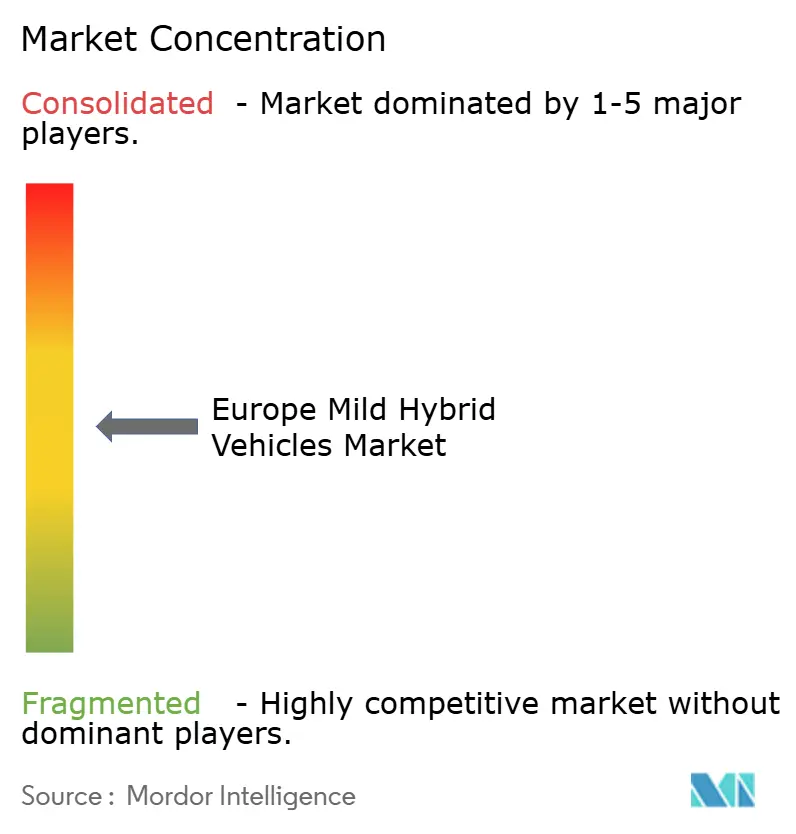
| Market Concentration | Medium |
Major Players *Disclaimer: Major Players sorted in no particular order Image © Mordor Intelligence. Reuse requires attribution under CC BY 4.0. | |
Europe Mild Hybrid Vehicles Market Analysis by Mordor Intelligence
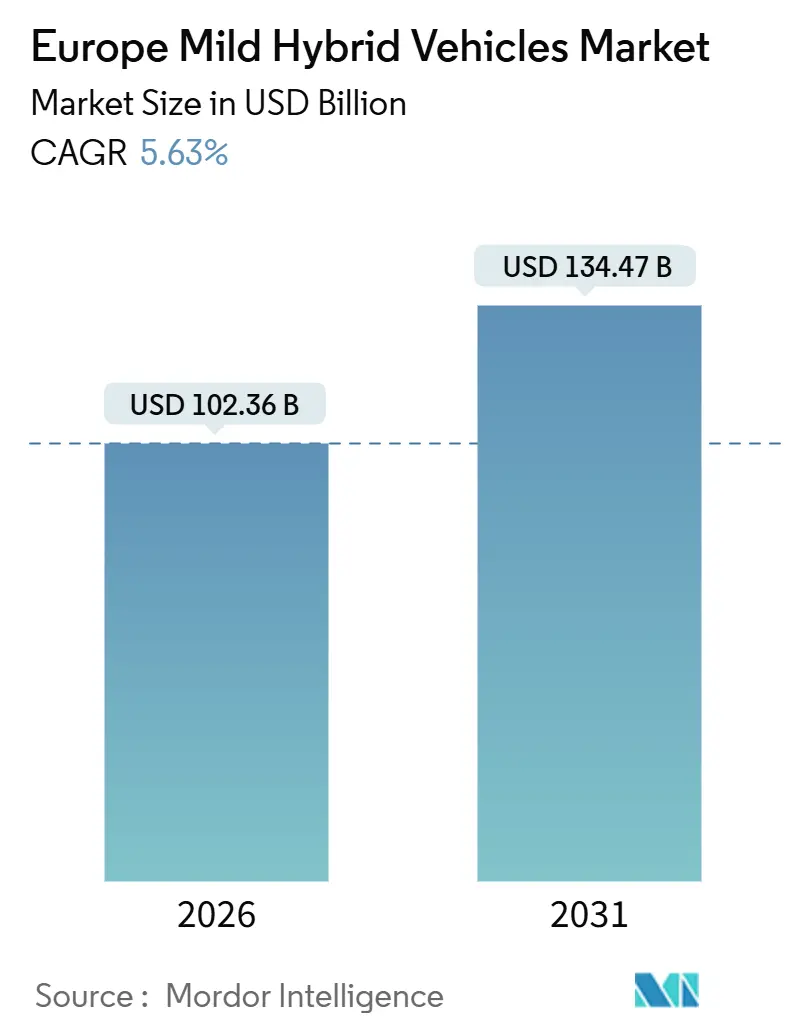
The European mild hybrid vehicles market size stood at USD 102.36 billion in 2026 and is projected to reach USD 134.47 billion by 2031, expanding at a 5.63% CAGR. Fleet CO₂ ceilings, coupled with a EUR 95 (approximately USD 110) penalty for every excess gram, make 48-volt architectures an attractive hedge against the capital outlay required for full-battery-electric platforms. Corporate buyers favor mild hybrids because they lower the total cost of ownership without range-anxiety trade-offs. Unlike full battery-electric architectures, 48-volt mild-hybrid systems deliver compliance headroom without the capital intensity of dedicated BEV platforms.
Key Report Takeaways
- By battery type, 48-volt systems led with 87.13% of Europe's mild hybrid vehicles market share in 2025, while above-48-volt captured the fastest 21.37% CAGR through 2031.
- By vehicle type, passenger cars held 81.26% share of the European mild hybrid vehicles market size in 2025, and commercial vehicles are expanding at a 14.18% CAGR to 2031.
- By powertrain, gasoline mild hybrids accounted for 68.42% of Europe's mild hybrid vehicle market size in 2025, whereas diesel mild hybrids are advancing at a 17.63% CAGR through 2031.
- By propulsion technology, belt-driven starter generators captured 56.08% share of the European mild hybrid vehicles market in 2025; integrated starter generators record the highest 18.92% projected CAGR to 2031.
- By country, Germany commanded a 29.31% market share in 2025, and the rest of Europe is expected to grow at a 6.84% CAGR over the forecast period.
Note: Market size and forecast figures in this report are generated using Mordor Intelligence’s proprietary estimation framework, updated with the latest available data and insights as of January 2026.
Market Trends and Insights
Drivers Impact Analysis of Europe Mild Hybrid Vehicles Market*
| Driver | (~) % Impact on CAGR Forecast | Geographic Relevance | Impact Timeline |
|---|---|---|---|
| EU CO₂-Target Tightening | +1.2% | Europe-Wide, Strongest in Germany, France, Italy | Short Term (≤ 2 Years) |
| Diesel Decline Accelerating 48V Adoption | +0.9% | Western Europe Core, Spillover to Eastern Europe | Medium Term (2–4 Years) |
| Falling 48V System Costs | +0.8% | Global, with Manufacturing Concentration in Germany | Medium Term (2–4 Years) |
| Consumer Shift from BEV to Hybrids | +0.7% | Northern and Western Europe, Urban Markets | Short Term (≤ 2 Years) |
| 48V Needed to Power ADAS L2 | +0.6% | Premium Segments in Germany, United Kingdom, Nordics | Long Term (≥ 4 Years) |
| BEV Plant-Conversion Gaps Back-Filled by MHEV Production | +0.4% | Manufacturing Hubs in Germany, Czech Republic, Slovakia | Medium Term (2–4 Years) |
| Source: Mordor Intelligence | |||
EU CO₂-Target Tightening 2025–2030
The European Union's fleet-average CO₂ ceiling of 93.6 g/km for passenger cars, effective January 2025, imposes a EUR 95 (approximately USD 110) penalty per excess gram multiplied by total annual registrations, creating a huge compliance cost for volume manufacturers missing the target by 5 g/km[1]. The regulation's zero- and low-emission vehicle crediting mechanism, which awards super-credits for battery electric vehicles (BEVs) and plug-in hybrids, paradoxically incentivizes mild-hybrid deployment as a hedge; manufacturers can meet the 2025 target by blending 15% BEVs with 40% mild hybrids rather than committing to 25% battery electric vehicles (BEVs) alone, preserving capital for the steeper 49.5 g/km threshold arriving in 2030.
Diesel Decline Accelerating 48V Adoption
In Q1 2025, diesel vehicles captured a 9.5% market share, following a 27.1% decline in the diesel car market[2], as urban low-emission zones in Paris, Madrid, and Milan tighten access for Euro 6d-TEMP vehicles. This contraction forces automakers with legacy diesel-engine capacity to repurpose production lines; Stellantis's decision to equip its 1.5-liter MultiJet diesel with a 48-volt belt-driven starter generator across the Peugeot 3008 and Opel Grandland platforms exemplifies this strategy, extracting residual value from sunk tooling investments while meeting CO₂ targets. Mild-hybrid vehicles, whether diesel or gasoline, enhance fuel economy modestly in urban settings, due to features like regenerative braking and start-stop functionality. Although diesel engines have been known for their efficiency on highways, the fuel savings in urban stop-and-go scenarios are not as pronounced as once thought, diminishing the perceived advantage of diesel efficiency. Fleet operators are now leaning towards 48-volt mild-hybrid gasoline systems. These systems not only simplify maintenance and sidestep the complexities of diesel particulate filter regeneration but also offer urban fuel savings without significant added costs.
Falling 48V System Costs
BloombergNEF's annual surveys reveal a consistent decline in lithium-ion battery pack prices over the years. Since 2010, global average prices have seen a notable drop. In 2023, the average price stood at approximately USD 139 per kWh, marking a decrease from prior years. Looking ahead, 2025 surveys project an average price of around USD 108 per kWh across all segments. As automakers seek cost-effective methods to improve fuel efficiency and comply with stringent emissions regulations, the adoption of 48-volt mild-hybrid systems is increasing. Analysis reveals that 48 V belt-driven starter generators (BSGs) dominate the landscape of mild-hybrid propulsion systems, striking a commendable balance between performance and cost.
Consumer Shift from BEV to Hybrids Amid Cost and Charging Anxiety
A survey commissioned by the Society of Motor Manufacturers and Traders (SMMT) reveals that most respondents in the United Kingdom view the scarcity of public charging infrastructure as a hurdle to buying electric vehicles. Notably, 44.4% highlighted a lack of local chargepoints, while 37.6% pointed out the limited number of operational chargepoints for extended journeys. These infrastructure challenges, alongside increasing vehicle prices and changes in incentives, lead consumers to favor hybrid powertrains. Mild hybrids, in particular, provide fuel efficiency advantages without relying on public charging stations.
Restraints Impact Analysis of Europe Mild Hybrid Vehicles Market*
| Restraint | (~) % Impact on CAGR Forecast | Geographic Relevance | Impact Timeline |
|---|---|---|---|
| Rapid BEV Price Parity | −0.5% | Western Europe, Premium Segments First | Medium Term (2–4 Years) |
| Non-Harmonized Tax Rules for Mild Hybrids | −0.3% | EU-Wide, Varying by Member State | Short Term (≤ 2 Years) |
| Belt-Drive Durability and Warranty Risk | −0.2% | Global OEM Platforms Using 48V Belt Starter Generators | Medium Term (2–4 Years) |
| 80–100 V MOSFET Supply Constraints | −0.1% | Semiconductor Hubs in Germany, Netherlands, and Taiwan | Short Term (≤ 2 Years) |
| Source: Mordor Intelligence | |||
Rapid BEV Price Parity Eroding MHEV Value
Battery-electric vehicles (BEVs) continued to gain traction in Europe in 2025, supported by expanding model availability and more competitive pricing strategies. Several entry-level electric models, particularly in the small-car segment, are now priced around or below EUR 25,000 (approximately USD 27,148) in select European markets, improving affordability relative to internal-combustion alternatives. Tesla has also adopted aggressive pricing in Europe, introducing lower-priced Model 3[3] variants to stimulate demand and enhance competitiveness against premium internal-combustion and hybrid sedans. These developments reflect intensifying price competition in the European battery electric vehicle market as manufacturers seek to accelerate adoption and defend market share amid tightening emissions regulations.
Non-Harmonized Tax Rules for Mild Hybrids
Across Europe, vehicle taxation and incentive regimes for mild hybrids remain non-harmonized, presenting challenges for both manufacturers and buyers. The United Kingdom's Vehicle Excise Duty (VED) reform eliminates preferential discounts for hybrid vehicles, aligning CO₂-based taxation with that of conventional petrol and diesel models. Consequently, mild hybrids will be taxed based on their emissions band, similar to traditional vehicles. In contrast, zero-emission vehicles will benefit from reduced rates during their first year. In Italy, the current Ecobonus schemes prioritize electric and low-emission vehicles, with no formal incentives available for mild hybrids. As a result, the adoption of mild hybrids is expected to rely primarily on private economic considerations rather than government subsidies.
*Our forecasts treat driver/restraint impacts as directional, not additive. The impact forecasts reflect baseline growth, mix effects, and variable interactions.
Europe Mild Hybrid Vehicles Market Segment Analysis
By Battery Type:
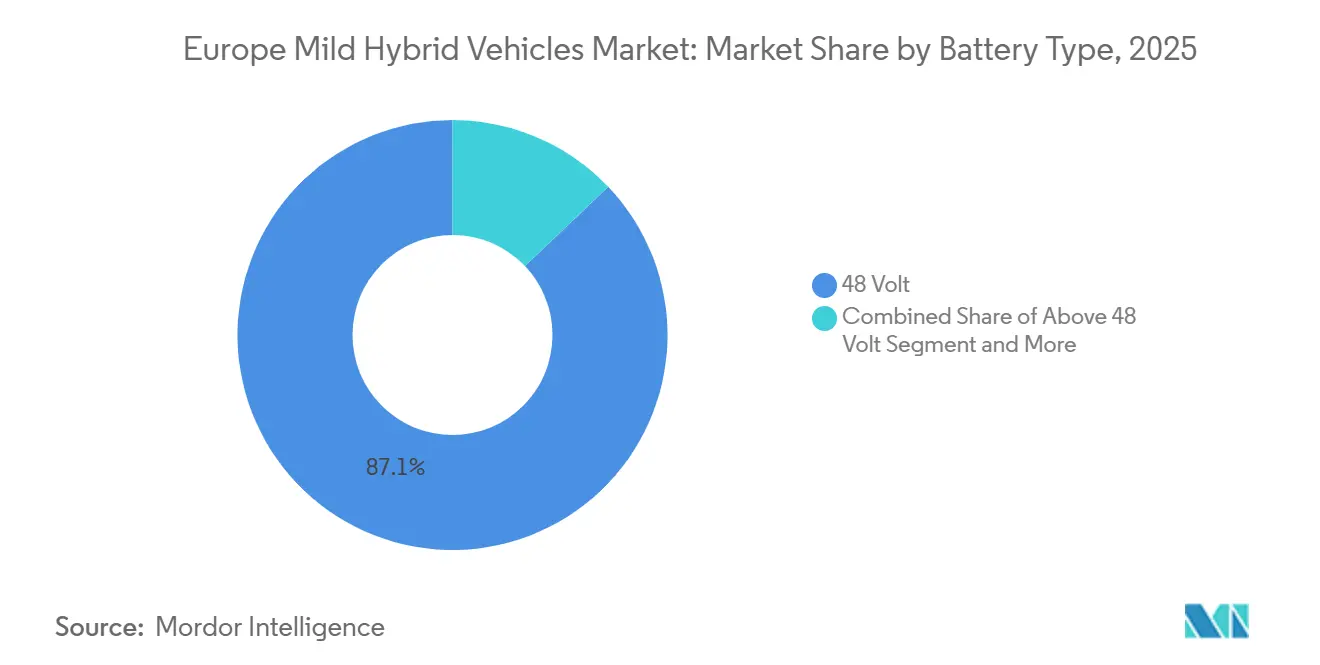
48-Volt Dominance Anchored in ADAS and Compliance EconomicsThe 48-volt segment captured an 87.13% Europe mild hybrid vehicles market share in 2025 as OEMs exploited its ability to trim 8-12 g/km CO₂ at a fraction of full-hybrid cost. DC-DC converters let them retain legacy 12-volt loads, avoiding wholesale redesign. Above-48-volt packs, required for regenerative braking in 3.5-ton vans, are projected to grow at a 21.37% CAGR through 2031.
Automakers are turning to 48-volt mild-hybrid systems as a budget-friendly solution to boost fuel efficiency and curb emissions, especially in light of tightening standards like Euro 7. These 48V systems enable advanced features such as regenerative braking, torque assist, and improved start-stop functionality, leading to greater reductions in fuel consumption and CO₂ emissions compared to traditional 12V systems.

By Vehicle Type:
Corporate Fleets Anchor Passenger-Car Volume While LCV Operators Chase TCO GainsPassenger cars accounted for 81.26% of the 2025 volume as fleet buyers optimized benefit-in-kind taxation. Commercial vehicles, however, are set to clock a 14.18% CAGR to 2031 as last-mile operators target sub-EUR 40,000 (approximately USD 47,000) vans that sidestep payload penalties.
In Germany, the taxation of company cars employs a standard 1% "Benefit-in-Kind" (BIK) rule for internal combustion vehicles. In contrast, fully electric vehicles enjoy a reduced tax base of 0.25% of their gross list price, albeit up to certain thresholds. Plug-in hybrids, contingent on meeting specific range and CO₂ criteria, are taxed at intermediate rates. This approach underscores a fiscal differentiation rooted in the vehicle's powertrain type. Notably, hybrids failing to meet these stringent criteria forfeit their preferential status, reverting to the standard 1% rate, a shift that significantly impacts corporate fleet choices.
By Powertrain Type:
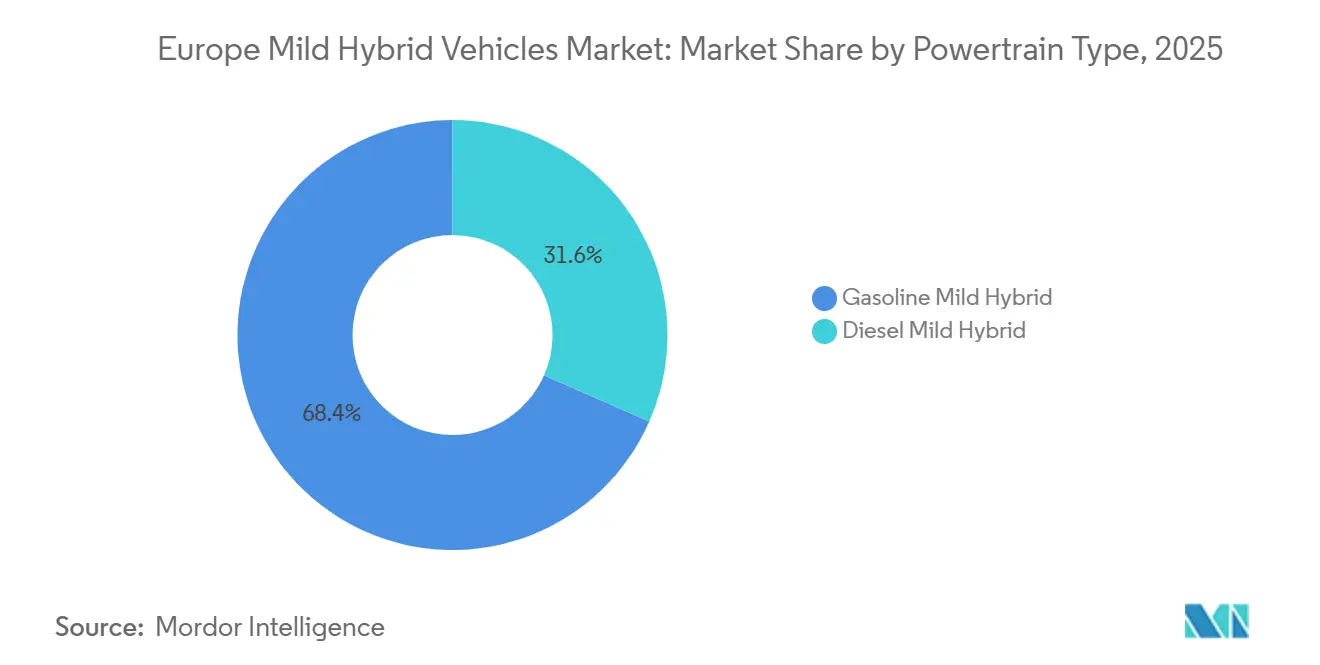
Gasoline Leads but Diesel Finds High-Mileage NichesGasoline mild hybrids held 68.42% of the mix in 2025, due to lower particulate output suited to low-emission zones. Diesel mild hybrids, though smaller, are poised for a 17.63% CAGR as Euro 7’s delay gives high-torque fleets breathing room.
Gasoline mild hybrids, with their lower upfront costs compared to diesel variants, sidestep the maintenance complexities tied to diesel particulate filters. These filters often elevate service needs throughout a vehicle's lifespan. As a result, the total cost of ownership leans towards gasoline mild hybrids, particularly in urban and suburban settings.
By Propulsion Technology:
Belt-Driven Systems Rule on Retrofit EconomicsBelt-Driven Starter Generator (BSG) held a 56.08% share in 2025 because it drops into existing engine bays with minimal tooling. Integrated starter-generators are poised to expand at an 18.92% CAGR through 2031 as Bosch and Valeo scale compact, belt-free units that erase warranty risk.
Southern Europe’s heat-related belt failures highlight the retrofit trade-off, yet belts remain cheapest for volume B- and C-segment cars. The European mild hybrid vehicles industry, therefore, balances retrofit affordability against long-term durability in propulsion choices.
Geography Analysis
Germany Mild Hybrid Vehicles Market
Germany commands 29.31% of market share in 2025, anchored by Volkswagen's MQB-platform scale and the Bundesamt für Wirtschaft und Ausfuhrkontrolle's continued inclusion of 48-volt hybrids in its CO₂-based vehicle-tax bands. BMW's decision to extend 48-volt mild-hybrid availability across its 3 Series lineup, including diesel variants, reflects the technology's compliance role in Europe's largest automotive economy, where manufacturers face penalties for every gram per kilometer above the fleet target.
Italy Mild Hybrid Vehicles Market
In 2025, Italy saw a notable surge in hybrid vehicle adoption, largely propelled by compact hatchbacks like the Fiat Panda, tailored for the country's narrow urban roads. The Italian market showcases a preference for compact mild-hybrid hatchbacks, a choice influenced by the nation's tight urban streets and the scarcity of home-charging facilities. Additionally, the growing emphasis on reducing emissions and government incentives for hybrid vehicles have further contributed to the increasing adoption of these vehicles in Italy. Automakers are also focusing on expanding their hybrid offerings to cater to this demand, ensuring a wider range of options for consumers.
Nordics, Benelux and Eastern Europe Mild Hybrid Vehicles Market
The Nordic countries and Benelux, where battery electric vehicle penetration exceeded 30% in 2024, show the steepest mild-hybrid share declines among buyers under 45 years old, a demographic that prioritizes digital connectivity and over-the-air updates, features more commonly bundled with BEV platforms. Eastern Europe, where average household income trails Western Europe by 40%, gravitates toward sub-EUR 25,000 (approximately USD 29,393) mild-hybrid hatchbacks that deliver 15 to 20% fuel savings over conventional gasoline engines without the range anxiety of battery electric vehicles.
Regulatory Landscape
The European mild hybrid vehicles market is shaped by EU fleet CO2 standards for new cars and vans (Regulation (EU) 2019/631, as amended). The passenger-car fleet-average target is 93.6 g CO2/km for 2025-2029 and tightens to 49.5 g CO2/km for 2030-2034. The EUR 95 per g/km penalty mechanism for exceedances keeps OEM attention on near-term compliance levers such as 48V mild-hybridization, while the one-off multiannual compliance assessment for 2025-2027 (three-year averaging) gives flexibility in managing annual registration mix across BEV, PHEV, and MHEV portfolios.
Euro 7 (Regulation (EU) 2024/1257) also updates type-approval requirements, including non-exhaust emissions (brake and tyre particles) and durability provisions. For new types of M1 and N1 vehicles, compliance applies from 29 November 2026, creating a 2026 pivot point where manufacturers must manage both fleet CO2 performance and certification updates for new or revised mild-hybrid derivatives to continue selling in the region.
Value Chain Analysis
The value chain begins with critical inputs for 48V systems, including lithium-ion low-voltage batteries, power electronics, DC-DC converters, e-machines, and 80-100 V semiconductor content. It then moves through Tier-1 integration of starter-generators and electrified transmissions, before reaching OEM platform engineering, assembly, and distribution via dealer and fleet channels. The technology mix supports both retrofit-friendly belt-driven starter generators and higher-integration solutions such as electrified dual-clutch transmissions, so Tier-1 module design and OEM calibration capabilities matter as CO2 compliance and drivability targets tighten.
Recent supply-side moves point to localization and scale-up across Europe. Horse Powertrain started production of an upgraded V20 hybrid engine with 48V mild-hybrid configurations at Skovde, Sweden (May 2026). Partnerships to secure 12V/48V low-voltage batteries have also expanded, including Eberspaecher and Farasis Energy Europe (February 2025). Downstream, OEMs are broadening 48V deployment across high-volume nameplates and light commercial applications, which raises demand for validated 48V packs, e-machines, and electronics while also surfacing bottlenecks in specific semiconductor voltage classes and warranty-sensitive belt-drive components in hotter operating regions.
Competitive Landscape
The top five OEMs, Volkswagen, Stellantis, Mercedes-Benz, BMW, and Renault, account for a significant share of the 2025 volume, resulting in a moderate concentration profile for the European mild hybrid vehicles market. Stellantis’s eDCT roll-out across four brands trims per-unit drivetrain cost by double digits, matching Asian rivals that leverage vertically integrated 48-volt supply chains. BMW’s blanket rollout across the 3 Series preserves CO₂ compliance flexibility amid uncertain battery electric vehicle uptake.
The competitive dynamic tilts toward automakers that have production between BEV, plug-in hybrid, and mild-hybrid variants on a single platform. For example, Volkswagen's MQB architecture, which accommodates all three powertrains with 70% parts commonality, exemplifies this strategy and enabled the group to backfill battery electric vehicle shortfalls with mild-hybrid volume at its Wolfsburg and Zwickau plants in 2025.
White-space opportunities concentrate in the commercial-vehicle segment, where mild-hybrid penetration lags passenger cars despite last-mile delivery operators' need for sub-EUR 40,000 (approximately USD 47,000) light commercial vans that meet urban low-emission-zone thresholds.
Europe Mild Hybrid Vehicles Industry Leaders
-
Volkswagen AG
-
Audi AG
-
BMW Group
-
Toyota Motor Corporation
-
Nissan Motor Co. Ltd.
- *Disclaimer: Major Players sorted in no particular order
Europe Mild Hybrid Vehicles Market Companies Covered in this Report
- Volkswagen AG
- Stellantis NV
- Mercedes-Benz Group AG
- BMW Group
- Nissan Motor Co. Ltd.
- Ford Motor Company
- Renault Group
- Hyundai Motor Company
- Kia Corporation
- Toyota Motor Corporation
- Suzuki Motor Corporation
- Volvo Car Corporation
- Audi AG
- Skoda
Market Opportunities and Future Outlook
White space is most apparent where mild-hybrid penetration lags passenger cars, especially in cost-sensitive commercial vehicle applications that still need urban access and fuel savings without payload trade-offs. Product cadence in 48V diesel and 48V-enabled workhorse platforms supports this, including Toyota adding a 48V mild-hybrid diesel system to the Hilux for Europe and expanding electrified off-road and utility offerings with Land Cruiser Hybrid 48V sales in 2025, which helps normalize 48V architectures beyond premium passenger cars.
Supply and manufacturing opportunities center on scaling electrified drivetrains and local component capacity for multi-brand portfolios. Stellantis has been expanding 48V mild-hybridization through its eDCT approach (including a stated plan to reach 36 hybrid models in Europe by 2026) and increasing control over eDCT production. At the same time, the company is committing more than EUR 1 billion in France to enable future Peugeot electric and hybrid C-segment models at Mulhouse from 2029. The regulatory timeline also adds near-term development demand: Euro 7 type-approval requirements applying from 29 November 2026 for new M1/N1 types push OEMs and suppliers to update compliant mild-hybrid derivatives and validate durability and emissions-related subsystems so high-volume nameplates can remain on sale within the 2025-2027 multiannual compliance window.
Recent Industry Developments in Europe Mild Hybrid Vehicles Market
- May 2026: Stellantis and Dongfeng Group signed a non-binding MOU to form a Europe-based joint venture covering sales, distribution, manufacturing, and engineering for Dongfeng new-energy vehicles in Europe. The announcement highlights a push to localize go-to-market and industrial footprints, which can intensify competitive pressure on incumbent OEM lineups that use mild-hybrid trims to protect price bands and fleet volumes.
- June 2025: Nissan announced the launch of its third-generation e-POWER technology in Europe, with rollout on the Qashqai from September 2025. The move raises the bar for electrified driving feel without external charging, increasing competitive tension for 48V mild-hybrid offerings that compete on cost and CO2 compliance rather than high electric-only capability.
- December 2024: Aramco completed the acquisition of a 10% stake in Horse Powertrain Limited to advance hybrid and internal-combustion powertrain technologies. The investment supports continued development and industrialization of hybrid-capable engine platforms, reinforcing supplier-side commitment to electrified ICE solutions that underpin mild-hybrid vehicle production in Europe.
Europe Mild Hybrid Vehicles Market Report Scope and Research Methodology
Market Definition and Coverage
For this methodology, the market covers the value of mild hybrid vehicles sold across Europe, where an internal combustion engine is supported by a small electric system that enables energy recovery and torque assist.
Scope exclusions: We exclude full hybrids, plug-in hybrids, and battery electric vehicles, and we also exclude aftermarket retrofit hybrid kits.
Segments Covered in This Report
- By Battery Type
- Less Than 48 Volt
- 48 Volt
- Above 48 Volt
- By Vehicle Type
- Passenger Cars
- Commercial Vehicles
- By Powertrain Type
- Gasoline Mild Hybrid
- Diesel Mild Hybrid
- By Propulsion Technology
- Belt-Driven Starter Generator (BSG)
- Integrated Starter Generator (ISG)
- Crankshaft-Mounted Starter Generator
- By Country
- Germany
- United Kingdom
- France
- Italy
- Spain
- Rest of Europe
Data Sources, Market Sizing, and Validation
Desk Research
Desk work starts by mapping the real vehicle market boundary for Europe and then connecting it to mild hybrid adoption signals. We rely on non-paywalled sources such as ACEA vehicle registrations, Eurostat trade and industrial statistics, the European Environment Agency CO2 and emissions datasets, UNECE vehicle regulation documents, and national vehicle registration authorities in major countries.
To make inputs more usable, we also review OEM annual reports and investor decks, technical papers in peer-reviewed journals on 48V systems and starter-generator architectures, and reputable auto press coverage for launch timing and platform rollouts. In selected cases, we use paid subscriptions for company financials and news, vehicle sales and parc tracking, and patent databases to double-check technology shifts and model-mix assumptions. These are not exhaustive examples, and additional public and paid sources were reviewed to collect data, validate it, and clarify open questions.
Primary Interviews and Surveys
Primary work is used to pressure-test desk assumptions on mild hybrid penetration, pricing, and the pace of 48V versus sub-48V adoption. We spoke with a mix of OEM-side planners, powertrain and electrical system specialists, dealer and fleet voices, and other informed participants across key European auto markets so gaps in country and vehicle-type coverage could be closed.
Distribution of primary research fieldwork respondents
| Company type | Respondent position |
|---|---|
| Top tier: 33% | CXOs: 17% |
| Mid tier: 50% | Functional/Unit leaders: 40% |
| Smaller Players: 17% | Managers: 43% |
Market-Sizing & Forecasting
The model is built using a top-down approach where vehicle registrations and sales by country are reconstructed first, and then mild hybrid penetration rates are applied to arrive at the addressable vehicle pool. Once the pool is set, value is formed by applying realistic transaction price bands and mix splits, which are then checked against observed pricing direction in the market.
A few inputs that matter a lot in this market include new passenger car and commercial vehicle registrations, the share of gasoline mild hybrids versus diesel mild hybrids, the mix between less than 48V, 48V, and above 48V systems, and the adoption of key architectures such as belt-driven starter generators versus integrated starter generators. Model-year launch cycles and CO2 compliance pressure are also tracked because they affect how quickly mild hybrid variants are added to mainstream trims. To keep totals grounded, we corroborate the top-down results with selective bottom-up approximations like sampled model line volumes multiplied by typical price ranges, followed by channel checks with informed stakeholders where gaps show up.
For forecasting, scenario analysis is used so the outlook stays realistic under different adoption and pricing paths, and then a central case is selected based on what primary respondents see for rollout timing and incentives. Where country-level or vehicle-type data is patchy, we fill gaps with proxy markets that have similar regulation and mix, and the assumptions are flagged for extra validation before final sign-off.
Data Validation & Update Cycle
Validation is done in layers so the final numbers are not driven by one data series. We compare the model outputs against independent signals such as registration trends, powertrain mix shifts, and public emissions compliance direction, and then we check for unusual jumps in volume, pricing, or mix that do not match market reality.
Before publication, the file is reviewed by another analyst who stress-tests assumptions and recalculates sensitive lines to catch errors early. The report is refreshed annually, and we also revisit it when a material event occurs, such as a major policy change, an unexpected demand drop, or a sharp pricing shift. Right before delivery, a fresh pass is done so clients receive the latest updated view instead of a stale snapshot.
Mordor Intelligence's Europe Mild Hybrid Vehicles Market Size Compared Against Other Published Estimates
Published market values for mild hybrid vehicles in Europe often do not match because the scope lines are drawn differently, and the pricing logic is not handled the same way. Differences also show up when some estimates lean more on component value, while others try to capture full vehicle transaction value, and the two are not interchangeable.
In this market, the biggest gap drivers are usually whether commercial vehicles are counted along with passenger cars, how 48V and above-48V systems are treated, and whether the number represents vehicle sales value or a narrower powertrain system revenue pool. Currency timing and refresh cadence can also move the number, especially when market share shifts quickly across Germany, the United Kingdom, France, Italy, Spain, and the Rest of Europe.
Benchmark comparison
| Source | Market Size | Gaps in Research Methodology |
|---|---|---|
| Mordor Intelligence | USD 102.36 B (2026) | |
| Regional Consultancy A | USD 68.20 B (2026) | Uses a narrower value definition that resembles mild hybrid system and component revenue, and it also applies conservative penetration assumptions for commercial vehicles in Europe. |
| Industry Publisher B | USD 121.90 B (2026) | Includes full hybrid variants within the electrified ICE bucket and assumes faster ASP lift from 48V uptake without validating mix by country and vehicle class. |
The table points to a wide spread that mainly comes from what is being priced and which vehicle types are included, and in Mordor Intelligence's model the value is counted at the mild hybrid vehicle level across passenger cars and commercial vehicles, rather than counting only the electrification hardware content. When these choices are made explicit, the estimate becomes easier to reproduce because the key inputs can be traced back to registrations, penetration, mix, and realistic pricing checks.
Key Questions Answered in the Report
How large will the Europe mild hybrid vehicles market be by 2031?
How large will the Europe Mild Hybrid Vehicles Market be by 2031?
Which battery architecture dominates European mild hybrids?
48-volt packs held 87.13% share in 2025 and remain the standard for CO₂ compliance and ADAS power needs.
Why do corporate fleets prefer mild hybrids over BEVs?
Fleet operators avoid range anxiety and upfront BEV premiums while still meeting CO₂ targets and benefiting from favorable tax rules.
Which segment is growing fastest within the market?
Light commercial vehicles are set to expand at a 14.18% CAGR as last-mile operators seek sub-EUR 40,000 vans with urban-zone access.
How are falling BEV prices affecting mild-hybrid demand?
Rapid BEV price parity narrows the cost gap, trimming the mild-hybrid value proposition, especially in high-mileage fleets.
What is the main technical challenge with belt-starter-generators?
Elevated heat shortens belt life to 60,000 km in Southern Europe, driving warranty costs and interest in integrated starter-generators.