
Europe Manufacturing Inspection Equipment Market Size and Share
Market Overview
| Study Period | 2021 - 2032 |
|---|---|
| Forecast Data Period | 2027 - 2032 |
| Base Year Market Size (2026) | USD 5.81 Billion |
| Market Size (2027) | USD 6.04 Billion |
| Market Size (2032) | USD 7.33 Billion |
| Growth Rate (2027 - 2032) | 3.95 % |
| Market Concentration | Medium |
Major Players *Disclaimer: Major Players sorted in no particular order Image © Mordor Intelligence. Reuse requires attribution under CC BY 4.0. | |
Europe Manufacturing Inspection Equipment Market Analysis by Mordor Intelligence
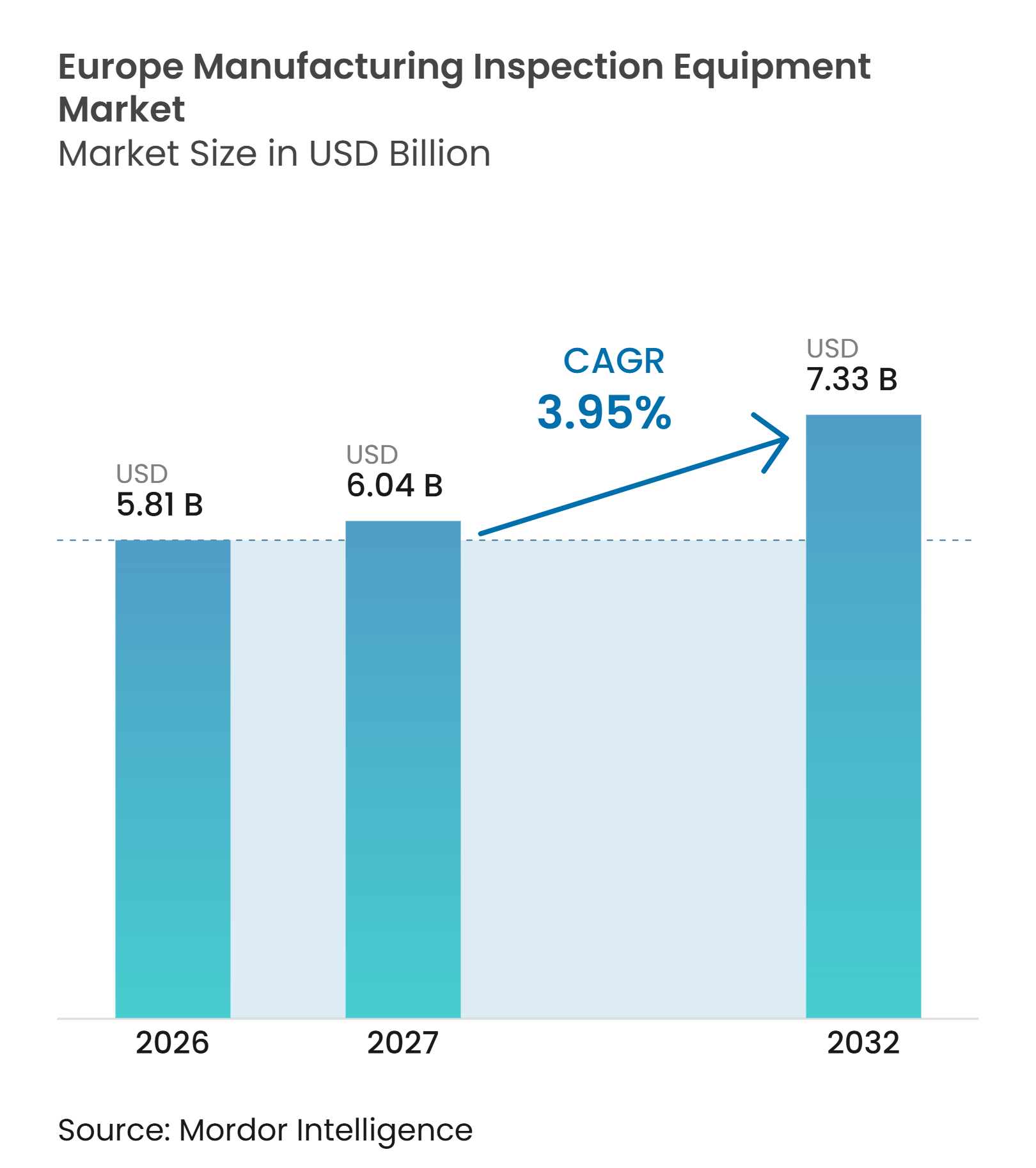
The Europe Manufacturing Inspection Equipment Market size is projected to expand from USD 5.81 billion in 2026 and USD 6.04 billion in 2027 to USD 7.33 billion by 2032, registering a CAGR of 3.95% between 2027 and 2032.
European manufacturers are moving inspection closer to production operations as customers, regulators, and internal quality teams require better traceability. The EU Machinery Regulation becomes mandatory on January 20, 2027, and broadens the importance of documented conformity processes for machinery supplied in the region. This change supports spending on systems that can capture, store, and retrieve inspection records across production lines. The Europe manufacturing inspection equipment market also reflects different investment patterns, as established German plants upgrade installed systems while newer Polish facilities add connected systems during capacity expansion. Lower investment activity remains a constraint because the EU business investment rate fell to 21.8% in the fourth quarter of 2025.
Key Report Takeaways
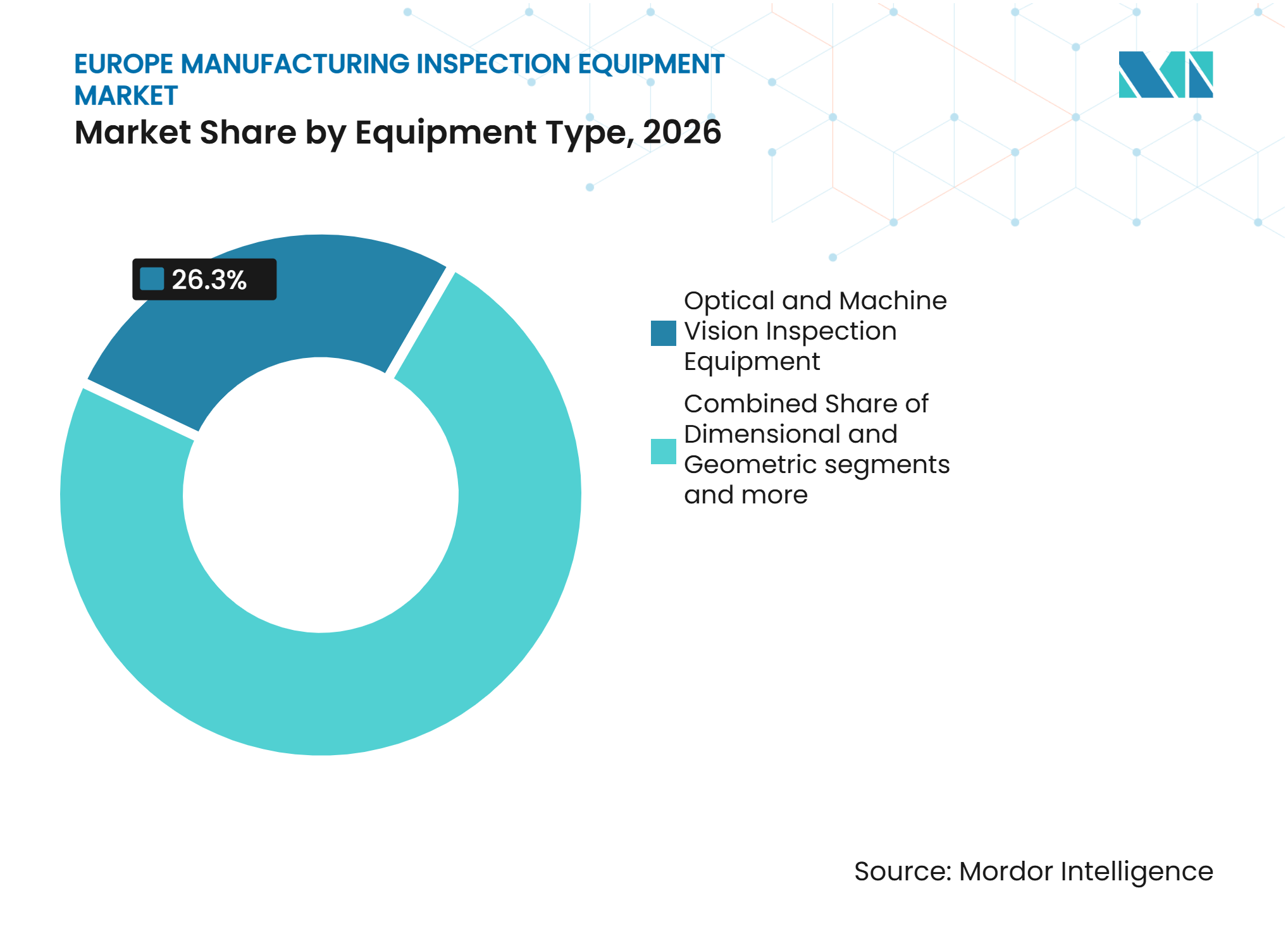
- By equipment type, optical and machine vision inspection equipment held 26.3% of the Europe manufacturing inspection equipment market share in 2026, while radiographic and computed tomography inspection equipment is forecast to expand at a 6.5% CAGR through 2032.
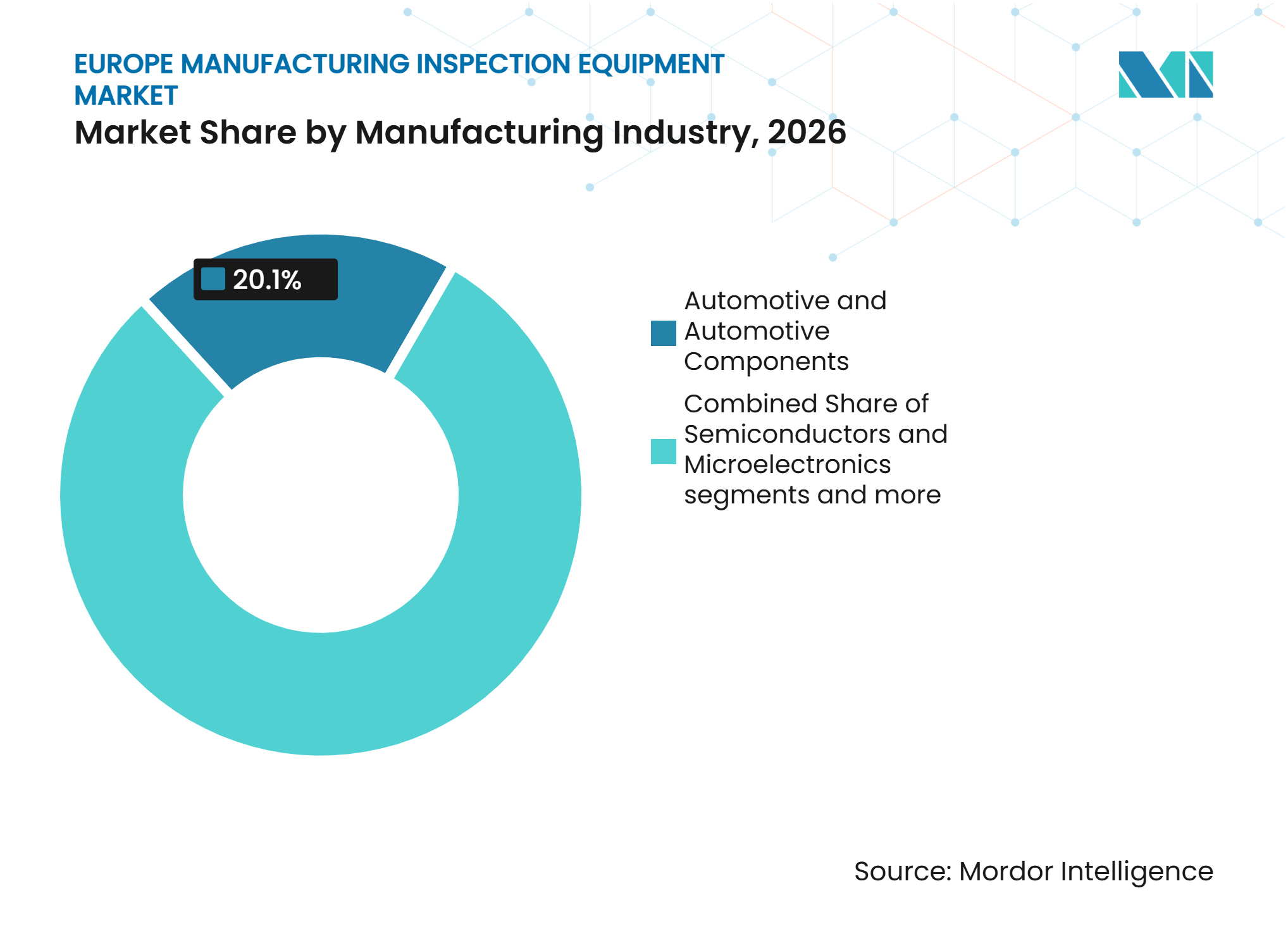
- By manufacturing industry, automotive and automotive components accounted for 20.1% of the Europe manufacturing inspection equipment market size in 2026, while other electronics and electrical equipment is forecast to grow at a 5.8% CAGR through 2032.
- By geography, Germany held 29.8% of market revenue in 2026, while Poland is forecast to record the highest national CAGR at 5.3% through 2032.
Note: Market numbers in this report are based on Mordor Intelligence's proprietary estimation framework, which combines nine months of actuals with Q4 projections for base year 2026.
Market Trends and Insights
Drivers Impact Analysis of Europe Manufacturing Inspection Equipment Market*
| Driver | (~) % Impact on CAGR Forecast | Geographic Relevance | Impact Timeline |
|---|---|---|---|
| Industry 4.0 and Smart Factory Quality Automation | +1.2% | Germany, Netherlands, France | Medium term (2-4 years) |
| Stricter Product Safety, Traceability, and Conformity Requirements | +0.9% | EU-wide, Germany, France, Italy most exposed | Short term (≤ 2 years) |
| Manufacturing Labor Shortages and Demand for 100% Inspection | +0.8% | EU-wide, acute in Germany, Austria, Nordics | Medium term (2-4 years) |
| EV, Battery, Semiconductor, and Additive Manufacturing Quality Complexity | +0.6% | Germany, Poland, Hungary, Czech Republic | Medium term (2-4 years) |
| Digital Quality Twins and Closed-Loop Process Control | +0.4% | Germany, Netherlands, France, with spillover to Nordics | Long term (≥ 4 years) |
| European Technician Shortage Accelerating No-Code and Edge-AI Inspection | +0.3% | All Europe, with early adoption in Germany and the Nordics | Long term (≥ 4 years) |
| Source: Mordor Intelligence | |||
Industry 4.0 and Smart Factory Quality Automation
The growing use of inspection tools within connected production workflows supports the Europe manufacturing inspection equipment market. The EU-funded AIMS5.0 project identifies a target of reducing industrial equipment monitoring time by 50% through artificial intelligence-enabled quality loops.[1] Manufacturers are increasingly buying inline sensors, edge-processing cameras, and defect classification tools as part of broader factory upgrades. Audi deployed a virtual programmable logic controller in its Böllinger Höfe facility during March 2025, integrating real-time production logic across body assembly cells. Fraunhofer IPT has also identified deep-learning weld inspection for battery cell modules as a production-ready application of digital-twin technology. Suppliers must therefore provide reliable data connections and closed-loop feedback functions alongside measurement hardware.
Stricter Product Safety, Traceability, and Conformity Requirements
A more demanding European product-conformity environment shapes the Europe manufacturing inspection equipment market. Regulation (EU) 2023/1230 introduces standardized conformity assessment provisions and addresses machinery that uses artificial intelligence or changes its behavior after deployment.[2] Six high-risk machinery categories will require assessment by a notified body from January 2027. Manufacturers that formerly relied on internal production control need auditable data when equipment enters the expanded Annex I scope. The regulation makes traceability more important for machinery suppliers and their component partners. These requirements establish a steadier base of demand for inspection systems across machinery, pharmaceuticals, aerospace, and pressure equipment operations.
Manufacturing Labor Shortages and Demand for 100% Inspection
The Europe manufacturing inspection equipment market benefits when manufacturers replace manual checks with consistent automated inspection across repeated production tasks. EURES identifies welders as a shortage occupation across European countries, affecting sectors that depend on welding quality controls and documented evidence of weld integrity. Production teams need systems that perform the same inspection process across shifts, parts, and locations without relying on individual visual judgment. CECIMO reports continued demand for automation specialists and artificial intelligence engineers while recruitment remains difficult across advanced manufacturing roles.[3] Automated inspection also retains quality knowledge when experienced technicians leave a site or move to another production function.
EV, Battery, Semiconductor, and Additive Manufacturing Quality Complexity
The Europe manufacturing inspection equipment market is growing due to production processes that require detection of internal defects. Lithium-ion battery manufacturing needs systems that can identify delamination, electrode overhang variation, and weld anomalies that can affect thermal behavior and service life. Fraunhofer FFB and RWTH Aachen identify quality failures and scrap as a leading operational issue during European battery production scale-up. Photon-counting detectors and metal-jet X-ray tubes can support scan times of one second per cell in inline CT processes. TRUMPF introduced VisionLine Inspect in March 2025 to inspect laser weld seams without requiring operator programming expertise. Additive manufacturing also increases demand for volumetric inspection where surface-based methods cannot assess internal geometries.
Restraints Impact Analysis of Europe Manufacturing Inspection Equipment Market*
| Restraint | (~) % Impact on CAGR Forecast | Geographic Relevance | Impact Timeline |
|---|---|---|---|
| High Total Cost of Ownership and Integration for SMEs | -0.5% | EU-wide, Italy, Spain, Poland most exposed | Short term (≤ 2 years) |
| Shortage of Certified Inspection and Systems Integration Skills | -0.4% | All Europe, acute in Central and Eastern Europe | Medium term (2-4 years) |
| Macroeconomic Headwinds and Cyclical Capital Expenditure Constraints | -0.3% | Euro area, Germany and France most affected | Short term (≤ 2 years) |
| Proprietary Data Models, Cybersecurity, and Validation Friction | -0.2% | Germany, France, Netherlands, with EU-wide spillover | Long term (≥ 4 years) |
| Source: Mordor Intelligence | |||
High Total Cost of Ownership and Integration for SMEs
Total cost of ownership remains an important barrier within the Europe manufacturing inspection equipment market. Small and medium-sized enterprises account for 51.8% of economic value and 64.4% of employment in the European Union. Basic industrial artificial intelligence inspection systems have installed prices of EUR 15,000 (USD 17,644.6) to EUR 50,000 (USD 58,815.5), while premium multispectral configurations range from EUR 80,000 (USD 94,104.8) to EUR 150,000 (USD 176,447). Complex manufacturing execution system, enterprise resource planning, and production-line integration can add USD 150,000 in fees. High-mix and low-volume production provides less labeled data for model training and raises the cost for each product variant. Service-based inspection models may reduce up-front costs, but uptake outside Germany and the Nordic countries remains limited.
Shortage of Certified Inspection and Systems Integration Skills
A limited supply of qualified personnel constrains system specification, deployment, validation, and the routine use of advanced inspection equipment. EURES reports that only 5.6% of European adults have basic digital skills adequate for advanced production technologies without additional training. Inspection deployment requires a combination of optics, automation, process knowledge, and data skills that formal training has not fully standardized. The shortage is particularly challenging for manufacturers adopting machine-vision systems, automated non-destructive testing, and AI-enabled inspection platforms, which require operators to interpret complex outputs and integrate equipment with existing production workflows. This skills gap lengthens commissioning work, delays returns, and can slow repeat orders from production sites. Smaller manufacturers face additional constraints because they may lack dedicated inspection engineers and the budgets to provide specialized training or recruit experienced personnel. Consequently, equipment suppliers and inspection service providers increasingly need to offer application engineering, operator training, remote diagnostics, and ongoing technical support to reduce implementation complexity.
*Our forecasts treat driver/restraint impacts as directional, not additive. The impact forecasts reflect baseline growth, mix effects, and variable interactions.
Europe Manufacturing Inspection Equipment Market Segment Analysis
By Equipment Type:
Vision Systems Lead, Radiographic and Computed Tomography Expands Inspection ScopeOptical and machine vision inspection equipment held 26.3% of the Europe manufacturing inspection equipment market share in 2026. The segment serves automotive body inspection, printed circuit board assembly checks, food-packaging conformity, and other applications needing rapid surface-level verification. Its installed base benefits from lower camera and illumination costs and from defect-classification tools that reduce setup time for new variants. The Europe manufacturing inspection equipment market size for this equipment type is also supported by its ability to operate close to production lines rather than only in centralized quality laboratories. Dimensional and geometric inspection equipment remains the second-largest category because automotive and aerospace production requires controlled measurements of critical tolerances.
Radiographic and computed tomography inspection equipment is forecast to grow at a 6.5% CAGR through 2032. ZEISS reports that its 320 kV X-ray systems can identify metal particles, delamination, and winding defects in battery cell assembly, which cannot be reliably checked with surface methods alone. Waygate Technologies introduced a Mesofocus X-ray tube option for its Phoenix V|tome|x C450 platform in February 2025. The option lets a single system serve automotive casting, electronics, and medical-device applications where a wider range of part sizes and internal structures must be assessed. Leak and seal integrity, material identification, and contamination systems retain specialized positions because food, chemical, and pharmaceutical producers must meet defined safety requirements.



By Manufacturing Industry:
Automotive Supports Scale, Electronics Drives GrowthAutomotive and automotive components accounted for 20.1% of the Europe manufacturing inspection equipment market size in 2026. German and French original equipment manufacturers and their Tier 1 suppliers operate under IATF 16949 quality frameworks, which support consistent checks throughout vehicle and component assembly. The move toward electric vehicles is changing the required inspection methods instead of reducing inspection activity. Manufacturers need battery module weld-seam checks and dimensional verification as vehicle architectures change and new component materials enter production. Aerospace, defense, and transportation equipment maintain demand for phased-array ultrasonics, eddy current arrays, and industrial radiography because low volumes do not reduce the consequences of quality failures.
Other electronics and electrical equipment is forecast to grow at a 5.8% CAGR through 2032. European printed circuit board, power-conversion, and embedded-electronics supply chains need more consistent defect detection as production becomes more complex and defect tolerances narrow. Batteries and energy storage products add a related source of demand because battery factories require inspection at electrode, module, and cell stages. Fraunhofer FFB states that inline measurement and process simulation are strategic requirements for European cell makers preparing for mass production and stable output quality. Pharmaceuticals, medical devices, and food and beverage plants also make recurring purchases because good manufacturing practice and medical-device audit requirements are non-discretionary.

Geography Analysis
Germany held 29.8% of the Europe manufacturing inspection equipment market share in 2026. Its automotive original equipment manufacturers, precision engineering clusters, and electronics plants support demand for machine vision, dimensional metrology, automated data capture, and certified non-destructive testing. German buyers increasingly expect inspection suppliers to connect equipment with production management systems and to make measurement results usable within their wider quality processes. The country has a substantial installed base, so demand includes replacement, capability upgrades, software integration, and systems that can extend the useful life of current production assets. The United Kingdom maintains demand for certified non-destructive testing and dimensional inspection through aerospace and pharmaceutical production.
France supports continued requirements for coordinate measuring machines, ultrasonic inspection, and vision systems through Airbus assembly operations and Stellantis manufacturing plants. At the same time, Italy favors leak and seal integrity and dimensional inspection for machinery components, packaging equipment, precision parts, and food-grade containers. Spain is adding thermal and ultrasonic inspection capability in renewable-energy manufacturing and automotive assembly, including checks for turbine blades and body panels. The Netherlands has a high requirement for semiconductor inspection relative to its manufacturing scale because of the Eindhoven semiconductor supply chain and related specialist production activities.
Poland is forecast to grow at a 5.3% CAGR through 2032, the highest national rate in the Europe manufacturing inspection equipment market. Greenfield electronics and electric-vehicle battery investments are replacing manual quality processes with automated inspection as new production lines are installed. Poland’s semiconductor strategy identifies inspection and metrology as capability gaps, while European Union cohesion funds support Industry 4.0 adoption and manufacturing technology investments. Kitron invested in a Waygate Technologies Microme|x 160 X-ray system for printed circuit board inspection in January 2025. The Czech Republic, Hungary, Romania, and Nordic countries provide an additional demand base through automotive reshoring and battery factory expansion.
Competitive Landscape
Market Concentration
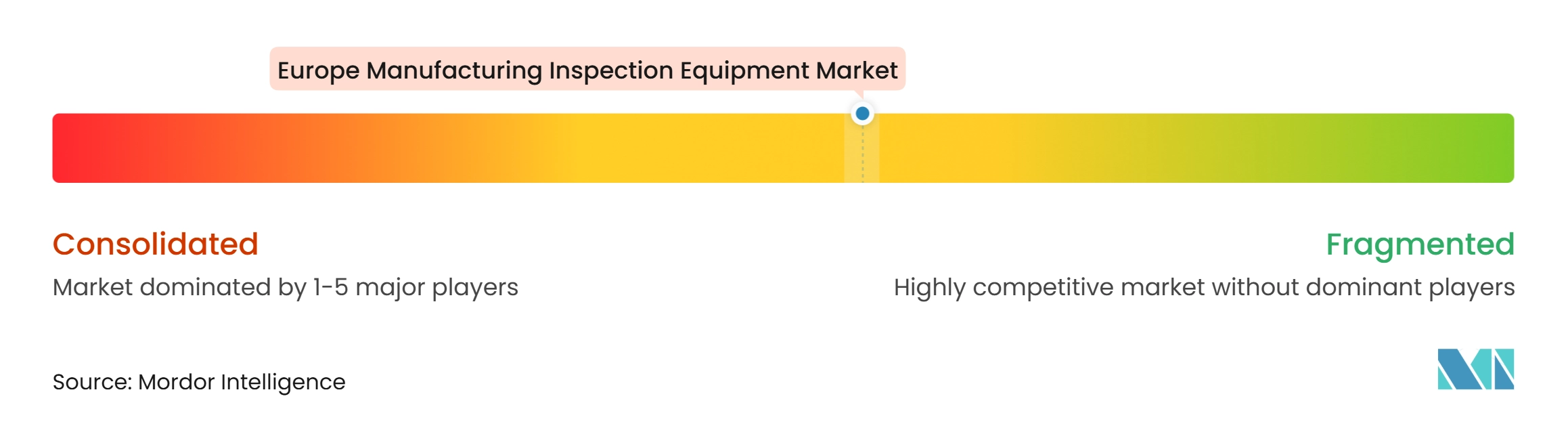
The Europe manufacturing inspection equipment market exhibits a medium level of market concentration. Hexagon AB, Carl Zeiss AG, and Cognex Corporation compete across several inspection methods, with competition increasingly focused on software analytics and artificial intelligence-supported defect classification. Hexagon announced in April 2026 that it would acquire Waygate Technologies for USD 1.45 billion. Waygate generated USD 630 million in fiscal 2025 revenue, and Europe represented 28% of that revenue. The transaction combines surface metrology, computed tomography, radiography, and remote visual inspection capabilities under one supplier.
AMETEK completed its acquisition of FARO Technologies in July 2025 for USD 920 million net of cash. The acquisition added portable measurement arms, laser scanners, and trackers to AMETEK’s Ultra Precision Technologies Division, reducing the number of independent portable metrology specialists. Eddyfi Technologies focuses on electromagnetic and phased-array ultrasonic testing, while Marposs targets in-process gauging and Viscom provides optical and X-ray inspection for electronics assembly. ZEISS Digital Innovation received the Microsoft Intelligent Manufacturing Award in 2025 for a closed-loop virtual and physical metrology platform used in brownfield coordinate measuring machine applications.
Service-based inspection and validated synthetic training data can help smaller manufacturers with limited capital and scarce labeled data. No-code edge-based inspection tools can reduce the reliance on specialists, while MVTec Software provides the HALCON library and Jenoptik extends photonic measurement into battery laser-process monitoring. The EU Artificial Intelligence Act adds documentation requirements for high-risk autonomous pass or fail systems, favoring vendors with compliance resources.
Europe Manufacturing Inspection Equipment Industry Leaders
-
Hexagon AB
-
Carl Zeiss AG
-
KEYENCE Corporation
-
Cognex Corporation
-
Mitutoyo Corporation
- *Disclaimer: Major Players sorted in no particular order
Europe Manufacturing Inspection Equipment Market Companies Covered in this Report
- Hexagon AB
- Carl Zeiss AG
- KEYENCE Corporation
- Cognex Corporation
- Mitutoyo Corporation
- Nikon Metrology NV
- Renishaw plc
- YXLON International GmbH
- Evident Europe GmbH
- Eddyfi Technologies
- MVTec Software GmbH
- Basler AG
- SICK AG
- Omron Corporation
- Teledyne DALSA Inc.
- Datalogic SpA
- Marposs S.p.A.
- Viscom AG
- Jenoptik AG
- VITRONIC Dr.-Ing. Stein Bildverarbeitungssysteme GmbH
- TÜV Rheinland AG
Recent Industry Developments in Europe Manufacturing Inspection Equipment Market
- September 2026: Cognex Corporation announced a definitive agreement to acquire RealSense, the market leader in depth-sensing cameras and 3D robotic perception for Physical AI, for USD 500 million in cash. RealSense is expected to generate USD 80 million to USD 90 million in 2026 revenue.
- September 2026: Hexagon AB completed the acquisition of the remaining 49% stake in Wuhan ZG Technology, achieving 100% ownership of the 3D scanning specialist.
- April 2026: Hexagon AB announced a definitive agreement to acquire Waygate Technologies from Baker Hughes for USD 1.45 billion in cash.
Europe Manufacturing Inspection Equipment Market Report Scope
The Europe Manufacturing Inspection Equipment Market Report is segmented by Equipment Type (Optical and Machine Vision Inspection Equipment, Dimensional and Geometric Inspection Equipment, and more), by Manufacturing Industry (Semiconductors and Microelectronics, Food and Beverage Products, and more), and by Geography (Germany, United Kingdom, France, Italy, and More). The Market Forecasts are Provided in Terms of Value (USD).
Segmentation Overview
| Optical and Machine Vision Inspection Equipment |
| Dimensional and Geometric Inspection Equipment |
| Radiographic and Computed Tomography Inspection Equipment |
| Ultrasonic and Acoustic Inspection Equipment |
| Electromagnetic and Magnetic Inspection Equipment |
| Thermal and Infrared Inspection Equipment |
| Specialized Semiconductor Inspection Equipment |
| Material Identification and Composition Inspection Equipment |
| Leak and Seal Integrity Inspection Equipment |
| Product Contamination and Physical Conformity Inspection Equipment |
| Other Specialized Manufacturing Inspection Equipment |
| Automotive and Automotive Components |
| Aerospace, Defense and Other Transportation Equipment |
| Semiconductors and Microelectronics |
| Other Electronics and Electrical Equipment |
| Batteries and Energy Storage Products |
| Industrial Machinery, Metal Products and Fabrication |
| Chemicals, Plastics and Industrial Materials |
| Food and Beverage Products |
| Pharmaceuticals and Biopharmaceuticals |
| Medical Devices and Healthcare Products |
| Textiles, Apparel, Footwear and Accessories |
| Furniture, Homeware, Toys and Other Consumer Products |
| Building Materials and Construction Products |
| Packaging, Paper and Printed Products |
| Other Manufactured Products |
| Germany |
| United Kingdom |
| France |
| Italy |
| Spain |
| Netherlands |
| Poland |
| Turkey |
| Russia |
| Rest of Europe |
| By Equipment Type | Optical and Machine Vision Inspection Equipment |
| Dimensional and Geometric Inspection Equipment | |
| Radiographic and Computed Tomography Inspection Equipment | |
| Ultrasonic and Acoustic Inspection Equipment | |
| Electromagnetic and Magnetic Inspection Equipment | |
| Thermal and Infrared Inspection Equipment | |
| Specialized Semiconductor Inspection Equipment | |
| Material Identification and Composition Inspection Equipment | |
| Leak and Seal Integrity Inspection Equipment | |
| Product Contamination and Physical Conformity Inspection Equipment | |
| Other Specialized Manufacturing Inspection Equipment | |
| By Manufacturing Industry | Automotive and Automotive Components |
| Aerospace, Defense and Other Transportation Equipment | |
| Semiconductors and Microelectronics | |
| Other Electronics and Electrical Equipment | |
| Batteries and Energy Storage Products | |
| Industrial Machinery, Metal Products and Fabrication | |
| Chemicals, Plastics and Industrial Materials | |
| Food and Beverage Products | |
| Pharmaceuticals and Biopharmaceuticals | |
| Medical Devices and Healthcare Products | |
| Textiles, Apparel, Footwear and Accessories | |
| Furniture, Homeware, Toys and Other Consumer Products | |
| Building Materials and Construction Products | |
| Packaging, Paper and Printed Products | |
| Other Manufactured Products | |
| By Geography | Germany |
| United Kingdom | |
| France | |
| Italy | |
| Spain | |
| Netherlands | |
| Poland | |
| Turkey | |
| Russia | |
| Rest of Europe |
Key Questions Answered in the Report
What is the projected value of manufacturing inspection equipment in Europe by 2032?
The Europe manufacturing inspection equipment market is projected to reach USD 7.33 billion by 2032, from USD 6.04 billion in 2027, at a 3.9% CAGR. This growth reflects stronger requirements for automated traceability and quality controls across European production sites. The figures cover equipment purchases across the region.
Which equipment category has the largest revenue share in 2026?
Optical and machine vision inspection equipment leads with a 26.3% share in 2026. Its broad use in automotive, electronics, and packaging production supports this position within the Europe manufacturing inspection equipment market. These applications need rapid surface-level verification during production.
Which inspection technology is forecast to grow fastest through 2032?
Radiographic and computed tomography inspection equipment is forecast to grow at a 6.5% CAGR. Battery, aerospace, and additive manufacturing facilities need internal defect detection that surface methods cannot provide consistently. These methods assess components with inaccessible internal features.
Why are battery plants buying more inspection systems?
Battery producers need to identify delamination, electrode variation, and weld anomalies. They are building 100% inline inspection into electrode, cell, and module processes as production capacity expands across Europe. This supports stable quality during mass production scale-up.
Which manufacturing sector accounts for the greatest demand?
Automotive and automotive components accounts for 20.1% of revenue in 2026. Demand is supported by original equipment manufacturers, Tier 1 suppliers, and changing battery-related quality requirements within vehicle production. Electric-vehicle systems require different inspection methods and checks.
Which European country is forecast to grow fastest?
Poland is forecast to grow at a 5.3% CAGR through 2032. Electronics and battery investments are adding automated inspection capacity as manufacturers replace manual quality processes in new facilities. Government strategy identifies inspection and metrology capability gaps.