
Europe Grapes Harvesters Market Size and Share
Market Overview
| Study Period | 2021 - 2031 |
|---|---|
| Forecast Data Period | 2026 - 2031 |
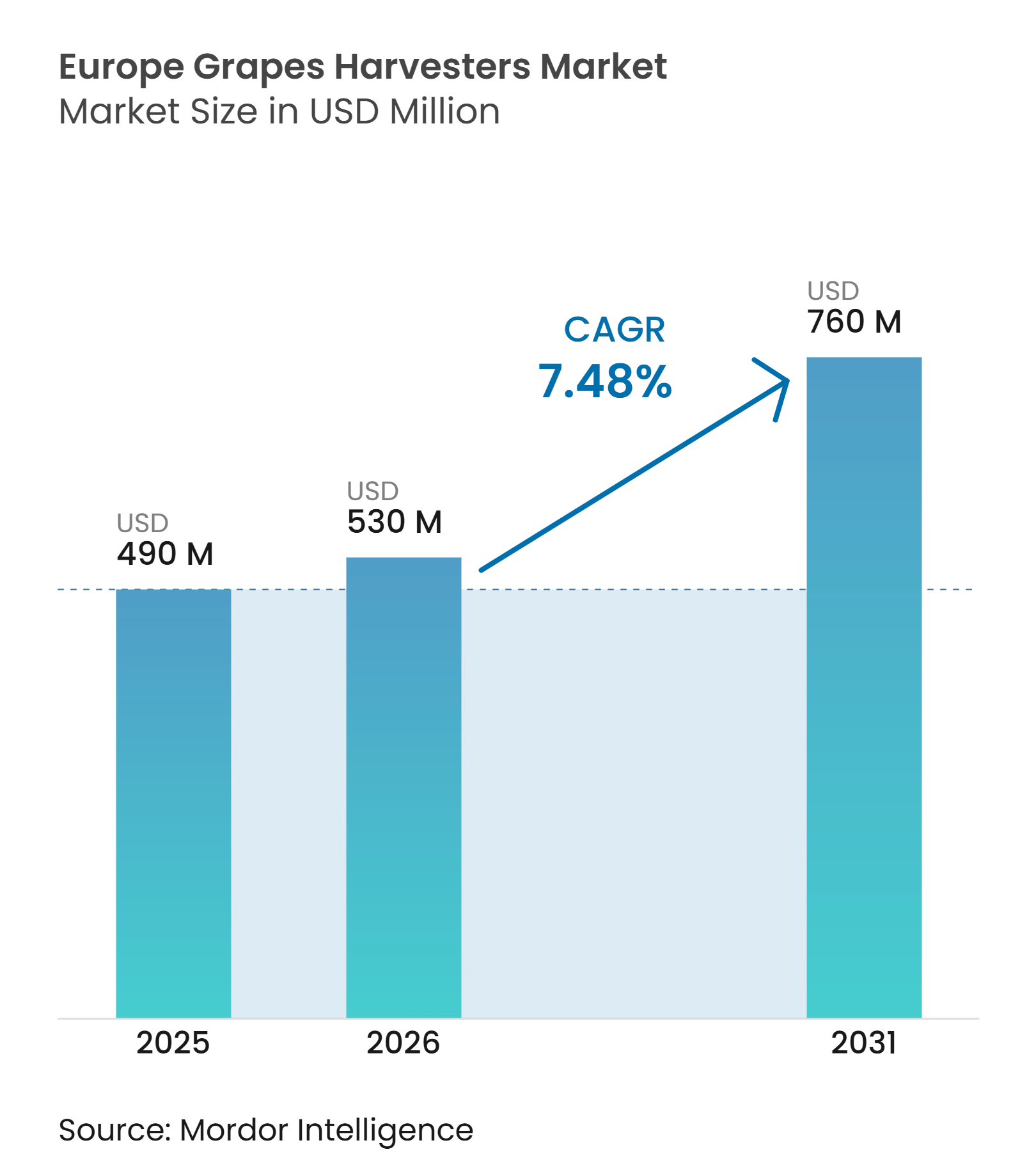
| Base Year Market Size (2025) | USD 490 Million |
| Market Size (2026) | USD 530 Million |
| Market Size (2031) | USD 760 Million |
| Growth Rate (2026 - 2031) | 7.48 % |
| Market Concentration | High |
Major Players *Disclaimer: Major Players sorted in no particular order Image © Mordor Intelligence. Reuse requires attribution under CC BY 4.0. | |
Europe Grapes Harvesters Market Analysis by Mordor Intelligence
The Europe grapes harvesters market size was valued at USD 490 million in 2025 and is forecast to grow from USD 530 million in 2026 to reach USD 760 million by 2031, at a CAGR of 7.48% during the forecast period 2026 to 2031. The market is supported by replacement demand following prolonged declines in grape harvester registrations in France in 2025[1]. Aging fleets are increasing replacement demand, particularly among larger vineyards that can distribute equipment costs across more hectares. Seasonal labor shortages are making mechanized harvesting more relevant, especially as earlier harvest dates reduce the availability of temporary workers[2]. Public support under the Common Agricultural Policy is encouraging investment in modern, compliant equipment and related digital capabilities[3]. The market is also constrained by the limits of mechanization in premium appellations, fragmented parcels, and steep vineyard sites.
Key Report Takeaways
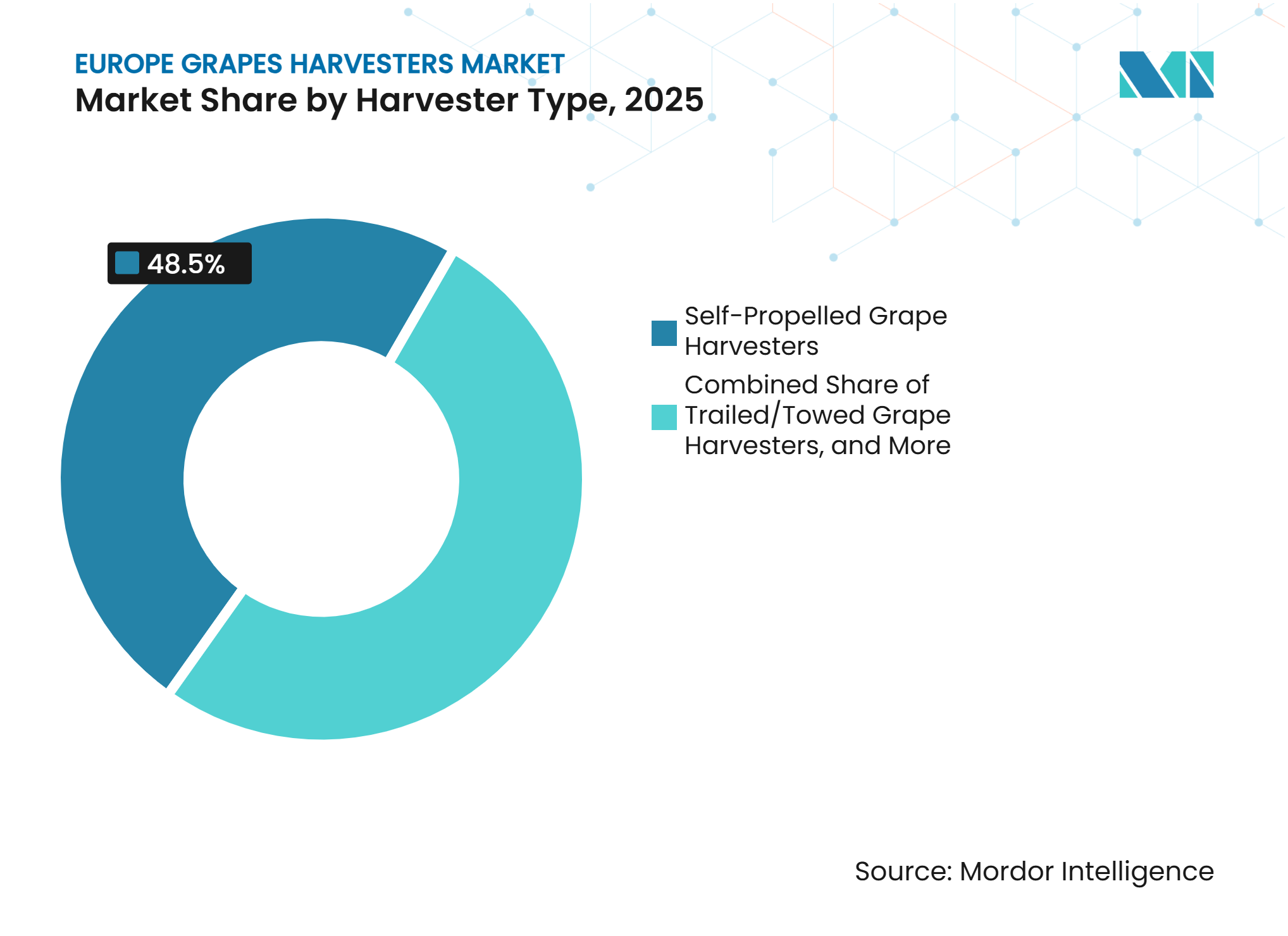
- By harvester type, self-propelled grape harvesters accounted for 48.5% of the Europe grape harvesters market share in 2025, while tractor-mounted grape harvesters are forecast to grow at a CAGR of 11.8% from 2026 to 2031.
- By mode of operation, assisted and precision-guided operation held 54.2% share of the Europe grape harvesters market size in 2025, while autonomous and semi-autonomous operation is forecast to grow at a CAGR of 13.2% from 2026 to 2031.
- By power source, diesel-powered harvesters accounted for 66.8% of the market share in 2025, while electric powertrains are forecast to grow at a CAGR of 14% from 2026 to 2031.
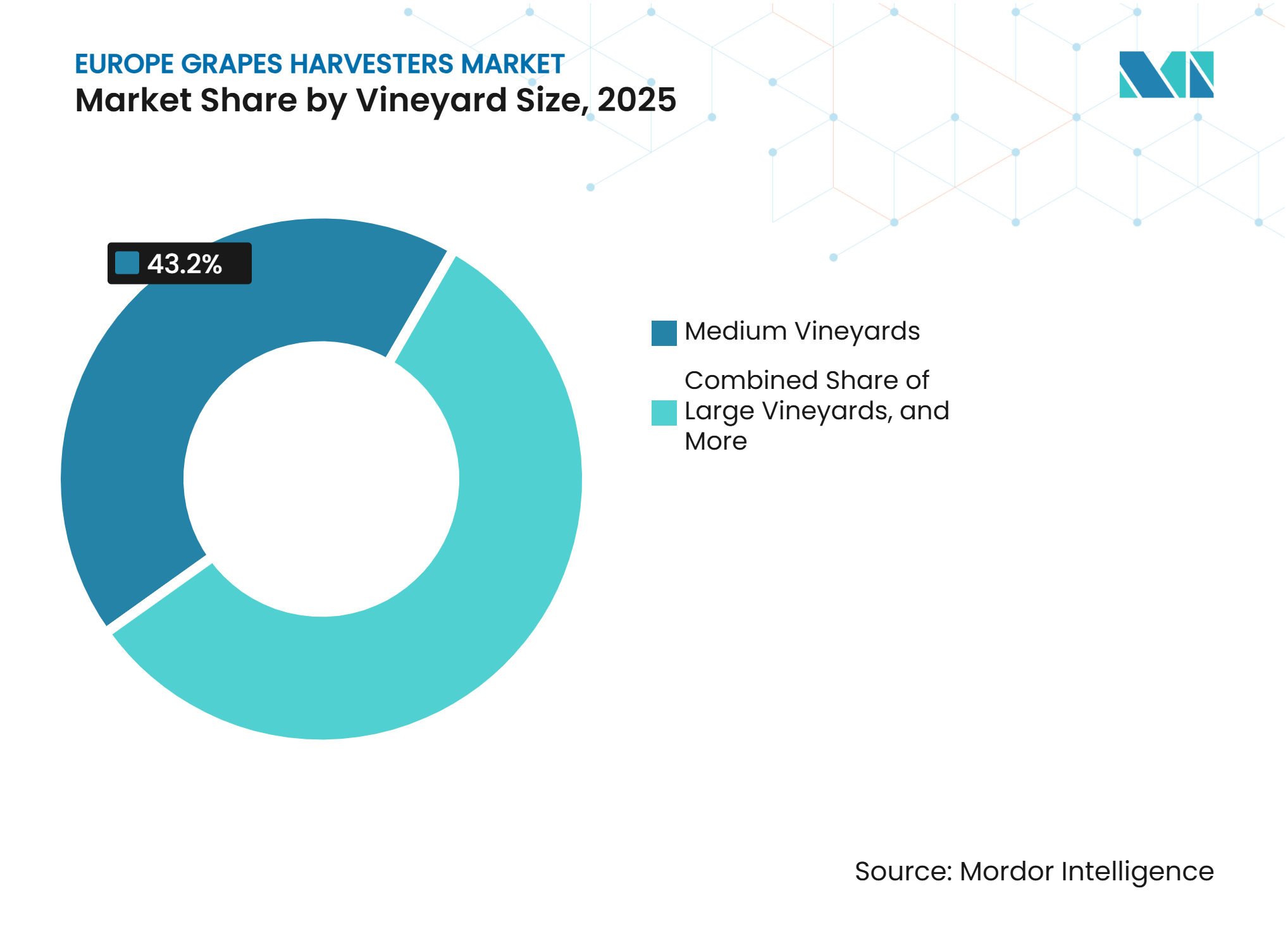
- By vineyard size, medium vineyards held 43.2% share in 2025, while small vineyards are forecast to grow at a CAGR of 12.4% from 2026 to 2031.
Note: Market size and forecast figures in this report are generated using Mordor Intelligence’s proprietary estimation framework, updated with the latest available data and insights as of January 2026.
Market Trends and Insights
Drivers Impact Analysis of Europe Grapes Harvesters Market*
| Driver | (~) % Impact on CAGR Forecast | Geographic Relevance | Impact Timeline |
|---|---|---|---|
| Vineyard labor shortages and wage inflation | +1.9% | France, Italy, Spain, Germany, Austria | Short term (≤ 2 years) |
| Vineyard consolidation and multi-unit fleet procurement | +1.1% | France, Spain, Italy, Portugal | Medium term (2-4 years) |
| Common agricultural policy support for mechanization and digitalization | +1.4% | European Union member states, especially France, Italy, Spain, and Germany | Medium term (2-4 years) |
| Precision viticulture and data-ready harvesting equipment | +0.9% | France, Germany, Italy | Medium term (2-4 years) |
| Narrow-row and alpine-terrace micro-harvester development | +0.7% | France, Italy, Austria, Switzerland | Long term (≥ 4 years) |
| Seasonal custom-hiring and equipment-as-a-service models | +0.6% | France, Italy, Spain | Short term (≤ 2 years) |
| Source: Mordor Intelligence | |||
Vineyard Labor Shortages and Wage Inflation
Labor scarcity is a consistent reason vineyards consider mechanical harvesting. France faced a 30% annual harvest labor deficit and required 300,000 to 400,000 seasonal workers nationally. Earlier harvesting added further pressure in 2025, when the Beaujolais harvest began two weeks ahead of the 2024 harvest, reducing the availability of students and seasonal workers. A May 2025 study published in AgriEngineering found that mechanized harvesting cost EUR 531.6 per hectare (USD 575.9), compared with EUR 2,161.8 per hectare (USD 2,341.1) for manual harvesting. The study also reported a 75% reduction in direct labor costs and a payback period of 3.5 harvest seasons. These economics strengthen the case for mechanized harvesting in the Europe grape harvesters market, where access to workers is uncertain.
Vineyard Consolidation and Multi-Unit Fleet Procurement
Vineyard consolidation is changing equipment purchases from isolated replacements to coordinated fleet decisions. European vineyard area declined to 3.2 million hectares in 2024. Spain reduced its vineyard area by 1.5%, while France reduced its area by 0.7%. Italy expanded its vineyard area by 0.8% during the same year. Remaining operators are often larger and better positioned to standardize equipment across multiple sites. Fleet management becomes more valuable when operators use connected machines within a consistent software environment. New Holland Agriculture’s IntelliField platform can coordinate up to 6 grape harvesters in near real time. The Europe grapes harvesters market, therefore, favors suppliers that combine high-capacity equipment with fleet management capabilities.
Common Agricultural Policy Support for Mechanization and Digitalization
The Common Agricultural Policy supports investment in modern agricultural equipment across the European Union. The CAP Strategic Plans are underpinned by EUR 307 billion (USD 327.4 billion) in public expenditure for 2023–2027. Wine-sector measures receive EUR 1.1 billion (USD 1.1 billion) in annual support. Vineyard restructuring accounts for 50% of those wine-sector disbursements. Italy activated EUR 144.1 million (USD 152 million) for vineyard restructuring during 2026, with harvester upgrades listed as an explicit priority. CAP co-financing increasingly steers buyers toward equipment that meets Stage V requirements under Regulation EU 2016/1628.
Precision Viticulture and Data-Ready Harvesting Equipment
Precision viticulture is increasing the value of harvesters that collect usable field data. A 2026 study published in Precision Agriculture examined a 150.7-hectare Tuscan winegrowing farm using a self-propelled harvester, unmanned aerial vehicle yield maps, and variable-rate technology. The study found that an innovative management approach incorporating precision technologies increased gross margins by approximately 54% compared with conventional management and increased revenue by 33.6%. Harvester telemetry can be combined with remote sensing data to map yields at the sub-row level. A 2025 study published in Precision Agriculture validated Bayesian yield mapping using remote sensing and grape harvester tracking in Sicilian vineyards. These functions help link harvesting conditions with quality management decisions. The Europe grapes harvesters market increasingly rewards equipment that supports both field operations and vineyard records.
Restraints Impact Analysis of Europe Grapes Harvesters Market*
| Restraint | (~) % Impact on CAGR Forecast | Geographic Relevance | Impact Timeline |
|---|---|---|---|
| High upfront capital cost and long payback periods | -1.4% | All European markets, especially Greece, Austria, and Switzerland | Short term (≤ 2 years) |
| Operator skill, service network, and maintenance complexity | -0.7% | France, Italy, Germany, with gaps in Portugal and Greece | Medium term (2-4 years) |
| Premium wine quality preferences for selective hand harvesting | -0.8% | France, Italy, Spain, Portugal, Germany | Long term (≥ 4 years) |
| Fragmented small parcels and extreme-slope compatibility limits | -0.8% | France, Italy, Austria, Switzerland, Portugal, Greece | Long term (≥ 4 years) |
| Source: Mordor Intelligence | |||
High Upfront Capital Cost and Long Payback Periods
High upfront investment costs remain a key barrier to grape harvester adoption among smaller vineyards. A 2026 study published in Precision Agriculture found that the economic viability of precision technologies, including self-propelled grape harvesting, depends on vineyard scale, and that high investment costs can limit adoption among smaller winegrowing operations. Italy's relatively small average vineyard size can limit the economic attractiveness of owning dedicated harvesting equipment for smaller growers. The high purchase cost of specialized harvesting equipment can extend investment recovery periods and limit adoption among small and independent growers. Limited equipment utilization outside the grape harvesting season further reduces the economic attractiveness of investing in dedicated harvesting machinery. These factors constrain grape harvester adoption in smaller European vineyards.
Operator Skill, Service Network, and Maintenance Complexity
Modern harvesters integrate several functions into a single machine, including harvesting heads, onboard destemming, optical sorting, row following, telematics, and Stage V powertrain controls. Operators require training to use these functions reliably within a short harvest window. France, Germany, and Italy have relatively dense authorized dealer networks, while Portugal, Greece, and Austria have less consistent service coverage. A day of equipment downtime can materially affect seasonal results when harvesting windows are only 3 to 6 weeks long. Stage V aftertreatment systems also require service support for diesel particulate filters and selective catalytic reduction components. Equipment-as-a-Service models reduce some of this burden but remain concentrated in France, Italy, and Spain.
*Our forecasts treat driver/restraint impacts as directional, not additive. The impact forecasts reflect baseline growth, mix effects, and variable interactions.
Europe Grapes Harvesters Market Segment Analysis
By Harvester Type:
Self-Propelled grape harvesters Anchor the Market, Tractor-Mounted Gains GroundSelf-propelled grape harvesters held 48.5% of the Europe grapes harvesters market share in 2025. They are widely used by mid-sized and large vineyards that require high throughput. Their autonomous row-following capability can support productivity during short harvest windows. The premium purchase price is easier to justify when machines serve larger vineyard areas. Tractor-mounted grape harvesters are forecast to grow at an 11.8% CAGR through 2031, the fastest growth rate among harvester-type segments. Compact tractor-mounted designs support growers who already own narrow-track tractors and may not have sufficient scale for a dedicated self-propelled harvester. The market for tractor-mounted equipment is supported by first-time mechanization rather than replacement of established fleets.
Trailed and towed grape harvesters offer an alternative for growers seeking lower acquisition costs. Pellenc S.A.S. states that its GRAPES'LINE platform has a 3,600-liter bin capacity. The equipment can provide harvesting capacity comparable to self-propelled options at 50% lower acquisition cost. This price position is relevant for cooperatives and contractor fleets. New Holland Agriculture announced a 2026 Braud 9.80N narrow-row update with a terrain-compensating front axle and IntelliView IV Plus display. European certification requirements favor established manufacturers with proven compliance processes. Self-propelled platforms are likely to remain central to large-vineyard purchases, while towed and tractor-mounted machines provide entry points for smaller operations.



By Mode of Operation:
Assisted/Precision-Guided Systems Dominate, Autonomy Scales FastAssisted/precision-guided operation accounted for 54.2% of the Europe grapes harvesters market in 2025. Sensor-based row following and GPS-assisted steering have become common on mid-range and premium models. These systems reduce operator fatigue and improve row accuracy. Grégoire S.A.S’s EasyPilot uses a 3D camera rather than satellite positioning, providing 3-centimeter guidance accuracy in rows with irregular vine geometry. Autonomous/semi-autonomous operations are forecast to expand at a 13.2% CAGR through 2031. European research programs are testing autonomous harvesting platforms in major wine regions.
Autonomy could become more practical as equipment prices move closer to those of operator-supervised models. The shortage of qualified machinery operators improves the value proposition for semi-autonomous systems. Current adoption still depends on field reliability and the ability to operate safely in varied vineyard conditions. Manual steering remains relevant in terraced and steep-slope vineyards, where terrain changes can exceed current guidance-system reliability limits. The CH Engineering GmbH UT110evo crawler supports operator-controlled harvesting on gradients of up to 75%. Each model generation shifts more tasks from the operator to the machine, which can broaden the available labor pool and help growers manage the effects of an aging agricultural workforce.
By Power Source:
Diesel Dominates, Electric Registers the Fastest GrowthDiesel-powered harvesters accounted for 66.8% of the market in 2025. Their leading position reflects high energy density and established refueling infrastructure. Diesel engines also offer torque characteristics suitable for steep vineyard terrain. ERO GmbH stated that its full grape harvester range complies with EU Stage V requirements. Its Grapeliner 8000 uses an AGCO Power Tier V engine and a Poclain CT200 electronic control unit. The machine can travel at 40 kilometers per hour and operate for a full day without refueling. Stage V requirements are increasing the importance of emissions compliance when vineyards replace older harvesting equipment.
Electric powertrains are forecast to grow at a 14% CAGR through 2031, the fastest rate among power-source segments. Demand is likely to be strongest in emission-sensitive locations such as Champagne, the Rhine Valley, and Italy’s Prosecco zones. Italy’s 2026 vineyard restructuring budget emphasizes sustainability-aligned equipment. Lower noise and exhaust emissions can add commercial value in vineyards located close to urban areas. Hybrid systems provide an intermediate option for growers concerned about electric range, retaining flexibility in use while reducing reliance on conventional diesel operation. Added powertrain complexity remains a limitation for hybrid equipment.
By Vineyard Size:
Medium Vineyards Drive Volume, Small Vineyards Drive RateMedium vineyards accounted for 43.2% of the Europe grapes harvesters market in 2025. This group combines an adequate operating scale with greater flexibility to finance fleet replacement. Cooperatives, established family estates, and regional wine groups are active buyers in this segment. These growers often replace harvester generations at 8 to 12-year intervals, and their purchases represent a significant portion of dealer-financed transactions. Large vineyards remain important buyers of premium self-propelled machines. Their equipment specifications can influence later purchases by smaller operations. The market benefits when these customers standardize equipment across multiple vineyard sites.
Small vineyards are forecast to grow at a 12.4% CAGR through 2031. Equipment-as-a-Service and contractor fleets can lower the capital hurdle for this group. France and Spain have custom-hire networks that charge EUR 500 to EUR 700 per hectare (USD 541.5 to USD 758.1) in 2025. Towed harvesters can cost 50% less than self-propelled equivalents, creating a practical route toward mechanization for growers using contractor services. Small vineyards can adopt machinery without assuming full ownership or maintenance burdens, thereby supporting broader mechanization.

Geography Analysis
France, Italy, and Spain account for a significant share of the installed equipment base and annual demand in the Europe grape harvesters market. France has a high level of vineyard mechanization across major wine-producing regions, including Champagne, Bordeaux, and Burgundy. Domestic suppliers such as Pellenc and Grégoire benefit from their proximity to these vineyard regions. Italy recorded a 0.8% increase in vineyard area in 2024, while the country allocated EUR 144.1 million (USD 152 million) for vineyard restructuring in 2026.
Spain has the largest vineyard area in Europe, although its vineyard area declined by 1.5% in 2024. The country's large commercial vineyards across regions such as Rioja, La Mancha, and Penedès provide opportunities for mechanized harvesting equipment. Portugal, Austria, Switzerland, and Greece represent smaller but distinct markets within Europe. In Portugal, the steep and terraced vineyards of the Douro Valley create demand for specialized harvesting equipment, as conventional harvesters have limited suitability for extreme slopes.
Austria and Switzerland also present opportunities for compact grape harvesters suited to narrow vineyard rows and challenging terrain. Equipment such as the CH Engineering GmbH UT110-CH500 is designed to operate on slopes up to 75%, underscoring the need for specialized machinery in steep-slope vineyards. In Croatia, grape harvesting labor costs EUR 80 net per day (USD 86.6), plus EUR 35 (USD 37.9) in employer charges, indicating the cost pressures associated with manual harvesting. PORTAL.HR Rising labor costs and labor availability concerns are supporting the case for greater mechanization in European vineyards.
Competitive Landscape
Market Concentration
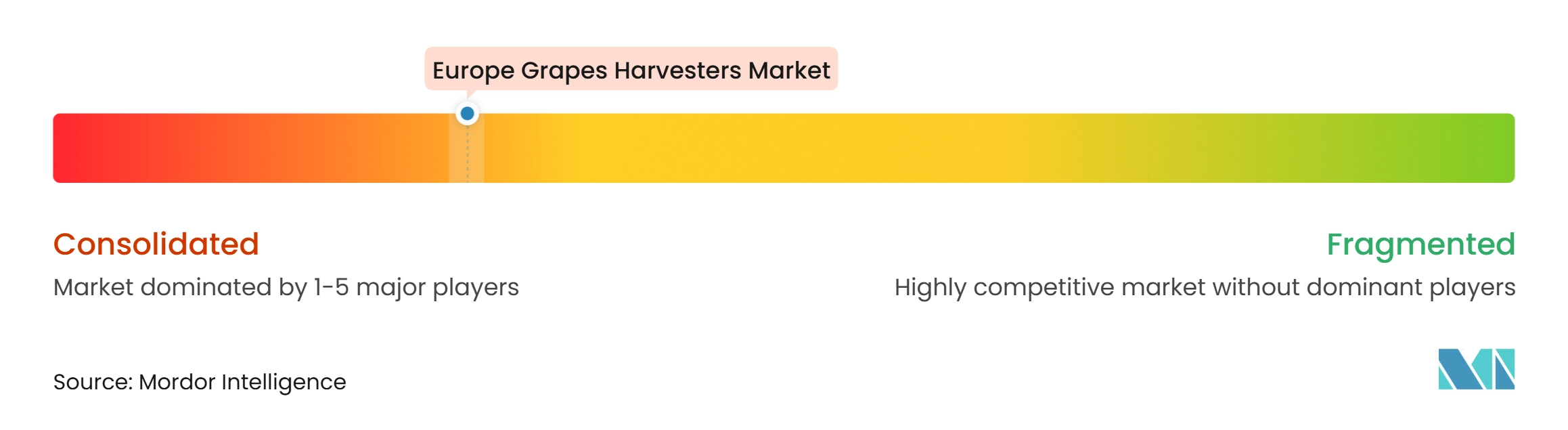
The Europe grape harvesters market is highly consolidated, with a few established manufacturers maintaining a strong presence across major wine-producing countries. New Holland Agriculture is one of the prominent manufacturers, with more than 19,000 Braud harvesters sold globally. Its market position is supported by patented SDC shaking-rod and Noria bucket-conveyance systems. At SITEVI 2025, CNH Industrial introduced the Braud 9.50L, 9.70L, and 9.70M models. The Vari-Control proportional leveling system can raise productivity by at least 10% at working speeds up to 13 kilometers per hour.
Pellenc S.A.S. competes by offering modular, multifunctional carriers and expanded harvesting solutions. The company launched the Optimum XXL80 in January 2026 for super-intensive grape, olive, and almond operations. The launch expands its product portfolio into high-capacity harvesting applications. ERO GmbH focuses on specialized engineering and emissions-compliant harvesting equipment, with its complete product line meeting Stage V requirements across the 75 to 130 kilowatt power range. Oxbo International Corporation is another established competitor in the Europe grape harvesters market. These manufacturers compete on machine capacity, connected functions, emissions compliance, and application-specific equipment design.
Affordable harvesting equipment for vineyards below 50 hectares remains an opportunity for manufacturers seeking to address smaller vineyard operations. Zero-emission equipment for noise-sensitive wine regions also provides scope for product differentiation. CH Engineering GmbH and Andreoli Engineering are addressing steep-slope harvesting requirements through their UT110-CH500 collaboration. EU rules governing the free flow of non-personal data are also becoming relevant to onboard telematics and connected-machine procurement. Vendors with established data-management and connected-equipment capabilities may have an advantage in procurement decisions. Overall, the Europe grape harvesters market remains concentrated, while specialized vineyard applications, smaller vineyard operations, and low-emission equipment provide opportunities for product differentiation.
Europe Grapes Harvesters Industry Leaders
-
New Holland Agriculture - Braud (CNH Industrial N.V.)
-
Pellenc S.A.S.
-
Grégoire S.A.S. (SDF S.p.A.)
-
ERO GmbH
-
Oxbo International Corporation (Ploeger Oxbo Group B.V.)
- *Disclaimer: Major Players sorted in no particular order
Europe Grapes Harvesters Market Companies Covered in this Report
- Pellenc S.A.S.
- New Holland Agriculture - Braud (CNH Industrial N.V.)
- Grégoire S.A.S. (SDF S.p.A.)
- ERO GmbH
- Oxbo International Corporation (Ploeger Oxbo Group B.V.)
- ALMA (Arnaud Frères S.A.S.)
- CRF Costruzioni S.r.l.
- Bobard Frères
- I.ME.CA s.n.c. di Macorigh M. & C.
- CH engineering GmbH
- Andreoli Engineering
- GEIER SRL Tracked Vehicles
- Blueline Manufacturing Company Inc.
- Pulcinelli Giovan Battista S.r.l.
- American Grape Harvesters, Inc.
Recent Industry Developments in Europe Grapes Harvesters Market
- November 2025: New Holland Agriculture launched the Braud 9.50L, 9.70L, and 9.70M at SITEVI 2025 in Montpellier, featuring a Vari-Control proportional leveling system that raises productivity by at least 10%.
- October 2025: ERO GmbH’s Grapeliner 8000 was featured in an engineering case study that confirmed Tier V engine integration, CT200 electronic control unit cruise control, TwinLock MSE18 rear motors, 35% gradeability, and all-day operation without refueling.
- January 2025: CH Engineering GmbH introduced the UT110evo compact crawler harvesting vehicle for vineyard slopes up to 75% gradient and row widths from 1,600 millimeters, with lower-maintenance energy chains and standard tractor-trailer transportability.
Europe Grapes Harvesters Market Report Scope
Grape harvesters are agricultural machines designed for the mechanical harvesting of grapes from vineyards. They automate the harvesting process by removing grapes from vines and collecting them for further processing or handling.
The Europe Grapes Harvesters Report is Segmented by Harvester Type (Self-Propelled Grape Harvesters, Trailed/Towed Grape Harvesters, and Tractor-Mounted Grape Harvesters), by Mode of Operation (Manual Steering and Operation, Assisted/Precision-Guided Operation, and Autonomous/Semi-Autonomous Operation), by Power Source (Diesel-Powered, Hybrid, Electric), by Vineyard Size (Small Vineyards, Medium Vineyards, Large Vineyards), and by Geography (France, Italy, Spain, Germany, Portugal, Russia, Rest of Europe). The Market Forecasts are Provided in Terms of Value (USD).
Segmentation Overview
| Self-Propelled Grape Harvesters |
| Trailed/Towed Grape Harvesters |
| Tractor-Mounted Grape Harvesters |
| Manual Steering and Operation |
| Assisted/Precision-Guided Operation |
| Autonomous/Semi-Autonomous Operation |
| Diesel-Powered |
| Hybrid |
| Electric |
| Small Vineyards |
| Medium Vineyards |
| Large Vineyards |
| France |
| Italy |
| Spain |
| Germany |
| Portugal |
| Russia |
| Rest of Europe |
| By Harvester Type | Self-Propelled Grape Harvesters |
| Trailed/Towed Grape Harvesters | |
| Tractor-Mounted Grape Harvesters | |
| By Mode of Operation | Manual Steering and Operation |
| Assisted/Precision-Guided Operation | |
| Autonomous/Semi-Autonomous Operation | |
| By Power Source | Diesel-Powered |
| Hybrid | |
| Electric | |
| By Vineyard Size | Small Vineyards |
| Medium Vineyards | |
| Large Vineyards | |
| By Geography | France |
| Italy | |
| Spain | |
| Germany | |
| Portugal | |
| Russia | |
| Rest of Europe |
Key Questions Answered in the Report
What is the projected value of Europe grapes harvesters in 2031?
The market is forecast to reach USD 760 million by 2031, rising from USD 530 million in 2026 at a 7.48% CAGR.
Which grape harvester type led Europe in 2025?
Self-propelled grape harvesters led the market with a 48.5% share in 2025, while tractor-mounted units have the fastest forecast growth at 11.8% CAGR.
Why are vineyards adopting mechanical harvesting equipment?
Seasonal labor shortages, higher manual-harvesting costs, and access to contractor fleets are increasing adoption across suitable vineyard sites.
Which power source is growing fastest for grape harvesters?
Electric powertrains are forecast to grow at a CAGR of 14% through 2031, supported by sustainability-focused equipment investment.
What limits harvesting equipment adoption in European vineyards?
High equipment cost, service limitations, steep terrain, fragmented parcels, and hand-harvesting preferences in premium appellations limit adoption.