
Europe Electric Vehicle Battery Anode Market Size and Share
| Study Period | 2019 - 2030 |
| Forecast Data Period | 2025 - 2030 |
| Historical Data Period | 2019 - 2023 |
| Market Size (2025) | USD 0.81 Billion |
| Market Size (2030) | USD 1.47 Billion |
| CAGR (2025 - 2030) | 12.61% |
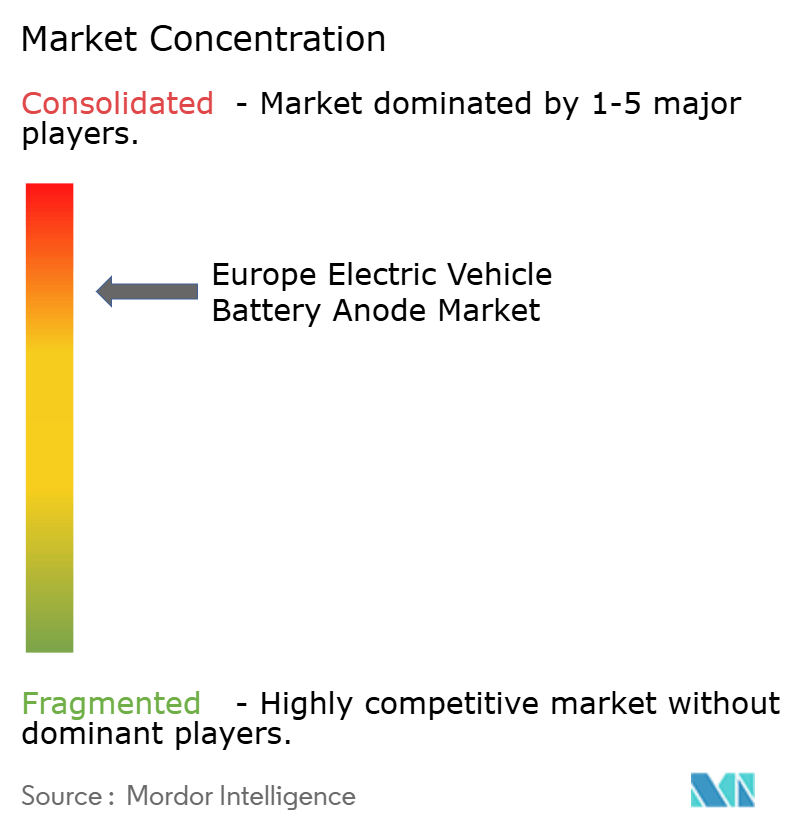
| Market Concentration | High |
Major Players *Disclaimer: Major Players sorted in no particular order |
Europe Electric Vehicle Battery Anode Market Analysis by Mordor Intelligence
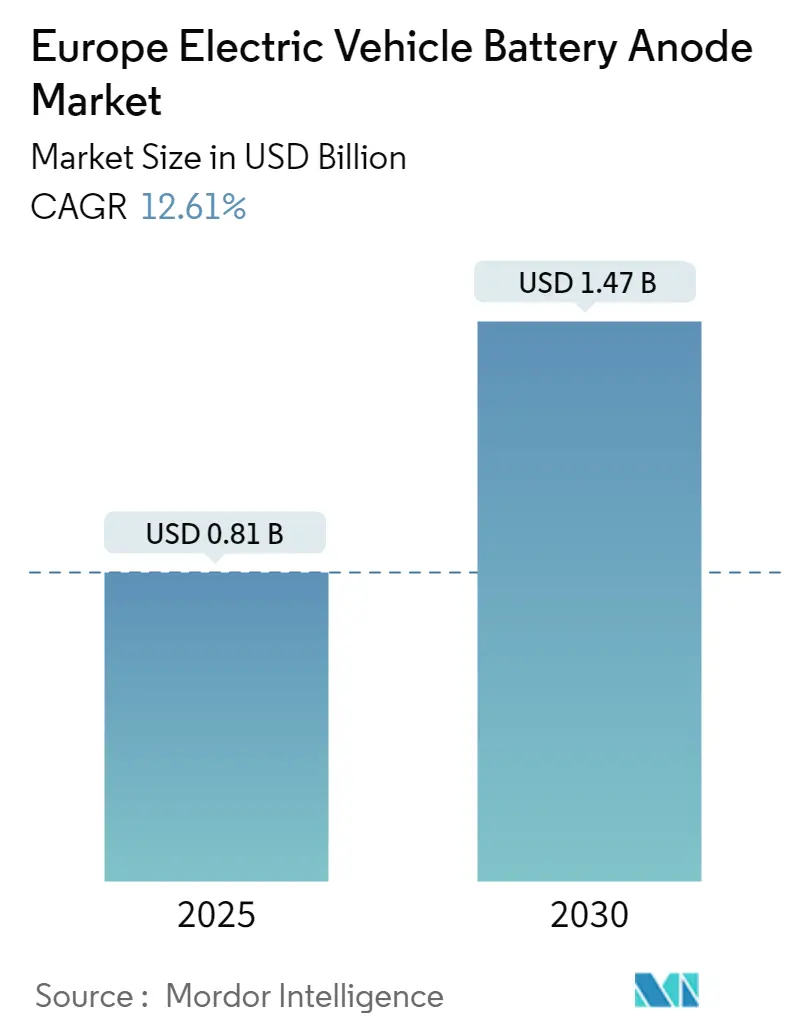
The Europe Electric Vehicle Battery Anode Market size is estimated at USD 0.81 billion in 2025, and is expected to reach USD 1.47 billion by 2030, at a CAGR of 12.61% during the forecast period (2025-2030).
- In the coming years, the Europe electric vehicle battery anode market is poised for growth, driven by the rising adoption of electric vehicles, decreasing costs of battery raw materials (leading to lower prices for Li-ion batteries), and supportive government policies.
- Conversely, challenges such as limited raw material reserves and gaps in the supply chain may hinder the growth of the Europe electric vehicle battery anode market.
- However, advancements in battery anode technologies and ambitious long-term targets for electric vehicles present significant opportunities for players in the European electric Vehicle Battery Anode Market.
- Among the key players in Europe, France is set to experience notable growth in the Europe electric vehicle battery anode market.
Europe participates in a competitive field that extends beyond its own borders. The market landscape in the global electric vehicle battery anode industry outlined by Mordor Intelligence covers that wider structure.
Europe Electric Vehicle Battery Anode Market Trends and Insights
Lithium-ion Battery Segment to Dominate the Market
- In the early days of the lithium-ion battery industry, consumer electronics were the primary market. However, over time, electric vehicle (EV) manufacturers emerged as the leading consumers of these batteries, driven by a surge in EV sales, particularly in plug-in hybrid electric vehicles (PHEVs). This growing demand for lithium-ion batteries in the EV sector bolstered the market for battery anode materials.
- Over the past decade, Europe has seen a meteoric rise in the adoption of lithium-ion batteries, especially in the automotive sector. Countries like France, the UK, Germany, Italy, and Spain are increasingly favoring lithium-ion rechargeable batteries, due to their superior capacity-to-weight ratio. Moreover, lithium batteries in EVs produce no emissions of NOX, CO2, or other greenhouse gases, resulting in a significantly lower environmental impact compared to traditional internal combustion engine (ICE) vehicles. Recognizing this advantage, several European nations are actively promoting lithium-ion technology-driven EVs and fostering the development of the Electric Vehicle Battery Anode Market through subsidies and government initiatives.
- Bloomberg reported that in 2023, global average prices for lithium-ion battery packs used in electric vehicles (EVs) fell to USD 139/kWh, a 13% drop from the previous year. This decline followed a trend of rising prices in earlier years. With ongoing technological advancements and improved manufacturing efficiencies, prices are projected to continue their downward trajectory. Forecasts indicate a price drop to USD 113/kWh by 2025, and an even steeper decline to USD 80/kWh by 2030. Such trends bolster the dominance of the lithium-ion battery segment in Europe's Electric Vehicle Battery Anode Market during the forecast period.
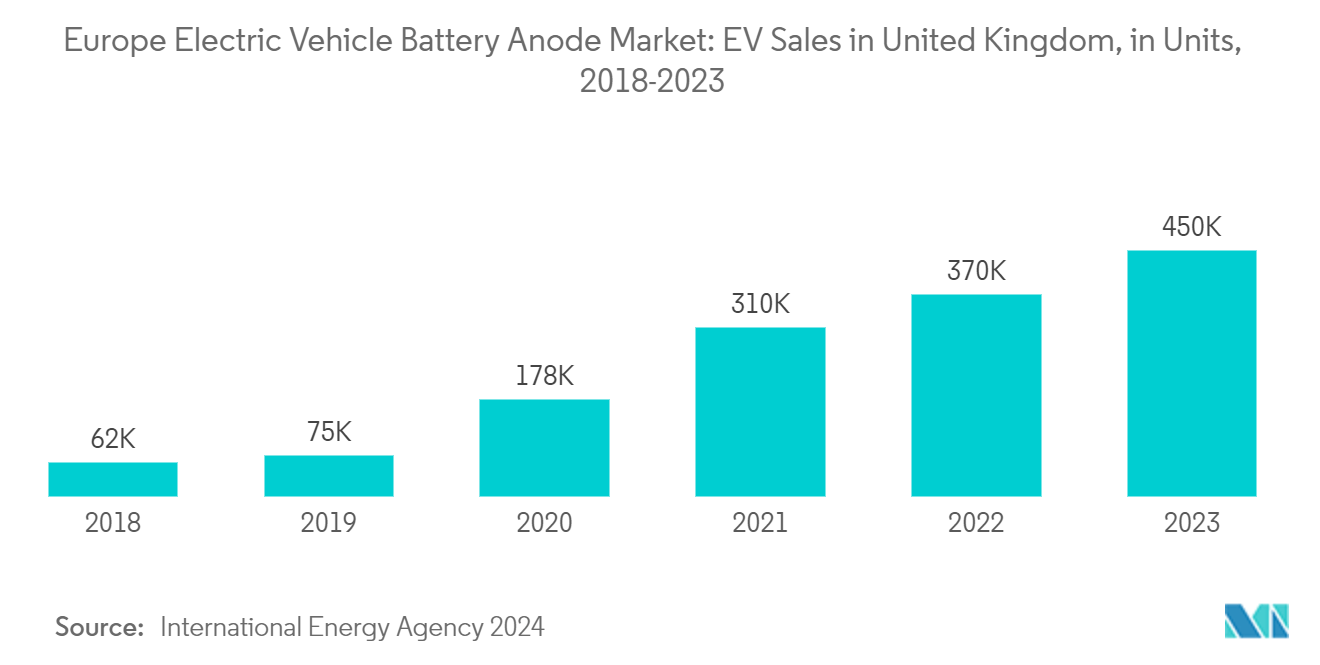
- According to the International Energy Agency (IEA), in 2023, electric vehicle sales in the United Kingdom, predominantly utilizing lithium-ion battery technology (over 95% share), reached 450,000, up from 370,000 in 2022. Given this robust growth in the battery electric vehicle sector, lithium-ion batteries, with their distinct advantages, are poised to capture a significant share of Europe's Electric Vehicle Battery Anode Market.
- In June 2024, Stora Enso and Altris unveiled their partnership aimed at establishing a sustainable battery value and materials chain in Europe. Their collaboration focuses on integrating Stora Enso’s Lignode, a hard carbon solution, as an anode material in Altris’ sodium-ion battery cells. These cells are designed for both motive and stationary power storage. Lignode, as described by Stora Enso, is a sustainable hard carbon derived from lignin, a pulp manufacturing byproduct. This novel anode material boasts compatibility with both lithium-ion and sodium-ion batteries, marking it as a more sustainable choice compared to conventional anode solutions.
- Given these developments, it's evident that the lithium-ion battery segment is set to dominate Europe's Electric Vehicle Battery Anode Market in the coming years.


France to Dominate the Electric Vehicle Battery Anode Market in Europe
- France, a leading developed nation, has taken on the monumental challenge of significantly reducing its greenhouse gas emissions in recent years. In addition to integrating renewable energy sources into its energy mix, France has prioritized tackling vehicular emissions as a key strategy in its fight against climate change. This focus has opened up lucrative opportunities for players in the EV battery anode market. Numerous foreign companies have set up operations in France, consistently expanding their manufacturing capabilities.
- On October 14th, 2024, at the Paris Motor Show, ProLogium Technology, a frontrunner in lithium ceramic battery innovation, unveiled the world's first EV battery featuring a 100% silicon composite anode. This revolutionary battery can be charged in a mere 8.5 minutes. Such advancements underscore the burgeoning anode market in Europe, with companies actively innovating in EV battery anode materials.
- In May 2024, AnteoTech, a clean energy tech firm, revealed that a prominent electric vehicle maker will adopt its battery anode technology in their prototype batteries. At the 14th International Advanced Automotive Battery Conference (AABC) in Strasbourg, AnteoTech held talks with battery manufacturers, including a meeting with EV1's project management team. EV1, a global electric vehicle manufacturer, is evaluating the integration of Anteo XTM technology into its vehicles. AnteoTech highlights that EV1 has confirmed that Anteo XTM not only reduces their input costs but also boosts the performance of their proprietary anode.
- In August 2024, Novacium SAS, a French subsidiary focused on green engineering of silica and silicon-based anode materials, reached a pivotal milestone in battery innovation. Their latest batteries, combining graphite with a refined third-generation (GEN3) silicon-based anode, achieved a capacity of over 4,030 mAh. This is nearing the world record of 4,095 mAh for 18650 batteries. With this feat, Novacium SAS becomes one of only three companies worldwide to report 18650 battery capacities surpassing 4,000 mAh. Such milestones bolster the prospects of the EV battery anode material market in France.
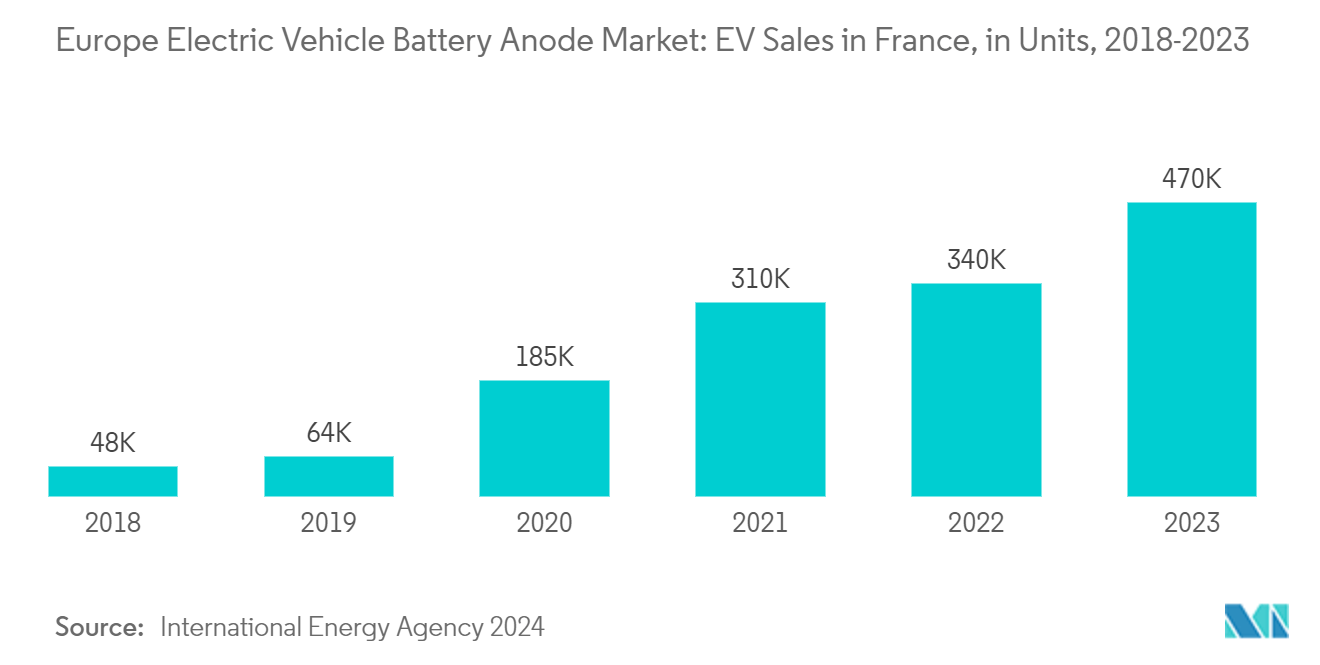
- Data from the International Energy Agency (IEA) reveals that in 2023, France saw electric vehicle sales hit 470,000, up from 340,000 in 2022, with over 95% relying on Li-ion battery technology. Given this surge in the battery electric vehicle sector, lithium-ion batteries, with their distinct advantages, are poised to command a substantial share of the Electric Vehicle Battery Anode Market in France.
- Consequently, these developments position France as a pivotal player in the European Electric Vehicle Battery Anode Market in the coming years.

Mordor Intelligence provides coverage of the electric vehicle battery anode market across other key regional markets, including Europe, Middle East, and Africa, Asia, and North America, each with their regulatory frameworks and demand patterns. Detailed country-level analysis extends to Germany, France, United Kingdom, Italy, United States, and Canada incorporating local coverage and market participation, as required.
Competitive Landscape
The Europe Electric Vehicle Battery Anode Market is moderately consolidated. Some of the major players in the market (in no particular order) include BTR New Material Group Co., Ltd., Novacium SAS, ProLogium Technology Co., Ltd, Talga Group, and NEO Battery Materials Ltd, among others.
Europe Electric Vehicle Battery Anode Industry Leaders
BTR New Material Group Co.
Novacium SAS
ProLogium Technology Co., Ltd
Talga Group
NEO Battery Materials Ltd
- *Disclaimer: Major Players sorted in no particular order

Recent Industry Developments
- October 2024: Vianode, a leader in advanced battery materials, has inaugurated its first full-scale Via ONE anode graphite battery production facility in Herøya, Norway. This significant step highlights Europe's commitment to solidifying its value chain for batteries and electric vehicles (EVs). The plant, equipped with four state-of-the-art furnaces, focuses on producing synthetic anode graphite, a crucial component for lithium-ion batteries. Once operating at full capacity, the facility aims to produce 2,000 tons annually, sufficient for around 30,000 electric vehicles each year.
- October 2024: AnteoTech has clinched its first commercial order for the Ultranode battery anode technology, worth AUD 40,000, from the leading European electric vehicle manufacturer, EV1. This order plays a crucial role in EV1's battery optimization program. Kicking off a testing and evaluation phase, EV1 will closely examine the anode's performance alongside its ongoing battery optimization efforts, employing Anteo X. The main goal is to assess how the Ultranode can enhance battery performance and align with EV1's goal of moving to higher silicon battery anodes. AnteoTech's Ultranode technology replaces traditional graphite anodes with a sustainable, high-performance design, utilizing cost-effective silicon as the active material. AnteoTech believes this groundbreaking approach provides a vital edge for lithium-ion batteries, central to the worldwide shift towards clean energy.


Europe Electric Vehicle Battery Anode Market Report Scope
An electric vehicle (EV) battery anode is a key component in lithium-ion and other rechargeable battery types used in EVs. The anode is the negative electrode within the battery, where lithium ions are stored during charging and released during discharging, thus providing the required electric motive power. It is critical in determining the EV battery's energy capacity, lifespan, efficiency, and safety.
The Europe Electric Vehicle Battery Anode Market is Segmented by Battery Technology Type, Material Type, and Geography. By Battery Technology Type, the market is segmented into Lithium-Ion, Lead-Acid, and Other Technologies. By Material Type, the market is segmented into Silicon, Graphite, Lithium, and Other Materials, and by Geography, the market is segmented into France, the United Kingdom, Germany, Spain, Italy, Nordic countries, and the Rest of Europe.
The Report Offers the Market Size and Forecasts in revenue (USD) for all the above segments.
| Lithium-ion |
| Lead-acid |
| Other technology |
| Silicon |
| Graphite |
| Lithium |
| Other Materials |
| France |
| United Kingdom |
| Germany |
| Spain |
| Italy |
| Nordic countries |
| Rest of Europe |
| By Battery type | Lithium-ion |
| Lead-acid | |
| Other technology | |
| By Material Type | Silicon |
| Graphite | |
| Lithium | |
| Other Materials | |
| Geography | France |
| United Kingdom | |
| Germany | |
| Spain | |
| Italy | |
| Nordic countries | |
| Rest of Europe |


Key Questions Answered in the Report
How big is the Europe Electric Vehicle Battery Anode Market?
The Europe Electric Vehicle Battery Anode Market size is expected to reach USD 0.81 billion in 2025 and grow at a CAGR of 12.61% to reach USD 1.47 billion by 2030.
What is the current Europe Electric Vehicle Battery Anode Market size?
In 2025, the Europe Electric Vehicle Battery Anode Market size is expected to reach USD 0.81 billion.
Who are the key players in Europe Electric Vehicle Battery Anode Market?
BTR New Material Group Co., Novacium SAS, ProLogium Technology Co., Ltd, Talga Group and NEO Battery Materials Ltd are the major companies operating in the Europe Electric Vehicle Battery Anode Market.
What years does this Europe Electric Vehicle Battery Anode Market cover, and what was the market size in 2024?
In 2024, the Europe Electric Vehicle Battery Anode Market size was estimated at USD 0.71 billion. The report covers the Europe Electric Vehicle Battery Anode Market historical market size for years: 2019, 2020, 2021, 2022, 2023 and 2024. The report also forecasts the Europe Electric Vehicle Battery Anode Market size for years: 2025, 2026, 2027, 2028, 2029 and 2030.
Page last updated on:
Europe Electric Vehicle Battery Anode Market Report
Statistics for the 2025 Europe Electric Vehicle Battery Anode market share, size and revenue growth rate, created by Mordor Intelligence™ Industry Reports. Europe Electric Vehicle Battery Anode analysis includes a market forecast outlook for 2025 to 2030 and historical overview. Get a sample of this industry analysis as a free report PDF download.





