
Market Overview
| Study Period | 2021 - 2031 |
|---|---|
| Forecast Data Period | 2026 - 2031 |
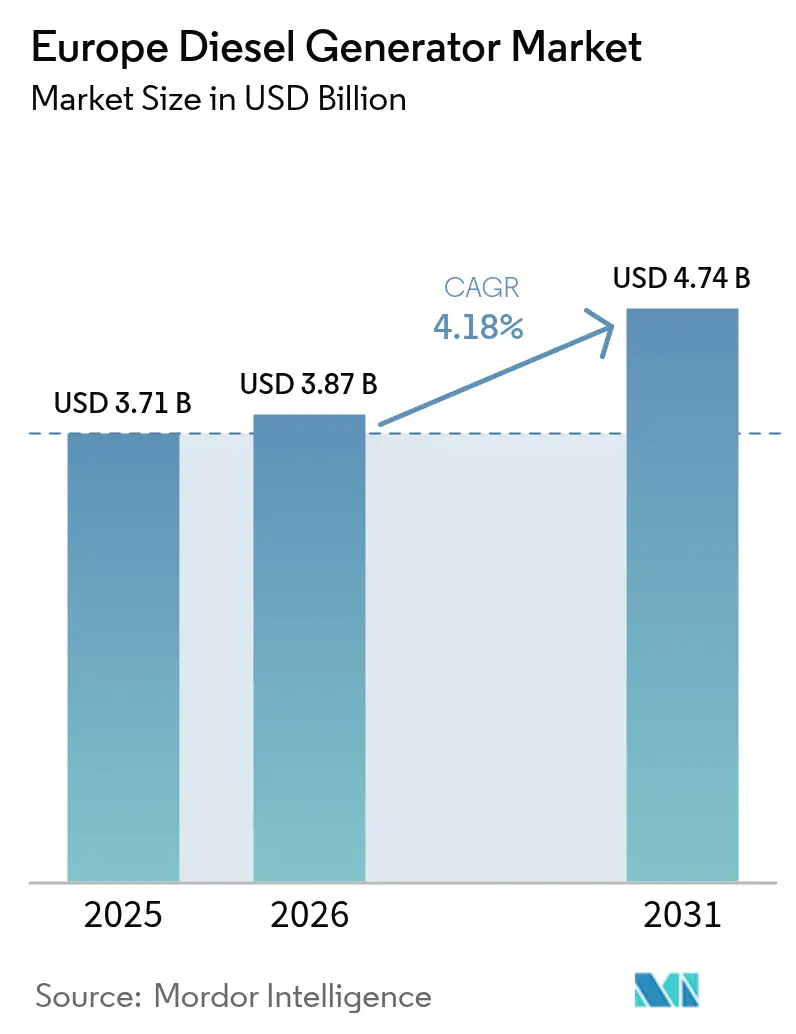
| Base Year Market Size (2025) | USD 3.71 Billion |
| Market Size (2026) | USD 3.87 Billion |
| Market Size (2031) | USD 4.74 Billion |
| Growth Rate (2026 - 2031) | 4.18 % |
| Market Concentration | Medium |
Major Players *Disclaimer: Major Players sorted in no particular order Image © Mordor Intelligence. Reuse requires attribution under CC BY 4.0. | |
Europe Diesel Generator Market Analysis by Mordor Intelligence
The Europe Diesel Generator Market size is expected to grow from USD 3.71 billion in 2025 to USD 3.87 billion in 2026 and is forecast to reach USD 4.74 billion by 2031 at 4.18% CAGR over 2026-2031.
Grid reliability concerns, NATO-linked resilience rules, and surging data center construction are the strongest demand catalysts. Standby units dominate 2024 revenue, yet rising microgrid adoption is lifting prime-power sales and lengthening duty cycles. Generator rental penetration continues to expand as contractors favor pay-per-use fleets that bundle Stage V diesel sets with battery modules, reducing fuel bills and noise. Incumbent engine makers are upgrading their product lines for HVO100 compatibility to defend their market share while meeting the looming Stage VI emission caps. Structural headwinds stem from cheaper batteries and stringent exhaust rules, but hybrid diesel-battery systems are mitigating the impact.
Key Report Takeaways
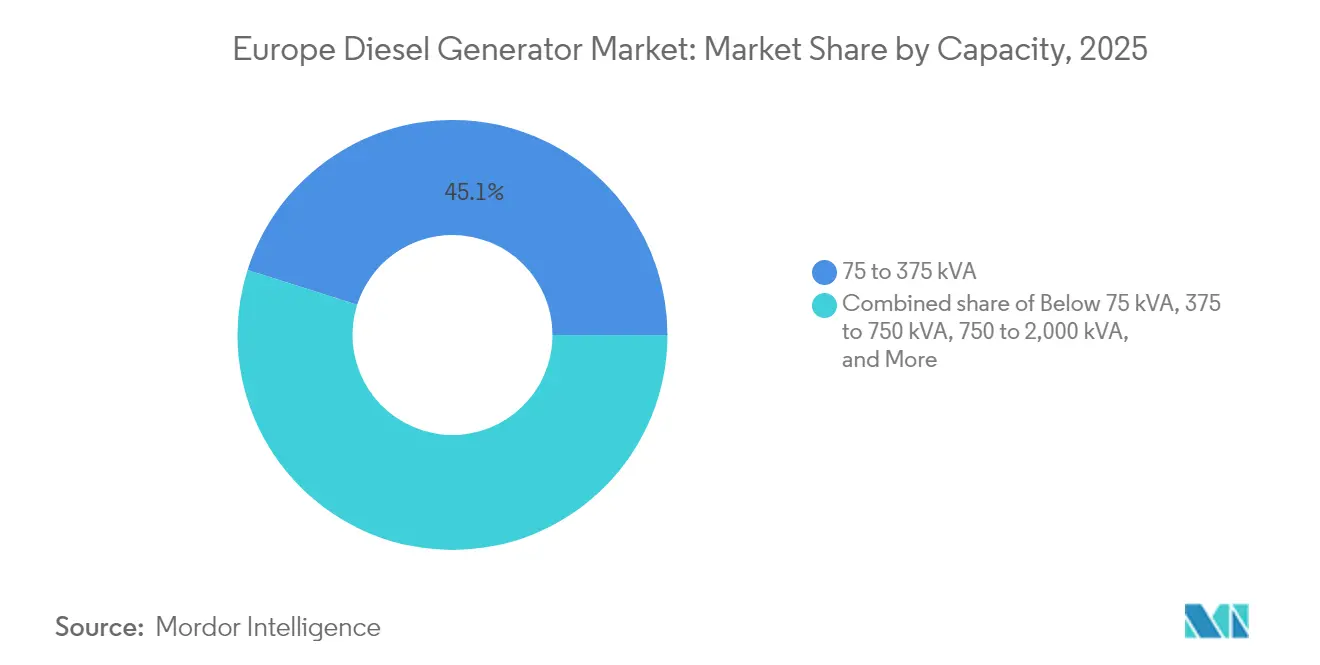
- By capacity, the 75-to-375 kVA tier commanded 45.12% of the European diesel generator market share in 2025; the 375-to-750 kVA class is forecast to expand at a 6.80% CAGR through 2031.
- By application, standby and backup captured 68.25% of the revenue in 2025, while prime and continuous duty are growing at a 6.52% CAGR to 2031.
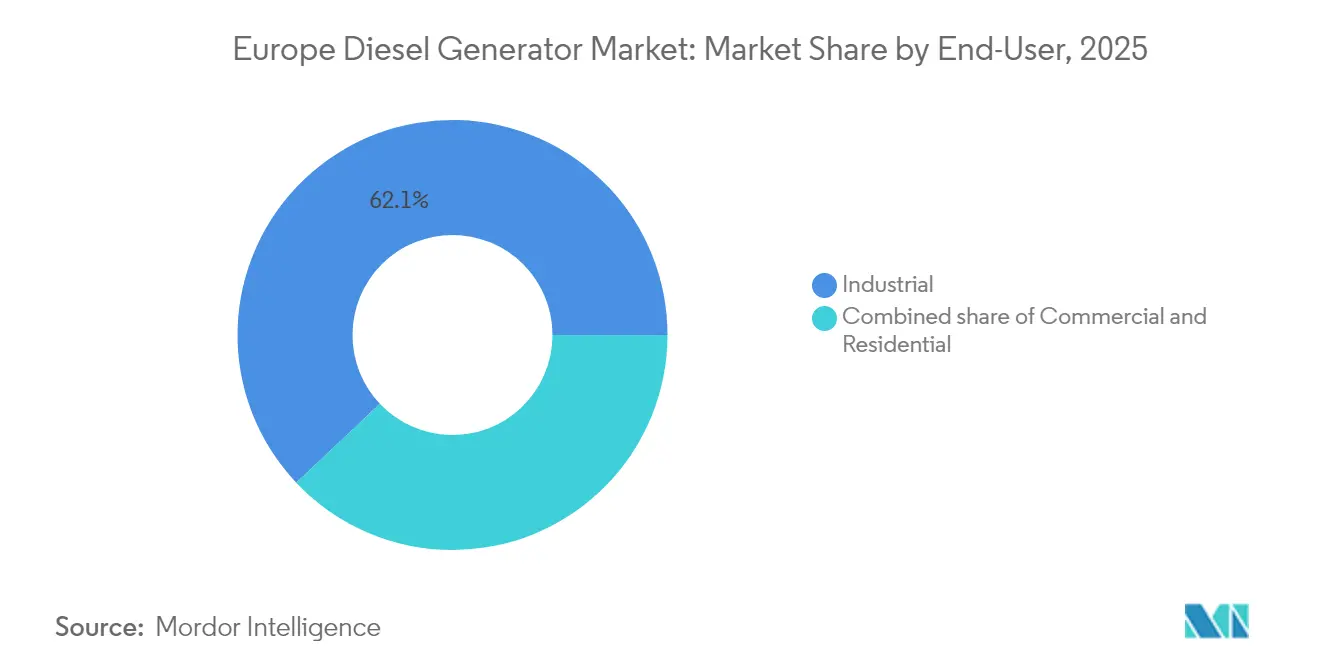
- By end user, industrial facilities held 62.05% of 2025 demand; commercial deployments are advancing at a 6.98% CAGR over the outlook.
- By geography, Germany led with 23.10% of 2025 revenue, whereas Russia posted the fastest CAGR at 6.32% through 2031.
Note: Market size and forecast figures in this report are generated using Mordor Intelligence’s proprietary estimation framework, updated with the latest available data and insights as of 2026.
Market Trends and Insights
Drivers Impact Analysis of Europe Diesel Generator Market*
| Driver | (~) % Impact on CAGR Forecast | Geographic Relevance | Impact Timeline |
|---|---|---|---|
| Grid-outage driven standby demand surge | +1.2% | Germany, UK, Nordics, with spillover to France and Benelux | Short term (≤ 2 years) |
| Industrial & commercial capacity expansion | +0.9% | Germany, France, Italy, Spain, Poland | Medium term (2-4 years) |
| Growth in generator-rental ecosystem | +0.7% | UK, Germany, France, Benelux, Nordics | Medium term (2-4 years) |
| Stage-V retrofit boom (2027–2029) | +0.6% | EU-27 countries, with highest uptake in Germany, France, Netherlands | Long term (≥ 4 years) |
| NATO energy-security stockpiles | +0.4% | NATO member states, concentrated in Germany, Poland, Baltics, UK | Medium term (2-4 years) |
| Residential back-up adoption (sub-75 kVA) | +0.3% | Spain, Italy, rural France, Greece, with limited urban penetration | Long term (≥ 4 years) |
| Source: Mordor Intelligence | |||
Grid-Outage Driven Standby Demand Surge
Fourteen member states face capacity shortfalls in the 2024-2025 winter outlook, prompting hospitals, data centers, and telecom towers to secure new standby sets.(1) The United Kingdom alone installed 1,200 hospital backup units in 2024 to satisfy a 72-hour autonomy rule.(2) After the Baltic Sea cable sabotage, mobile gensets were dispatched to remote cell sites once fed only by the grid, underscoring how security threats convert into immediate equipment orders. Manufacturers have responded with automatic transfer switches that start within ten seconds to protect critical loads. This surge keeps the European diesel generator market at the forefront of emergency-power planning across the continent.
Industrial and Commercial Capacity Expansion
New semiconductor fabs, mixed-use towers, and logistics hubs require multi-megawatt contingencies that conventional grids cannot always guarantee.(3) With every cleanroom spin valued in the millions, voltage dips are intolerable, so developers specify redundant diesel arrays during design. Paris and Milan high-rises are similarly pre-installing 200 to 500 kVA sets to secure lift and HVAC uptime. Because these projects lock in long-run demand, the European diesel generator market gains durable revenue streams even as operating profiles evolve toward hybrid duty.
Growth in Generator-Rental Ecosystem
Rental penetration increased to 38% in 2024, up seven percentage points since 2020.(4) Aggreko grew European temporary-power sales 14% by pairing Stage-V units with battery packs that trim fuel use 30%, an approach well-received at Spanish wind-farm sites. Atlas Copco’s hybrid fleet matches this model, targeting projects that last weeks rather than days. OpEx models fit tight construction budgets and bypass emission-compliance paperwork, strengthening market stickiness.
Stage-V Retrofit Boom
EU Regulation 2016/1628 sets a January 2027 deadline for new Stage-V-compliant gensets and a 2029 switch for rental fleets. Retrofit kits priced between EUR 8,000 and EUR 15,000 prompt owners to opt for early replacement, thereby swelling OEM order books to 18-month lead times. Makers offering plug-and-play exhaust after-treatment enjoy clear pricing power. This retrofit wave is forecast to lift the European diesel generator market through the late decade.
Restraints Impact Analysis of Europe Diesel Generator Market*
| Restraint | (~) % Impact on CAGR Forecast | Geographic Relevance | Impact Timeline |
|---|---|---|---|
| Renewables + storage displacement | -0.8% | Germany, UK, Spain, Denmark, Netherlands | Medium term (2-4 years) |
| Stricter EU Stage V/VI emission caps | -0.5% | EU-27 countries, with highest compliance costs in urban Germany, France, Italy | Long term (≥ 4 years) |
| Bio-/eFuel & hybrid microgrid shift | -0.3% | Sweden, Finland, Netherlands, Denmark, Germany | Medium term (2-4 years) |
| Urban noise-ordinance bans (>90 dB) | -0.2% | Urban centers in Germany, France, Italy, UK, Spain, Netherlands | Short term (≤ 2 years) |
| Source: Mordor Intelligence | |||
Renewables plus Storage Displacement
Battery energy-storage installations hit 9.2 GW in 2024, with 4-hour discharge systems now beating diesel variable costs in many markets. Data centers in Frankfurt and Amsterdam cut genset runtime by up to 70% by shifting short outages to lithium-ion banks. Residential and small commercial users with capacities below 200 kVA are adopting rooftop solar plus batteries, reducing demand for portable diesel. Price declines below EUR 150 per megawatt-hour put further pressure on traditional standby sets. Nonetheless, diesel remains the only economical choice for multi-day outages, which preserves a baseline for the European diesel generator market.
Stricter EU Stage V/VI Emission Caps
Stage VI rules proposed for 2028 will lower nitrogen-oxide limits to 0.4 g/kWh and impose real-world testing. Compliance adds EUR 12,000-20,000 per unit, raising barriers for small owners. Acoustic ordinances in major cities also require enclosures, which can increase project costs by up to 25%. These layers accelerate interest in HVO drop-in fuels, which slash particulates by 80% without hardware changes. While the rules temper growth, they also drive a shift toward premium hybrid and biofuel-ready models, supporting value in the European diesel generator market.
*Our forecasts treat driver/restraint impacts as directional, not additive. The impact forecasts reflect baseline growth, mix effects, and variable interactions.
Europe Diesel Generator Market Segment Analysis
By Capacity:
Mid-Range Leads While High-Power Gains PaceThe 75-to-375 kVA band accounted for 45.12% of 2025 revenue, thanks to strong uptake in retail chains and municipal treatment plants. Rental fleets also favor this range because it strikes a balance between transport weight and fuel efficiency. Sub-75 kVA sets remain common on job sites, yet they face substitution from solar-battery combinations in subsidized markets. Above-750 kVA units serve oil refineries and mines that lack economical grid feeders, with Wärtsilä containerized modules delivering 20-MW blocks to Arctic locales.
Hybrid demand converges on 150-to-300 kVA, where batteries smooth load spikes and reduce fuel burn by roughly one-third. Stage-V rules accelerate turnover in the 200 to 500 kVA cohort, as pre-2019 engines prove cost-prohibitive to retrofit. Together, these mechanics underpin sustained volume in this core tranche of the European diesel generator market.

By Application:
Standby Dominates Yet Prime-Power AcceleratesStandby arrays captured 68.25% of 2025 sales, especially in data centers and hospitals where 10-second start and 72-hour autonomy are mandated. Shorter outages are shifting toward batteries, but diesel still anchors compliance. Peak shaving remains a modest 7.00% slice, yet demand charges above EUR 100 per kW each month in Germany encourage factories to operate generators during grid peaks.
Prime-power units, which account for only 24.75% of the total in 2025, are projected to grow 6.52% annually through microgrids on islands and remote mines. OEMs now certify engines for HVO100 to address carbon targets at these sites. These developments expand the operational palette and increase the European diesel generator market size across various duty profiles.
By End User:
Industrial Share Holds While Commercial RisesIndustrial plants consumed 62.05% of gensets in 2025, anchored by statutory backup obligations for high-load facilities. Cement, steel, and chemical operators regard diesel reliability as non-negotiable.
Commercial projects exhibit the fastest growth rate of 6.98%, fueled by hyperscale data hubs in Frankfurt, Amsterdam, and Dublin. Hospitals, telecom towers, and 5G cell sites add further tailwinds across the European diesel generator market.
Geography Analysis
Germany Diesel Generator Market
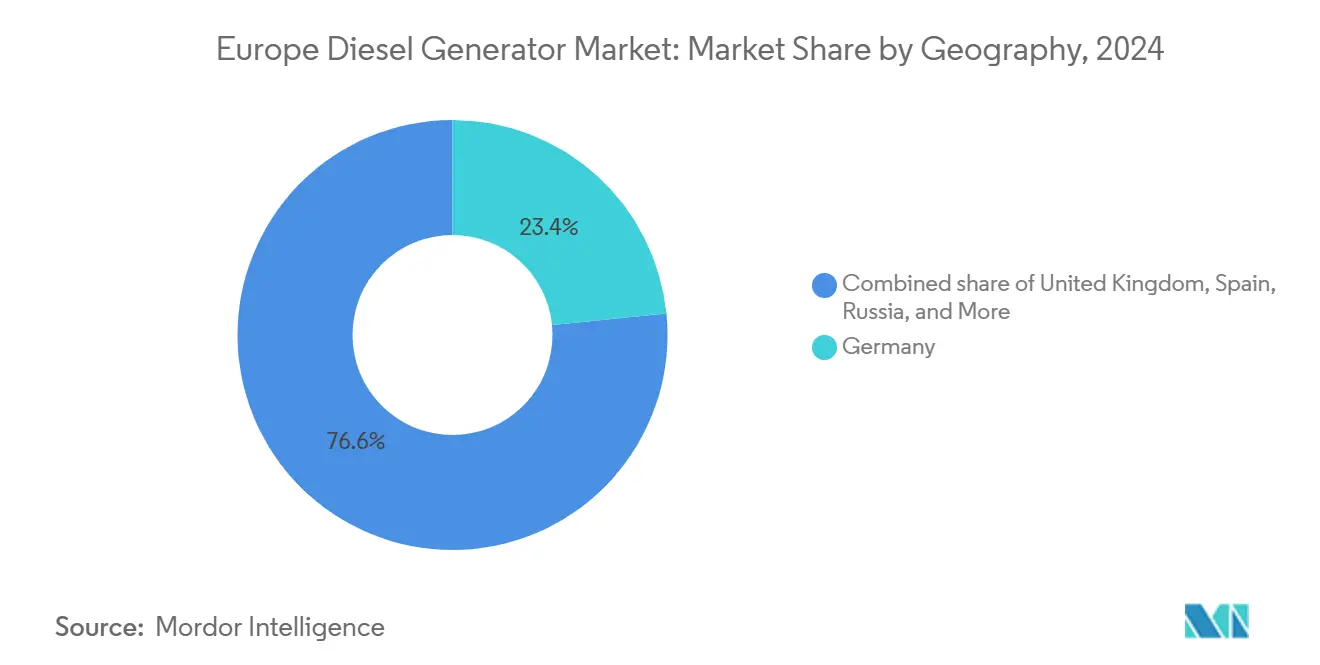
Germany supplied 23.10% of 2025 revenue due to its export-heavy manufacturing base and stringent grid-code backup mandates. Intel’s EUR 30 billion Magdeburg fab alone booked multi-megawatt contingencies to avert wafer loss. Data centers in Frankfurt added 450 MW of standby capacity that same year. Renewable penetration above 55% increases the risk of intermittency, keeping diesel embedded even as battery capacity grows.
Russia Diesel Generator Market
Russia is projected to show the highest 6.32% CAGR through 2031, as sanctions drive energy self-sufficiency and oil-field electrification, favoring localized engine supply. Domestic brands fill gaps left by export controls while Arctic oil projects order containerized gensets rated for extreme cold.
Broader European Markets
The United Kingdom accounts for 16.00% of the 2025 spend, led by London and Manchester colocation hubs with 99.99% uptime guarantees. France relies on backup sets during reactor maintenance cycles, sustaining regional demand near Lyon and Marseille. Italy and Spain combine for 19.00% share, where tourism and construction rebound fuel portable rentals. The Nordics hold 11.00% thanks to off-grid mines and island microgrids that rely on diesel safety nets. Benelux claims 8% growth in data centers and logistics near Rotterdam and Amsterdam. Remaining Central and Eastern markets advance 5.8% per year as EU funds and 5G rollout lift tower backup needs
Regulatory Landscape
EU Regulation 2016/1628 underpins the emissions regime for diesel engines used in non-road mobile machinery (NRMM), which includes many portable and mobile generator sets sold across the EU-27. The regulation requires Stage V compliance and EU type-approval by a designated Member State authority before engines can be placed on the EU market, pushing OEMs and fleet owners toward diesel particulate filters and SCR-equipped packages in higher-output classes.
Stationary generator installations that are permanently integrated into buildings are generally treated outside the NRMM pathway and instead face local air-quality permitting and broader EU product-policy obligations. In parallel, Regulation (EU) 2024/1781 (Ecodesign for Sustainable Products Regulation) replaced the earlier ecodesign directive framework and expands the EU toolkit for sustainable product requirements, reinforcing pressure on manufacturers and buyers to document compliant configurations and lifecycle-related attributes alongside emissions performance.
Competitive Landscape
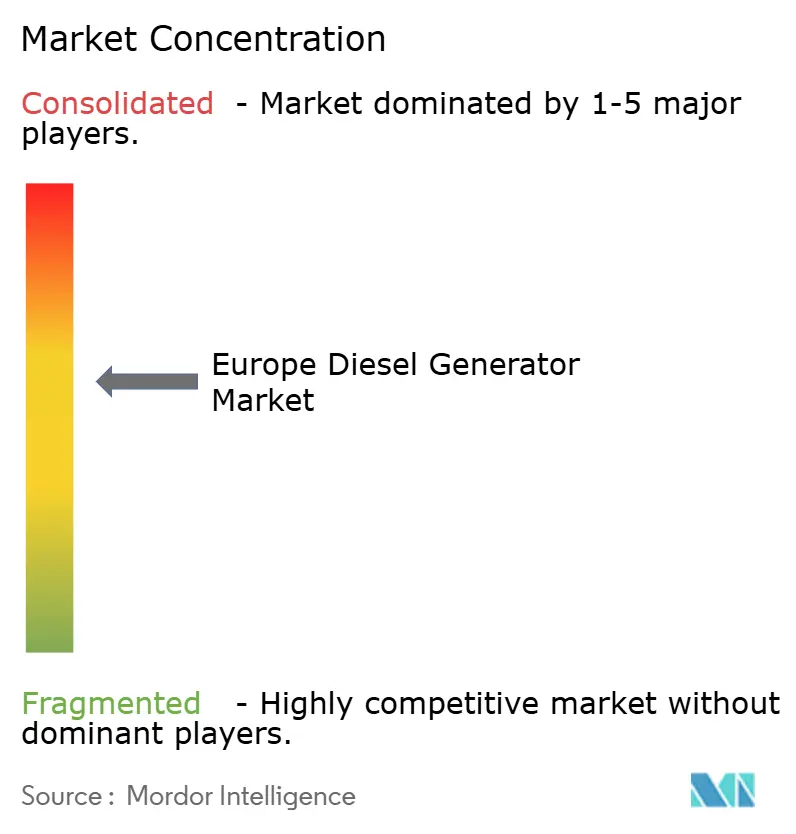
The top five suppliers, Caterpillar, Cummins, Rolls-Royce Power Systems, Kohler-SDMO, and Aggreko, collectively held about 48% revenue in 2024, pointing to moderate concentration. Each invests in Stage V engines and HVO certification to comply with EU regulations, while marketing hybrid packs that reduce runtime by 30% in urban areas. Aggreko and Atlas Copco increase share by bundling storage with rentals, an offering that undercuts ownership for multi-week jobs.
The technology race centers on emission compliance and digital diagnostics. Cummins’ Connected Diagnostics suite monitors 12,000 European sets for predictive maintenance, lowering unplanned outages. Rolls-Royce promotes MTU EnergyPack hybrids to hospitals and telecom towers, with a noise level cap of 90 dB.
Challengers such as AKSA and Pramac target price-sensitive segments with Stage-V sets priced up to 20% lower than those of Western rivals. Anticipated Stage VI rules are expected to widen compliance cost gaps and may spur additional consolidation within the European diesel generator market.
Europe Diesel Generator Industry Leaders
-
Caterpillar Inc
-
Cummins Inc
-
Rolls-Royce Power Systems (MTU)
-
Kohler-SDMO
-
Aggreko PLC
- *Disclaimer: Major Players sorted in no particular order
Europe Diesel Generator Market Companies Covered in this Report
- Caterpillar Inc.
- Cummins Inc.
- Rolls-Royce Power Systems (MTU)
- Kohler-SDMO
- Aggreko PLC
- Mitsubishi Heavy Industries Engine & Turbocharger Ltd
- FG Wilson
- Yanmar Holdings Co. Ltd / Himoinsa
- Generac Power Systems
- Doosan Corporation
- Atlas Copco AB
- Wärtsilä Corporation
- Deutz AG
- Volvo Penta AB
- AKSA Power Generation
- Perkins Engines Company
- Pramac Group
- Grupel S.A.
- Wacker Neuson SE
- JCB Power Products
Market Opportunities and Future Outlook
Hybridization and low-carbon drop-in readiness are translating compliance pressure into an upgrade cycle, particularly for fleets exposed to Stage V enforcement and urban noise constraints. Rental penetration (38% in 2024 per the European Rental Association) and contractor preference for bundled Stage V diesel sets with battery modules creates whitespace for OEMs and integrators that can deliver containerized, turnkey packages and digital monitoring, aligning with the market shift toward pay-per-use temporary power rather than outright ownership.
Energy-security measures are also shaping procurement behavior around fuel availability and backup autonomy. In April 2026, the European Commission presented the AccelerateEU plan to coordinate emergency supplies of jet fuel and diesel during supply disruptions, while EU countries maintain emergency oil stocks equivalent to at least 90 days of net imports; this policy backdrop supports demand for backup systems that can demonstrate fuel-security planning and reliable multi-day operation when batteries alone do not cover extended outages. At the grid-interface level, workstreams around NC RfG 2.0 and grid-forming roadmaps highlight a pathway for genset controls and microgrid architectures to move beyond standby-only use cases, creating opportunities for suppliers that pair diesel with power electronics and control upgrades for critical sites.
Recent Industry Developments in Europe Diesel Generator Market
- June 2026: Cummins Power Generation expanded its high-horsepower generator portfolio to 50 Hz markets, including Europe, using the QSK78 engine platform. The move targets large critical-load and infrastructure applications where footprint and commissioning speed influence project selection. It also increases competitive pressure in higher-capacity nodes as European buyers standardize on compliant, high-density packages.
- April 2025: Rolls-Royce signed a five-year framework agreement with AVK in the UK to guarantee production capacity for mtu Series 4000 emergency power generators. The agreement formalizes capacity allocation for emergency-power projects and strengthens supply assurance for integrators serving data centers and other critical facilities. Securing build slots supports shorter lead times and de-risks multi-site rollouts that specify identical genset platforms.
- November 2024: Cummins debuted a unified ownership approach for its Marine and Onan generator offerings under the Cummins brand. The consolidation simplifies sourcing and aftersales support for customers operating mixed fleets and multi-application sites. It also supports a more integrated service proposition that can influence lifecycle costs in standby-heavy European deployments.
Europe Diesel Generator Market Report Scope and Research Methodology
Market Definition and Coverage
For this study, the market covers revenue generated from diesel generator sets sold and deployed across Europe for standby, prime, or peak shaving power needs, including the alternator and engine package that forms the genset.
Scope exclusions: We exclude natural gas, gasoline, and hybrid-only generator sets, and we also exclude service-only revenue (maintenance contracts, spare parts, and rentals) unless bundled with a genset sale.
Segments Covered in This Report
- By Capacity (kVA)
- Below 75 kVA
- 75 to 375 kVA
- 375 to 750 kVA
- 750 to 2,000 kVA
- Above 2,000 kVA
- By Application
- Stand-by/Backup Power
- Prime/Continuous Power
- Peak-shaving/Load Management
- By End User
- Residential
- Commercial
- Industrial
- By Geography
- Germany
- United Kingdom
- France
- Italy
- Spain
- NORDIC Countries
- Russia
- Rest of Europe
Data Sources, Market Sizing, and Validation
Desk Research
Desk research is used to set the market frame, build the country mix, and pressure-test demand drivers that typically move genset purchases. We reviewed public power reliability signals and energy statistics, and then aligned those with construction and industrial activity indicators that influence backup power buying.
Public and official sources used for this market included references such as Eurostat (industry output and construction activity), ENTSO-E (electricity system context), the European Commission and national energy agencies (policy and emissions direction), and national statistics offices across key countries. We also used company annual reports, investor decks, and reputable press coverage to confirm product positioning, channel routes, and pricing direction, and we supplemented this with paid subscriptions for company financials and intelligence, news and financials, and selective tender tracking where relevant. The desk sources listed here are illustrative rather than exhaustive, and other documents were also used to collect data, validate findings, and clarify assumptions.
Primary Interviews and Surveys
Primary work was used to confirm what portion of generator demand is truly diesel within Europe, and to validate typical price bands by kVA range and application. We spoke with a mix of manufacturers, packagers, distributors, EPC and rental-channel stakeholders, and end users in commercial facilities, industrial sites, and public infrastructure, with coverage balanced across major European sub-regions so the final assumptions did not lean on one country cycle.
Distribution of primary research fieldwork respondents
| Company type | Respondent position |
|---|---|
| Top tier: 37% | CXOs: 13% |
| Mid tier: 49% | Functional/Unit leaders: 29% |
| Smaller Players: 14% | Managers: 58% |
Market-Sizing & Forecasting
Sizing starts with a top-down build where country-level demand pools are reconstructed from power reliability context, building and infrastructure activity, and the installed base need for standby and prime backup in critical sites. The totals are subsequently checked using selective bottom-up approximations, such as sampled price per kVA by capacity band multiplied by estimated unit movement proxies from channel conversations, which is then used to adjust outliers.
Key inputs tracked in the model include the split by kVA ranges (below 75 kVA, 75-350 kVA, and above 350 kVA), the application mix (standby versus prime and peak shaving), and the end-user weight across residential, commercial, and industrial buyers. We also monitor permitting and construction activity signals, grid disturbance frequency themes discussed by buyers, and emissions-related buying constraints that can shift demand to newer compliant units and change average selling prices. Forecasts are built using scenario analysis, where the base case is anchored to expected construction and industrial activity trends and then tuned using primary feedback on lead times, pricing escalation, and replacement cycles. When bottom-up visibility is uneven in smaller countries, gaps are handled by applying validated country multipliers tied to activity indicators and distributor footprint coverage.
Data Validation & Update Cycle
Outputs are validated through triangulation across independent signals, and then reviewed for unusual jumps by country, kVA band, and application before sign-off. We compare implied spend per active site type, the pace of industrial capex changes, and price progression logic so the total does not drift from what buyers and channels describe.
Anomalies trigger re-checks of currency timing, one-off project effects, and country weightings, followed by targeted re-contacts with contributors when needed. Reports are refreshed annually, with interim updates when material events occur, and a final pre-delivery review is performed so clients receive the latest updated view.
Mordor Intelligence's Europe Diesel Generator Market Sizing Compared With Other Published Estimates
Published numbers for this market often differ because the scope can shift between diesel-only gensets and broader generator sets, and because some estimates mix sales with rentals or service revenue. Differences also come from the way countries are counted under Europe and how exchange rates and inflation are applied in the base year.
The main gap comes from whether non-diesel generator sets and rental fleets are included. Mordor Intelligence counts only diesel genset revenue sold into Europe by capacity band and end-user, then cross-checks country totals using the standby, prime, and peak shaving application mix.
Benchmark comparison
| Source | Market Size | Gaps in Research Methodology |
|---|---|---|
| Mordor Intelligence | USD 3.71 B (2025) | |
| Trade Journal A | USD 8.00 B (2025) | Uses a broader generator sets scope that can include non-diesel types and may also fold in independent and rental-oriented genset revenue, which lifts totals versus diesel-only sales. |
| Market Bulletin B | USD 5.69 B (2024) | Anchors on a different base year and appears to apply a wider Europe diesel genset definition with a faster price and replacement-cycle assumption, while currency timing is not clearly stated. |
The spread in the table is largely explained by what gets counted as part of the market and how the base year is treated in pricing and currency conversion. By keeping inclusions tied to diesel genset sales, and by checking totals against capacity and application splits that buyers recognize, the final market size stays traceable to clear inputs and repeatable steps.
Key Questions Answered in the Report
What is the current value of the Europe diesel generator market?
The Europe diesel generator market size was USD 3.87 billion in 2026 and is set to reach USD 4.74 billion by 2031.
Which capacity range sells the most units across Europe?
Sets rated 75-to-375 kVA led 2025 revenue, accounting for 45.12% share due to strong demand from retail chains and mid-sized factories.
Why are rental diesel generators gaining popularity?
Rental fleets let users avoid capital outlay and emission-compliance paperwork, while new hybrid models lower fuel consumption by around 30%.
How will Stage VI rules affect buyers?
Stage VI will mandate expensive after-treatment systems from 2028, adding up to EUR 20,000 per unit and accelerating fleet renewal toward compliant or hybrid models.
What fuels are emerging alternatives to conventional diesel?
Hydrotreated vegetable oil (HVO100) is the leading drop-in option, delivering up to 90% particulate reduction without engine modifications.
Which country is projected to grow fastest through 2031?
Russia shows the highest forecast CAGR at 6.32%, driven by localized energy infrastructure and oil-field electrification needs.