
Europe Data Center Technical Workforce Market Size and Share
Market Overview
| Study Period | 2021 - 2032 |
|---|---|
| Forecast Data Period | 2027 - 2032 |
| Base Year Market Size (2026) | USD 24.57 Billion |
| Market Size (2027) | USD 29.37 Billion |
| Market Size (2032) | USD 70.21 Billion |
| Growth Rate (2027 - 2032) | 19.04 % |
| Market Concentration | Medium |
Major Players *Disclaimer: Major Players sorted in no particular order Image © Mordor Intelligence. Reuse requires attribution under CC BY 4.0. | |
Europe Data Center Technical Workforce Market Analysis by Mordor Intelligence
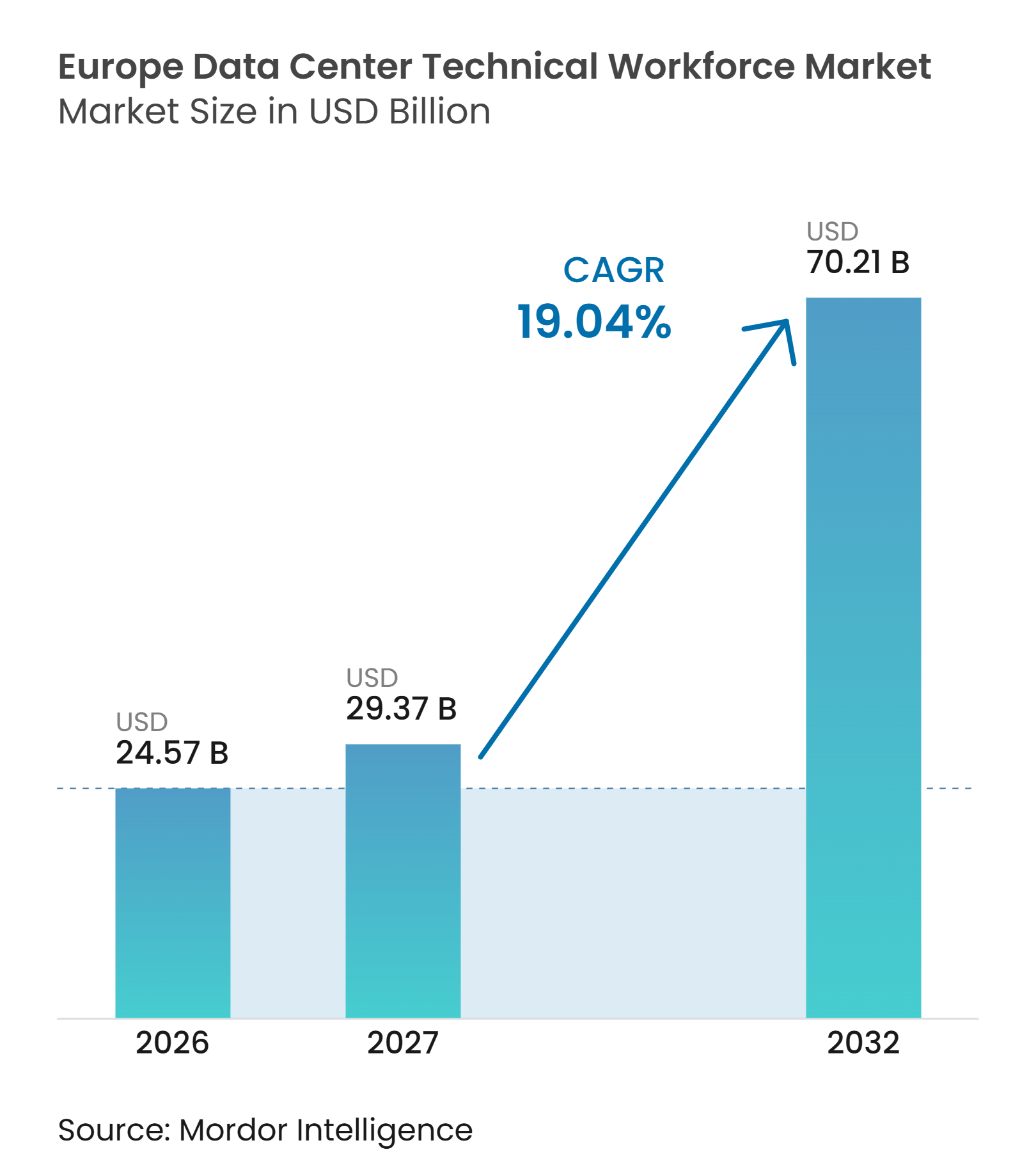
The Europe data center technical workforce market size is projected to be USD 24.57 billion in 2026, USD 29.37 billion in 2027, and reach USD 70.21 billion by 2032, expanding at a CAGR of 19.04% from 2027 to 2032. Demand is being shaped by new AI computing capacity, sovereign cloud requirements, and continued construction across established and secondary locations. These programs require more design, construction, commissioning, operations, and cybersecurity workers at the same time. The Europe data center technical workforce market is also shifting toward locations outside the largest hubs, as power availability and permitting influence project decisions. Contract-based specialist services remain important because staffing needs change sharply between design, construction, commissioning, and operations. Grid delays and a limited supply of experienced personnel can postpone project handovers and increase pressure on delivery schedules.
Key Report Takeaways
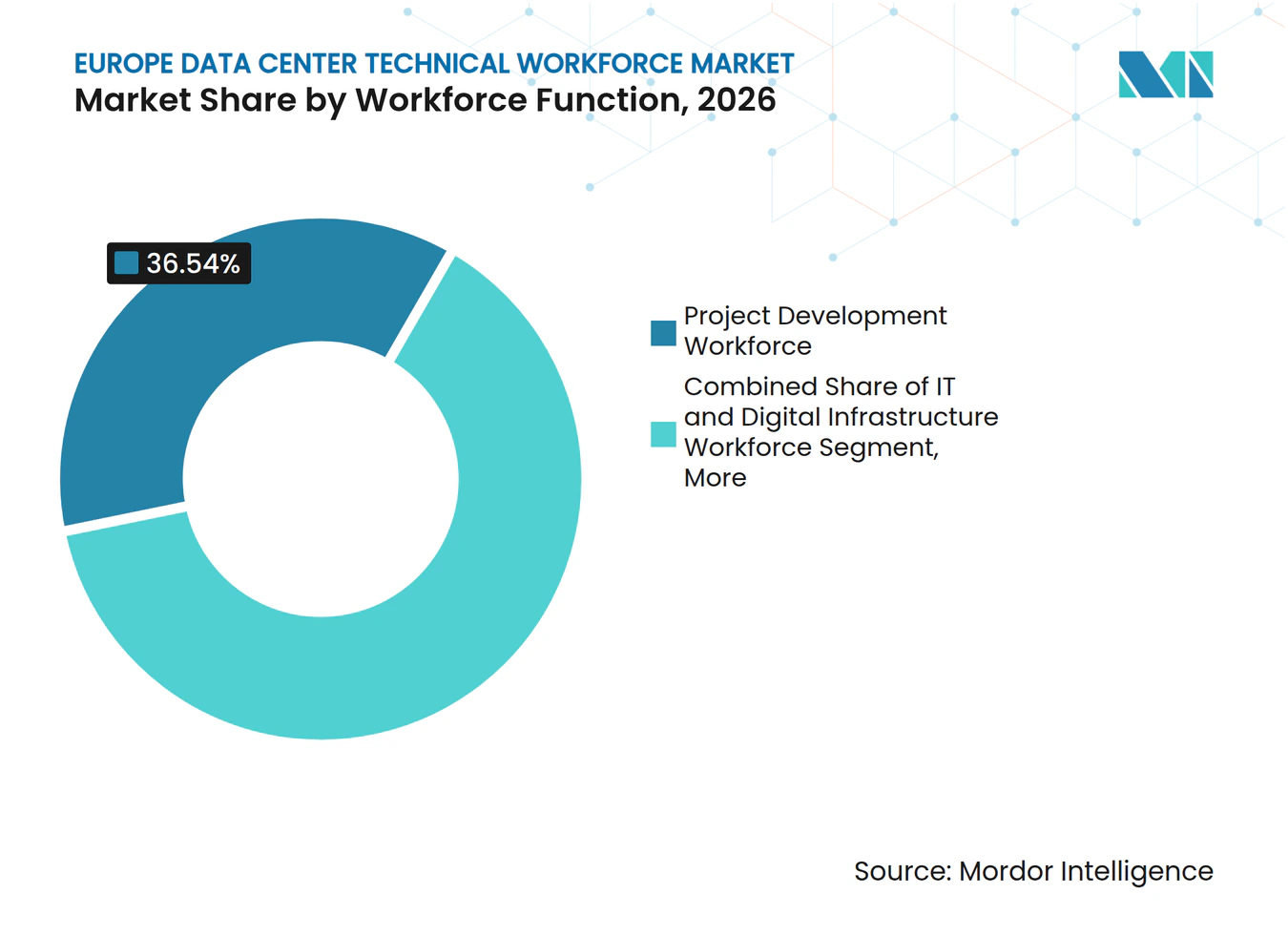
- By workforce function, Project Development Workforce held 36.54% of the Europe data center technical workforce market share in 2026, while the IT and Digital Infrastructure Workforce is projected to expand at a 20.61% CAGR through 2032.
- By employment model, External Workforce Services held 55.34% revenue share in 2026 and is expected to expand at a 20.27% CAGR through 2032.
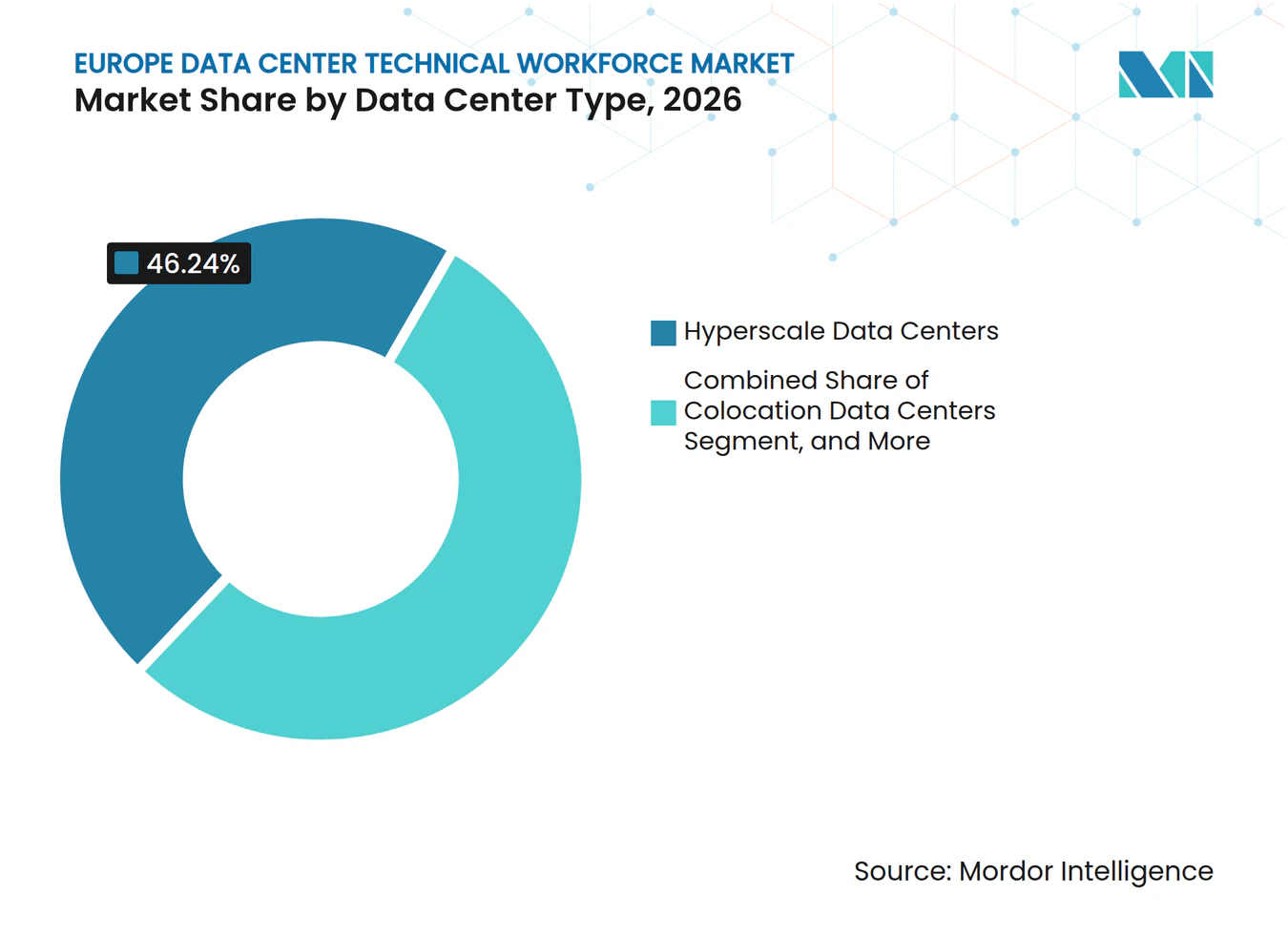
- By data center type, Hyperscale Data Centers held 46.24% revenue share in 2026 and are projected to advance at a 20.65% CAGR through 2032.
- By geography, the United Kingdom held 28.22% revenue share in 2026, while Spain is projected to expand at a 20.47% CAGR through 2032.
Note: Market numbers in this report are based on Mordor Intelligence's proprietary estimation framework, which combines nine months of actuals with Q4 projections for base year 2026.
Market Trends and Insights
Drivers Impact Analysis of Europe Data Center Technical Workforce Market*
| Driver | (~) % Impact on CAGR Forecast | Geographic Relevance | Impact Timeline |
|---|---|---|---|
| AI-Optimized Data Center Build-Outs | +5.8% | Europe-wide, concentrated in FLAP-D and secondary markets | Short term (≤ 2 years) |
| Cloud Region Expansion and Sovereign Infrastructure Demand | +4.2% | Germany, Netherlands, Ireland, with spillover to Poland and the Baltics | Medium term (2–4 years) |
| Retirement of Mission-Critical Infrastructure Specialists | +2.8% | United Kingdom, Germany, and Netherlands | Medium term (2–4 years) |
| Prefabricated Modular Construction Increasing Workforce Throughput | +2.1% | European markets served by global hyperscale operators | Short term (≤ 2 years) |
| Liquid Cooling and High-Density Rack Deployment | +1.9% | FLAP-D hubs and AI-intensive secondary markets, including Milan, Madrid, and Helsinki | Medium term (2–4 years) |
| European Data Center Capacity Expansion Beyond FLAP-D Hubs | +2.3% | Spain, Italy, the Nordics, Poland, and Czechia | Medium term (2–4 years) |
| Source: Mordor Intelligence | |||
AI-Optimized Data Center Build-Outs Drive Workforce Demand at Record Scale
AI-optimized facilities require specialized design, electrical, mechanical, and commissioning work. Indeed Hiring Lab reported that data center job postings exceeded pre-pandemic levels in 9 European economies by August 2026.[1] The posting mix indicated concurrent hiring for operating facilities and AI-related construction. The Europe data center technical workforce market needs licensed electricians, site engineers, commissioning specialists, and technical operations workers. Projects can therefore face shortages in different roles, even when some field labor requirements decline.
Cloud Region Expansion and Sovereign Infrastructure Demand Create a New Hiring Category
Sovereign cloud programs require workers who can operate infrastructure within European legal and security requirements. AWS launched the AWS European Sovereign Cloud in Brandenburg in January 2026 and committed more than EUR 7.8 billion (USD 8.58 billion) in infrastructure investment.[2] The company stated that the program is expected to support an average of 2,800 full-time equivalent jobs annually. The Europe data center technical workforce market needs personnel with validated security, infrastructure, residency, and access capabilities. Regulated operations can require in-house staff and can strengthen demand for security monitoring, networking, and facility operations skills. This workforce need continues after construction is complete, especially in Germany, the Netherlands, and Ireland.
Retirement of Mission-Critical Infrastructure Specialists Creates Succession Risk
The Europe data center technical workforce market faces a limited supply of experienced mission-critical specialists. Bitkom reported 79,000 unfilled IT roles in Germany in mid-2026, and 78% of surveyed companies described an active IT skills shortage.[3] Its survey also found that 76% expected the shortage to worsen. Skills England reported that 68% of priority engineering occupations were in critical or elevated demand in 2026. Commissioning and high-voltage workers require years of live-site experience that short courses cannot immediately replace. Operators must plan succession and supervised field training before senior specialists leave the project or operations teams.
Prefabricated Modular Construction Reshapes Field Workforce Economics
Prefabricated construction is being used to manage a shortage of licensed construction labor and improve project throughput. AWS described its Project Houdini approach as prebuilding data hall elements before on-site installation. The method includes racks, power distribution, cabling, and fire protection systems. It can reduce site congestion and transfer some field work to specialized assembly settings. Commissioning professionals remain necessary because completed modules require verification before a facility enters service. The Europe data center technical workforce market, therefore, needs more coordination among designers, suppliers, assembly workers, and site teams.
Restraints Impact Analysis of Europe Data Center Technical Workforce Market*
| Restraint | (~) % Impact on CAGR Forecast | Geographic Relevance | Impact Timeline |
|---|---|---|---|
| Persistent Shortage of Qualified Mission-Critical Technical Staff | -2.4% | Europe-wide, most acute in the United Kingdom, Germany, and Netherlands | Short term (≤ 2 years) |
| Power and Grid-Connection Delays Deferring Workforce Mobilization | -1.8% | FLAP-D markets, with early signs in the Nordics and Spain | Medium term (2–4 years) |
| Long Qualification Cycles for Advanced Commissioning and Liquid Cooling | -1.2% | Markets with large AI-density pipelines | Long term (≥ 4 years) |
| High Wage Inflation and Cross-Sector Competition for Technical Talent | -1.5% | Europe-wide, most acute in the United Kingdom and Germany | Short term (≤ 2 years) |
| Source: Mordor Intelligence | |||
Persistent Shortage of Qualified Mission-Critical Technical Staff Constrains Delivery
The Europe data center technical workforce market is limited by the difference between the required specialization and the rate of qualified worker supply. Uptime Institute reported that nearly two-thirds of operators had difficulty hiring and retaining qualified personnel in its 2025 Global Data Center Survey. BCS Consultancy reported that 84% of respondents faced rising operational costs, 79% reported greater workload pressure, and 54% had difficulty meeting deadlines in 2026. The survey also stated that 22% had discontinued products or services due to staffing shortfalls. When specialists are unavailable, construction schedules can extend, commissioning dates can move, and operational changes can be deferred. The constraint can increase workload pressure on existing teams and make retention harder.
Power and Grid-Connection Delays Defer Workforce Mobilization and Compress Project Economics
Grid-connection timing constraints European data center development and workforce scheduling. Reuters reported in February 2026 that AWS identified European projects with grid wait times reaching 7 years. Ember reported that connection processes can extend to 13 years in some European markets. ENTSO-E noted that concentrated data center loads can disconnect hundreds of megawatts during power-system disturbances. Delayed connections can move commissioning schedules, require contract changes, and leave specialist teams unevenly deployed. The Europe data center technical workforce market must therefore mobilize around infrastructure readiness as well as construction plans.
*Our forecasts treat driver/restraint impacts as directional, not additive. The impact forecasts reflect baseline growth, mix effects, and variable interactions.
Europe Data Center Technical Workforce Market Segment Analysis
By Workforce Function:
Project Development Workforce Anchors the AI Build CycleProject Development Workforce held 36.54% of the Europe data center technical workforce market share in 2026. The role group supports design, engineering, procurement, construction coordination, and site delivery. These workers manage dependencies among civil works, power equipment, cooling systems, and digital infrastructure. Testing and commissioning teams validate systems before a facility begins service. The Europe data center technical workforce market needs experienced personnel because these roles can be difficult to fill during concentrated project activity.
The IT and Digital Infrastructure Workforce is projected to expand at a 20.61% CAGR through 2032. Cybersecurity, networking, and platform specialists support monitoring, incident response, connectivity, and cloud workloads. AI infrastructure work also requires knowledge of dense compute environments. Facility Operations and Maintenance Workforce expands as more facilities need 24/7 skilled coverage. Training programs can improve entry-level supply, but live-site experience remains important for operational readiness.



By Employment Model:
External Workforce Services Dominate and AccelerateExternal Workforce Services held 55.34% of the total in 2026 and is projected to expand at a 20.27% CAGR through 2032. Operators use external providers when work intensity rises during design, construction, commissioning, and operations. This model prevents large permanent teams from being maintained during lower activity periods. The Europe data center technical workforce market relies on specialist services when schedules require several disciplines in sequence. Early contractor engagement can matter because the same providers may be committed to multiple projects.
In-house Workforce held 44.66% of the 2026 total and remains important for long-cycle operational roles. Operators retain personnel for operations, facility management, cybersecurity, and functions that benefit from local knowledge. Sovereign cloud obligations can require EU-resident and security-vetted workers. The Europe data center technical workforce market must meet that need while external providers handle changing construction workloads. This division supports operational control but can increase permanent staffing pressure in scarce skill categories.
By Data Center Type:
Hyperscale Data Centers Command Workforce Concentration and GrowthHyperscale Data Centers held 46.24% of the total in 2026 and are projected to expand at a 20.65% CAGR through 2032. Their scale concentrates labor needs across civil construction, power, cooling, digital infrastructure, and security. Regional labor pools may struggle when several large campuses reach peak activity together. The Europe data center technical workforce market is sensitive to the timing and geographic clustering of these programs. Jacobs described the SINES DC Campus in Portugal, which targets 1.2 GW of IT capacity and opened its first 33 MW phase in April 2025.
Colocation facilities maintain operational staffing needs and can use external specialists for upgrades, retrofits, and expansions. Enterprise, Edge, and Modular sites require technical teams familiar with high-density power and cooling outside traditional campuses. Liquid cooling retrofit work must protect live operations while the infrastructure is changed. The Europe data center technical workforce market needs technicians who understand installation, equipment controls, and operational risk. Specialist providers can support mature sites where in-house cooling expertise is limited.

Geography Analysis
United Kingdom Data Center Technical Workforce Market
The United Kingdom held 28.22% of the Europe data center technical workforce market size in 2026. Its position reflects a large operational base, sovereign AI policy commitments, and continuing hyperscale investment. Equinix announced a GBP 3.9 billion investment (USD 5.01 billion) in Hertfordshire in October 2025. The company expects the project to support 2,500 construction jobs and more than 200 permanent skilled roles.
Germany, Ireland and Netherlands Data Center Technical Workforce Market
Germany supports technical roles across data center construction and operations. AWS opened its European Sovereign Cloud in Brandenburg in January 2026, linking infrastructure investment to secure local operations teams. Germany also faces a national IT worker shortage that affects cybersecurity and digital infrastructure hiring. Ireland and the Netherlands sustain commissioning and operations workforces because of dense cloud infrastructure.
Spain, Finland and Central and Eastern Europe Data Center Technical Workforce Market
Spain is projected to expand at a 20.47% CAGR through 2032. AECOM was appointed in December 2025 for the 500 MW Nostrum Evergreen campus in Badajoz, with investment exceeding EUR 1.9 billion (USD 2.1 billion). Skanska announced 2026 Finnish contracts for atNorth’s Espoo expansion and another undisclosed facility. Poland, Czechia, and the Baltics are drawing attention as AI compute moves beyond established hubs. EuroHPC selected 6 additional AI Factories in October 2025 across Czechia, Lithuania, the Netherlands, Poland, Romania, and Spain. Workforce availability will influence whether these newer locations can convert planned capacity into operating facilities.
Competitive Landscape
Market Concentration
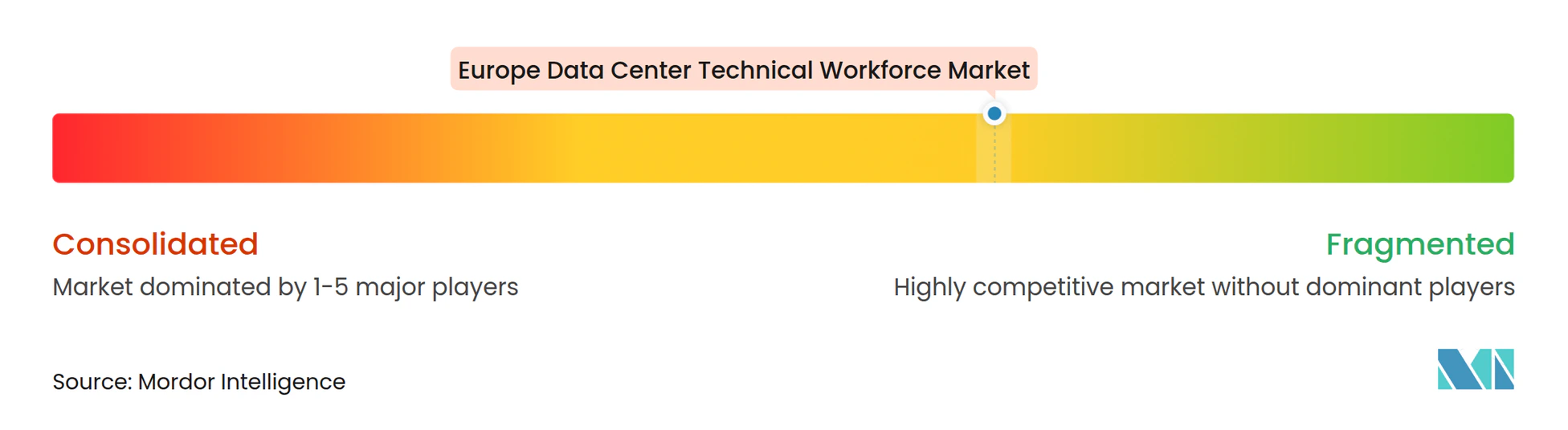
The Europe data center technical workforce market is moderately concentrated in large project delivery and fragmented in operational staffing. Large engineering and construction firms can secure design-and-build mandates before construction begins. Jacobs is delivering the SINES DC Campus in Portugal, demonstrating the engineering depth required for complex projects. Smaller providers can compete where they offer specialized cooling and AI commissioning skills.
AECOM, Jacobs Solutions, Mercury Engineering, and Skanska are among the firms associated with major European development assignments. Their roles cover design, construction management, engineering delivery, and commissioning coordination. Skanska signed a CZK 2.1 billion (USD 93 million) contract for a data center near Prague in October 2026. These firms organize workers and suppliers across borders, but they still depend on experienced electricians, mechanical engineers, and commissioning personnel. High demand for those workers can narrow delivery capacity despite strong project pipelines.
Operators and equipment providers are investing in training to develop qualified talent. Vertiv opened a Frankfurt training academy with more than 100 certification courses in July 2025. Schneider Electric opened a liquid cooling technical training laboratory in Conselve, Italy, in March 2026. Hyperscalers may internalize skills through academies, while colocation providers may rely more heavily on service agreements. Structured 6 to 12 month pathways can improve responsiveness, but they do not replace years of advanced commissioning experience.
Europe Data Center Technical Workforce Industry Leaders
-
Amazon Web Services, Inc.
-
Microsoft Corporation
-
Google LLC
-
Equinix, Inc.
-
Digital Realty Trust, Inc.
- *Disclaimer: Major Players sorted in no particular order
Europe Data Center Technical Workforce Market Companies Covered in this Report
- Amazon Web Services, Inc.
- Microsoft Corporation
- Google LLC
- Equinix, Inc.
- Digital Realty Trust, Inc.
- NTT DATA Corporation
- Vantage Data Centers Management Company, LLC
- STACK Infrastructure
- CyrusOne LLC
- Global Switch Holdings Limited
- Colt Data Centre Services
- OVH Groupe S.A.
- Iron Mountain Incorporated
- KDDI Corporation
- Schneider Electric SE
- Vertiv Holdings Co
- AECOM
- Jacobs Solutions Inc.
- Mercury Engineering Unlimited Company
- Skanska AB
Recent Industry Developments in Europe Data Center Technical Workforce Market
- October 2026: Skanska signed a CZK 2.1 billion (USD 93 million) contract with CRA Prague Gateway DC to build a data center near Prague. Construction commenced in August 2026 with completion scheduled for 2028, placing Skanska at the forefront of CEE data center construction.
- September 2026: Indeed Hiring Lab's European analysis found that data center job postings exceeded pre-pandemic levels in 9 European economies by August 2026, with Spain, Italy, and Ireland recording the steepest year-on-year increases, underscoring the geographic dispersal of workforce demand.
- June 2026: The OVHcloud, DEEP, and Clever Cloud consortium was selected by the European Commission to provide sovereign cloud services to EU institutions in a tender valued at up to EUR 180 million (~USD 198 million) over 6 years, a landmark step in European digital sovereignty infrastructure and EU-resident workforce development.
- March 2026: Schneider Electric opened a dedicated Liquid Cooling Technical Training Lab at its Cooling Training Center in Conselve, Italy, launching hands-on training for service representatives across Europe in direct-to-chip and immersion cooling systems to address the specialist skills gap in high-density thermal management.
Europe Data Center Technical Workforce Market Report Scope
The Europe Data Center Technical Workforce Market refers to the demand for, supply of, and specialized staffing services associated with skilled professionals required to design, build, commission, operate, maintain, secure, and upgrade data center infrastructure across European countries, including major hubs such as the United Kingdom, Ireland, Germany, the Netherlands, France, the Nordics, Spain, and Italy.
The Europe Data Center Technical Workforce Market Report is Segmented by Workforce Function (Project Development Workforce [Design and Engineering Workforce, Construction and Installation Workforce, Testing and Commissioning Workforce], Facility Operations and Maintenance Workforce [Data Center Operations Workforce, Facility Management Workforce, Maintenance and Reliability Workforce], IT and Digital Infrastructure Workforce [IT Hardware and Cloud Infrastructure Workforce, Network Infrastructure Workforce, Cybersecurity and Technical Security Workforce, AI Infrastructure Workforce]), Employment Model (In-house Workforce, External Workforce Services), Data Center Type (Hyperscale Data Centers, Colocation Data Centers, Enterprise, Edge and Modular Data Centers), and Geography (United Kingdom, Germany, Netherlands, Ireland, Spain, Italy, Sweden, Norway, Finland, and Rest of Europe). The Market Forecasts are Provided in Terms of Value (USD).
Segmentation Overview
| Project Development Workforce | Design and Engineering Workforce |
| Construction and Installation Workforce | |
| Testing and Commissioning Workforce | |
| Facility Operations and Maintenance Workforce | Data Center Operations Workforce |
| Facility Management Workforce | |
| Maintenance and Reliability Workforce | |
| IT and Digital Infrastructure Workforce | IT Hardware and Cloud Infrastructure Workforce |
| Network Infrastructure Workforce | |
| Cybersecurity and Technical Security Workforce | |
| AI Infrastructure Workforce |
| In-house Workforce |
| External Workforce Services |
| Hyperscale Data Centers |
| Colocation Data Centers |
| Enterprise, Edge and Modular Data Centers |
| Germany |
| Netherlands |
| United Kingdom |
| Ireland |
| Spain |
| Italy |
| Sweden |
| Norway |
| Finland |
| Rest of Europe |
| By Workforce Function | Project Development Workforce | Design and Engineering Workforce |
| Construction and Installation Workforce | ||
| Testing and Commissioning Workforce | ||
| Facility Operations and Maintenance Workforce | Data Center Operations Workforce | |
| Facility Management Workforce | ||
| Maintenance and Reliability Workforce | ||
| IT and Digital Infrastructure Workforce | IT Hardware and Cloud Infrastructure Workforce | |
| Network Infrastructure Workforce | ||
| Cybersecurity and Technical Security Workforce | ||
| AI Infrastructure Workforce | ||
| By Employment Model | In-house Workforce | |
| External Workforce Services | ||
| By Data Center Type | Hyperscale Data Centers | |
| Colocation Data Centers | ||
| Enterprise, Edge and Modular Data Centers | ||
| By Geography | Germany | |
| Netherlands | ||
| United Kingdom | ||
| Ireland | ||
| Spain | ||
| Italy | ||
| Sweden | ||
| Norway | ||
| Finland | ||
| Rest of Europe | ||
Key Questions Answered in the Report
What is the size of the Europe data center technical workforce market?
The Europe data center technical workforce market is projected to reach USD 24.57 billion in 2026, increase to USD 29.37 billion in 2027, and grow to USD 70.21 billion by 2032.
What is driving demand for technical data center workers in Europe?
Growing investments in AI infrastructure, sovereign cloud initiatives, new data center capacity construction, and increasingly stringent data center operations requirements are driving demand for specialized technical talent across Europe.
Which workforce function leads data center staffing demand in Europe?
Project Development Workforce leads the market with a 36.54% share in 2026, supported by strong demand for design, engineering, construction, commissioning, and deployment expertise.
Why do external workforce services have a major role?
External Workforce Services account for 55.34% of market demand in 2026, as operators and developers rely heavily on specialized contractors and service providers for project-based construction, installation, and commissioning activities.
Which data center type has the strongest workforce demand?
Hyperscale Data Centers hold the largest share at 46.24% in 2026 and are expected to grow at a 20.65% CAGR through 2032, driven by cloud and AI infrastructure expansion.
Which European geography is expanding fastest for technical workforce demand?
Spain is projected to be the fastest-growing market, expanding at a 20.47% CAGR through 2032, supported by significant hyperscale and colocation data center investments requiring large-scale technical staffing.