
Europe Data Center Climate Risk and Resilience Market Size and Share
Market Overview
| Study Period | 2021 - 2032 |
|---|---|
| Forecast Data Period | 2027 - 2032 |
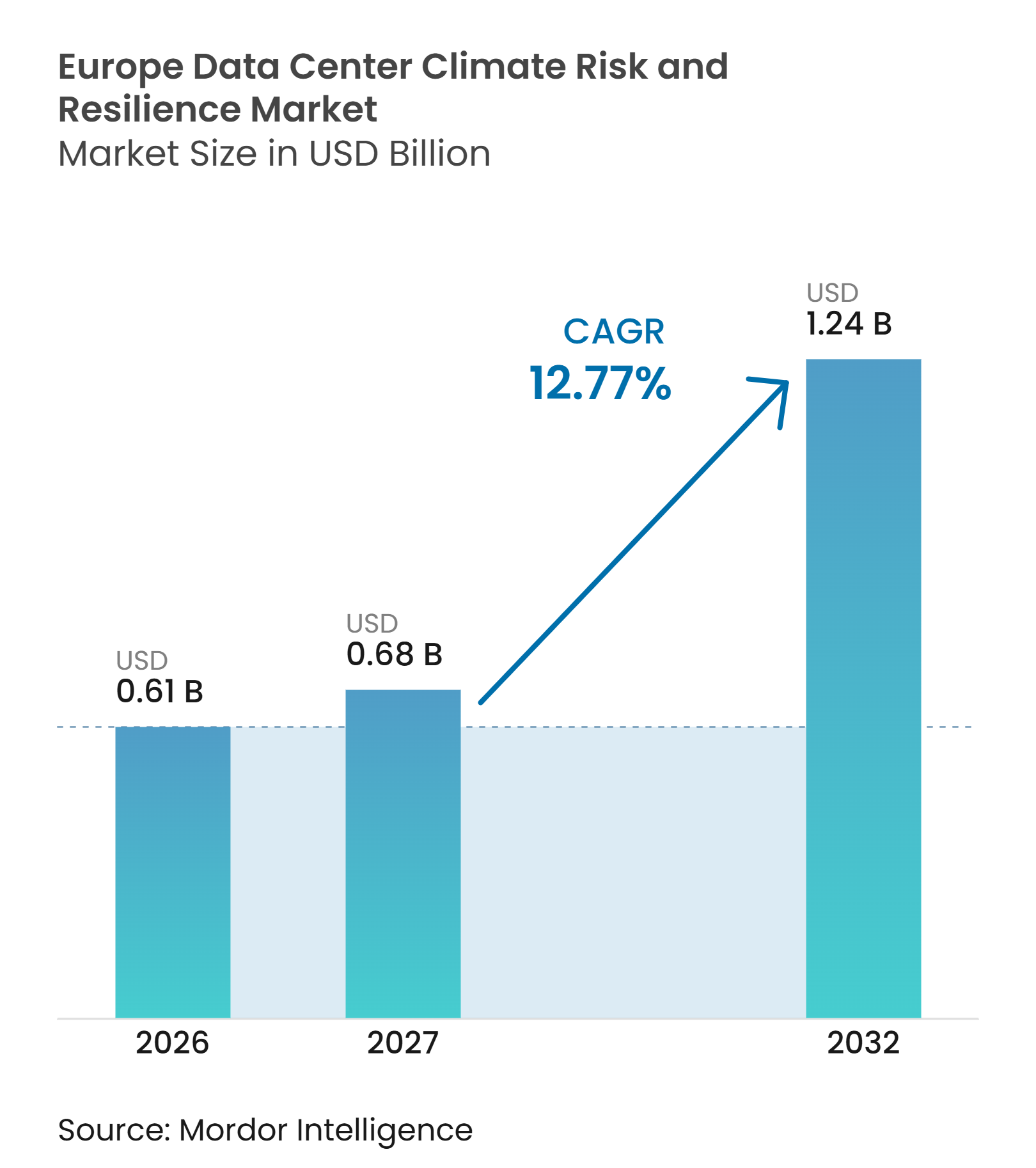
| Base Year Market Size (2026) | USD 0.61 Billion |
| Market Size (2027) | USD 0.68 Billion |
| Market Size (2032) | USD 1.24 Billion |
| Growth Rate (2027 - 2032) | 12.77 % |
| Market Concentration | Medium |
Major Players *Disclaimer: Major Players sorted in no particular order Image © Mordor Intelligence. Reuse requires attribution under CC BY 4.0. | |
Europe Data Center Climate Risk and Resilience Market Analysis by Mordor Intelligence
The Europe Data Center Climate Risk and Resilience Market size is expected to grow from USD 0.61 billion in 2026 to USD 0.68 billion in 2027 and is forecast to reach USD 1.24 billion by 2032 at a 12.77% CAGR over 2027-2032. Investment in AI infrastructure is increasing the value concentrated in individual facilities and raising the cost of a cooling or power disruption. Physical hazards now affect site selection, design, insurance coverage, and financing decisions simultaneously. EU disclosure rules are making energy, water, and climate-risk documentation more important in procurement and tenant discussions. Insurance premiums and lender requirements are also pushing operators to document resilience before committing capital to large campuses. The Europe data center climate risk market therefore benefits from demand that is linked to infrastructure planning and compliance, rather than a single equipment cycle.
Key Report Takeaways
- By solution type, Climate Risk Assessment and Analytics held 27.68% of the Europe data center climate risk market share in 2026, while Climate Risk Monitoring and Early Warning is projected to expand at a 13.38% CAGR through 2032.
- By climate hazard, Flooding and Sea-Level Rise accounted for 33.47% of the Europe data center climate risk market size in 2026, while Compound and Multi-Hazard Events are expected to grow at a 13.24% CAGR through 2032.
- By assessment method, Forward-Looking Climate Scenario Analysis held a 29.36% share in 2026, while Climate Stress Testing is projected to grow at a 13.36% CAGR through 2032.
- By resilience strategy, Cooling and Thermal Resilience captured 26.93% of the Europe data center climate risk market share in 2026, while Water Availability and Conservation Measures is expected to expand at a 13.53% CAGR through 2032.
- By service type, Climate Risk Consulting held 34.82% share in 2026, while Risk Auditing and Disclosure Support is projected to advance at a 13.42% CAGR through 2032.
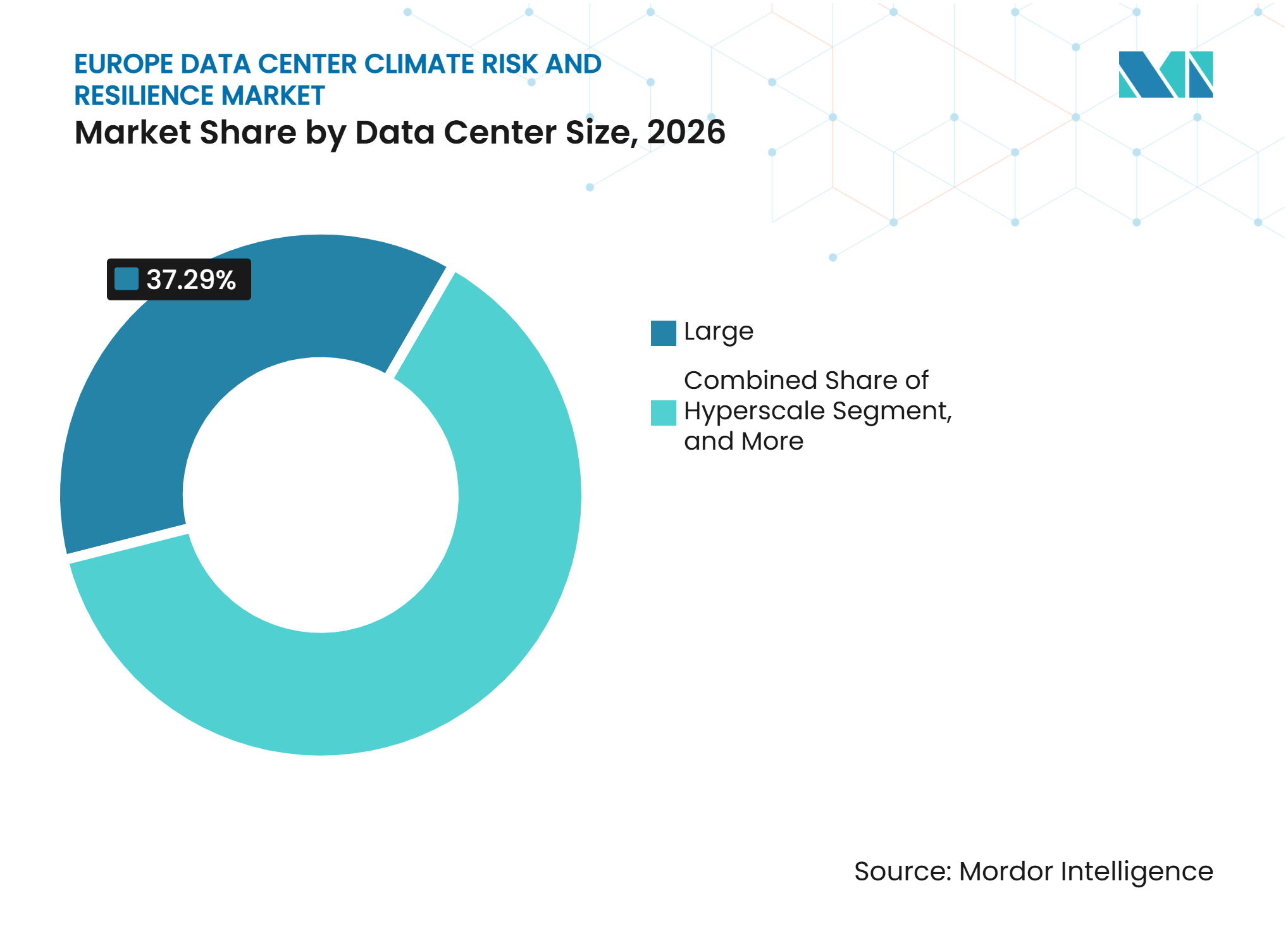
- By data center size, Large Data Centers accounted for 37.29% share in 2026, while Hyperscale Data Centers is expected to grow at a 13.62% CAGR through 2032.
- By data center type, Colocation held 42.74% share in 2026, while Cloud Service Providers is projected to expand at a 13.49% CAGR through 2032.
- By geography, Germany accounted for 28.57% share in 2026, while Spain is projected to grow at a 13.47% CAGR through 2032.
Note: Market numbers in this report are based on Mordor Intelligence's proprietary estimation framework, which combines nine months of actuals with Q4 projections for base year 2026.
Market Trends and Insights
Drivers Impact Analysis of Europe Data Center Climate Risk and Resilience Market*
| Driver | (~) % Impact on CAGR Forecast | Geographic Relevance | Impact Timeline |
|---|---|---|---|
| Expansion of AI and High-Performance Computing Infrastructure | +3.5% | Global, concentrated in Germany, United Kingdom, France, Sweden, and Netherlands | Short term (≤ 2 years) |
| Escalating Downtime and Climate-Related Business Interruption Costs | +2.2% | Global, most acute in Frankfurt, London, Amsterdam, Paris, and Dublin | Short term (≤ 2 years) |
| Regulatory and Customer Demand for Verified Resilience | +2.0% | EU-wide, with early compliance concentrations in Germany, France, and Nordic states | Medium term (2-4 years) |
| Climate-Informed Siting as a Capital Allocation Requirement | +1.5% | Global, with spillover to emerging EU hubs in Spain, Italy, and Poland | Medium term (2-4 years) |
| Water Stress Driving Closed-Loop Cooling and Reuse Investment | +1.2% | Southern Europe, including Spain, Italy, and France's Mediterranean corridor, with spillover to Belgium | Medium term (2-4 years) |
| Insurer and Lender Pricing of Physical Climate Exposure | +1.0% | Global, concentrated in high-value European colocation and hyperscale locations | Long term (≥ 4 years) |
| Source: Mordor Intelligence | |||
Expansion of AI and High-Performance Computing Infrastructure
AI facilities concentrate more computing capacity and equipment value within each site, which raises the consequences of a heat, flood, or power event. Schneider Electric reported that AI-era data centers carry 2.6 times as much physical risk per GW as the prior installed base because dense GPU systems reduce cooling margins and increase the potential loss from a single incident.[1] In July 2026, the European Commission pledged EUR 10 billion (USD 11.5 billion) for up to 7 AI Gigafactories, bringing resilience assessment into early project planning. New locations outside established hubs require local analysis of flood, heat, grid, and water conditions before construction begins. This supports the recurring demand for monitoring and early-warning tools across the European data center climate risk market. It also encourages developers to include redundant cooling and power provisions before their designs reach the procurement stage.
Escalating Downtime and Climate-Related Business Interruption Costs
Climate-related outages are becoming an operational issue because a disruption can affect operators, tenants, suppliers, and customers simultaneously. The World Economic Forum cited S&P data projecting USD 3.3 trillion in cumulative climate-driven data center losses by 2055 under a high-emissions scenario, with extreme heat responsible for more than two-thirds of losses. Uptime Institute reported that more than 54% of organizations said their most significant outage cost over USD 100,000, and 1 in 5 said it cost more than USD 1 million. These costs are accelerating investment in continuous hazard monitoring and response planning. Contractual service-level penalties can extend the financial effect beyond direct repair costs. The European data center climate risk market is therefore gaining relevance among operating teams, as well as enterprise risk and finance teams.
Regulatory and Customer Demand for Verified Resilience
EU reporting requirements are turning climate and resource performance into a documented responsibility for many operators. Delegated Regulation (EU) 2024/1364 requires reporting on power and water usage effectiveness for relevant facilities, and the European Commission introduced a data center rating system in September 2026. The Corporate Sustainability Reporting Directive applies double-materiality principles, making physical-risk assessment and assurance relevant to qualifying organizations. The OECD described TCFD, IFRS S2, CSRD, and CDP as interconnected disclosure frameworks that depend on reliable asset-level risk information. Colocation providers can also face indirect requirements when large tenants seek verified information from their suppliers. This environment supports risk auditing and disclosure services within the Europe data center climate risk market.
Climate-Informed Siting as a Capital Allocation Requirement
Site selection now weighs multi-hazard exposure alongside connectivity, energy availability, land, and construction capacity. HDI Global identified a compound risk profile around Frankfurt that includes pluvial flooding, extreme heat, and storm winds above 100 km/h. Asset-level studies using geographic information systems and scenario data show that site rankings can change when flood, heat, and water stress are assessed together. Investors are responding by testing site elevation, drainage, cooling options, and grid resilience before land commitments. This creates a need for mapping, scenario analysis, and engineering interpretation rather than a generic regional score. It also directs capital toward designs that avoid expensive changes after a facility becomes operational. The Europe data center climate risk market benefits when these reviews become a standard approval step.
Restraints Impact Analysis of Europe Data Center Climate Risk and Resilience Market*
| Restraint | (~) % Impact on CAGR Forecast | Geographic Relevance | Impact Timeline |
|---|---|---|---|
| High Retrofit Cost and Mission-Critical Downtime Risk | -1.8% | Global, most acute at legacy colocation facilities in Frankfurt, London, Amsterdam, Paris, and Dublin | Short term (≤ 2 years) |
| Fragmented Climate Data and Inconsistent Modeling Methodologies | -1.2% | EU-wide, with variation in national hazard-data quality | Medium term (2-4 years) |
| Long Lead Times for Transformers, Switchgear, and Resilience Equipment | -0.9% | Global, most acute for European operators competing with United States hyperscalers | Medium term (2-4 years) |
| Shared Utility-Node and Supply-Chain Correlation Risk | -0.8% | Established hubs and emerging locations sharing grid nodes and cooling-water sources | Long term (≥ 4 years) |
| Source: Mordor Intelligence | |||
High Retrofit Cost and Mission-Critical Downtime Risk
Resilience upgrades are harder to implement in live facilities because operators must protect continuous service while modifying critical systems. S&P Global noted that retrofitting cooling systems can be costly and disruptive, limiting operators to partial measures rather than full redesigns. Legacy colocation sites in flood-prone urban districts can face difficult investment choices where shutdown risk competes with a long-term resilience benefit. The NHS London heatwave incident showed this exposure when a cooling failure caused GBP 1.4 million (USD 1.8 million) in unexpected IT costs and took 6 weeks to fully restore. Operators may defer broad upgrades when the near-term return is unclear. This constraint can slow adoption in established European facilities even as climate concerns increase.
Fragmented Climate Data and Inconsistent Modeling Methodologies
Climate datasets and methods vary by country, making comparisons between locations more difficult. The European Central Bank stated that integration of climate risk into EU-wide stress testing will be gradual because methodological differences limit cross-border comparisons. National datasets can provide useful local detail but may not align with the regional view needed for portfolio assessment. The Joint Research Center launched the TRACE dashboard in October 2026 to provide climate-risk data across 1,366 regions, helping address this gap. Vendors still need to validate and reconcile inputs before making asset-level recommendations. That added work can raise delivery costs and extend decision cycles for analytics services.
*Our forecasts treat driver/restraint impacts as directional, not additive. The impact forecasts reflect baseline growth, mix effects, and variable interactions.
Europe Data Center Climate Risk and Resilience Market Segment Analysis
By Solution Type:
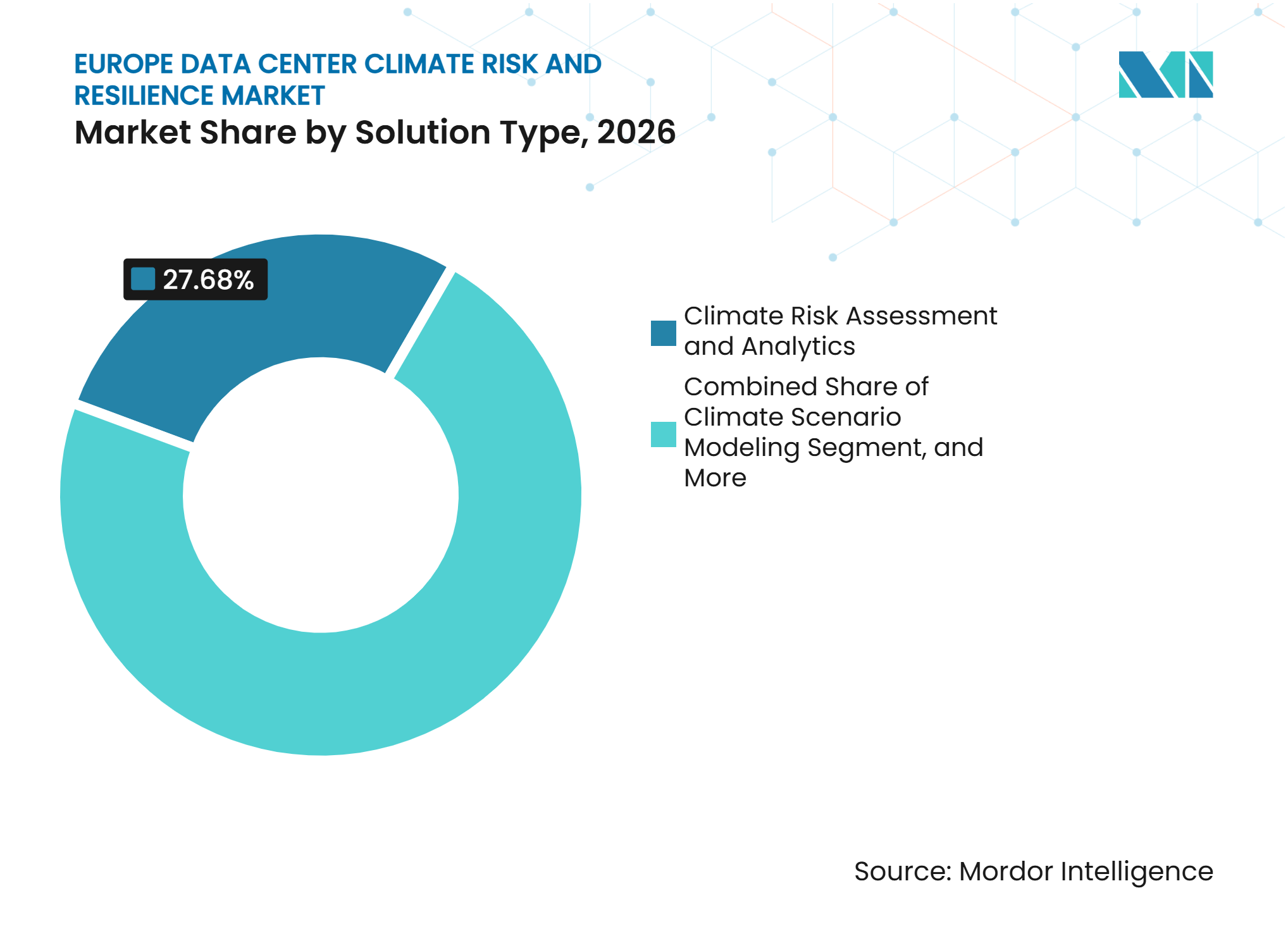
Risk Assessment Leads, Monitoring AcceleratesClimate Risk Assessment and Analytics accounted for 27.68% of the European data center climate risk market in 2026. Lenders, insurers, and large operators use this work to establish an auditable view of physical exposure before approving capital or setting coverage terms. Climate Scenario Modeling, Climate Risk Mapping, and Geospatial Analysis support the planning process by translating regional conditions into site-specific exposure. Climate Adaptation and Resilience Planning then turns those findings into investment priorities, design changes, and continuity procedures.
Climate Risk Assessment and Analytics accounted for 27.68% of the European data center climate risk market in 2026. Lenders, insurers, and large operators use this work to establish an auditable view of physical exposure before approving capital or setting coverage terms. Climate Scenario Modeling and Geospatial Analysis support the planning process by translating regional conditions into site-specific exposure. Climate Adaptation and Resilience Planning then turns those findings into investment priorities, design changes, and continuity procedures. This combination is moving buyers from reactive hazard reviews toward continuous infrastructure management.



By Climate Hazard:
Flood Risk Dominates, Compound Events EmergeFlooding and Sea-Level Rise accounted for 33.47% of the Europe data center climate risk market share in 2026. Major capacity centers in Frankfurt, Amsterdam, London, and Dublin face exposure to riverine, surface-water, or coastal flooding. Lockton reported that more than 1-third of Europe's 3,000 data centers operate in areas of high or extremely high water stress. This creates a difficult link between cooling needs and water-related risk during severe weather.
Compound and Multi-Hazard Events are expected to grow at a 13.24% CAGR through 2032 as operators recognize that one hazard can intensify another. The Institut der deutschen Wirtschaft documented that water scarcity and flooding can occur together in German regions, creating planning requirements that cannot be addressed by a single-hazard model. Extreme heat and drought are increasing the case for cooling upgrades, while wildfire smoke can contaminate air intakes at southern European sites. Atlantic markets also require attention to severe wind and storm risks.
By Assessment Method:
Forward Scenarios Command the Largest ShareForward-Looking Climate Scenario Analysis held a 29.36% share in 2026 because historical experience alone does not fully represent future asset exposure. TCFD requirements for larger United Kingdom companies and the CSRD double-materiality framework are increasing the use of future-oriented assessment. Historical Hazard Analysis remains relevant for insurance calibration and post-event review. Physical Risk and Vulnerability Assessment and Geographic and Geospatial Risk Mapping provide the local detail needed to evaluate individual assets.
Climate Stress Testing is projected to grow at a 13.36% CAGR through 2032 as financial institutions and their clients integrate physical risk into formal planning. The European Central Bank described how firm-level climate risk affects the wider financial system through the EU-wide stress-test framework. Financial and Asset-Level Climate Risk Quantification connects physical risk with potential impairment and funding decisions. Operators increasingly need consistent output to support TCFD, ESRS, and IFRS S2 reporting. Integrated platforms are becoming increasingly useful when a single risk model can inform multiple disclosure obligations. Clear audit trails are important when scenario assumptions are reviewed by lenders or assurance providers. They also help operators compare investment options across a dispersed portfolio.
By Resilience Strategy:
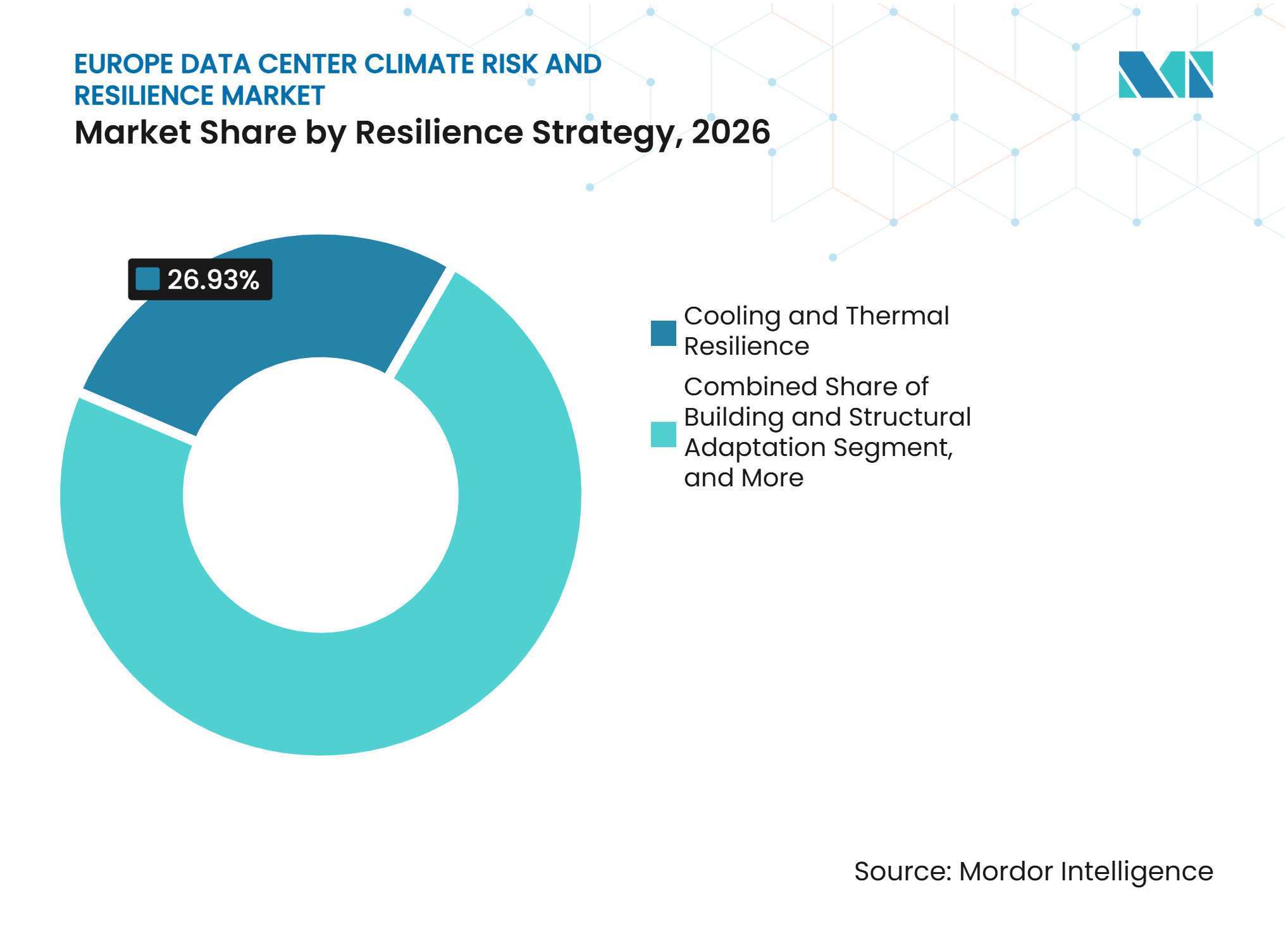
Cooling Leads, Water Conservation Gains GroundCooling and Thermal Resilience captured 26.93% of the Europe data center climate risk market share in 2026. A cooling failure can quickly lead to a service interruption, enabling operators to identify both the technical problem and the financial exposure. Vertiv modernized NFrance's sovereign data center in France in July 2026, eliminating cooling-related water use and delivering 20% lower power consumption without interrupting service.[2] This type of project gives operators a reference point for waterless cooling upgrades in live environments.
Water Availability and Conservation Measures is projected to grow at a 13.53% CAGR through 2032. The World Economic Forum reported that closed-loop liquid and immersion cooling can reduce water consumption by up to 91% compared with conventional air cooling. NVIDIA's DSX AI Factory architecture includes closed-loop liquid cooling and dry coolers, in partnership with ABB, Eaton, Schneider Electric, Trane Technologies, and Vertiv. Site selection, structural adaptation, grid resilience, and flood protection remain necessary alongside cooling measures. Longer transformer lead times also make power-resilience planning a much earlier part of development. Facilities also need to assess the source and quality of water available during a prolonged heat event. Reuse systems become more valuable where local water restrictions or drought plans limit conventional cooling.

By Service Type:
Consulting Captures the Largest ShareClimate Risk Consulting held a 34.82% share in 2026 because many operators need help translating hazard information into capital, insurance, and operational decisions. Climate Engineering and Design converts this work into practical specifications for greenfield sites and retrofits. Climate Adaptation Planning supports the selection and sequencing of upgrades. These services are important where companies do not maintain internal climate-science or infrastructure-risk teams.
Risk Auditing and Disclosure Support is projected to expand at a 13.42% CAGR through 2032. The CSRD assurance requirement makes independent verification important for qualifying sustainability reports. Allianz Commercial stated that comprehensive insurance has become a financing prerequisite for large AI infrastructure, increasing the importance of risk documentation. Monitoring and Early Warning Services complete the offering by providing continuous operating information after the initial assessment. Service providers that connect risk findings to finance, disclosure, and engineering needs have a clearer role in the Europe data center climate risk market.
By Data Center Size:
Large Facilities Drive Spend, Hyperscale Grows FastestLarge Data Centers accounted for 3 in 2026 because their outage exposure and regulatory obligations are substantial. The Energy Efficiency Directive's 500 kW reporting threshold brings many large facilities into a more formal disclosure regime. Medium- and small-sized facilities often purchase standardized consulting and monitoring packages rather than bespoke engineering programs. This limits their spending per site even when their operational risks remain material.
Hyperscale Data Centers is projected to grow at a 13.62% CAGR through 2032 as AI capacity expands across Europe. The European Commission's AI Gigafactory program is expanding the number of large campuses that need climate-informed planning. Reuters reported that generator step-up transformer lead times exceeded 160 weeks in Q1 2026, increasing the need for early power-resilience decisions. Hyperscale operators can spread assessment and monitoring systems across larger portfolios. Their planning timelines are increasingly aligned with climate scenarios and construction schedules. This enables standardized requirements for new campuses and major refurbishments. It also raises the value of consistent data across several countries and operating environments.
By Data Center Type:
Colocation Leads, Cloud Providers Gain MomentumColocation held a 42.74% share in 2026, making it the leading data center type in the Europe data center climate risk market. Multi-tenant sites concentrate the exposure of many enterprise customers, so an outage can lead to service-level penalties and reputational effects across a wide tenant base. XDI reported that the Frankfurt, London, Amsterdam, Paris, and Dublin cluster represents more than half of Europe's operational capacity. This concentration increases pressure on operators to demonstrate physical resilience to lenders and insurers.
Cloud Service Providers are projected to expand at a 13.49% CAGR through 2032 as hyperscalers increase investment in Europe and standardize risk review for large approvals. Enterprise and edge sites face more diverse localized conditions, including wildfire and extreme cold exposure outside metropolitan clusters. The proposed EU labeling approach creates differing compliance urgency across colocation, cloud, and enterprise facilities. Global Switch opened a liquid-cooling showcase in London in June 2025, featuring systems from LiquidStack, Vertiv, and other vendors, illustrating how operators use resilience infrastructure to support customer evaluation. These demonstrations can support longer tenant commitments where cooling capacity is a visible requirement.
Geography Analysis
Germany: Europe’s Largest Data Center Hub Confronts Acute Climate Exposure
Germany held 28.57% of the Europe data center climate risk market share in 2026. Deutsche Energie-Agentur counted more than 2,000 data centers and more than 2,700 MW of installed IT power demand in March 2025, while projecting electricity demand of 31 TWh by 2030 and 80 TWh by 2045.[3] Frankfurt combines high asset concentration with exposure to surface-water flooding, extreme heat, and severe wind. Google committed EUR 5.5 billion (USD 6.2 billion) in Germany through 2029, including a data center in Dietzenbach and a heat-recovery project that underscores the importance of resilience planning.
Spain: Rapid Expansion Meets Compound Water and Heat Risk
Spain is projected to grow at a 13.47% CAGR through 2032. Renewable energy availability, land outside constrained hubs, and subsea cable connections are supporting new data center proposals. Spain’s ERICC-2025 national risk assessment identified 141 climate risks, including urgent risks from heat, drought, and coastal flooding. Vertiv delivered a 70% reduction in cooling energy consumption at Acciona’s Madrid data center in May 2026, providing the European data center climate risk market with a practical example of retrofit potential in a hot climate. Spain’s National Climate Adaptation Work Program for 2026-2030 adds a public planning context for critical-infrastructure resilience
Rising Hazards Reshape Investment Across Europe
The United Kingdom, France, Italy, Sweden, and Russia have different risk profiles and investment priorities. In the United Kingdom, storm and rainfall events can damage building fabric and cause water ingress, while TCFD reporting has increased demand for auditable risk information. France is adding AI capacity, including a proposed 1.4 GW campus near Paris, while coastal assets near Marseille face inundation risks. Northern Italy combines flood exposure with southern heat stress, and Submer’s immersion-cooling deployment near Milan shows early adoption of waterless cooling. Sweden benefits from cooler ambient conditions and renewable energy, while Russia remains constrained by geopolitical limits on cross-border data sharing and access to equipment.
Competitive Landscape
Market Concentration
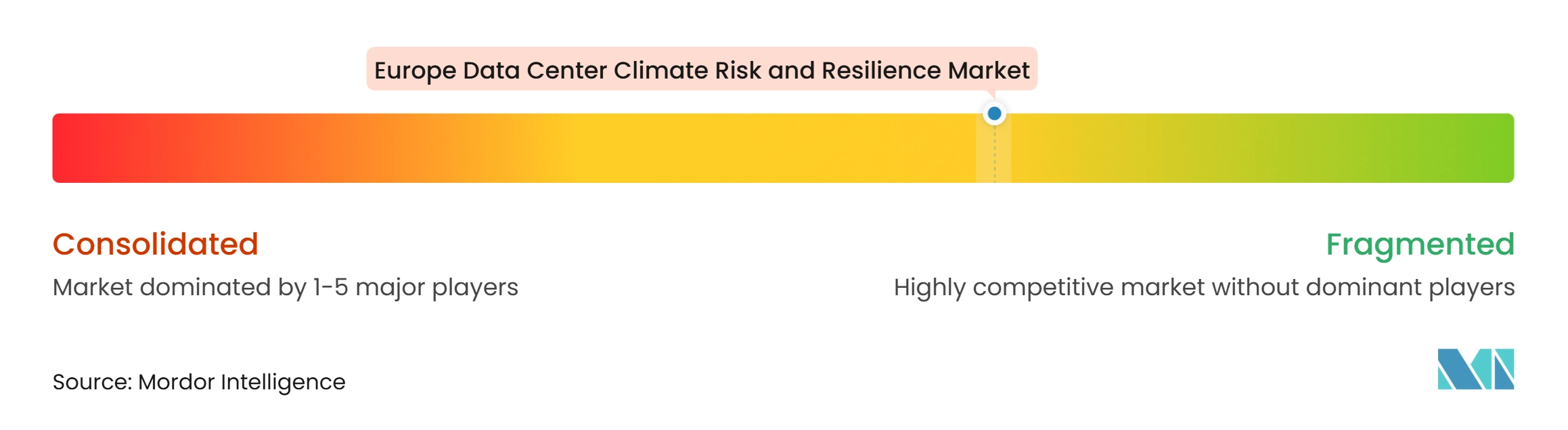
The Europe data center climate risk market is moderately fragmented across industrial integrators, thermal-management specialists, and smaller advisory and analytics providers. Schneider Electric, Vertiv, Eaton, ABB, and Siemens compete through broad portfolios that combine power, cooling, controls, and project delivery. Vertiv announced a 22,000-square-meter expansion of its Nové Mesto nad Váhom campus in Slovakia in September 2026 to increase production of power, switchgear, and thermal management. Schneider Electric is using climate risk analysis to link resilience expenditure to protected asset value. Its June 2026 analysis stated that proactive adaptation could protect 30% to 39% of the value of exposed data center assets across modeled scenarios.
NVIDIA’s DSX AI Factory reference architecture brings ABB, Eaton, Schneider Electric, Trane Technologies, and Vertiv into a shared approach to closed-loop liquid cooling and low water use. Munters, CoolIT Systems, LiquidStack, Submer Technologies, and Iceotope are concentrating on immersion and direct-to-chip systems. Munters reported USD 215 million in order intake from a single hyperscaler in Q4 2025 for custom computer room air handlers.[4] These examples show that AI infrastructure is increasing demand for vendors with proven thermal-management capacity.
The analytics layer has more open space because few listed companies focus primarily on hazard quantification or geospatial climate modeling for data centers. This allows partnerships between climate-data providers, engineering firms, and equipment suppliers to address both site planning and facility upgrades. Compliance with Delegated Regulation (EU) 2024/1364 is becoming a supplier-selection factor alongside thermal and power performance. Larger vendors retain an advantage when customers want integrated power, cooling, monitoring, and services from one provider. The market remains competitive because no single group covers every layer of physical-risk analysis and resilience implementation.
Europe Data Center Climate Risk and Resilience Industry Leaders
-
Schneider Electric SE
-
Vertiv Holdings Co.
-
Johnson Controls International plc
-
STULZ GmbH
-
Rittal GmbH & Co. KG
- *Disclaimer: Major Players sorted in no particular order
Europe Data Center Climate Risk and Resilience Market Companies Covered in this Report
- Schneider Electric SE
- Vertiv Holdings Co.
- Johnson Controls International plc
- STULZ GmbH
- Rittal GmbH & Co. KG
- Eaton Corporation plc
- ABB Ltd
- Siemens AG
- Legrand SA
- Delta Electronics, Inc.
- Huawei Technologies Co., Ltd.
- Daikin Industries, Ltd.
- Mitsubishi Electric Corporation
- Trane Technologies plc
- Munters Group AB
- CoolIT Systems Inc.
- LiquidStack Inc.
- Submer Technologies S.L.
- Iceotope Technologies Limited
Recent Industry Developments in Europe Data Center Climate Risk and Resilience Market
- October 2026: The European Commission's Joint Research Centre launched the TRACE dashboard, providing granular climate risk data for 1,366 EU, Norwegian, Swiss, and UK regions down to NUTS-3 level. The platform directly addresses the fragmented national data landscape constraining cross-border climate stress testing for data center assets and is expected to accelerate demand for harmonized site-level assessments.
- October 2026: Schneider Electric unveiled the RapidScale Modular Data Center Reference Design 115, a pre-engineered blueprint reducing engineering risk and accelerating delivery for high-density AI factory construction programs.
- September 2026: Vertiv announced expansion of its Nové Mesto nad Váhom campus in Slovakia by 22,000 square meters over 18 to 24 months, targeting production of power, switchgear, and advanced liquid cooling systems for high-density AI workloads across EMEA markets.
- September 2026: Schneider Electric launched the WCDU coolant distribution unit, delivering up to 3.5 MW of cooling capacity and supporting hybrid air- and liquid-cooling architectures, with approach temperature differences as low as 2°C for high-density AI data center deployments.
Europe Data Center Climate Risk and Resilience Market Report Scope
The Europe data center climate risk and resilience market comprises solutions and services that help data center operators assess, mitigate, and adapt to climate-related risks, including extreme weather events, rising temperatures, flooding, and water scarcity. These offerings support business continuity, infrastructure protection, and operational resilience across European data centers.
The Europe Data Center Climate Risk and Resilience Market Report is Segmented by Solution Type (Climate Risk Assessment and Analytics, Climate Scenario Modeling, Climate Risk Mapping and Geospatial Analysis, Climate Adaptation and Resilience Planning, Climate Risk Monitoring and Early Warning, and Climate Risk Advisory and Engineering Services), Climate Hazard (Extreme Heat and Heatwaves, Flooding and Sea-Level Rise, Hurricanes, Cyclones, and Severe Windstorms, Wildfires and Smoke Exposure, Drought and Water Scarcity, Extreme Cold, Ice, and Snow Events, and Compound and Multi-Hazard Events), Assessment Method (Historical Hazard Analysis, Forward-Looking Climate Scenario Analysis, Physical Risk and Vulnerability Assessment, Geographic and Geospatial Risk Mapping, Climate Stress Testing, and Financial and Asset-Level Climate Risk Quantification), Resilience Strategy (Site Selection and Climate-Informed Planning, Building and Structural Adaptation, Cooling and Thermal Resilience, Water Availability and Conservation Measures, Power Supply and Grid Resilience, Flood, Fire, and Severe Weather Protection, and Multi-Hazard Adaptation Planning), Service Type (Climate Risk Consulting, Climate Engineering and Design, Climate Adaptation Planning, Monitoring and Early Warning Services, and Risk Auditing and Disclosure Support), Data Center Size (Small, Medium, Large, and Hyperscale), Data Center Type (Colocation, Cloud Service Providers (CSPs), and Enterprise and Edge), and Geography (Germany, United Kingdom, France, Italy, Spain, Sweden, Russia, and Rest of Europe). The Market Forecasts are Provided in Terms of Value (USD).
Segmentation Overview
| Climate Risk Assessment and Analytics |
| Climate Scenario Modeling |
| Climate Risk Mapping and Geospatial Analysis |
| Climate Adaptation and Resilience Planning |
| Climate Risk Monitoring and Early Warning |
| Climate Risk Advisory and Engineering Services |
| Extreme Heat and Heatwaves |
| Flooding and Sea-Level Rise |
| Hurricanes, Cyclones, and Severe Windstorms |
| Wildfires and Smoke Exposure |
| Drought and Water Scarcity |
| Extreme Cold, Ice, and Snow Events |
| Compound and Multi-Hazard Events |
| Historical Hazard Analysis |
| Forward-Looking Climate Scenario Analysis |
| Physical Risk and Vulnerability Assessment |
| Geographic and Geospatial Risk Mapping |
| Climate Stress Testing |
| Financial and Asset-Level Climate Risk Quantification |
| Site Selection and Climate-Informed Planning |
| Building and Structural Adaptation |
| Cooling and Thermal Resilience |
| Water Availability and Conservation Measures |
| Power Supply and Grid Resilience |
| Flood, Fire, and Severe Weather Protection |
| Multi-Hazard Adaptation Planning |
| Climate Risk Consulting |
| Climate Engineering and Design |
| Climate Adaptation Planning |
| Monitoring and Early Warning Services |
| Risk Auditing and Disclosure Support |
| Small |
| Medium |
| Large |
| Hyperscale |
| Colocation |
| Cloud Service Providers (CSPs) |
| Enterprise and Edge |
| Germany |
| United Kingdom |
| France |
| Italy |
| Spain |
| Sweden |
| Russia |
| Rest of Europe |
| By Solution Type | Climate Risk Assessment and Analytics |
| Climate Scenario Modeling | |
| Climate Risk Mapping and Geospatial Analysis | |
| Climate Adaptation and Resilience Planning | |
| Climate Risk Monitoring and Early Warning | |
| Climate Risk Advisory and Engineering Services | |
| By Climate Hazard | Extreme Heat and Heatwaves |
| Flooding and Sea-Level Rise | |
| Hurricanes, Cyclones, and Severe Windstorms | |
| Wildfires and Smoke Exposure | |
| Drought and Water Scarcity | |
| Extreme Cold, Ice, and Snow Events | |
| Compound and Multi-Hazard Events | |
| By Assessment Method | Historical Hazard Analysis |
| Forward-Looking Climate Scenario Analysis | |
| Physical Risk and Vulnerability Assessment | |
| Geographic and Geospatial Risk Mapping | |
| Climate Stress Testing | |
| Financial and Asset-Level Climate Risk Quantification | |
| By Resilience Strategy | Site Selection and Climate-Informed Planning |
| Building and Structural Adaptation | |
| Cooling and Thermal Resilience | |
| Water Availability and Conservation Measures | |
| Power Supply and Grid Resilience | |
| Flood, Fire, and Severe Weather Protection | |
| Multi-Hazard Adaptation Planning | |
| By Service Type | Climate Risk Consulting |
| Climate Engineering and Design | |
| Climate Adaptation Planning | |
| Monitoring and Early Warning Services | |
| Risk Auditing and Disclosure Support | |
| By Data Center Size | Small |
| Medium | |
| Large | |
| Hyperscale | |
| By Data Center Type | Colocation |
| Cloud Service Providers (CSPs) | |
| Enterprise and Edge | |
| By Geography | Germany |
| United Kingdom | |
| France | |
| Italy | |
| Spain | |
| Sweden | |
| Russia | |
| Rest of Europe |
Key Questions Answered in the Report
What is the Europe data center climate risk market size?
The Europe data center climate risk market is projected to increase from USD 0.61 billion in 2026 and USD 0.68 billion in 2027 to USD 1.24 billion by 2032, at a 12.77% CAGR.
What is driving spending on climate resilience for European data centers?
AI infrastructure investment, rising outage costs, EU reporting requirements, and lender and insurer scrutiny are increasing demand for assessment, monitoring, and resilience services.
Which solution category leads European data center climate risk spending?
Climate Risk Assessment and Analytics leads with 27.68% share in 2026, while Climate Risk Monitoring and Early Warning has the fastest projected growth at 13.38% CAGR.
Why are water and cooling strategies important for European facilities?
Heat and water stress affect cooling reliability and operating cost. Water Availability and Conservation Measures is expected to grow at a 13.53% CAGR through 2032.
Which country leads European demand for data center climate risk services?
Germany leads with 28.57% share in 2026, supported by its large installed data center base and Frankfurt’s compound flood, heat, and wind exposure.
Which data center customers are growing fastest for resilience providers?
Cloud Service Providers are projected to expand at a 13.49% CAGR through 2032 as hyperscalers add European capacity and formalize climate-risk review.