
Europe Clothing and Footwear Technical Textile Market Size and Share
Market Overview
| Study Period | 2021 - 2032 |
|---|---|
| Forecast Data Period | 2027 - 2032 |
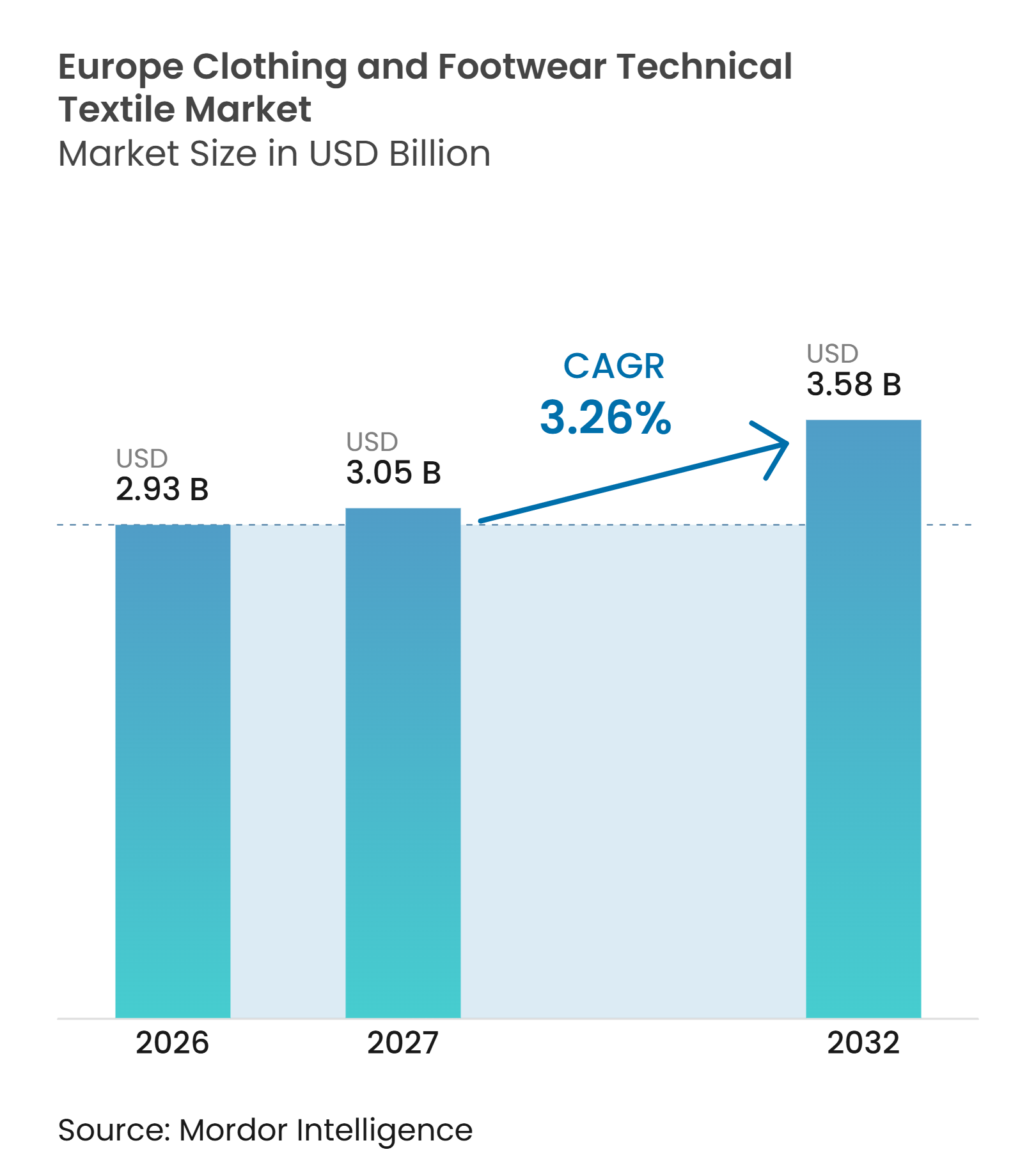
| Base Year Market Size (2026) | USD 2.93 Billion |
| Market Size (2027) | USD 3.05 Billion |
| Market Size (2032) | USD 3.58 Billion |
| Growth Rate (2027 - 2032) | 3.26 % |
| Market Concentration | Low |
Major Players *Disclaimer: Major Players sorted in no particular order Image © Mordor Intelligence. Reuse requires attribution under CC BY 4.0. | |
Europe Clothing and Footwear Technical Textile Market Analysis by Mordor Intelligence
The Europe Clothing And Footwear Technical Textile Market size is projected to be USD 2.93 billion in 2026, USD 3.05 billion in 2027, and reach USD 3.58 billion by 2032, growing at a CAGR of 3.26% from 2027 to 2032.
The market covers apparel interlinings, structural reinforcement textiles, elastic narrow fabrics and tapes, sewing and embroidery threads, textile fastening and closure systems, labels and identification textiles, and footwear reinforcement components. Demand is becoming less dependent on volume apparel production because performance garments, structured apparel, and technical footwear use more specialized components per unit. The European Commission has identified textiles as a priority product group in the Ecodesign for Sustainable Products Regulation Working Plan 2025-2030, with the textile-specific delegated act currently scheduled for adoption in Q4 2027. The final delegated requirements and transition periods will determine when Digital Product Passport obligations apply. Component suppliers may need to provide material composition, chemical, and traceability information to apparel manufacturers to support their obligations, depending on the final requirements.
Key Report Takeaways
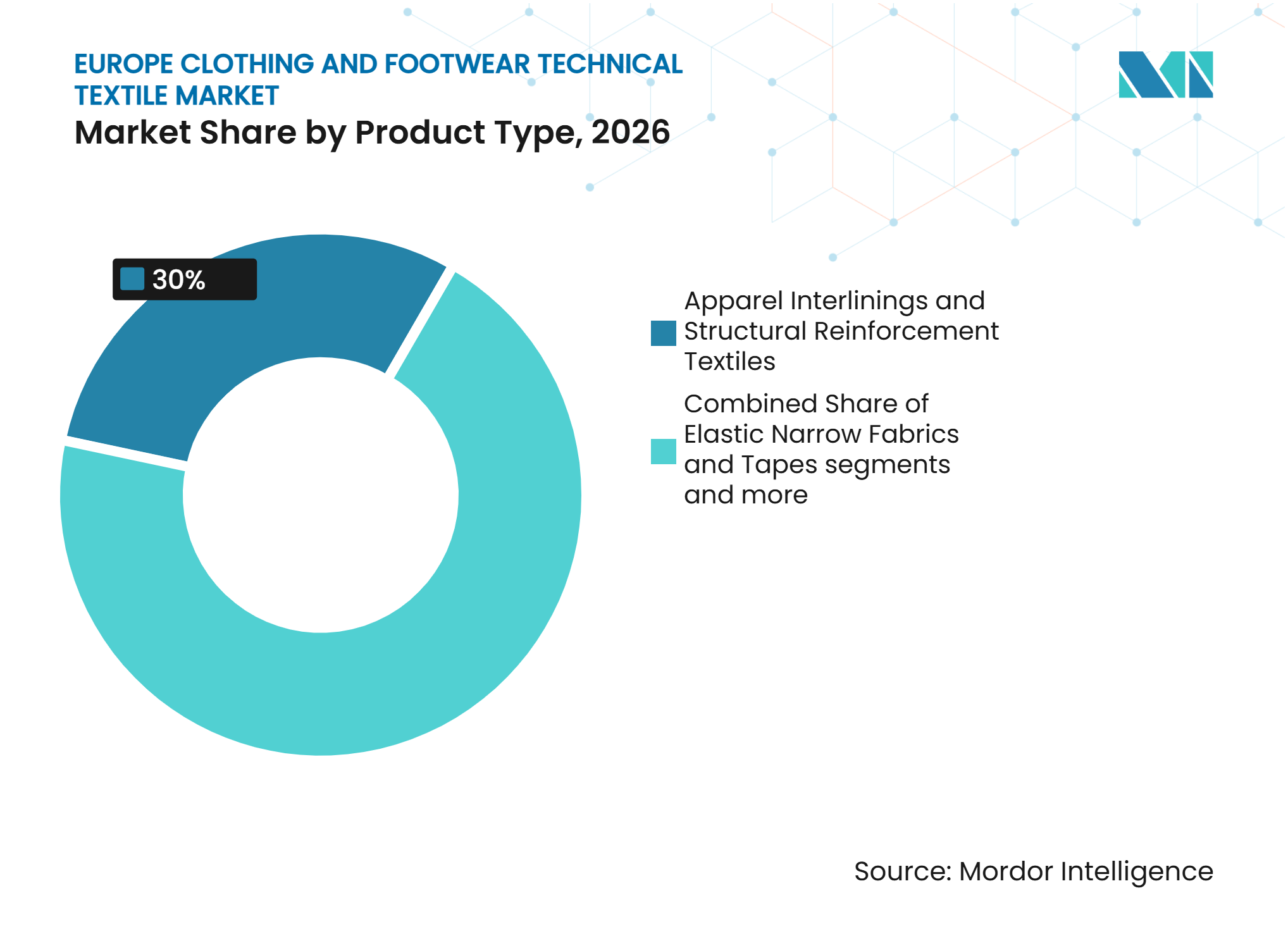
- By product type, apparel interlinings and structural reinforcement textiles held a 30.0% share of the Europe clothing and footwear technical textile market in 2026, while elastic narrow fabrics and tapes are forecast to expand at a 5.0% CAGR through 2032.
- By material type, polyester accounted for a 36.0% share in 2026, while elastane and other elastomeric fibers are forecast to grow at a 5.2% CAGR through 2032.
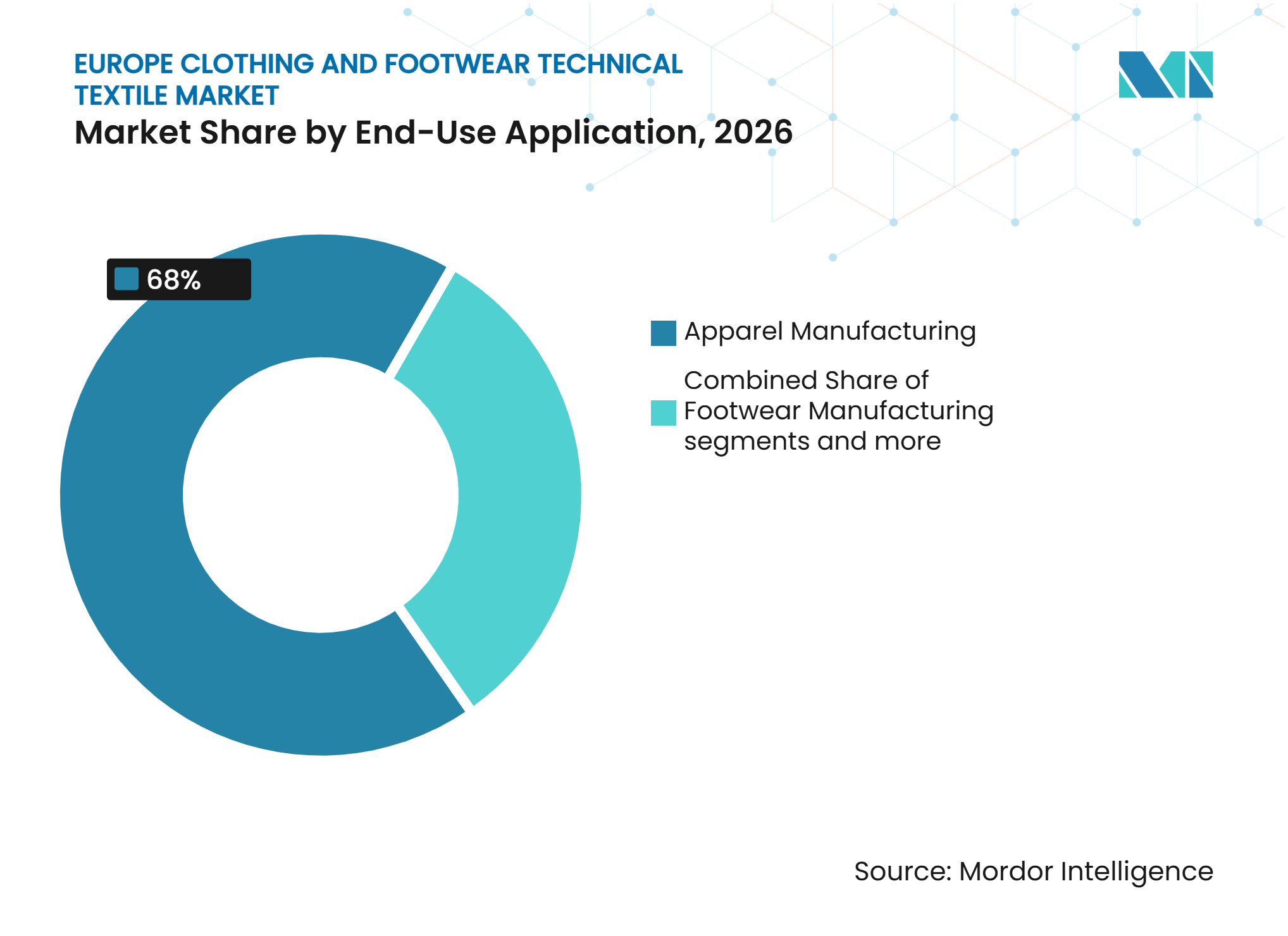
- By end-use application, apparel manufacturing commanded 68.0% of the Europe clothing and footwear technical textile market size in 2026, while footwear manufacturing is forecast to advance at a 5.3% CAGR through 2032.
- By geography, Italy held a 24.0% share in 2026, while Poland is forecast to expand at a 5.1% CAGR through 2032.
Note: Market numbers in this report are based on Mordor Intelligence's proprietary estimation framework, which combines nine months of actuals with Q4 projections for base year 2026.
Market Trends and Insights
Drivers Impact Analysis of Europe Clothing and Footwear Technical Textile Market*
| Driver | (~) % Impact on CAGR Forecast | Geographic Relevance | Impact Timeline |
|---|---|---|---|
| EU Circularity and Product Traceability Mandates | +1% | EU-27 core, with high compliance intensity in Germany, France, and the Netherlands | Medium term (2-4 years) |
| Growth of Performance Outdoor, Sports, and Workwear | +0.9% | Western Europe, with spillover to the Nordics and Poland | Short term (≤ 2 years) |
| Adoption of Lightweight Textile Components in Performance Apparel and Footwear | +0.6% | Italy, Germany, and Spain | Medium term (2-4 years) |
| Premium Demand for Durability, Comfort, and Protection | +0.5% | Germany, the United Kingdom, France, and the Nordics | Medium term (2-4 years) |
| PFAS-Free and Mono-Material Innovation | +0.5% | France, Denmark, and the EU-27 | Short term (≤ 2 years) |
| Customer Qualification and Validation Requirements Favoring Established Suppliers | +0.4% | Global demand, with manufacturing in Germany, Italy, Portugal, and Czechia | Medium term (2-4 years) |
| Source: Mordor Intelligence | |||
EU Circularity and Product Traceability Mandates
Component suppliers may need to provide material composition, chemical, and traceability information to apparel manufacturers to support product-level Digital Product Passport obligations, depending on the final delegated requirements. Interlining, closure, tape, thread, and label suppliers that can provide interoperable records will be better placed to support customers preparing for the new framework. Additional compliance requirements arise from REACH chemical restrictions, textile labeling obligations, and developing extended producer responsibility systems. The regulatory effect is principally one of supply-chain documentation and product-data readiness, rather than a direct obligation applying in the same way to every component supplier.
Growth of Performance Outdoor, Sports, and Workwear
Demand for functional apparel supports consumption of clothtech components through higher requirements for reinforcement textiles, elastic tapes, closures, and specialized sewing threads. Outdoor and workwear garments use these components more extensively than basic apparel. Trail running, fastpacking, and urban outdoor apparel are also supporting lighter seam tapes, bonded waistbands, and narrow-fabric trims. These applications allow component suppliers to differentiate through functional performance, durability, and product specifications rather than price alone.[1]
Adoption of Lightweight Textile Components in Performance Apparel and Footwear
European footwear and performance-garment manufacturers are increasing their use of lightweight textile components in specific constructions. Lightweight construction requirements, material-efficiency targets, circular-design considerations, and demand for non-leather footwear drive this substitution. W.L. Gore and HAIX introduced a fire boot in 2025 using the EXTRAGUARD upper, which the companies describe as 40% lighter than conventional leather-based upper materials. The launch is relevant as an example of textile upper construction that can require reinforcement textiles, technical threads, bonding layers, and functional trims. The exact component mix depends on the footwear construction and specification. It increases the importance of component engineering, particularly in reinforcement, bonding, and seam-construction systems.
Premium Demand for Durability, Comfort, and Protection
Premium garment and footwear producers specify components that maintain shape, comfort, and performance through repeated use. Structured formalwear needs interlinings that preserve dimensional stability and garment appearance. Protective workwear and outdoor apparel need components that perform under heat, moisture, abrasion, and movement. These requirements make technical certification and product testing important parts of the supply relationship. Suppliers serving premium customers also need dependable quality across production runs. The European clothtech market is supported by this preference for reliable materials because it reduces the role of purely price-based sourcing.
Restraints Impact Analysis of Europe Clothing and Footwear Technical Textile Market*
| Restraint | (~) % Impact on CAGR Forecast | Geographic Relevance | Impact Timeline |
|---|---|---|---|
| Energy, Labor, and Compliance Cost Disadvantage | -0.6% | Germany, Belgium, and Austria, with effects in Italy and France | Short term (≤ 2 years) |
| Fragmented Collection and Recycling Infrastructure | -0.4% | EU-27, with feedstock gaps in Eastern Europe | Medium term (2-4 years) |
| Performance Trade-Offs in Recycled and Bio-Based Inputs | -0.2% | Global supply base, with high specification requirements in Europe | Medium term (2-4 years) |
| Complex Product Classification and Application-Specific Compliance Requirements | -0.1% | EU-27, particularly Germany, the Netherlands, and Sweden | Long term (≥ 4 years) |
| Source: Mordor Intelligence | |||
Energy, Labor, and Compliance Cost Disadvantage
European manufacturers face an energy and compliance burden that limits their ability to compete in commodity component categories. EURATEX's 2025 energy survey identifies grid costs and taxes as a significant concern for European textile businesses. Energy, labor, testing, and documentation costs can reduce the resources available for investment in new products and processes. Smaller producers can be particularly exposed where input costs account for a larger share of total operating costs. Regulatory requirements add further work because suppliers must test, document, and maintain compliance records. These conditions increase the importance of validated product performance and consistent quality alongside purchase price.
Fragmented Collection and Recycling Infrastructure
Separate textile collection requirements took effect across the European Union in 2025, but collection and recycling capacity remains uneven. The European Commission has proposed extended producer responsibility for textiles as part of the Waste Framework Directive revision. Component manufacturers cannot consistently source recycled feedstock when sorting, collection, and processing systems are fragmented. This constrains the scale of recycled-content interlinings, threads, and tapes. It also makes it harder for suppliers to meet brand specifications on a predictable basis. The restraint is especially relevant for smaller firms that do not have long-term sourcing arrangements or sufficient inventory buffers.
*Our forecasts treat driver/restraint impacts as directional, not additive. The impact forecasts reflect baseline growth, mix effects, and variable interactions.
Europe Clothing and Footwear Technical Textile Market Segment Analysis
By Product Type:
Interlinings Lead While Elastic Fabrics AdvanceApparel interlinings and structural reinforcement textiles held a 30% share of European demand in 2026. Their position reflects the central role of fusible and structural materials in constructed garments. Collars, chest pieces, outerwear fronts, waistbands, denim, and performance trousers use interlinings to manage shape and handle. Formalwear requires stable chest pieces and collars, while outerwear and performance trousers need support without excessive bulk. Woven interlinings are used where the garment needs controlled structure, while nonwoven constructions can provide support with lower weight or different processing characteristics. The performance required from the component differs by garment construction, fabric weight, wash conditions, and intended wear cycle. Premium garment production in Italy, Germany, and France calls for higher-specification woven and nonwoven interlinings. This supports demand even when mass-market apparel production shifts toward lower-cost locations.
Elastic narrow fabrics and tapes are projected to grow at a 5% CAGR through 2032, the strongest rate among product categories. The growing use of elastic components in athleisure, compression-fit innerwear, and stretch workwear supports demand for this segment. Stretch waistbands and engineered elastic systems are used where garments must move comfortably while retaining fit over repeated wear. Functional garments also use elastic bonding tapes and narrow fabrics where flexibility and waterproof performance matter. The component choice depends on recovery properties, tensile behavior, wash durability, and compatibility with the wider garment construction. Specialized sewing and embroidery threads maintain demand through garment production volumes. Textile fastening components, labels, badges, and identification items are gaining relevance because product traceability needs component-level information. Footwear reinforcement components and garment insulation materials remain smaller categories, but they serve applications with demanding performance requirements.



By Material Type:
Polyester Retains Scale While Elastomeric Fibers GrowPolyester held a 36% share of European demand in 2026. It is used across interlinings, threads, narrow fabrics, nonwovens, and functional tapes because it combines cost efficiency with broad processing capability. The material also benefits from established supply chains across Western and Eastern Europe. Its use across several component categories allows manufacturers to use familiar production methods and source material at scale. Polyester can be adapted through fiber form, yarn structure, coating, or fabric construction to meet the needs of different component categories. Regulatory scrutiny of recycled polyester can complicate certain specifications. EURATEX has noted concerns that PFAS testing can create issues for recycled PET due to cross-contamination. Even so, polyester has no like-for-like alternative at comparable scale across all of these component uses.[2]
Elastane and other elastomeric fibers are projected to expand at a 5.2% CAGR through 2032. Growth is tied to performance apparel, stretch-panel workwear, compression garments, and footwear linings. Rising elastomeric-fiber use supports elastic narrow fabrics and stretch tapes, but the material and product segments have different boundaries. These fibers are incorporated where fit retention, controlled compression, and freedom of movement are more important than the properties of a rigid construction. Polyamide remains important in footwear upper mesh and seam-tape applications. Cotton remains relevant for sewing thread and woven interlining substrates. Regenerated cellulosic fibers are being used in liner fabrics, footwear linings, and sustainable-specification threads. Each material group serves different component functions, so material selection must be considered alongside the product architecture and end-use requirements.
By End-Use Application:
Apparel Manufacturing Anchors Demand While Athletic Footwear GrowsApparel manufacturing accounted for 68% of the European clothtech market size in 2026. This application includes formalwear, casualwear, innerwear, lingerie, outerwear, functional clothing, sportswear, and athleisure. Outerwear and functional garments require waterproof tapes, multilayer interlinings, engineered closures, and lamination materials. Innerwear and lingerie use elastic narrow fabrics at a high rate. Sportswear and athleisure require a combination of stretch, moisture management, seam integrity, and comfort, creating demand for several component types in one garment. Structured suit jackets also use substantially more interlining than comparable casualwear garments, which helps preserve higher-value demand in premium clothing. The mix of applications means that apparel demand is shaped not only by the number of garments produced but also by the construction standard and functional requirements of each garment.
Footwear manufacturing is projected to grow at a 5.3% CAGR through 2032. Technical footwear uses engineered heel-counter textiles, toe-puff reinforcements, lamination films, and specialized threads. At the same time, knitted uppers are part of the wider upper construction rather than a separate component category. The shift from leather-based uppers to textile-based constructions can increase the use of specialized reinforcement and functional components per pair, depending on the construction. W.L. Gore and HAIX demonstrated one such textile upper construction with their 2025 EXTRAGUARD fire boot launch. Casual and fashion footwear and occupational footwear provide additional end-use demand for relevant components. Clothing accessories and umbrellas remain peripheral applications and are included only where the product uses an explicitly defined garment-construction textile component. Product rules and producer responsibility systems are encouraging designs that can support material recovery.[3]

Geography Analysis
Italy: Premium Manufacturing Anchor
Italy held a 24% share of European demand in 2026. Italy's established garment and footwear manufacturing base generates demand for interlinings, elastic narrow fabrics, bonding films, and technical footwear components. The Como, Biella, Le Marche, and Riviera del Brenta districts are relevant because they combine textile, apparel, and footwear activity, rather than because each district represents a single clothtech category. Luxury formalwear, lingerie, shapewear, fashion footwear, and performance footwear are key sources of demand. These categories require components that control structure, provide comfort, or improve functional performance while preserving a premium appearance. The country is therefore a major setting for component suppliers that serve high-specification garment and footwear manufacturing. Suppliers must align the component's physical performance with the appearance, handle, and production needs of the finished product.
Poland: Fast-Growing Manufacturing Base
Poland is projected to grow at a 5.1% CAGR through 2032. The country has an established role in European textile and apparel supply chains. Its workwear demand also supports local requirements for threads, tapes, interlinings, and closures. Poland was among the leading European workwear import markets, and its workwear imports grew at 9% per year from 2019 to 2024. This is a downstream demand indicator rather than a direct proxy for clothtech growth. The construction sector provides another source of occupational clothing demand. Neighboring Czech technical-textile capacity complements Poland-based garment assembly and component sourcing. Together, these factors support an environment in which component manufacturers can serve both local production needs and broader regional supply chains. The relationship remains application-specific because finished workwear trade does not disclose the value or volume of individual clothtech components.
Germany, France, the United Kingdom, Spain, Portugal, the Nordics, and Other European Markets
Germany has major manufacturing capability in interlinings, membranes, and specialty nonwovens, but energy and labor costs limit competitiveness in basic component categories. EURATEX identifies energy taxes as a major concern for surveyed companies. France has a strong regulatory influence on reformulation needs for functional tapes, bonding films, and water-resistant coatings. The United Kingdom has a separate UK REACH framework, so its requirements should be considered separately from EU rules for suppliers serving both markets. Spain has workwear demand linked to construction and industrial activity. Portugal specializes in performance narrow fabrics and elastic components for European customers. Nordic buyers commonly consider chemical-safety and sustainability certifications, including bluesign and OEKO-TEX STANDARD 100, when evaluating textile suppliers. Romania and other lower-cost locations remain relevant for production close to European customers. These national and regional positions are distinct, so they should not be treated as a single demand pattern across Europe.
Competitive Landscape
Market Concentration
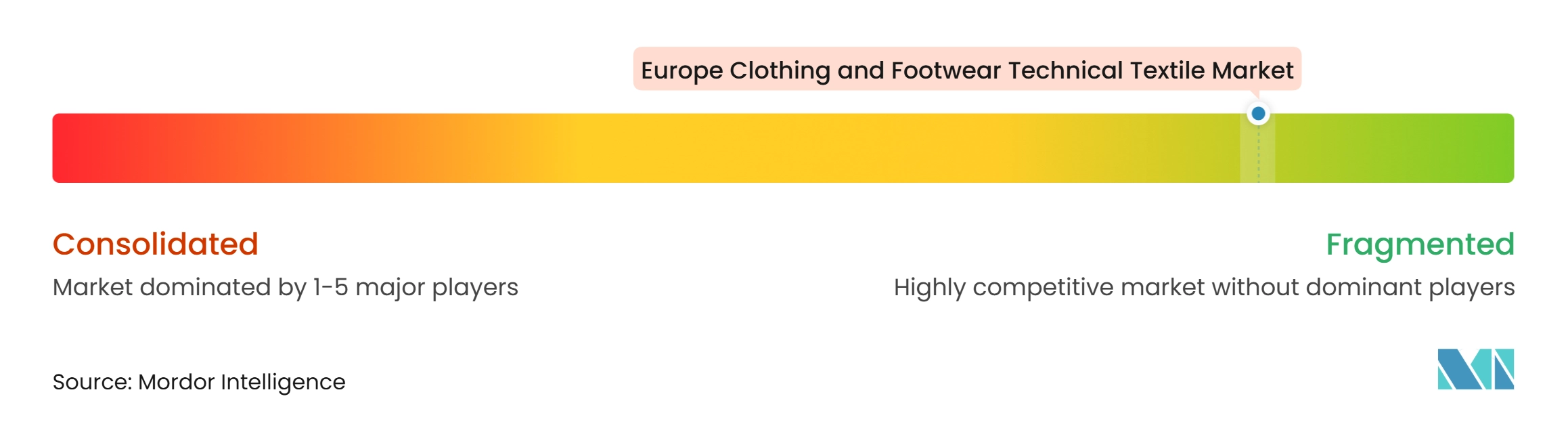
The European clothtech market comprises numerous specialized suppliers across component categories. Freudenberg Performance Materials is directly active in interlinings and nonwovens, while Coats and Amann serve sewing-thread applications and Strähle + Hess supplies narrow elastic fabrics and waistband systems. W.L. Gore & Associates is relevant to selected membrane and laminate systems, although membranes are not automatically included within the defined clothtech component scope. Other suppliers, including Schoeller Textil, Sympatex, HeiQ, TWE Group, and Polartec, operate in adjacent technical-textile or material categories. Customer qualification requirements can create entry barriers in applications where components affect garment fit, protection, durability, or regulatory compliance.
Competition centers on validated product performance, consistent quality, technical documentation, and the ability to meet customer-specific specifications. Freudenberg's 2025 binder-free PLA and wood-pulp nonwoven launch is directly relevant to interlining and embroidery-backing applications. Suppliers are also responding to demand for components with lower-impact material inputs, traceability records, and suitable bonding or durability performance. A supplier's competitive position depends on how reliably it can deliver these requirements within the relevant component category. Upstream fiber and yarn investments may affect future input availability, but they do not directly represent clothtech component competition.
Component specialists compete through product engineering and customer validation rather than through a single shared technology platform. Interlining and nonwoven suppliers address garment structure and reinforcement. Thread, elastic, closure, and label suppliers address distinct construction, fit, fastening, and identification needs. This product-level specialization explains how the market can remain fragmented while established suppliers retain advantages in qualified customer relationships.
Europe Clothing and Footwear Technical Textile Industry Leaders
-
W. L. Gore & Associates, Inc.
-
Freudenberg Performance Materials
-
Sympatex GmbH
-
Polartec, LLC (Milliken and Company)
-
HeiQ Materials AG
- *Disclaimer: Major Players sorted in no particular order
Europe Clothing and Footwear Technical Textile Market Companies Covered in this Report
- W. L. Gore & Associates, Inc.
- Freudenberg Performance Materials
- Sympatex GmbH
- Polartec, LLC (Milliken and Company)
- HeiQ Materials AG
- TWE Group GmbH
- TenCate Protective Fabrics
- Ahlstrom Oyj
- Lenzing AG
- Teijin Aramid B.V.
- DuPont de Nemours, Inc.
- Toray Industries, Inc.
- Asahi Kasei Corporation
- Pertex (Mitsui and Company)
- eVent Fabrics (Clarus Corporation)
- Arville Textiles Ltd.
- Beaulieu International Group
- Strähle + Hess GmbH
- Amann Group
- Coats plc
- Fothergill Group
Recent Industry Developments in Europe Clothing and Footwear Technical Textile Market
- April 2026: In April 2026, Germany-based AMANN Group partnered with Belgium-based Resortecs to industrialize design-for-disassembly solutions using Resortecs Smart Stitch™ heat-activated sewing threads. The technology enables controlled heating to disassemble garments, facilitating the separation of textile components and improving material recovery for recycling. The partnership combines AMANN's sewing thread manufacturing and quality assurance capabilities with Resortecs garment disassembly technology to support the development of circular sewing solutions for apparel manufacturers.
- October 2025: Freudenberg Performance Materials launched 100% bio-based PLA and wood-pulp binder-free wetlaid nonwovens for biodegradable interlining and embroidery-backing applications.
Europe Clothing and Footwear Technical Textile Market Report Scope
The Europe Clothing and Footwear Technical Textile Market Report is Segmented by Product Type (Apparel Interlinings and Structural Reinforcement Textiles and More), by Material Type (Polyester, Polyamide, and More), by End-Use Application (Apparel Manufacturing, Footwear Manufacturing, and More), and by Geography (Germany, Italy, and More). The Report Offers Market Size and Forecasts in Value (USD) for all the Above Segments.
Segmentation Overview
| Apparel Interlinings and Structural Reinforcement Textiles |
| Specialized Sewing and Embroidery Threads |
| Elastic Narrow Fabrics and Tapes |
| Non-Elastic Functional Garment Tapes and Trims |
| Textile Fastening and Closure Components |
| Textile Labels, Badges, and Identification Components |
| Footwear Technical Textile Components |
| Garment Insulation and Specialty Functional Textile Components |
| Umbrella and Other Functional Accessory Textiles |
| Polyester |
| Polyamide |
| Cotton |
| Elastane and Other Elastomeric Fibers |
| Polypropylene and Other Polyolefins |
| Regenerated Cellulosic Fibers |
| Acrylic and Modacrylic Fibers |
| Other Specialty Synthetic Fibers |
| Other Materials |
| Apparel Manufacturing | Formalwear and Tailored Apparel |
| Casualwear and Everyday Clothing | |
| Innerwear, Lingerie, and Shapewear | |
| Outerwear and Functional Clothing | |
| Sportswear and Athleisure Apparel Components | |
| Other Apparel Manufacturing | |
| Footwear Manufacturing | Casual and Fashion Footwear |
| Athletic and Performance Footwear | |
| Occupational, Specialty and Other Footwear Components | |
| Clothing Accessories and Umbrellas | Headwear and Wearable Accessories |
| Umbrellas and Rain Accessories | |
| Other Specialized Clothing and Footwear Applications |
| Germany |
| Italy |
| France |
| United Kingdom |
| Spain |
| Portugal |
| Poland |
| Czech Republic |
| Sweden |
| Finland |
| Netherlands |
| Belgium |
| Austria |
| Romania |
| Rest of Europe |
| By Product Type | Apparel Interlinings and Structural Reinforcement Textiles | |
| Specialized Sewing and Embroidery Threads | ||
| Elastic Narrow Fabrics and Tapes | ||
| Non-Elastic Functional Garment Tapes and Trims | ||
| Textile Fastening and Closure Components | ||
| Textile Labels, Badges, and Identification Components | ||
| Footwear Technical Textile Components | ||
| Garment Insulation and Specialty Functional Textile Components | ||
| Umbrella and Other Functional Accessory Textiles | ||
| By Material Type | Polyester | |
| Polyamide | ||
| Cotton | ||
| Elastane and Other Elastomeric Fibers | ||
| Polypropylene and Other Polyolefins | ||
| Regenerated Cellulosic Fibers | ||
| Acrylic and Modacrylic Fibers | ||
| Other Specialty Synthetic Fibers | ||
| Other Materials | ||
| By End-Use Application | Apparel Manufacturing | Formalwear and Tailored Apparel |
| Casualwear and Everyday Clothing | ||
| Innerwear, Lingerie, and Shapewear | ||
| Outerwear and Functional Clothing | ||
| Sportswear and Athleisure Apparel Components | ||
| Other Apparel Manufacturing | ||
| Footwear Manufacturing | Casual and Fashion Footwear | |
| Athletic and Performance Footwear | ||
| Occupational, Specialty and Other Footwear Components | ||
| Clothing Accessories and Umbrellas | Headwear and Wearable Accessories | |
| Umbrellas and Rain Accessories | ||
| Other Specialized Clothing and Footwear Applications | ||
| By Geography | Germany | |
| Italy | ||
| France | ||
| United Kingdom | ||
| Spain | ||
| Portugal | ||
| Poland | ||
| Czech Republic | ||
| Sweden | ||
| Finland | ||
| Netherlands | ||
| Belgium | ||
| Austria | ||
| Romania | ||
| Rest of Europe | ||
Key Questions Answered in the Report
What is the projected value of the European clothtech market by 2032?
The European clothing and footwear technical textile market is projected to reach USD 3.05 billion by 2032, growing at a 3.26% CAGR from 2027 to 2032.
Which product category leads European clothtech demand?
Apparel interlinings and structural reinforcement textiles lead with a 30% share in 2026.
Which clothtech product category is growing fastest in Europe?
Elastic narrow fabrics and tapes are projected to grow at a 5% CAGR through 2032, supported by athleisure, innerwear, and functional workwear.
What material is most widely used in European clothtech components?
Polyester leads with a 36% share in 2026 because it is broadly used in interlinings, threads, narrow fabrics, nonwovens, and functional tapes.
Why are Digital Product Passports relevant for textile component suppliers?
Suppliers may need to provide material composition, chemical, and traceability information to support apparel manufacturers' future Digital Product Passport obligations, subject to final delegated requirements.
What are the main component categories covered by European cloth tech?
The scope includes interlinings, reinforcement textiles, elastic narrow fabrics and tapes, sewing threads, fastening and closure systems, labels, and footwear reinforcement components.