
Europe Bathroom Furniture Market Size and Share
Market Overview
| Study Period | 2021 - 2031 |
|---|---|
| Forecast Data Period | 2026 - 2031 |
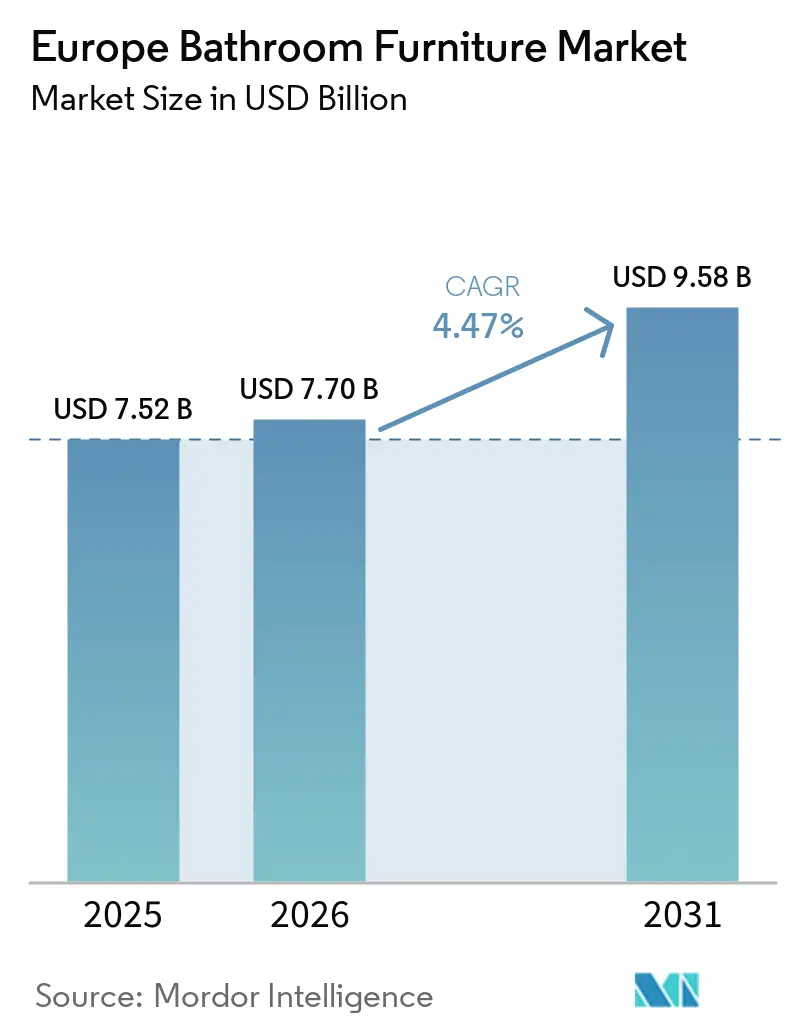
| Base Year Market Size (2025) | USD 7.52 Billion |
| Market Size (2026) | USD 7.70 Billion |
| Market Size (2031) | USD 9.58 Billion |
| Growth Rate (2026 - 2031) | 4.47 % |
| Market Concentration | Low |
Major Players *Disclaimer: Major Players sorted in no particular order Image © Mordor Intelligence. Reuse requires attribution under CC BY 4.0. | |
Europe Bathroom Furniture Market Analysis by Mordor Intelligence
The European bathroom furniture market was valued at USD 7.52 billion in 2025 and is estimated to grow from USD 7.70 billion in 2026 to reach USD 9.58 billion by 2031, at a CAGR of 4.47% during the forecast period from 2026 to 2031. Europe’s bathroom-furniture market is increasingly renovation-led, as aging housing stock and regulatory support for upgrading existing homes offset weak new residential construction. Demand is shifting toward coordinated collections, integrated storage, moisture-resistant materials and premium finishes, raising average order values. However, wood-panel cost pressure and subdued construction constrain volume growth. Suppliers combining modular ranges, durable materials, reliable delivery, and digital planning tools are best positioned to capture renovation demand and reduce specification errors.
Key Report Takeaways
- By product type, bathroom cabinets accounted for 61.3% of the market in 2025, while storage furniture and accessories are projected to register a CAGR of 6.10% through 2031.
- By material, wood accounted for 46.5% of the market in 2025, while plastic and polymer are projected to register a CAGR of 5.64% through 2031.
- By price range, the mid-range segment accounted for 46.3% of the market in 2025, while premium products are projected to register a CAGR of 5.80% through 2031.
- By end-user, the residential segment accounted for 68.3% of the market in 2025, while the commercial segment is projected to register a CAGR of 5.34% through 2031.
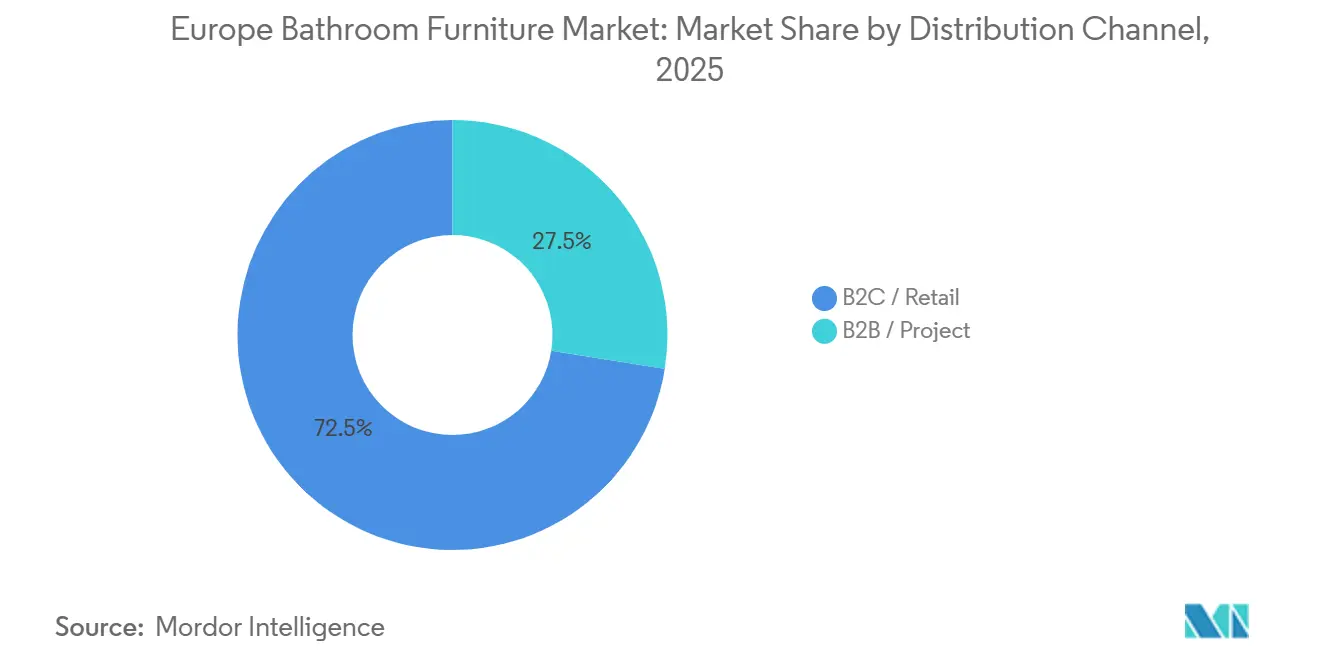
- By distribution channel, B2C and retail accounted for 72.5% of the market in 2025, while B2B and manufacturer channels are projected to register a CAGR of 5.28% through 2031.
- By geography, Germany held 23.4% of the market share in 2025, while Spain is forecast to register a 6.25% CAGR through 2031.
Note: Market size and forecast figures in this report are generated using Mordor Intelligence’s proprietary estimation framework, updated with the latest available data and insights as of January 2026.
Market Trends and Insights
Drivers Impact Analysis of Europe Bathroom Furniture Market*
| Driver | (~) % Impact on CAGR Forecast | Geographic Relevance | Impact Timeline |
|---|---|---|---|
| Bathroom Renovation and Modernization Demand | +1.8% | Western Europe, particularly Germany, France, the United Kingdom, and Italy | Short term (≤ 2 years) |
| Premiumization of Bathroom Interiors | +0.9% | Western and Southern Europe, particularly Germany, Italy, and France | Medium term (2-4 years) |
| Wall-Hung, Space-Efficient, and Smart Furniture | +0.7% | Northern and Western Europe, with spillover to BENELUX and NORDICS | Short term (≤ 2 years) |
| Aging Housing Stock, Accessibility, and Digital Planning | +0.6% | Germany, the United Kingdom, France, NORDICS, and Spain | Medium term (2-4 years) |
| Integrated Lighting, Storage, and Smart Features | +0.5% | European Union markets, BENELUX, and NORDICS | Medium term (2-4 years) |
| Configurable Digital Bathroom Planning | +0.4% | Western Europe, with early adoption in Germany and Spain | Long term (≥ 4 years) |
| Source: Mordor Intelligence | |||
Bathroom Renovation and Modernization Demand Sustaining Growth
Renovation and refurbishment generate most demand for the European bathroom furniture market because mature housing stock requires regular upgrades. The recast Energy Performance of Buildings Directive requires national renovation plans and supports a higher renovation rate across member states[1]. Nearly 50% of European Union housing stock was built before 1980, which leaves a large base for bathroom renewal alongside energy-related work. The European Investment Bank supported renovation of more than 580,000 homes during 2021 to 2025, showing the scale of activity across the housing base. Style considerations are becoming more important in purchase decisions, as the share of United Kingdom homeowners renovating because of deterioration fell to 51% in 2025 from 59%, while style-led upgrades increased[2]. This change supports replacement with coordinated cabinets, vanities, mirrors, and storage rather than a single functional item.
Premiumization of Bathroom Interiors Lifting Order Values
The European bathroom furniture market benefits from consumers increasingly viewing the bathroom as a space for comfort, relaxation, and personal well-being. A 2025 consumer monitor across Italy, France, and Germany found that 54% of respondents consider the bathroom the focal point of domestic well-being, with the share rising to 57% in Italy. This indicates broad consumer recognition of the bathroom as a wellness-oriented living space, supporting demand for coordinated, comfort-led and premium bathroom solutions.[3]. This preference encourages spending on better surface finishes, real-wood veneers, matte lacquers, and coordinated collections. In June 2025, Duravit introduced its Balcoon collection with designer Patricia Urquiola and placed upgraded materials and finishes in a mid-price offer. Such products reduce the distance between entry-level replacement furniture and premium design choices. The resulting mix supports selling prices even when unit demand grows more slowly. The growing focus on bathroom wellness and premium aesthetics is encouraging consumers to invest in higher-quality materials, refined finishes, and coordinated furniture collections. This premiumization trend supports higher average selling prices and market value growth, even amid moderate unit demand.
Wall-Hung, Space-Efficient, and Smart Furniture Gaining Use
Wall-hung furniture is becoming a common choice in renovation projects across Northern and Western Europe owing to its freeing up visible floor space and simplifying cleaning. The format also suits barrier-free layouts and works with pre-wall systems that can shorten installation time. Azzurra offers its modular Wally system in depths from 17 cm to 36.5 cm. In contrast, LAUFEN's RAIA system combines wall paneling, storage, furniture, and concealed installation within an 18 cm-deep arrangement. The European bathroom furniture market is also seeing more LED mirror cabinets, dimmers, motion-sensitive lighting, and charging functions in mid-range and upper-tier products. These features make a bathroom plan more useful without requiring a larger room. Modular wall-hung systems can reduce the number of stock-keeping units while raising the value of a completed order.
Aging Housing Stock, Accessibility, and Digital Planning Supporting Demand
Older housing creates a long-running need for bathroom changes that address both building condition and accessibility. Nearly 75% of European Union buildings are energy-inefficient, and up to 85% of current homes are expected to remain in use through 2050[4]. Aging occupants, families, and hospitality operators need wall-hung units, adjustable vanity heights, wider circulation space, and soft-close fittings. This demand is less dependent on discretionary redecorating because it responds to practical access requirements. Digital planning is also becoming more useful as installers and planners need to confirm fit, product compatibility, and documentation before work begins. The European bathroom furniture market can benefit when suppliers pair accessible products with configuration tools that make small renovation projects easier to specify.
Restraints Impact Analysis of Europe Bathroom Furniture Market*
| Restraint | (~) % Impact on CAGR Forecast | Geographic Relevance | Impact Timeline |
|---|---|---|---|
| Weak New Residential Construction in Major European Markets | -1.5% | Germany, France, and Austria | Short term (≤ 2 years) |
| Volatility in Wood, Engineered Board, and Hardware Costs | -0.5% | Germany and Central Europe | Medium term (2-4 years) |
| Skilled Installation and Manufacturing Labor Shortages | -0.4% | Germany, Italy, the Netherlands, and Belgium | Medium term (2-4 years) |
| Moisture-Resistance, Repairability, and End-of-Life Compliance Costs | -0.3% | European Union core markets | Long term (≥ 4 years) |
| Source: Mordor Intelligence | |||
Weak New Residential Construction Limits Volume Growth in Core Markets
New residential construction remains a key constraint on the European bathroom furniture market, as housing completions generate consistent demand through large-scale, contractor-led procurement. Europe was projected to complete 1.5 million homes in 2025, the lowest annual level in a decade and 5.5% below 2024. The slowdown is particularly pronounced in Germany, where dwelling completions are forecast at 175,000 in 2026, significantly below the estimated annual requirement of 400,000 homes. According to the European Construction Industry Federation, construction investment declined by 2.5% in 2024 and was projected to contract by a further 2.1% in 2025, reflecting elevated financing costs, restricted credit availability, and persistent construction cost pressures. Although renovation activity provides partial demand support, it does not fully offset the loss of new-build projects, limiting volume growth and intensifying pricing and margin pressures for manufacturers with greater exposure to residential construction channels.
Volatility in Wood, Engineered Board and Hardware Costs
Wood-based panels remain important for cabinet structures, yet their prices remain elevated compared with the long-term pattern. European particleboard and MDF prices stood 32% above their 2000 to 2020 average in 2025, even after easing from their earlier peak. OSB prices rose again after increases in the second quarter of 2025, while MDF and particleboard prices were more stable. Labor shortages in manufacturing and installation add pressure in Germany, Italy, the Netherlands, and Belgium, while moisture resistance, repairability, and end-of-life requirements add design and documentation costs. These costs are most difficult to pass through in entry-level and mid-range products where buyers remain price-sensitive. Suppliers need simpler components and reliable material sourcing to preserve margins without reducing product quality.
*Our forecasts treat driver/restraint impacts as directional, not additive. The impact forecasts reflect baseline growth, mix effects, and variable interactions.
Europe Bathroom Furniture Market Segment Analysis
By Product Type:
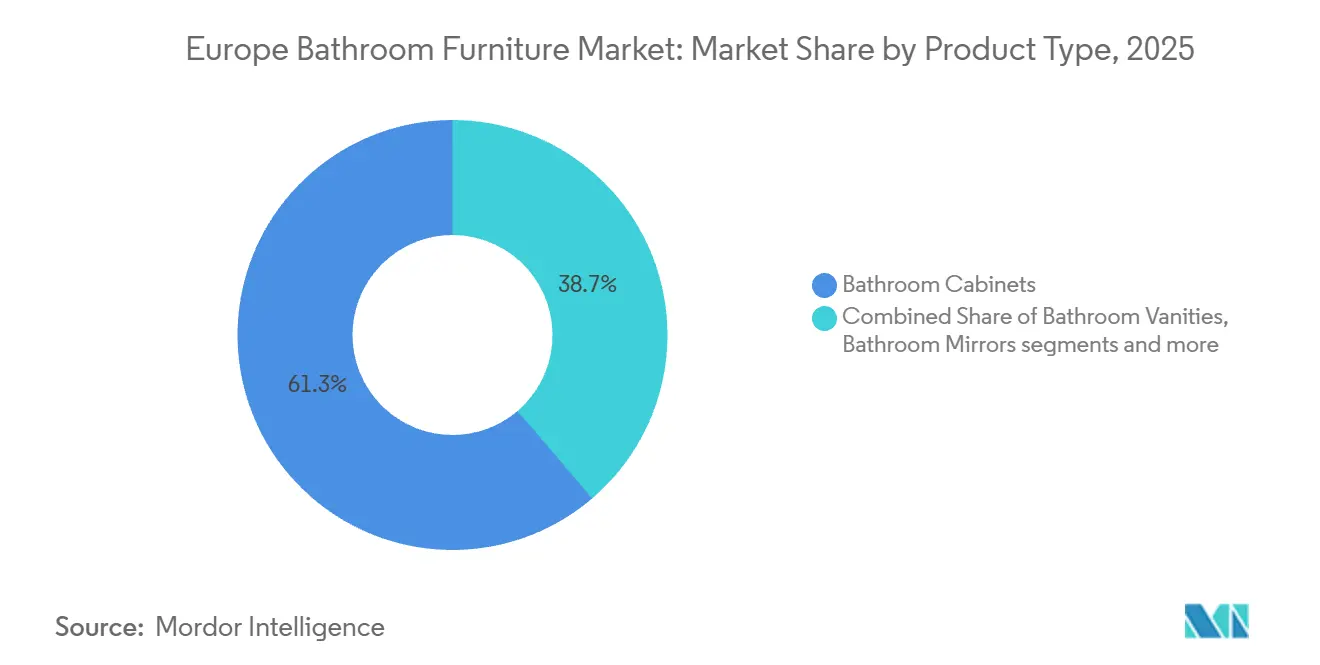
Cabinets Lead While Storage Additions Grow FasterBathroom Cabinets held 61.3% of the European bathroom furniture market in 2025, supported by their essential storage function and contribution to overall bathroom aesthetics. The segment comprises base units, tall cabinets, under-basin furniture, and mirror-integrated cabinet systems, with product innovation increasingly focused on LED lighting, sensor controls, charging functions, and optimized storage layouts. Bathroom Vanities maintain a significant position in renovation projects involving washbasin replacement and the adoption of freestanding or countertop-basin designs. Meanwhile, Bathroom Mirrors are gaining functional relevance through integrated lighting and demisting features, strengthening their role in contemporary bathroom planning.
Storage Furniture and Accessories is forecast to record a 6.10% CAGR through 2031, the highest rate among product categories in the Europe bathroom furniture market. Smaller apartment bathrooms support demand for vertical storage, towel rails, open shelves, and modular additions that use underused wall space. The pattern is especially relevant in BENELUX, NORDICS, urban Germany, and the United Kingdom, where homeowners may add storage without replacing the full cabinet system. In March 2025, Burgbad introduced its Moto collection and later expanded its quick-delivery range with Devio for compact renovations, with dispatch in 2 to 4 working days. Hansgrohe also entered the furniture category with the PEFC-certified Xilesa range, which is designed for use with its washbasins and shows the growing overlap between fittings suppliers and furniture specialists.

By Material:
Wood Holds the Lead While Polymers ExpandWood held 46.5% of the market share in 2025, supported by its design flexibility, established supply base, and appeal in premium and mid-range products. Real-oak veneers, natural textures, and matte lacquers remain common in contemporary bathroom design. Burgbad's Uomo collection uses real-wood veneers and lacquer choices that align with this preference for natural-looking finishes. Metal-framed furniture and accessories have a smaller but established role in commercial bathrooms and schemes seeking an industrial visual style. Stone-effect composites, high-pressure laminates, and ceramic-surface furniture serve narrower design-led projects.
Plastic and Polymer is projected to grow at a 5.64% CAGR through 2031, making it the fastest-growing material category in the Europe bathroom furniture market. Its growth reflects moisture resistance, easier repair without resealing, and compatibility with post-consumer recycled content. Composite wood boards remain attractive for many uses, but their end-of-life treatment can be less direct than that of polymer products. Suppliers that document material content and recyclability can meet the growing attention to lifecycle information without relying on price as the only proposition.
By Price Range:
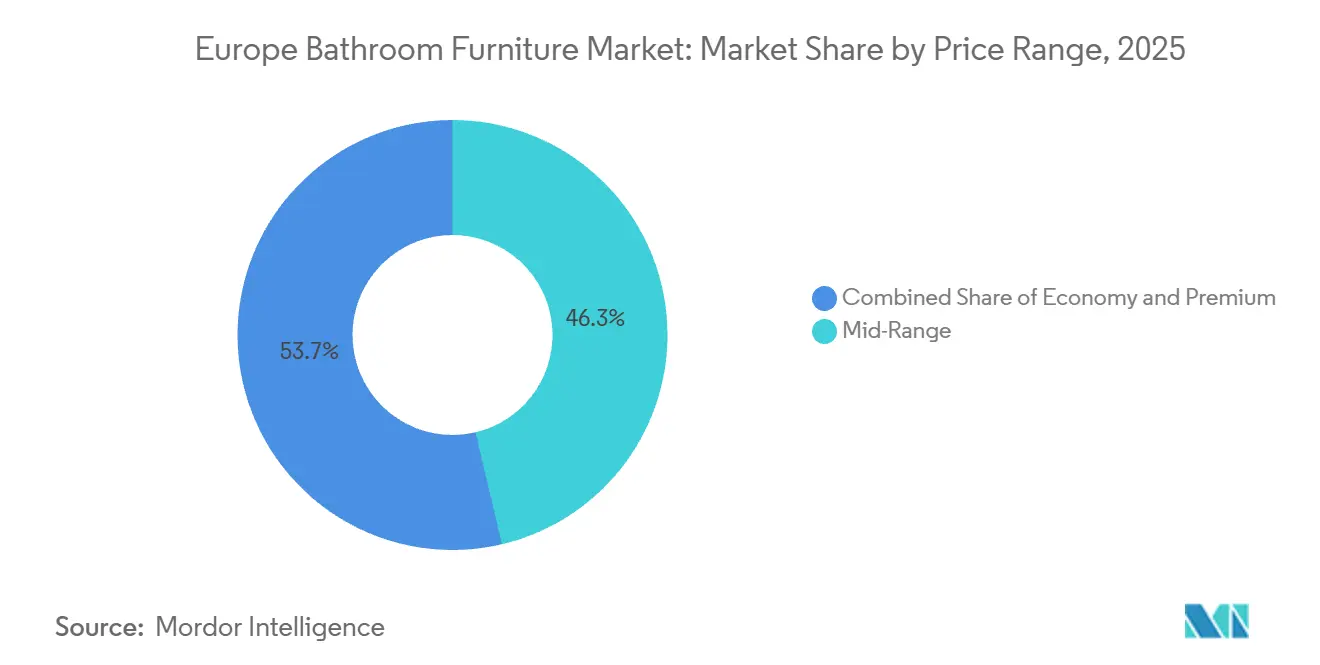
Mid-Range Leads Demand and Premium Gains ValueMid-Range accounted for 46.3% of the market share in 2025 and remains the core choice for renovation budgets. Consumers in the major European countries look for visible design improvement without the cost of a luxury installation. The quality-price ratio remained the principal purchase consideration in research among consumers in Germany, France, and Italy. This places pressure on manufacturers to offer good storage, durable surfaces, and useful fittings at an accessible price. Duravit's Balcoon collection illustrates this approach with several widths and upgraded ceramic finishes in a mid-price range.
Premium is forecast to grow at a 5.80% CAGR through 2031 as wellness-oriented design, recognizable designers, and distinctive materials gain attention. Higher-income renovation buyers seek durable furniture, differentiated surfaces, solid-surface countertops, and refined drawer systems. Economy products remain relevant for rental homes, social housing programs, and short-cycle hospitality refurbishment. The distance between mid-range and premium offers is narrowing as better coatings, soft-close hardware, and integrated lighting enter more accessible collections. This gives manufacturers a way to raise the value of product mixes while maintaining a mid-range entry point. The Europe bathroom furniture industry therefore has room to improve margins where additional features command a higher selling price without an equal rise in cost.
By End-User:
Residential Demand Leads and Commercial Refits ExpandResidential buyers accounted for 68.3% of the market share in 2025, owing to housing renovation remaining the dominant source of demand. Homeowners now often select several coordinated items during a bathroom project rather than replace a single damaged unit. The move from a utilitarian room toward a personal well-being space raises the number and value of products in a typical residential order. Hospitality is a major commercial source of demand because hotel owners need coordinated furniture during refurbishment programs. Retail and office washroom upgrades contribute steadier but smaller demand, where modern design and sustainability credentials support a wider renovation project.
Commercial end users are forecast to grow at a 5.34% CAGR through 2031, outpacing residential growth in the Europe bathroom furniture market. Healthcare and education projects are important because public buildings, care homes, and multi-family housing must increasingly accommodate design-for-all requirements. Such work is more specification-led and less discretionary than household redesign. In June 2025, The Singular Configurator, launched by Ideal Standard and Villeroy & Boch, includes more than 12,000 products and supports residential, hospitality, healthcare, and commercial planning. A shared professional workflow can help suppliers serve several end-user settings while reducing planning complexity and giving accessible furniture ranges a clearer position in a part of the category without a single European leader.
By Distribution Channel:
Retail Converts Demand and B2B Channels Gain PaceB2C and Retail represented 72.5% of the market share in 2025, covering home centers, specialist stores, and online sales. Consumer research in Italy, France, and Germany found that 97% of renovation buyers used the internet before buying, but 90% completed their purchase in a physical outlet. This shows that online research supports rather than replaces the showroom and store conversion role. Forty-one percent of consumers combined online and physical purchasing in their latest renovation, rising to 50% in Germany. Home centers benefit from convenience, while specialist stores remain important for design-led purchases requiring advice.
B2B and direct manufacturer channels are projected to grow at a 5.28% CAGR through 2031 as commercial projects use more direct specification and procurement processes. Hotel upgrades, healthcare retrofits, and multi-unit residential development depend on project managers, architects, installers, and bathroom contractors. Digital tools allow them to configure compatible products, plan installations, and create documentation without repeated showroom visits. KEUCO's IXMO Planner generates installation plans, building information modeling data, and configuration documents for installers and planners. The Europe bathroom furniture market can gain from direct digital specification because it reduces reliance on distributor-led volume contracts and rewards manufacturers that offer accurate product data and responsive delivery.
Geography Analysis
Germany and United Kingdom Bathroom Furniture Market
Germany accounted for 23.4% of the Europe bathroom furniture market share in 2025, making it the largest national market in the study scope. The country combines a substantial installed base of post-war housing with major domestic producers, including Duravit, Burgbad, KEUCO, Pelipal, and Puris. Its renovation demand remains meaningful, but new construction is weak, with 205,000 completions projected in 2025 and 185,000 in 2026. The DACH market for bathroom furniture and mirror cabinets grew 3.1% to EUR 909 million (~USD 1,069.3 million) in 2025 after a 3.5% contraction in 2024. The United Kingdom remains significant, though Spanish bathroom-sector exports to the country fell 16.7% in the first 9 months of 2025 amid weak spending and added post-Brexit complexity.
Spain, France and Italy Bathroom Furniture Market
Spain is forecast to expand at a 6.25% CAGR through 2031, the strongest country growth rate in the Europe bathroom furniture market. Total Spanish bathroom-sector billing increased to EUR 1,931 million (~In USD 2,271.5 million) in 2025 from EUR 1,825 million (~USD 970.5 million) in 2024, while bathroom furniture billing rose to EUR 666 million (~USD 783.4 million) from EUR 586 million (~USD 689.3 million). Bathroom furniture imports into Spain rose 8.2% to EUR 450.9 million (~USD 530.4 million) in 2025, including growth of 23.9% from China and 30.9% from Lithuania. This import pattern increases pressure on mid-range suppliers but also confirms that total demand is expanding. France showed mixed results in 2025, while Italy remained a major supply base with EUR 4.2 billion (~USD 5 billion) in bathroom furnishing production turnover in 2024.
Nordics, BENELUX and Central and Eastern Europe Bathroom Furniture Market
The NORDICS are smaller in total value but have high spending per household and a preference for minimalist, natural, and integrated bathroom solutions. Denmark and Finland were forecast to record residential construction growth of 28% and 23%, respectively, in 2026, providing a new-build base not widely present elsewhere in Europe. BENELUX benefits from dense urban housing and renovation activity, while Central and Eastern European markets are expanding from a lower base as modernization spending and home-improvement demand rise. The Europe bathroom furniture market has scope to grow as consumer preferences converge with Western European specification standards. However, suppliers need price positions and distribution systems suited to varied household budgets.
Competitive Landscape
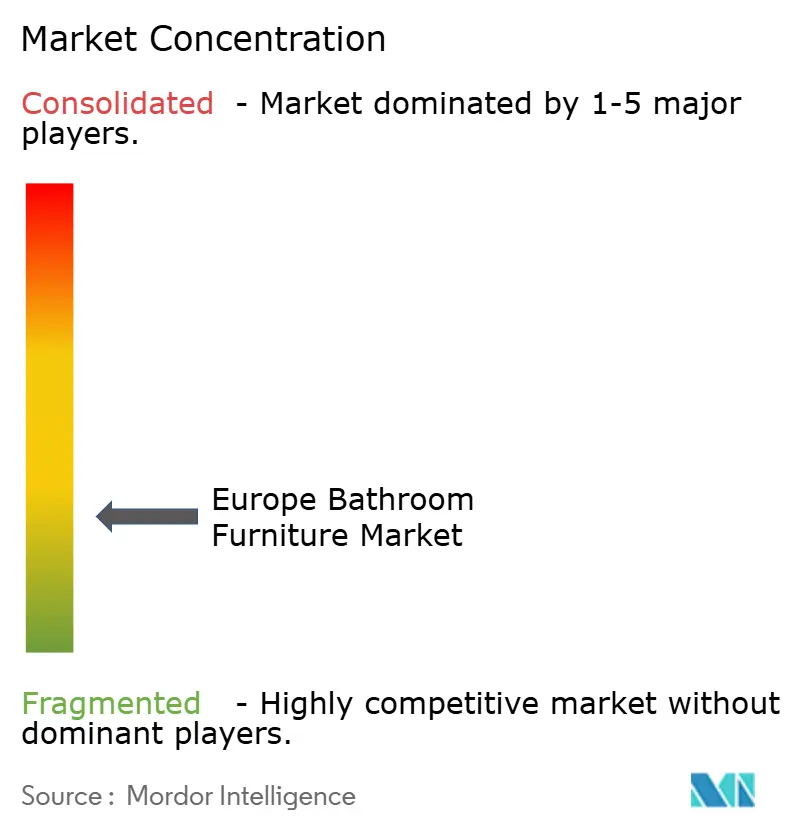
The Europe bathroom furniture market is fragmented, with no supplier holding a dominant share across the region. Specialist producers include German companies such as Burgbad, KEUCO, Pelipal, and Puris, Italian companies such as Arbi Arredobagno, Novello, Cerasa, Puntotre, Boffi, and Artiqua, and Spanish companies such as Comercial Salgar, Royo Group, Inbani Design, and Noken. They compete with integrated groups including Roca Group, Villeroy & Boch, Duravit, and Ideal Standard, whose broader catalogues can appeal to designers and project managers seeking furniture, ceramics, fittings, and accessories from fewer suppliers. The balance between specialist design capability and integrated product ranges keeps competition active across price and project types.
Villeroy & Boch reported EUR 865.6 million (~USD 1,018.2 million) in revenue for the first 9 months of 2025, up 8.3% year over year, and directed 76.6% of EUR 35.1 million (~USD 41.3 million) in capital investment to its Bathroom and Wellness Division. The investments covered production modernization and automation in Germany, Bulgaria, Thailand, and Hungary. Roca Group returned to EUR 43 million (~USD 50.6 million) in net earnings in 2025 after a EUR 61 million (~USD 71.8 million) loss in 2024 and invested EUR 126 million (~USD 148.2 million) in robotized factories, digitalization, and showrooms. Roca also acquired a majority stake in Antonio Lupi Design, extending its reach in luxury bathroom products. These moves show how larger participants use capital investment and acquisition to strengthen their position across price tiers.
Product design and digital specification are the other main areas of differentiation in the Europe bathroom furniture market. Duravit's Balcoon collection, created with Patricia Urquiola, gives the company a design-led offer with mid-range positioning. Ideal Standard and Villeroy & Boch launched the Singular Configurator in June 2025 to simplify product selection across project settings. Burgbad commissioned an automated order-picking logistics hall in Greding in November 2025, supporting 2- to 4-day delivery for its quick-delivery program. Accessible-design products remain an open opportunity because no brand has established clear European leadership in barrier-free furniture.
Europe Bathroom Furniture Industry Leaders
-
Roca Group
-
Villeroy & Boch AG
-
Duravit AG
-
burgbad GmbH
-
KEUCO GmbH & Co. KG
- *Disclaimer: Major Players sorted in no particular order
Europe Bathroom Furniture Market Companies Covered in this Report
- Roca Group
- Villeroy & Boch AG
- HSK GmbH & Co. KG
- Duravit AG
- burgbad GmbH
- KEUCO GmbH & Co. KG
- Pelipal GmbH
- Puris Bad GmbH & Co. KG
- Comercial Salgar S.L.
- Royo Group
- Arbi Arredobagno Srl
- Novello S.r.l.
- Cerasa S.p.A.
- Puntotre S.r.l.
- Inbani Design S.L.
- Boffi S.p.A.
- Noken, Porcelanosa Grupo
- Ideal Standard International S.A.
- Eczacıbaşı Building Products
- Hansgrohe SE
- Ravak a.s.
- Artiqua GmbH
Recent Industry Developments in Europe Bathroom Furniture Market
- June 2026: Burgbad launched the Uomo bathroom furniture collection, adapting the Japandi design trend for a modern bathroom architecture using real-wood veneers and premium lacquer finishes. The collection targets buyers seeking material durability alongside minimalist aesthetics, signalling Burgbad's continued elevation of the mid-premium specification tier.
- March 2026: Roca Group introduced Verso, a configurable modular bathroom furniture system designed for compact urban bathrooms through to full-scale hospitality projects. The system features soft-close full-extension drawers, hidden wall brackets, optional interior lighting and a range of HPL stone countertop finishes, reflecting Roca's strategy of converting design flexibility into a project-specification tool.
- March 2026: Burgbad expanded its sys10 quick-delivery range with the Devio series, targeting compact renovation projects with a 2-to-4-day factory dispatch time. The modular series is specifically aimed at small bathrooms and faster project timelines, which represent an underserved specification need in the dense renovation market.
Europe Bathroom Furniture Market Report Scope
Segmentation Overview
| Bathroom Vanities |
| Bathroom Cabinets |
| Bathroom Mirrors |
| Storage Furniture & Accessories |
| Wood |
| Metal |
| Plastic and Polymer |
| Others |
| Economy |
| Mid-Range |
| Premium |
| Residential | |
| Commercial | Hospitality |
| Retail and Office | |
| Healthcare and Education | |
| Others Commercial End User |
| B2C / Retail | Home Centers |
| Specialty Furniture Stores | |
| Online | |
| Other Distribution Channels | |
| B2B /Directly from Manufacturers |
| United Kingdom |
| Germany |
| France |
| Spain |
| Italy |
| BENELUX (Belgium, Netherlands, Luxembourg) |
| NORDICS (Denmark, Finland, Iceland, Norway, Sweden) |
| Rest of Europe |
| By Product Type | Bathroom Vanities | |
| Bathroom Cabinets | ||
| Bathroom Mirrors | ||
| Storage Furniture & Accessories | ||
| By Material | Wood | |
| Metal | ||
| Plastic and Polymer | ||
| Others | ||
| By Price Range | Economy | |
| Mid-Range | ||
| Premium | ||
| By End User | Residential | |
| Commercial | Hospitality | |
| Retail and Office | ||
| Healthcare and Education | ||
| Others Commercial End User | ||
| By Distribution Channel | B2C / Retail | Home Centers |
| Specialty Furniture Stores | ||
| Online | ||
| Other Distribution Channels | ||
| B2B /Directly from Manufacturers | ||
| By Country | United Kingdom | |
| Germany | ||
| France | ||
| Spain | ||
| Italy | ||
| BENELUX (Belgium, Netherlands, Luxembourg) | ||
| NORDICS (Denmark, Finland, Iceland, Norway, Sweden) | ||
| Rest of Europe | ||
Key Questions Answered in the Report
What is the projected growth rate for Europe bathroom furniture through 2031?
The category is forecast to grow at a 4.47% CAGR from 2026 to 2031, reaching USD 9.58 billion by 2031.
Which product category has the largest share in Europe?
Bathroom Cabinets lead with a 61.3% share in 2025 because storage and visual design make them central to renovation projects.
Why are renovation projects important for bathroom furniture demand?
Existing housing drives demand because nearly 50% of European Union homes were built before 1980 and require continuing upgrades.
Which material is growing fastest for bathroom furniture?
Plastic and Polymer is forecast to grow at a 5.64% CAGR through 2031, supported by moisture resistance and recyclable-content options.
Which country is expected to grow fastest in Europe?
Spain is projected to grow at a 6.25% CAGR through 2031, supported by higher bathroom-sector billing and expanding imports.