
Market Overview
| Study Period | 2020 - 2031 |
|---|---|
| Forecast Data Period | 2026 - 2031 |
| Base Year Market Size (2025) | USD 630.69 Million |
| Market Size (2026) | USD 676.79 Million |
| Market Size (2031) | USD 962.93 Million |
| Growth Rate (2026 - 2031) | 7.31 % |
| Market Concentration | Medium |
Major Players *Disclaimer: Major Players sorted in no particular order Image © Mordor Intelligence. Reuse requires attribution under CC BY 4.0. | |
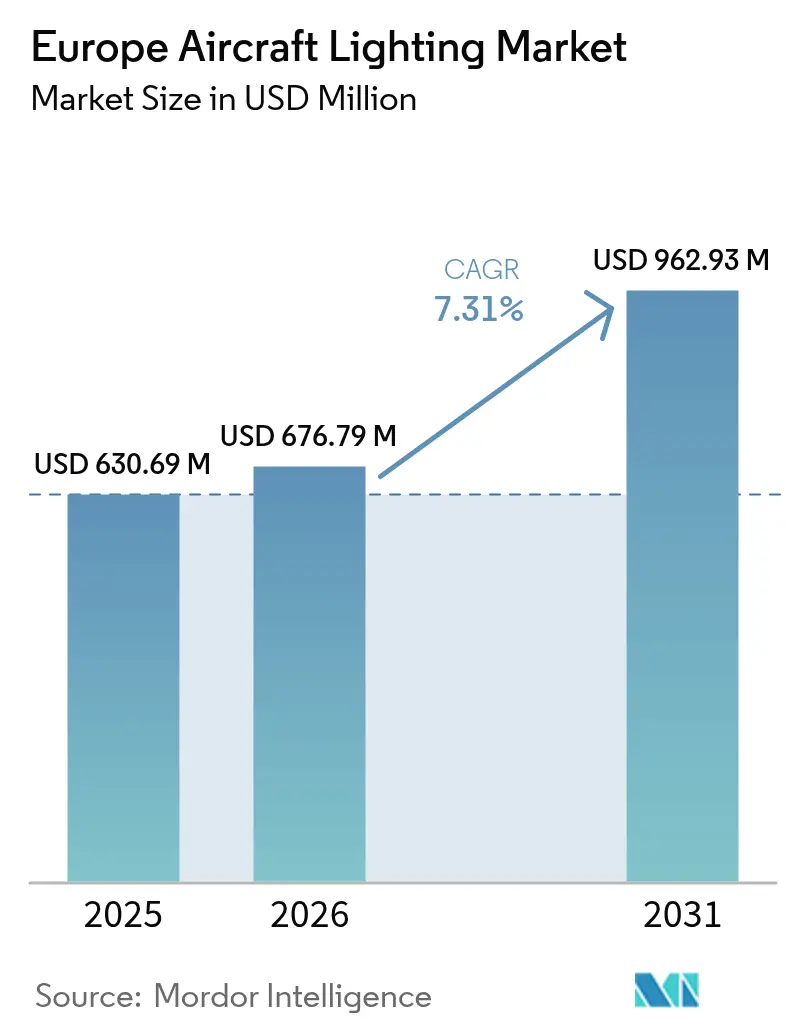
Europe Aircraft Lighting Market Analysis by Mordor Intelligence
Market Analysis
The European aircraft lighting market size was valued at USD 630.69 million in 2025 and estimated to grow from USD 676.79 million in 2026 to reach USD 962.93 million by 2031, at a CAGR of 7.31% during the forecast period (2026-2031). Fleet modernization programs, rapid LED adoption, and EASA-driven safety regulations continue to anchor growth. Airlines view cabin lighting as an essential brand asset that supports passenger well-being on long-haul routes, while OEMs and Tier-1 suppliers work on smart, sensor-rich solutions that cut maintenance events. Germany’s large aerospace manufacturing base sustains robust original-equipment demand, and Spain’s rising regional jet activity fuels retrofit opportunities. LED systems already dominate the installed base and offer up to 75% lower energy draw than legacy solutions, making them the default choice for both commercial and military operators. Moderate consolidation lets major vendors capture integration synergies, yet niche players still find room in eVTOL and specialty-exterior lighting niches.
Key Report Takeaways
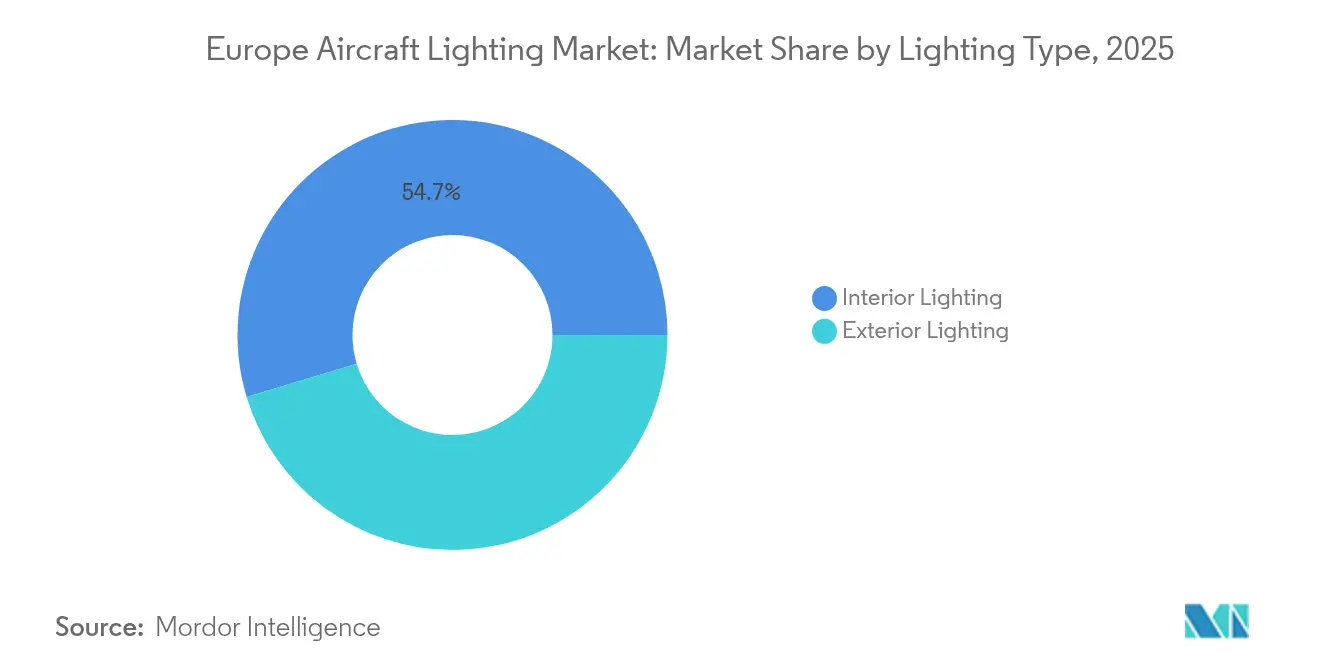
- By lighting type, interior lighting captured 54.65% of the European aircraft lighting market share in 2025; exterior lighting is projected to grow at an 8.05% CAGR through 2031.
- By aircraft type, narrowbody platforms held 53.12% of the European aircraft lighting market size in 2025, while business jets are advancing at a 6.31% CAGR to 2031.
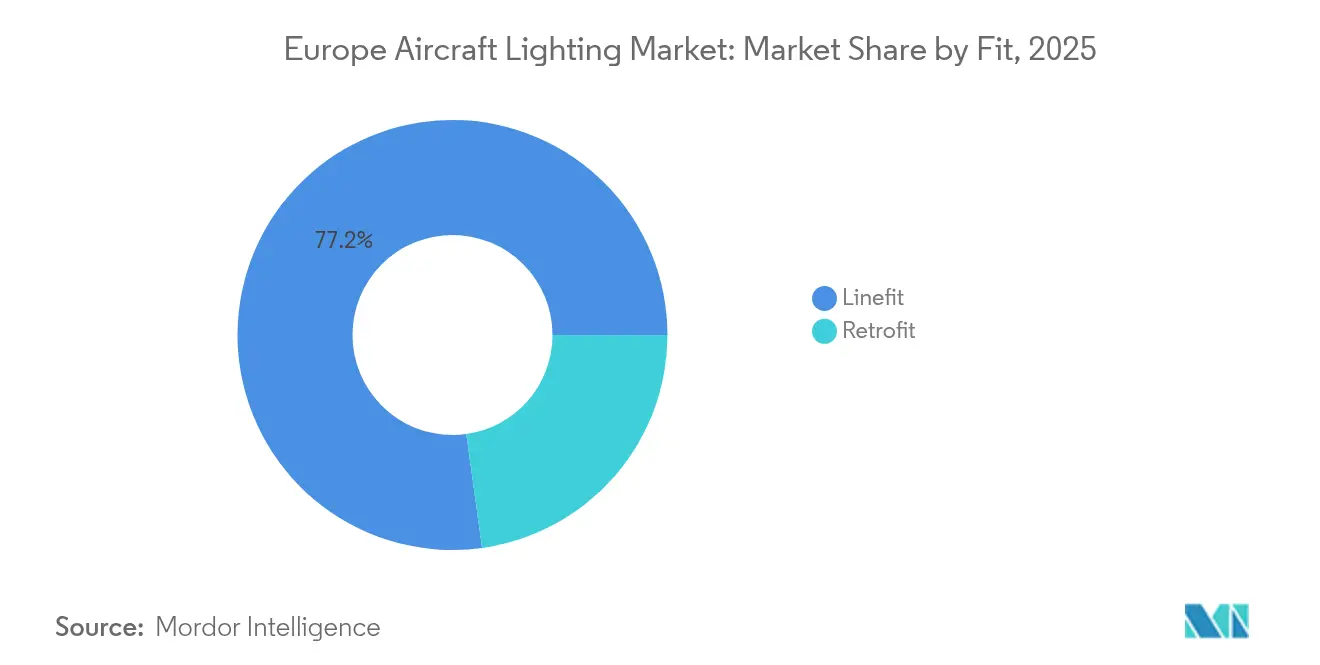
- By fit, linefit installations accounted for 77.20% of the European aircraft lighting market size in 2025; retrofit demand is expanding at a 7.1% CAGR.
- By technology, LED systems commanded 77.60% revenue in 2025 and will post a 9.85% CAGR through 2031.
- By geography, Germany led with a 30.10% revenue share in 2025, whereas Spain is forecasted to log the highest 7.62% CAGR between 2026 and 2031.
Note: Market size and forecast figures in this report are generated using Mordor Intelligence’s proprietary estimation framework, updated with the latest available data and insights as of 2026.
Europe Aircraft Lighting Market Trends and Insights
Drivers Impact Analysis*
| Driver | (~) % Impact on CAGR Forecast | Geographic Relevance | Impact Timeline |
|---|---|---|---|
| Fleet modernization and LED adoption | +1.8% | Germany, France, UK | Medium term (2-4 years) |
| Passenger demand for mood-enhancing cabin ambience | +1.2% | Western Europe | Long term (≥ 4 years) |
| Regulatory mandates on safety-critical lighting upgrades | +1.5% | EU-wide | Short term (≤ 2 years) |
| Smart, sensor-integrated lighting enabling predictive maintenance | +0.9% | Germany, France, Netherlands | Medium term (2-4 years) |
| eVTOL growth creating specialized lighting demand | +0.7% | Urban hubs in Germany, France, UK, Italy | Long term (≥ 4 years) |
| Advanced manufacturing capabilities and R&D investments | +1.1% | Germany, France, UK | Medium term (2-4 years) |
| Source: Mordor Intelligence | |||
Fleet Modernization and LED Adoption
Airlines in Germany, France, and the UK accelerate fleet renewal to cut fuel burn and improve passenger comfort. Replacing incandescent or halogen fixtures with LED kits yields up to 75% energy savings and component life beyond 50,000 hours.[1] Modular retrofit products let carriers install upgrades during regular checks, avoiding long ground time. Interior LEDs with variable color temperatures help airlines deliver a premium in-flight ambience that rivals Gulf competitors. Strong production runs of A320neo family jets ensure sustained OEM demand, while rising retrofit cycles on mature fleets enlarge aftermarket revenue pools.
Passenger Demand for Mood-Enhancing Cabin Ambience
European flyers place a higher value on wellness and brand cues during travel. Dynamic lighting scenes that mimic daylight changes support circadian alignment on long-haul routes, reducing jet lag complaints. Premium carriers configure cabin zones with distinct hues, reinforcing corporate identity and segment differentiation. STG Aerospace introduced eco-friendly packaging for its saf-Tglo emergency lights, underscoring airlines’ focus on sustainability alongside aesthetics.[2] Business jets add fully programmable LED strips that let owners personalize ambience without structural modification.
Regulatory Mandates on Safety-Critical Lighting Upgrades
EASA updated ETSO C30, C96, C85, C141, and C168 standards, tightening performance thresholds for exit, emergency, and exterior lights.[3] Operators of older aircraft must replace legacy fixtures or pursue costly exemptions, prompting predictable retrofit demand. Suppliers with pre-certified LED portfolios benefit from abbreviated approval cycles, shortening airline decision time. The directive heightens urgency for cargo operators still running halogen-based systems, accelerating LED penetration in freighter cabins and holds.
Smart, Sensor-Integrated Lighting Enabling Predictive Maintenance
Leading vendors embed IoT sensors that track temperature, shock events, and usage hours, feeding data to airline health-monitoring dashboards. Predictive algorithms flag degradation early, letting maintenance teams swap modules before in-flight failures. Airlines cut unscheduled removals and shrink spares inventory, generating measurable operational savings. German manufacturers collaborate with national research labs to refine sensor packaging that withstands high-cycle narrowbody flights. The approach aligns with Europe’s push toward data-driven maintenance under the clean aviation program.
Restraints Impact Analysis*
| Restraint | (~) % Impact on CAGR Forecast | Geographic Relevance | Impact Timeline |
|---|---|---|---|
| High certification and compliance costs | -1.4% | EU-wide | Short term (≤ 2 years) |
| Semiconductor supply chain constraints | -1.1% | Germany and France plants | Short term (≤ 2 years) |
| Thermal management limits for high-power LEDs | -0.8% | Nordic markets | Medium term (2-4 years) |
| Weight penalties of dynamic lighting for regional fleets | -0.6% | Spain, Italy, Eastern Europe | Medium term (2-4 years) |
| Source: Mordor Intelligence | |||
High Certification and Compliance Costs
EASA’s exhaustive testing regime requires vibration, electromagnetic, and temperature cycling across thousands of hours, adding millions of euros to product qualification budgets.[4] Smaller innovators struggle to finance the entire process, slowing the pace at which disruptive ideas reach airlines. Lengthy documentation adds overhead for each variant, discouraging highly customized solutions. Even established Tier-1s face stretched engineering teams as they requalify entire families for evolving cybersecurity and fire-safety clauses.
Semiconductor Supply Chain Constraints
COVID-era chip shortages linger into 2025, pushing lead times for LED drivers and micro-controllers beyond 50 weeks for some part numbers. European lighting assembly sites remain exposed to Asian wafer fabs for specialized components. ams OSRAM’s Premstätten expansion will add regional capacity, but output will ramp only after 2026. Until then, suppliers carry larger raw-material inventories and airlines defer some non-critical retrofits, tempering short-term order volumes.
*Our forecasts treat driver/restraint impacts as directional, not additive. The impact forecasts reflect baseline growth, mix effects, and variable interactions.
Segment Analysis
By Lighting Type: Interior systems drive current revenue
Interior systems held 54.65% of Europe's aircraft lighting market share in 2025, driven by persistent cabin retrofit programs and large installed bases among legacy narrowbody aircraft. Cabin, cockpit, and emergency lights form the bulk of sales as airlines seek energy savings and a differentiated ambiance. Interior LEDs integrate with in-flight entertainment controls, letting crews adjust brightness by cabin zone. Europe's aircraft lighting market size for interior applications is forecasted to climb at a 6.55% CAGR through 2031 as retrofit kits proliferate across low-cost carriers.
Exterior lights represented 45.35% revenue in 2025 but will outpace interiors at an 8.05% CAGR, lifted by stringent anti-collision visibility rules and eVTOL design needs. High-intensity LEDs now rival xenon bulbs for landing-light candela output while cutting maintenance labor. Sensor-driven brightness modulation improves energy efficiency during taxi phases. OEM programs such as the Airbus A321XLR adopt smart exterior packages as standard, ensuring steady volume for suppliers.

By Aircraft Type: Narrowbody aircraft dominate, business jets surge
Narrowbody units represented 53.12% of 2025 shipments, reflecting A320neo and B737 MAX build rates. Operators standardize LED configurations to streamline spares across fleets, accelerating line-fit volumes. Europe's aircraft lighting market share for narrowbodies benefits from low-cost carriers upgrading cabins to differentiate amid fare competition.
Business jets deliver the fastest 6.31% CAGR as charter demand and corporate travel rebound. Owners specify bespoke reading lamps, ceiling washes, and accent lights that integrate with smart-cabin apps. Sustainable aviation-fuel initiatives spur new airframe programs that embed ultra-efficient LEDs.
By Fit: Linefit still dominant but retrofit gains momentum
Linefit accounted for 77.20% of the 2025 value, driven by direct supplier-OEM contracts that bundle lighting into electrical-system shipsets. Integrated design cuts wiring weight and simplifies certification, preserving the segment’s lead.
Retrofit activity, at 22.80%, is rising at a 7.1% CAGR as carriers realize quick payback from LED conversions. Drop-in kits reduce modification man-hours, and predictive maintenance dashboards help airlines plan provisioning. The European aircraft lighting market will increasingly pivot toward the aftermarket as the installed fleet swells and sustainability targets tighten.
By Technology: LEDs cement market transformation
LED platforms held 77.60% share in 2025 and will accelerate at a 9.85% CAGR. Smart drivers allow dim-to-warm profiles and Bluetooth commissioning, streamlining MRO workflows. Diehl Aviation’s Lightshifter concept projects dynamic light carpets that guide boarding and deplaning, underscoring experiential design trends.
Incandescent, halogen, and fluorescent solutions collectively decline as spares dwindle and energy penalties grow. Some cockpit indicators still rely on incandescent bulbs pending certification of LED alternatives, but suppliers expect a complete phase-out before 2030.
Geography Analysis
Germany retained a 30.10% lead in 2025 thanks to its concentrated aerospace cluster around Hamburg, Munich, and Bremen. Proximity to Airbus final-assembly lines and Diehl’s engineering centers accelerates codevelopment cycles. Government support for Clean Aviation and national hydrogen-flight roadmaps underpins long-term lighting R&D budgets. EU Chips Act incentives channel semiconductor investment into Saxony and Bavaria, supporting future LED driver availability.
Spain posts a brisk 7.62% CAGR through 2031, fueled by Iberia and Vueling fleet renewals and substantial regional jet utilization. Vertiport pilots in Barcelona and Madrid attract specialty-lighting prototypes designed for urban air taxis. Local MRO hubs in Andalusia and Galicia expand retrofit hangar capacity, capturing overflow work from saturated facilities in Northern Europe.
France and the UK hold roughly one-quarter of the 2025 value, anchored by Toulouse and Bristol capabilities. Brexit-driven customs checks elongate some inbound electronics flows, yet long-standing Airbus programs continue to secure lighting volumes for French suppliers. Italy benefits from Leonardo’s helicopter manufacturing and Piaggio’s business jet line, while Eastern Europe climbs steadily as OEMs pursue cost-competitive labor and industrial-park incentives.
Regulatory Landscape
Aircraft lighting in Europe is governed primarily by the European Union Aviation Safety Agency (EASA) through airworthiness and equipment standards covering both interior safety lighting and exterior conspicuity functions. For transport-category aircraft, CS-25 requirements include emergency lighting provisions such as CS 25.812 (cabin aisle and exit illumination, including independent power supply expectations) and exterior lighting requirements across CS 25.1381 to CS 25.1403 (instrument, landing, position, anti-collision, and related lights), which drives performance-based qualification for luminaires, drivers, and installation data.
On the equipment-approval side, EASA CS-ETSO sets minimum performance standards for lighting appliances, and the 2025 updates under EASA ED Decision 2025/017/R revise key lighting ETSOs, including ETSO-C30d for position lights and ETSO-C96c for anti-collision light systems, to align requirements with current industry practice. Manufacturers supplying into European programs operate under EASA Part 21, including Subpart G Production Organisation Approval (POA) for certified production of aircraft parts, and they increasingly reference European aerospace standards that standardize LED attributes (for example, EN 4706:2019 for manufacturer-independent LED color/brightness classification), which supports repeatable qualification and fleet-wide configuration control.
Value Chain Analysis
The European aircraft lighting value chain starts with upstream electronics, LED emitters, drivers, optics, and thermal-management materials, followed by design, qualification, and certified production. Lighting OEMs and system integrators translate aircraft and CS-ETSO performance requirements into circuit-board, optical, and EMI-compliant designs, then validate through reliability and environmental tests aligned to aviation electronic hardware expectations before release to production under EASA Part 21 POA frameworks. Semiconductor lead times for drivers and controllers remain an operational constraint for some programs, which keeps attention on sourcing resilience and standardization of electronics across part families.
Downstream, Tier-1 integrators and specialist lighting manufacturers supply linefit packages to airframers and cabin integrators, while retrofit channels serve airlines and MROs through certified modification pathways and drop-in kits. In Europe, specialist players such as STG Aerospace (photoluminescent and LED cabin and emergency lighting), Sela (cockpit and cabin lighting), and AES (LED light systems) operate alongside larger integrators such as Collins Aerospace, with Design Organization capabilities (for example, DOTAS Aviation as a Part 21J design organization) supporting plug-and-play retrofit solutions. Distribution and aftermarket fulfillment for lighting spares increasingly run through structured agreements with aerospace distributors and OEM-authorized channels, tying demand to scheduled maintenance events and cabin refresh cycles.
Competitive Landscape
Competitive Landscape
The market shows moderate concentration. Collins Aerospace, Honeywell, and Safran integrate optics, electronics, and predictive maintenance software to deepen their share of wallet with OEMs. Safran's purchase of Microtecnica's actuation assets widens its systems portfolio and cross-selling opportunities. Diehl Aviation's Space³ cabin concept illustrates the supplier's drive toward holistic passenger-experience modules. Collins Aerospace launched modular LED reading lights that airlines can retrofit without cabin structural work, underscoring the retrofit wave.
Midsize specialists maintain relevance by addressing eVTOL, infrared, or specialty-cargo niches. Oxley and Aveo Engineering deliver rugged exterior strobes approved for helicopter rescue missions, while UK-based Beadlight focuses on high-end business jet reading lamps. Semiconductor reliability remains a key differentiator as airlines demand proven MTBF statistics. Boeing's USD 4.7 billion bid for Spirit AeroSystems signals broader consolidation of aerospace supply chains, potentially reshaping tier allocation and joint sourcing strategies for lighting packages.
Europe Aircraft Lighting Industry Leaders
-
Honeywell International Inc.
-
Astronics Corporation
-
Collins Aerospace (RTX Corporation)
-
Safran SA
-
Diehl Stiftung & Co. KG
- *Disclaimer: Major Players sorted in no particular order

Market Opportunities and Future Outlook
One of the clearer opportunities is modular, software-defined cabin lighting architectures that reduce the certification and downtime burden of frequent cabin reconfigurations, particularly as LED already leads the installed base (77.60% revenue share in 2025). Airlines and integrators are prioritizing lighting that can be re-zoned or reprogrammed through controlled configuration changes, rather than requiring full hardware swaps. This direction aligns with predictive-maintenance initiatives, where sensor-enabled luminaires feed health-monitoring dashboards that aim to reduce unscheduled removals.
Health- and chronobiology-oriented lighting is also actively developed in Europe, supported by supplier collaboration rather than purely conceptual roadmaps. Schott and Jetlite, for instance, have been working on next-generation, health-focused cabin lighting technologies, and Schott highlighted reading-light and cabin-lighting concepts at Aircraft Interiors Expo (AIX) 2026, reinforcing near-term productization and airline-spec interest. On the exterior side, EASA’s 2025 CS-ETSO updates (including ETSO-C30d and ETSO-C96c revisions) create room for suppliers with pre-qualified, high-uniformity LED position and anti-collision solutions to simplify compliance-driven replacement cycles and support modern platforms and retrofits across narrowbody, rotorcraft, and emerging UAS/eVTOL-related lighting needs.
Recent Industry Developments
- July 2026: Thales introduced a flush-mounted helicopter search and landing light featuring 360-degree illumination and a software-defined, connected architecture for civil, security, and military missions. The flush integration and connectivity focus addresses operator demand for reduced drag and tighter integration with mission and situational-awareness systems, supporting upgrades on both new-build and retrofit rotorcraft.
- April 2025: Satair and Collins Aerospace (RTX Corporation) extended their cabin interior parts distribution agreement for four years, covering a range of internal and external lighting products such as landing, taxi, navigation, and emergency lights. The extension reinforces aftermarket continuity for European operators by maintaining a scalable distribution pathway for certified lighting spares across multiple aircraft platforms.
- June 2024: STG Aerospace expanded its sustainability-linked offering around saf-Tglo emergency lighting by introducing eco-friendly packaging for these products. The change supports airline and MRO initiatives to reduce waste across high-volume consumables while keeping emergency-lighting replacement programs aligned with certified product configurations.
Research Methodology Framework and Report Scope
Market Definition and Coverage
For this study, the market covers the value of aircraft lighting sold and installed in Europe for use on aircraft, including interior and exterior lights that support safety, operations, and cabin experience across new build and retrofit demand.
Scope exclusions: We exclude airport and runway lighting, passenger terminal lighting, and non-aircraft lighting equipment used only in ground support vehicles.
Segmentation Overview
- By Lighting Type
- Interior Lighting
- Cabin Lighting
- Cockpit Lighting
- Emergency and Exit Lighting
- Cargo/Baggage Lighting
- Exterior Lighting
- Navigation and Position Lights
- Landing and Taxi Lights
- Anti-Collision and Strobe Lights
- Logo and Wing Inspection Lights
- Interior Lighting
- By Aircraft Type
- Narrowbody Aircraft
- Widebody Aircraft
- Regional Jets
- Business Jets
- Helicopters
- Unmanned Aerial Vehicles (UAVs)
- By Fit
- Linefit
- Retrofit
- By Technology
- Light-Emitting Diode (LED)
- Fluorescent
- Incandescent/Halogen
- By Geography
- United Kingdom
- France
- Germany
- Spain
- Italy
- Russia
- Rest of Europe
Data Sources, Market Sizing, and Validation
Desk Research
Desk research starts by mapping Europe aviation activity and safety requirements to a realistic demand pool for aircraft lighting. Public sources such as EASA publications, Eurostat trade statistics, ICAO air transport indicators, OECD industry statistics, and European Commission transport data help us anchor fleet trends and cross-check import patterns where applicable.
We then align that backdrop with supply and pricing signals using sources such as company annual reports, investor presentations, press releases, and association websites, followed by technical references from patent databases and selected peer reviewed aerospace journals. For company level context, we also use paid subscriptions for company financials and intelligence, plus news and financials, to track program exposure and event-driven changes. These sources are illustrative, and we rely on additional references for data collection, cross-checks, and clarification.
Primary Interviews and Surveys
Primary work is used to confirm what is being bought, installed, and replaced in Europe, and how price ranges move across interior versus exterior lighting, as well as linefit versus retrofit demand. We speak with a mix of aircraft OEM and tier suppliers, maintenance and overhaul participants, and airline and business aviation stakeholders across key European countries. The respondent input clarifies split assumptions used in the model, fills data gaps, and helps pressure test the final totals.
Distribution of primary research fieldwork respondents
| Company type | Respondent position |
|---|---|
| Top tier: 27% | CXOs: 15% |
| Mid tier: 54% | Functional/Unit leaders: 27% |
| Smaller Players: 19% | Managers: 58% |
Market-Sizing & Forecasting
Sizing is built using top-down logic where Europe fleet activity, aircraft deliveries, and retrofit cycles are converted into an addressable lighting demand pool, and then translated into value using typical pricing bands by lighting type and fit. To keep the output realistic, we corroborate the demand pool with selective bottom-up checks, such as sampled ASP timing against unit volumes for common lighting assemblies and channel feedback on replacement rates, and then adjust the totals when inconsistencies show up.
Key inputs used in the model include aircraft deliveries and in-service fleet by major aircraft classes, cabin retrofit cadence tied to heavy maintenance events, LED conversion rates versus legacy technologies, average content value per aircraft for interior and exterior lighting, and country-level activity signals where procurement and maintenance intensity differs. Where bottom-up inputs are incomplete, such as when smaller retrofit suppliers do not disclose detailed splits, the gaps are handled using conservative ranges validated through interviews and then reconciled back to the demand pool.
For forecasting, we use scenario analysis so near-term and mid-term outcomes reflect different delivery pacing and retrofit intensity in Europe, followed by smoothing of year-to-year swings when programs move between peaks and troughs. Assumptions are reviewed with primary respondents so the trajectory reflects practical constraints, including certification lead times and airline upgrade budgeting.
Data Validation & Update Cycle
Validation is done through several checks that compare the model totals against independent signals, such as reported fleet additions, MRO workload indicators, and changes in lighting technology mix. Outliers are investigated, and if a country or aircraft type looks overstated, the underlying inputs are rechecked and interview follow-ups are triggered to confirm what changed.
Before sign-off, the work is reviewed in steps by another analyst to spot arithmetic issues, scope leakage, and inconsistent pricing logic. Reports are refreshed annually, and interim updates are made when material events occur, such as large order shifts or major retrofit waves. Right before delivery, a final pass is completed so clients receive the most current view available.
Mordor Intelligence's Europe Aircraft Lighting Market Sizing Compared With Other Published Estimates
Published market values for Europe aircraft lighting do not always match because the counted products and the timing assumptions differ. The largest differences usually come from whether retrofit demand is fully included, how interior and exterior lighting are bundled, and which European countries are treated as in-scope.
Some estimates also mix global aircraft lighting averages into a Europe number, or they apply aggressive LED upgrade timing without checking maintenance-driven replacement cycles. Here, the sizing stays tied to Europe specific fleet activity and realistic replacement patterns, with linefit and retrofit treated separately and then reconciled, which is a scope choice applied by Mordor Intelligence.
Benchmark comparison
| Source | Market Size | Gaps in Research Methodology |
|---|---|---|
| Mordor Intelligence | USD 630.69 M (2025) | |
| Regional Consultancy A | USD 1.50 B (2025) | Often broadens the scope by folding adjacent electrical systems and cabin equipment into lighting, and may assume faster, uniform LED refresh across airlines without linking it to heavy maintenance timing. |
| Trade Journal B | USD 0.90 B (2024) | Typically extrapolates from global aircraft lighting totals using a regional share, which can miss Europe specific retrofit cycles, country coverage choices, and currency timing effects. |
The table shows that the spread is mainly driven by what gets counted as lighting and how retrofit is treated over time. When the scope is kept tight to aircraft lighting and the demand pool is anchored to fleet activity and maintenance-linked replacements, the final number becomes easier to trace and repeat across updates.
Key Questions Answered in the Report
How large will the Europe aircraft lighting market be in 2031?
The Europe aircraft lighting market is projected to reach USD 962.93 million by 2031, advancing at a 7.31% CAGR during 2026-2031.
Which technology dominates aircraft lighting across Europe?
LED platforms hold 77.60% revenue share and continue to expand thanks to energy efficiency and predictive-maintenance capabilities.
Why is Spain the fastest-growing market within Europe?
Expanding regional jet networks, rising retrofit activity, and early eVTOL test programs drive Spain’s 7.62% CAGR outlook.
How does EASA regulation influence lighting upgrades?
Updated ETSO standards mandate higher performance for emergency and exterior lights, prompting predictable retrofit cycles across older fleets.
What role does predictive maintenance play in aircraft lighting?
Sensor-integrated LED fixtures stream operating data that lets airlines replace units before failure, cutting unscheduled maintenance and inventory costs.