
Europe 5G Core Network Market Size and Share
Market Overview
| Study Period | 2020 - 2031 |
|---|---|
| Forecast Data Period | 2026 - 2031 |
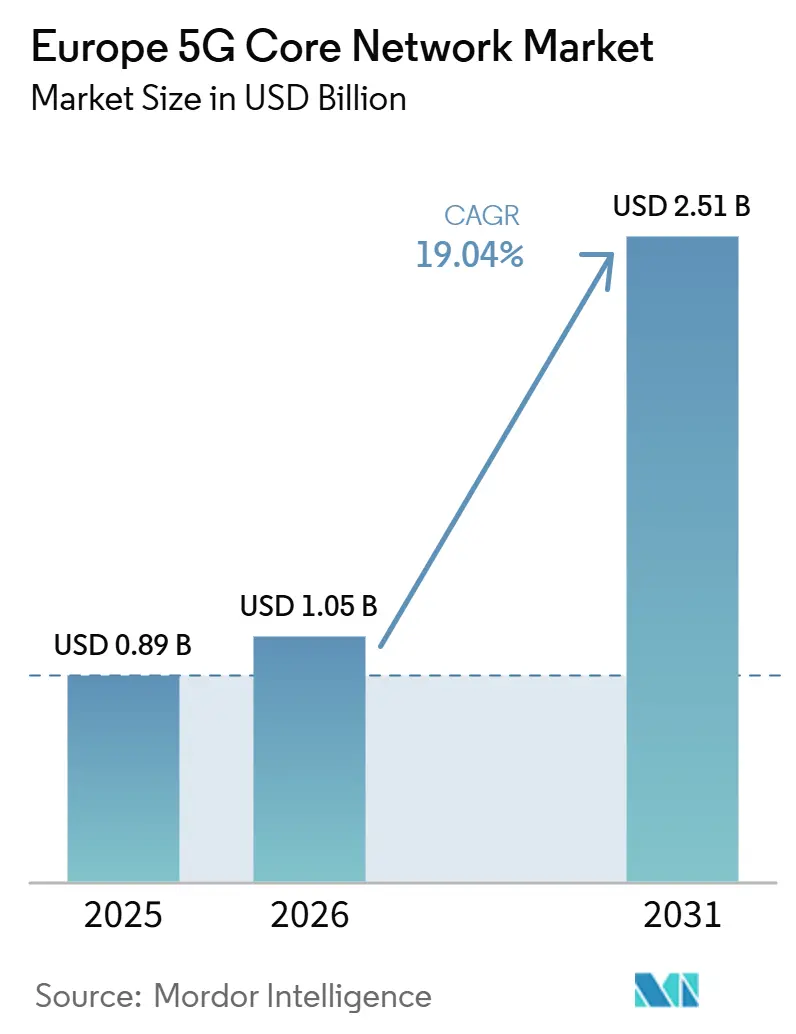
| Base Year Market Size (2025) | USD 0.89 Billion |
| Market Size (2026) | USD 1.05 Billion |
| Market Size (2031) | USD 2.51 Billion |
| Growth Rate (2026 - 2031) | 19.04 % |
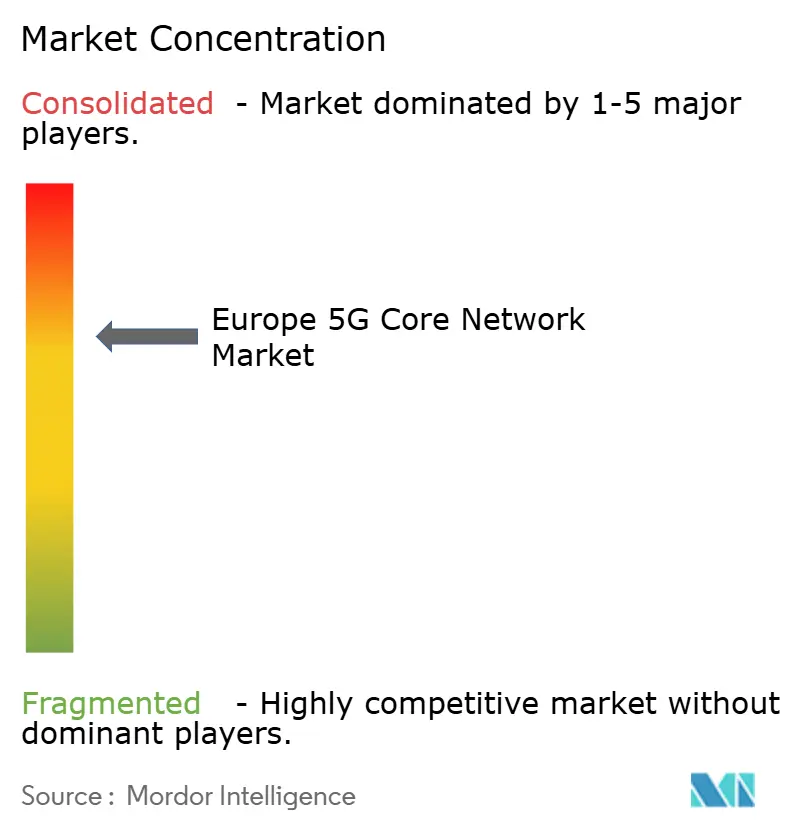
| Market Concentration | Medium |
Major Players *Disclaimer: Major Players sorted in no particular order Image © Mordor Intelligence. Reuse requires attribution under CC BY 4.0. | |
Europe 5G Core Network Market Analysis by Mordor Intelligence
The Europe 5G Core Network Market size is projected to expand from USD 0.89 billion in 2025 and USD 1.05 billion in 2026 to USD 2.51 billion by 2031, registering a CAGR of 19.04% between 2026 to 2031. The shift from non-standalone networks toward cloud-native standalone cores is changing the investment focus from coverage expansion to programmable services. Operators are modernizing charging, policy, orchestration, and traffic-management layers together, which broadens the scope of each core upgrade. Enterprise network slicing, private 5G, exposure APIs, and edge services are creating commercial uses for these capabilities. Security rules, data sovereignty needs, and vendor-risk reviews are also shaping procurement choices across Europe. Investment constraints remain material because operators must fund core modernization alongside spectrum, hardware, and legacy-network obligations.
Key Report Takeaways
- By component, solutions held a 62.59% share in the Europe 5G core network market in 2025, while services are projected to expand at a 20.98% CAGR through 2031.
- By deployment model, on-premise and dedicated infrastructure accounted for 55.00% share in 2025, while public cloud is projected to expand at a 23.87% CAGR through 2031 in the Europe 5G core network market.
- By end user, telecom operators held 74.65% share in 2025, while enterprises are projected to expand at a 22.67% CAGR through 2031 in the Europe 5G core network market.
- By network function, the User Plane Function held 21.76% share in 2025, while the Network Exposure Function is projected to expand at a 27.45% CAGR through 2031.
- By geography, Germany held a 22.50% share in the Europe 5G core network market in 2025, while Spain is projected to expand at a 20.39% CAGR through 2031.
Note: Market size and forecast figures in this report are generated using Mordor Intelligence’s proprietary estimation framework, updated with the latest available data and insights as of January 2026.
Market Trends and Insights
Drivers Impact Analysis of Europe 5G Core Network Market*
| DRIVER | (~) % IMPACT ON CAGR FORECAST | GEOGRAPHIC RELEVANCE | IMPACT TIMELINE |
|---|---|---|---|
| Cloud-Native Standalone Core Migration in Mature Networks | +5.2% | Germany, the United Kingdom, France, and the Nordic region | Medium term (2–4 years) |
| Network Slicing Monetization for Enterprise and Private 5G Use Cases | +4.0% | Germany, the United Kingdom, and Spain | Medium term (2–4 years) |
| Regulatory Push for Resilient, Secure, and Sovereign Telecom Infrastructure | +3.1% | European Union-wide, with early gains in Germany and France | Short term (≤2 years) |
| 5G Core Modernization Through Vendor Diversification and Open Architectures | +2.8% | United Kingdom, Germany, and France | Medium term (2–4 years) |
| Edge-Enabled Low-Latency Services Across Industrial Hubs | +2.3% | Germany, the United Kingdom, France, and Spain | Long term (≥4 years) |
| Energy-Efficient Core Upgrades to Reduce Operating Costs | +1.5% | Germany, the Nordic region, and the Rest of Europe | Medium term (2–4 years) |
| Source: Mordor Intelligence | |||
Cloud-Native Standalone Core Migration in Mature European Networks
Cloud-native standalone core migration is the most influential structural driver in the Europe 5G core network market, as operators replace non-standalone overlays built for rapid coverage deployment. A standalone architecture gives operators greater control over service creation, policy management, and network automation. Deutsche Telekom moved standalone traffic through Mavenir's containerized packet core under its Horizontal TelCo Cloud program.[1] Telia completed Nokia's cloud-native 5G standalone core deployment across Finland, Sweden, Norway, Estonia, and Lithuania in 2025. This regional approach supports common operating tools across several national networks. The Europe 5G core network market also benefits because core migration requires concurrent work on charging, policy, and orchestration functions.
Network Slicing Monetization for Enterprise and Private 5G Use Cases
Network slicing is moving from technical testing toward commercial offerings for industrial and enterprise customers. Vodafone Germany introduced the Campus Flex Exclusive and Campus Flex Starter tariffs in 2025, including an exclusive tier priced at EUR 2,000 (USD 2,310.14) per location per month for mission-critical applications. The offering supports use cases such as automated production and autonomous vehicle control. Vodafone also extended service models with service-level commitments to the United Kingdom. Deutsche Telekom implemented commercial network slices, including consumer-scale integration with Apple FaceTime through iOS 26. These actions show how the European 5G core network market can support revenue models distinct from basic mobile connectivity.
Regulatory Push for Resilient, Secure, and Sovereign Telecom Infrastructure
European rules are affecting 5G core procurement as direct requirements rather than as background guidance. The Council of the European Union called for the implementation of the 5G Cybersecurity Toolbox and stronger supply-chain risk measures under the NIS 2 and CER Directives.[2] These measures increase scrutiny of suppliers that support critical core functions. National reviews can also accelerate replacement programs when a vendor is considered a high risk. MasOrange selected Ericsson in February 2026 to consolidate separate legacy 5G standalone cores and IMS platforms. The project reflected a need to simplify a multi-vendor architecture while responding to changing security expectations.
5G Core Modernization Through Vendor Diversification and Open Architectures
Vendor diversification has become an industrial policy and resilience issue for European telecom operators. VodafoneThree awarded Ericsson an SEK 12.5 billion (USD 1.3 billion), eight-year contract in September 2025 for its 5G standalone core and more than 10,000 radio sites.[3] Nokia secured a separate eight-year agreement covering 7,000 sites and voice core maintenance. Deutsche Telekom, Orange, Telefónica, and Vodafone have also committed to Open RAN collaboration. Samsung and Orange expanded European vRAN and Open RAN activity in 2026 after earlier pilots.
Restraints Impact Analysis of Europe 5G Core Network Market*
| RESTRAINT | (~) % IMPACT ON CAGR FORECAST | GEOGRAPHIC RELEVANCE | IMPACT TIMELINE |
|---|---|---|---|
| High Up-Front Capital Expenditure and Uncertain Payback for Standalone Core Upgrades | -3.2% | European Union-wide, concentrated in smaller markets and Southern Europe | Short term (≤2 years) |
| Integration Complexity with Legacy EPC and Multi-Vendor Environments | -2.3% | Germany, the United Kingdom, and France | Medium term (2–4 years) |
| Shortage of Cloud-Native Core and Telecom DevOps Skills | -1.4% | Southern and Eastern Europe | Medium term (2–4 years) |
| Security and Compliance Burden from Core Automation and Exposure APIs | -0.9% | European Union-wide | Long term (≥4 years) |
| Source: Mordor Intelligence | |||
High Up-Front Capital Expenditure and Uncertain Payback for Standalone Core Upgrades
Capital intensity remains the immediate constraint on standalone core deployment across Europe. GSMA Europe reported in May 2026 that European mobile operators require EUR 475 billion (USD 548.66 billion) in mobile network investment by 2035, while EUR 270 billion (USD 311.87 billion) is currently expected to materialize.[4] The EUR 205 billion (USD 236.79 billion) gap limits the ability to fund core software migration, hardware refreshes, and spectrum renewal simultaneously. European operators had spent more than EUR 30 billion (USD 34.65 billion) on spectrum since 2020. Capital expenditure per connection stood at EUR 35 (USD 40.43) in Europe in 2024, compared with EUR 70 (USD 80.85) in global connectivity leaders.
Integration Complexity With Legacy EPC and Multi-Vendor Environments
The transition from 4G EPC to 5G standalone core is more disruptive than non-standalone interoperability allowed many operators to anticipate. Legacy EPC and standalone control-plane functions must coexist during extended migration periods. Three United Kingdom selected Ericsson's Cloud Native Infrastructure Solution in January 2025 rather than following Nokia's transition to Red Hat. This decision illustrates how legacy infrastructure can require a long-term architectural commitment. MasOrange consolidated two 5G standalone cores and four IMS platforms into a unified Ericsson architecture after the formation of Orange Spain and MásMóvil. The Europe 5G core network market must therefore address inherited technical complexity as well as new service requirements.
*Our forecasts treat driver/restraint impacts as directional, not additive. The impact forecasts reflect baseline growth, mix effects, and variable interactions.
Europe 5G Core Network Market Segment Analysis
By Component:
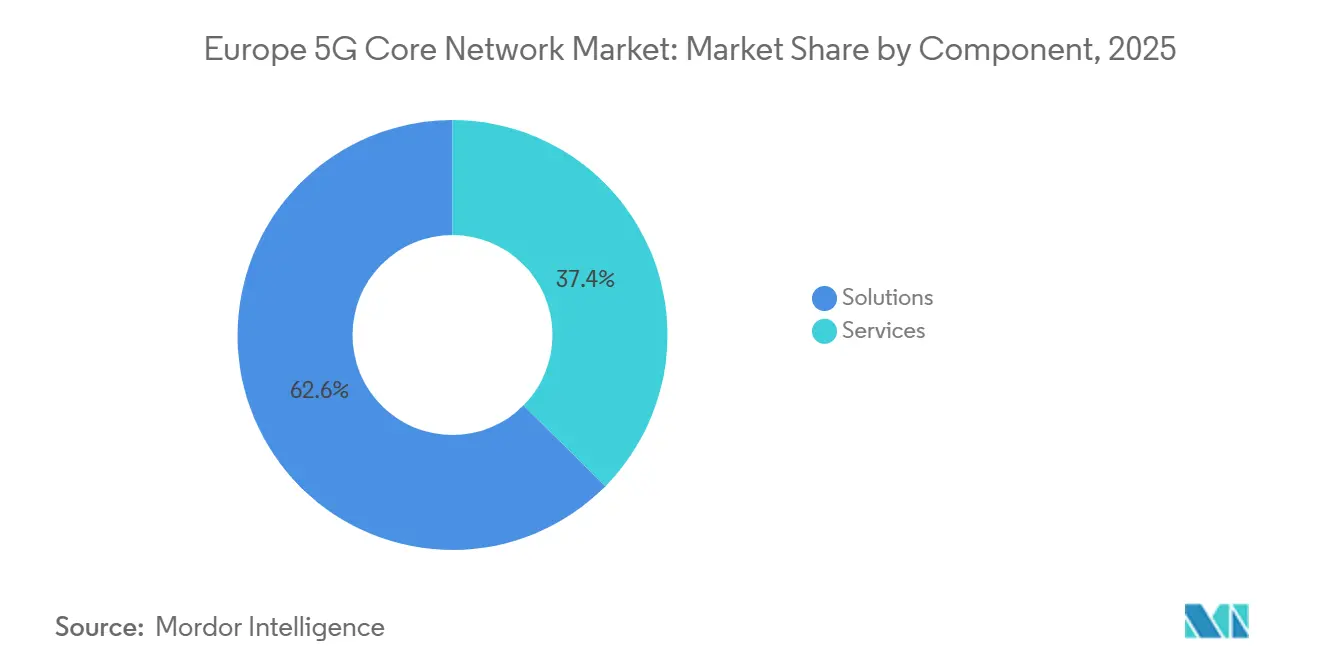
Solutions Lead Revenue While Services Capture Recurring ValueSolutions are expected to account for 62.59% of the Europe 5G core network market share in 2025. Packet-core software, network functions virtualization infrastructure, and orchestration and management tools form the primary spending layer for standalone network programs. Packet-core software includes functions such as AMF, SMF, UPF, PCF, and related 5G core functions. Operators purchase these functions as virtualized or containerized software bundles under multiyear license agreements. Nokia, Ericsson, and Mavenir are among the suppliers providing these capabilities. Network functions virtualization infrastructure includes commercial off-the-shelf servers and cloud platforms that host virtualized functions. Some large operators use hyperscaler arrangements, while others continue to operate proprietary cloud stacks.
The services segment in the Europe 5G core network services market size is projected to expand at a CAGR of 20.98% through 2031. Integration and deployment services see the highest demand during the initial migration stage. Support and maintenance agreements can extend for 5-8 years in large programs, such as the VodafoneThree modernization. Operators without dedicated cloud engineering teams also require support for containerization, continuous integration, continuous delivery, and Open RAN integration. Standards changes can increase demand for advisory work on exposure APIs and policy control. Release 18 expanded the Network Exposure Function API and policy capabilities within the 5G system. These requirements create recurring work for system integrators and cloud-native specialists.
By Deployment Model:
On-Premise Remains Important While Public Cloud Changes Delivery EconomicsOn-premises and dedicated deployments are expected to account for 55.00% of the market in 2025. Under this model, operators retain physical control over latency-sensitive control-plane functions. Existing dedicated infrastructure remains expensive to replace because it may also support lawful interception and data sovereignty requirements. Security and sovereignty rules in Germany, France, and the United Kingdom reinforce the use of operator-controlled or nationally governed data environments. Operators also use hybrid and telco-edge-cloud models in industrial private-network environments. BMW is expected to begin production of the iX3 at its Debrecen facility in Hungary in October 2025, using a hybrid public-private 5G network operated by Magyar Telekom. The deployment is expected to connect robots, autonomous vehicles, and digital twins across more than 400 hectares.
The public cloud is projected to expand at a CAGR of 23.87% from 2026 to 2031 in the Europe 5G core network market. O2 Telefónica is expected to deploy production-scale 5G core functions on AWS Outposts in its own data center in March 2026 using Nokia technology. The deployment is expected to serve 1 million customers and use Amazon Bedrock models in maintenance workflows. Public-cloud infrastructure can reduce the time required to introduce new functions and limit commitments to dedicated hardware cycles. Hybrid configurations can keep sensitive functions under operator control while placing selected workloads at the edge. ETSI standards provide a common basis for interoperability between edge-hosted user-plane functions and edge application platforms.
By End User:
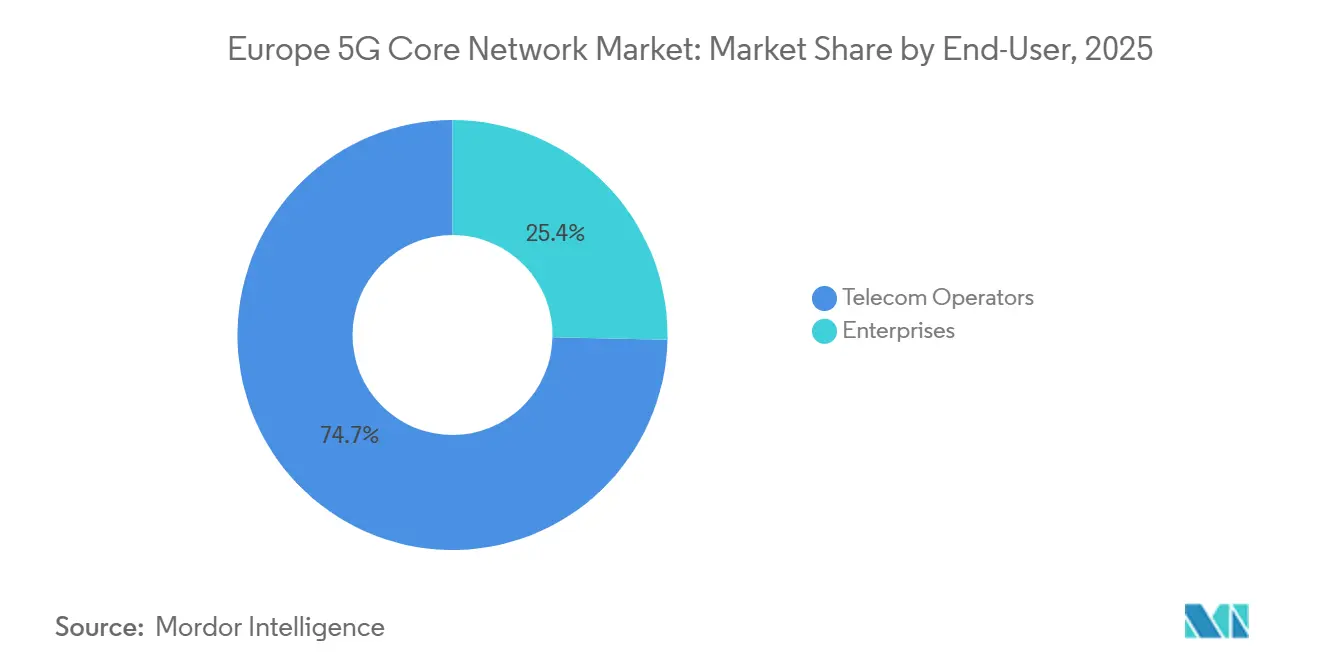
Telecom Operators Lead While Enterprises Shift Structural DemandTelecom operators are expected to hold 74.65% of the Europe 5G core network market in 2025. Their share reflects the scale of standalone core investment by national and regional carriers. These operators are rebuilding the service layer that supports network slicing, exposure APIs, and quality-on-demand offerings. Large deployments often combine core software, radio access infrastructure, automation, and support services, creating contract values that can reach hundreds of millions of euros. Enterprises are moving from pilot projects toward multisite private-network deployments. This transition is creating a distinct demand base for core functions outside public mobile networks.
The Europe 5G core network market size for enterprises is projected to expand at a CAGR of 22.67% through 2031. Manufacturing is a prominent early application because private standalone networks can support sensors, autonomous vehicles, and asset monitoring. Ericsson and Vodafone Portugal deployed a private 5G standalone network across three Cimpor cement sites in Portugal. Nokia and Verizon Business are expected to secure a multisite private 5G contract at Thames Freeport in June 2025, covering 1,700 acres of port and manufacturing infrastructure. Energy, utilities, public safety, and municipal services also represent smaller but important demand areas. Different national approaches to private 5G spectrum licensing may still delay enterprise planning in Southern and Eastern Europe.
By Network Function:
UPF Anchors Traffic While NEF Opens API Revenue PathsThe User Plane Function is expected to hold a 21.76% share of the Europe 5G core network market in 2025. It handles data-plane traffic between the radio network and external data networks. Its role becomes more significant at the edge because distributed UPF instances can reduce round-trip latency for industrial and consumer applications. The EXIGENCE project is expected to present work in June 2026 using AI-driven reinforcement learning to consolidate UPF workloads. The project is expected to report a 2%-5% reduction in per-user power consumption compared with baseline policies. AMF and SMF functions manage subscriber mobility and session lifecycles, so demand for these functions scales with standalone network deployment.
The Network Exposure Function is projected to expand at a CAGR of 27.45% from 2026 to 2031. It provides a standardized interface between network capabilities and third-party applications. The GSMA Open Gateway and CAMARA frameworks use network exposure capabilities to support services such as quality-on-demand, network-event exposure, and SIM location. 3GPP describes the capability exposure framework as a means of exposing service APIs to application functions. Nokia and Ericsson provide platforms that implement Release 18 Network Exposure Function APIs. Demand for the Policy Control Function and Network Slice Selection Function is also linked to commercial slicing because these functions support quality enforcement and slice assignment. UDM, AUSF, and NRF are expected to remain steady functions because they are closely tied to the size of active subscriber bases.
Geography Analysis
Germany and United Kingdom 5G Core Network Market
Germany is expected to hold 22.50% of the Europe 5G core network market share in 2025 and remain the leading country in 2026. Deutsche Telekom's Horizontal TelCo Cloud routes standalone traffic through Mavenir's containerized core. In February 2026, Mavenir stated that live testing under the joint initiative achieved energy savings of up to 65%. Vodafone Germany launched commercial 5G slicing tariffs in 2025, including an enterprise tier starting at EUR 2,000 (USD 2,310) per month per location. The United Kingdom is also expected to gain momentum through VodafoneThree's SEK 12.5 billion (USD 1.3 billion) Ericsson contract for a nationwide 5G standalone core program. Vendor-risk requirements in both countries are shaping supplier selection and replacement programs.
Spain and France 5G Core Network Market
Spain is projected to expand at a CAGR of 20.39% from 2026 to 2031, the highest rate among the countries assessed. In February 2026, MasOrange signed a six-year agreement with Ericsson valued at EUR 100 million (USD 118 million) to consolidate its dual legacy standalone cores and four IMS voice platforms. The project reflects Spain's operator consolidation and the need for a unified standalone architecture. France is developing a complementary industrial-edge pipeline following Orange's launch of 5G standalone services in 2025. Orange and Nokia deployed France's first industrial 5G private network at Schneider Electric's Le Vaudreuil facility. The country is developing enterprise use cases alongside public network modernization.
Russia and Broader Europe 5G Core Network Market
Russia follows a distinct path, as Nokia and Ericsson withdrew from new sales and deployment activity in the country after 2022. As a result, the country is represented primarily by legacy non-standalone investment and domestic supplier development. Its access to standalone-capable core equipment certified for 3GPP functions remains constrained. The Rest of Europe includes Austria, Switzerland, the Nordic region, the Baltic states, and Central and Eastern Europe. Telia's regional Nokia deployment made the Nordic and Baltic region a cluster of advanced standalone deployments in 2025. Nokia, Datwyler IT Infra, Intel, and Switzerland Innovation Park Biel/Bienne opened a private 5G and AI-powered edge innovation hub in Switzerland in 2025. These projects are helping smaller national markets develop enterprise demand before broad public standalone rollouts.
Competitive Landscape
The Europe 5G core network market has a moderate-to-high concentration in full-stack infrastructure contracts. Nokia and Ericsson hold strong positions with major Tier-1 operators, while cloud-native suppliers and cloud providers are gaining roles in software-defined functions. Ericsson won the VodafoneThree core program, a primary vendor role with VMO2, and the MasOrange standalone consolidation agreement. Its Cloud Native Infrastructure Solution supports operators seeking integrated cloud infrastructure and core software. Nokia remains active in radio and voice-core contracts while changing its cloud infrastructure approach. Its withdrawal of CBIS and NCS products requires some customers to review their future infrastructure choices.
Mavenir's role in Deutsche Telekom's standalone traffic architecture marks a material competitive shift in the Europe 5G core network market. It shows that Tier-1 operators can choose a disaggregated, cloud-native software platform instead of a traditional full-stack supplier. AWS, Microsoft Azure for Operators, and Google Cloud are expanding in the network functions virtualization infrastructure layer. O2 Telefónica's AWS Outposts deployment shows how cloud infrastructure can remain in an operator-owned data center. Amdocs, Red Hat, Oracle, and Dell Technologies compete for roles in orchestration, business support systems, operations support systems, and infrastructure. Red Hat holds an important position as Nokia's designated cloud infrastructure partner for affected customers.
Security-by-design is becoming a competitive factor as the Cyber Resilience Act and NIS 2 requirements affect core software procurement. The Council of the European Union has linked cybersecurity policy to supply-chain risk management for 5G networks. Suppliers that meet early assurance expectations may gain an advantage in regulated enterprise and public-safety projects. Distributed UPF orchestration, Network Exposure Function API management, and AI-enabled analytics remain areas where supplier positions are less settled. This creates opportunities for specialized companies to participate alongside established equipment vendors. Operators are also pursuing vendor diversity through Open RAN and proprietary telco-cloud platforms. Therefore, the Europe 5G core network market is not consolidating into a single-supplier model.
Europe 5G Core Network Industry Leaders
-
Nokia Corporation
-
Ericsson
-
Huawei Technologies Co., Ltd.
-
ZTE Corporation
-
Samsung Electronics Co., Ltd.
- *Disclaimer: Major Players sorted in no particular order
Europe 5G Core Network Market Companies Covered in this Report
- Nokia Corporation
- Ericsson
- Huawei Technologies Co., Ltd.
- ZTE Corporation
- Samsung Electronics Co., Ltd.
- Cisco Systems, Inc.
- Mavenir Systems, Inc.
- Ciena Corporation
- Hewlett Packard Enterprise Company
- Oracle Corporation
- Amazon Web Services, Inc.
- Microsoft Corporation
- Google Cloud LLC
- Amdocs Limited
- Broadcom Inc.
- Dell Technologies Inc.
- Red Hat, Inc.
Recent Industry Developments in Europe 5G Core Network Market
- March 2026: O2 Telefónica became the first telecommunications operator worldwide to deploy production-scale 5G core network functions on AWS Outposts within its own data center, using Nokia technology. The hybrid deployment serves 1 million customers and integrates Amazon Bedrock's large language models to automate core network maintenance workflows, extending the operator's hybrid cloud strategy and reducing dependence on any single network equipment vendor.
- February 2026: Mavenir confirmed that Deutsche Telekom achieved up to 65% energy savings in its 5G core network in live testing through a joint Full Stack Energy Efficiency initiative, based on the "Zero Bits, Zero Watts" principle. The program dynamically scales software and hardware resources in response to traffic demand and will be extended using AI-based predictive traffic algorithms across the Horizontal TelCo Cloud architecture.
- February 2026: Samsung Electronics and Orange Group announced expansion of their European vRAN and Open RAN collaboration, extending the number of vRAN and Open RAN sites in 2026 following multi-year pilot projects begun in 2023, with deployments targeting scalable virtualized alternatives to proprietary RAN hardware across Orange's European footprint.
- June 2025: Nokia was selected by Verizon Business as the sole hardware and software provider for the deployment of multiple private 5G networks across Thames Freeport in the United Kingdom, covering 1,700 acres of port, logistics, and manufacturing infrastructure using Nokia Digital Automation Cloud and MX Industrial Edge platforms to support AI, IoT, and edge computing applications.
Europe 5G Core Network Market Report Scope
The Europe 5G Core Network Market Report is Segmented by Component (Solutions [Packet-Core Software. NFV Infrastructure, and Orchestration and Management], and Services [Integration and Deployment, Consulting and Advisory, Support and Maintenance]), Deployment Model (On-Premises/Dedicated, Public Cloud, and Hybrid and Telco Edge Cloud), End-User (Telecom Operators, and Enterprises [Manufacturing, Energy and Utilities, Transportation and Logistics, Public Safety and Emergency, and Smart Cities and Municipalities]), Network Function (Network Exposure Function, User Plane Function, Application Function, Unified Data Management, Session Management Function, Network Slice Selection Function, Policy Control Function, Network Repository Function, Authentication Server Function, and Access and Mobility Management), and Country (Germany, United Kingdom, France, Spain, Russia, and Rest of Europe). The Market Forecasts are Provided in Terms of Value (USD).
Segmentation Overview
| Solutions | Packet-Core Software |
| NFV Infrastructure | |
| Orchestration and Management | |
| Services | Integration and Deployment |
| Consulting and Advisory | |
| Support and Maintenance |
| On-Premise/Dedicated |
| Public Cloud |
| Hybrid and Telco Edge Cloud |
| Telecom Operators | |
| Enterprises | Manufacturing |
| Energy and Utilities | |
| Transportation and Logistics | |
| Public Safety and Emergency | |
| Smart Cities and Municipalities |
| Network Exposure Function (NEF) |
| User Plane Function (UPF) |
| Application Function (AF) |
| Unified Data Management (UDM) |
| Session Management Function (SMF) |
| Network Slice Selection Function (NSSF) |
| Policy Control Function (PCF) |
| Network Repository Function (NRF) |
| Authentication Server Function (AUSF) |
| Access and Mobility Management (AMF) |
| Germany |
| United Kingdom |
| France |
| Spain |
| Russia |
| Rest of Europe |
| By Component | Solutions | Packet-Core Software |
| NFV Infrastructure | ||
| Orchestration and Management | ||
| Services | Integration and Deployment | |
| Consulting and Advisory | ||
| Support and Maintenance | ||
| By Deployment Model | On-Premise/Dedicated | |
| Public Cloud | ||
| Hybrid and Telco Edge Cloud | ||
| By End-User | Telecom Operators | |
| Enterprises | Manufacturing | |
| Energy and Utilities | ||
| Transportation and Logistics | ||
| Public Safety and Emergency | ||
| Smart Cities and Municipalities | ||
| By Network Function | Network Exposure Function (NEF) | |
| User Plane Function (UPF) | ||
| Application Function (AF) | ||
| Unified Data Management (UDM) | ||
| Session Management Function (SMF) | ||
| Network Slice Selection Function (NSSF) | ||
| Policy Control Function (PCF) | ||
| Network Repository Function (NRF) | ||
| Authentication Server Function (AUSF) | ||
| Access and Mobility Management (AMF) | ||
| By Country | Germany | |
| United Kingdom | ||
| France | ||
| Spain | ||
| Russia | ||
| Rest of Europe | ||
Key Questions Answered in the Report
What is the Europe 5G core network market size?
The Europe 5G Core Network Market is valued at USD 1.05 billion in 2026 and is projected to reach USD 2.51 billion by 2031 at a 19.04% CAGR.
What is driving 5G core deployment in Europe?
Cloud-native standalone migration, enterprise slicing, private 5G, exposure APIs, and security-driven modernization are supporting deployment.
Which component leads 5G core spending in Europe?
Solutions led with 62.59% share in 2025, while services are projected to expand at a 20.98% CAGR through 2031.
Which deployment approach is expanding fastest?
Public cloud is projected to expand at a 23.87% CAGR through 2031, while on-premises and dedicated infrastructure held 55.00% share in 2025.
Which country is expected to expand fastest through 2031?
Spain is projected to expand at a 20.39% CAGR from 2026 to 2031, supported by operator consolidation and standalone core investment.
What role do exposure APIs play in 5G core networks?
Exposure APIs allow third-party applications to use selected network capabilities, supporting services such as quality-on-demand and network-event exposure.