
EU AI Act Compliance Software Market Size and Share
Market Overview
| Study Period | 2020 - 2031 |
|---|---|
| Forecast Data Period | 2026 - 2031 |
| Base Year Market Size (2025) | USD 0.92 Billion |
| Market Size (2026) | USD 1.14 Billion |
| Market Size (2031) | USD 4.05 Billion |
| Growth Rate (2026 - 2031) | 28.86 % |
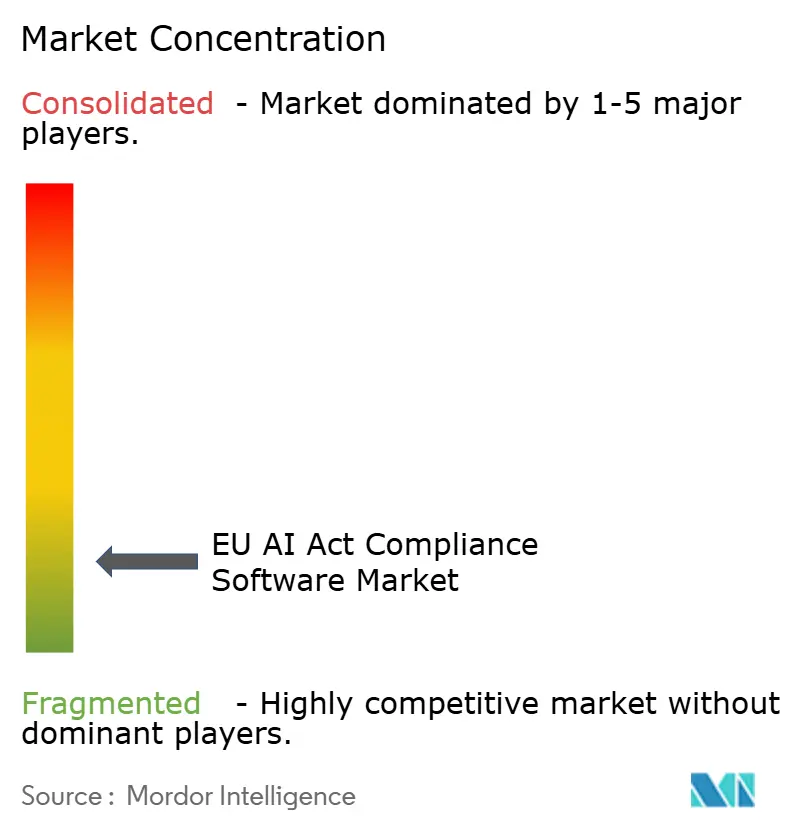
| Market Concentration | Low |
Major Players *Disclaimer: Major Players sorted in no particular order Image © Mordor Intelligence. Reuse requires attribution under CC BY 4.0. | |
EU AI Act Compliance Software Market Analysis by Mordor Intelligence
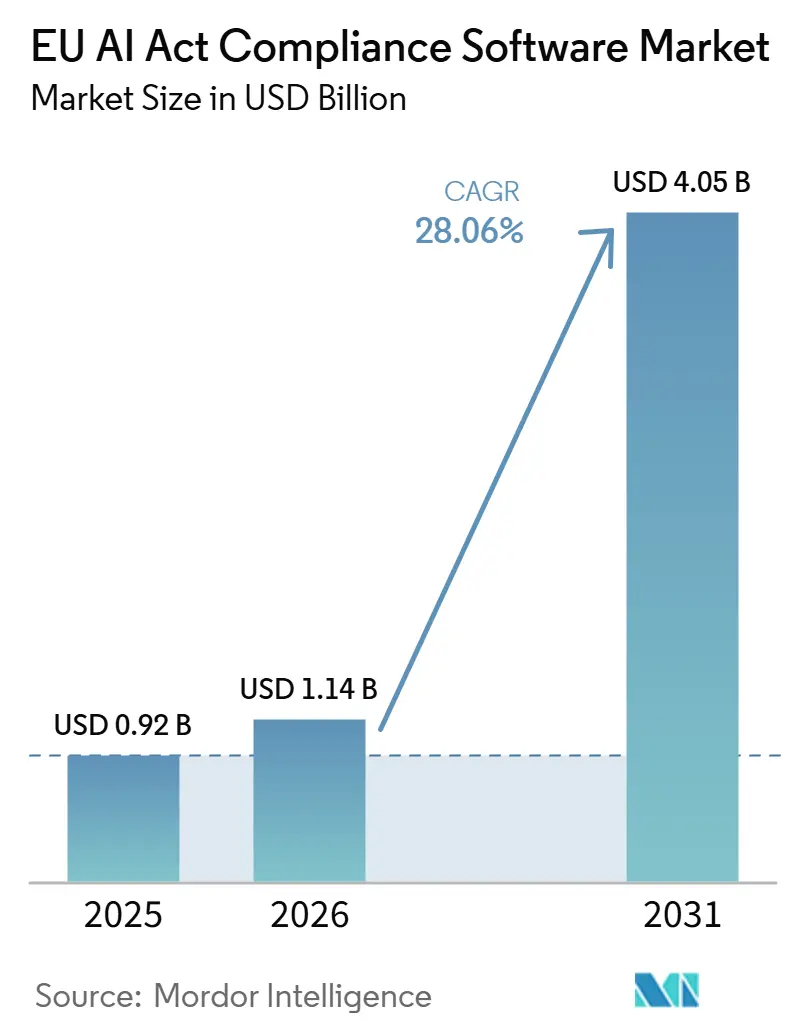
The EU AI Act Compliance Software Market size was valued at USD 0.92 billion in 2025 and is estimated to grow from USD 1.14 billion in 2026 to reach USD 4.05 billion by 2031, at a CAGR of 28.86% during the forecast period (2026-2031). The phased implementation of Regulation (EU) 2024/1689 is moving organizations from broad policy preparation to operational compliance. Article 50 transparency obligations apply from August 2, 2026, while the revised dates for high-risk obligations give buyers more time to build durable processes and systems. The Act also applies when AI system output is used in the Union, thereby extending procurement needs to providers and deployers outside Europe. Demand is increasingly tied to tools that can classify systems, organize evidence, support monitoring, and keep documentation current across the AI lifecycle. The legal timetable creates urgency, but unfinished standards and uneven national implementation can delay purchase decisions and require flexible software configurations.
Key Report Takeaways
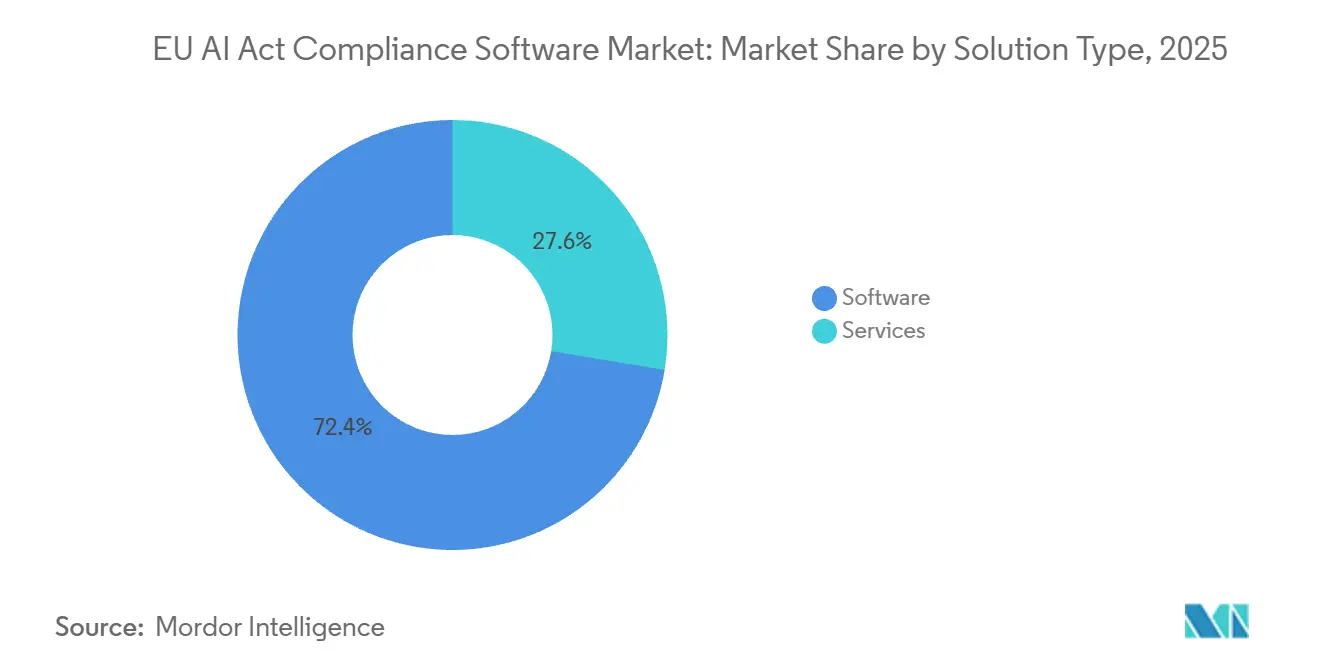
- By solution type, software held 72.41% of the EU AI Act Compliance Software Market share in 2025, while services are forecast to expand at a 30.74% CAGR through 2031.
- By compliance function, risk classification accounted for 26.83% of the EU AI Act Compliance Software Market share in 2025, while conformity assessment and audit management are forecast to grow at a 29.91% CAGR through 2031.
- By deployment model, cloud held 68.19% of the revenue share in 2025, while hybrid deployment is projected to grow at a 30.42% CAGR through 2031.
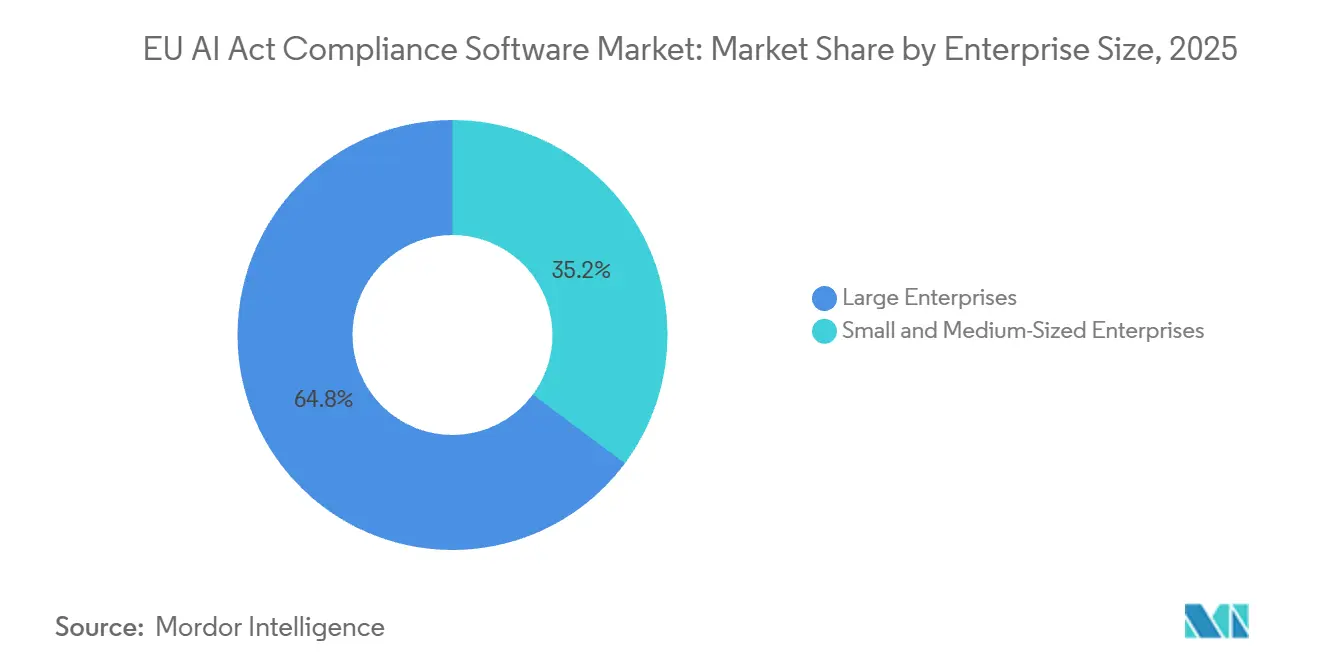
- By enterprise size, large enterprises represented 64.82% of demand in the EU AI Act Compliance Software Market 2025, while SMEs are forecast to grow at a 31.18% CAGR through 2031.
- By end user, IT and telecommunications accounted for 24.36% of demand in 2025, while healthcare and life sciences are forecast to expand at a 29.63% CAGR through 2031.
- By geography, Germany held 28.41% revenue share in the EU AI Act Compliance Software Market 2025, while France is forecast to expand at a 30.85% CAGR through 2031.
Note: Market size and forecast figures in this report are generated using Mordor Intelligence’s proprietary estimation framework, updated with the latest available data and insights as of January 2026.
Market Trends and Insights
Drivers Impact Analysis of EU AI Act Compliance Software Market*
| Driver | (~) % Impact on CAGR Forecast | Geographic Relevance | Impact Timeline |
|---|---|---|---|
| Phased EU AI Act Enforcement and Compliance Deadlines | +6.5% | EU Member States, Global | Short term (≤ 2 years) |
| Extraterritorial Reach and EU Market-Access Exposure | +5.2% | Global | Medium term (2-4 years) |
| Expansion of High-Risk AI Use Cases in Regulated Industries | +4.3% | EU, Global | Medium term (2-4 years) |
| Continuous Evidence Across the AI Lifecycle | +3.6% | EU, Global | Long term (≥ 4 years) |
| Convergence of EU AI Act, ISO/IEC 42001, and NIST AI RMF Controls | +2.9% | EU, United States, Global | Medium term (2-4 years) |
| Procurement and Board-Level Demand for Demonstrable Responsible AI | +2.1% | EU, Global | Short term (≤ 2 years) |
| Source: Mordor Intelligence | |||
Phased EU AI Act Enforcement and Near-Term Compliance Deadlines
The EU AI Act Compliance Software Market benefits from a phased compliance schedule that creates several purchasing points rather than a single deadline. Prohibitions in Article 5 have been in effect since February 2, 2025, and Article 50 transparency obligations apply from August 2, 2026.[1] The revised schedule places the Annex III high-risk requirements on December 2, 2027, and the Annex I product-embedded AI requirements on August 2, 2028. This sequence encourages organizations to establish an inventory and documentation process before their most demanding obligations apply. Penalties can reach EUR 35 million (USD 9.37 million) or 7% of worldwide annual turnover for prohibited AI practices, which raises the financial importance of early controls. Organizations also need to align AI Act work with sector rules such as DORA and the Medical Device Regulation, which support demand for software that consolidates several compliance tasks into a single workflow.
Extraterritorial Reach and EU Market-Access Exposure
The EU AI Act Compliance Software Market has demand beyond EU-based organizations, as the Act covers certain AI system outputs used within the Union. This scope affects providers and deployers that operate from the United States, the United Kingdom, Singapore, and other markets but serve European customers. Providers of high-risk systems established outside the Union also need an authorized representative in the EU. Software can help these organizations assign responsibilities, retain records, and make evidence available across different locations. Cloud delivery is useful for distributed teams because it lets users maintain shared compliance workflows without building a separate internal platform in every country. The same need for cross-border coordination supports tools that connect EU requirements with related governance frameworks, including ISO/IEC 42001 and the NIST AI Risk Management Framework.[2]
Expansion of High-Risk AI Use Cases in Regulated Industries
The EU AI Act Compliance Software Market is supported by the breadth of high-risk use cases identified under the Act. The European Commission’s guidance addresses areas such as biometrics, critical infrastructure, education, employment, essential services, law enforcement, migration, and justice. These areas include organizations with large AI deployments and formal audit requirements. Healthcare faces a demanding workload because clinical applications may require risk management, human oversight, post-market monitoring, and documentation under both AI and medical-device rules. Only 26% of hospital representatives reported readiness for the Act’s obligations in a 2026 study, while 72% of surveyed healthcare professionals identified new implementation challenges. In financial services, credit scoring, anti-money-laundering screening, and fraud detection can add AI Act requirements to existing DORA, MiFID II, and Solvency II obligations. This setting favors software that supports conformity assessment workflows, documentation controls, and audit trails, which can be adapted to sector use.
Need for Continuous Evidence Across the AI Lifecycle
The EU AI Act Compliance Software Market is also supported by obligations that continue after an AI system is deployed. Providers of high-risk systems must establish post-market monitoring, and serious incidents may require reporting to national authorities. Compliance, therefore, becomes an operating process rather than a one-time certification project. Organizations need reliable logs, current documentation, model-monitoring records, and evidence that can be reviewed when needed. This need also includes aligning AI Act controls with ISO/IEC 42001 and the NIST AI Risk Management Framework, as many enterprises use these frameworks to organize governance work. Procurement teams and boards increasingly require proof that responsible AI controls operate in practice, rather than policy statements alone. The limited supply of governance specialists makes software-based monitoring and evidence collection more practical for organizations that manage many systems.
Restraints Impact Analysis of EU AI Act Compliance Software Market*
| Restraint | (~) % Impact on CAGR Forecast | Geographic Relevance | Impact Timeline |
|---|---|---|---|
| Unsettled Technical Standards and Interpretive Guidance | -3.2% | EU, Global | Medium term (2-4 years) |
| Fragmented Accountability Across the AI Value Chain | -2.5% | EU, Global | Long term (≥ 4 years) |
| Limited Availability of AI Governance and Conformity-Assessment Expertise | -1.8% | EU-wide | Medium term (2-4 years) |
| Integration Friction Across Shadow AI, Legacy MLOps, and Multi-Cloud Estates | -1.4% | EU, Global | Short term (≤ 2 years) |
| Source: Mordor Intelligence | |||
Unsettled Technical Standards and Moving Interpretive Guidance
The EU AI Act Compliance Software Market faces constraints due to the gap between legal obligations and the technical infrastructure required to demonstrate conformity. Harmonized standards had not yet been published in the Official Journal as of April 2026, leaving buyers less certain about the exact technical basis for some controls. The lack of formally designated notified bodies for AI Act assessments adds to this uncertainty. Software providers must configure workflows for requirements that may become more specific as standards and guidance mature. Buyers may delay decisions if they expect to revise a platform after detailed standards are issued. The updated timetable adds more time for preparation, but it also leaves organizations balancing immediate transparency duties with later high-risk obligations. Limited availability of AI governance and conformity-assessment expertise further slows implementation, especially where internal teams must interpret regulatory, technical, and sector-specific requirements together.
Fragmented Accountability Across Providers, Deployers, and Third-Party Model Vendors
The division of responsibility among providers, deployers, and third-party model vendors constrains the EU AI Act Compliance Software Market. A deployer may need to show data governance and human oversight, while a provider may control technical documentation and conformity assessment materials. Neither party necessarily has a full view of the other party’s compliance evidence. This makes shared workflows, document requests, role-based access, and evidence tracking important product capabilities. Integration can be difficult when organizations use unregistered AI tools, legacy machine learning operations platforms, and multiple cloud environments. Software must therefore connect data from different teams and systems without losing the record of who completed each control. Vendors that support collaboration across the value chain are better placed to address this operational issue than products designed for a single internal user group.
*Our forecasts treat driver/restraint impacts as directional, not additive. The impact forecasts reflect baseline growth, mix effects, and variable interactions.
EU AI Act Compliance Software Market Segment Analysis
By Solution Type:
Software Maintains the Largest Revenue Base While Services Grow FasterSoftware captured 72.41% of the EU AI Act Compliance Software Market share in 2025. The segment leads because organizations need practical tools for risk classification, technical documentation, monitoring, and management of conformity assessment. These functions are repeated across many AI systems and are difficult to manage consistently through spreadsheets or isolated legal reviews. A centralized platform can help teams document the system's purpose, identify applicable obligations, assign actions, and retain evidence. This makes software the primary delivery model for enterprises with broad AI inventories. The segment also fits organizations that need to update controls as guidance and internal policies change.
Services are forecast to grow at a 30.74% CAGR through 2031. Many organizations that selected a platform in 2025 are now moving into implementation, configuration, training, and audit-readiness work. This creates demand for specialist support that can translate requirements into internal procedures. Credo AI expanded its partner program in 2025 to include Databricks, Microsoft, and governance and risk specialists, illustrating the use of partner ecosystems for enterprise delivery.[3] Smaller firms may also need guided services because they lack in-house legal and technical capacity. The mix of platforms and services can widen vendor revenue opportunities, although a larger services role can place pressure on margins.
By Compliance Function:
Risk Classification Leads While Conformity Assessment Gains PaceRisk classification held 26.83% of the EU AI Act Compliance Software Market share in 2025. Classification is the starting point for a compliance program because organizations must determine whether a system is prohibited, high-risk, subject to transparency requirements, or subject to lower-level obligations. The process also helps teams identify the relevant owner, data sources, and required documentation. The European Commission’s high-risk classification guidance supports a more structured approach to this work. Software can make classification more consistent by using repeatable questions and keeping the decisions connected to the system record. Lifecycle monitoring, data governance and lineage, and transparency and documentation management are related functions that become more important after the initial classification is complete.
Conformity assessment and audit management are forecast to grow at a 29.91% CAGR through 2031. Providers of high-risk AI systems will need to prepare technical documentation, complete applicable assessments, and register systems before placing them on the EU market under the revised timeline. The task requires evidence from product, engineering, legal, security, and operational teams. Software can reduce manual follow-up by linking controls, test results, documentation, and approvals into a single record. LatticeFlow AI launched AI Atlas in April 2026 to map AI governance frameworks to technical evaluations, an example of a product approach focused on verifiable evidence. This function becomes more valuable as organizations move from identifying systems to preparing an audit-ready compliance file.[4]
By Deployment Model:
Cloud Retains the Lead While Hybrid Meets Regulated-Sector NeedsCloud deployment accounted for 68.19% of the EU AI Act Compliance Software Market size in 2025. Cloud platforms can be provisioned quickly and updated as regulatory guidance, templates, and internal controls change. They also allow teams in several countries to work from a shared system and support non-EU organizations that need to manage obligations connected to European operations. Many vendors in this field were built as software-as-a-service platforms, which has reinforced the cloud model. Cloud tools can support ongoing monitoring, evidence collection, and reporting without a long on-premises implementation cycle. However, certain public-sector, defense-related, and highly regulated users remain cautious about placing all records in a public cloud environment.
Hybrid deployment is forecast to advance at a 30.42% CAGR through 2031. This model is relevant to institutions that need to keep sensitive data or model operations in a private environment while sharing selected audit records through a cloud-based portal. Financial institutions may use this approach when credit-scoring or other regulated AI systems must align with both the AI Act and DORA requirements. European sovereign-cloud activity also supports the need for interoperability between private infrastructure and cloud governance tools. In July 2026, Gravitee and Clever Cloud announced a partnership to deliver a sovereign AI governance control plane on French infrastructure. The ability to work across cloud, private cloud, and on-premises environments can become a deciding factor in regulated-sector procurement.
By Enterprise Size:
Large Enterprises Hold the Majority While SMEs Expand FasterLarge enterprises accounted for 64.82% of demand in 2025. These organizations often have broad AI inventories, operations in multiple jurisdictions, and exposure across several high-risk use cases. Financial institutions, healthcare systems, telecommunications operators, and large technology providers may manage hundreds of models and AI-enabled processes. They need a formal way to identify systems, assign owners, maintain documentation, and demonstrate oversight to internal and external stakeholders. Large enterprises also have more established compliance teams and budgets for enterprise platforms. Their early adoption gives vendors a base of complex deployments that can shape product requirements for the wider customer base.
SMEs are forecast to grow at a 31.18% CAGR through 2031. The revised framework extends certain support measures to small- and mid-cap companies with up to 750 employees and annual revenue of up to EUR 150 million (USD 170.53 million), including simplified documentation requirements and access to regulatory sandboxes. This broadens the addressable user base beyond the largest regulated organizations. SMEs are likely to favor guided, lower-cost, and self-service tools because they have fewer internal compliance specialists. Vendors that offer templates, clear workflows, and straightforward pricing can reduce the need for lengthy advisory engagements. As a result, the SME opportunity rewards products that make complex obligations easier to manage without removing the need for legal judgment.
By End User:
IT and Telecommunications Leads While Healthcare and Life Sciences AccelerateIT and telecommunications accounted for 24.36% of demand in 2025. The sector has dual exposure because it both deploys AI in its own customer, network, and operational systems and provides infrastructure used by other organizations. Providers with EU market access must consider obligations related to systems they place on the market. The sector’s large enterprise deployments can produce meaningful contract values for vendors. It also needs governance tools that fit cloud operations, API-based services, and AI systems supplied to business customers. BFSI remains another important source of demand because credit scoring, fraud detection, and anti-money-laundering tools can involve high-risk use cases and operate alongside established financial regulations.
The healthcare and life sciences sector is forecast to grow at a 29.63% CAGR through 2031. The segment faces a combination of clinical AI adoption, high-risk classification questions, and medical-device requirements. Only 26% of hospital representatives reported readiness for the Act’s obligations in 2026. This readiness gap creates demand for software that organizes risk files, human-oversight procedures, data records, and post-market monitoring. Automotive and transportation also contribute to demand, as AI embedded in advanced driver-assistance systems is linked to Annex I obligations due in 2028. Retail and e-commerce deployers need to manage transparency considerations for consumer-facing recommendation and pricing tools.
Geography Analysis
Germany and the United Kingdom EU AI Act Compliance Software Market
Germany held 28.41% of the EU AI Act Compliance Software Market share in 2025. Its position reflects a large base of AI deployers, including Mittelstand firms using AI for recruitment, predictive maintenance, and supply-chain operations. Germany’s KI-MIG framework designated the Bundesnetzagentur as the lead market-surveillance authority and the contact point for the EU AI Office, with sector responsibilities for BaFin and BSI. The Bundesnetzagentur launched its KI Service Desk in July 2025 to provide businesses with operational information on the AI Act, giving buyers a clearer path to translating the Act into internal controls. The United Kingdom is also relevant because UK-headquartered organizations can fall within the Act’s scope when their AI outputs are used in the Union.
France EU AI Act Compliance Software Market
France is forecast to grow at a 30.85% CAGR through 2031. The country combines a significant AI development base with an evolving domestic implementation framework that supports demand for tools connecting EU requirements with national regulatory practices. France is also building a domestic supply. Naaia raised EUR 6 million (USD 6.48 million) in July 2026 to expand its team, enhance its platform, and extend its European operations. The presence of local vendors can increase the importance of French-language documentation, local hosting options, and alignment with national guidance.
Broader European Markets
Spain is gaining relevance as local implementation develops and enterprises in energy, banking, and manufacturing address high-risk AI exposure. Nordic, Benelux, and Central European countries also add demand through technology-intensive economies and advancing authority designations. Russia is not an EU member state, but Russian organizations may still need to consider the Act when AI-system outputs reach EU users. Vendors need to support EU-hosted data options, local-language documentation, and country-specific enforcement guidance without fragmenting the core compliance record. These needs make localization a relevant selection factor for buyers operating across several European jurisdictions. They also favor platforms that maintain a single core record while adapting documentation and workflows to local enforcement practices, language, and operating conditions.
Competitive Landscape
The EU AI Act Compliance Software Market is fragmented, with more than 20 identifiable pure-play and adjacent vendors. Holistic AI, Credo AI, ModelOp, LatticeFlow AI, and Trustible are among vendors built around AI lifecycle governance and compliance mapping. Their offerings differ from traditional governance, risk, and compliance platforms that have added AI Act capabilities to broader product suites, leaving buyers to choose between AI-specific controls and wider enterprise integration. Coralogix acquired Aporia Technologies in December 2024, bringing AI guardrails, monitoring, and reliability capabilities into its observability platform as consolidation changes the vendor landscape. This type of transaction can make broader infrastructure and security vendors stronger competitors for standalone governance specialists.
Product strategy centers on technical evidence and interoperability across frameworks. LatticeFlow AI introduced AI Atlas in April 2026, mapping more than 40 AI governance frameworks to ready-to-run technical evaluations, addressing buyers who need evidence from tests rather than a simple policy declaration. ModelOp launched its AI Delivery Engine in June 2026 to help organizations use governed delivery workflows across varied AI environments, reflecting the need to manage systems from development through deployment and monitoring. Vendors that connect AI Act controls with ISO/IEC 42001, the NIST AI Risk Management Framework, security controls, and data governance can reduce duplication for organizations working across multiple frameworks.
There remains an opening for self-service products aimed at SMEs, tools for organizations subject to rules in several jurisdictions, and sector-focused offerings for healthcare and automotive. These buyers may value workflows configured for specific Annex III categories and the regulations that sit alongside them. Holistic AI’s Guardian Agents show another approach, using paired agents to support continuous AI governance. Credo AI’s partner ecosystem shows the importance of alliances with cloud, data, and specialist service providers for enterprise delivery. Competition is likely to remain dispersed because buyers vary widely in AI maturity, sector obligations, deployment needs, and internal governance capacity.
EU AI Act Compliance Software Industry Leaders
-
Holistic AI Limited
-
Credo AI, Inc.
-
ModelOp, Inc.
-
Fairly AI Inc.
-
LatticeFlow AG
- *Disclaimer: Major Players sorted in no particular order
EU AI Act Compliance Software Market Companies Covered in this Report
- Holistic AI Limited
- Credo AI, Inc.
- ModelOp, Inc.
- Fairly AI Inc.
- LatticeFlow AG
- Fiddler Labs, Inc.
- ArthurAI, Inc.
- Aporia Technologies Ltd.
- Monitaur, LLC
- Trustible, Inc.
- Modulos AG
- Mindgard Ltd.
- CalypsoAI Corp.
- FairNow, Inc.
- WhyLabs, Inc.
- ComplyAI, Inc.
- Parity Responsible AI, Inc.
- Securiti.ai, Inc.
- Truera, Inc.
- Robust Intelligence, Inc.
Recent Industry Developments in EU AI Act Compliance Software Market
- July 2026: Naaia raised EUR 6 million (USD 6.48 million), in a Series A round led by Ventech. The funding supports team expansion, platform enhancement, and European growth
- July 2026: ModelOp partnered with Kong Inc. to integrate Kong’s API Gateway with ModelOp’s AI governance platform. The integration supports zero-trust enforcement of governance decisions at the API gateway layer.
- June 2026: ModelOp launched the ModelOp AI Delivery Engine, which lets customers and systems integrators connect their agents to governed delivery workflows
- April 2026: LatticeFlow AI launched AI Atlas, a public registry that maps more than 40 AI governance frameworks to technical evaluations.
EU AI Act Compliance Software Market Report Scope
The EU AI Act compliance software market refers to the ecosystem of specialized software solutions and associated services designed to help organizations align their artificial intelligence systems with the regulatory requirements of the European Union’s AI Act. This market encompasses tools that automate and streamline critical compliance functions, including AI risk classification (such as identifying high-risk or prohibited systems), AI lifecycle governance and monitoring, data governance and lineage tracking, transparency and technical documentation management, and conformity assessment and audit preparation. Deployed via cloud, hybrid, or on-premises models, these solutions cater to organizations of all sizes across industries such as IT, BFSI, automotive, and healthcare. By providing continuous monitoring, automated reporting, and robust audit trails, EU AI Act compliance software enables businesses to mitigate legal and operational risks, avoid substantial financial penalties, ensure ethical and transparent AI deployment, and maintain seamless market access within the European Economic Area.
The EU AI Act Compliance Software Market Report is Segmented by Solution Type (Software, and Services), Compliance Function (Risk Classification, AI Lifecycle Governance and Monitoring, Data Governance and Lineage, Transparency and Documentation Management, and Conformity Assessment and Audit Management), Deployment Model (Cloud, Hybrid, and On-Premises), Enterprise Size (Large Enterprises, and Small and Medium-Sized Enterprises), End User (IT and Telecommunication, BFSI, Automotive and Transportation, Healthcare and Life Sciences, Retail and E-Commerce, and Others), and Geography (Germany, United Kingdom, France, Russia, Spain, and Rest of Europe). The Market Forecasts are Provided in Terms of Value (USD).
| Software |
| Services |
| Risk Classification |
| AI Lifecycle Governance and Monitoring |
| Data Governance and Lineage |
| Transparency and Documentation Management |
| Conformity Assessment and Audit Management |
| Cloud |
| Hybrid |
| On-Premises |
| Large Enterprises |
| Small and Medium-Sized Enterprises |
| IT and Telecommunication |
| BFSI |
| Automotive and Transportation |
| Healthcare and Life Sciences |
| Retail and E-Commerce |
| Other End Users |
| Germany |
| United Kingdom |
| France |
| Russia |
| Spain |
| Rest of Europe |
| By Solution Type | Software |
| Services | |
| By Compliance Function | Risk Classification |
| AI Lifecycle Governance and Monitoring | |
| Data Governance and Lineage | |
| Transparency and Documentation Management | |
| Conformity Assessment and Audit Management | |
| By Deployment Model | Cloud |
| Hybrid | |
| On-Premises | |
| By Enterprise Size | Large Enterprises |
| Small and Medium-Sized Enterprises | |
| By End User | IT and Telecommunication |
| BFSI | |
| Automotive and Transportation | |
| Healthcare and Life Sciences | |
| Retail and E-Commerce | |
| Other End Users | |
| By Geography | Germany |
| United Kingdom | |
| France | |
| Russia | |
| Spain | |
| Rest of Europe |
Key Questions Answered in the Report
How large is the EU AI Act Compliance Software Market?
The EU AI Act Compliance Software Market was valued at USD 0.92 billion in 2025 and is estimated at USD 1.14 billion in 2026. It is forecast to reach USD 4.05 billion by 2031, reflecting a 28.86% CAGR from 2026 to 2031.
What is driving demand for EU AI Act compliance software?
The phased application of the Act drives demand, particularly as Article 50 transparency obligations apply in 2026 and high-risk requirements follow in 2027 and 2028.
Which solution type leads spending on AI Act compliance?
Software led with 72.41% revenue share in 2025 because enterprises need repeatable tools for classification, documentation, monitoring, and audit management.
Why are healthcare organizations adopting compliance tools?
Healthcare and life sciences is forecast to grow at a 29.63% CAGR through 2031, while 26% of hospital representatives reported readiness for the Acts obligations in 2026.
Why does hybrid deployment matter for regulated organizations?
Hybrid deployment allows users to retain sensitive data or model operations in a private environment while using cloud-based governance and audit workflows.
How fragmented is the vendor landscape?
The field includes more than 20 identifiable pure-play and adjacent vendors, with varied AI maturity, sector obligations, deployment preferences, and governance requirements.