
Ethyl Cyanoacetate Market Size and Share
Market Overview
| Study Period | 2022 - 2032 |
|---|---|
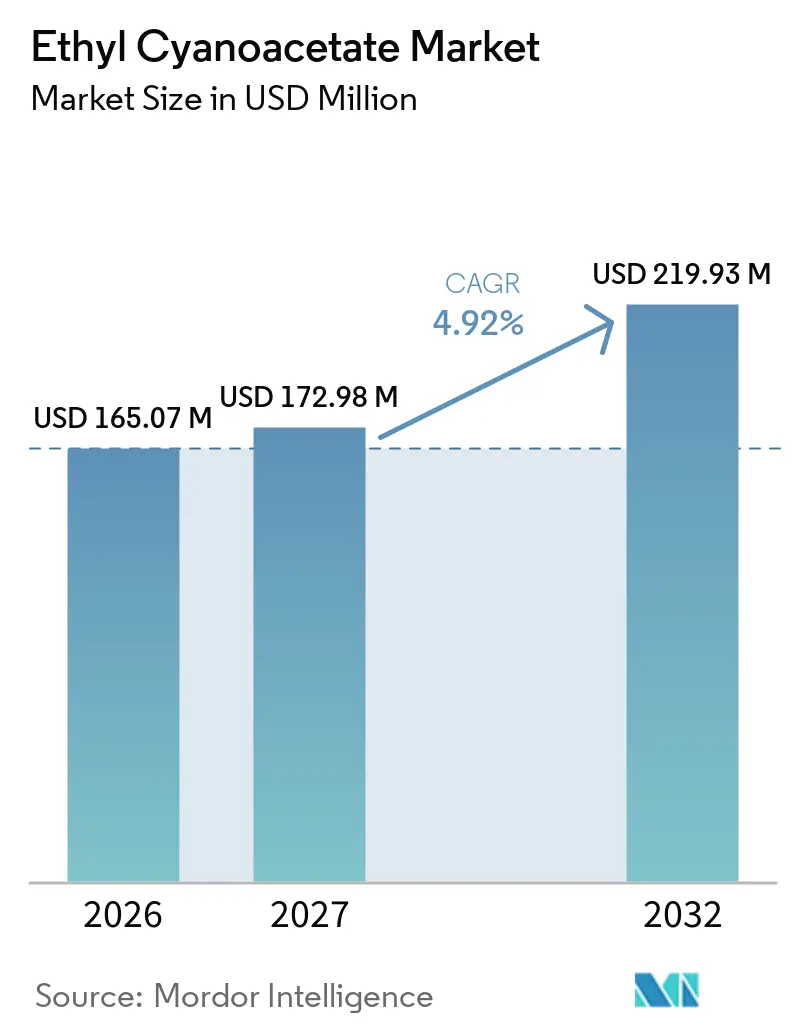
| Market Size (2027) | USD 172.98 Million |
| Market Size (2032) | USD 219.93 Million |
| Growth Rate (2027 - 2032) | 4.92 % |
| Fastest Growing Market | Asia-Pacific |
| Largest Market | Asia-Pacific |
| Market Concentration | Medium |
Major Players *Disclaimer: Major Players sorted in no particular order Image © Mordor Intelligence. Reuse requires attribution under CC BY 4.0. | |
Ethyl Cyanoacetate Market Analysis by Mordor Intelligence
The ethyl cyanoacetate market size was valued at USD 165.07 million in 2026 and is estimated to grow from USD 172.98 million in 2027 to USD 219.93 million by 2032, at a CAGR of 4.92% during the forecast period (2027-2032). The compound is used in pharmaceutical, agrochemical, and specialty adhesive production because its reactive methylene group supports multiple chemical synthesis pathways. It is relevant to customers who require a flexible starting material for multi-step production, rather than one limited to a single end use. India's pharmaceutical production incentive program has mobilized INR 40,294 crore (approximately USD 4,245.78 million) and enabled domestic production of active pharmaceutical ingredients (APIs), key starting materials, and drug intermediates, thereby supporting demand for upstream fine chemicals. Demand also benefits from the compound's use in synthesis routes for pharmaceutical and other specialty chemical products. Supply conditions remain important, as the costs of chloroacetic acid and sodium cyanide, along with regulatory controls, process safety requirements, and qualification requirements, can influence producers' margins and customer selection.
Key Report Takeaways
- By grade, pharmaceutical grade held 42.56% market share in 2026, while industrial grade is forecast to grow at a 5.25% CAGR through 2032.
- By function, chemical intermediates accounted for 61.23% of the market share in 2026 and are projected to grow at a 5.41% CAGR through 2032.
- By application, pharmaceutical intermediates held 43.11% market share in 2026, while cyanoacrylate adhesives are forecast to record a 5.73% CAGR through 2032.
- By geography, Asia-Pacific accounted for 48.79% market share in 2026 and is forecast to expand at a 5.66% CAGR through 2032.
Note: Market numbers in this report are based on Mordor Intelligence's proprietary estimation framework, which combines nine months of actuals with Q4 projections for base year 2026.
Market Trends and Insights
Drivers Impact Analysis of Ethyl Cyanoacetate Market*
| Drivers | (~) % Impact on CAGR Forecast | Geographic Relevance | Impact Timeline |
|---|---|---|---|
| Expanding Pharmaceutical Active Pharmaceutical Ingredient (API) and Heterocyclic Intermediate Demand | +1.8% | Global, with the highest pull in India, China, and Europe | Medium term (2–4 years) |
| Rising Agrochemical Intermediate Requirements | +0.9% | Asia-Pacific core, spillover to Latin America | Medium term (2–4 years) |
| Growth in High-Purity Fine-Chemical Procurement | +0.7% | North America and Europe, with growing uptake in Japan and South Korea | Long term (≥ 4 years) |
| Continuous-Flow and Safer Process Adoption | +0.6% | Europe, North America, and the Asia-Pacific | Long term (≥ 4 years) |
| Demand for Low-Moisture Cyanoacetate-Grade Material | +0.5% | North America and Europe, Asia-Pacific core, and spillover to the Middle East and Africa | Short term (≤ 2 years) |
| Source: Mordor Intelligence | |||
Expanding Pharmaceutical Active Pharmaceutical Ingredient (API) and Heterocyclic-Intermediate Demand
India's generic medicine production creates recurring demand for chemical intermediates that support several reaction pathways and product development programs. The ethyl cyanoacetate market benefits when suppliers support synthesis programs with consistent quality documentation, defined impurity limits, and secure batch-to-batch supply. India's pharmaceutical incentive program attracted INR 40,294 crore (~USD 4,245.78 million) in investment and enabled the domestic manufacture of 191 products for the first time. These investments added API and intermediate production lines that require verified upstream inputs, especially when manufacturing facilities must document their supply chains during qualification. The resulting demand is less dependent on a single therapeutic product because qualified materials can serve several synthesis programs and chemical routes. The ethyl cyanoacetate market, therefore, has an opportunity to serve pharmaceutical customers that prioritize reliable supply, validated specifications, and long-term supplier relationships, particularly where production plans require approved materials across several synthesis steps and where supply interruptions can affect the timing of higher-value pharmaceutical manufacturing programs.
Rising Agrochemical Intermediate Requirements
Ethyl cyanoacetate is used in chemical routes associated with crop-protection intermediates and other agricultural chemistry products. This demand is tied to planting schedules, inventory replenishment, formulation requirements, and the timing of regional crop-protection purchasing. India's policy support for domestic chemical manufacturing encourages investment in local production capabilities and upstream supply chains. The ethyl cyanoacetate market can benefit when domestic producers seek inputs that meet commercial-scale production needs and reduce dependence on imported key starting materials. Agrochemical procurement adds a demand channel distinct from pharmaceutical buying cycles and is tied to seasonal agricultural requirements. Diversification can help suppliers serve both pharmaceutical and agricultural customers with the right grades, predictable documentation, and dependable delivery schedules, while allowing producers to spread commercial activity across end uses with different purchasing calendars, production plans, inventory practices, and customer qualification requirements.
Growth in High-Purity Fine-Chemical Procurement
Pharmaceutical-grade material requires tighter control of impurities and moisture than industrial-grade material, because small variations can affect chemical processing in multi-step synthesis. Buyers in regulated applications request certificates of analysis, batch traceability, validated analytical methods, and clear records before approving a supplier. The United Kingdom introduced commodity code 2926907032 in 2025 for ethyl or methyl cyanoacetate with a purity of at least 97%, which recognizes the distinction between higher-purity and commodity material[1]. This differentiation supports separate commercial positions for suppliers that can document product quality and maintain consistent specifications. The ethyl cyanoacetate market also benefits when customers favor stable quality over short-term spot pricing, particularly when changing an approved material supplier would require further review. Qualification requirements can make approved supplier relationships more durable in pharmaceutical and research applications, because buyers may need additional analysis, internal review, and procurement documentation before replacing a material that already meets their required purity, moisture, traceability, and handling standards.
Continuous-Flow and Safer Process Adoption
Continuous-flow methods can provide tighter temperature control, more consistent operating conditions, and more manageable production steps than batch production in fine chemical manufacturing. A 2025 study reported lower modeled global warming potential and lower capital and operating expenditure for the assessed continuous-flow process compared to the comparable batch process. Hovione and Microinnova Engineering announced a 2025 partnership to develop modular flow chemistry equipment for small-molecule API production. Asymchem also expanded flow chemistry capabilities at Discovery Park in 2025. These investments support the broader use of documented, scalable production platforms among pharmaceutical manufacturers and service providers that need to move production from development to larger-scale production. The ethyl cyanoacetate market benefits when downstream production systems require consistent input quality, controlled process conditions, and suppliers capable of meeting specifications at commercial scale. Customers using documented production platforms place greater value on materials that perform consistently across development, scale-up, routine manufacturing, and repeat procurement cycles.
Restraints Impact Analysis of Ethyl Cyanoacetate Market*
| Restraints | (~) % Impact on CAGR Forecast | Geographic Relevance | Impact Timeline |
|---|---|---|---|
| Cyanide Handling, Wastewater, and Emissions-Control Costs | -1.2% | Global, with the highest compliance burden in Europe and China | Medium term (2–4 years) |
| Chloroacetic Acid and Sodium Cyanide Price Volatility | -1.0% | Asia-Pacific core, with global pass-through to contract pricing | Short term (≤ 2 years) |
| Dependence on a Concentrated Producer Base | -0.6% | Global demand side, with supply concentrated in China | Long term (≥ 4 years) |
| Source: Mordor Intelligence | |||
Cyanide Handling, Wastewater, and Emissions-Control Costs
The chloroacetate-cyanide production route can generate wastewater streams containing residual cyanide that require treatment before discharge. Producers must install treatment systems before discharge, which adds capital and operating costs and can be particularly demanding for smaller facilities. A 2026 scientific review identified advanced oxidation as a treatment method for cyanide-containing industrial wastewater. The U.S. Environmental Protection Agency proposed updated hazardous air pollutant standards in November 2025 that include hydrogen cyanide emission limits for hazardous waste combustors. European discharge requirements also increase the need for documented environmental management and evidence that industrial operations meet applicable standards[2]. The ethyl cyanoacetate market favors producers that can spread compliance costs across larger, integrated operations while maintaining acceptable production economics, as these businesses can allocate investments in wastewater treatment, monitoring, safety management, and emissions control across broader output and multiple related chemical production streams.
Chloroacetic Acid and Sodium Cyanide Price Volatility
Chloroacetic acid and sodium cyanide are the principal feedstocks for ethyl cyanoacetate production. Their costs can fluctuate with energy conditions, environmental requirements, supply availability, and demand from other industries that use the same materials. Sodium cyanide demand is also influenced by gold mining activity, which does not align with pharmaceutical or specialty chemical purchasing cycles. Producers without backward integration into cyanoacetic acid face greater exposure to input price changes and fewer options to manage their internal supply. The ethyl cyanoacetate market can face margin pressure when feedstock costs rise faster than contract prices or when customers resist price adjustments. Long-term supply agreements, integrated production, and careful inventory planning can reduce this exposure for qualified suppliers, helping them manage procurement timing, maintain material availability for established customers, and limit the effect of short-term feedstock cost changes on production schedules, contract negotiations, and working capital requirements.
*Our forecasts treat driver/restraint impacts as directional, not additive. The impact forecasts reflect baseline growth, mix effects, and variable interactions.
Ethyl Cyanoacetate Market Segment Analysis
By Grade:
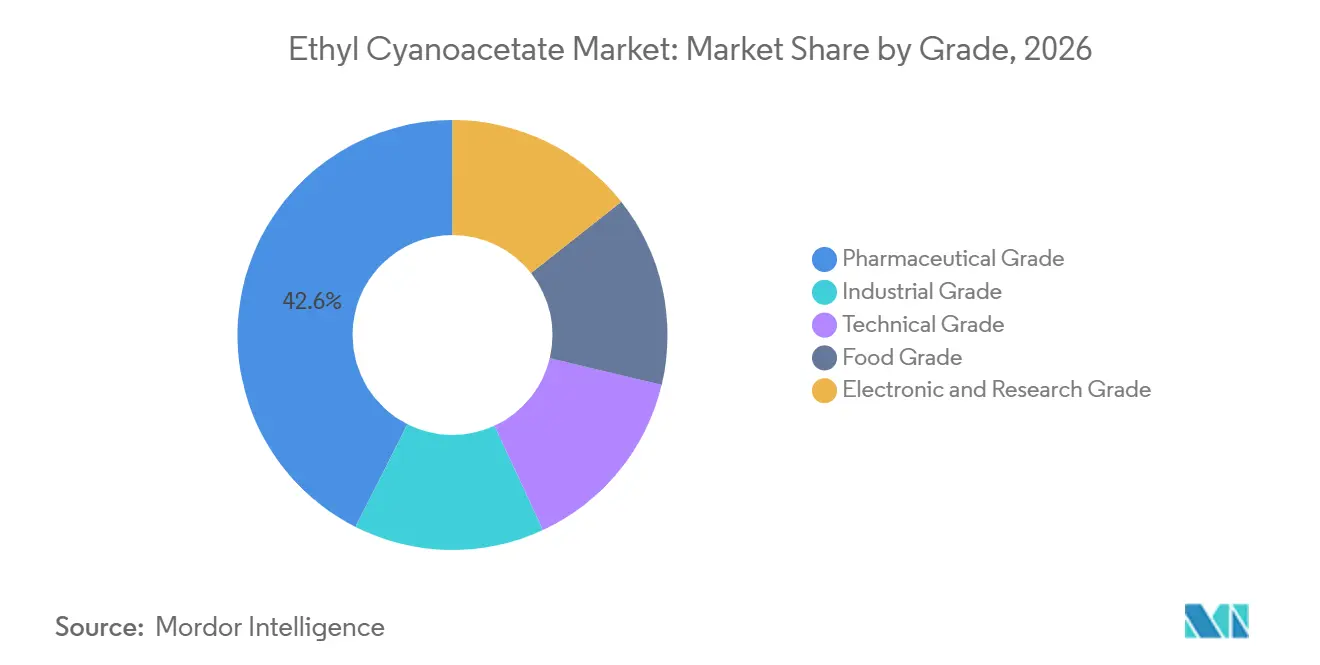
Pharmaceutical Specifications Widen the Premium Gap Over Technical GradesPharmaceutical grade held 42.56% of the ethyl cyanoacetate market share in 2026, as active pharmaceutical ingredient (API) synthesis requires controlled impurity profiles and consistent batch quality. This grade serves customers who need complete analytical records before a material can enter regulated production. The United Kingdom's dedicated tariff code for material of at least 97% purity reflects an established distinction between higher-purity and commodity products. Pharmaceutical producers place value on batch traceability, validated testing, and stable moisture specifications. These requirements favor suppliers that can maintain quality systems across repeated supply cycles.
Industrial grade is projected to grow at a 5.25% CAGR through 2032. It supports adhesive production and agrochemical intermediate synthesis, where moisture and purity remain important. However, specifications are less restrictive than those for pharmaceuticals, and supplier approval can be more closely tied to practical production performance. Technical grade supports dye and pigment applications, while food grade serves specialized flavor-intermediate uses that require their own defined quality controls. Electronic and research grades produce smaller yields but require very low levels of metal ions and particulates for specialized chemical applications, making analytical documentation and packaging practices important to their customers. The ethyl cyanoacetate market, therefore, spans both larger commercial grades and smaller high-specification categories, with each grade reflecting a distinct combination of purity, handling, documentation, and end-use requirements.

By Function:
Chemical Intermediates Retain Leadership in Share and GrowthChemical intermediates accounted for 61.23% of the ethyl cyanoacetate market share in 2026 and are forecast to grow at a 5.41% CAGR through 2032. This function includes materials used across pharmaceutical, agrochemical, adhesive, and dye synthesis routes. Its broad downstream use reduces reliance on any single end-use program. The ethyl cyanoacetate market size in the chemical intermediates segment benefits from this ability to serve multiple customer groups. A 2025 peer-reviewed study reported that Cu-Mg-Al layered double hydroxide catalysts achieved a 95% product yield in a Knoevenagel condensation using benzaldehyde and ethyl cyanoacetate.
Knoevenagel condensation remains an important reaction pathway for this function. Polymerization, cross-linking agents, and catalysts form secondary function categories with applications in specialty polymers and materials, where demand is lower but remains linked to established specialty chemical production. These categories support stable demand from a broader specialty-chemistry base and help preserve the compound's relevance beyond its pharmaceutical and agrochemical uses. The catalyst category also benefits from research into more efficient chemical synthesis methods, including efforts to improve yield, recyclability, and process control. Chemical intermediates lead in both output and growth within the functional structure, and the ethyl cyanoacetate market is supported by this function's role across multiple reaction systems rather than by dependence on a single reaction or final product.
By Application:
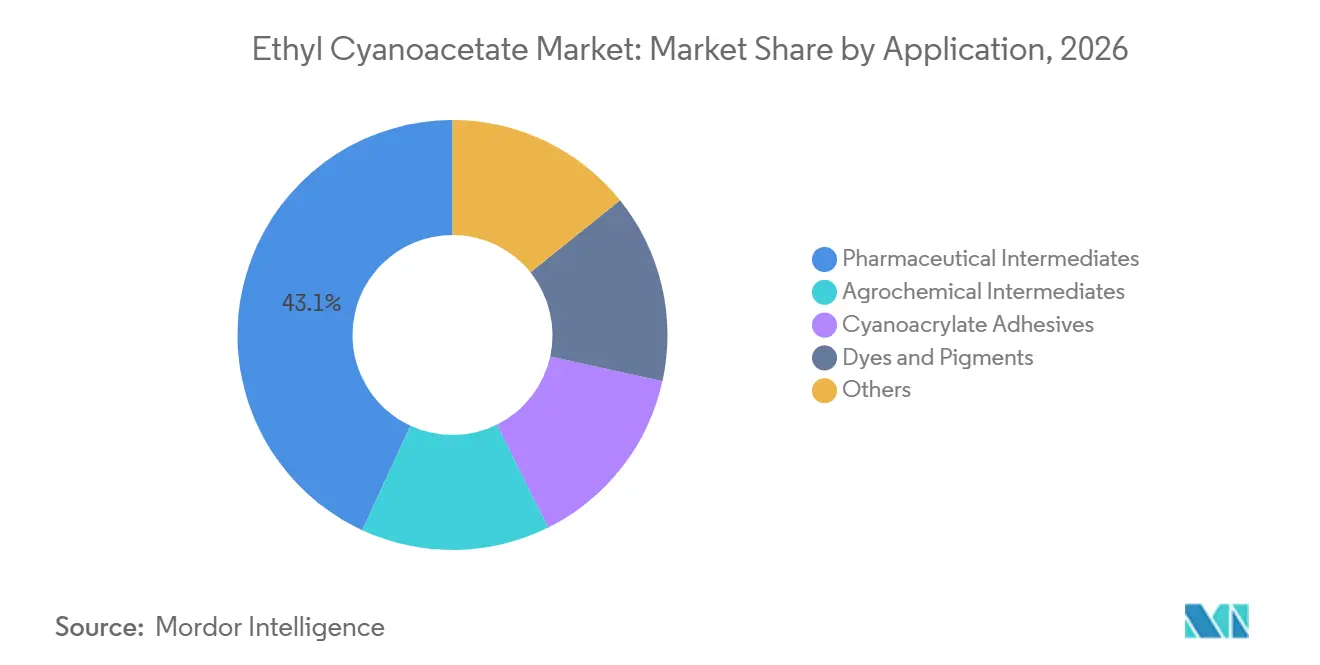
Pharmaceutical Intermediates Lead While Cyanoacrylate Adhesives Grow FasterHarmaceutical intermediates held 43.11% of the ethyl cyanoacetate market share in 2026. This application uses the compound across several heterocyclic synthesis routes, which allows qualified suppliers to support multiple drug programs. India's pharmaceutical incentive program has helped expand domestic production of APIs, key starting materials, and drug intermediates. This production expansion supports the procurement of verified upstream inputs. Pharmaceutical customers also place a high value on reliable documentation and repeatable batch quality.
Cyanoacrylate adhesives are projected to record a 5.73% CAGR through 2032, the fastest application growth rate in the ethyl cyanoacetate market. Electronics assembly, medical bonding, and automotive lightweighting support demand for instant-curing adhesives. Agrochemical intermediates remain the second-largest application and are linked to crop-protection manufacturing in Asia-Pacific and Latin America. Dyes and pigments continue to use the compound, but demand for this application is growing more slowly as sustainability considerations affect demand for synthetic colorants. Application diversity helps suppliers address different purchasing cycles across the pharmaceutical, agricultural, and materials sectors.
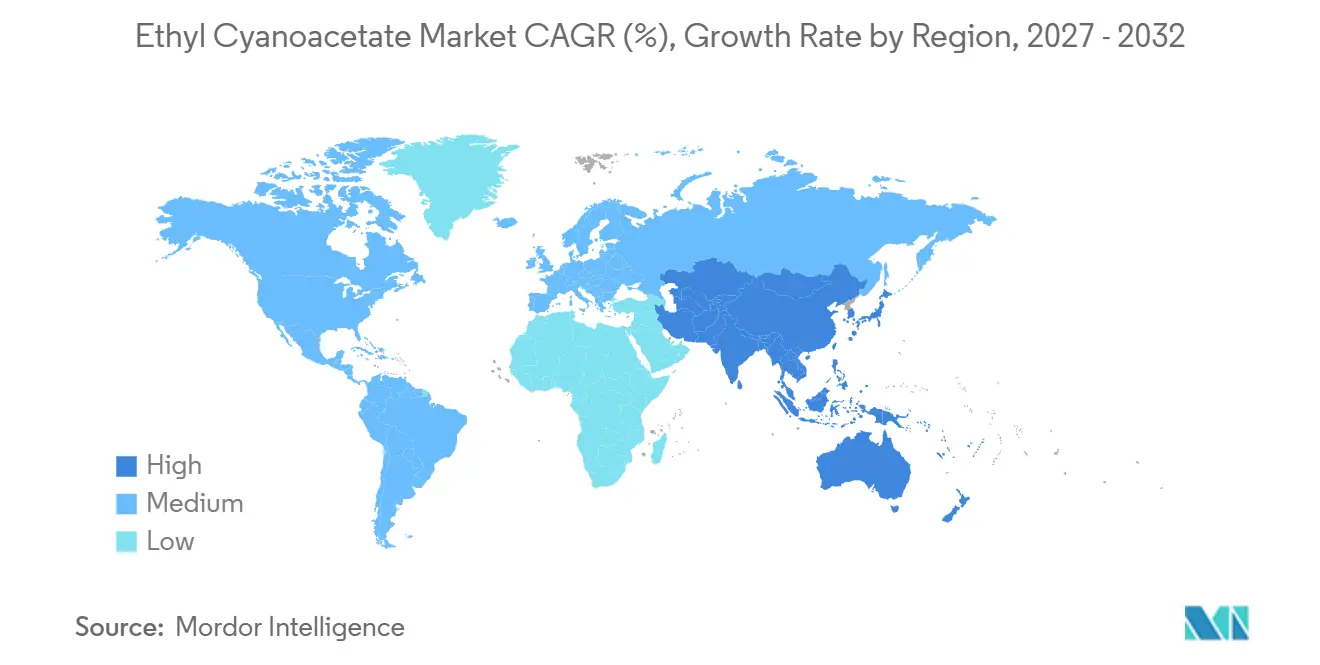
Geography Analysis
APAC Ethyl Cyanoacetate Market
Asia-Pacific held 48.79% of the ethyl cyanoacetate market share in 2026 and is expected to grow at a 5.66% CAGR through 2032. China is the principal production center, with Tiande Chemical Holdings, Hebei Chengxin, and Weifang Binhai Petro-Chem among the suppliers; Weifang Binhai Petro-Chem operates a 10,000-ton facility. The region has domestic demand from pharmaceutical, agrochemical, and adhesive producers that use intermediate chemicals across several production routes, from regulated drug synthesis to commercial crop-protection production. India adds demand through its generic medicine production base and continued investment in domestic pharmaceutical manufacturing.
Japan, South Korea and ASEAN Ethyl Cyanoacetate Market
Japan and South Korea contribute to the demand for laboratory, research, and electronic-research grades, where analytical documentation, material consistency, and the ability to deliver small, well-defined batches are important. Tokyo Chemical Industry and TATEYAMA KASEI serve high-specification research requirements in Japan and export markets. ASEAN demand is linked to agricultural production systems, including rice, palm oil, and rubber cultivation. Documentation requirements are becoming more important across these supply chains as buyers assess material quality, origin, storage conditions, and continuity of supply before confirming procurement decisions. The ethyl cyanoacetate market size in Asia-Pacific is supported by the region's combined manufacturing base, domestic consumption, export-oriented fine-chemical production, and the presence of customers operating across various chemical end uses.
The Americas and EMEA Ethyl Cyanoacetate Market
North America and Europe are mature demand centers for pharmaceutical-grade and high-purity specialty chemicals. U.S. pharmaceutical and Contract Development and Manufacturing Organization (CDMO) customers use supplier qualification processes that support longer procurement relationships for approved materials, as changes in inputs may require additional review, testing, and documentation. European buyers require REACH compliance, which creates a barrier for suppliers lacking the necessary registrations, safety documentation, and responsible supply chain controls. The United Kingdom's 2025 tariff code for cyanoacetate material of at least 97% purity supports a clearer commercial distinction for higher-purity imports and may reinforce grade-based pricing. South America, the Middle East, and Africa represent smaller demand areas, with Brazil and Argentina supporting agrochemical demand, and Saudi Arabia serving as an organized pharmaceutical and specialty chemical demand center. Merck Life Science opened a Formulation and Technology Center in Navi Mumbai in 2025 to support India, Asia-Pacific, the Middle East, and Africa.
Competitive Landscape
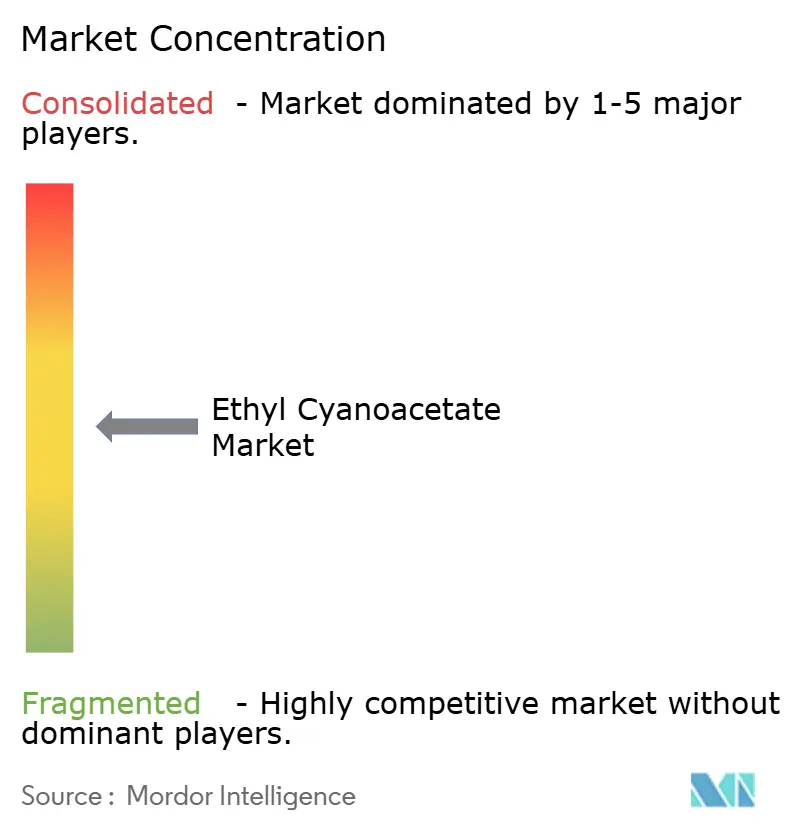
The ethyl cyanoacetate market is moderately fragmented, with a small group of Chinese producers holding positions in the production of sodium cyanide, cyanoacetic acid, and cyanoacetate esters. Integrated feedstock access reduces exposure to input price fluctuations, supports supply continuity amid commodity cost volatility, and gives producers greater control over raw material quality and availability.
Hebei Chengxin and Shandong Xinhua Pharma combine cyanoacetate chemistry with pharmaceutical intermediate capabilities, enabling them to serve customers who need validated quality systems, traceable batches, dependable documentation, and ongoing supply rather than one-time spot purchases. Indian distributors and reagent companies, including Loba Chemie, Sisco Research Laboratories, Triveni Interchem, and EMCO Dyestuff, extend product availability across South Asian pharmaceutical and specialty chemical markets without holding primary manufacturing capacity. In 2025, Tiande reported that its sourcing of bio-based raw materials for ethyl cyanoacetate had received International Sustainability and Carbon Certification, a move aimed at customers who prioritize carbon documentation and feedstock traceability in supplier selection. The ethyl cyanoacetate market rewards suppliers that deliver fit-for-purpose quality, transparent sourcing records, stable delivery, and documentation that supports customers' supplier review processes.
European and Japanese companies operate mainly in laboratory reagents and high-specification research supplies, where catalog breadth, analytical records, service quality, packaging, and reliable product availability matter more than bulk output. Merck KGaA supplies research-grade material through its Sigma-Aldrich life science portfolio, serving academic and drug-discovery customers who purchase smaller quantities with clearly defined specifications. In March 2025, it deployed SYNTHIA AI retrosynthesis software to plan pharmaceutical synthesis. Tokyo Chemical Industry and TATEYAMA KASEI compete on analytical documentation, catalog availability, and research customer support rather than commodity-scale output, positioning them in smaller but more specification-sensitive segments of the supply base. Tiande has also identified trade frictions, tariff policy adjustments, and domestic overcapacity as risks while pursuing automation and process optimization to maintain competitiveness in an environment where export conditions and domestic capacity can affect pricing. The competitive environment includes cost-based competition in bulk supply, quality-based competition in regulated supply, and growing procurement interest in traceable feedstock sourcing. Individual suppliers must therefore align their commercial position with the technical, regulatory, and documentation requirements of the customer groups they serve.
Ethyl Cyanoacetate Industry Leaders
-
Tiande Chemical Holdings Limited
-
HeBei ChengXin
-
Shandong Xinhua Pharma
-
TATEYAMA KASEI Co., Ltd.
-
Tokyo Chemical Industry Co., Ltd.
- *Disclaimer: Major Players sorted in no particular order
Ethyl Cyanoacetate Market Companies Covered in this Report
- EMCO Dyestuff
- HeBei ChengXin
- Imperial Chemical Corporation
- Jiaxing Isen Chemical Co., Ltd.
- LobaChemie Pvt. Ltd.
- Merck KGaA
- Parchem
- Shandong Xinhua Pharma
- SimSon Pharma Limited
- Sisco Research Laboratories Pvt. Ltd.
- TATEYAMA KASEI Co., Ltd.
- Tiande Chemical Holdings Limited
- Tokyo Chemical Industry Co., Ltd.
- TRIVENI INTERCHEM PVT. LTD.
- VIVAN Life Sciences
Recent Industry Developments in Ethyl Cyanoacetate Market
- September 2025: Hovione and Microinnova Engineering announced a formal partnership to develop modular, plug-and-play continuous-flow chemistry equipment for small-molecule API manufacturing, targeting faster lab-to-commercial scale-up and lower time to market for pharmaceutical customers. The partnership directly advances the commercialization of continuous-flow synthesis of ethyl cyanoacetate-based API intermediates.
- August 2025: Merck KGaA completed the sale of its pigments business unit to GNMI, sharpening its strategic focus on technology-driven science and life science businesses and freeing capital to strengthen its specialty chemical and life science reagents franchises, which include pharmaceutical-research-grade ethyl cyanoacetate supply through the Sigma-Aldrich portfolio.
Global Ethyl Cyanoacetate Market Report Scope
Ethyl cyanoacetate is an organic compound containing a carboxylate ester and a nitrile. It is a colorless liquid with a pleasant odor. The compound serves as a useful starting material for synthesis due to its variety of functional groups and chemical reactivity.
The ethyl cyanoacetate market is segmented by grade, function, application, and geography. By grade, the market is segmented into pharmaceutical grade, industrial grade, technical grade, food grade, and electronic and research grade. By function, the market is segmented into chemical intermediates, polymerization, cross-linking agents, catalysts, and others. By application, the market is segmented into pharmaceutical intermediates, agrochemical intermediates, cyanoacrylate adhesives, dyes and pigments, and others. The report also covers market sizes and forecasts for the global ethyl cyanoacetate across 15 countries in major regions. The market sizes and forecasts are provided in terms of value (USD).
Segmentation Overview
| Pharmaceutical Grade |
| Industrial Grade |
| Technical Grade |
| Food Grade |
| Electronic and Research Grade |
| Chemical Intermediates |
| Polymerization |
| Cross-Linking Agents |
| Catalysts |
| Others |
| Pharmaceutical Intermediates |
| Agrochemical Intermediates |
| Cyanoacrylate Adhesives |
| Dyes and Pigments |
| Others |
| Asia-Pacific | China |
| India | |
| Japan | |
| South Korea | |
| ASEAN Countries | |
| Rest of Asia-Pacific | |
| North America | United States |
| Canada | |
| Mexico | |
| Europe | Germany |
| United Kingdom | |
| France | |
| Italy | |
| NORDIC Countries | |
| Rest of Europe | |
| South America | Brazil |
| Argentina | |
| Rest of South America | |
| Middle East and Africa | Saudi Arabia |
| South Africa | |
| Rest of Middle East and Africa |
| By Grade | Pharmaceutical Grade | |
| Industrial Grade | ||
| Technical Grade | ||
| Food Grade | ||
| Electronic and Research Grade | ||
| By Function | Chemical Intermediates | |
| Polymerization | ||
| Cross-Linking Agents | ||
| Catalysts | ||
| Others | ||
| By Application | Pharmaceutical Intermediates | |
| Agrochemical Intermediates | ||
| Cyanoacrylate Adhesives | ||
| Dyes and Pigments | ||
| Others | ||
| By Geography | Asia-Pacific | China |
| India | ||
| Japan | ||
| South Korea | ||
| ASEAN Countries | ||
| Rest of Asia-Pacific | ||
| North America | United States | |
| Canada | ||
| Mexico | ||
| Europe | Germany | |
| United Kingdom | ||
| France | ||
| Italy | ||
| NORDIC Countries | ||
| Rest of Europe | ||
| South America | Brazil | |
| Argentina | ||
| Rest of South America | ||
| Middle East and Africa | Saudi Arabia | |
| South Africa | ||
| Rest of Middle East and Africa | ||
Key Questions Answered in the Report
What is current market size of Ethyl Cyanoacetate Market?
The ethyl cyanoacetate market size was valued at USD 165.07 million in 2026 and is estimated to grow from USD 172.98 million in 2027 to USD 219.93 million by 2032, at a CAGR of 4.92% during the forecast period (2027-2032).
Which grade accounts for the largest share of ethyl cyanoacetate demand?
Pharmaceutical-grade led with a 42.56% share in 2026, reflecting the need for controlled impurities, moisture, batch documentation, and repeatable quality in regulated synthesis.
Which application is growing fastest through 2032?
Cyanoacrylate adhesives are expected to grow at a 5.73% CAGR through 2032, supported by applications in electronics, medical, and automotive bonding that require controlled material performance.
Which region leads ethyl cyanoacetate demand?
Asia-Pacific held a 48.79% share in 2026 and is projected to expand at a 5.66% CAGR through 2032, supported by its production base and broad regional consumption across pharmaceutical, agrochemical, adhesive, laboratory, and specialty chemical production activities.