
Electro-Oxidation Market Size and Share
Market Overview
| Study Period | 2022 - 2032 |
|---|---|
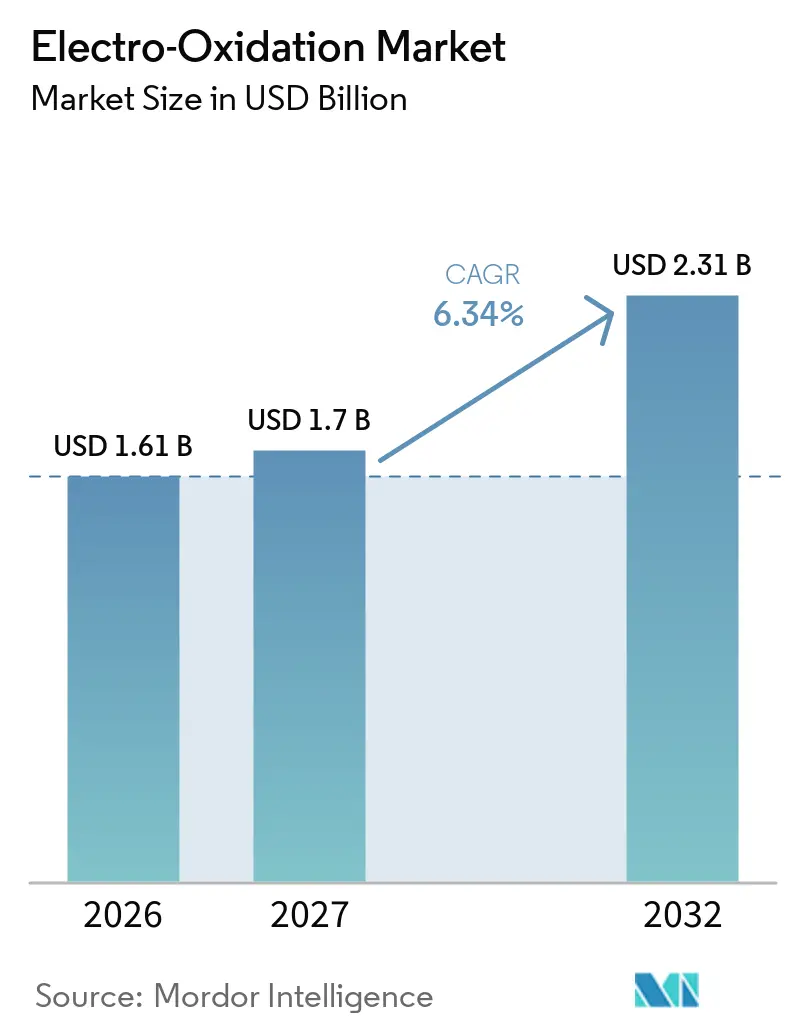
| Market Size (2027) | USD 1.7 Billion |
| Market Size (2032) | USD 2.31 Billion |
| Growth Rate (2027 - 2032) | 6.34 % |
| Fastest Growing Market | Asia-Pacific |
| Largest Market | Asia-Pacific |
| Market Concentration | Low |
Major Players *Disclaimer: Major Players sorted in no particular order Image © Mordor Intelligence. Reuse requires attribution under CC BY 4.0. | |
Electro-Oxidation Market Analysis by Mordor Intelligence
The Electro-oxidation market size was valued at USD 1.61 billion in 2026 and is estimated to grow from USD 1.70 billion in 2027 to USD 2.31 billion by 2032, at a CAGR of 6.34% during the forecast period (2027-2032). The electro-oxidation market is shifting from contaminant capture toward on-site destruction of persistent pollutants. This shift is significant because activated carbon and ion exchange retain contaminants for later disposal, while electrochemical treatment can support mineralization at the treatment site. Stricter controls on per- and polyfluoroalkyl substances (PFAS), micropollutants, and refractory organics are increasing the value of treatment systems that can demonstrate destruction rather than separation. Water scarcity is also driving interest in reuse systems capable of handling difficult industrial wastewater. These conditions are shortening procurement cycles in industrial and municipal settings and favoring modular systems with documented performance.
Key Report Takeaways
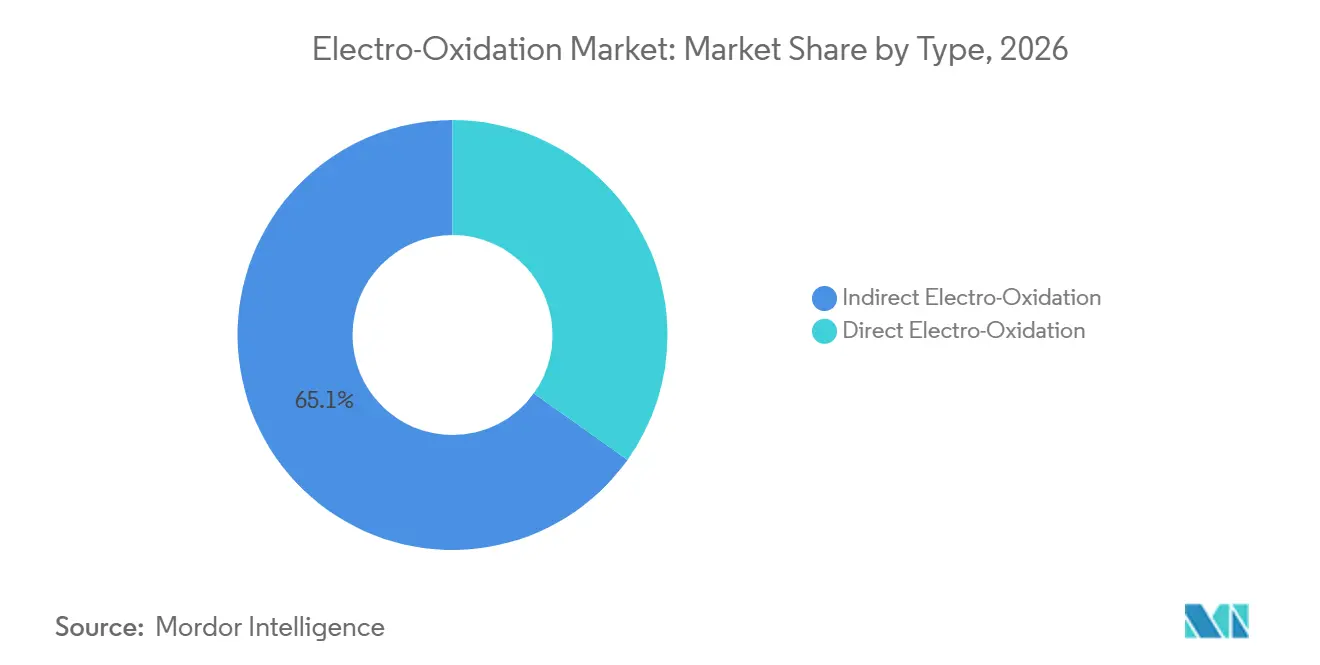
- By type, indirect electro-oxidation held 65.12% of revenue in 2026, while direct electro-oxidation is projected to grow at a 6.96% CAGR through 2032.
- By electrode material, boron-doped diamond held 44.63% of revenue in 2026, while stannic oxide is forecast to grow at a 7.42% CAGR through 2032.
- By application, organic and micropollutant treatment accounted for 54.58% of the Electro-oxidation market size in 2026, while disinfection and specialized treatment are forecast to expand at a 7.53% CAGR through 2032.
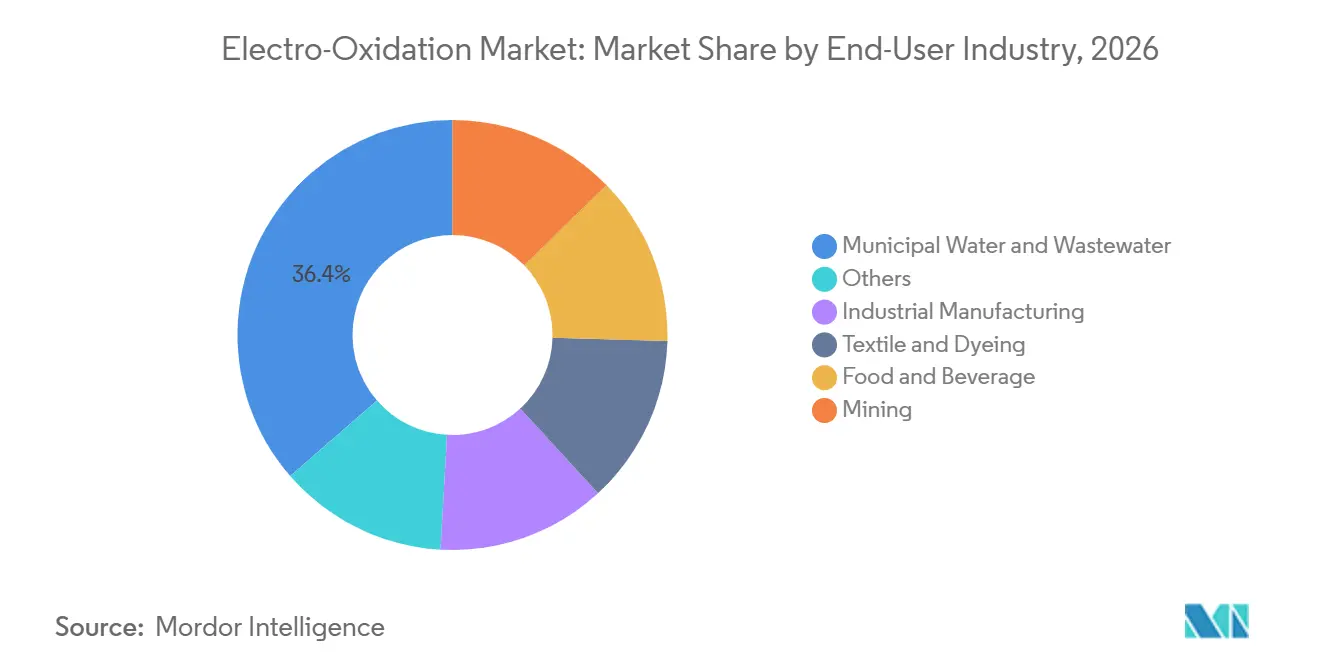
- By end-user industry, municipal water and wastewater held 36.39% of revenue in 2026, while industrial manufacturing is projected to grow at an 8.08% CAGR through 2032.
- By geography, Asia-Pacific held 39.17% of revenue in 2026 and is forecast to grow at a 7.71% CAGR through 2032.
Note: Market numbers in this report are based on Mordor Intelligence's proprietary estimation framework, which combines nine months of actuals with Q4 projections for base year 2026.
Market Trends and Insights
Drivers Impact Analysis of Electro-Oxidation Market*
| Drivers | (~) % Impact on CAGR Forecast | Geographic Relevance | Impact Timeline |
|---|---|---|---|
| Tightening Per- and Polyfluoroalkyl Substances (PFAS) and Micropollutant Discharge Standards | +1.6% | Global, with early regulatory pressure in North America and Europe | Short term (≤ 2 years) |
| Expansion of Zero-Liquid-Discharge and Water-Reuse Projects | +1.2% | Asia-Pacific, with spillover to the Middle East | Medium term (2-4 years) |
| Industrial Demand for Destruction of Refractory Organics | +1.0% | North America, Europe, and industrial Asia-Pacific | Medium term (2-4 years) |
| Growing Adoption of Modular and Decentralized Treatment Systems | +0.8% | Global, with accelerated uptake in Asia-Pacific and South America | Medium term (2-4 years) |
| Electrification of Chemical-Free Advanced Oxidation | +0.5% | Global | Long term (≥ 4 years) |
| Source: Mordor Intelligence | |||
Tightening Per- and Polyfluoroalkyl Substances (PFAS) and Micropollutant Discharge Standards
In April 2025, the U.S. EPA announced plans to address per- and polyfluoroalkyl substances (PFAS) contamination through several actions, including annual updates to its PFAS destruction and disposal guidance. The regulatory agenda also includes developing effluent limitations guidelines for PFAS manufacturers and metal finishers. The 2024 designation of perfluorooctanoic acid (PFOA) and perfluorooctanesulfonic acid (PFOS) as hazardous substances under CERCLA increased liability exposure for affected facilities. A 2025 scientific review identified electrochemical approaches among the technologies used to treat PFAS-contaminated water and wastewater. The electro-oxidation market gains relevance where industrial operators require treatment processes that destroy PFAS rather than transfer it to a separate waste stream. Municipal plants may also restrict acceptance of contaminated influent, which can prompt affected industrial facilities to consider on-site destruction capacity.
Expansion of Zero-Liquid-Discharge and Water-Reuse Projects
Zero-liquid-discharge programs in China and India create a role for electro-oxidation as a polishing step before evaporation. The approach is suited to saline concentrates containing refractory organics that challenge biological treatment systems. A 2025 study of rubber wastewater reported stable chemical oxygen demand removal of 71% during 300 hours of continuous electrochemical operation, with an operating cost of USD 1.06/m³ for the evaluated saline wastewater system. The electro-oxidation market can benefit from reuse projects that require a technology capable of handling high conductivity and substantial organic loading. Its position near the end of a treatment train also helps meet water-quality requirements before reuse or final concentration.
Industrial Demand for Destruction of Refractory Organics
Industrial wastewater can contain surfactants, endocrine-disrupting compounds, pharmaceutical ingredients, and other recalcitrant organic compounds that exceed the practical limits of biological oxidation, creating a demand for advanced treatment systems. A 2025 pilot-scale study reported 99.9% phenol removal from petroleum refinery wastewater during continuous operation over three months, with energy use of 0.25–0.45 kWh/m³ under the evaluated conditions. Axine Water Technologies described the commercial deployment of its electraCLEAR platform for industrial wastewater treatment[1]. The electro-oxidation market is supported by applications in which systems must continue operating as influent composition changes in industrial processes.
Growing Adoption of Modular and Decentralized Treatment Systems
Modular systems can shorten deployment schedules compared with centralized treatment expansions and allow operators to align capital decisions with specific compliance dates and wastewater quantities. A 2025 review identified adaptability to changing wastewater characteristics, lower sludge generation, and on-site reuse potential as advantages of decentralized electrochemical systems. In July 2025, Hydroleap reported funding to expand its modular water-treatment technology across applications, including data centers, food processing, and palm oil operations. This example illustrates the range of operating environments that compact treatment equipment can address. The electro-oxidation market can benefit further where real-time controls adjust current density and flow in response to changes in influent conditions.
Restraints Impact Analysis of Electro-Oxidation Market*
| Restraints | (~) % Impact on CAGR Forecast | Geographic Relevance | Impact Timeline |
|---|---|---|---|
| High Electricity Consumption at Elevated Current Density | -0.8% | Global, most acute in regions with high industrial electricity tariffs | Short term (≤ 2 years) |
| High Cost and Supply Risk of Boron-Doped Diamond (BDD) and Platinum-Group Materials | -0.7% | Global, with supply concentrated in selected European and Asian manufacturing hubs | Medium term (2-4 years) |
| Wastewater-Matrix Variability and Process-Optimization Complexity | -0.5% | Global, especially industrial applications with variable influent quality | Medium term (2-4 years) |
| Source: Mordor Intelligence | |||
High Electricity Consumption at Elevated Current Density
Energy demand remains a material constraint on the direct electro-oxidation of concentrated per- and polyfluoroalkyl substances (PFAS) and pharmaceutical residues. A 2025 study on p-benzoquinone degradation reported an energy demand of 100-127 kWh/m³ under optimized conditions for high-refractory streams. A 2025 assessment estimated energy costs for electrochemical processes in potable reuse at USD 0.062-0.804/m³ across applications. This range indicates that operating economics vary across water chemistry, treatment targets, and system designs. Fixed-rate service contracts can create margin pressure if electricity prices rise after contract terms are set. Renewable power integration is being considered for remote and decentralized configurations, where power supply can be planned alongside the treatment system.
High Cost and Supply Risk of Boron-Doped Diamond (BDD) and Platinum-Group Materials
Boron-doped diamond (BDD) electrodes require chemical vapor deposition, which is both energy-intensive and capital-intensive. A 2025 review identified lower-cost BDD production as a major research priority, as fabrication costs limit broader industrial deployment[2]. Platinum-group metals are also used in mixed metal oxide and specialty electrode systems. Their concentrated supply can expose buyers to price volatility and procurement delays. Electrode replacement cost is therefore part of long-term system evaluation rather than an isolated technical consideration. This is driving interest in stannic oxide and titanium suboxide alternatives for applications that do not require the highest oxidation capability.
*Our forecasts treat driver/restraint impacts as directional, not additive. The impact forecasts reflect baseline growth, mix effects, and variable interactions.
Electro-Oxidation Market Segment Analysis
By Type:
Indirect Oxidation Holds Revenue Scale, Direct Gains Precision GroundDirect electro-oxidation is forecast to grow at a 6.96% CAGR through 2032. It is used where direct electron transfer supports molecular-level mineralization of concentrated refractory pollutants, including per- and polyfluoroalkyl substances (PFAS). This operating characteristic is valuable when indirect pathways do not provide consistent destruction performance for a difficult contaminant mixture. The direct approach may apply to residual concentrates remaining after preliminary treatment. It can also provide a focused treatment step where discharge requirements demand lower contaminant concentrations. Direct systems are used in settings where the nature of the wastewater justifies high treatment intensity. The approach is particularly relevant when conventional biological treatment cannot manage persistent compounds. Its greater precision must be weighed against its energy demand and electrode requirements. System buyers, therefore, assess direct treatment against the concentration, flow rate, and composition of the specific stream. That assessment also determines whether direct treatment is used as a standalone process or as a final step after another technology reduces the main contaminant load.
Indirect electro-oxidation held 65.12% of revenue in 2026. This share reflects demand for systems that can treat high-conductivity municipal and industrial streams while reducing the risk of electrode passivation. Indirect systems generate oxidants such as hypochlorite and hydrogen peroxide in situ. These oxidants can be applied to wastewater from food processing, textile operations, and municipal facilities. The approach is often suited to chloride-containing streams where indirect oxidant generation is effective. Direct and indirect systems are increasingly combined rather than treated as mutually exclusive options. Indirect treatment can be applied first, followed by direct treatment of a smaller and more concentrated residual stream. A 2025 study reported stable chemical oxygen demand removal during 300 hours of direct electro-oxidation in saline industrial wastewater. This supports modular configurations in which treatment performance, rather than a single technology type, guides system selection. This combination also allows a facility to align the operating intensity of each treatment step with the condition of the incoming water.

By Electrode Material:
BDD Commands Capability Premium, Stannic Oxide Builds Commercial MomentumStannic oxide is forecast to grow at a 7.42% CAGR through 2032. Its growth reflects interest from industrial buyers seeking electrode materials with a lower cost profile than boron-doped diamond (BDD) systems. A September 2025 review found that rare-earth doping can improve the surface properties of stannic oxide, the generation of hydroxyl radicals, and the electrocatalytic durability. The review also described homojunction designs with projected service lives of 2.3 years. These developments address the historical concern that stannic oxide may have limited stability in demanding applications. The electro-oxidation market is examining materials that can achieve adequate treatment performance without incurring premium electrode fabrication costs. Stannic oxide may therefore have a role in mid-range industrial systems and high-demand applications. Its commercial position depends on balancing lifetime, current efficiency, and replacement costs. These factors determine whether a lower initial electrode cost translates into a lower whole-life system cost. This consideration is especially important where treatment economics are evaluated over an electrode replacement cycle rather than only at the point of equipment purchase.
Boron-doped diamond held 44.63% of revenue in 2026. Its position reflects a high oxidation potential that is useful for difficult wastewater remediation applications. A 2025 review reported that boron-doped diamond anodic oxidation achieved up to 93% chemical oxygen demand removal and 97% mineralization in real wastewater remediation studies. A separate 2025 study found that free-standing boron-doped diamond electrodes at high current density more effectively destroyed short-chain PFAS than thin-film configurations. Mixed metal oxide electrodes remain relevant for cost-sensitive disinfection and inorganic treatment. Titanium suboxides are being studied for PFAS degradation, while graphite has specialized uses in refinery and specialty chemical treatment. Lead dioxide can be effective in oxidation systems, but concerns about secondary contamination are influencing its suitability for municipal specifications. Material selection in the electro-oxidation market depends on the pollutant target, wastewater conductivity, operating life, and acceptable capital cost. It also determines how closely a system can be tailored to a particular pollutant mixture without imposing an unnecessary cost premium on less demanding applications.
By Application:
Micropollutant Treatment Anchors Revenue, Disinfection AcceleratesOrganic and micropollutant treatment accounted for 54.58% of revenue in 2026. This application includes PFAS remediation, pharmaceutical compound management, and treatment of persistent pesticides in municipal and industrial streams. It benefits from the gap between regulatory pollutant limits and the capabilities of biological or physicochemical treatment. Electro-oxidation can address this gap by supporting mineralization rather than transferring contaminants to a spent media stream. The electro-oxidation market has a clear role where industrial wastewater contains compounds that resist conventional biological treatment. Inorganic treatment addresses heavy metals, cyanide, and nitrates in mining and chemical effluents. This application is important for high-total-dissolved-solids and high-conductivity streams that are difficult for biological processes to handle. It is particularly relevant to industrial wastewater systems that require robust treatment under varying loading conditions. The application mix depends on both the regulated contaminant and the wastewater's physical chemistry. It also reflects whether the treatment objective is pollutant destruction, disinfection, reuse preparation, or removal of a specific inorganic contaminant.
Disinfection and specialized treatment are forecast to grow at a 7.53% CAGR through 2032. Demand is linked to chemical-free pathogen inactivation for potable reuse, hospital wastewater, and remote drinking-water systems. A 2025 study reported 96% bacterial inactivation in simulated hospital wastewater and 92% in real sewage using a continuous mixed-metal-oxide-anode system. The study reported energy consumption of 0.184 kWh/m³ and an operating cost of USD 1.88/m³. This performance supports use in decentralized settings where chemical delivery and residual handling are concerns. The European Union Water Reuse Regulation is also associated with demand for treatment systems used in agricultural irrigation reuse. The electro-oxidation market can therefore extend beyond conventional wastewater treatment into site-specific reuse applications. Adoption will depend on local water-quality requirements, system reliability, and operating cost. It will also depend on whether a site requires a compact treatment option that avoids routine handling of chemical disinfectants. The case for adoption is strongest where reused water must meet a defined microbial standard and where treatment space is limited.
By End-User Industry:
Municipal Scale Meets Industrial UrgencyIndustrial manufacturing is forecast to grow at an 8.08% CAGR through 2032. Automotive finishing, specialty chemicals, semiconductor fabrication, and pharmaceutical production generate wastewater streams that require treatment beyond the capabilities of conventional systems. These facilities face a growing need to manage liability and maintain compliance across multiple sites. The electro-oxidation market is relevant because modular systems can be placed close to the source of difficult wastewater, potentially reducing the need to transfer complex waste streams to a municipal treatment plant. Industrial buyers also value treatment technologies that can be deployed in phases as manufacturing capacity changes. Multi-site procurement can follow when pilot performance is consistent across facilities. The strongest demand is likely to remain in applications where refractory pollutants, high salinity, or stringent discharge limits make treatment failure costly. The segment's growth reflects the urgency of those conditions rather than a general replacement of conventional wastewater technologies. This is particularly relevant when wastewater variability makes a centralized treatment process insufficient for a specific production line.
Municipal water and wastewater held 36.39% of revenue in 2026. Municipal contracts can be large because they are tied to treatment upgrades and public infrastructure programs. Electro-oxidation is used in tertiary treatment settings where facilities must address emerging contaminants. Municipal influent acceptance standards can also affect industrial demand, as generators may be required to treat difficult streams on-site. Textile and dyeing operations are relevant because their effluents can contain high color, chemical oxygen demand, and surfactants. Viridis Research reported that its February 2026 pilot with H&M Group in Bangladesh achieved 99.6%–99.9% color removal from dye baths via electrochemical oxidation. Food and beverage facilities use electro-oxidation for zero-liquid-discharge compliance and chemical-free disinfection. Mining operations use the technology for acid drainage and cyanide detoxification, where discharge requirements are strongly enforced. Pharmaceutical and electronics manufacturing also offer potential, as pharmaceutical residues and ultrapure rinse wastewater require specialized treatment. These end-user settings differ in flow, pollutant profile, and compliance risk, which is why modular application design is a recurring consideration across the electro-oxidation market.
Geography Analysis
APAC Electro-Oxidation Market
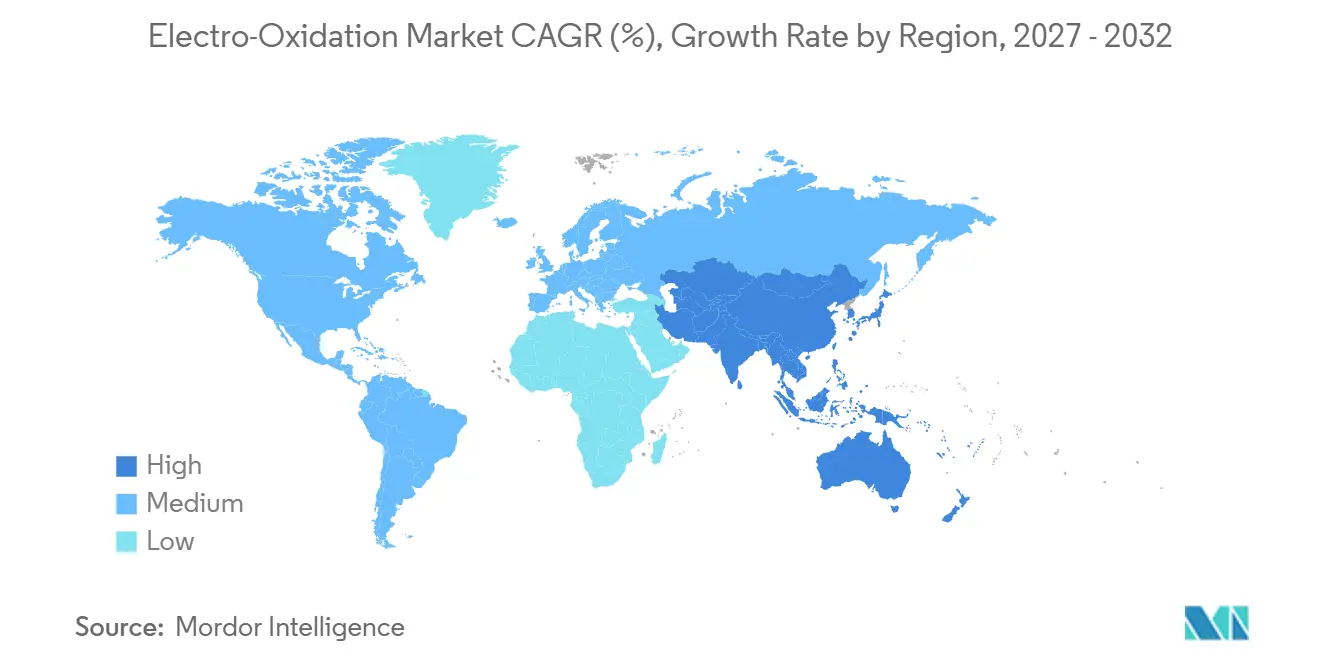
Asia-Pacific accounted for 39.17% of global revenue in 2026 and is forecast to grow at a 7.71% CAGR through 2032. The region is the largest and fastest-growing geographic area in the analysis, reflecting the scale of its industrial wastewater challenge. China drives regional demand, as manufacturing wastewater and zero-liquid-discharge requirements spur treatment of saline, concentrated, and difficult streams. India also supports demand, as textile, pharmaceutical, and chemical facilities require compact systems suited to decentralized industrial estates. Japan and South Korea drive demand for precision specifications in semiconductor and electronics manufacturing, while Vietnam, Indonesia, and Thailand represent emerging opportunities as industrial estates expand and environmental enforcement strengthens.
North America Electro-Oxidation Market
North America is the second-largest region in the analysis, supported by PFAS liability exposure under the Comprehensive Environmental Response, Compensation, and Liability Act (CERCLA) and state-level requirements that can exceed federal limits in scope or stringency. Axine Water Technologies has described commercial industrial PFAS treatment deployments, indicating a shift from pilot evaluation toward broader procurement. WSP launched its PFASER modular boron-doped diamond electrode system in June 2025 to destroy PFAS and perchlorate, using commercial reactors supplied by Pro Aqua. WaterTectonics launched WT Oil & Gas in October 2025 to target produced-water recycling in the Permian and Delaware Basins. These applications illustrate why the electro-oxidation market in North America is closely linked to industrial PFAS and produced-water treatment.
EMEA and South America Electro-Oxidation Market
Europe has seen early adoption of pharmaceutical and chemical operations, while the Axine and Nijhuis Saur Industries partnership, announced in March 2025, supports European PFAS destruction projects. South America offers opportunities in acid mine drainage and agri-food water reuse, particularly in Brazil. At the same time, the smaller Middle East and African markets have clear applications in petroleum, petrochemical, and mining wastewater. A 2025 study reported 84%- 90% removal of chemical oxygen demand from produced water during continuous electrochemical treatment. Saudi Arabia's produced-water and spent-caustic requirements, together with South African acid mine drainage needs, support use cases involving high-salinity, high-metal, or high-organic wastewater that require durable, site-specific treatment configurations.
Competitive Landscape
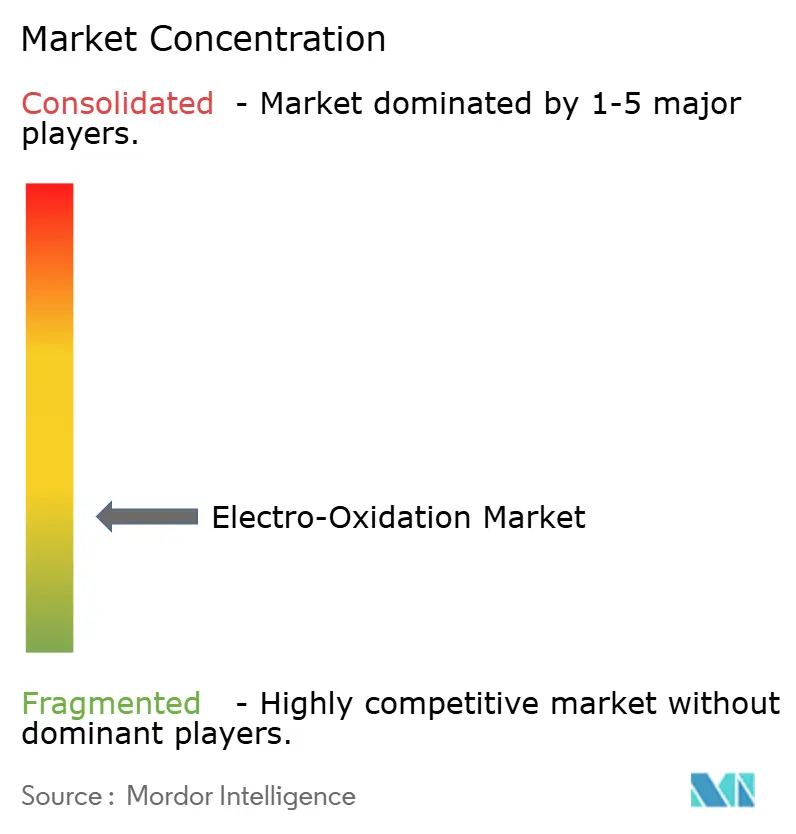
The electro-oxidation market is fragmented. Large water service companies, including Veolia and Xylem, compete alongside specialist providers such as Axine Water Technologies, Arvia Technology, Aclarity, and Hydroleap. Xylem expanded its electrochemical product portfolio through its 2023 acquisition of Evoqua, while specialists compete on application focus, compact system design, and treatment performance for difficult wastewater streams. Competition is strongest where buyers require treatment of short-chain PFAS or complete mineralization of persistent pollutants. Providers also offer containerized and mobile systems to lower the initial capital threshold for industrial adopters.
OVIVO's Obreak system, developed with E2metrix, illustrates an application-led approach to PFAS treatment procurement, while Element Six supplies boron-doped diamond materials to downstream system builders. Companies commonly combine concentration and destruction technologies to reduce the quantity treated electrochemically and lower energy consumption. Axine Water Technologies and Nijhuis Saur Industries announced a partnership in March 2025 to destroy PFAS using electraCLEAR technology. WSP launched PFASER in June 2025, introducing a modular system designed to destroy PFAS and perchlorate simultaneously. Hydroleap's 2025 funding supported the expansion of its modular treatment technology across Asia-Pacific.
The electro-oxidation market presents opportunities in agricultural irrigation reuse, mining acid drainage, and pharmaceutical facility effluent treatment. These applications can favor specialist design, as wastewater chemistry and operating requirements vary considerably by site. Buyers evaluate treatment performance, electrode life, energy consumption, and the ability to accommodate changes in wastewater composition. Integrated water companies can leverage their installed base and service networks for larger projects, while specialists can respond more quickly to specific pollutants and industrial applications.
Electro-Oxidation Industry Leaders
-
Nora S.p.A.
-
OVIVO USA LLC
-
Hydroleap
-
AXINE WATER TECHNOLOGIES
-
Aqua Pulsar
- *Disclaimer: Major Players sorted in no particular order
Electro-Oxidation Market Companies Covered in this Report
- Aclarity, Inc.
- Aqua Pulsar
- Aqua-Aerobic Systems, Inc.
- Aquarden Technologies
- Arvia Technology
- AXINE WATER TECHNOLOGIES
- Element Six
- EnviroChemie GmbH
- Hydroleap
- Nora S.p.A.
- OVIVO USA LLC
- SUEZ
- Veolia
- WaterTectonics
- Xylem
Recent Industry Developments in Electro-Oxidation Market
- September 2026: WaterTectonics acquired the patents and intellectual property of Dynamic Water Technologies, becoming the exclusive OEM (Original Equipment Manufacturer) of the Dynamic Scale Remover (DSR) electrochemical technology for industrial and commercial cooling tower treatment across North America. This acquisition expanded its electro-oxidation portfolio into a new industrial sub-vertical.
- May 2026: Nijhuis Saur Industries (NSI, part of Saur Group) launched PFAS (per- and polyfluoroalkyl substances) Resolve at IFAT 2026 in Munich. The product is an integrated modular system combining Coldep's VAL Foam Fractionation technology with Axine Water Technologies' electraCLEAR electro-oxidation. It targets on-site destruction of long-, short-, and ultra-short-chain PFAS, including TFA (trifluoroacetic acid), a compound that has historically been difficult to treat using electro-oxidation methods.
Global Electro-Oxidation Market Report Scope
Electro-oxidation is an advanced oxidation process used to break down organic and inorganic pollutants in water or to convert chemical precursors into higher-value products. The process works by applying an electric current to drive oxidation reactions at the surface of an anode, generating reactive species such as hydroxyl radicals, chlorine, and ozone, which then degrade contaminants or facilitate chemical transformations.
The electro-oxidation market is segmented by type, electrode material, application, end-user industry, and geography. By type, the market is segmented into direct electro-oxidation and indirect electro-oxidation. By electrode material, the market is segmented into boron-doped diamond, mixed metal oxide, lead dioxide, stannic oxide, titanium suboxides, graphite, and platinum. By application, the market is segmented into organic and micropollutant treatment, inorganic treatment, disinfection and specialized treatment, and others. By end-user industry, the market is segmented into municipal water and wastewater, industrial manufacturing, textile and dyeing, food and beverage, mining, and others. The report also covers market sizes and forecasts for electro-oxidation across 15 countries in major regions. The market sizes and forecasts are provided in terms of value (USD).
Segmentation Overview
| Direct Electro-Oxidation |
| Indirect Electro-Oxidation |
| Boron-Doped Diamond |
| Mixed Metal Oxide |
| Lead Dioxide |
| Stannic Oxide |
| Titanium Suboxides |
| Graphite |
| Platinum |
| Organic and Micropollutant Treatment |
| Inorganic Treatment |
| Disinfection and Specialized Treatment |
| Others |
| Municipal Water and Wastewater |
| Industrial Manufacturing |
| Textile and Dyeing |
| Food and Beverage |
| Mining |
| Others |
| Asia-Pacific | China |
| India | |
| Japan | |
| South Korea | |
| ASEAN Countries | |
| Rest of Asia-Pacific | |
| North America | United States |
| Canada | |
| Mexico | |
| Europe | Germany |
| United Kingdom | |
| France | |
| Italy | |
| NORDIC Countries | |
| Rest of Europe | |
| South America | Brazil |
| Argentina | |
| Rest of South America | |
| Middle East and Africa | Saudi Arabia |
| South Africa | |
| Rest of Middle East and Africa |
| By Type | Direct Electro-Oxidation | |
| Indirect Electro-Oxidation | ||
| By Electrode Material | Boron-Doped Diamond | |
| Mixed Metal Oxide | ||
| Lead Dioxide | ||
| Stannic Oxide | ||
| Titanium Suboxides | ||
| Graphite | ||
| Platinum | ||
| By Application | Organic and Micropollutant Treatment | |
| Inorganic Treatment | ||
| Disinfection and Specialized Treatment | ||
| Others | ||
| By End-User Industry | Municipal Water and Wastewater | |
| Industrial Manufacturing | ||
| Textile and Dyeing | ||
| Food and Beverage | ||
| Mining | ||
| Others | ||
| By Geography | Asia-Pacific | China |
| India | ||
| Japan | ||
| South Korea | ||
| ASEAN Countries | ||
| Rest of Asia-Pacific | ||
| North America | United States | |
| Canada | ||
| Mexico | ||
| Europe | Germany | |
| United Kingdom | ||
| France | ||
| Italy | ||
| NORDIC Countries | ||
| Rest of Europe | ||
| South America | Brazil | |
| Argentina | ||
| Rest of South America | ||
| Middle East and Africa | Saudi Arabia | |
| South Africa | ||
| Rest of Middle East and Africa | ||
Key Questions Answered in the Report
What is current market size of Electro-Oxidation Market?
The Electro-oxidation market size was valued at USD 1.61 billion in 2026 and is estimated to grow from USD 1.70 billion in 2027 to USD 2.31 billion by 2032, at a CAGR of 6.34% during the forecast period (2027-2032).
Which electro-oxidation type has the largest revenue share?
Indirect electro-oxidation held the largest share at 65.12% in 2026, while direct electro-oxidation is the fastest-growing type at a 6.96% CAGR.
Which application is growing fastest for electro-oxidation?
Disinfection and specialized treatment are forecast to grow at a 7.53% CAGR through 2032, supported by potable reuse, hospital wastewater treatment, and decentralized systems.
Which region leads electro-oxidation adoption?
Asia-Pacific holds 39.17% of revenue in 2026 and is projected to grow at a 7.71% CAGR through 2032.