
E-Commerce Small-Parcel Delivery Market Size and Share
Market Overview
| Study Period | 2020 - 2031 |
|---|---|
| Market Size (2026) | USD 165.32 Billion |
| Market Size (2031) | USD 212.51 Billion |
| Growth Rate (2026 - 2031) | 5.15 % |
| Fastest Growing Market | Asia-Pacific |
| Largest Market | North America |
| Market Concentration | Medium |
Major Players *Disclaimer: Major Players sorted in no particular order Image © Mordor Intelligence. Reuse requires attribution under CC BY 4.0. | |
E-Commerce Small-Parcel Delivery Market Analysis by Mordor Intelligence
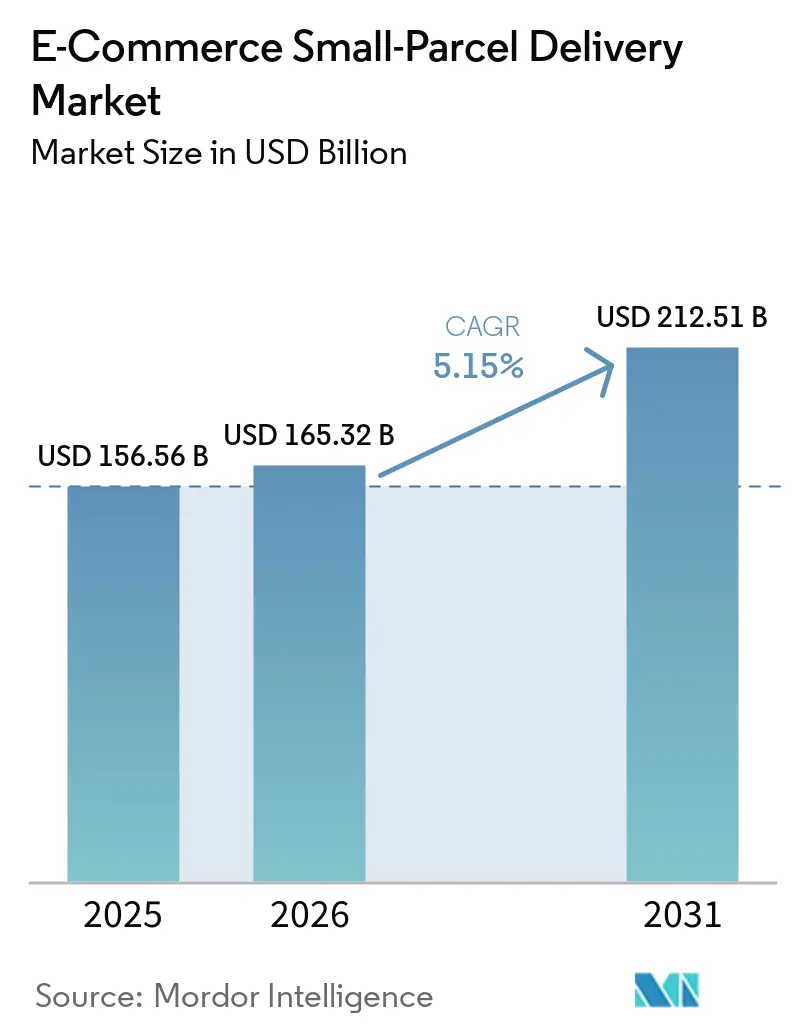
The e-commerce small-parcel delivery market size was valued at USD 156.56 billion in 2025 and is estimated to grow from USD 165.32 billion in 2026 to reach USD 212.51 billion by 2031, at a CAGR of 5.15% during the forecast period (2026-2031).
Online retail continued to increase the number of consumer shipments, with the United States retail e-commerce sales rising 12.2% year-over-year in Q2 2026 and representing 17.1% of total retail sales. Mobile shopping, social commerce, and marketplace buying support more frequent orders and smaller baskets, which increases the number of lightweight parcels handled by delivery networks. The e-commerce small-parcel delivery market also faces a more demanding operating model as buyers place greater importance on quick and reliable delivery. Cross-border rule changes are raising the need for customs processing, duty-paid delivery, and shipment visibility, particularly for shipments originating in Asia. Carriers and retailer-owned networks are responding with localized fulfillment, out-of-home collection points, and wider rural coverage.
Key Report Takeaways
- By destination, domestic shipments held 68.50% of the e-commerce small-parcel delivery market share in 2025, while international shipments registered at a 6.78% CAGR through 2031.
- By speed of delivery, non-express delivery held 62.60% of the e-commerce small-parcel delivery market size in 2025, while express delivery registered at a 6.65% CAGR through 2031.
- By model, B2C held 56.70% of the e-commerce small-parcel delivery market share in 2025, while C2C registered at a 7.05% CAGR through 2031.
- By mode of transport, road transport held 58.15% of the e-commerce small-parcel delivery market size in 2025, while air transport registered at a 6.85% CAGR through 2031.
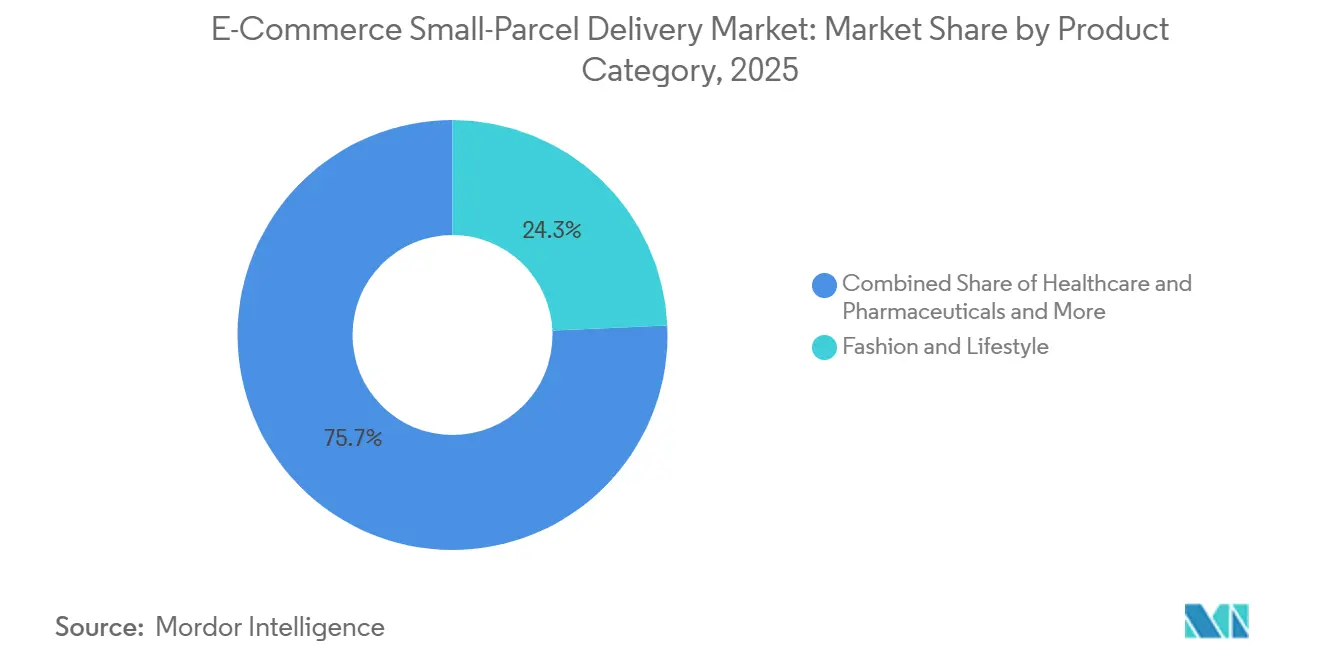
- By product category, fashion and lifestyle held 24.30% of the e-commerce small-parcel delivery market share in 2025, while healthcare and pharmaceuticals registered at a 7.15% CAGR through 2031.
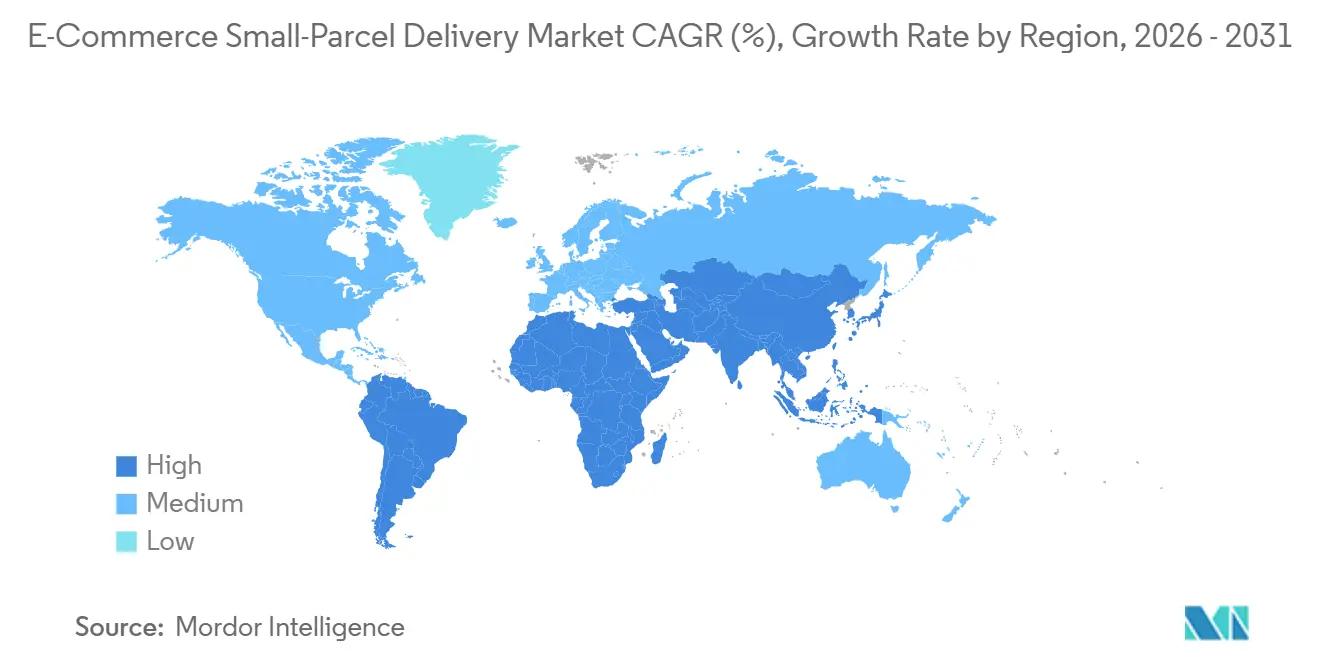
- By geography, North America held 39.50% of the e-commerce small-parcel delivery market share in 2025, while Asia-Pacific registered at a 6.89% CAGR through 2031.
Note: Market size and forecast figures in this report are generated using Mordor Intelligence’s proprietary estimation framework, updated with the latest available data and insights as of January 2026.
Global E-Commerce Small-Parcel Delivery Market Trends and Insights
Drivers Impact Analysis*
| Driver | (~) % Impact on CAGR Forecast | Geographic Relevance | Impact Timeline |
|---|---|---|---|
| Expansion of Online Retail and Mobile Commerce | +1.2% | Global, with strongest pull in North America and Asia-Pacific | Medium term (2-4 years) |
| Cross-Border Marketplace Penetration | +0.8% | Asia-Pacific, Europe, North America | Medium term (2-4 years) |
| Same-Day and Next-Day Delivery Adoption | +0.7% | North America, Europe, Asia-Pacific core | Short term (≤ 2 years) |
| Fulfillment Localization and Distributed Inventory | +0.5% | North America, Asia-Pacific, Europe | Medium term (2-4 years) |
| Open-Standard Parcel Lockers and Out-of-Home Delivery | +0.4% | Europe, Asia-Pacific | Medium term (2-4 years) |
| Retailer-Owned Parcel Networks and Rural Coverage Expansion | +0.4% | North America, Asia-Pacific | Long term (≥ 4 years) |
| Source: Mordor Intelligence | |||
Expansion of Online Retail and Mobile Commerce
Online retail is increasing parcel demand faster than total retail activity. The United States retail e-commerce sales rose 12.2% year-over-year in Q2 2026 and accounted for 17.1% of total retail sales[1]. Mobile and social commerce reduce the time between browsing and purchase, which supports more unplanned orders. These orders often contain 1 lightweight item and fit the service profile of the e-commerce small-parcel delivery market. Smaller baskets can lower revenue per parcel for carriers, yet they raise the structural volume base. The United States package volumes grew 29% from 2015 to 2025, reflecting the longer-term expansion of online shopping.
Cross-Border Marketplace Penetration
Cross-border marketplace activity is widening the range of delivery corridors that carriers need to serve. International sales create demand for customs data, duty handling, tracking, and returns management across the full shipment cycle. The e-commerce small-parcel delivery market benefits when operators can combine these services within a single shipment process. Cainiao expanded its Global 5-Day Delivery service to 6 Eurasian markets in September 2025. It also launched a cross-border service from the United States to Mexico in January 2026, covering 99% of Mexico. Such network additions raise competitive pressure on international carriers and increase service expectations among exporters.
Same-Day and Next-Day Delivery Adoption
Faster delivery commitments are changing how merchants position inventory and select parcel partners. Retailers need inventory closer to demand centers when they offer same-day or next-day services. That approach can create more split shipments when items are dispatched from different fulfillment sites. Split fulfillment increases the number of small-parcel movements linked to one consumer order. The e-commerce small-parcel delivery market, therefore, gains volume even where the number of completed purchases changes little. The operating trade-off is that carriers need dependable capacity and route density to protect delivery performance while limiting cost per stop.
Fulfillment Localization and Distributed Inventory
Distributed inventory is becoming a core operating model in high-frequency consumer markets. Amazon announced a USD 4 billion investment to expand its United States rural delivery network through 2026. The investment extends delivery reach beyond high-density urban routes and reduces the distance between stock and end customers. JD Logistics operated in 26 countries and more than 200 bonded, direct-mail, and overseas warehouses as of June 2026. Local fulfillment shortens delivery windows and can reduce long-distance delivery costs. It also makes parcel operations more dependent on warehouse placement, inventory accuracy, and reliable local delivery partners.
Restraints Impact Analysis*
| Restraint | (~) % Impact on CAGR Forecast | Geographic Relevance | Impact Timeline |
|---|---|---|---|
| Low-Yield Residential Density and Last-Mile Cost Inflation | -0.7% | Global, acute in North America and Europe | Short term (≤ 2 years) |
| De Minimis, Customs, and Lithium-Battery Compliance Complexity | -0.6% | Cross-border corridors, EU and the United States inbound, Asia-Pacific exporters | Medium term (2-4 years) |
| Returns, Failed Deliveries, and Reverse-Logistics Leakage | -0.5% | Global, acute in Europe and North America | Short term (≤ 2 years) |
| Peak-Capacity Imbalance and Retailer Volume Insourcing | -0.4% | North America, Europe | Long term (≥ 4 years) |
| Source: Mordor Intelligence | |||
Low-Yield Residential Density and Last-Mile Cost Inflation
Residential delivery remains a cost-intensive part of the parcel value chain. Low-density suburban and rural routes require more time and distance for each delivery stop. Free and fast delivery commitments limit the ability to recover these costs through consumer pricing. The cost challenge increases when large platform networks retain the highest-density urban routes. Remaining carrier networks can then face a less favorable mix of suburban and rural shipments. Fleet requirements in cities also add capital and operating costs without an equivalent increase in delivery revenue.
De Minimis, Customs, and Lithium-Battery Compliance Complexity
Customs policy is raising the compliance burden for cross-border low-value shipments. The United States suspended the USD 800 de minimis exemption for merchandise arriving through all modes other than the international postal network, effective June 2026. The European Union introduced a USD 3 flat customs duty on low-value B2C consignments from July 2026.[2] These rules increase the importance of accurate customs data, duty-paid delivery, and brokerage capabilities. They can reduce the advantage held by non-compliant low-cost exporters. Lithium-battery shipment rules create an additional classification burden for air-based consumer electronics and healthcare parcels.
*Our forecasts treat driver/restraint impacts as directional, not additive. The impact forecasts reflect baseline growth, mix effects, and variable interactions.
Segment Analysis
By Destination: Domestic Volume Anchors Share, International Corridors Accelerate
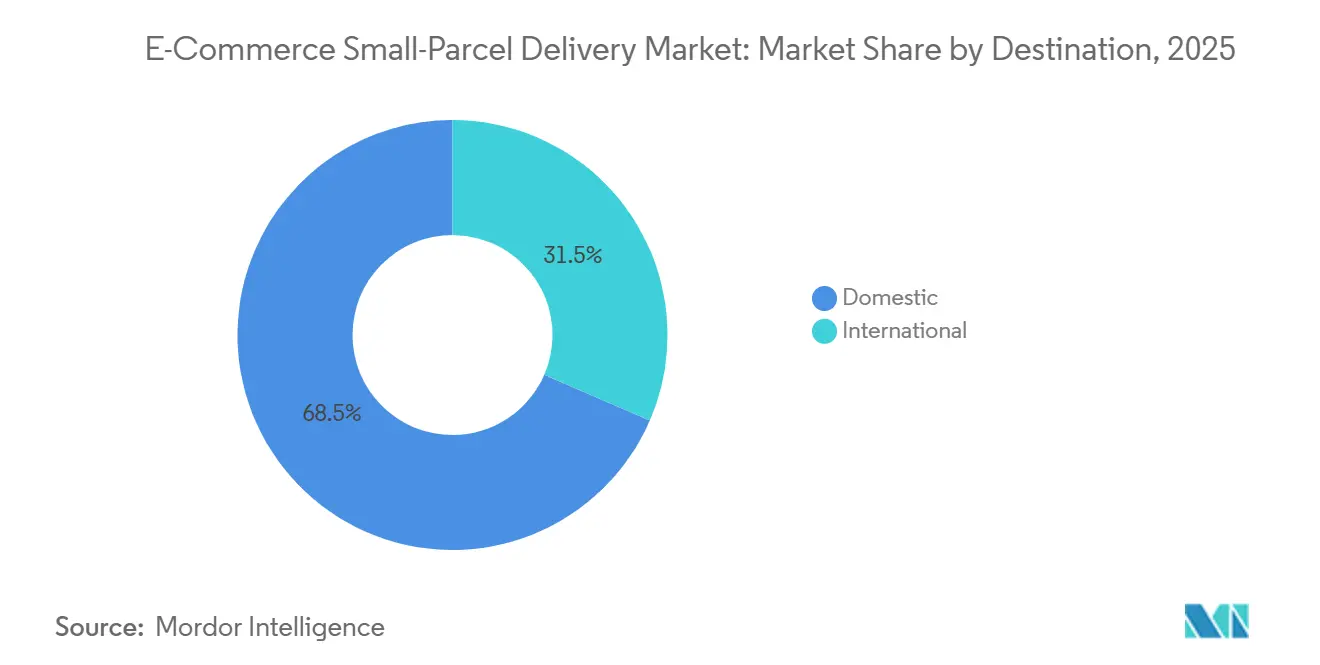
Domestic shipments represented 68.50% of the e-commerce small-parcel delivery market share in 2025. This position reflects established national carrier networks, predictable customs environments, and consumer preference for local sellers. Domestic delivery also benefits from mature delivery-point coverage and long-standing investment in last-mile operations[3]. The concentration reflects the cost and operational complexity of parcel delivery rather than transaction volume alone. Carriers can use dense domestic route networks to manage standard delivery commitments and service differentiation.
International shipments registered at a 6.78% CAGR through 2031. Cross-border flows depend on logistics investment, customs processing, and consistent delivery visibility. The United States policy change on de minimis shipments requires a formal or informal customs entry for relevant low-value imports. The European Union’s temporary low-value import duty similarly increases the value of compliant duty-paid shipping processes. These shifts favor operators that can manage customs data, brokerage, and tracking across the shipment lifecycle.

By Speed of Delivery: Non-Express Commands Volume, Express Gains Pricing Power
Non-express delivery held 62.60% of the e-commerce small-parcel delivery market size in 2025. Standard and economy services support carrier utilization across domestic routes and longer ground corridors. These services match consumer price sensitivity and allow carriers to consolidate shipments. Parcel consolidation can reduce unit costs and fill linehaul capacity on established routes. The segment, therefore, remains central to the network economics of ground carriers.
Express delivery registered at a 6.65% CAGR through 2031. Faster delivery services depend on localized inventory and reliable movement between fulfillment nodes. Regional carriers are adding hybrid air-and-ground options to support shorter transit times without building a full integrated air network. Air shipment requirements for lithium-containing batteries add compliance costs and classification work.[4] These requirements can make express service more difficult for smaller merchants to manage consistently. Express growth is tied to faster consumer delivery commitments and retailer investment in fulfillment proximity.
By Model: B2C Revenue Dominant, C2C Flows Emerge as Fastest-Growing Channel
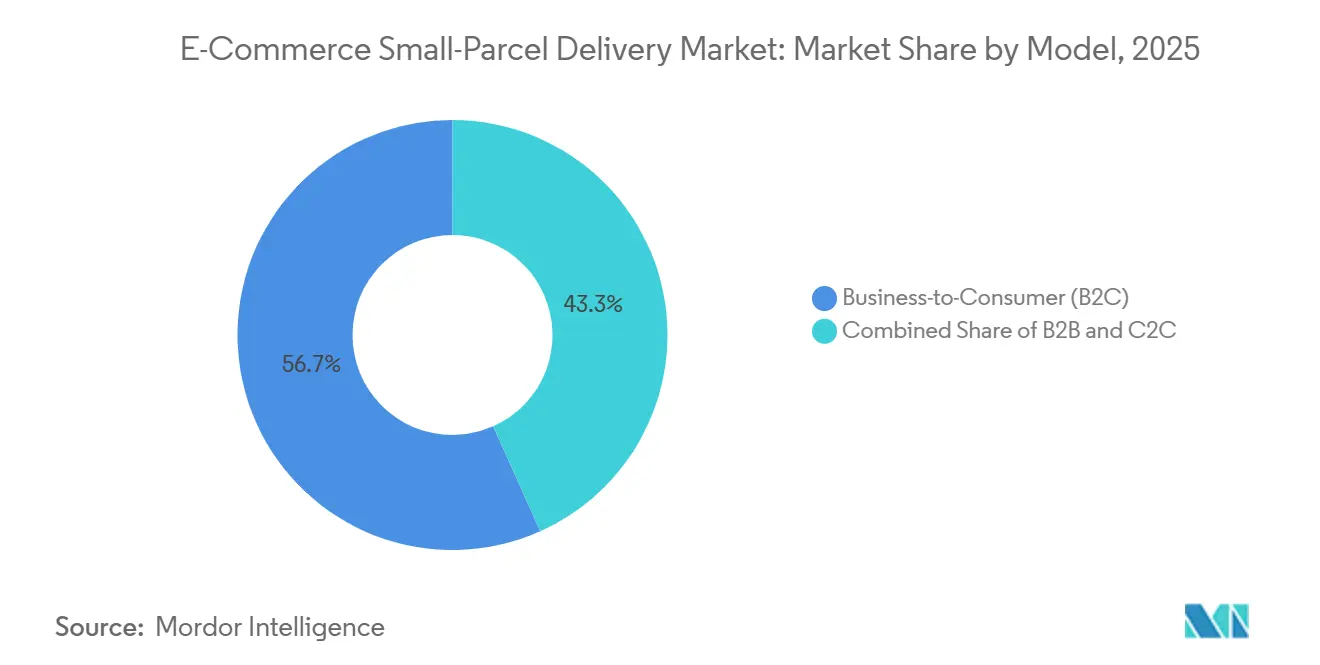
B2C shipments held 56.70% of the e-commerce small-parcel delivery market share in 2025. The segment reflects the broad role of consumer-directed shipping in online retail. B2C deliveries have higher average order values and more scope for service differentiation than C2C flows. B2B remains relevant for industrial supplies, professional services, and healthcare distribution. The e-commerce small-parcel delivery industry continues to serve both residential and business addresses through different operating models.
C2C delivery registered at a 7.05% CAGR through 2031. Re-commerce platforms and peer-to-peer marketplace transactions are expanding the flow of parcels sent by individual consumers. International Distribution Services reported that its multi-year platform agreements remained important for marketplace parcel growth in 2025/26. C2C senders may provide less consistent weight, value, content, and labeling information than commercial merchants. This raises handling complexity and inspection risk for cross-border carriers. The e-commerce small-parcel delivery industry needs services that simplify parcel drop-off, labeling, and returns for individual senders.
By Mode of Transport: Road Networks Lead Volume, Air Capacity Tracks Cross-Border Demand
Road transport accounted for 58.15% of the e-commerce small-parcel delivery market share in 2025. Ground networks have a cost advantage for domestic last-mile service and provide wide coverage across North America, Europe, and China. Most small parcels start and end in locations where air freight is not economical. Road networks also support routine collection, sorting, linehaul, and final delivery. Rail, water, and multimodal services hold the remaining share and can support selected cross-border corridors.
Air transport registered at a 6.85% CAGR through 2031. Time-sensitive international shipments are the main source of demand for this mode. Cainiao and Qatar Airways Cargo expanded their cooperation in September 2025 to increase charter capacity on China-Europe routes. Trade and tariff changes can require carriers to reroute international shipments and revise capacity plans. Air services also face stricter requirements for battery-containing consumer electronics and healthcare cargo. These conditions make compliance capability an important part of cross-border air operations.
By Product Category: Fashion Leads by Revenue Share, Pharma Delivery Gains Structural Momentum
Fashion and lifestyle held the largest product category share at 24.30% of the e-commerce small-parcel delivery market share in 2025. Apparel, accessories, and footwear generate frequent shipments and meaningful return activity. Most items have low unit weight and suit standard small-parcel service. Fast-fashion operators have also established short delivery window expectations among buyers. Consumer electronics, household appliances, home goods, food and beverages, personal care, and automotive parts remain meaningful product categories.
Healthcare and pharmaceuticals registered at a 7.15% CAGR through 2031. Home-based care, specialty therapies, and mail-order pharmacy services are increasing the need for trackable and time-sensitive delivery. FDA drug traceability requirements create documentation obligations for pharmaceutical distribution. Temperature control and good distribution practices require additional carrier capabilities. These requirements create a more specialized service segment than general merchandise delivery. Carriers with appropriate infrastructure can target this category alongside high-volume fashion shipments.
Geography Analysis
North America accounted for 39.50% of the global e-commerce small-parcel delivery market size in 2025. The region combines high consumer spending, mature road networks, and broad residential delivery coverage. DHL eCommerce and the United States Postal Service signed an exclusive multi-year last-mile agreement in May 2026, covering more than 170 million United States delivery points across 41,000+ ZIP codes and supporting national reach for e-commerce shipments. Amazon’s rural-network investment also shows that delivery coverage outside large cities remains strategically important. Canada and Mexico add cross-border demand, while Brazil and Chile are emerging South American markets where regional marketplace activity is supporting logistics investment.
Europe has a dense and competitive parcel landscape with a growing out-of-home delivery base. International Distribution Services expanded Royal Mail’s out-of-home network to approximately 30,000 parcel points in FY 2026, including 3,300 lockers and 8,500 Royal Mail Shops. La Poste Group announced a USD 43 million investment in a logistics facility near Lille in July 2026 as part of its network expansion. EU low-value customs changes can redirect volumes toward operators that manage compliant entry and local delivery. The Middle East and Africa are growing from a smaller base, with Aramex planning capacity expansion across Dubai, Saudi Arabia, Egypt, and Nigeria in 2026.
Asia-Pacific is registered at a 6.89% CAGR through 2031, the fastest regional rate. Growth is concentrated in Southeast Asia and in cross-border flows linked to China, where J&T Express reported parcel volume of 7.66 billion and revenue of USD 4.5 billion in 2025. Its new markets achieved adjusted EBIT-per-parcel profitability in the second half of 2025, while J&T Global Express and SF Holding formed a strategic cross-shareholding relationship in January 2026 with a total transaction value of USD 1 billion. The arrangement links cross-border air express capabilities with Southeast Asian and international last-mile networks, and Japan’s carriers are strengthening logistics coverage through new hub and partnership arrangements.
Competitive Landscape
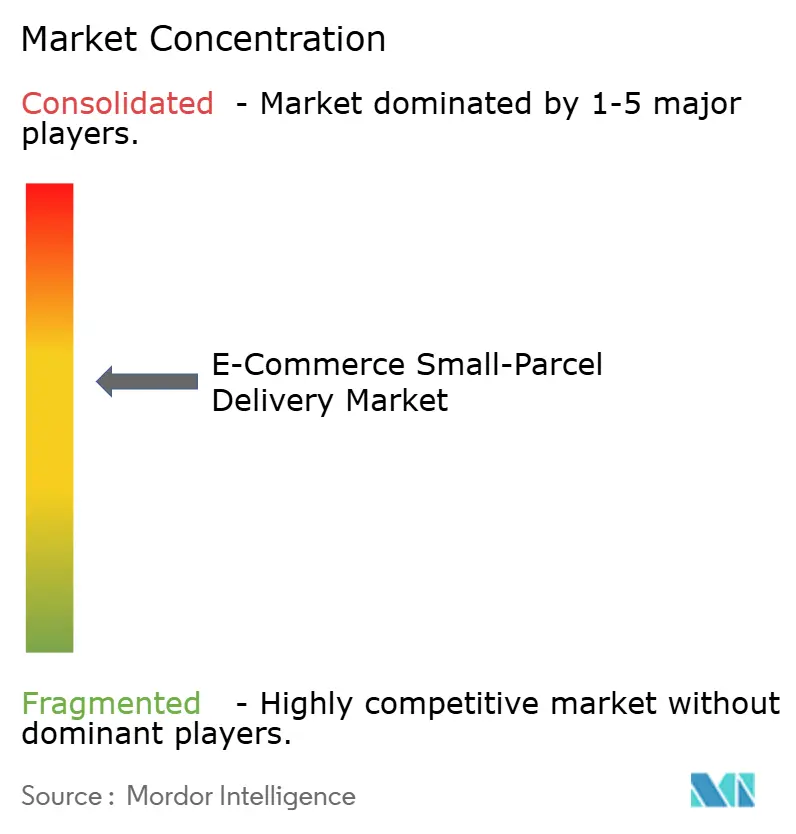
The e-commerce small-parcel delivery market has a moderately concentrated tier of integrated carriers and platform-owned logistics networks, alongside regional specialists and technology-enabled last-mile operators. FedEx, DHL Group, Amazon Logistics, and USPS anchor major North American delivery networks, while SF Holding, JD Logistics, and Cainiao hold strong positions on Asian export corridors. The e-commerce small-parcel delivery market is shaped by competition on route density, delivery speed, geographic reach, customs capability, and service reliability. J&T Global Express and SF Holding entered a USD 1 billion cross-shareholding agreement in January 2026, linking their international networks. The transaction shows how operators are using alliances to strengthen cross-border service without replicating all network assets.
Competitive opportunities remain in rural and low-density suburban delivery, C2C returns, and pharmaceutical-grade last-mile services. Veho expanded its United States delivery network to 66 markets in February 2026, covering 144 million Americans through new regional hubs and third-party logistics partnerships. Amazon opened its logistics infrastructure to third-party businesses in May 2026, extending its operations into contract logistics and bringing a large retailer-owned network into more direct competition with established providers. The e-commerce small-parcel delivery market is also rewarding carriers that can support certified temperature-controlled and regulated healthcare deliveries.
DHL Group and JD.com signed a memorandum of understanding in February 2026 to support German brand expansion in China through retail and end-to-end logistics services. FedEx expanded its collaboration with Japan Post in March 2026 for U-Global Express shipments to the United States and Canada. These partnerships show that established carriers are strengthening specific trade lanes rather than relying only on broad global coverage. Automated sorting, locker management, and route-planning systems remain important for managing cost and service quality. The e-commerce small-parcel delivery market remains competitive because merchants can use national, regional, platform-owned, or specialist delivery providers, and carriers match service capability with the economics of each route and shipment type.
E-Commerce Small-Parcel Delivery Industry Leaders
-
DHL Group
-
United Parcel Service of America, Inc. (UPS)
-
Amazon, Inc.
-
FedEx
-
SF Holding Co., Ltd.
- *Disclaimer: Major Players sorted in no particular order
Recent Industry Developments
- September 2026: JD Logistics released a comprehensive operational overview of its international supply chain infrastructure, confirming expansion to 26 countries and regions, utilizing more than 200 bonded, direct-mail, and overseas warehouses, with total overseas floor space exceeding 2 million m². The initiative, operating under its JoyLogistics and JoyExpress brands, targets integrated warehouse-centered 3PL delivery in core markets including the United States, the United Kingdom, Germany, France, Poland, and the UAE.
- May 2026: DHL eCommerce and the United States Postal Service signed an exclusive multi-year last-mile delivery contract valued at more than USD 10 billion. USPS serves as the exclusive last-mile provider for DHL eCommerce, covering more than 170 million United States delivery points across 41,000+ ZIP codes.
- May 2026: Amazon opened its logistics and supply chain network to third-party businesses across industries, including retail, healthcare, and manufacturing, enabling outside companies to store and ship goods through Amazon's ocean, road, rail, and air infrastructure.
- April 2026: FedEx named Viettel Post its National Network Provider for Vietnam, under a partnership agreement covering nationwide pickup and delivery, warehouse operations, and customs-clearance coordination.
Global E-Commerce Small-Parcel Delivery Market Report Scope
| Domestic |
| International |
| Express |
| Non-Express |
| Business-to-Business (B2B) |
| Business-to-Consumer (B2C) |
| Consumer-to-Consumer (C2C) |
| Air |
| Road |
| Others |
| Automotive Parts and Accessories |
| Foods & Beverages |
| Personal & Household Care |
| Fashion & Lifestyle (accessories, apparel, footwear) |
| Home Furnishing and Small Household Goods |
| Consumer Electronics & Household Appliances |
| Healthcare and Pharmaceuticals |
| Other Products |
| North America | United States |
| Canada | |
| Mexico | |
| South America | Brazil |
| Argentina | |
| Peru | |
| Chile | |
| Rest of South America | |
| Europe | Germany |
| United Kingdom | |
| France | |
| Italy | |
| Spain | |
| Russia | |
| Nordics (Denmark, Finland, Iceland, Norway, and Sweden) | |
| Rest of Europe | |
| Asia-Pacific | China |
| India | |
| Japan | |
| South Korea | |
| Australia | |
| Southeast Asia (ASEAN) | |
| Rest of Asia-Pacific | |
| Middle East and Africa | Saudi Arabia |
| United Arab Emirates | |
| Qatar | |
| South Africa | |
| Nigeria | |
| Egypt | |
| Rest of Middle East and Africa |
| By Destination | Domestic | |
| International | ||
| By Speed of Delivery | Express | |
| Non-Express | ||
| By Model | Business-to-Business (B2B) | |
| Business-to-Consumer (B2C) | ||
| Consumer-to-Consumer (C2C) | ||
| By Mode of Transport | Air | |
| Road | ||
| Others | ||
| By Product Category | Automotive Parts and Accessories | |
| Foods & Beverages | ||
| Personal & Household Care | ||
| Fashion & Lifestyle (accessories, apparel, footwear) | ||
| Home Furnishing and Small Household Goods | ||
| Consumer Electronics & Household Appliances | ||
| Healthcare and Pharmaceuticals | ||
| Other Products | ||
| By Geography | North America | United States |
| Canada | ||
| Mexico | ||
| South America | Brazil | |
| Argentina | ||
| Peru | ||
| Chile | ||
| Rest of South America | ||
| Europe | Germany | |
| United Kingdom | ||
| France | ||
| Italy | ||
| Spain | ||
| Russia | ||
| Nordics (Denmark, Finland, Iceland, Norway, and Sweden) | ||
| Rest of Europe | ||
| Asia-Pacific | China | |
| India | ||
| Japan | ||
| South Korea | ||
| Australia | ||
| Southeast Asia (ASEAN) | ||
| Rest of Asia-Pacific | ||
| Middle East and Africa | Saudi Arabia | |
| United Arab Emirates | ||
| Qatar | ||
| South Africa | ||
| Nigeria | ||
| Egypt | ||
| Rest of Middle East and Africa | ||
Key Questions Answered in the Report
What is the value of the e-commerce small-parcel delivery market in 2026?
The e-commerce small-parcel delivery market is valued at USD 165.32 billion in 2026 and is forecast to reach USD 212.51 billion by 2031.
Which destination type holds the largest share of e-commerce small-parcel delivery?
Domestic shipments held 68.50% of revenue in 2025, supported by established national carrier networks and predictable delivery conditions.
Which delivery service is growing faster?
Express delivery registered at a 6.65% CAGR through 2031 as retailers invest in faster fulfillment and shorter delivery windows.
Which transport mode leads small-parcel deliveries?
Road transport held 58.15% revenue share in 2025 because it supports cost-effective domestic collection, linehaul, and last-mile delivery.
Which region is growing fastest for small-parcel delivery?
Asia-Pacific registered at a 6.89% CAGR through 2031, supported by Southeast Asian parcel growth and China-linked cross-border flows.