
DRAM For PC and Laptop Market Size and Share
Market Overview
| Study Period | 2020 - 2031 |
|---|---|
| Market Size (2026) | USD 30.81 Billion |
| Market Size (2031) | USD 51.28 Billion |
| Growth Rate (2026 - 2031) | 10.73 % |
| Fastest Growing Market | Asia-Pacific |
| Largest Market | Asia-Pacific |
| Market Concentration | High |
Major Players *Disclaimer: Major Players sorted in no particular order Image © Mordor Intelligence. Reuse requires attribution under CC BY 4.0. | |
DRAM For PC and Laptop Market Analysis by Mordor Intelligence
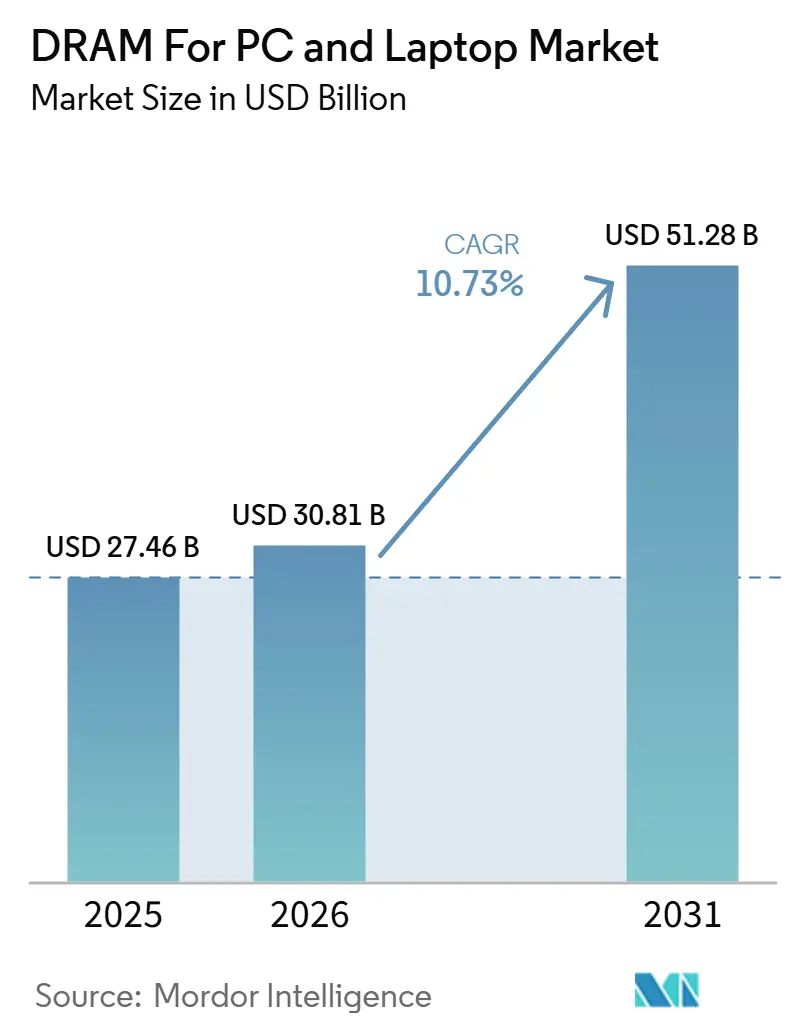
The DRAM for PC and Laptop market size is projected to be USD 27.46 billion in 2025, USD 30.81 billion in 2026, and reach USD 51.28 billion by 2031, growing at a CAGR of 10.73% from 2026 to 2031. The current expansion in the DRAM market for PCs and laptops is being driven less by unit growth alone and more by firmer pricing and a clear move toward higher-capacity memory configurations across new systems. The broad shift to new CPU platforms on DDR5, the memory requirements tied to AI-ready PCs, and the enterprise replacement cycle following Windows 10 end of support are pushing buyers toward higher-value configurations across the DRAM for PC and Laptop market. Supply conditions are also tightening because Samsung Electronics, SK Hynix, and Micron Technology are directing more wafer capacity toward HBM and server DRAM, which leaves client PC channels with less visible supply even as overall semiconductor output rises. That supply discipline is supporting elevated client DRAM pricing and is also changing how OEMs balance base memory specifications, retail pricing, and product positioning in the DRAM for PC and Laptop market. At the same time, LPDDR5 and LPDDR5X adoption, along with the move toward CAMM2 and LPCAMM2, are opening a new modular upgrade path in thin notebooks, helping offset some of the pressure from soldered memory designs.
Key Report Takeaways
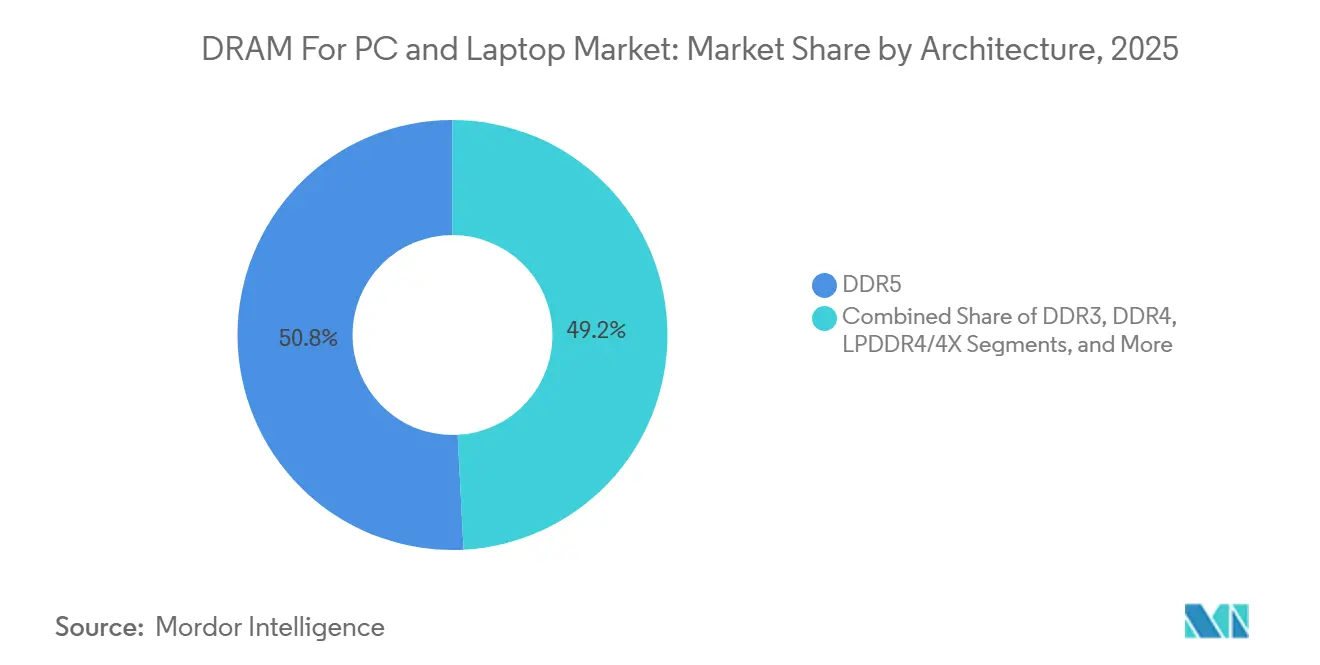
- By architecture, DDR5 held 50.82% of the market share in 2025, while LPDDR5 and LPDDR5X recorded the highest projected CAGR of 11.10% through 2031 in the DRAM for pc and laptop market.
- By technology node, below-10-nm EUV accounted for 60.47% of market value in 2025 and is also advancing at a 10.95% CAGR through 2031 in the DRAM for pc and laptop market.
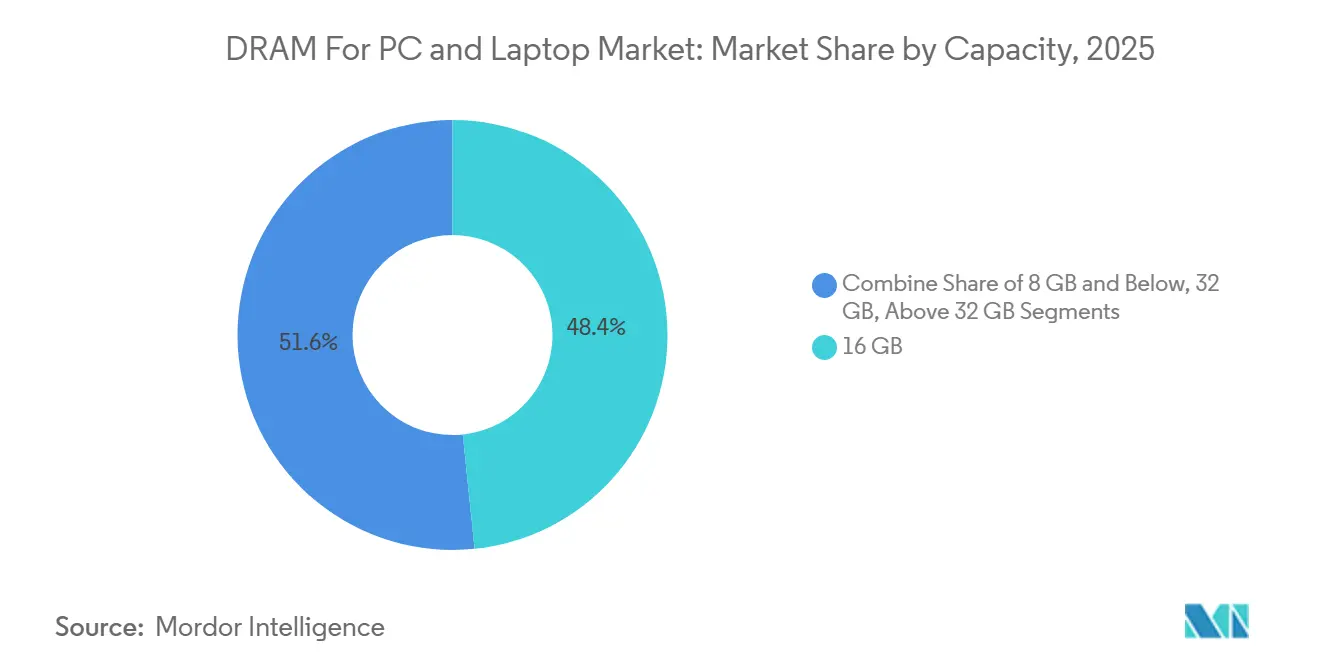
- By capacity, 16 GB captured 48.36% of market value in 2025, while the above 32 GB segment is forecast to grow at an 11.25% CAGR through 2031 in the DRAM for pc and laptop market.
- By form factor, SODIMM accounted for 44.21% of market value in 2025, while CAMM2 and LPCAMM2 are projected to expand at a 11.35% CAGR through 2031 in the DRAM for pc and laptop market.
- By geography, Asia-Pacific held 56.74% of the DRAM for PC and Laptop market share in 2025 and is also the fastest-growing region with a 12.15% CAGR through 2031.
Note: Market size and forecast figures in this report are generated using Mordor Intelligence’s proprietary estimation framework, updated with the latest available data and insights as of January 2026.
Market Trends and Insights
Drivers Impact Analysis of DRAM For PC and Laptop Market*
| Driver | (~) % Impact on CAGR Forecast | Geographic Relevance | Impact Timeline |
|---|---|---|---|
| Rising DDR5 Default Spec In New PC And Laptop Platforms | +3.2% | Global | Short term (≤ 2 years) |
| AI PC Memory Bump In Mainstream Notebooks | +2.5% | Global, APAC core and North America | Medium term (2-4 years) |
| Corporate Refresh Cycle Triggered By Windows End-Of-Support And Fleet Modernization | +1.8% | North America and EU | Short term (≤ 2 years) |
| Notebook Thinness And Power Efficiency Favoring LPDDR And CAMM2 Adoption | +1.3% | Global, APAC core | Medium term (2-4 years) |
| OEM SKU Rationalization Toward Higher Memory Configurations | +0.8% | Global | Medium term (2-4 years) |
| Supply Reallocation Away From Client DRAM Toward Higher-Margin Segments | +0.5% | Global | Long term (≥ 4 years) |
| Source: Mordor Intelligence | |||
Rising DDR5 Default Spec In New PC And Laptop Platforms
The DRAM for PC and Laptop market is benefiting from a platform transition that is now embedded in new product roadmaps rather than left to buyer preference. New mainstream systems are increasingly entering the market with DDR5 as the standard memory path, leaving OEMs less room to preserve older DDR4-era designs in current launches. That change is lifting the value of the DRAM for PC and Laptop market because newer DDR5 configurations carry higher pricing and are tied to more advanced notebook and desktop builds. The transition also narrows the cost advantage of staying on legacy systems, as reduced new-platform investment in DDR4 is tightening supply for the older architecture at the same time. This creates a market condition where both legacy and next-generation memory types support value growth, even though the strategic center of the DRAM for PC and Laptop market has already shifted toward DDR5. The result is a more durable migration pattern that supports higher average selling prices across the forecast period.
AI PC Memory Bump In Mainstream Notebooks
The DRAM for PC and Laptop market is also being lifted by the hardware floor attached to AI-ready notebooks, especially in mainstream commercial and premium consumer systems. Microsoft’s Copilot+ PC framework requires at least 16 GB of RAM, raising the baseline memory requirement for devices designed for on-device AI workloads. This is important because the DRAM for PC and Laptop market is not only gaining from more systems shipping with 16 GB, but also from a rising need for higher bandwidth memory in thinner designs, where local inference is a selling point. Once users buy a notebook with soldered LPDDR memory, the capacity is fixed for the life of the device, which can shorten replacement timing if AI workloads outgrow the original memory choice. That dynamic is reinforcing demand for better-equipped systems at the point of purchase instead of leaving upgrades to the aftermarket. It also gives OEMs a strong reason to promote higher-memory configurations as a practical requirement rather than as an optional premium feature.
Corporate Refresh Cycle Triggered By Windows End-Of-Support And Fleet Modernization
The DRAM for PC and Laptop market is receiving additional support from enterprise fleet replacement, as organizations continue to move away from Windows 10-era hardware. This replacement cycle matters because the newer commercial devices entering fleets are typically aligned with Windows 11 and AI-oriented use cases, which makes 16 GB memory configurations more common than in the prior cycle. The cost of extending support on older systems rises over time, so many organizations have a financial reason to refresh hardware rather than delay indefinitely. At the same time, high DRAM prices can delay purchasing decisions for several quarters, potentially clustering some deferred demand into a narrower replacement window later in the cycle. That pattern does not remove demand from the DRAM for PC and Laptop market, but it can change the timing and intensity of enterprise purchases. It also increases the importance of supply planning and contract visibility for both OEMs and enterprise buyers.
Notebook Thinness And Power Efficiency Favoring LPDDR And CAMM2 Adoption
The DRAM for PC and Laptop market is also changing because notebook design priorities now place greater weight on thinness, thermal balance, and battery life than in earlier replacement cycles. These requirements favor LPDDR-based solutions and newer module formats that can support tighter layouts while preserving high memory speeds. The move matters because it expands the addressable role of high-performance mobile memory in the DRAM for PC and Laptop market and reduces the share of older socketed approaches in premium thin-and-light systems. CAMM2 and LPCAMM2 are particularly important because they provide a path that preserves notebook modularity, which would otherwise move directly to soldered memory. This gives OEMs a way to balance performance, serviceability, and roadmap continuity as memory requirements rise. It also creates a new aftermarket opportunity in categories that had become difficult for upgrade-oriented module vendors to serve.
Restraints Impact Analysis of DRAM For PC and Laptop Market*
| Restraint | (~) % Impact on CAGR Forecast | Geographic Relevance | Impact Timeline |
|---|---|---|---|
| Persistent DRAM Price Volatility In Client Channels | -1.2% | Global | Short term (≤ 2 years) |
| Supply Allocation Bias Toward Servers And AI Accelerators | -0.9% | Global | Medium term (2-4 years) |
| Faster Transition To Soldered Memory In Ultra-Thin Devices | -0.6% | Global, APAC core and North America | Long term (≥ 4 years) |
| Demand Deferral From Higher System Prices In Entry And Mid-Tier PCs | -0.4% | Global, with emerging markets most affected | Short term (≤ 2 years) |
| Source: Mordor Intelligence | |||
Persistent DRAM Price Volatility In Client Channels
Price volatility remains the clearest restraint on the DRAM for PC and Laptop market because OEMs cannot absorb higher memory costs evenly across all price bands. Rising client DRAM prices have already pushed some notebook vendors to return to 8 GB base configurations in the mid-range, even though that runs counter to the broader shift toward AI-ready systems. The tension is especially visible in the DRAM for PC and Laptop market because higher retail prices can slow replacement in entry and mid-tier segments, while lower base memory can weaken the practical value proposition of new devices. This creates an unusual split where premium notebooks continue to move up the memory curve, but mainstream systems can temporarily move backward on base capacity. The same volatility also encourages enterprise buyers to rethink procurement timing and inventory strategy. As long as price movement remains sharp, it will limit the speed at which demand translates into stable shipment growth.
Supply Allocation Bias Toward Servers And AI Accelerators
The DRAM market for PCs and laptops is also constrained by the fact that major manufacturers are prioritizing HBM and server DRAM, where margins and strategic demand visibility are stronger. This supply bias reduces transparency for PC OEMs and module vendors because client memory availability depends more heavily on allocation decisions than on total wafer investment. In practice, the DRAM for PC and Laptop market is competing for capacity with faster-growing AI infrastructure categories, raising the risk of tighter supply even during periods of broad semiconductor expansion. Relief should improve only gradually as new fabs and process ramps come online over 2026, 2027, and beyond. Even then, premium-performance supply is likely to remain concentrated with the largest incumbent manufacturers. That means the client market may continue to face periodic tightness even if overall industry capacity grows.
*Our forecasts treat driver/restraint impacts as directional, not additive. The impact forecasts reflect baseline growth, mix effects, and variable interactions.
DRAM For PC and Laptop Market Segment Analysis
By Architecture:
DDR5 Consolidates Platform Share As LPDDR5 And LPDDR5X AccelerateDDR5 held 50.82% of the DRAM for PC and Laptop market by value in 2025, which made it the leading architecture as new desktop and notebook platforms moved further into the DDR5 cycle. LPDDR5 and LPDDR5X are the fastest-growing architecture segment, with the DRAM for PC and Laptop market size for this category projected to expand at an 11.10% CAGR through 2031. This pattern shows that the market is now being pulled by 2 linked forces: fixed platform migration in mainstream systems and stronger bandwidth demand in thinner mobile devices. DDR4 and older architectures are losing share as new product development focuses on newer standards, though DDR4 still plays a role in the aftermarket, enterprise support, and budget-oriented configurations. The DRAM for PC and Laptop industry is therefore moving through a mixed transition where legacy demand stays relevant in the near term, but the center of value creation has already shifted.
The second layer of this shift is visible in the wider LPDDR5X ecosystem, where new suppliers are gaining ground in advanced mobile memory. CXMT reported that DDR5 accounted for 31.9% of its DRAM revenue in 2025, up from 13.3% in 2024, underscoring how quickly the new architecture is spreading, even among later entrants.[1]Shanghai Stock Exchange, “CXMT's USD 4.3 Billion IPO Could Be Star Market's Second-Largest as China's DRAM Industry Gains Ground,” Shanghai Stock Exchange, english.sse.com.cn That matters for the DRAM for PC and Laptop market because broader DDR5 participation can expand supply options in consumer-oriented categories, even if the top 3 manufacturers keep their premium focus on other memory products. LPDDR4 and LPDDR4X still retain a place in value notebooks and in regions with slower refresh timing, but their long-term role is narrowing as OEMs align future launches with AI-ready specifications. The DRAM for PC and Laptop industry is therefore not just moving to a new standard, it is reorganizing around memory architectures that better match mobile AI and next-generation notebook design needs.



By Technology Node:
Below 10 Nm EUV Leads Value ConcentrationBelow 10 nm EUV technology accounted for 60.47% of the market value in 2025, giving it the largest position within the DRAM for the PC and Laptop market. It is also the fastest-moving node segment, with the DRAM for PC and Laptop market size for below 10 nm EUV advancing at an 10.95% CAGR through 2031. This dominance reflects the fact that leading-edge DDR5 and LPDDR5X production is increasingly tied to advanced process technology across the largest manufacturers. The node mix also matters because smaller geometries help support higher densities, better power efficiency, and the product roadmaps needed for higher-capacity client memory. As a result, value concentration in the DRAM for PC and Laptop market is moving toward manufacturers and regions that can sustain advanced-node execution at scale.
SK Hynix stated in September 2025 that it had assembled the industry’s first commercial High-NA EUV system for production at its M16 fab in Icheon, which positions advanced lithography as a direct competitive lever in memory manufacturing. Samsung also deepened its next-generation memory strategy through platform-level collaboration with AMD in 2026, underscoring the broader commercial importance of advanced DRAM development for future product stacks.[2]Samsung Electronics, “Samsung and AMD Expand Strategic Collaboration on Next-Generation AI Memory Solutions,” Samsung Global Newsroom, news.samsung.com Transitional 18 nm to 11 nm nodes remain relevant for mid-tier systems where the cost-to-performance balance is still acceptable, but their share should keep narrowing as new launches favor more advanced memory. Chinese producers continue to expand, but export restrictions on advanced EUV tools preserve a structural edge for incumbents at the leading node. This keeps the technology premium firmly aligned with the manufacturers that control the most advanced DRAM process capabilities.
By Capacity:
16 GB Anchors Demand While Above 32 GB Gains SpeedThe 16 GB segment accounted for 48.36% of market value in 2025, making it the largest capacity tier in the DRAM for PC and Laptop market. At the same time, above 32 GB is the fastest-growing band, and the DRAM for PC and Laptop market size for that tier is projected to rise at an 11.35% CAGR through 2031. This split captures the current market structure well because 16 GB has become the practical baseline for AI-ready systems, while higher capacities are moving into more commercial and professional notebooks. The result is a DRAM for PC and Laptop market where the core volume tier is still broad, but the next stage of value growth is moving to richer memory configurations. That shift is also compressing the price gap between standard and higher-memory systems in parts of the commercial notebook category.
Microsoft’s Copilot+ PC requirements place 16 GB of RAM at the center of AI-oriented system design, reinforcing the size of that segment across new notebooks. Above 32 GB is expanding because AI inference, professional content creation, and more workstation-like use cases are moving to mobile PCs faster than in prior replacement cycles. The DRAM for PC and Laptop market share of higher-capacity systems is therefore improving not only in premium notebooks, but also in business devices where users need more headroom over the life of the machine. At the lower end, 8 GB and below have seen some short-term support as OEMs try to offset higher memory costs, but that comes with a performance and feature tradeoff in newer Windows-centered use cases. The capacity ladder in the DRAM for PC and Laptop market is therefore stretching in 2 directions at once, with price pressure pulling some entry systems down while AI and professional workloads keep pushing the profitable middle and upper tiers higher.
By Form Factor:
SODIMM Retains Scale While CAMM2 And LPCAMM2 Reshape Upgrade PathsSODIMM accounted for 44.21% of market value in 2025, making it the largest form factor category in the DRAM for PC and Laptop market. CAMM2 and LPCAMM2 are the fastest-growing form factor groups, with an 11.35% CAGR through 2031, indicating that the DRAM for PC and Laptop market is redesigning itself around thinner notebooks that still need high bandwidth and practical serviceability. SODIMM remains important because of its large installed base and its continued presence in many mainstream notebooks. At the same time, form factor growth is moving toward designs that can preserve modularity while fitting more demanding thermal and mechanical requirements. This gives the DRAM for PC and Laptop market a transition path that is more flexible than a complete shift to soldered memory.
The importance of CAMM2 and LPCAMM2 goes beyond simple physical packaging because the format supports the broader push toward AI-capable thin notebooks without fully closing the door on field replacement and aftermarket upgrades. That is significant for module vendors because soldered-onboard memory has steadily reduced the number of notebooks consumers and IT teams can upgrade after purchase. The DRAM for PC and Laptop market, therefore, gains a new retail and commercial opportunity if modular high-performance memory expands in thin-and-light systems that previously depended on fixed onboard memory. UDIMM keeps a stable role in desktop and small-form-factor PC configurations, but it remains a smaller part of the combined notebook and PC opportunity described in this report. Over time, the form factor mix should show a sharper divide between upgradeable mainstream systems, ultra-thin soldered designs, and newer modular architectures that bridge the two.
Geography Analysis
APAC DRAM for PC and Laptop Market
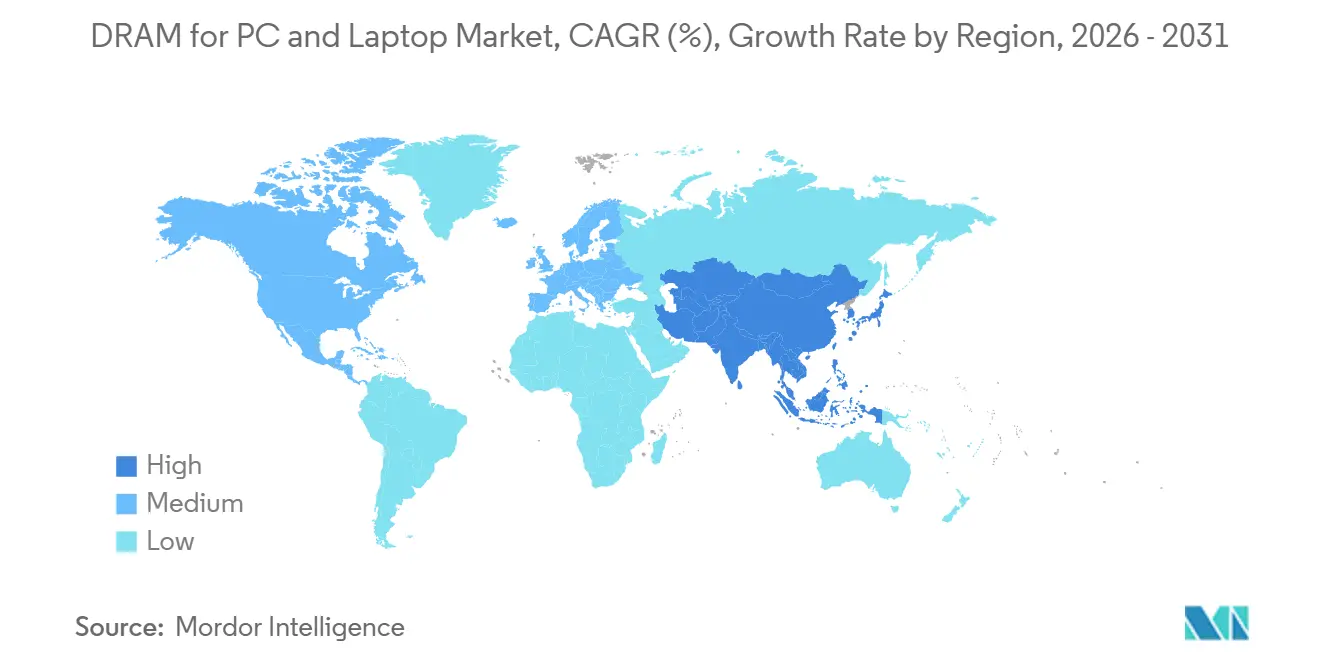
Asia-Pacific accounted for 56.74% of the market value in 2025 and remains the largest regional block in the DRAM for the PC and Laptop market. It is also the fastest-growing geography, with the DRAM for PC and Laptop market size in Asia-Pacific projected to rise at a 12.15% CAGR through 2031. The region holds this position because it combines the deepest production base with the strongest downstream ecosystem for module assembly, distribution, and electronics manufacturing. South Korea remains central because Samsung Electronics and SK Hynix continue to anchor global DRAM output and shape supply conditions for the wider client market. Taiwan adds a strong downstream layer through module and memory ecosystem companies that connect wafer supply to global OEM and channel demand. China is becoming more influential through CXMT, which disclosed an intended CNY 29.5 billion listing, equivalent to USD 4.1 billion, and a global DRAM revenue share near 8% in Q1 2026.[3]Shanghai Stock Exchange, “CXMT's USD 4.3 Billion IPO Could Be Star Market's Second-Largest as China's DRAM Industry Gains Ground,” Shanghai Stock Exchange, english.sse.com.cn
Japan and APAC DRAM for PC and Laptop Market
Japan also matters because advanced DRAM investment in the country is supporting the regional concentration of high-value memory production. Even without citing regional shipment shares, the Asia-Pacific position in the DRAM for PC and Laptop market is strengthened by the fact that most critical production decisions still sit inside this manufacturing cluster. That concentration makes the region both the main engine of supply and the main source of pricing influence for the rest of the market. It also means that client memory availability in other regions depends heavily on production and allocation decisions made in Asia-Pacific.
North America, Europe and APAC DRAM for PC and Laptop Market
North America remains a major consumption center in the DRAM for PC and Laptop market because of its large enterprise installed base and its relatively early movement into commercial refresh cycles. Demand in the region is supported by organizations replacing older fleets with systems that are more likely to carry 16 GB memory as a practical starting point. Europe follows a similar replacement pattern, although cost pressure and weaker consumer momentum can make the cycle less even across countries and user groups. The Rest of the World remains more exposed to entry-level notebook demand, which means higher DRAM prices have a larger effect on configuration choices and replacement timing there. As a result, the DRAM for PC and Laptop market should continue to show the strongest value concentration in Asia-Pacific, while North America and Europe remain important demand anchors and emerging markets lag in the move to richer memory configurations.

Competitive Landscape
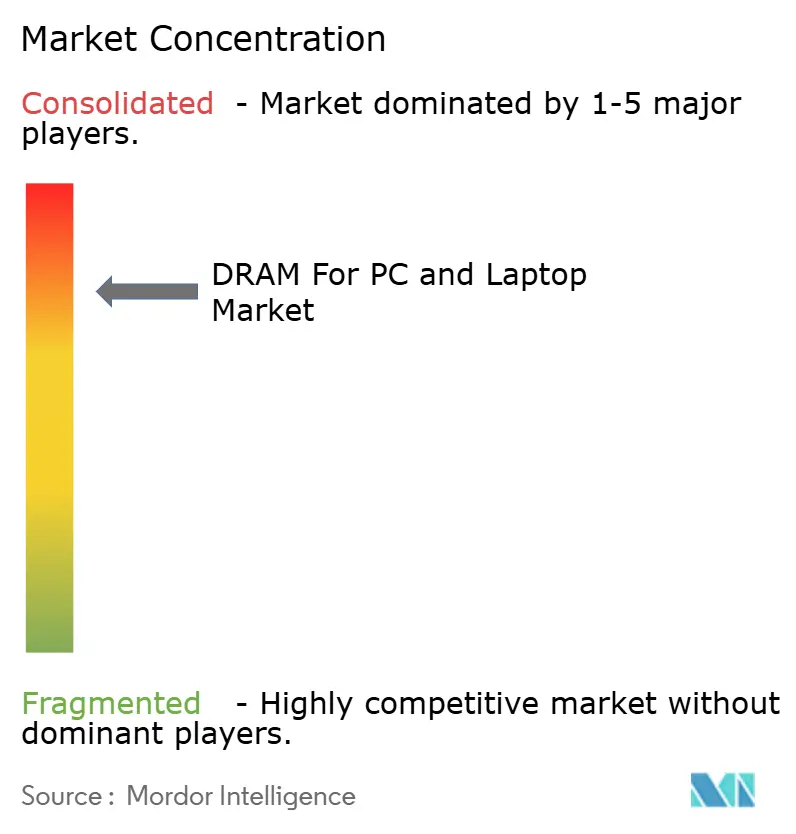
The DRAM for PC and Laptop market is highly consolidated at the manufacturing level, with Samsung Electronics, SK Hynix, and Micron Technology continuing to control most global DRAM production capacity. This structure gives the leading suppliers strong influence over pricing, allocation, and technology direction across client memory categories. The competitive picture is also becoming more uneven because the largest producers are directing more strategic focus toward HBM and server DRAM, which can leave the client PC segment with tighter effective supply. That does not diminish the importance of DRAM for the PC and Laptop market, but it does mean decisions in higher-margin memory categories increasingly shape the client segment. The market, therefore, combines strong demand fundamentals with a supply structure that remains concentrated and strategically selective.
Samsung and AMD signed a memorandum of understanding in March 2026 to expand collaboration on next-generation AI memory solutions, including a joint DDR5 co-development path for AMD EPYC Venice CPUs and Samsung’s role as the primary HBM4 supplier for AMD’s Instinct MI455X. SK Hynix and NVIDIA formalized a multi-year technology partnership in June 2026 that spans AI systems, CPUs, PCs, and robotics platforms, extending memory collaboration beyond infrastructure into client computing roadmaps.[4]SK Hynix, “SK Hynix and NVIDIA Announce Multi-year Technology Partnership to Advance Memory for AI Factories,” SK Hynix Newsroom, news.skhynix.com These moves matter because they show how major memory suppliers are tying themselves more closely to platform partners rather than competing only on commodity output. CXMT is also becoming harder to ignore in the DRAM for PC and Laptop market, especially in consumer-focused DDR5 and LPDDR5X categories, where it can supply some of the demand that incumbent producers are not prioritizing. Even so, the technology ceiling facing Chinese manufacturers at advanced nodes still leaves the top 3 with the clearest advantage in premium-performance and leading-edge production.
Below the manufacturing tier, the module and distribution layer is more fragmented but still strategically important to the DRAM for PC and Laptop market. Companies such as Kingston Technology, ADATA Technology, G.SKILL International Enterprise Co., Ltd., Corsair Gaming, and Patriot Memory compete more on validated compatibility, speed positioning, and channel reach than on die manufacturing scale. Their position becomes more interesting as CAMM2 and LPCAMM2 expand, as a new modular aftermarket can emerge in thin notebooks that previously relied solely on soldered memory. Smaller players continue to serve legacy or niche applications, but the strongest value creation in the DRAM for PC and Laptop market remains concentrated around the large manufacturers that control advanced-node output and long-range platform partnerships. This leaves the overall market consolidated at the top, but still open to tactical competition in modules, channels, and selected consumer-focused memory formats.
DRAM For PC and Laptop Industry Leaders
SK Hynix Inc.
Samsung Electronics Co., Ltd.
Micron Technology, Inc.
Winbond Electronics Corporation
Nanya Technology Corporation
- *Disclaimer: Major Players sorted in no particular order
DRAM For PC and Laptop Market Companies Covered in this Report
- Samsung Electronics Co., Ltd.
- SK Hynix Inc.
- Micron Technology, Inc.
- Nanya Technology Corporation
- Winbond Electronics Corporation
- ChangXin Memory Technologies, Inc.
- Powerchip Semiconductor Manufacturing Corp.
- GigaDevice Semiconductor (Beijing) Inc.
- Etron Technology, Inc.
- Integrated Silicon Solution, Inc.
- Elite Semiconductor Memory Technology Inc.
- Alliance Memory, Inc.
- AP Memory Technology Corp.
- Kingston Technology Company, Inc.
- ADATA Technology Co., Ltd.
- Transcend Information, Inc.
- Corsair Gaming, Inc.
- G.SKILL International Enterprise Co., Ltd.
- Patriot Memory, LLC
- Smart Modular Technologies, Inc.

Recent Industry Developments in DRAM For PC and Laptop Market
- July 2026: Micron Technology broke ground on a JPY 1.5 trillion (USD 9.3 billion) expansion of its Hiroshima fab, targeting 1γ DRAM and HBM output, with Japan's Ministry of Economy, Trade and Industry (METI) pledging up to JPY 500 billion (approximately USD 3.1 billion) in subsidies. Equipment delivery and installation are set for H2 2028, extending Micron's Japan-based advanced DRAM capacity significantly into the next decade.
- July 2026: Samsung Electronics and SK Hynix announced participation in an industry-wide 392 trillion won (USD 252.5 billion) investment commitment into South Korea's Chungcheong region, including new HBM packaging fabs and advanced memory manufacturing facilities. The announcement, coordinated with South Korea's Ministry of Trade, Industry and Energy, signals sustained capacity expansion concentrated in high-value memory products.
- June 2026: SK Hynix and NVIDIA formalized a multi-year technology partnership to co-develop next-generation memory for NVIDIA's AI infrastructure roadmap, covering supply for Vera Rubin AI supercomputers, Vera CPUs, RTX Spark-powered PCs, and Jetson Thor robotics platforms. The partnership extends SK Hynix's NVIDIA relationship from HBM into client PC memory supply.
- June 2026: CXMT's IPO registration was approved on China's Shanghai STAR Market at a target of CNY 29.5 billion (approximately USD 4.1 billion), poised to become the STAR Market's second-largest listing. CXMT disclosed a global DRAM revenue share of 7.7-8% in Q1 2026 and reported that DDR5 accounted for 31.9% of its DRAM revenue in 2025, up from 13.3% in 2024.


Global DRAM For PC and Laptop Market Report Scope
The DRAM for PC and Laptop Market is Segmented by Architecture (DDR3, DDR4, DDR5, LPDDR4/4X, and LPDDR5/5X), Technology Node (19 Nm and Above, 18 Nm to 11 Nm, and Below 10 Nm EUV), Capacity (8 GB and Below, 16 GB, 32 GB, and Above 32 GB), Form Factor (UDIMM, SODIMM, CAMM2 and LPCAMM2, and Soldered Onboard Memory), and Geography (North America, Europe, Asia Pacific, Rest of the World). The Market Forecasts are Provided in Terms of Value (USD).
| DDR3 |
| DDR4 |
| DDR5 |
| LPDDR4/4X |
| LPDDR5/5X |
| 19 Nm and Above |
| 18 Nm to 11 Nm |
| Below 10 Nm EUV |
| 8 GB and Below |
| 16 GB |
| 32 GB |
| Above 32 GB |
| UDIMM |
| SODIMM |
| CAMM2 and LPCAMM2 |
| Soldered Onboard Memory |
| North America | |
| Europe | |
| Asia Pacific | China |
| Japan | |
| South Korea | |
| Taiwan | |
| Rest of Asia Pacific | |
| Rest of the World |
| By Architecture | DDR3 | |
| DDR4 | ||
| DDR5 | ||
| LPDDR4/4X | ||
| LPDDR5/5X | ||
| By Technology Node | 19 Nm and Above | |
| 18 Nm to 11 Nm | ||
| Below 10 Nm EUV | ||
| By Capacity | 8 GB and Below | |
| 16 GB | ||
| 32 GB | ||
| Above 32 GB | ||
| By Form Factor | UDIMM | |
| SODIMM | ||
| CAMM2 and LPCAMM2 | ||
| Soldered Onboard Memory | ||
| By Geography | North America | |
| Europe | ||
| Asia Pacific | China | |
| Japan | ||
| South Korea | ||
| Taiwan | ||
| Rest of Asia Pacific | ||
| Rest of the World | ||


Key Questions Answered in the Report
What is driving growth in DRAM for PC and laptop demand through 2031?
Growth is being supported by DDR5 becoming the default standard, AI-ready notebook memory requirements, and enterprise device refresh cycles. The market is projected to reach USD 51.28 billion by 2031 at a 10.73% CAGR.
Why is DDR5 taking the lead over DDR4 in PCs and laptops?
DDR5 held 50.82% of market value in 2025 because new mainstream platforms are increasingly built around it. That shift is also supported by stronger performance and higher-value configurations.
Which memory capacity tier is growing fastest in notebooks?
Above 32 GB is the fastest-growing capacity band with an 11.25% CAGR through 2031. This reflects heavier AI, creative, and professional workloads moving into mobile PCs.
Which region leads global DRAM for PC and laptop sales?
Asia-Pacific led with 56.74% of market value in 2025 and is projected to grow at a 12.15% CAGR through 2031. Its lead comes from its strong production base and broad electronics manufacturing ecosystem.
How are AI PCs changing notebook memory configurations?
AI-ready systems are pushing 16 GB into the mainstream and increasing demand for higher bandwidth LPDDR memory. This is also encouraging more buyers to choose higher-capacity systems at the point of purchase.
Is the supplier base concentrated in this space?
Yes. Samsung Electronics, SK Hynix, and Micron Technology still dominate manufacturing capacity, which gives the top tier strong influence over supply allocation, technology direction, and pricing.
Page last updated on:





