
DRAM For Industrial and IoT Applications Market Size and Share
Market Overview
| Study Period | 2020 - 2031 |
|---|---|
| Market Size (2026) | USD 3.51 Billion |
| Market Size (2031) | USD 6.32 Billion |
| Growth Rate (2026 - 2031) | 12.48 % |
| Fastest Growing Market | Asia-Pacific |
| Largest Market | Asia-Pacific |
| Market Concentration | Medium |
Major Players *Disclaimer: Major Players sorted in no particular order Image © Mordor Intelligence. Reuse requires attribution under CC BY 4.0. | |
DRAM For Industrial and IoT Applications Market Analysis by Mordor Intelligence
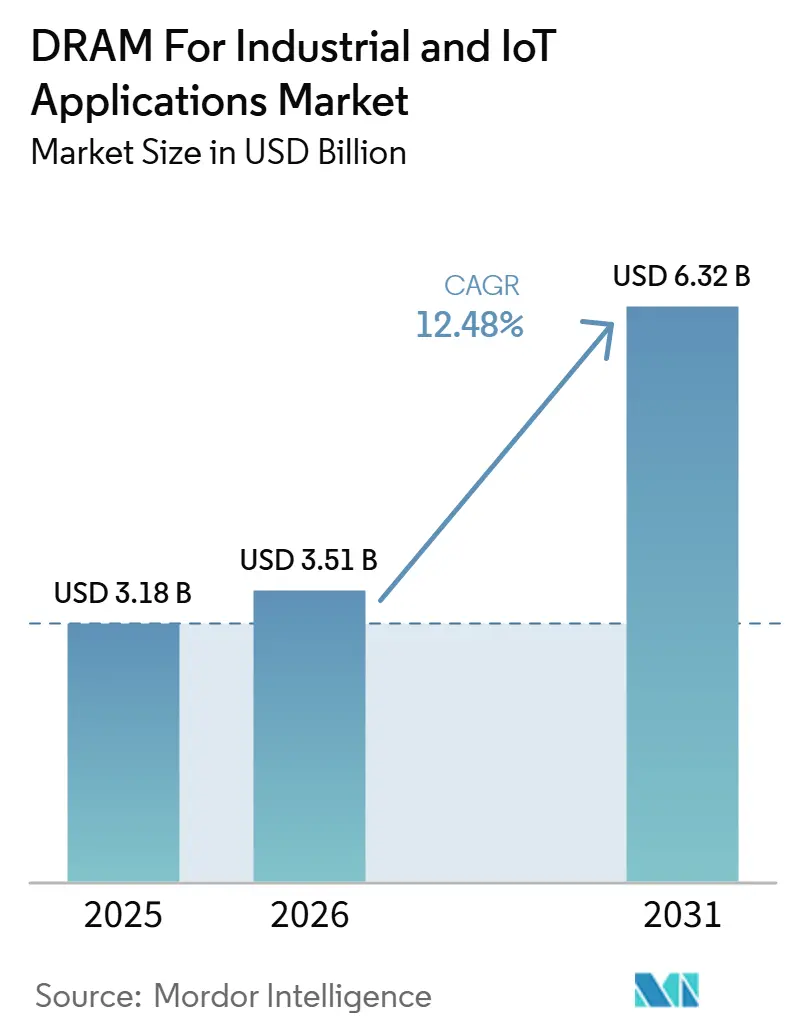
The DRAM for industrial and IoT applications market size is projected to be USD 3.18 billion in 2025, USD 3.51 billion in 2026, and reach USD 6.32 billion by 2031, growing at a CAGR of 12.48% from 2026 to 2031. The DRAM for industrial and IoT applications market is expanding faster than commodity memory markets because industrial deployments need higher reliability, longer product availability, and wider operating tolerances than mainstream devices. Demand is driven by edge AI inference in factories, robotics cells, smart inspection systems, and industrial gateways that require greater local memory bandwidth and capacity. The installed base still keeps DDR4 relevant, but new platform designs are moving toward DDR5 and LPDDR5X as compute density rises across automation and embedded systems. Supply conditions also remain important because leading wafer capacity is being pulled toward AI server memory, which keeps availability, qualification depth, and supply continuity central to procurement. These conditions allow specialist suppliers in the DRAM for industrial and IoT applications to compete on certification, thermal performance, and lifecycle support rather than solely on price.
Key Report Takeaways
- By architecture, DDR4 led with 50.71% share in 2025, while DDR5 is projected to grow at a 13.14% CAGR through 2031 in the DRAM for Industrial and IoT applications market.
- By technology node, the 19 nm to 10 nm range held a 54.26% share in 2025, while EUV below 10 nm is forecast to expand at a 12.68% CAGR through 2031 in the DRAM for Industrial and IoT applications market.
- By capacity, the 4 GB to 8 GB tier accounted for 41.32% of the market in 2025, while the 16 GB and above tier is expected to grow at a 12.55% CAGR through 2031 in the DRAM for Industrial and IoT applications market.
- By end-use application, industrial PCs and controllers captured a 33.18% share in 2025, while robotics and machine vision are projected to grow at a 12.78% CAGR through 2031 in the DRAM for Industrial and IoT applications market.
- By geography, Asia-Pacific held 46.53% of the DRAM market share for industrial and IoT applications in 2025 and is also projected to record the fastest regional expansion at a 13.19% CAGR through 2031 in the DRAM for Industrial and IoT applications market.
Note: Market size and forecast figures in this report are generated using Mordor Intelligence’s proprietary estimation framework, updated with the latest available data and insights as of January 2026.
Market Trends and Insights
Drivers Impact Analysis of DRAM For Industrial and IoT Applications Market*
| Driver | (~) % Impact on CAGR Forecast | Geographic Relevance | Impact Timeline |
|---|---|---|---|
| Rising Industrial Edge AI Workloads | +3.8% | Global, with Asia-Pacific core and North America as primary markets | Medium term (2-4 years) |
| Fast Qualification of Low-Power DDR5 and LPDDR5X Modules | +2.9% | Global, with spill-over to Middle East and Africa and South America | Medium term (2-4 years) |
| Zonal and Domain Architectures in Industrial Automation | +2.0% | North America and Europe, with Asia-Pacific adoption accelerating | Long term (≥ 4 years) |
| CXL-Based Memory Expansion for Edge Servers | +1.5% | North America and Europe | Long term (≥ 4 years) |
| Ruggedized and Wide-Temperature Memory Adoption | +1.2% | Global, concentrated in heavy-industry belts including China, Germany, and Japan | Medium term (2-4 years) |
| Localization of Memory Supply Chains for Industrial OEMs | +0.9% | North America, Europe, Japan, and South Korea | Long term (≥ 4 years) |
| Source: Mordor Intelligence | |||
Rising Industrial Edge AI Workloads
The DRAM for industrial and IoT applications market is gaining direct support from the shift of AI inference workloads from centralized servers to equipment placed on factory floors. Smart cameras, inspection stations, robotics controllers, and industrial gateways now process more data locally, increasing memory bandwidth requirements even before compute limits are reached. The Edge AI and Vision Alliance noted that multi-camera workloads running detection, tracking, and segmentation can exhaust LPDDR5X bandwidth budgets before neural processing resources are fully used. NVIDIA also positioned its IGX Thor industrial platform around 128 GB of LPDDR5X and 273 GB/s of bandwidth with full DRAM ECC, underscoring how memory is becoming a core system design element in robotics, medical, and factory automation environments.[1]NVIDIA Corporation, “NVIDIA IGX Thor Powers Industrial Medical and Robotics Edge AI Applications,” NVIDIA Developer Blog, developer.nvidia.com The same industry source also described persistent undersupply of LPDDR4X and LPDDR5X across edge AI applications, indicating that memory is increasingly treated as a constrained production input rather than a routine bill-of-materials item. As this pattern spreads, the DRAM for industrial and IoT applications market is likely to reward suppliers that can offer bandwidth, ECC protection, and supply assurance together rather than selling memory only on capacity.
Fast Qualification of Low-Power DDR5 and LPDDR5X Modules
The DRAM for industrial and IoT applications market is also being boosted by faster qualification of DDR5 and LPDDR5X modules for embedded and rugged systems. Innodisk introduced DDR5 CAMM2 and LPDDR5X CAMM2 modules in August 2025 with speeds up to 8,533 MT/s, a footprint 60% smaller than SO-DIMM, and screw-lock mounting for vibration resistance in industrial, transportation, and aerospace use cases. Advantech extended that direction in March 2026 with its SQRAM DDR5 7,200 MT/s series, combining 64 GB capacity with an operating range of -25°C to 95°C for smart city, defense, and industrial automation deployments.[2]Advantech, “Advantech Unveils Next-Generation SQRAM DDR5 7200 MT/s 64GB Memory With Superior Rugged Reliability for Edge AI,” Advantech, advantech.com JEDEC then published the JESD400-5D version 1.4 update in October 2025, adding support for DDR5 speeds up to 9,200 MT/s and formalizing the SOCAMM2 form factor that industrial validation programs need before committing to long product cycles. This reduces the historical lag between mainstream memory generations and industrial acceptance. It also strengthens the position of suppliers that already know how to validate products for industrial mechanical, thermal, and reliability requirements across multiple form factors.
Zonal and Domain Architectures in Industrial Automation
The DRAM for industrial and IoT applications market is further supported by the move toward zonal and domain controller designs in automation systems. These architectures centralize more processing and gather data from multiple sensors and actuators via faster communication backbones, which increases the need for higher memory bandwidth and tighter reliability controls. Samsung Semiconductor described how zonal architectures are becoming central to software-defined vehicle platforms, and that the same central-compute logic is now relevant to industrial systems moving toward more integrated control structures. In industrial settings, this means a controller that once handled deterministic control with modest DDR4 resources now has to support sensor fusion, time-sensitive networking, and broader software functions that lean toward DDR5-class performance. The change is gradual because industrial adoption trails faster product cycles in automotive systems. Even so, the DRAM for industrial and IoT applications market should benefit over several years as each new centralized control layer increases memory content per automation cell.
CXL-Based Memory Expansion for Edge Servers
The DRAM for industrial and IoT applications market is also seeing a new opportunity in CXL-based memory expansion for compact industrial edge servers. Innodisk launched a CXL Add-in Card in February 2026 that connects via PCIe and expands memory capacity without consuming DIMM slots or requiring a motherboard redesign, directly addressing space and upgrade limitations in edge deployments. Marvell followed in March 2026 with the Structera S 30260, a 260-lane CXL switch built to support rack-level memory pooling across disaggregated compute nodes, with sampling scheduled for the third quarter of 2026. This matters because edge operators in oil and gas, rail, utilities, and similar sectors often keep platforms in the field for many years and prefer upgrade paths that avoid full hardware replacement. CXL therefore supports a more flexible memory-scaling model within DRAM for the industrial and IoT applications market. It also expands the role of specialist module and subsystem vendors, enabling them to bridge industrial lifecycle needs with newer memory interconnect approaches.
Restraints Impact Analysis of DRAM For Industrial and IoT Applications Market*
| Restraint | (~) % Impact on CAGR Forecast | Geographic Relevance | Impact Timeline |
|---|---|---|---|
| DRAM Price Cyclicality and Allocation Risk | -3.2% | Global | Short term (≤ 2 years) |
| Qualification and Reliability Burden for Harsh Environments | -2.1% | Global, with highest burden in North America, Europe, and Japan | Medium term (2-4 years) |
| Export Controls and Customer Vetting on High-End Memory | -1.7% | Asia-Pacific core including China, with spill-over to North America and Europe | Short term (≤ 2 years) |
| Legacy Industrial Platforms Lock In DDR3 and Low-Density SKUs | -1.4% | Global, concentrated in mature industrial economies including Germany, Japan, and the United States | Long term (≥ 4 years) |
| Source: Mordor Intelligence | |||
DRAM Price Cyclicality and Allocation Risk
The DRAM for industrial and IoT applications market still faces clear restraints from allocation pressure and unstable procurement conditions. The issue is no longer just a normal memory cycle, because producers are placing greater strategic focus on AI-era products that deliver higher returns. Samsung began commercial HBM4 shipments in February 2026 and said HBM sales were expected to more than triple in 2026, which shows where premium capacity is being directed. SK hynix also shipped 12-layer HBM4E samples in June 2026 and emphasized higher data processing speeds and better power efficiency to meet the demand for high-performance computing. When advanced wafers favor those products, industrial buyers face tighter access to standard DDR4 and DDR5 resources, even if their own demand remains steady. This keeps pricing, lead times, and allocation risk as ongoing constraints for the DRAM market for industrial and IoT applications, especially for buyers without long-term supply agreements.
Qualification and Reliability Burden for Harsh Environments
The DRAM for industrial and IoT applications market is also slowed by the lengthy qualification burden associated with harsh-environment use cases. Industrial modules must withstand broader thermal ranges, vibration, and reliability stress that are not expected in standard consumer memory deployments. Advantech’s March 2026 industrial DDR5 launch highlighted an operating range of -25°C to 95°C, while Innodisk’s rugged CAMM2 products added screw-lock mounting for vibration resistance, underscoring that industrial validation requirements go beyond speed and density alone. DDR5 also introduces new power management and signaling behavior, so qualification libraries built around DDR4 cannot be carried over without additional testing effort. JEDEC’s ongoing DDR5 standard updates show that the ecosystem is advancing, but industrial programs still need more time before those advances are field-proven in conservative applications. This favors incumbent suppliers with established validation systems, but it slows conversion to newer memory generations across the broader installed base.
*Our forecasts treat driver/restraint impacts as directional, not additive. The impact forecasts reflect baseline growth, mix effects, and variable interactions.
DRAM For Industrial and IoT Applications Market Segment Analysis
By Architecture:
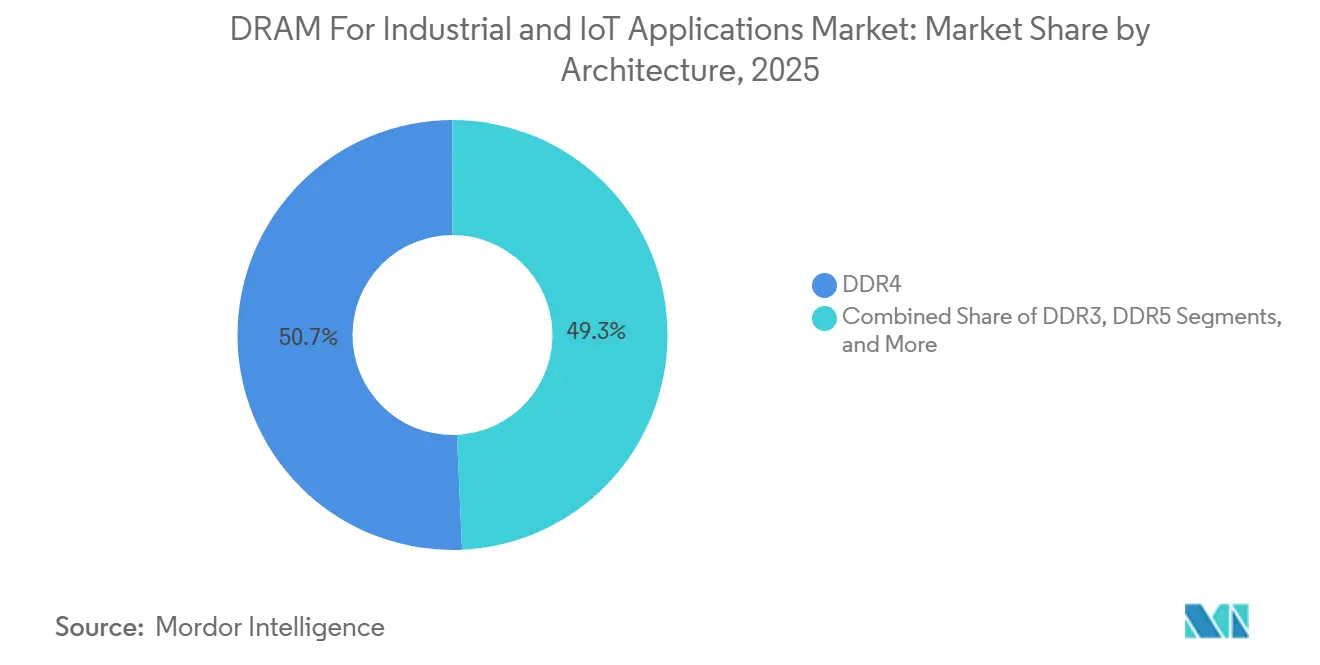
DDR4 Incumbency Meets DDR5 Platform MigrationDDR4 accounted for 50.71% of the DRAM for industrial and IoT applications market in 2025, while DDR5 is projected to grow at a 13.14% CAGR through 2031. That starting point reflects the large number of industrial systems that completed DDR4 qualification cycles earlier and are still in production with long service commitments. The DRAM for industrial and IoT applications market remains meaningful for DDR4 because factory systems, SCADA platforms, and embedded controllers typically remain active well beyond typical consumer replacement cycles. At the same time, newer designs are increasingly adopting DDR5 because bandwidth, efficiency, and on-die ECC are better aligned with edge AI inference and more centralized control functions. JEDEC’s April 2024 JESD79-5C update gave industrial programs a firmer standards base for DDR5 adoption by adding reliability, security, and performance features that matter in next-generation compute environments.
This transition does not mean legacy memory disappears quickly. DDR3 still plays a residual role in older PLCs, SCADA, and low-compute control systems, where redesign costs remain hard to justify. LPDDR variants are becoming more relevant in compact gateways, fanless embedded systems, and tightly constrained edge nodes where conventional DIMM architectures are less practical. Industrial buyers are therefore running two tracks at once, maintaining mature platforms while qualifying newer memory generations for systems that need higher throughput. The DRAM for industrial and IoT applications market is shaped by that overlap because supplier value depends on supporting both continuity and migration rather than forcing a full platform break. Firms that can document standards compliance, long availability, and industrial validation across DDR4, DDR5, and low-power formats are likely to hold the strongest position in this architectural shift.



By Technology Node:
Mature Volume Holds While EUV Builds the Next TierThe 19 nm to 10 nm node range held a 54.26% share in 2025, while EUV below 10 nm is projected to expand at a 12.68% CAGR through 2031. This confirms that the DRAM for industrial and IoT applications market still relies on the node range that best balances cost, yield, and qualification maturity across a wide set of industrial products. Mature production remains important because many industrial applications do not need the highest densities if reliability, availability, and predictable sourcing are the main purchasing criteria. At the same time, faster memory content growth in robotics, machine vision, and high-end edge servers will increasingly need the density and bandwidth gains that come with smaller nodes. SK hynix assembled the industry’s first High NA EUV lithography system in September 2025 and linked it to its next-generation DRAM roadmap, which shows how the manufacturing base for future high-performance memory is being built now.
The practical implication for buyers is that advanced nodes matter most when memory intensity is rising quickly. High-bandwidth automation cells, large AI models at the edge, and multi-sensor robotics platforms are likely to absorb the earliest benefits of sub-10 nm production. By contrast, low-density IoT endpoints, communication modules, and conservative control systems will continue to rely on older nodes for longer periods. The DRAM for industrial and IoT applications market, therefore, shows a split structure where mature-node supply supports volume stability and EUV-led advances support performance expansion. This reduces the chance of a sudden market-wide migration because the application base remains diverse. It also means the most attractive opportunities are concentrated in segments where advanced nodes unlock a visible improvement in bandwidth-per-watt or density-per-board rather than only a modest technical upgrade.
By Capacity:
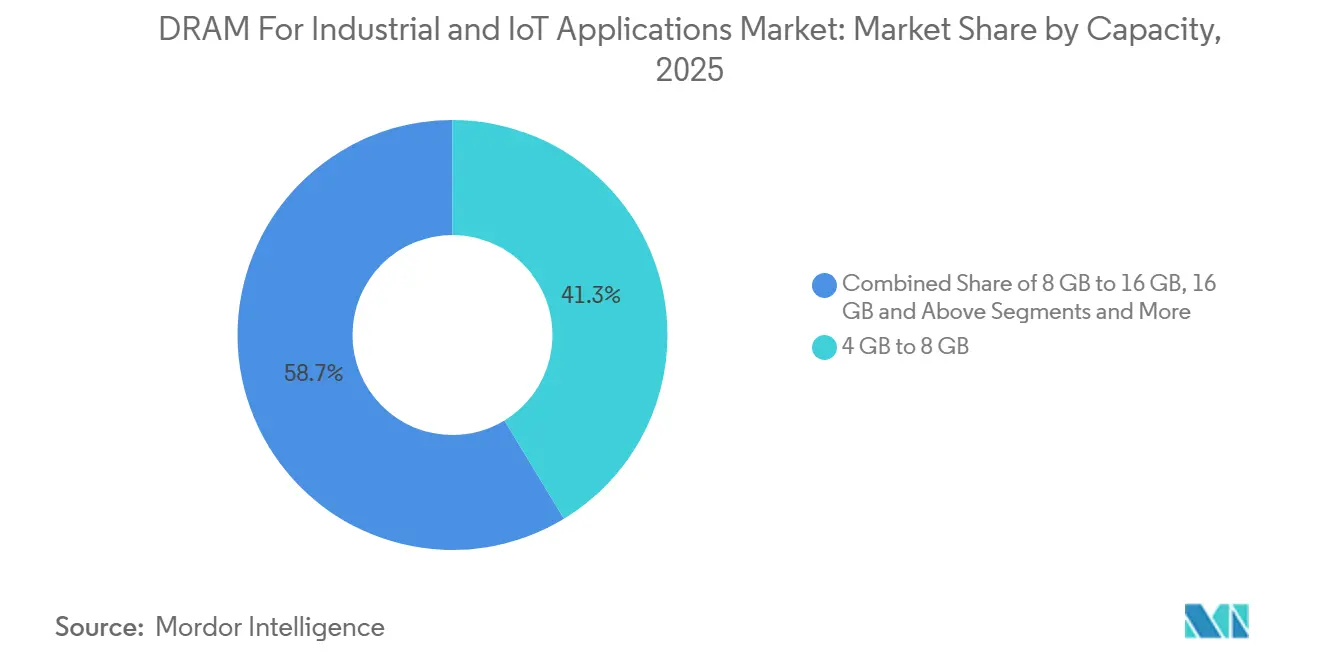
Higher Density Gains Importance as Workloads ExpandThe 4 GB to 8 GB tier dominated with 41.32% share in 2025, while the 16 GB and above tier is forecast to rise at a 12.55% CAGR through 2031. This makes sense because a large installed base of industrial PCs, PLCs, and communication equipment still runs effectively within the mid-density range. Even so, the DRAM for industrial and IoT applications market size of 16 GB and above is rising faster as AI inference, machine vision, and sensor fusion place heavier local memory demands on edge equipment. NVIDIA’s Jetson Orin NX 16 GB platform already serves as a practical baseline for production-grade computer vision systems using multiple cameras and low-latency models.[3]NVIDIA Corporation, “NVIDIA IGX Thor Powers Industrial Medical and Robotics Edge AI Applications,” NVIDIA Developer Blog, developer.nvidia.com That elevates the role of higher-density modules from a premium option to a standard design requirement in advanced deployments.
The 8 GB to 16 GB segment serves as a transition band for systems adding lightweight AI features but not yet requiring the highest configurations. Higher densities move further into view when workloads include multi-task pipelines, larger transformer models, or concurrent inference across several input streams. Longsys reinforced that direction at COMPUTEX 2026 by presenting AIDIMM modules with up to 128 GB capacity and 307.2 GB/s bandwidth for edge large language model use cases. Low-capacity configurations of 4 GB and below still serve cost-sensitive sensor nodes and legacy embedded controllers, so they are not disappearing from the mix. The DRAM for industrial and IoT applications market will therefore keep adding density at the top end while retaining stable demand pockets at the low end, with the strongest commercial momentum centered on systems that need more intelligence at the device level.
By End-Use Application:
Installed Compute Leads While Robotics Lifts GrowthIndustrial PCs and controllers accounted for 33.18% of the DRAM for industrial and IoT applications market in 2025, while robotics and machine vision are expected to expand at a 12.78% CAGR through 2031. The leading share of industrial PCs and controllers reflects steady replacement demand across factory-floor compute nodes, HMIs, embedded terminals, and process-control environments. That broad installed base keeps the DRAM for industrial and IoT applications market size anchored in established automation infrastructure, even before newer AI-driven applications are added. Robotics and machine vision are growing faster because each unit carries more memory content as autonomy, perception, and local analytics become more capable. The Edge AI and Vision Alliance noted in May 2026 that DRAM requirements are climbing across robot categories as AI-driven autonomy expands.
The same source cited Micron’s view that fully autonomous industrial systems could require up to 300 GB of DRAM per unit, underscoring how memory intensity can exceed that of conventional factory hardware. Industrial automation systems outside robotics still matter because many can add AI capability through daughter boards or co-processors without replacing the full platform. Industrial IoT gateways and edge devices are also becoming more memory-intensive as they aggregate more sensor data and support local anomaly detection or predictive maintenance logic. Networking and communication equipment keeps a stable place because deterministic access, ECC protection, and wide-temperature operation remain important in industrial Ethernet, TSN, and private wireless edge infrastructure. The DRAM for industrial and IoT applications market therefore combines a stable demand floor from broad automation infrastructure with a much higher growth ceiling in robotics and machine vision.
Geography Analysis
APAC DRAM for Industrial and IoT Applications Market
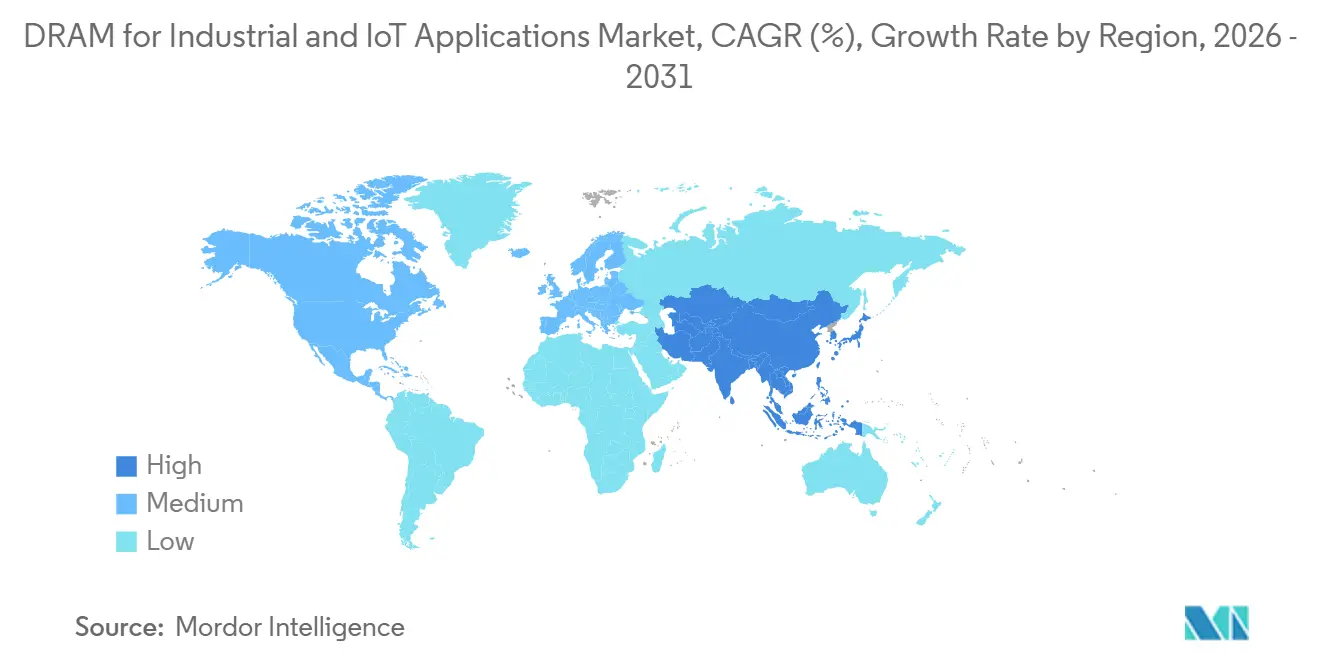
Asia-Pacific held 46.53% of the DRAM for industrial and IoT applications market in 2025 and is projected to grow at a 13.19% CAGR through 2031. The region leads because it combines major fabrication capacity with dense industrial OEM ecosystems in China, Japan, South Korea, and Taiwan. That mix gives Asia-Pacific both supply-side strength and a large installed demand base in automation, electronics manufacturing, and embedded systems. South Korea remains especially important because Samsung Electronics and SK hynix committed KRW 392 trillion (USD 252.5 billion) to a new semiconductor cluster in the Chungcheong region in July 2026, including HBM fabrication and advanced packaging facilities. Even though that investment is closely tied to AI-era memory, its scale reinforces the regional manufacturing base that underpins the broader DRAM for industrial and IoT applications market.
North America DRAM for Industrial and IoT Applications Market
North America presents a smaller but more premium demand profile. Aerospace and defense electronics, semiconductor equipment, advanced medical devices, and oil and gas automation all require stronger qualification, broader thermal support, and higher documentation standards than mass-market electronics. The BIS rule formalized on January 15, 2026 changed export licensing conditions for advanced semiconductors and introduced a total DRAM bandwidth threshold below 6,500 GB/s for exports to China under more flexible treatment, which added a compliance layer to memory sourcing decisions. Micron’s manufacturing expansion in Manassas, Virginia, announced in May 2026, shows how domestic supply and secure provenance have become more important for U.S. industrial and government-linked buyers. That gives North America an outsized role in premium, compliance-heavy purchasing within the DRAM for industrial and IoT applications market.
Europe DRAM for Industrial and IoT Applications Market
Europe remains centered on Germany, France, and the Nordic countries, where machinery, robotics, and precision manufacturing OEMs need memory that supports industrial functional safety and environmental compliance. The Rest of the World remains smaller, but still benefits from automation demand in oil and gas, mining, rail, and traffic systems. These markets mostly consume mature-node, mid-density configurations and tend to adopt newer memory generations more slowly than the largest industrial economies. Across all regions, the DRAM for industrial and IoT applications market is shaped by the same structural divide between advanced-node capacity concentration and broad industrial demand for stable long-lifecycle supply.

Competitive Landscape
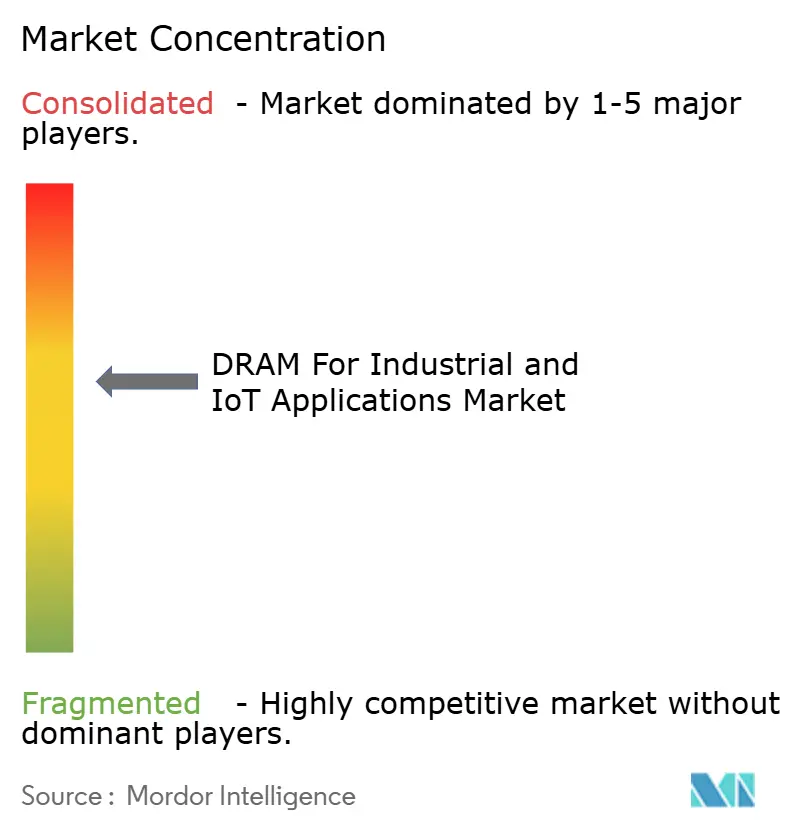
The DRAM for industrial and IoT applications market remains highly concentrated at the die production level and more fragmented at the module and solution level. Samsung Electronics, SK hynix, and Micron Technology continue to anchor global DRAM wafer output, while industrial specialists such as Innodisk, Apacer, Transcend, and ADATA compete more on qualification depth, thermal support, and lifecycle continuity. This creates a two-layer structure in which upstream manufacturing scale is concentrated, but downstream industrial offerings remain more diverse. The difference matters because industrial customers often value validation breadth and availability more than the lowest die cost. As a result, competitive advantage in the DRAM for industrial and IoT applications market depends on how well suppliers combine secure sourcing with industrial-grade packaging, certification, and product longevity.
Several strategic moves in 2025 and 2026 show how the field is developing. Samsung and SK hynix backed a combined KRW 392 trillion (USD 252.5 billion) semiconductor cluster investment in South Korea, reinforcing long-term manufacturing depth around advanced memory production. Micron announced a manufacturing expansion in Virginia as part of a broader domestic investment program, which strengthens its position with defense, industrial, and government-sensitive customers in North America. Innodisk launched a CXL Add-in Card for scalable edge AI memory expansion, showing how specialist suppliers are trying to capture value beyond standard module sales. Advantech also introduced a new rugged DDR5 industrial memory line with 64 GB capacity and an operating range of -25°C to 95°C, signaling that wide-temperature and performance positioning remain central at the solution layer.
The competitive picture is also shaped by where leading-edge capacity is going. Samsung began commercial HBM4 shipments in February 2026, while SK Hynix shipped 12-layer HBM4E samples in June 2026, which shows how aggressively top-tier producers are pursuing AI memory categories.[4]Samsung Electronics, “Samsung Ships Industry-First Commercial HBM4 With Ultimate Performance for AI Computing,” Samsung Global Newsroom, news.samsung.com That focus can leave a strategic gap in long-lifecycle industrial DDR4 and DDR5 supply, where specialist module vendors and smaller memory players can still defend share. The most attractive white-space opportunities remain industrial LPDDR5X modules for rugged systems, CXL-enabled memory expansion for edge servers, and long-availability DDR5 programs for sectors that buy on continuity rather than speed alone. The DRAM for industrial and IoT applications market, therefore, remains concentrated on supply fundamentals, but differentiated in how industrial value is delivered to end customers.
DRAM For Industrial and IoT Applications Industry Leaders
Samsung Electronics Co., Ltd.
SK hynix Inc.
Micron Technology, Inc.
Nanya Technology Corporation
Winbond Electronics Corporation
- *Disclaimer: Major Players sorted in no particular order
DRAM For Industrial and IoT Applications Market Companies Covered in this Report
- Samsung Electronics Co., Ltd.
- SK hynix Inc.
- Micron Technology, Inc.
- Nanya Technology Corporation
- Winbond Electronics Corporation
- Apacer Technology Inc.
- ADATA Technology Co., Ltd.
- Innodisk Corporation
- Transcend Information, Inc.
- Kingston Technology Company, Inc.
- G.SKILL International Enterprise Co., Ltd.
- Rambus Inc.
- Renesas Electronics Corporation
- Super Micro Computer, Inc.
- Synology Inc.
- Elite Semiconductor Memory Technology Inc.
- Integrated Silicon Solution, Inc.
- Alliance Memory, Inc.
- GigaDevice Semiconductor Inc.
- ChangXin Memory Technologies, Inc.

Recent Industry Developments in DRAM For Industrial and IoT Applications Market
- July 2026: Samsung Electronics and SK hynix committed to a combined KRW 392 trillion (USD 252.5 billion) investment in a semiconductor cluster in South Korea's Chungcheong region, including HBM fabrication and advanced packaging facilities, as part of a government-led initiative to reinforce AI-era memory supply leadership and geographic diversification of production capacity.
- June 2026: SK hynix shipped samples of 12-layer HBM4E to major customers, featuring a 16 Gbps-per-pin data processing speed and more than 20% improvement in power efficiency over prior HBM4. The 48 GB capacity product uses Advanced MR-MUF technology to improve heat resistance by 17%, extending memory stability in high-performance computing environments.
- June 2026: Samsung Electronics began supplying the world's first 12-layer HBM4E samples to major customers, entering the HBM4E race 3 months after beginning HBM4 mass production. The company anticipates HBM sales will more than triple in 2026 versus 2025, with custom HBM samples scheduled to reach customers in 2027.
- May 2026: Micron Technology announced a manufacturing expansion in Manassas, Virginia, as part of a USD 250 billion domestic investment program spanning multiple U.S. sites. The Virginia facility produces long-life-cycle memory for defense, industrial, and government end markets, reinforcing supply chain sovereignty for North American industrial OEMs.
- April 2026: SK hynix began mass production of its 192 GB SOCAMM2 module built on the 1cnm, sixth-generation 10 nm-class, LPDDR5X process and optimized for NVIDIA's Vera Rubin AI platform, delivering more than double the bandwidth and over 75% improved power efficiency compared with conventional RDIMM2 configurations.


Global DRAM For Industrial and IoT Applications Market Report Scope
The DRAM for Industrial and IoT Applications Market is Segmented by Architecture (DDR2 and Earlier, DDR3, DDR4, DDR5, LPDDR, and Other Specialized DRAM), Technology Node (20 Nm and Above, 19 Nm to 10 Nm, and Below 10 Nm EUV), Capacity (4 GB and Below, 4 GB to 8 GB, 8 GB to 16 GB, and 16 GB and Above), End-Use Application (Industrial PCs and Controllers, Industrial Automation Systems, Industrial IoT Gateways and Edge Devices, Robotics and Machine Vision, Industrial Networking and Communication Equipment, and Other Industrial and IoT Applications), and Geography (North America, Europe, Asia Pacific, Rest of the World). The Market Forecasts are Provided in Terms of Value (USD).
| DDR2 and Earlier |
| DDR3 |
| DDR4 |
| DDR5 |
| LPDDR |
| Other Specialized DRAM |
| 20 Nm and Above |
| 19 Nm to 10 Nm |
| Below 10 Nm EUV |
| 4 GB and Below |
| 4 GB to 8 GB |
| 8 GB to 16 GB |
| 16 GB and Above |
| Industrial PCs and Controllers |
| Industrial Automation Systems |
| Industrial IoT Gateways and Edge Devices |
| Robotics and Machine Vision |
| Industrial Networking and Communication Equipment |
| Other Industrial and IoT Applications |
| North America | |
| Europe | |
| Asia Pacific | China |
| Japan | |
| South Korea | |
| Taiwan | |
| Rest of Asia Pacific | |
| Rest of the World |
| By Architecture | DDR2 and Earlier | |
| DDR3 | ||
| DDR4 | ||
| DDR5 | ||
| LPDDR | ||
| Other Specialized DRAM | ||
| By Technology Node | 20 Nm and Above | |
| 19 Nm to 10 Nm | ||
| Below 10 Nm EUV | ||
| By Capacity | 4 GB and Below | |
| 4 GB to 8 GB | ||
| 8 GB to 16 GB | ||
| 16 GB and Above | ||
| By End-Use Application | Industrial PCs and Controllers | |
| Industrial Automation Systems | ||
| Industrial IoT Gateways and Edge Devices | ||
| Robotics and Machine Vision | ||
| Industrial Networking and Communication Equipment | ||
| Other Industrial and IoT Applications | ||
| By Geography | North America | |
| Europe | ||
| Asia Pacific | China | |
| Japan | ||
| South Korea | ||
| Taiwan | ||
| Rest of Asia Pacific | ||
| Rest of the World | ||


Key Questions Answered in the Report
What is driving demand for DRAM in industrial and IoT deployments?
Edge AI, robotics, machine vision, and more capable industrial gateways are increasing local memory bandwidth and density needs. These use cases are pushing the category from USD 3.51 billion in 2026 to USD 6.32 billion by 2031 at a CAGR of 12.48%.
Which memory architecture is gaining the most traction in new designs?
DDR4 remained the largest architecture in 2025, but DDR5 is the fastest-growing at a 13.14% CAGR through 2031 because newer industrial platforms need more bandwidth, efficiency, and stronger error handling.
Why is robotics becoming so important for this space?
Robotics and machine vision are projected to grow at a 12.78% CAGR through 2031 as autonomy, perception, and multi-camera processing increase DRAM content per unit.
Which region leads global demand?
Asia-Pacific led with 46.53% share in 2025 and is also the fastest-growing region at a 13.19% CAGR through 2031 because it combines strong fabrication capacity with dense industrial OEM demand.
What is the main supply-side risk for buyers?
Allocation pressure remains the biggest risk because top-tier producers are prioritizing AI memory categories such as HBM, which can tighten availability and keep pricing elevated for standard industrial DDR4 and DDR5 products.
Where are the strongest competitive opportunities for suppliers?
The best openings are in rugged DDR5 and LPDDR5X modules, CXL-enabled memory expansion for edge servers, and long-lifecycle supply programs for industries that value continuity and validation more than lowest cost.
Page last updated on:





