
Downhole Tools Market Size and Share
Market Overview
| Study Period | 2022 - 2032 |
|---|---|
| Market Size (2027) | USD 5.96 Billion |
| Market Size (2032) | USD 7.71 Billion |
| Growth Rate (2027 - 2032) | 5.27 % |
| Fastest Growing Market | Asia-Pacific |
| Largest Market | North America |
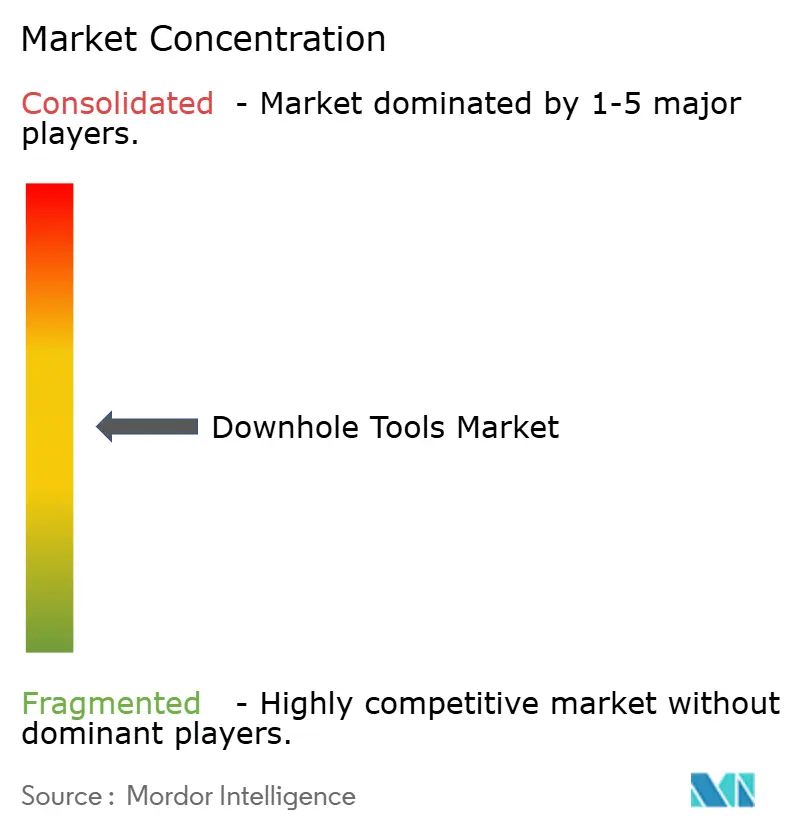
| Market Concentration | Medium |
Major Players *Disclaimer: Major Players sorted in no particular order Image © Mordor Intelligence. Reuse requires attribution under CC BY 4.0. | |
Downhole Tools Market Analysis by Mordor Intelligence
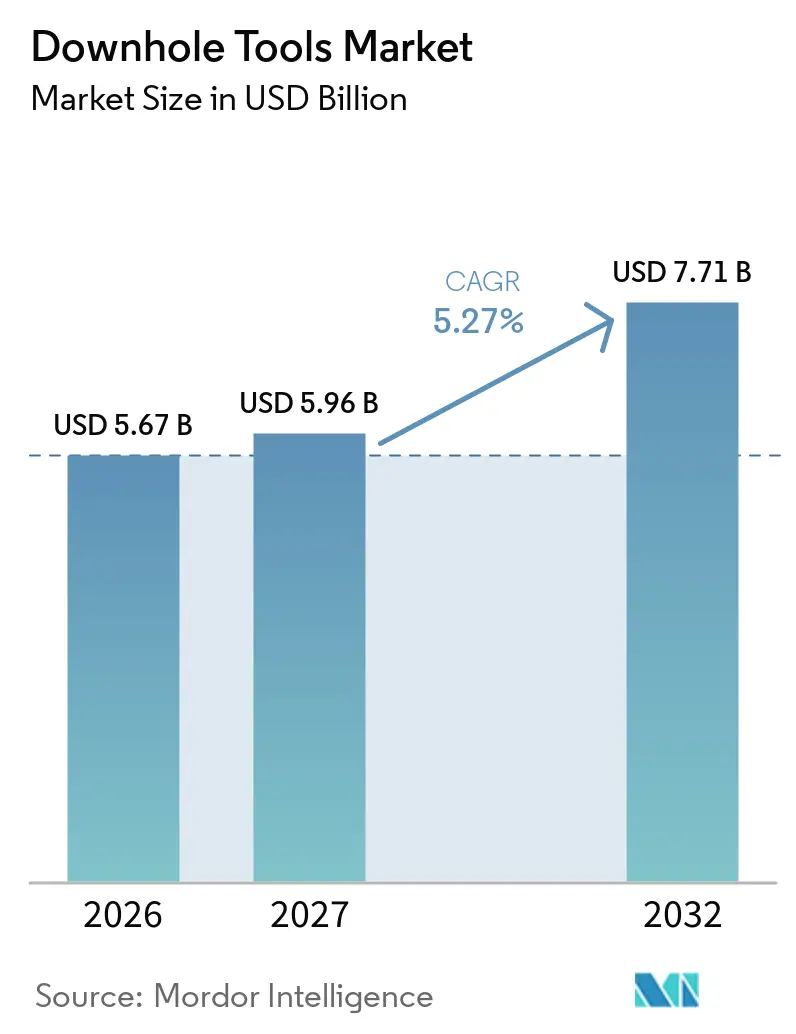
The Downhole Tools Market size is projected to be USD 5.67 billion in 2026, USD 5.96 billion in 2027, and reach USD 7.71 billion by 2032, growing at a CAGR of 5.27% from 2027 to 2032. Demand is shifting toward wells that require longer drilling sections, tighter directional control, and equipment that can operate reliably under high pressure and high temperature. Operators are seeking more recovery from each well, while national oil companies are sustaining longer-term capacity programs and mature assets require continuing workover activity. These conditions support demand for equipment that combines drilling performance, measurement, control, and intervention capabilities within a single service package. The Downhole tools market is also becoming more dependent on digital functions because real-time data is increasingly part of drilling and completion decisions. Competitive advantage therefore depends not only on physical tool reliability, but also on the ability to provide integrated services and usable performance data.
Key Report Takeaways
- By tool type, drilling tools held 33.7% of the Downhole tools market share in 2026, while downhole control tools are forecast to expand at a 6.1% CAGR through 2032.
- By operation environment, onshore operations accounted for 77.1% of the Downhole tools market size in 2026, while offshore operations are forecast to grow at a 5.7% CAGR through 2032.
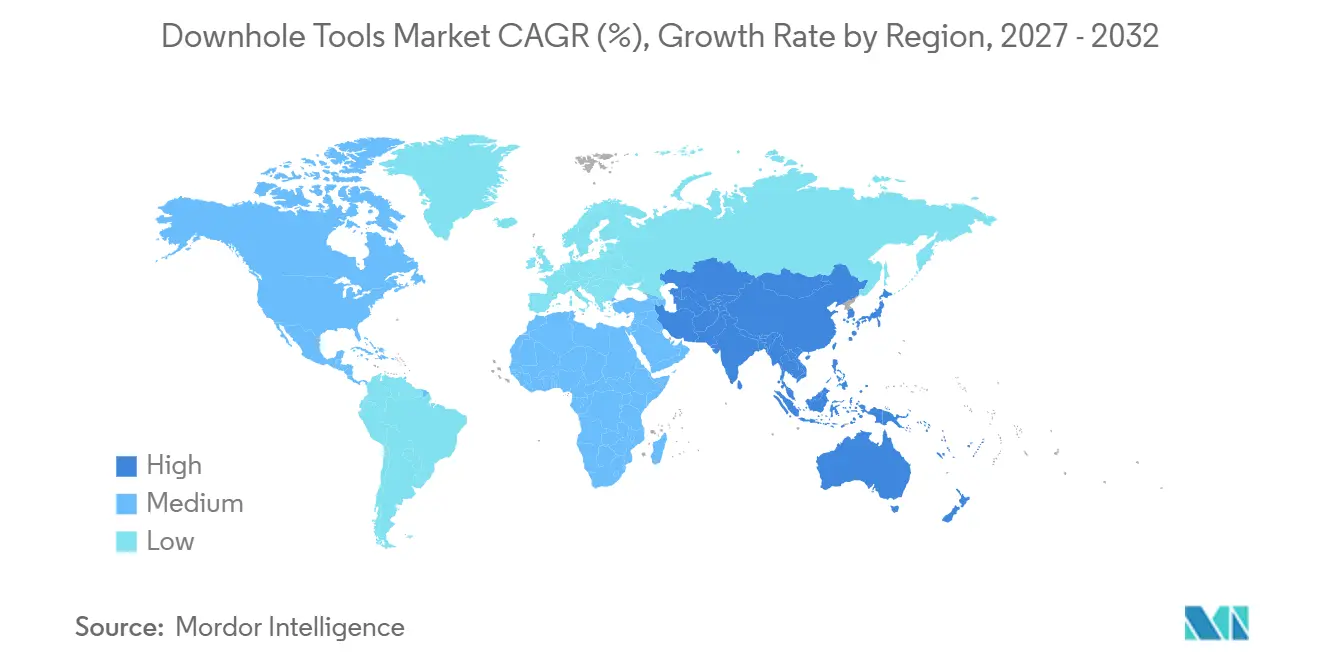
- By geography, North America held 34.7% of the global Downhole tools market in 2026, while Asia-Pacific is forecast to advance at a 5.6% CAGR through 2032.
Note: Market numbers in this report are based on Mordor Intelligence's proprietary estimation framework, which combines nine months of actuals with Q4 projections for base year 2026.
Market Trends and Insights
Drivers Impact Analysis of Downhole Tools Market*
| Driver | (~) % Impact on CAGR Forecast | Geographic Relevance | Impact Timeline |
|---|---|---|---|
| Rising Horizontal and Extended-Reach Well Intensity | +1.4% | North America, Middle East | Short term (≤ 2 years) |
| Deepwater and HPHT Project Sanctioning | +1.1% | South America, West Africa, Southeast Asia | Medium term (2-4 years) |
| Real-Time MWD and LWD Adoption | +0.9% | Global, with early concentration in North America and Middle East and Africa | Medium term (2-4 years) |
| National Oil Company Capacity Expansion | +0.8% | Middle East and Africa, Asia-Pacific | Medium term (2-4 years) |
| Mature-Field Workover and Intervention Demand | +0.6% | North America, Europe, Russia | Short term (≤ 2 years) |
| Tool Replacement Cycles and Rental-Fleet Turnover | +0.5% | Global | Long term (≥ 4 years) |
| Source: Mordor Intelligence | |||
Rising Horizontal and Extended-Reach Well Intensity
Longer horizontal well sections increase the use of directional, drilling, and completion equipment in the Downhole tools market. Average lateral lengths in the Permian Basin reached 10,867 feet in 2025, rising 77% from 6,149 feet in 2015, while wells longer than 3 miles represented 15% of new Permian completions in 2025.[1] Longer laterals increase exposure to shock, vibration, and tool failure, which raises rental frequency and replacement needs. Expand Energy drilled the longest well and longest lateral on record in the United States in 2025, showing that operators continue to test the practical limits of well reach.[2] Extended-reach activity is also spreading beyond North America, as the East Baghdad South field in Iraq recorded a 5,449.6-meter horizontal well in 2025. This wider use of complex well profiles favor suppliers that can demonstrate dependable performance across the full bottom-hole assembly.
Deepwater and High-Pressure High-Temperature (HPHT) Project Sanctioning
Deepwater project approvals create a multi-year demand base for high-specification equipment in the Downhole tools market. ExxonMobil approved the USD 6.8 billion Hammerhead project offshore Guyana in September 2025, which includes 18 production and injection wells.[3] Nigerian National Petroleum Corporation (NNPC) Limited secured approval for a USD 20 billion final investment decision on the Bonga deepwater project in March 2026, the first deepwater production-sharing contract sanction in Nigeria since 2008.[4] These developments require Downhole tools market suppliers to provide equipment that can support deepwater completions, high-pressure environments, and difficult intervention work. High-temperature and high-pressure wells also require qualified alloy components and longer procurement lead times, which can favor suppliers that are approved before field execution begins. The resulting project pipeline places more importance on proven control, completion, and monitoring tools than on basic standalone equipment.
Real-Time MWD and LWD Adoption
Real-time measurement while drilling and logging while drilling functions are becoming more important to tool selection in the Downhole tools market. Halliburton launched EarthStar 3DX in May 2025, a horizontal look-ahead resistivity service designed to identify geological discontinuities up to 50 feet ahead of the drill bit during drilling. Published research in 2025 described the broader use of measurement while drilling technology for trajectory control, reservoir evaluation, and wellbore safety. This shift makes digital capability a procurement consideration in the Downhole tools market alongside pressure and temperature performance. Suppliers without sensing, telemetry, and data integration capabilities may find it harder to qualify for complex drilling work. China National Petroleum Corporation (CNPC) also disclosed a centimeter-precision magnetic guidance drilling system and high-end polycrystalline diamond compact (PDC) bit developments in 2025, indicating broader technology competition in intelligent drilling tools.
National Oil Company Capacity Expansion, Mature-Field Workover and Tool Replacement Demand
National oil company programs provide a longer planning horizon for the Downhole tools market in the Middle East, Asia-Pacific, and other resource-holding regions. Saudi Aramco guided for USD 52 billion to USD 58 billion of capital investment in 2025, including upstream gas growth activities. Oil and Natural Gas Corporation (ONGC) set a capital expenditure target of INR 369.2 billion for fiscal year 2025-26 and allocated 30% to development drilling and 20% to exploratory drilling. Mature fields also need workovers, re-entry work, retrieval activity, and replacement equipment, which provides the Downhole tools market with demand that is less dependent on new field approvals. Repeated use and rental-fleet turnover support a continuing requirement for dependable drilling and intervention tools. Integrated contracts can favor large service companies because they combine tool provision, rig support, and digital services within the same scope.
Restraints Impact Analysis of Downhole Tools Market*
| Restraint | (~) % Impact on CAGR Forecast | Geographic Relevance | Impact Timeline |
|---|---|---|---|
| Operator Capital Discipline and Oil-Price Volatility | -0.7% | Global, most acute in North America and Europe | Short term (≤ 2 years) |
| Specialty-Alloy and Tungsten-Carbide Cost Volatility | -0.5% | Global, most acute in North America and Europe | Short term (≤ 2 years) |
| Shortage of Directional Drillers and MWD Engineers | -0.4% | Global, with acute shortages in Middle East and Africa and Asia-Pacific expansion markets | Medium term (2-4 years) |
| Long Qualification Cycles for New Tool Designs | -0.4% | Global | Long term (≥ 4 years) |
| Source: Mordor Intelligence | |||
Operator Capital Discipline and Oil-Price Volatility
Oil-price volatility can reduce tool demand quickly when operators cut rig activity and drilling budgets. Independent exploration and production companies can treat rig count and associated tool spending as variable expenditures, particularly in North America and Europe. This creates short demand cycles for rental fleets when capital plans change. At the same time, tighter budgets increase the value placed on tools that reduce nonproductive time and improve drilling efficiency. Suppliers must therefore show measured performance data if they are to retain preferred supplier status. The outcome is a wider separation in the Downhole tools market between integrated systems with proven performance and lower-cost tool rentals that compete mainly on price.
Specialty-Alloy Costs, Skills Availability and Qualification Cycles
The Downhole tools market faces cost pressure from materials used in drill bits, control systems, and high-pressure equipment. Tungsten carbide is central to Polycrystalline diamond compact (PDC) bit construction, while specialty alloys are needed for applications that must withstand challenging downhole conditions. Higher input costs can restrict supplier margins and make it harder to maintain frequent replacement programs across the Downhole tools market for long-lateral wells. A shortage of directional drillers and measurement while drilling engineers can also limit the pace at which complex work is executed in expansion regions. New tool designs require lengthy qualifications because operators need evidence of reliability before use in high-value wells. These constraints can delay broader adoption even when the underlying drilling program remains active.
*Our forecasts treat driver/restraint impacts as directional, not additive. The impact forecasts reflect baseline growth, mix effects, and variable interactions.
Downhole Tools Market Segment Analysis
By Tool Type:
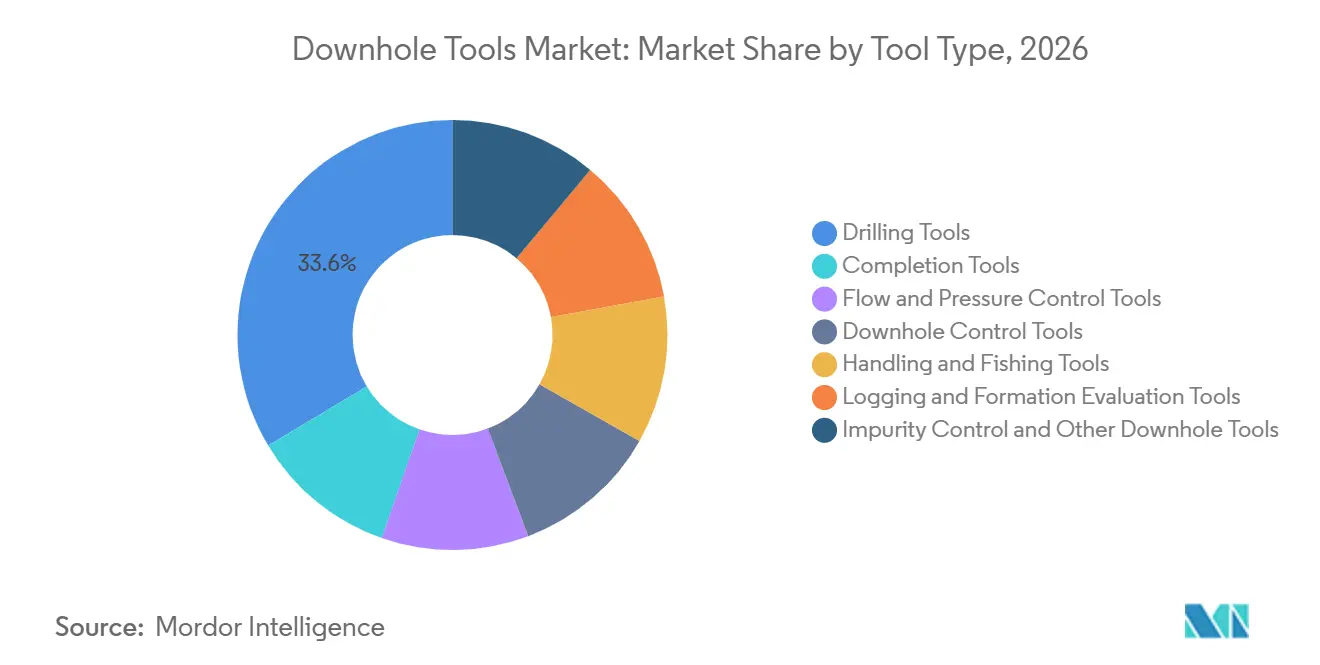
Drilling Tools Lead, Control Tools Set the Next Technology CycleDrilling tools captured 33.7% of the global Downhole tools market share in 2026 because they are needed across new-well programs. PDC bits are a major consumable source of revenue within this group, while rotary steerable systems and bottom-hole assembly components support rental activity. Completion tools and logging and formation evaluation tools form the next tier of demand. Logging and formation evaluation equipment benefits from wider use of measurement while drilling and logging while drilling functions. Handling and fishing tools have a more maintenance-led role because their use is tied to stuck-pipe events and retrieval needs. Flow and pressure control tools are gaining relevance in deepwater completions where zone isolation and downhole barrier reliability are important. Impurity control and other tool categories serve smaller requirements in geothermal-adjacent and sour-gas applications. The broad role of drilling tools keeps the category central to both onshore and offshore work.
Downhole control tools are projected to expand at a 6.1% CAGR through 2032, the highest rate among tool types. The Downhole tools market size for this category is supported by intelligent completion systems that provide multi-zone monitoring and control. Halliburton’s SmartWell Turing electro-hydraulic system supports up to 12 zones and integrates with the Clariti reservoir management suite. SLB launched the ExaCT electrical downhole coiled tubing control system in August 2026 to provide real-time electrical actuation during intervention work. These offerings address extended-reach and multilateral wells where pressure-dependent hydraulic approaches have limits. Equipment reliability under high-pressure and high-temperature conditions remains essential for supplier qualification. This requirement creates a barrier for new entrants that lack field evidence. It also supports demand for suppliers with established control, monitoring, and intervention technology.

By Operation Environment:
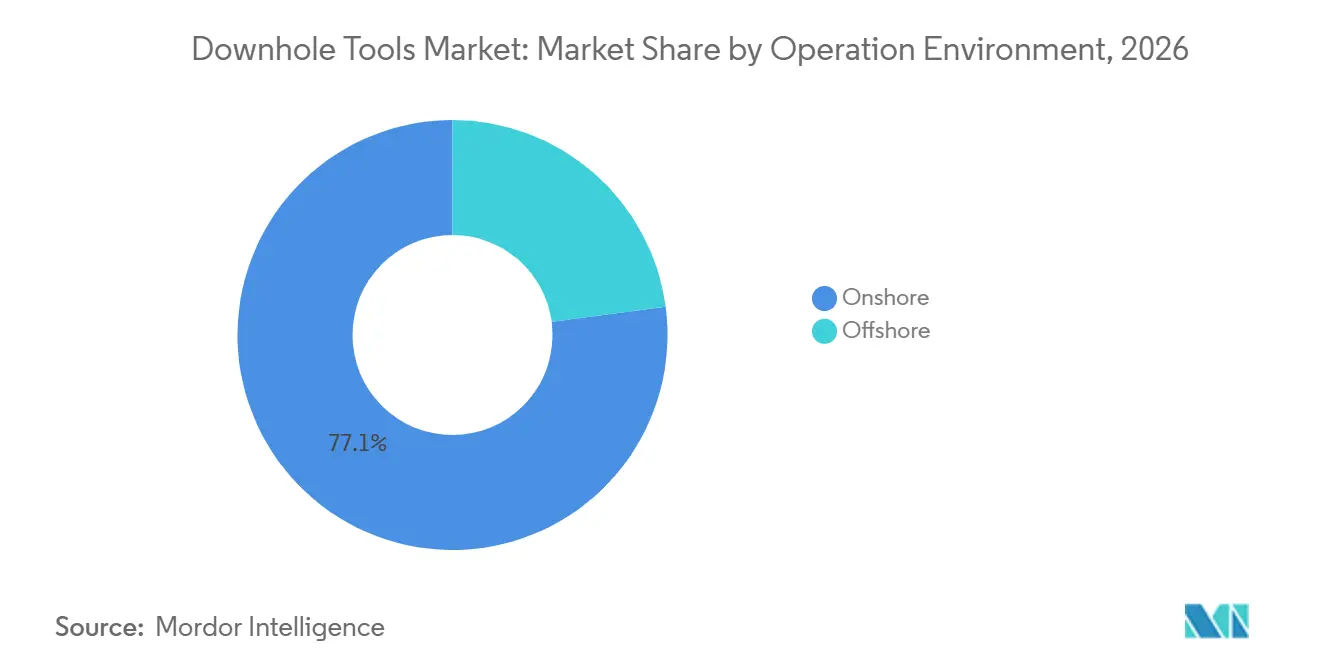
Onshore Leads by Volume, Offshore Commands a Technology PremiumOnshore operations accounted for 77.1% of the Downhole tools market size in 2026, supported by land drilling activity in North America, the Middle East, and China. Pad drilling increases tool use because a single rig can work through multiple wells in sequence. The Permian Basin and Montney are important examples of this model, where long horizontal drilling programs maintain high utilization of rental equipment. Abu Dhabi National Oil Company (ADNOC) Drilling targeted a fleet of more than 148 rigs by 2026, with a focus on land operations supporting unconventional and tight-gas programs. China National Petroleum Corporation (CNPC) Western Drilling reported a 30.57% improvement in mechanical drilling speed and a 23.25% improvement in monthly rig speed in the first quarter of 2025 through tool deployment and process standardization. This shows that onshore competition increasingly depends on tool performance and process quality, not simply the number of active rigs. Established manufacturers benefit when operating standards set a high baseline for equipment quality.
Offshore operations are forecast to grow at a 5.7% CAGR through 2032, faster than the overall Downhole tools market. Revenue per tool is higher offshore because equipment must be suitable for subsea, high-pressure, and high-temperature work. Deepwater development activity will support demand for high-specification completion tools, intelligent control systems, and intervention equipment over the forecast period. Baker Hughes signed a multi-year integrated completions agreement with Petrobras in March 2025 for high-pressure offshore fields. Offshore work also requires long approval periods for equipment and system compatibility. These requirements reward suppliers that achieve qualification early in project planning. The segment remains smaller by volume than onshore work, but its technical demands create stronger opportunities for specialist equipment and integrated service offerings.
Geography Analysis
North America Downhole Tools Market
North America held 34.7% of the global Downhole tools market in 2026, supported by frequent horizontal drilling in the Permian Basin, Eagle Ford, Marcellus, and Montney. Regional demand is shaped more by drilling productivity than by rig count alone. Operators are drilling more footage per rig per day and using equipment more intensively. The region is also an early user of automated directional drilling and real-time steering functions. Baker Hughes launched SureCONNECT FE in January 2025 as a downhole fiber-optic wet-connect system designed to enable real-time sand face monitoring without intervention.
APAC Downhole Tools Market
Asia-Pacific is forecast to grow at a 5.6% CAGR through 2032, making it the fastest-growing geography in the Downhole tools market. The region combines national oil company capacity programs in China and India with greenfield activity in Southeast Asia. China completed the 10,910-meter Deep Earth Tarkell 1 well in February 2025 using domestically developed high-pressure and high-temperature equipment, including measurement while drilling instruments rated to 230°C and 180 MPa. Oil and Natural Gas Corporation (ONGC)’s fiscal year 2025-26 capital plan directs 50% of drilling-related expenditure toward drilling activities, including preparations for ultra-deepwater exploration in the Andaman Basin.
EMEA and South America Downhole Tools Market
The Middle East and Africa has a long-duration demand profile because national oil company programs are less tied to short-term oil-price movements. Saudi Aramco awarded Baker Hughes a multi-year coiled tubing drilling contract in October 2025 that expands active underbalanced coiled tubing drilling units from 4 to 10 from 2026. Abu Dhabi National Oil Company (ADNOC) Drilling completed 75 of 144 planned unconventional wells through its 2025 program and planned to increase activity to more than 300 wells annually from 2027. ARO Drilling and Saudi Aramco began a 6-month SAIRO smart-rig pilot in September 2025 to use real-time rig sensor data for performance and safety improvements. Europe remains supported by Norwegian Continental Shelf activity and North Sea intervention work, while South America benefits from deepwater development activity in Brazil and Guyana.
Competitive Landscape
The Downhole tools market is moderately consolidated among SLB, Baker Hughes, and Halliburton, while regional specialists, independent rental companies, and national oil company-affiliated manufacturers form the rest of the supplier base. The largest providers are increasingly bundling drilling tools, measurement services, completions, and digital analytics in a single contract. This approach raises switching costs because customers buy an integrated operating system rather than a single physical tool. SLB received a contract to deliver integrated services for 18 ultra-deepwater wells at Woodside Energy’s Trion development offshore Mexico, including AI-enabled drilling capabilities across several service lines. Specialist suppliers still have opportunities in vibration mitigation, flow-control accessories, fishing, and monitoring modules where product performance can be judged at the individual well level.
Technology pairing is an important competitive method in the Downhole tools market. Baker Hughes introduced the TRU-Steer rotary steerable system and PermaFORCE-TRU PDC bit as a coordinated solution in February 2026. Baker Hughes also launched the GuardVibe torsional vibration dampener in June 2025 to reduce high-frequency torsional oscillations and support longer bottom-hole assembly life. Halliburton’s EarthStar 3DX service combines tool hardware with look-ahead geological information, increasing the value of compatible tools and usable data.
Domestic suppliers in China and national oil company-adjacent technology companies in the Middle East are adding competitive pressure. China National Petroleum Corporation’s (CNPC) 2025 developments in magnetic guidance drilling and PDC bits indicate an effort to replace products that had been supplied from abroad. Superior Energy Services acquired Rival Downhole Tools in February 2025 and added its JOLT friction-reduction and STORM oscillation-reduction equipment to the Stabil Drill rental portfolio. The transaction expanded its offering for long-lateral wells, where vibration-management equipment can command premium prices. Drilling Tools International also acquired Titan Tools Services in January 2025, adding materials expertise and Drill-N-Ream hole-opening capability in Europe and the Middle East.
Downhole Tools Industry Leaders
-
SLB
-
Halliburton Company
-
Baker Hughes Company
-
NOV Inc.
-
Weatherford International plc
- *Disclaimer: Major Players sorted in no particular order
Downhole Tools Market Companies Covered in this Report
- SLB
- Archer Limited
- Baker Hughes Company
- Cougar Drilling Solutions
- Drilling Tools International
- Expro Group Holdings
- Forum Energy Technologies, Inc.
- Halliburton Company
- Hunting PLC
- Nabors Industries Ltd.
- National Energy Services Reunited Corp.
- NOV Inc.
- Oil States International, Inc.
- Rival Downhole Tools
- Rubicon Oilfield International
- Sandvik AB (Rock Tools)
- Scientific Drilling International
- TechnipFMC plc
- Tenaris S.A.
- United Drilling Tools Ltd.
- Vallourec S.A.
- Varel International Energy Services
- Weatherford International plc
- Wenzel Downhole Tools Ltd.
Recent Industry Developments in Downhole Tools Market
- August 2026: SLB launched ExaCT electrical downhole coiled tubing control system. The platform replaces pressure-dependent hydraulic actuation with real-time electrical communication, enabling on-demand tool actuation across extended-reach and multilateral wells. This marks a step-change in intervention precision for high-value subsea and deepwater assets.
- March 2026: NNPC secures presidential approval for USD 20 billion final investment decision on Bonga Southwest Aparo deepwater project. The project, operated by Shell, will produce 150,000 bopd, representing Nigeria’s first deepwater PSC sanction since 2008. The development’s multi-decade production life creates a sustained downstream demand stream for HPHT downhole tools.
- October 2025: Aramco awards Baker Hughes multi-year coiled tubing drilling contract, expanding fleet from 4 to 10 Underbalanced Coiled Tubing Drilling (UBCTD) units. The contract, booked in Q3 2025, covers underbalanced drilling, re-entry, and greenfield gas field development, reinforcing Baker Hughes’ long-term position in Saudi Arabia’s gas capacity build-out.
- September 2025: ExxonMobil takes final investment decision on USD 6.8 billion Hammerhead development offshore Guyana. The seventh Stabroek Block project will include 18 wells and add 150,000 bopd of capacity, generating sustained multi-year demand for HPHT completion and production tools in the deepwater Guyana basin.
Global Downhole Tools Market Report Scope
Downhole tools are specialized instruments and equipment deployed below the wellhead into an oil and gas wellbore via drill string, wireline, or coiled tubing. They are designed to withstand extreme temperatures, high pressure, and corrosive fluids while performing drilling, completion, production, and intervention tasks.
The global downhole tools market is segmented by tool type, operation environment, and geography. By tool type, the market is segmented into drilling tools, completion tools, flow and pressure control tools, downhole control tools, handling and fishing tools, logging and formation evaluation tools, and impurity control and other downhole tools. By operation environment, the market is segmented into onshore and offshore. The report also covers the market size and forecasts for the global downhole tools market across 26 countries in key regions. For each segment, the market sizing and forecasts have been provided on the basis of value (USD).
Segmentation Overview
| Drilling Tools |
| Completion Tools |
| Flow and Pressure Control Tools |
| Downhole Control Tools |
| Handling and Fishing Tools |
| Logging and Formation Evaluation Tools |
| Impurity Control and Other Downhole Tools |
| Onshore |
| Offshore |
| North America | United States |
| Canada | |
| Mexico | |
| Europe | Germany |
| France | |
| Italy | |
| Norway | |
| United Kingdom | |
| Russia | |
| Rest of Europe | |
| Asia-Pacific | China |
| India | |
| Japan | |
| South Korea | |
| Australia | |
| Indonesia | |
| Malaysia | |
| Thailand | |
| Rest of Asia-Pacific | |
| South America | Brazil |
| Argentina | |
| Colombia | |
| Rest of South America | |
| Middle East and Africa | Saudi Arabia |
| United Arab Emirates | |
| Qatar | |
| Kuwait | |
| Oman | |
| Egypt | |
| Nigeria | |
| Rest of Middle East and Africa |
| By Tool Type | Drilling Tools | |
| Completion Tools | ||
| Flow and Pressure Control Tools | ||
| Downhole Control Tools | ||
| Handling and Fishing Tools | ||
| Logging and Formation Evaluation Tools | ||
| Impurity Control and Other Downhole Tools | ||
| By Operation Environment | Onshore | |
| Offshore | ||
| By Geography | North America | United States |
| Canada | ||
| Mexico | ||
| Europe | Germany | |
| France | ||
| Italy | ||
| Norway | ||
| United Kingdom | ||
| Russia | ||
| Rest of Europe | ||
| Asia-Pacific | China | |
| India | ||
| Japan | ||
| South Korea | ||
| Australia | ||
| Indonesia | ||
| Malaysia | ||
| Thailand | ||
| Rest of Asia-Pacific | ||
| South America | Brazil | |
| Argentina | ||
| Colombia | ||
| Rest of South America | ||
| Middle East and Africa | Saudi Arabia | |
| United Arab Emirates | ||
| Qatar | ||
| Kuwait | ||
| Oman | ||
| Egypt | ||
| Nigeria | ||
| Rest of Middle East and Africa | ||
Key Questions Answered in the Report
What is the forecast growth rate for downhole tools through 2032?
The global sector is forecast to grow at a 5.27% CAGR from 2027 to 2032, reaching USD 7.71 billion by 2032.
Which downhole tool category leads by revenue?
Drilling tools lead with a 33.7% share in 2026 because they are used across new-well programs and well profiles.
Which downhole tool category is growing the fastest?
Downhole control tools are projected to grow at a 6.1% CAGR through 2032, supported by intelligent completion and real-time control needs.
Why are offshore downhole tools growing faster than onshore tools?
Offshore tools are forecast to grow at a 5.7% CAGR because deepwater wells require high-specification completion, control, and intervention equipment.
Which region has the largest demand for downhole tools?
North America leads with 34.7% of global demand in 2026, driven by high-frequency horizontal drilling and advanced directional drilling practices.
What technologies are changing downhole drilling operations?
Real-time measurement and logging functions, look-ahead resistivity services, fiber-optic monitoring, and electrical control systems are increasing the value of data-enabled equipment.