
Disposable Tweezers Market Size and Share
Market Overview
| Study Period | 2021 - 2032 |
|---|---|
| Market Size (2027) | USD 184.97 Million |
| Market Size (2032) | USD 246.14 Million |
| Growth Rate (2027 - 2032) | 5.88 % |
| Fastest Growing Market | Asia-Pacific |
| Largest Market | North America |
| Market Concentration | Medium |
Major Players *Disclaimer: Major Players sorted in no particular order Image © Mordor Intelligence. Reuse requires attribution under CC BY 4.0. | |
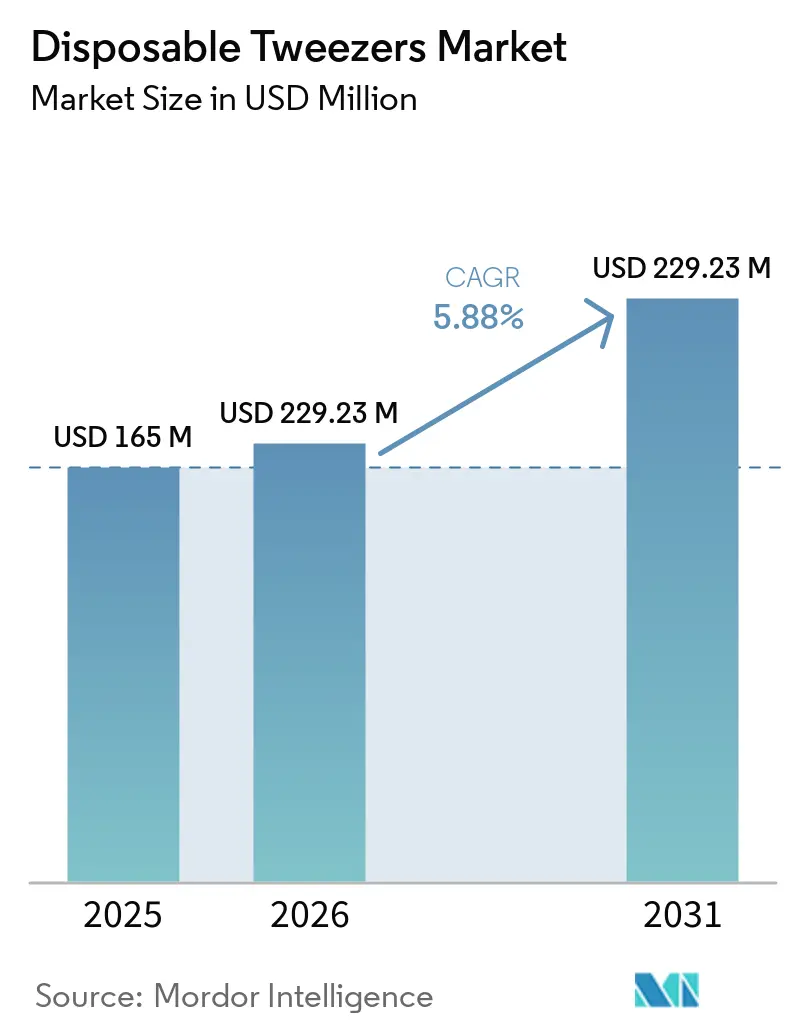
Disposable Tweezers Market Analysis by Mordor Intelligence
The Disposable Tweezers Market size was valued at USD 174.70 million in 2026 and is estimated to grow from USD 184.97 million in 2027 to reach USD 246.14 million by 2032, at a CAGR of 5.88% during the forecast period (2027-2032).
Infection prevention remains central to purchasing decisions because healthcare-associated infections continue to create clinical and cost pressures for providers worldwide. Single-use instruments remove the need for cleaning, disinfection, sterilization, and inspection at the facility level. This shifts responsibility for maintaining sterile supply to manufacturers and can simplify workflows in high-throughput settings. The disposable tweezers market also benefits as surgical, dental, diagnostic, and outpatient care activities increase. Suppliers are responding through precision materials, sterile packaging, and digital purchasing support, while waste costs and plastic restrictions continue to influence product design and purchasing choices
Key Report Takeaways
- By material, plastic held 72% of the disposable tweezers market share in 2026, while titanium is forecast to grow at a 6.8% CAGR through 2032.
- By tip geometry, straight-tip tweezers held 39.2% revenue share in 2026, while pointed-tip tweezers are projected to grow at a 6.3% CAGR through 2032.
- By sterility status, sterile tweezers held 67.5% revenue share in 2026 and are forecast to grow at a 6% CAGR through 2032.
- By application, surgical procedures held 36.8% revenue share in 2026, while laboratory and clinical diagnostics are forecast to grow at a 6.6% CAGR through 2032.
- By end user, hospitals held 45.8% revenue share in 2026, while ambulatory surgery centers are forecast to grow at a 6.4% CAGR through 2032.
Note: Market numbers in this report are based on Mordor Intelligence's proprietary estimation framework, which combines nine months of actuals with Q4 projections for base year 2026.
Market Trends and Insights
Drivers Impact Analysis of Disposable Tweezers Market*
| Driver | (~) % Impact on CAGR Forecast | Geographic Relevance | Impact Timeline |
|---|---|---|---|
| Infection Prevention and Cross-Contamination Control | +1.5% | Global | Short term (≤ 2 years) |
| Growth in Dental, Surgical, and Clinical Procedures | +1.2% | Global, led by North America and APAC | Medium term (2-4 years) |
| Expansion of Laboratory Automation and High-Throughput Testing | +0.8% | North America, Europe, APAC | Medium term (2-4 years) |
| Growth of Online and Direct Procurement Channels | +0.6% | Global, digital-first markets | Medium term (2-4 years) |
| Demand for Cleanroom-Compatible, Ready-to-Use Instruments | +0.5% | North America and Europe | Long term (≥ 4 years) |
| Material Innovation Enabling Lower-Impact Disposable Designs | +0.4% | Global, with early adoption in Europe | Long term (≥ 4 years) |
| Source: Mordor Intelligence | |||
Infection Prevention and Cross-Contamination Control
Healthcare-associated infections continue to create a direct need for reliable infection prevention in hospitals and clinics. The disposable tweezers market gains from this need because a single-use instrument avoids reuse-related contamination risk. Reprocessing requires cleaning, disinfection, sterilization, and inspection, and each step requires validated procedures. The Centers for Disease Control and Prevention[1] identifies single-use devices as appropriate where reuse and cleaning reliability are uncertain. Facilities without validated reprocessing capacity can use prepackaged sterile products to support consistent clinical practice. This keeps demand strongest in settings with rapid patient turnover and limited instrument-processing resources.
Growth in Dental, Surgical, and Clinical Procedures
A higher number of procedures increases the consumption of instruments used for tissue handling, dressing, and specimen work. The International Society of Aesthetic Plastic Surgery[2] reported nearly 38 million aesthetic procedures in its 2024 global survey, including more than 2.1 million eyelid surgeries. Each procedure can require a fresh set of instruments when clinical protocols require single-use products. Dental practices also use single-use devices where cleaning is difficult or where they cannot be heat sterilized. Growth in outpatient and minimally invasive care supports frequent replenishment of basic consumables. The disposable tweezers market, therefore, depends on procedure volumes as well as the required level of instrument control.
Expansion of Laboratory Automation and High-Throughput Testing
Laboratory automation increases sample-processing capacity, but manual handling remains necessary for several preparation steps. Disposable tweezers can support tissue transfer, biopsy handling, and slide preparation where cross-sample contamination must be controlled. A 2024 scientific review identified clinical and diagnostic laboratories as the fastest-growing end-user group for total laboratory automation systems. ISO 14644-18 addresses the assessment of consumables used in controlled environments. Laboratories that expand daily throughput can increase their consumption of sterile handling tools even if the unit cost remains stable. This creates recurring demand for the disposable tweezers market in genomics, oncology, and other controlled laboratory workflows.
Growth of Online and Direct Procurement Channels
Digital procurement is changing how smaller clinics and professional buyers source frequently used clinical products. Consolidated purchasing portals allow buyers to order low-value consumables together with larger clinical supply orders. Henry Schein stated that it continued to expand its consolidated digital platform in its 2025 financial results and 2026 outlook. This can improve product visibility for standard and specialized disposable formats. Digital channels also make list prices easier to compare, which can increase pressure on commodity products. The disposable tweezers market has room for online growth where suppliers combine clear product specifications with dependable fulfillment.
Restraints Impact Analysis of Disposable Tweezers Market*
| Restraint | (~) % Impact on CAGR Forecast | Geographic Relevance | Impact Timeline |
|---|---|---|---|
| Medical-Waste Treatment and Disposal Costs | -0.7% | North America and EU, with spillover to APAC | Medium term (2-4 years) |
| Price Premium Versus Reusable Tweezers in Low-Volume Settings | -0.5% | Emerging markets, rural, and low-volume settings globally | Medium term (2-4 years) |
| Sterility-Shelf-Life Risk in Long-Distance Distribution | -0.3% | MEA, South America, South Asia, and Southeast Asia | Long term (≥ 4 years) |
| Plastic Restrictions and Procurement Preference for Reusable Instruments | -0.4% | Europe, with early signals in Canada and Australia | Long term (≥ 4 years) |
| Source: Mordor Intelligence | |||
Medical-Waste Treatment and Disposal Costs
Disposables add waste handling requirements after clinical use, which can weaken their cost advantage in lower-volume settings. The U.S. Environmental Protection Agency sets requirements for hazardous waste generators, and healthcare facilities must manage regulated waste within applicable rules. Higher collection, treatment, and disposal charges affect the full cost of a single-use product. The effect can be more pronounced when facilities use high volumes of individually packaged sterile instruments. Compact packaging and material-efficient formats can reduce the waste burden associated with each unit. The disposable tweezers market faces greater pressure where facilities evaluate procurement and waste expenses together.
Price Premium Versus Reusable Tweezers in Low-Volume Settings
Reusable tweezers can remain less costly per use for clinics with low procedure volumes and reliable sterilization capacity. Small specialty practices and rural health posts may spread the purchase cost of a reusable instrument across several years. Disposable options must justify their unit price through sterility, time savings, or specialized performance. This is particularly relevant in price-sensitive procurement systems with constrained supply budgets. Suppliers can address the constraint through volume contracts, differentiated tip geometries, radiopaque markers, or improved ergonomic features. The disposable tweezers market remains commercially limited in settings where the clinical benefit does not outweigh the recurring purchasing cost.
*Our forecasts treat driver/restraint impacts as directional, not additive. The impact forecasts reflect baseline growth, mix effects, and variable interactions.
Disposable Tweezers Market Segment Analysis
By Material:
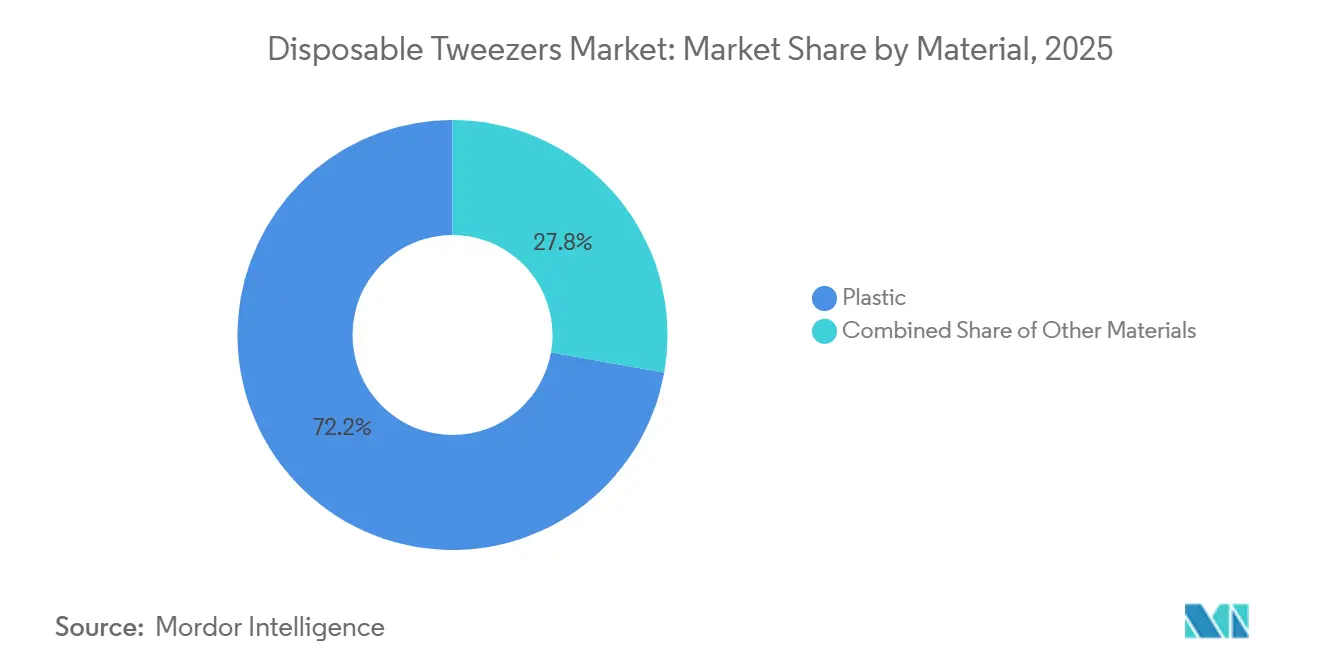
Polymer Dominance Meets Precision-Grade TitaniumPlastic held 72.21% of the disposable tweezers market share in 2026. Polypropylene supports cost-efficient production, color coding, and compatibility with gamma irradiation. Its lightweight can also support repeated instrument exchanges during wound care and routine clinical work. The material remains the common choice for high-volume hospital purchasing. Stainless steel serves applications that need greater tip precision but do not require a premium titanium product. Dental procedures and general surgical wound closure remain relevant uses for disposable stainless-steel designs.
Titanium is forecast to grow at a 6.8% CAGR from 2027 to 2032. Its corrosion resistance and nonmagnetic properties support use in neurosurgery, ophthalmology, and advanced diagnostic work. AROSurgical introduced FDA-cleared disposable titanium spring microvascular clamps in October 2025 with a calibrated 15-120 g force range and radiopaque visibility. ISO[3] 13402:2025 sets test methods for resistance to autoclaving, corrosion, and thermal exposure in surgical and dental hand instruments. Commodity plastic lines are likely to face stronger price competition in bulk tenders. Titanium and specialty-polymer lines can support higher pricing when users require demonstrated precision and material performance.

By Tip Geometry:
Procedural Specialization Shapes Design PreferenceStraight-tip tweezers held 39.2% of the disposable tweezers market share in 2026. Their general-purpose design supports wound care, dental cotton placement, and routine specimen handling. Users value a firm grasp and consistent basic performance in these applications. Curved tips support access to recessed anatomy during ENT and ophthalmic procedures. Slanted designs can assist fine laboratory work and peripheral nonclinical uses. Straight-tip products therefore retain broad purchasing relevance across routine clinical settings.
Pointed-tip tweezers are forecast to grow at a 6.3% CAGR from 2027 to 2032. This geometry supports precise handling in laboratory diagnostics, histology, and forensic sample work. Fine-tipped instruments can also support tissue handling and specimen retrieval in minimally invasive procedures. Product developers are adding asymmetric tip designs, textured grips, and locking mechanisms to differentiated formats. These features move pointed-tip products beyond a basic commodity design. The disposable tweezers market can gain value where users require consistent handling of very small objects in confined work areas.
By Sterility Status:
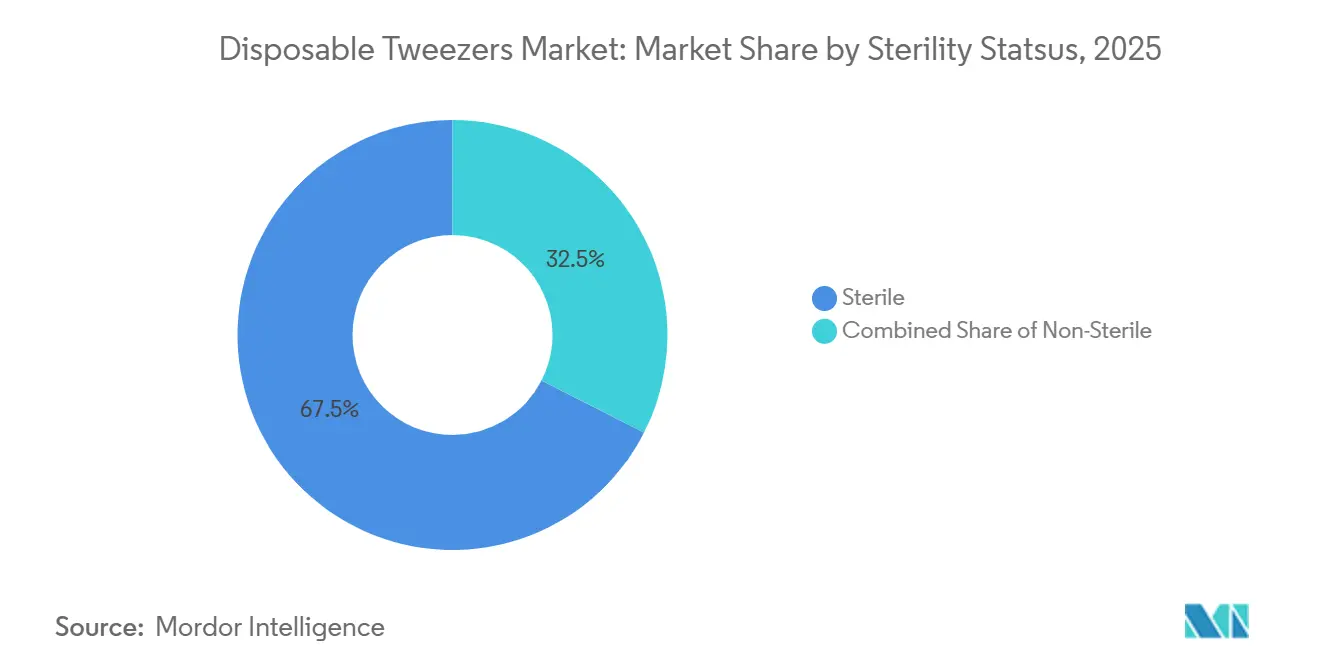
A Structurally Dominant Sterile SegmentSterile tweezers held 67.5% of the disposable tweezers market share in 2026. The segment is also forecast to grow at a 6% CAGR through 2032. Surgical and clinical procedure growth aligns directly with demand for presterilized, ready-to-use products. Nonsterile tweezers remain relevant for research, forensics, and noncontact cosmetic work. Their role is narrower where clinical protocols require terminal sterility. Sterile configurations, therefore, remain central to the disposable tweezers market across regulated care settings.
European rules reinforce the need for a compliant sterile supply. Article 17 of the EU Medical Device Regulation permits reprocessing of single-use devices only where national law allows it. The European Commission[4] reported in November 2024 that 10 of 30 countries permitted this activity and 6 notified bodies offered certification services for reprocessed single-use devices. Manufacturers must validate sterile packaging and shelf life for long distribution routes. These requirements raise the cost and technical threshold for new suppliers. Established producers can use documented packaging performance to protect product positioning.
By Application:
Surgery Leads Volume While Diagnostics Leads GrowthSurgical procedures held 36.8% of the disposable tweezers market share in 2026. Operating rooms use instruments frequently, and sterile fields can favor single-use products. Wound care and dressing remain important because home healthcare and community nursing may lack on-site sterilization resources. Dental procedures also support demand where single-use device guidance applies. The CDC provides dental guidance on the use of single-use devices that cannot be heat sterilized. Surgical settings consequently remain the leading source of volume for the disposable tweezers market.
Laboratory and clinical diagnostics are forecast to grow at a 6.6% CAGR from 2027 to 2032. Molecular diagnostics, genomics, and oncology workflows require controlled handling of rising sample volumes. A 2024 review reported that 115 South Korean institutions operated total laboratory automation systems, representing 77% of tertiary general hospitals. Laboratory demand is tied to per-sample activity rather than only to scheduled procedures. Avantor and p-Chip announced an October 2025 collaboration to develop digitally traceable smart consumables. Barcode-ready packaging and chain-of-identity support can help suppliers serve this application with higher-value products.
By End User:
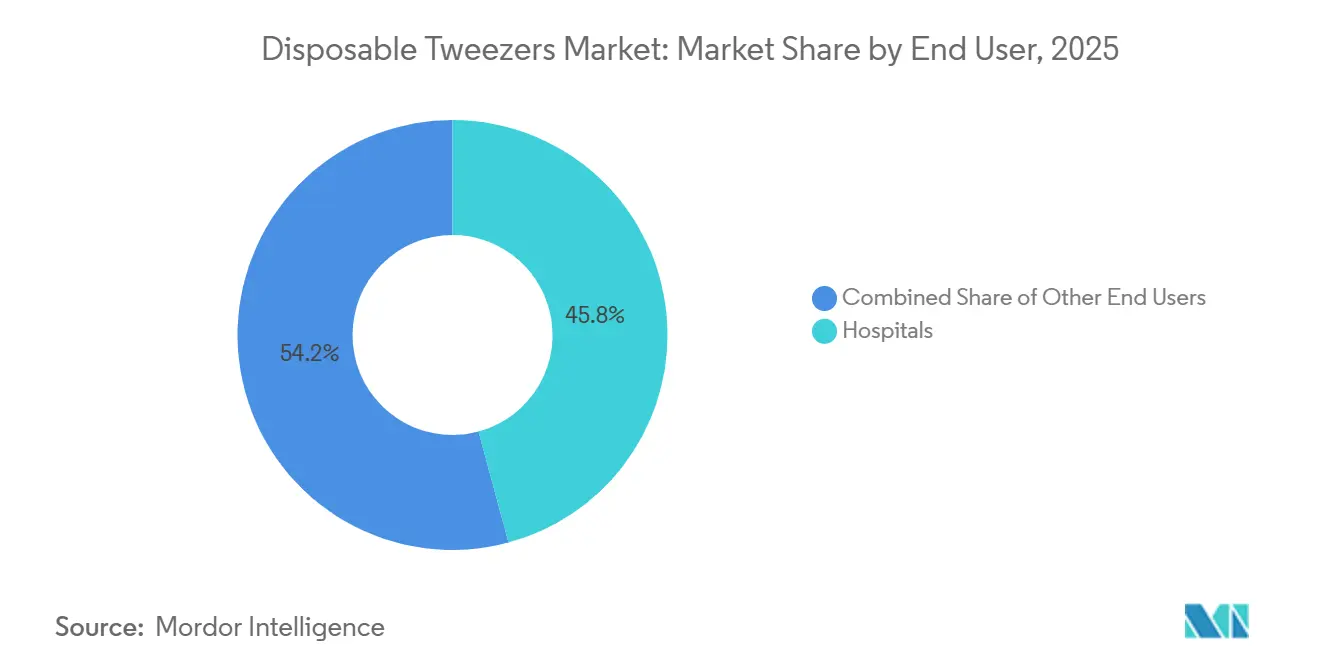
Hospital Scale Persists as ASC Velocity AcceleratesHospitals held 45.8% of the disposable tweezers market share in 2026. Their broad procedure mix and centralized purchasing support large and recurring orders. Hospitals can negotiate lower unit prices through volume commitments. Specialty clinics in dermatology, ophthalmology, ENT, and orthopedics purchase at a lower frequency. Clinical laboratories and academic institutions form a growing niche where workflow automation standardizes disposable handling products. Hospitals, therefore, remain the core end-user group for the disposable tweezers market.
Ambulatory surgery centers are forecast to grow at a 6.4% CAGR from 2027 to 2032. MedPAC stated that ASC procedure volumes per Medicare beneficiary increased 3.5% in 2024, and spending for ASC facility services reached USD 7.5 billion. Higher-acuity outpatient care can increase the use of precision-tip and sterile-packaged instruments. These centers require reliable stock replenishment without maintaining the same inventory scale as a hospital. Suppliers can tailor product packs to procedure types and outpatient workflow needs. This supports demand for specialized formats rather than only the lowest-cost designs.
Geography Analysis
North America Disposable Tweezers Market
North America held 34.1% of the disposable tweezers market share in 2026. The United States has a dense network of hospitals, ambulatory surgery centers, and dental practices that use high volumes of clinical consumables. Infection-control guidance from the CDC supports the appropriate use of single-use devices. Henry Schein reported USD 13.2 billion in 2025 revenue, with 69% of net sales generated through U.S. operations. MedPAC reported continued ASC volume growth, which supports demand for sterile and precision-oriented formats. Canada and Mexico add incremental volume through hospital investment and expanding private care activity.
Europe Disposable Tweezers Market
Europe remains a significant regional base, with Germany, the United Kingdom, and France as major volume markets. Regional demand is moderated by concerns about medical waste, packaging, and the use of single-use plastics. Regulation (EU) 2025/40 establishes packaging and packaging waste requirements that will affect medical product packaging, while specific healthcare provisions may apply. Article 17 of the EU Medical Device Regulation also creates different national conditions for reprocessing single-use devices. This variation makes country-level regulatory planning important for suppliers. The region offers stable procedure demand, but product designs must respond to environmental requirements and purchasing preferences.
APAC, MEA and South America Disposable Tweezers Market
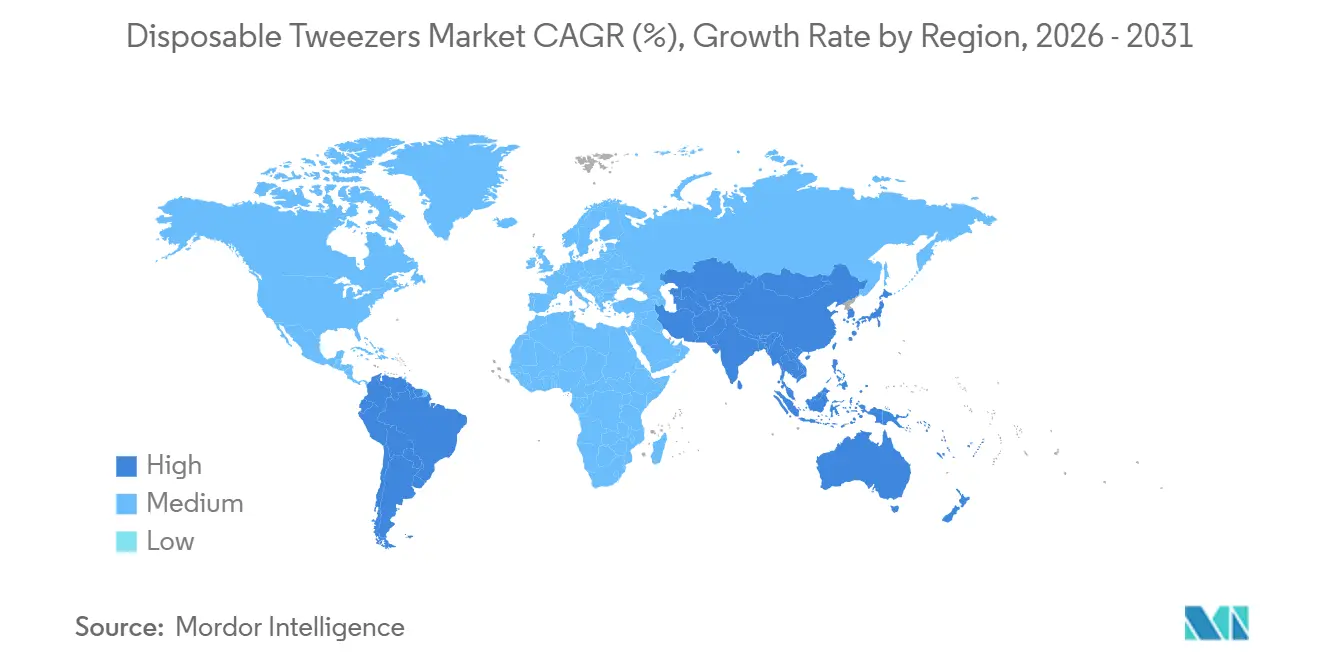
Asia-Pacific is forecast to grow at a 6.7% CAGR from 2027 to 2032. China, India, and Southeast Asian countries are expanding hospital and outpatient capacity, which broadens the customer base for disposable supplies. Japan’s medical device framework includes a registration category for disposable tweezers under code 35079001. India’s tertiary hospital development and Southeast Asia’s outpatient facilities add to regional demand. Middle East and Africa and South America remain smaller opportunities, supported by modernization programs and private hospital expansion. Long-distance distribution can make sterile shelf-life management more difficult in these regions.
Competitive Landscape
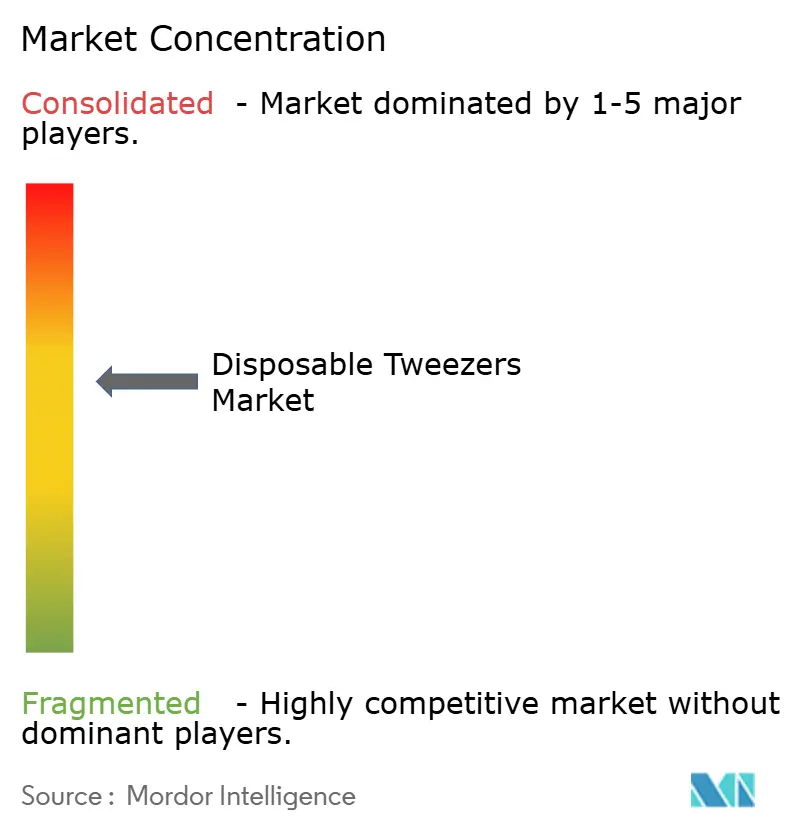
The disposable tweezers market is moderately fragmented, with no company holding a decisive position across all applications and regions. Global distributors include Henry Schein, Medline, Avantor, and Thermo Fisher Scientific. Specialist instrument suppliers include HuFriedyGroup, Excelta Corporation, Ideal-tek SA, and Dumont Tweezers. These companies compete through distribution reach, product quality, precision design, and material selection. Regional suppliers often compete through lower costs in Asia-Pacific markets. The competitive structure gives healthcare providers several supply options but makes established distribution relationships valuable.
Medline is expanding distribution capacity to improve replenishment for healthcare customers. In March 2026, Medline broke ground on a 1.2 million-square-foot distribution center in Midlothian, Texas, which includes AutoStore retrieval systems and temperature-controlled storage. In July 2026, Medline announced leases for two Northern California facilities totaling 1.6 million square feet. These investments can support faster delivery of high-frequency consumables. Aesculap introduced irrigating specialty nonstick disposable bipolar forceps in October 2025, using nonstick tips and integrated irrigation. Product performance can therefore be as important as price in specialized single-use instruments.
Opportunities are strongest in precision titanium products for ambulatory surgery centers and in traceable formats for laboratory diagnostics. AROSurgical’s 2025 disposable titanium clamp launch illustrates the role of calibrated precision in a single-use product. Avantor’s collaboration with p-Chip also points to demand for traceability within life sciences and diagnostics. Dentsply Sirona launched Smart View-Detect in May 2026 and expanded its agreement with Atlanta Dental Supply. These actions show how dental suppliers can combine new clinical tools with broader channel access. The disposable tweezers market remains open to suppliers that can meet regulatory, packaging, and application-specific requirements.
Disposable Tweezers Industry Leaders
-
Medline Industries, LP
-
Dentsply Sirona Inc.
-
Kerr Corporation
-
COLTENE Group
-
B. Braun Melsungen AG
- *Disclaimer: Major Players sorted in no particular order
Disposable Tweezers Market Companies Covered in this Report
- Rubis
- Dumont Tweezers
- Excelta Corporation
- Ideal-tek SA
- Robert Burkle GmbH
- Sampling Systems Ltd
- TIGA-MED Deutschland GmbH
- MECO Instruments Pvt. Ltd
- Arrowhead Forensics
- AmScope
- Avantor Inc.
- Heathrow Scientific LLC
- Henry Schein
- LABOAO
- Medline Industries
- Misumi Group Inc.
- B. Braun
- Hu-Friedy Mfg
- Ultradent Products, Inc.
- Dentsply Sirona
- Patterson Companies
- Kerr
- COLTENE Group
- GC Corporation
- Young Innovations
Recent Industry Developments in Disposable Tweezers Market
- April 2026: Medline announced a strategic AI-robotics partnership with Symbotic to implement next-generation warehouse automation at one of Medline’s 45 U.S. distribution centers in 2027, aimed at improving speed, accuracy, and scalability of medical supply fulfillment
- October 2025: Aesculap, Inc. launched Irrigating Specialty Non-Stick Disposable Bipolar Forceps in the U.S. market, featuring nonstick tips, integrated irrigation, and 49% higher irrigation output than competitive dual-irrigation systems
- October 2025: Avantor, Inc. announced a collaboration with p-Chip Corporation to co-develop Smart Consumables by embedding microtransponder technology into laboratory and clinical consumables for chain-of-identity compliance in life sciences, diagnostics, and biomanufacturing settings
- September 2025: HuFriedyGroup appointed Robert Woolley as CEO, succeeding Andy Xilas and signaling a strategic realignment focus for the global dental instrument manufacturer
Global Disposable Tweezers Market Report Scope
As per the scope of the report, disposable tweezers are single-use handheld instruments designed for grasping, holding, manipulating, or removing small objects and tissues during medical, surgical, dental, laboratory, and diagnostic procedures. These tweezers help maintain sterility, reduce the risk of cross-contamination and healthcare-associated infections, and eliminate the need for cleaning and reprocessing. Disposable tweezers are commonly manufactured from plastic, stainless steel, or titanium and are available in various tip geometries to meet specific procedural requirements across healthcare and research settings.
The disposable tweezers market is segmented by material into plastic, stainless steel, and titanium; by tip geometry into straight tip, pointed tip, curved tip, and slanted tip; by sterility status into sterile and non-sterile; by application into surgical procedures, wound care & dressing, diagnostic procedures, dental procedures, and laboratory & clinical diagnostics; by end user into hospitals, ambulatory surgery centers, specialty clinics, and others (clinical laboratories, academic & research institutions); and by geography into North America, Europe, Asia-Pacific, Middle East and Africa, and South America. The market report also covers the estimated market sizes and trends for 17 countries across major regions globally.
Segmentation Overview
| Plastic |
| Stainless Steel |
| Titanium |
| Straight Tip |
| Pointed Tip |
| Curved Tip |
| Slanted Tip |
| Sterile |
| Non-Sterile |
| Surgical Procedures |
| Wound Care & Dressing |
| Diagnostic Procedures |
| Dental Procedures |
| Laboratory & Clinical Diagnostics |
| Hospitals |
| Ambulatory Surgery Centers |
| Specialty Clinics |
| Others (Clinical Laboratories, Academic & Research Institutions) |
| North America | United States |
| Canada | |
| Mexico | |
| Europe | Germany |
| United Kingdom | |
| France | |
| Italy | |
| Spain | |
| Rest of Europe | |
| Asia-Pacific | China |
| Japan | |
| India | |
| South Korea | |
| Australia | |
| Rest of Asia-Pacific | |
| Middle East and Africa | GCC |
| South Africa | |
| Rest of Middle East and Africa | |
| South America | Brazil |
| Argentina | |
| Rest of South America |
| By Material | Plastic | |
| Stainless Steel | ||
| Titanium | ||
| By Tip Geometry | Straight Tip | |
| Pointed Tip | ||
| Curved Tip | ||
| Slanted Tip | ||
| By Sterility Status | Sterile | |
| Non-Sterile | ||
| By Application | Surgical Procedures | |
| Wound Care & Dressing | ||
| Diagnostic Procedures | ||
| Dental Procedures | ||
| Laboratory & Clinical Diagnostics | ||
| By End User | Hospitals | |
| Ambulatory Surgery Centers | ||
| Specialty Clinics | ||
| Others (Clinical Laboratories, Academic & Research Institutions) | ||
| By Geography | North America | United States |
| Canada | ||
| Mexico | ||
| Europe | Germany | |
| United Kingdom | ||
| France | ||
| Italy | ||
| Spain | ||
| Rest of Europe | ||
| Asia-Pacific | China | |
| Japan | ||
| India | ||
| South Korea | ||
| Australia | ||
| Rest of Asia-Pacific | ||
| Middle East and Africa | GCC | |
| South Africa | ||
| Rest of Middle East and Africa | ||
| South America | Brazil | |
| Argentina | ||
| Rest of South America | ||
Key Questions Answered in the Report
What is the projected value of disposable tweezers by 2032?
The category is forecast to reach USD 246.14 million by 2032, growing at a 5.88% CAGR from 2027. Infection prevention, procedure growth, laboratory testing, and outpatient care support this expansion. Product design also increasingly reflects requirements for sterility, precision, and documented performance.
Why are sterile disposable tweezers widely used?
Sterile products held 67.5% share in 2026 because they support infection control and avoid the need for facility reprocessing. This is particularly relevant where staff need a ready-to-use instrument for a regulated procedure. Manufacturers must also demonstrate packaging integrity and shelf-life performance across distribution routes.
Which material is growing fastest for disposable tweezers?
Titanium is forecast to grow at a 6.8% CAGR through 2032, supported by demand for precision and corrosion-resistant instruments. Its nonmagnetic properties and potential use in specialized surgical and diagnostic settings support this position. Plastic continues to lead volume because it supports cost-efficient supply for routine clinical applications.
Which application will grow fastest through 2032?
Laboratory and clinical diagnostics is forecast to grow at a 6.6% CAGR, supported by molecular diagnostics, genomics, and oncology workflows. These uses depend on controlled sample handling and can create recurring demand based on testing activity. Traceable packaging and suitable consumables support reproducibility in regulated laboratory environments.
Which region is expected to grow fastest?
Asia-Pacific is projected to grow at a 6.7% CAGR through 2032 as hospital and outpatient capacity expands. Demand is supported by China, India, Japan, and Southeast Asian countries that are building clinical and diagnostic capacity. Suppliers need to manage shelf life and logistics carefully across long regional distribution routes.
What limits adoption in low-volume clinical settings?
Recurring purchasing costs and medical-waste handling can make reusable instruments more economical for providers with low procedure volumes. Suppliers can respond with specialized features, volume agreements, and packaging formats that reduce the disposal footprint. The choice depends on clinical protocol, validated sterilization capacity, total cost, and expected instrument use.