
Directory Services Market Size and Share
Market Overview
| Study Period | 2021 - 2032 |
|---|---|
| Market Size (2027) | USD 16.37 Billion |
| Market Size (2032) | USD 26.17 Billion |
| Growth Rate (2027 - 2032) | 9.84 % |
| Fastest Growing Market | Asia-Pacific |
| Largest Market | North America |
| Market Concentration | Medium |
Major Players *Disclaimer: Major Players sorted in no particular order Image © Mordor Intelligence. Reuse requires attribution under CC BY 4.0. | |
Directory Services Market Analysis by Mordor Intelligence
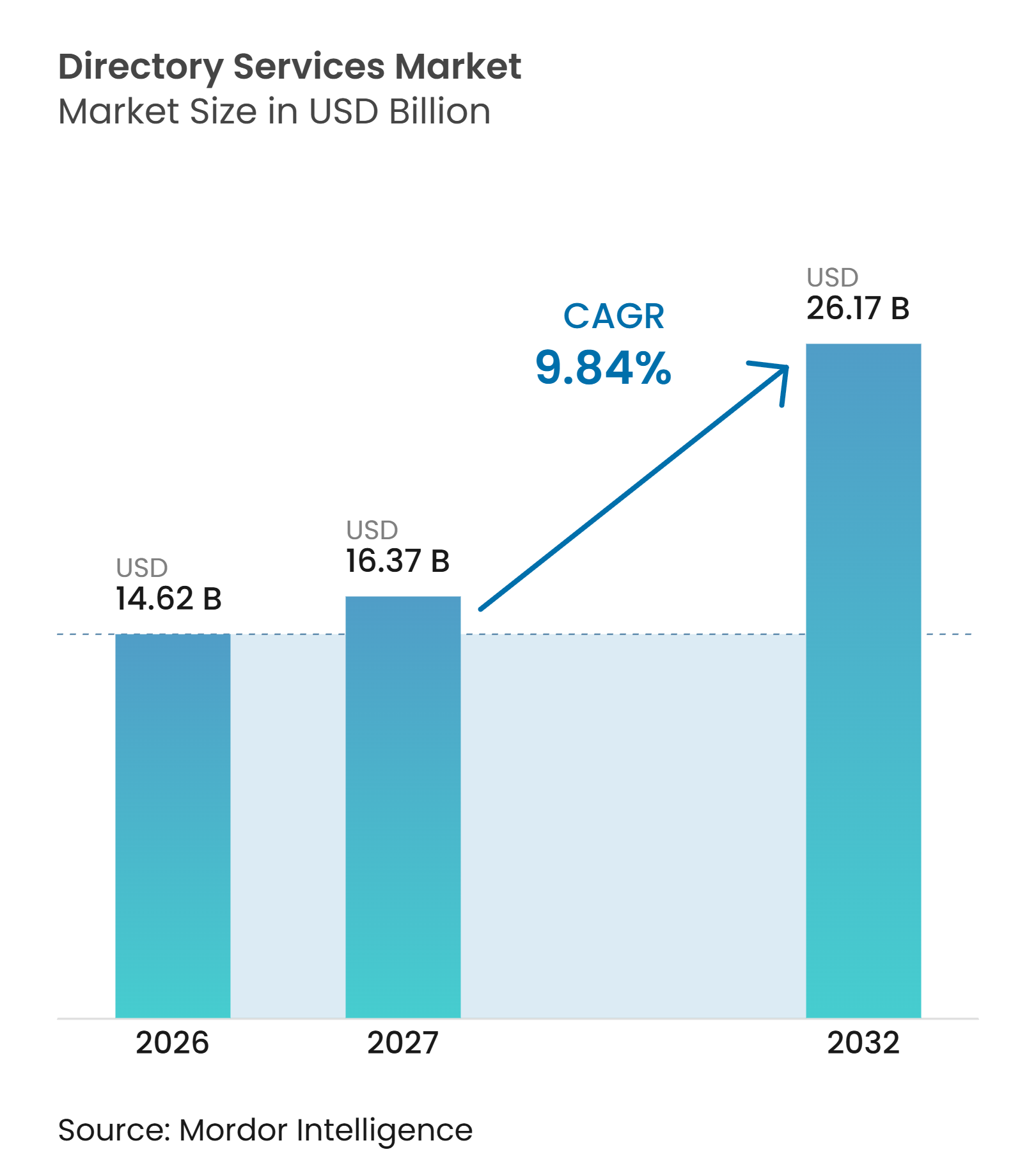
The Directory Services Market size is projected to expand from USD 14.62 billion in 2026 and USD 16.37 billion in 2027 to USD 26.17 billion by 2032, registering a CAGR of 9.84% between 2027 to 2032. The Directory services market is being shaped by cloud migration, wider SaaS use, and the need to manage human and machine identities across fragmented technology environments, where each application can introduce a separate account, permission model, and compliance obligation. Buyers are placing greater value on centralized access controls, identity governance, and reliable synchronization across on-premises and multi-cloud systems, with particular attention to whether policies can remain consistent during a phased migration. Demand is also moving from periodic access administration toward continuous verification, because access decisions increasingly depend on device state, location, behavior, and the sensitivity of the application being accessed. Cloud providers benefit from bundled identity services, while specialist vendors compete through governance depth, privileged access controls, and support for non-human identities, making interoperability an important practical factor for buyers that use more than one cloud environment. Legacy Active Directory estates remain a practical constraint because complex migrations require application remediation and staged deployment, allowing the Directory services market to retain demand for coexistence tools, transition support, integration expertise, and security controls that safely protect older systems while modernization work takes place.
Key Report Takeaways
- By service type, Solutions held 78.62% of the directory services market share in 2026 and is projected to expand at a 10.32% CAGR through 2032.
- By deployment model, Public Cloud accounted for 45.63% of the directory services market share in 2026 and is projected to expand at a 10.27% CAGR through 2032.
- By organization size, Large Enterprises held 67.66% share in 2026, while SMEs are projected to expand at a 10.14% CAGR through 2032.
- By functionality, User Management accounted for 26.48% share in 2026, while Authentication Services are projected to expand at a 10.46% CAGR through 2032.
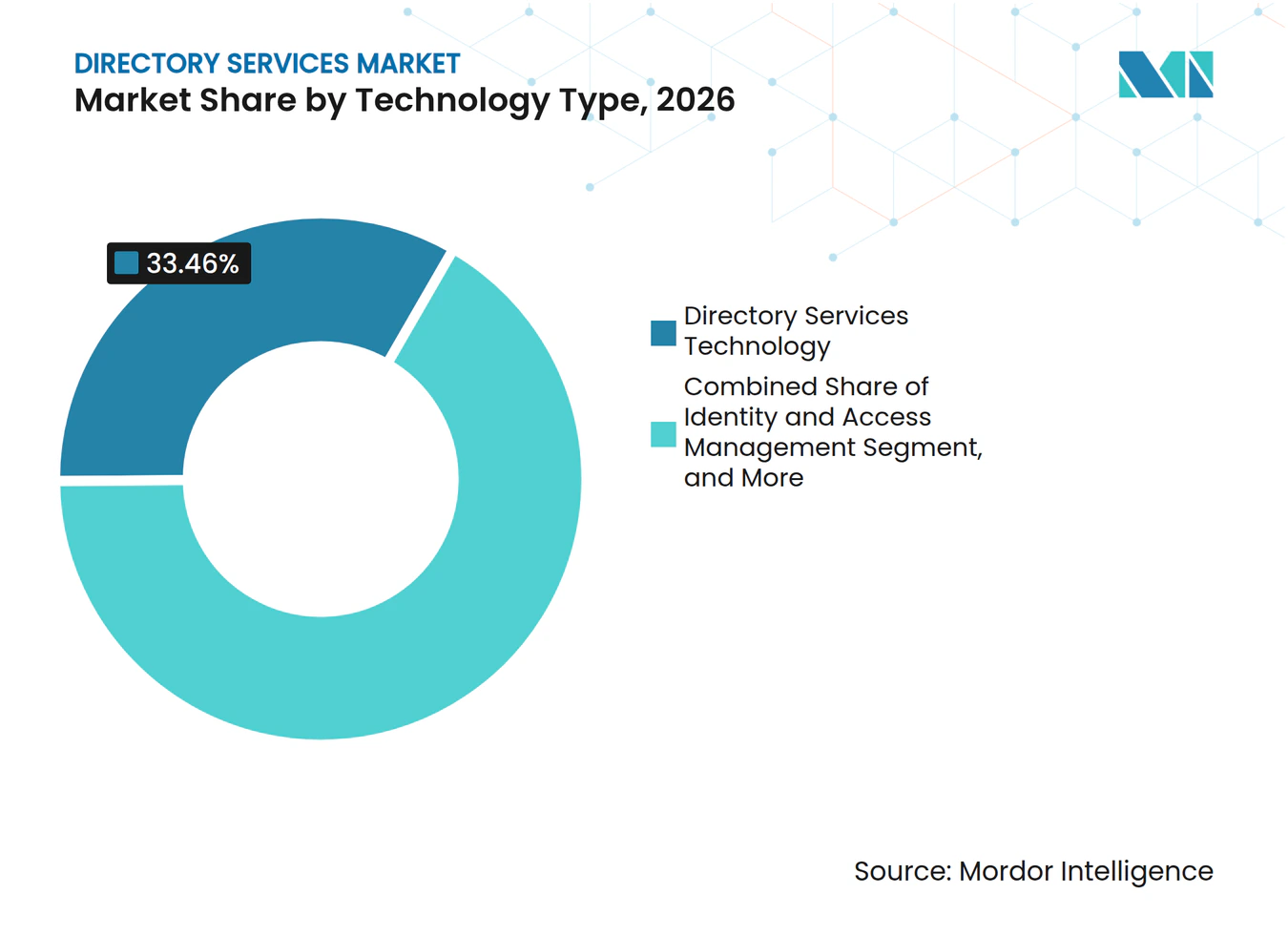
- By technology type, Directory Services Technology accounted for 33.46% share in 2026, while AI and Behavioral Analytics are projected to expand at a 10.81% CAGR through 2032.
- By end-user industry, BFSI held 21.77% share in 2026, while IT and Telecommunications are projected to expand at a 10.11% CAGR through 2032.
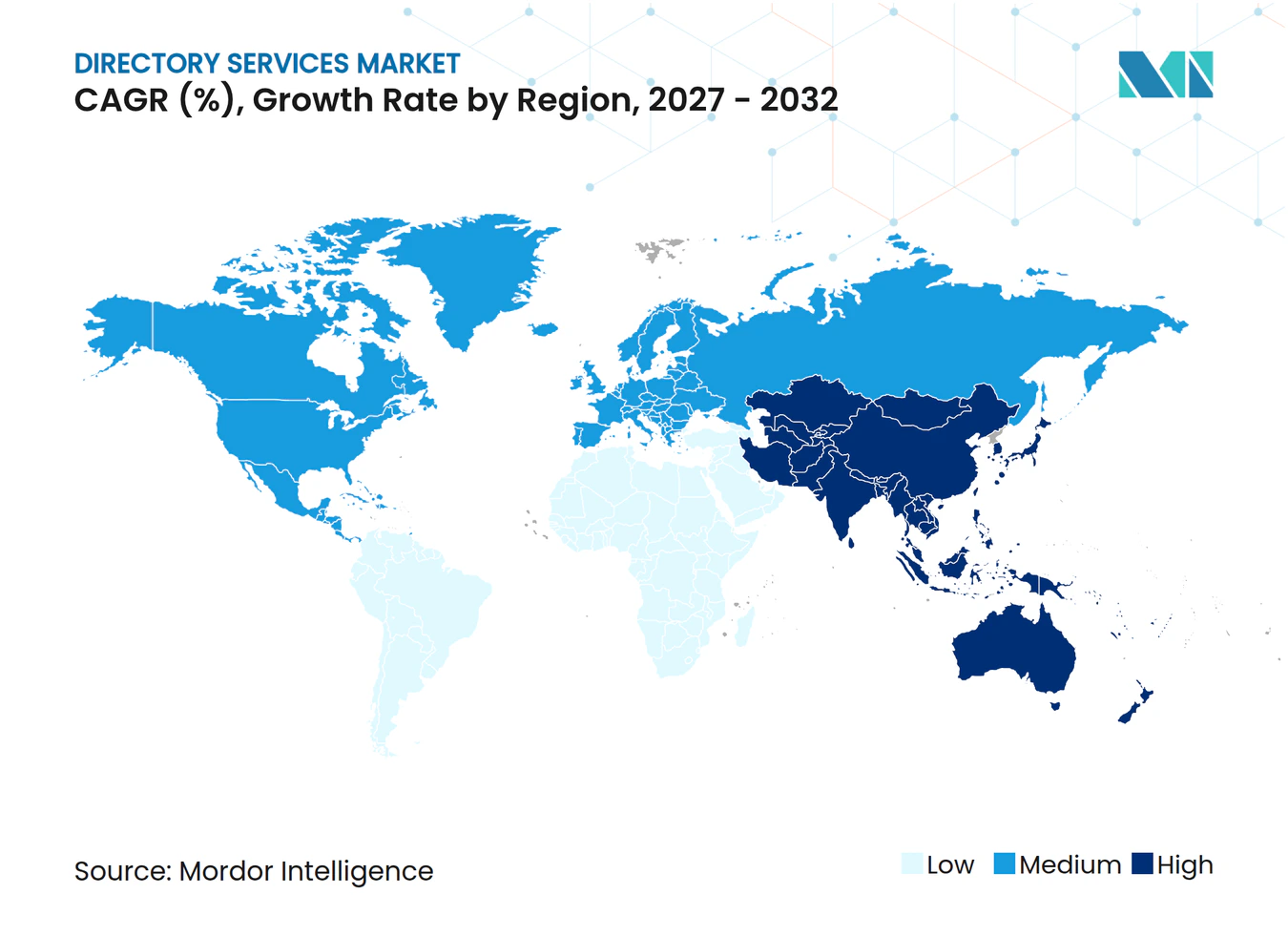
- By geography, North America accounted for 38.14% share in 2026, while Asia-Pacific is projected to expand at a 10.42% CAGR through 2032.
Note: Market numbers in this report are based on Mordor Intelligence's proprietary estimation framework, which combines nine months of actuals with Q4 projections for base year 2026.
Market Trends and Insights
Drivers Impact Analysis of Directory Services Market*
| Driver | (~) % Impact on CAGR Forecast | Geographic Relevance | Impact Timeline |
|---|---|---|---|
| Cloud and SaaS Application Expansion | +3.2% | Global, the highest concentration in North America and the Asia-Pacific | Short term (≤ 2 years) |
| Zero Trust and Multifactor Authentication Adoption | +2.8% | Global, with accelerated adoption in North America and Europe | Medium term (2-4 years) |
| Hybrid Workforce Security Requirements | +1.9% | Global, with the highest urgency in BFSI, IT, and Telecommunications | Short term (≤ 2 years) |
| Regulatory Access Governance Requirements | +1.5% | Europe, North America, Asia-Pacific core, and spillover to the Middle East and Africa | Medium term (2-4 years) |
| AI Agent and Non-Human Identity Proliferation | +1.2% | Global, with initial intensity in North America | Long term (≥ 4 years) |
| Directory Synchronization Across Multi-Cloud Control Planes | +0.8% | North America, Europe, and the Asia-Pacific enterprise corridors | Medium term (2-4 years) |
| Source: Mordor Intelligence | |||
Cloud and SaaS Application Expansion
Enterprise staff use 90 to 150 SaaS applications on average, which makes manual provisioning difficult and increases the need for centralized identity administration. Each added service creates new synchronization points, access rules, and credential lifecycle events that must be controlled consistently across applications with different account models, approval paths, and administrative interfaces. This changes procurement in the directory services market because integration breadth and SCIM provisioning are becoming more important than directory performance alone. Buyers also need to know whether connectors can maintain accurate records when an employee changes jobs, a contractor leaves, or a new application is added outside the central technology team. Vendors with established application connectors can reduce the work required to deploy and maintain an identity platform, especially where users need access to many services from the first day of employment. The resulting opportunity extends beyond initial access setup because every additional application can create recurring demand for lifecycle management, policy updates, audit records, and periodic review of dormant accounts. Okta projected USD 3.17 billion to USD 3.19 billion in revenue for fiscal year 2027, indicating continued commercial demand for identity services linked to SaaS workloads.[1]
Zero Trust and Multifactor Authentication Adoption
Zero-trust programs require identity systems that verify every request instead of extending trust based on a network boundary. Microsoft reported that multifactor authentication blocks more than 99% of identity-based attacks, including attacks where an adversary has valid credentials. Microsoft also reported a 32% increase in identity-based attacks in the first half of 2025 and stated that Entra ID blocked 7,000 password attacks per second.[2] These conditions make the directory services market more dependent on tools that can assess device posture, user location, and behavioral signals during access decisions, then apply a policy without relying on a static network location. CISA identified phishing-resistant multifactor authentication as a foundational identity capability for federal zero-trust implementation in April 2025.[3] Federal implementation requirements can sustain demand for directory modernization because agencies need systems that support continuous, auditable access decisions and can demonstrate which controls were used when access was granted or denied.
Hybrid Workforce Security Requirements
Hybrid work has moved the identity perimeter beyond the corporate network and placed user identity, device posture, and session risk at the center of access decisions. Microsoft found that 36% of organizations cited progress on zero trust as a leading challenge in securing hybrid employees, while 29% identified hybrid work security as a critical operational gap. This creates demand for directory platforms that act as a current source of authorization rather than a record used only for periodic certification, particularly when employees connect from unmanaged networks or use personal devices for limited work activity. Buyers in BFSI, IT, and Telecommunications need automated deprovisioning and just-in-time access as employees, contractors, and devices move between locations. Okta reported a 70% adoption rate for workforce multifactor authentication in January 2025, up from 66% a year earlier. That increase indicates that hybrid work requirements are translating into wider investment in identity controls, device-aware policies, and supporting directory infrastructure.
Regulatory Access Governance Requirements
Compliance obligations are making access governance a required operating capability for regulated organizations. The Digital Operational Resilience Act became applicable on January 17, 2025, and requires financial entities to manage information and communication technology risk under a harmonized European framework. Germany's NIS2 law took effect on December 6, 2025, increasing cybersecurity obligations for essential and important entities. These frameworks increase demand in the directory services market for audit records, access reviews, and controls that show who had access to which systems, including when rights were approved, changed, or withdrawn. Buyers increasingly need real-time visibility and automated evidence rather than written policies alone, because compliance teams must be able to demonstrate that controls operated over time. Vendors with configurations that support regulatory workflows can shorten implementation work during compliance-driven procurement cycles and make those workflows easier to apply consistently across country operations.
Restraints Impact Analysis of Directory Services Market*
| Restraint | (~) % Impact on CAGR Forecast | Geographic Relevance | Impact Timeline |
|---|---|---|---|
| Legacy Directory Integration Complexity | -1.3% | Global, most acute in North America and Western Europe | Long term (≥ 4 years) |
| High Migration and Operating Costs | -0.9% | Global, concentrated in mid-market organizations with 500-5,000 users | Medium term (2-4 years) |
| Protocol and Schema Drift Across Industrial and Operational Technology Assets | -0.5% | Industrial corridors in North America, Europe, and Asia-Pacific | Long term (≥ 4 years) |
| Data Sovereignty and Cross-Border Directory Replication Friction | -0.4% | Europe, China, India, and Middle East and Africa jurisdictions with strict data residency laws | Medium term (2-4 years) |
| Source: Mordor Intelligence | |||
Legacy Directory Integration Complexity
On-premises Active Directory remains embedded in many enterprise environments, so organizations cannot simply switch it off and enable a cloud alternative. Complex migrations take 12 to 36 months because applications that depend on NTLM and Kerberos often need individual remediation. The platform deployment itself can take 3 to 4 months, but the application connector cutover tends to extend the overall program. Organizations may also fund legacy operations and a new cloud platform at the same time, which limits the available budget for wider modernization. Microsoft provides source-of-authority conversion guidance that supports a phased approach for organizations with hybrid identity requirements. Vendors that support coexistence can improve their position in the directory services market by allowing cloud operations to expand while legacy dependencies are gradually retired.
High Migration and Operating Costs
Migration costs can delay adoption among organizations that must balance current directory operations with modernization spending. Smaller organizations face the same protocol dependencies as large enterprises, but they usually have fewer specialists and smaller migration budgets. This can extend migration timelines by 12 to 18 months compared with large enterprise programs. The delay helps explain why large enterprises currently hold the leading share, while SMEs have the faster projected expansion rate. Managed directory services can help customers shift technical work to a provider and spread spending through subscriptions. This delivery model provides vendors with a path to participate in the directory services market, even when customers cannot fund a large, immediate migration program.
*Our forecasts treat driver/restraint impacts as directional, not additive. The impact forecasts reflect baseline growth, mix effects, and variable interactions.
Directory Services Market Segment Analysis
By Service Type:
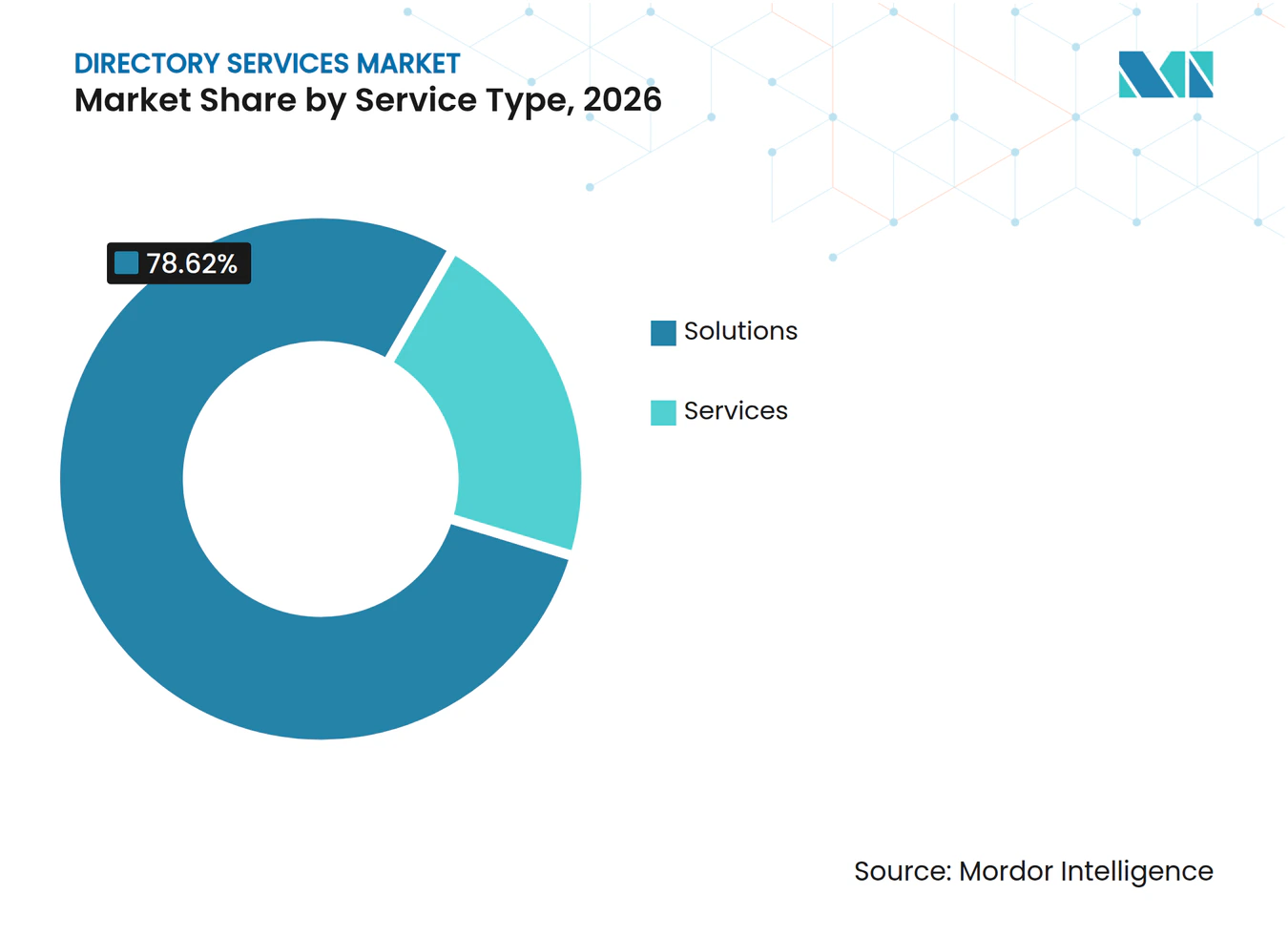
Solutions Anchor Enterprise Identity InfrastructureSolutions held 78.62% of directory services revenue in 2026 and are projected to expand at a 10.32% CAGR through 2032. The segment includes access control management, user identity management, authentication and authorization, and directory synchronization platforms that support core identity work across distributed applications. Organizations favor software platforms because they form the operating layer for identity policies, authentication events, user lifecycle actions, and reporting across cloud and on-premises systems. Authentication and authorization, together with user identity management, receive strong procurement attention as zero trust programs and multifactor authentication deployments expand. The combination of leading share and leading expansion indicates that software platforms remain the primary spending priority in the directory services market, as buyers seek controls that can be administered centrally and applied consistently.
Services include implementation and integration, consulting and advisory work, managed directory services, training and support, and maintenance and upgrades. They remain important for organizations managing hybrid migrations, large identity populations, complex application dependencies, and responsibilities that internal teams cannot address alone. Managed directory services are the fastest-expanding service subcategory because SMEs and mid-market organizations often need outside operational support, continuing administration, and help with incident response procedures. Platform automation reduces routine service work for established workflows that can be embedded in software, while multi-forest consolidation, legacy protocol remediation, and operational technology integration continue to require specialized expertise within the directory services market. SailPoint introduced adaptive identity capabilities in March 2026 that included AI-powered access reviews, non-human identity governance, and just-in-time privilege management, illustrating the functions being incorporated into platforms.


By Deployment Model:
Public Cloud Leads on Share and ExpansionPublic Cloud accounted for 45.63% of the directory services market size in 2026 and is projected to expand at a 10.27% CAGR through 2032. Cloud deployment appeals to buyers because it can scale with identity volumes, receive security updates without local patching cycles, and reduce the burden of maintaining directory infrastructure. It also integrates directly with the SaaS applications that hold an increasing share of enterprise workloads, making it easier to coordinate access management across a changing application portfolio. This combination places Public Cloud at the center of the directory services market for organizations modernizing access across distributed workforces and environments. Private Cloud and Hybrid Cloud remain relevant for organizations with data residency obligations, regulatory limits on public cloud use, or critical applications that cannot move to public infrastructure.
On-Premises deployment is declining in relative importance, but it remains necessary where legacy authentication and operational technology assets cannot be moved quickly or without interruption. Many organizations that made public cloud decisions during 2021 to 2024 are now implementing hybrid configurations for sensitive directory workloads, recovery requirements, and data sovereignty obligations. This creates a second infrastructure decision centered on portability, policy consistency, and the ability to retain local control over selected identity data. Microsoft launched bidirectional Entra Cloud Sync in September 2026 to support provisioning from Entra ID back into on-premises Active Directory. Independent vendors can compete in the directory services market when they show consistent administration across public, private, hybrid, and on-premises systems, rather than forcing customers to replace established configurations all at once.
By Organization Size:
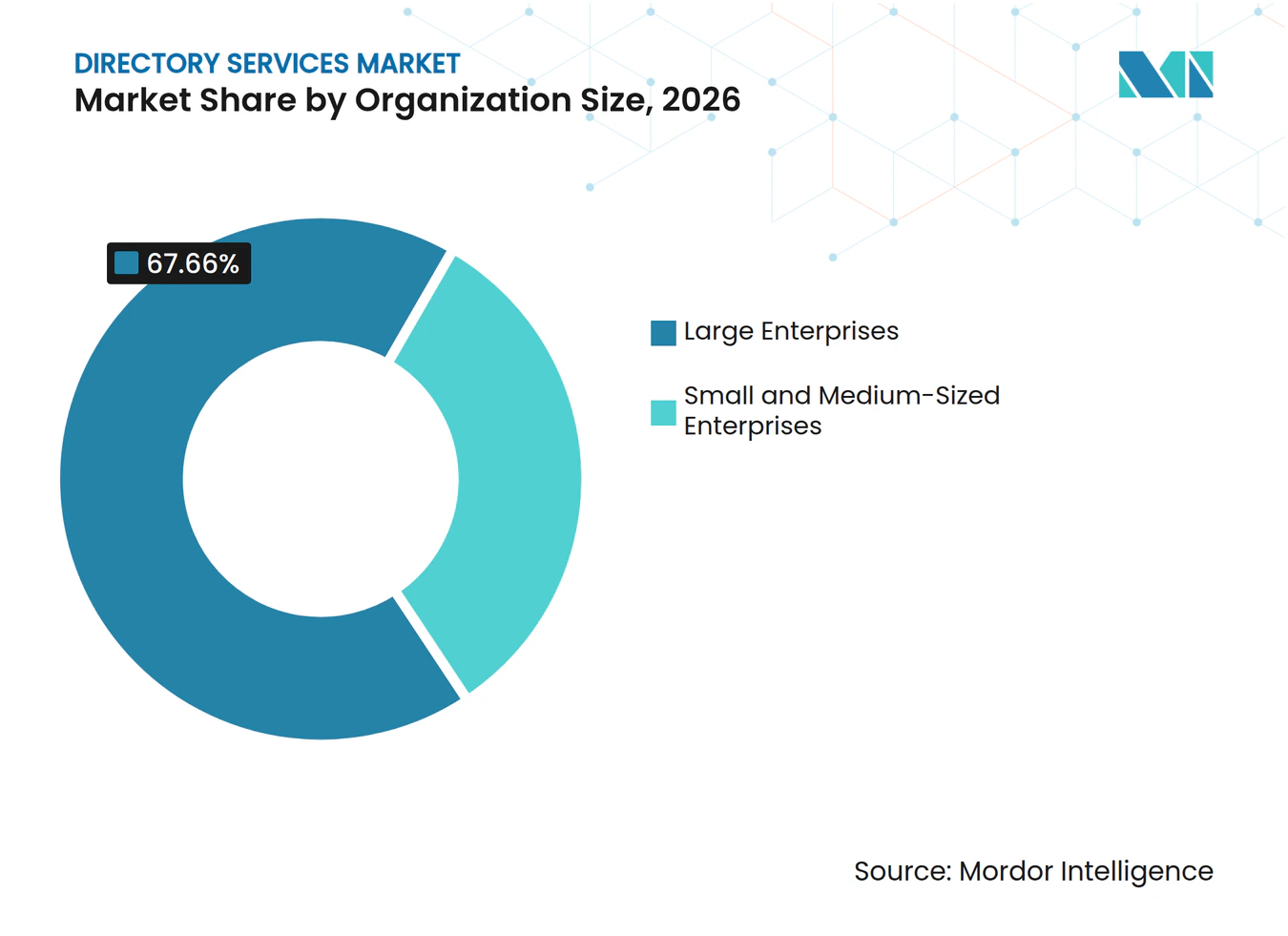
Large Enterprises Set the Revenue Base and SMEs Add New DemandLarge Enterprises held 67.66% of directory services revenue in 2026. Their position reflects global employee populations, multi-forest Active Directory environments, contractor access, and application stacks that require extensive single sign-on federation across geographies. Their purchases often combine identity governance and administration, privileged access management, enterprise authentication, and audit functions that smaller deployments may not require in the same scope. These organizations need controls that work across business units, regions, cloud providers, and legacy systems while preserving access for essential applications. Their scale gives them the resources to invest in complex migration, governance, and integration programs, which keeps large enterprises central to the current directory services market revenue.
SMEs are projected to expand at a 10.14% CAGR through 2032 as cloud-native subscriptions lower entry barriers and reduce the need to buy and operate local directory infrastructure. JumpCloud, Okta, and Microsoft Entra offer cloud directory, multifactor authentication, single sign-on, and device controls that can be deployed without the same operating model used by large enterprises. SMEs face the same problems as larger organizations, including hybrid work, SaaS access, phishing-resistant authentication, and employee lifecycle changes, but often lack dedicated identity specialists. This creates demand for managed directory services, training, and support alongside the platform subscription, particularly where a small technology team must support many applications. Smaller buyers are an important source of new adoption in the directory services market as cloud tools make governance more accessible, while large enterprises continue to account for the broader installed base.

By Functionality:
User Management Holds the Largest Role and Authentication Services Advance FastestUser Management held 26.48% of directory services revenue in 2026. It remains the foundational function because access control, authentication services, identity federation, and synchronization all depend on accurate user records, clear ownership, and maintained group membership. Organizations must manage identity attributes, lifecycle status, authorization links, and changes in employment or contract status before they can apply more advanced access policies. This dependency preserves the function's leading role in the directory services market even as adjacent capabilities expand, because reliable identity data remains essential for access decisions and compliance documentation. User management also supports the records required for access reviews, audit activities, and deprovisioning when users leave or change roles.
Authentication Services are projected to expand at a 10.46% CAGR through 2032 as enterprises reduce reliance on passwords and implement stronger methods across workforce and customer access systems. Phishing-resistant multifactor authentication, FIDO2 passkeys, and risk-based controls are becoming increasingly important in environments where a credential compromise could expose sensitive applications or data. NIST published implementation recommendations in 2026 for agencies and cloud service providers on protecting tokens and assertions from forgery, theft, and misuse. Access Control and Identity Federation are often purchased as part of a wider zero trust program, while Directory Synchronization has gained importance because multiple cloud environments create several authoritative identity sources. Integrated suites benefit from this buying pattern because customers need the functions to work together under shared policies, with a clear record of how users and permissions change.
By Technology Type:
AI and Behavioral Analytics Become the Fastest AcceleratorDirectory Services Technology held 33.46% of directory services revenue in 2026. Its position reflects the continuing use of LDAP-based infrastructure and Active Directory across enterprise authentication environments, including systems that retain older applications and internal networks. Identity and Access Management and Public Key Infrastructure are established technologies with mature use in government and large organizations, where they support access assurance and certificate-based controls. Multifactor Authentication is widely deployed, while FIDO2 passkeys and hardware security keys are gaining importance where phishing resistance is required or higher-risk access must be protected. These technologies provide the core controls on which modern identity programs are built and continue to support baseline demand across the directory services market.
AI and Behavioral Analytics are projected to expand at a 10.81% CAGR through 2032, the highest rate among the stated technology segments. Microsoft found that 70% of organizations had experienced an AI-related security incident in the previous 12 months, with 28% involving AI agent privilege escalation. Behavioral analytics uses authentication logs and identity data to identify account compromise, lateral movement, unusual privilege use, and activity that diverges from a normal baseline. It augments traditional directory systems rather than replacing them, because the directory remains a source of the records that the analytics engine assesses. Vendors can improve their position in the directory services market when analytics are embedded in the directory platform instead of requiring a separate security information and event management integration.

By End-User Industry:
BFSI Anchors Revenue and IT and Telecommunications Leads ExpansionBFSI held 21.77% of directory services revenue in 2026. The sector has substantial regulatory exposure, sensitive data, and direct financial consequences from identity-related incidents, which increase the value of documented access controls. Financial entities need records of access rights, regular access review, and audit-ready information for users, systems, and privileged actions across both internal and customer-facing operations. DORA has strengthened the governance requirements that support this spending. These needs make BFSI a stable demand base for identity platforms and supporting services, while the sector's legacy infrastructure increases the need for staged modernization and reliable integration.
IT and Telecommunications are projected to expand at a 10.11% CAGR through 2032. These organizations use directory platforms internally and also operate the SaaS and managed service environments that manage access for customers, employees, partners, and technical teams. Healthcare is gaining importance as clinical workflows become more digital and access controls require closer oversight, while government agencies face zero-trust requirements from CISA and comparable national frameworks. Industrial Manufacturing, Retail and E-Commerce, Education and Research Institutions, and Transportation and Logistics follow different digital transformation schedules, leading to longer and more episodic purchasing cycles.
Geography Analysis
North America Directory Services Market
North America accounted for 38.14% of global directory services revenue in 2026. The region benefits from a concentration of hyperscaler headquarters, mature enterprise cloud use, and early zero trust adoption in the United States federal sector. The United States accounts for most regional demand, while Canada and Mexico add opportunities in financial services, public sector modernization, and organizations moving critical applications to cloud-based environments. Federal requirements for phishing-resistant multifactor authentication create a recurring procurement signal for government agencies, and that demand can extend to state and local government and then to commercial buyers with similar security requirements.
EMEA and South America Directory Services Market
Europe is the second-largest regional market, with Germany, the United Kingdom, France, Italy, and Spain as major consuming countries. Germany's NIS2 legislation and the European Union's DORA framework create demand for access control, multifactor authentication, audit records, and clearer accountability for technology risk. European organizations often use Hybrid Cloud models that retain sensitive data on controlled infrastructure while using cloud-based single sign-on and federation services. This supports demand for identity federation and proxy solutions alongside core directory platforms, while the European Union AI Act is beginning to influence procurement for high-risk AI systems that require access governance. South America, the Middle East, and Africa remain earlier-stage demand areas where cloud investment, digital transformation programs, and e-government initiatives guide institutional adoption.
APAC Directory Services Market
Asia-Pacific is projected to expand at a 10.42% CAGR through 2032, making it the fastest-growing regional part of the directory services market. China, India, Japan, and South Korea, are the main contributors, although adoption patterns vary by local cloud systems, regulations, and enterprise technology maturity. India's enterprise SaaS adoption, digital identity infrastructure, and financial-sector cybersecurity requirements support centralized identity management, while China's cloud platforms embed identity and access management services and its Personal Information Protection Law increases the need for controls around personal data. Japan's established enterprise technology base, South Korea's cloud infrastructure provide further support for regional demand. Singapore's Cybersecurity Act and India's evolving information technology requirements also encourage businesses to strengthen centralized directory and identity controls.
Competitive Landscape
Market Concentration
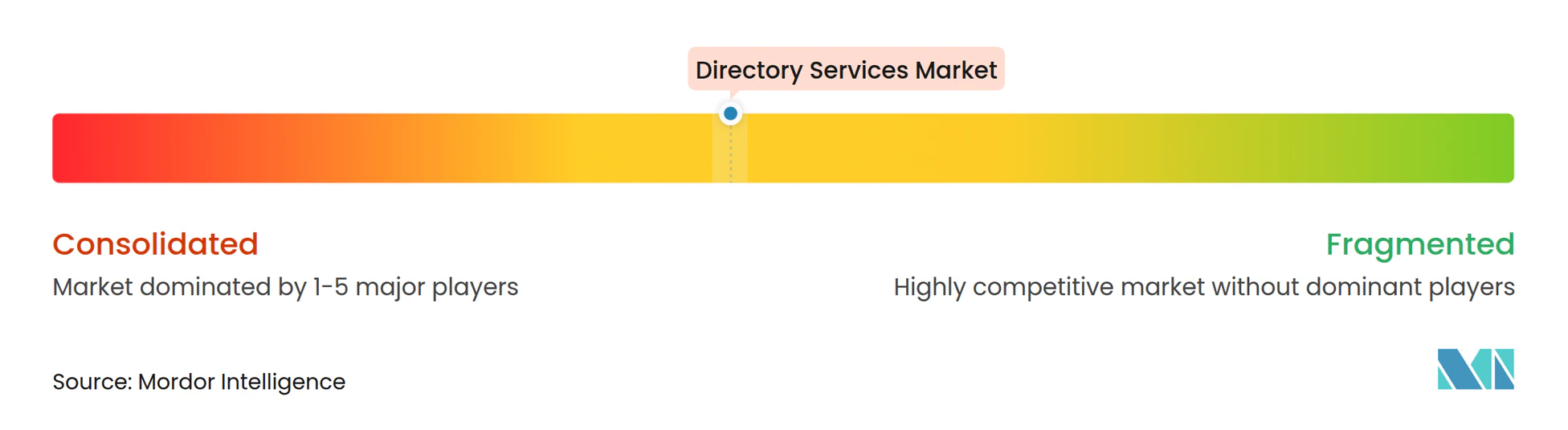
Microsoft, Amazon Web Services, Google, and Oracle have distribution advantages because identity services are bundled with their cloud platforms. Okta, SailPoint, Ping Identity, JumpCloud, and One Identity compete through governance functions, integrations, and deployment flexibility across mixed technology estates. The directory services market is split between broad cloud platforms and specialists that address detailed identity requirements, including privileged access management, identity governance, Active Directory protection, and support for non-human identities. Large enterprise evaluations often include the question of whether a buyer should accept a bundled provider or retain an independent platform, which keeps integration breadth and operational neutrality important competitive factors. The competition, therefore, involves product capability, the size of the cloud ecosystem, and the ability to work across platforms that a customer already uses.
Palo Alto Networks completed its acquisition of CyberArk in February 2026 for USD 25 billion. The transaction brings CyberArk's privileged access management, identity provider, and identity governance capabilities into a platform that also covers network and endpoint security. It increases pressure on standalone providers, as buyers may seek to consolidate security tools, though organizations with mixed cloud environments may still favor independent identity platforms. SailPoint completed its acquisition of Entro Security in June 2026 to add non-human identity and credentials security capabilities. These moves show that vendors are treating machine identities and agentic systems as part of the core identity lifecycle, while operational technology environments remain an opening because older industrial assets do not support newer identity standards.
Smaller suppliers such as Semperis and Netwrix address Active Directory protection and auditing, while ManageEngine competes for cost-conscious mid-market buyers. Vendors are incorporating AI into access reviews, entitlement analysis, and least-privilege recommendations, and SailPoint's 2026 product announcements included AI agent governance and controls for non-human accounts. Product strategy is shifting toward systems that manage human, machine, and agent identities together without creating more administrative work for security teams. Providers that reduce administration while improving auditability can strengthen their position as buyers assess platform consolidation and the risk of relying on a single cloud provider.
Directory Services Industry Leaders
-
Microsoft Corporation
-
Amazon Web Services, Inc.
-
Okta, Inc.
-
Google LLC
-
International Business Machines Corporation
- *Disclaimer: Major Players sorted in no particular order
Directory Services Market Companies Covered in this Report
- Microsoft Corporation
- Amazon Web Services, Inc.
- Okta, Inc.
- Google LLC
- International Business Machines Corporation
- Oracle Corporation
- Cisco Systems, Inc.
- Broadcom Inc.
- Thales S.A.
- Open Text Corporation
- JumpCloud, Inc.
- Ping Identity Corporation
- CyberArk Software Ltd.
- One Identity LLC
- Entrust Corporation
- Netwrix Corporation
- SecureAuth Corporation
- ForgeRock, Inc.
- ManageEngine
- Semperis Inc.
- Quest Software Inc.
- SailPoint Technologies Holdings, Inc.
- MiniOrange, Inc.
- Gluu Federation, Inc.
- OneLogin, Inc.
- Red Hat, Inc.
Recent Industry Developments in Directory Services Market
- October 2026: SailPoint's SaaS release notes confirmed that the Microsoft Entra SaaS connector now supports app client secrets, certificates, federated credentials, and SAML certificates as non-human identity credential types through SailPoint Agentic Fabric, enhancing machine-identity governance for Entra-integrated enterprises.
- September 2026: Microsoft Entra ID achieved general availability for Access Reviews and introduced bidirectional Entra Cloud Sync, allowing organizations to provision users, groups, and group memberships from Entra ID back into on-premises Active Directory. This positions Entra ID as a viable authoritative directory for cloud-first organizations that still maintain legacy application dependencies, addressing a critical gap in the hybrid identity toolkit.
- June 2026: SailPoint completed its acquisition of Tel Aviv-based Entro Security, a non-human identity and credentials security pioneer. Entro's non-human identity detection and response technology, which monitors token behavior, intercepts malicious AI tool calls, and safeguards against prompt injection threats in real time, was immediately made available to SailPoint customers, accelerating the company's machine-identity governance roadmap.
- March 2026: SailPoint announced its adaptive identity security innovations, unveiling new AI-powered connectors for its Agent Identity Security product that can discover and govern AI agents on Microsoft 365 Co-Pilot, Amazon Bedrock, Google Vertex AI, Salesforce Agentforce, ServiceNow AI Platform, and Snowflake Cortex AI. The announcement also included a next-generation Access Certification engine and a comprehensive Separation of Duties revamp planned for general availability in the second half of 2026.
Global Directory Services Market Report Scope
The Directory Services Market comprises software solutions that centrally store, organize, and manage information about users, devices, and network resources in a hierarchical structure, serving as the authoritative identity source for authentication, authorization, and access control.
The Directory Services Market Report is Segmented by Service Type (Solutions, and Services), Deployment Model (Public Cloud, Private Cloud, Hybrid Cloud, and On-Premises), Organization Size (Small and Medium-Sized Enterprises, and Large Enterprises), Functionality (User Management, Access Control, Authentication Services, Mobile Device Management, and Identity Federation, Directory Synchronization), Technology Type (Directory Services Technology, Identity and Access Management, Public Key Infrastructure, Multifactor Authentication, and AI and Behavioral Analytics), End-User Industry (BFSI, Healthcare, IT and Telecommunications, Government, Retail and E-Commerce, Education and Research Institutions, Industrial Manufacturing, and Energy and Utilities), and Geography (North America, South America, Europe, Asia-Pacific, and Middle East and Africa). The Market Forecasts are Provided in Terms of Value (USD).
Segmentation Overview
| Solutions | User Identity Management |
| Authentication and Authorization | |
| Access Control Management | |
| Directory Synchronization | |
| Policy and Role Management | |
| Services | Implementation and Integration |
| Consulting and Advisory | |
| Training and Support | |
| Maintenance and Upgrades | |
| Managed Directory Services |
| Public Cloud |
| Private Cloud |
| Hybrid Cloud |
| On-Premises |
| Small and Medium-Sized Enterprises |
| Large Enterprises |
| User Management |
| Access Control |
| Authentication Services |
| Mobile Device Management |
| Identity Federation |
| Directory Synchronization |
| Directory Services Technology |
| Identity and Access Management |
| Public Key Infrastructure |
| Multifactor Authentication |
| Artificial Intelligence and Behavioral Analytics |
| Banking, Financial Services, and Insurance |
| Healthcare |
| Information Technology and Telecommunications |
| Government |
| Retail and E-Commerce |
| Education and Research Institutions |
| Industrial Manufacturing |
| Other End-User Industry |
| North America | United States |
| Canada | |
| Mexico | |
| Rest of North America | |
| South America | Brazil |
| Argentina | |
| Chile | |
| Rest of South America | |
| Europe | Germany |
| United Kingdom | |
| France | |
| Italy | |
| Spain | |
| Rest of Europe | |
| Asia-Pacific | China |
| India | |
| Japan | |
| South Korea | |
| Rest of Asia-Pacific | |
| Middle East and Africa | Saudi Arabia |
| United Arab Emirates | |
| South Africa | |
| Egypt | |
| Rest of Middle East and Africa |
| By Service Type | Solutions | User Identity Management |
| Authentication and Authorization | ||
| Access Control Management | ||
| Directory Synchronization | ||
| Policy and Role Management | ||
| Services | Implementation and Integration | |
| Consulting and Advisory | ||
| Training and Support | ||
| Maintenance and Upgrades | ||
| Managed Directory Services | ||
| By Deployment Model | Public Cloud | |
| Private Cloud | ||
| Hybrid Cloud | ||
| On-Premises | ||
| By Organization Size | Small and Medium-Sized Enterprises | |
| Large Enterprises | ||
| By Functionality | User Management | |
| Access Control | ||
| Authentication Services | ||
| Mobile Device Management | ||
| Identity Federation | ||
| Directory Synchronization | ||
| By Technology Type | Directory Services Technology | |
| Identity and Access Management | ||
| Public Key Infrastructure | ||
| Multifactor Authentication | ||
| Artificial Intelligence and Behavioral Analytics | ||
| By End-User Industry | Banking, Financial Services, and Insurance | |
| Healthcare | ||
| Information Technology and Telecommunications | ||
| Government | ||
| Retail and E-Commerce | ||
| Education and Research Institutions | ||
| Industrial Manufacturing | ||
| Other End-User Industry | ||
| By Geography | North America | United States |
| Canada | ||
| Mexico | ||
| Rest of North America | ||
| South America | Brazil | |
| Argentina | ||
| Chile | ||
| Rest of South America | ||
| Europe | Germany | |
| United Kingdom | ||
| France | ||
| Italy | ||
| Spain | ||
| Rest of Europe | ||
| Asia-Pacific | China | |
| India | ||
| Japan | ||
| South Korea | ||
| Rest of Asia-Pacific | ||
| Middle East and Africa | Saudi Arabia | |
| United Arab Emirates | ||
| South Africa | ||
| Egypt | ||
| Rest of Middle East and Africa | ||
Key Questions Answered in the Report
What is the projected size of the Directory Services Market?
The Directory Services Market is projected to reach USD 26.17 billion by 2032, from USD 16.37 billion in 2027, at a 9.84% CAGR.
Which service type leads directory services spending?
Solutions lead, with a 78.62% share in 2026, because they provide the platform functions used for identity, authorization, and synchronization.
Why are cloud deployments important for directory services?
Public Cloud held 45.63% share in 2026 and is projected to expand at a 10.27% CAGR as buyers need scalable identity services integrated with SaaS workloads.
Which organizations create the largest demand for directory platforms?
Large Enterprises held 67.66% share in 2026 because they manage complex identity populations, multiple applications, and extensive governance requirements.
What is driving faster adoption of authentication services?
Authentication Services are projected to expand at a 10.46% CAGR as organizations implement phishing-resistant multifactor authentication, FIDO2 passkeys, and risk-based access controls.
Which region is expected to expand the fastest?
Asia-Pacific is projected to expand at a 10.42% CAGR through 2032, supported by digital transformation, cloud use, and strengthening cybersecurity requirements.