
Direct-to-Consumer Fresh Meal-Kit and Perishable Grocery Logistics Market Size and Share
Market Overview
| Study Period | 2021 - 2032 |
|---|---|
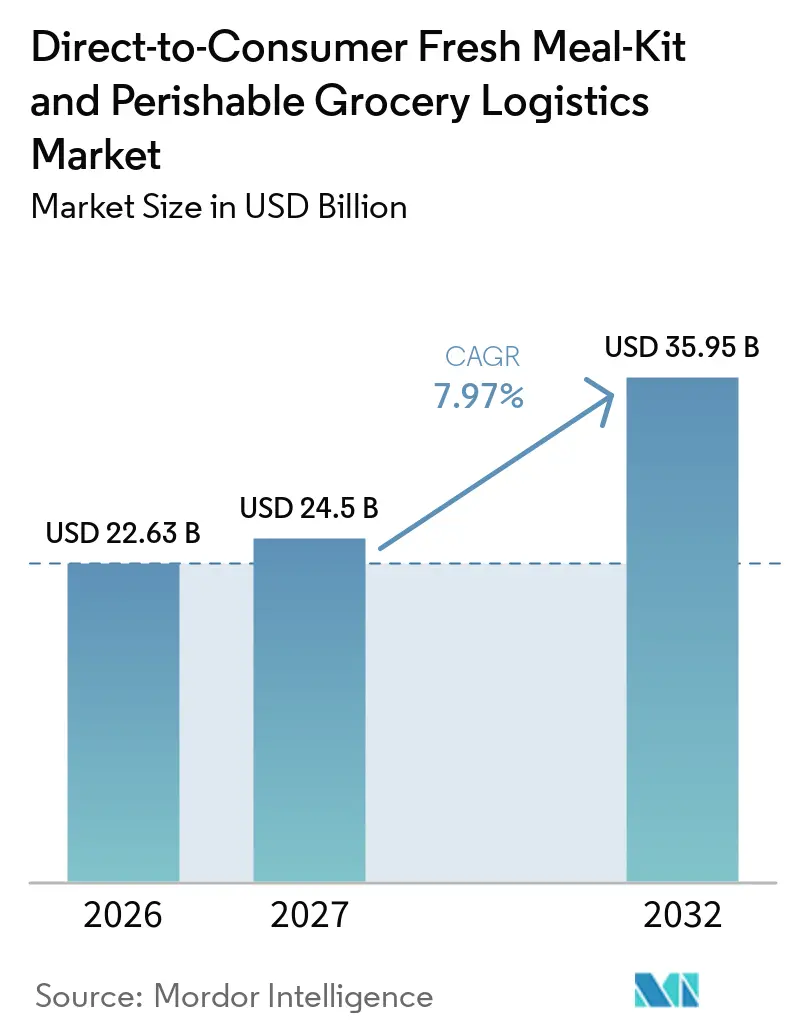
| Market Size (2027) | USD 24.5 Billion |
| Market Size (2032) | USD 35.95 Billion |
| Growth Rate (2027 - 2032) | 7.97 % |
| Fastest Growing Market | Asia-Pacific |
| Largest Market | North America |
| Market Concentration | Medium |
Major Players *Disclaimer: Major Players sorted in no particular order Image © Mordor Intelligence. Reuse requires attribution under CC BY 4.0. | |
Direct-to-Consumer Fresh Meal-Kit and Perishable Grocery Logistics Market Analysis by Mordor Intelligence
The direct-to-consumer fresh meal-kit and perishable grocery logistics market size is valued at USD 22.63 billion in 2026 and is estimated to grow from USD 24.50 billion in 2027 to reach USD 35.95 billion by 2032, registering a CAGR of 7.97% between 2027 and 2032.
The direct-to-consumer fresh meal-kit and perishable grocery logistics market is being shaped by urban households that need simpler grocery planning and dependable delivery of perishable food. Subscription models pair menu selection with delivery, which gives providers a role beyond transporting groceries and makes service quality part of the food offer. Cold-chain capacity remains central to the direct-to-consumer fresh meal-kit and perishable grocery logistics market because fresh proteins, dairy, produce, and prepared meals require controlled handling from fulfillment center to doorstep, often across several operational handoffs. Large grocery platforms, delivery platforms, and cold-storage providers are expanding their capabilities, raising delivery-speed expectations while putting pressure on margins and increasing the value of reliable capacity. The direct-to-consumer fresh meal-kit and perishable grocery logistics market also benefits from demand for diet-specific offerings and ready-to-eat food, which require more flexible fulfillment operations. Investment choices in the market increasingly depend on whether providers can match convenience with food safety, order accuracy, and predictable delivery windows.
Key Report Takeaways
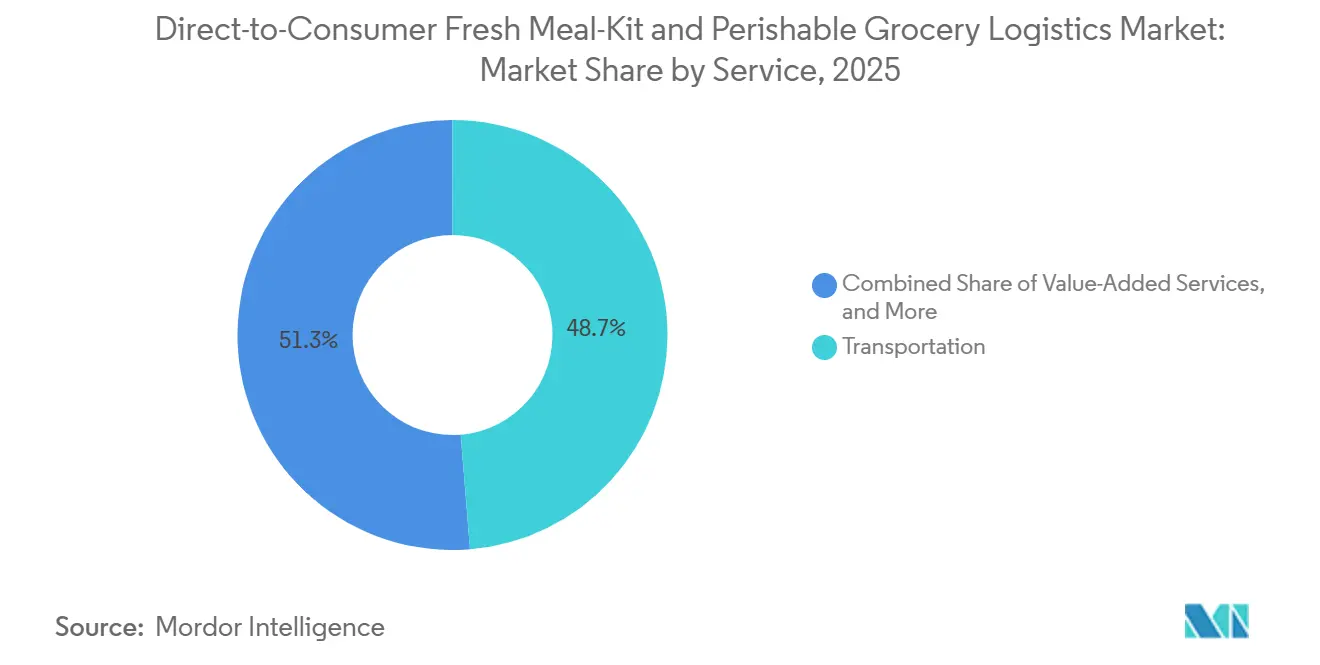
- By service, transportation held 48.70% of the direct-to-consumer fresh meal-kit and perishable grocery logistics market share in 2026, while value-added services recorded the highest projected CAGR at 9.48% through 2032.
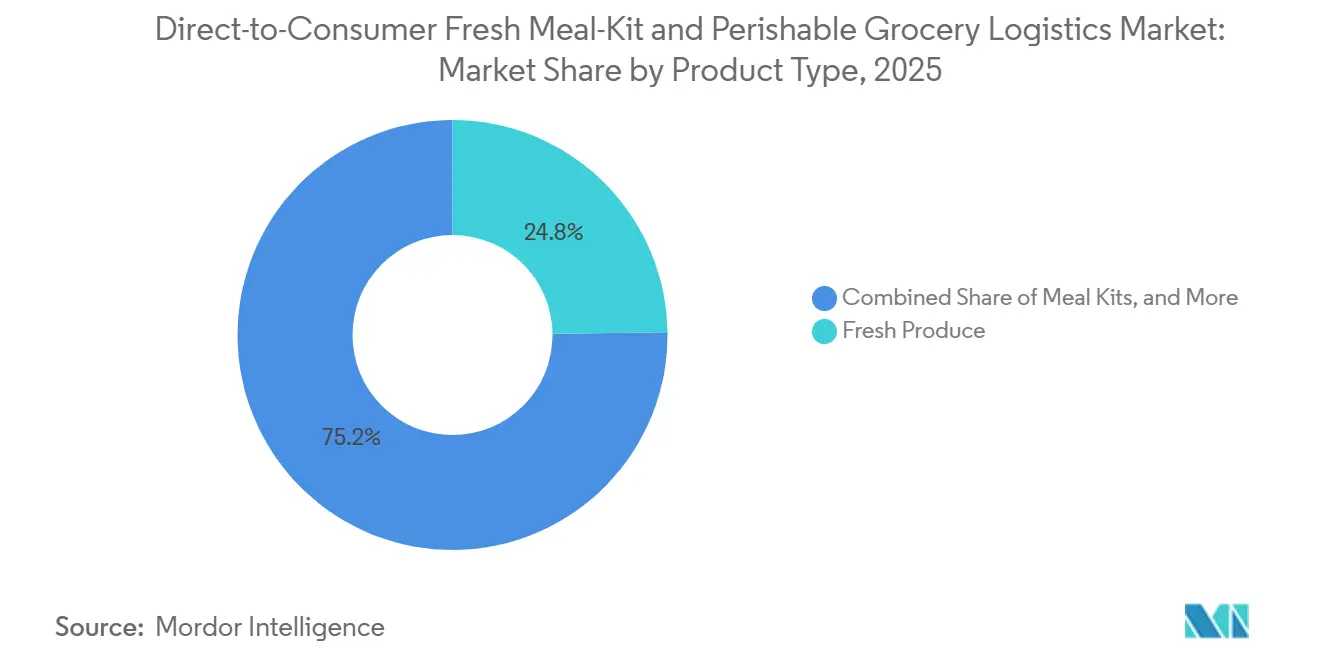
- By product type, fresh produce held 24.80% of the direct-to-consumer fresh meal-kit and perishable grocery logistics market share in 2026, while prepared and ready-to-eat foods recorded the highest projected CAGR at 9.67% through 2032.
- By temperature, temperature-controlled logistics held 83.60% of the direct-to-consumer fresh meal-kit and perishable grocery logistics market size in 2026, while non-temperature-controlled logistics recorded the highest projected CAGR at 10.01% through 2032.
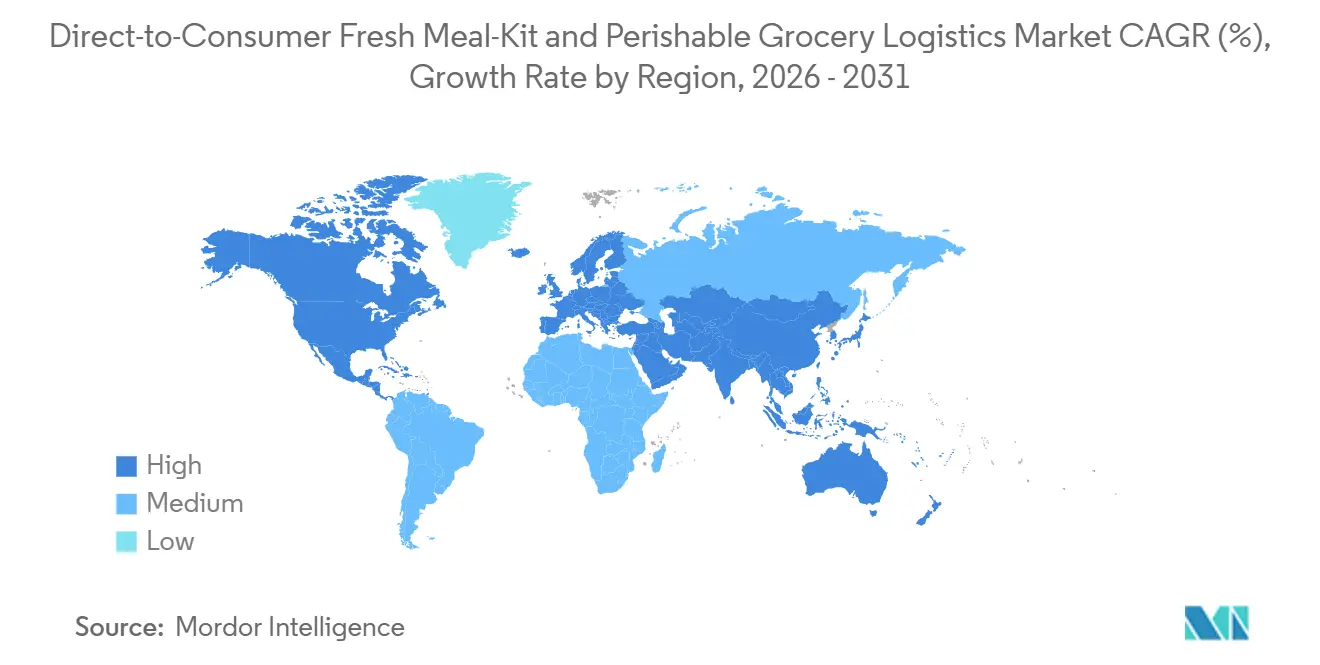
- By geography, North America held 37.40% of the direct-to-consumer fresh meal-kit and perishable grocery logistics market size in 2026, while Asia-Pacific recorded the highest projected CAGR at 9.78% through 2032.
Note: Market numbers in this report are based on Mordor Intelligence's proprietary estimation framework, which combines nine months of actuals with Q4 projections for base year 2026.
Market Trends and Insights
Drivers Impact Analysis of Direct-to-Consumer Fresh Meal-Kit and Perishable Grocery Logistics Market*
| Driver | (~) % Impact on CAGR Forecast | Geographic Relevance | Impact Timeline |
|---|---|---|---|
| Convenience and Time Scarcity Among Urban Households | +1.8% | Global, concentrated in North America, Europe, and East Asia metro corridors | Short term (≤ 2 years) |
| Expansion of Temperature-Controlled Last-Mile Capacity | +1.6% | Global, with capital concentration in North America, Germany, United Kingdom, Japan, South Korea, and UAE | Long term (≥ 4 years) |
| Digital Subscriptions and Mobile Commerce Adoption | +1.3% | North America and Europe core, with rapid spill-over to Asia-Pacific and Middle East and Africa | Medium term (2-4 years) |
| Personalized Health and Diet-Specific Meal Demand | +1.1% | North America, Europe, Australia, South Korea, with growth in urban India and China | Medium term (2-4 years) |
| Surplus-to-Consumer Routing Reducing Perishable Food Waste | +0.6% | North America and European Union core, with regulatory push in the United Kingdom and Nordics | Medium term (2-4 years) |
| Temperature-Data-Enabled Adaptive Packaging and Fulfillment | +0.5% | North America, Northern Europe, and Japan | Long term (≥ 4 years) |
| Source: Mordor Intelligence | |||
Convenience and Time Scarcity Among Urban Households
Urban households are an important source of demand for the direct-to-consumer fresh meal-kit and perishable grocery logistics market because grocery planning and food preparation compete with work, commuting, and family schedules. The United States Bureau of Labor Statistics reported that its American Time Use Survey tracks the time people spend on food preparation and related household activities[1]. Pre-portioned kits and chilled prepared meals address the time used for menu planning, shopping, ingredient preparation, and the handling of a weekly food list. The value proposition is broader than faster delivery because a subscription can remove the need to decide what to buy for several meals and can bring a repeatable structure to household routines. Same-day grocery delivery may reduce the trip to a store, but it does not organize weekly meal choices or reduce the burden of choosing recipes. Providers that combine curated menus, reliable delivery windows, and controlled food handling can therefore retain a distinct role in the direct-to-consumer fresh meal-kit and perishable grocery logistics market.
Digital Subscriptions and Mobile Commerce Adoption
Digital subscriptions give operators a direct channel for orders, recurring delivery schedules, and changes to household preferences.This wider digital base supports app-based grocery ordering in large cities and smaller urban centers where service availability is widening. Order data also helps providers assign delivery windows, position inventory, limit missed deliveries, and identify recurring demand patterns before a dispatch is planned. In the direct-to-consumer fresh meal-kit and perishable grocery logistics market, these operating improvements are more useful when the provider serves a large and recurring customer base with enough route density to act on the data. Mobile ordering also makes it easier for subscribers to pause, resume, or adjust orders, which can reduce friction around a service that depends on regular household participation.[2]
Personalized Health and Diet-Specific Meal Demand
Diet-specific food choices are increasing the need for more tailored product selection and fulfillment processes. The International Food Information Council reported in its 2025 survey that 5% of Americans followed a ketogenic or high-fat diet and 3% followed a plant-based diet[3]. These preferences create demand for meals with defined ingredients, nutritional profiles, portion sizes, and clearer information at the point of ordering. Hungryroot reported that its SmartCart meal recommendations achieved acceptance rates above 60% and served approximately 1.5 million consumers across 700,000 households. Personalized orders require operators to manage smaller and more varied picking lots than standard grocery shipments, increasing the importance of accurate inventory and packaging decisions. The direct-to-consumer fresh meal-kit and perishable grocery logistics market, therefore, needs flexible cold-chain picking, packaging, and inventory processes rather than only high-volume standardized assembly.
Expansion of Temperature-Controlled Last-Mile Capacity
Temperature-controlled capacity determines how much perishable volume can move through the direct-to-consumer fresh meal-kit and perishable grocery logistics market without weakening product quality. Americold closed a USD 1.3 billion joint venture with EQT in August 2026, adding 12 United States facilities with approximately 124 million cubic feet of temperature-controlled capacity and more than 400,000 pallet positions. The investment shows that large-scale cold storage remains a major requirement for direct distribution of perishable goods and for extending service across wider delivery territories. Asset-heavy providers can own storage, packing, and route infrastructure, while asset-light providers can use software to coordinate orders and carriers. In September 2026, Grip Shipping stated that it reached 80% of the United States population within 24 hours through 5 facilities and its order management technology. This difference between owned infrastructure and technology-led coordination may continue to influence operating models in the direct-to-consumer fresh meal-kit and perishable grocery logistics market.
Restraints Impact Analysis of Direct-to-Consumer Fresh Meal-Kit and Perishable Grocery Logistics Market*
| Restraint | (~) % Impact on CAGR Forecast | Geographic Relevance | Impact Timeline |
|---|---|---|---|
| Premium Pricing Versus Conventional Grocery Shopping | -1.1% | Global; acutest in South America, MEA, and Southeast Asia | Short term (≤ 2 years) |
| Customer Acquisition Costs and Subscription Churn | -0.8% | North America & Europe, where subscription market is most saturated | Medium term (2–4 years) |
| Thermal Packaging and Refrigerant Variability Across Delivery Networks | -0.7% | Global; most acute in Asia-Pacific last-mile and South American mid-mile corridors with inconsistent cold-storage density | Medium term (2–4 years) |
| Urban Delivery-Window Congestion and Failed-Drop Costs | -0.6% | High-density metro markets — New York, London, Tokyo, Mumbai, Sao Paulo, and comparable tier-1 cities globally | Short term (≤ 2 years) |
| Source: Mordor Intelligence | |||
Premium Pricing Versus Conventional Grocery Shopping
Premium pricing limits the reach of subscription-based offers in the direct-to-consumer fresh meal-kit and perishable grocery logistics market. A household comparing a meal-kit subscription with grocery purchases considers both the food price and the convenience services included in the box, including menu planning, portioning, packing, and delivery. That comparison becomes harder for operators when same-day delivery and curbside pickup make conventional grocery shopping more convenient and familiar. The constraint is stronger in markets where household budgets leave less room for premium food services and where subscription habits are less established. Lower-cost brands have addressed this issue by building supply chains designed for a lower price point rather than simply discounting a premium offer. Surplus-to-consumer routing and better use of adaptive packaging can reduce waste and support delivery efficiency, but they do not remove the underlying affordability issue.
Customer Acquisition Costs and Subscription Churn
Customer retention remains a material challenge for the direct-to-consumer fresh meal-kit and perishable grocery logistics market because a subscription has to recover marketing, food, packaging, and fulfillment costs over multiple orders. HelloFresh reported that marketing expenses represented 21.8% of revenue in 2025. Subscribers may leave after introductory offers, changes in household schedules, or a switch to grocery delivery alternatives that appear easier to use. The retention profile can differ by acquisition channel, particularly where wellness programs or health-plan relationships place food choices in a health-focused setting rather than a short-term promotion. Operators can improve the economics of customer acquisition by combining dietary relevance, dependable delivery, recurring menu value, and service communications that build routine use. The direct-to-consumer fresh meal-kit and perishable grocery logistics market may remain sensitive to this issue because recurring demand is necessary to use cold-chain assets efficiently.
*Our forecasts treat driver/restraint impacts as directional, not additive. The impact forecasts reflect baseline growth, mix effects, and variable interactions.
Direct-to-Consumer Fresh Meal-Kit and Perishable Grocery Logistics Market Segment Analysis
By Service:
Transportation Dominates as Value-Added Services Close the GapTransportation held 48.70% of the direct-to-consumer fresh meal-kit and perishable grocery logistics market share in 2026, reflecting the investment needed to move food through temperature-sensitive delivery routes and dispersed household delivery zones. Amazon announced that its same-day perishable grocery service reached more than 1,000 cities in the United States in August 2025 and was planned for more than 2,300 cities by the end of that year. Fast delivery commitments need route density, insulated packaging, reliable handoffs, and coordinated warehousing that can assemble orders without delaying final delivery. Americold stated that its direct-to-consumer fulfillment platform could reach approximately 99.5% of the United States population within 2 days from 5 sites.
Value-added services registered a 9.48% CAGR from 2027 to 2032, the fastest rate among service segments. Co-packing, retail-ready labeling, subscription management, returns processing, and data services are expanding the role of logistics providers beyond storage and transport. Grip Shipping reported that its order management system can reduce shipping costs by up to 30% and shipping failures by 25% through weather-sensitive routing decisions. These services help providers adapt routes, limit waste from failed deliveries, and offer brands a more integrated operating model. The direct-to-consumer fresh meal-kit and perishable grocery logistics industry is moving toward service platforms that combine fulfillment assets with order-management tools.

By Product Type:
Fresh Produce Leads While Prepared Foods AccelerateFresh produce accounted for 24.80% of the direct-to-consumer fresh meal-kit and perishable grocery logistics market size in 2026, supported by frequent household demand and the need to replenish short-life products. Direct procurement from farms and surplus-routing models can reduce spoilage between the source and the consumer, while careful packaging and delivery timing protect product condition. Dairy and eggs, together with meat, poultry, and seafood, remain important because their high value per unit and strict handling needs strengthen the case for specialized direct logistics. These categories need reliable cold-chain control from picking through last-mile delivery.
Prepared and ready-to-eat foods registered a 9.67% CAGR from 2027 to 2032, making it the fastest-growing product category. HelloFresh opened a factory production facility in Verden, Germany, in May 2026 for ready-to-eat production across 5 European markets. The facility expanded the company’s European ready-to-eat production capacity 8-fold, showing the operational response to demand for complete meals. Meal kits still serve customers who want to cook, but ready-to-eat food is growing faster within the same delivery ecosystem. Providers with both formats can support different meal occasions and retain more household food spending in the direct-to-consumer fresh meal-kit and perishable grocery logistics market.
By Temperature:
Chilled and Frozen Drive Cold-Chain Investment While Ambient MovesTemperature-controlled logistics captured 83.60% of the direct-to-consumer fresh meal-kit and perishable grocery logistics market share in 2026, reflecting the handling requirements of fresh proteins, dairy, produce, and prepared meals. Chilled products at 2 °C to 8 °C cover a broad range of daily-use products, while frozen handling supports food designed for longer storage and replenishment cycles. The United States Food and Drug Administration states that the Food Traceability Rule established additional traceability recordkeeping requirements for certain foods, and the compliance date was extended to July 2028[4]. These requirements raise the operating baseline for providers handling covered produce, seafood, and cheeses.
Non-temperature-controlled logistics registered a 10.01% CAGR from 2027 to 2032. The segment includes ambient dry grocery and pantry products added to chilled subscription boxes, which can increase the food value delivered on one trip. Operators use multi-temperature route batching to move ambient, chilled, and frozen goods in the same vehicle through separate insulated packaging. This model can lower the cost of adding shelf-stable items to chilled delivery and helps providers manage mixed orders in the direct-to-consumer fresh meal-kit and perishable grocery logistics market. Temperature-data-enabled packaging also helps manage changing delivery conditions without placing every item on a dedicated temperature-controlled route.
Geography Analysis
North America Direct-to-Consumer Fresh Meal-Kit and Perishable Grocery Logistics Market
North America accounted for 37.40% of the direct-to-consumer fresh meal-kit and perishable grocery logistics market size in 2026, supported by established subscriptions, cold-chain infrastructure, and large delivery platforms. Walmart stated in 2025 that it could provide delivery within 3 hours to 95% of the United States population. Its Wing partnership expanded to 100 stores across 5 states in 2025, with a planned network of 270 locations by 2027. Canada is adding ready-to-eat meal capacity, while cross-border logistics corridors support broader cold-chain investment. The region’s scale supports continuing competition among grocery retailers, marketplaces, and specialized fulfillment providers.
APAC and MEA Direct-to-Consumer Fresh Meal-Kit and Perishable Grocery Logistics Market
Asia-Pacific registered a 9.78% CAGR from 2027 to 2032, the highest regional rate in the direct-to-consumer fresh meal-kit and perishable grocery logistics market. Urbanization, rising disposable income, and mobile-first grocery commerce support demand across China, India, South Korea, and Southeast Asia. Ocado and Lotte launched their first automated customer fulfillment center in Busan in August 2026, serving 4 million households across the Yeongnam region. In September 2026, Yoshikei reported cumulative delivery of approximately 3.1 billion meals to around 500,000 households through a make-to-order model. The Middle East and Africa are developing as premium delivery demand increases in the UAE and Saudi Arabia, and investment in storage, automation, and route planning will shape regional growth.
Europe Direct-to-Consumer Fresh Meal-Kit and Perishable Grocery Logistics Market
Europe holds a substantial part of global value, with the United Kingdom, Germany, and Nordic countries showing strong subscription density. Gousto entered the Republic of Ireland in February 2025 through arrangements with Bond Freeze for cold storage and DPD for final delivery, adding more than 150 monthly recipes and a commitment to source more than one-third of ingredients from the island of Ireland. Ocado and Asda entered an e-commerce partnership in May 2026 to deploy the Ocado Smart Platform across Asda stores and dark stores from early 2027. Germany benefits from HelloFresh’s hub model and expanded ready-to-eat production at Verden, while food-safety and traceability practices reinforce disciplined cold-chain operations.
Competitive Landscape
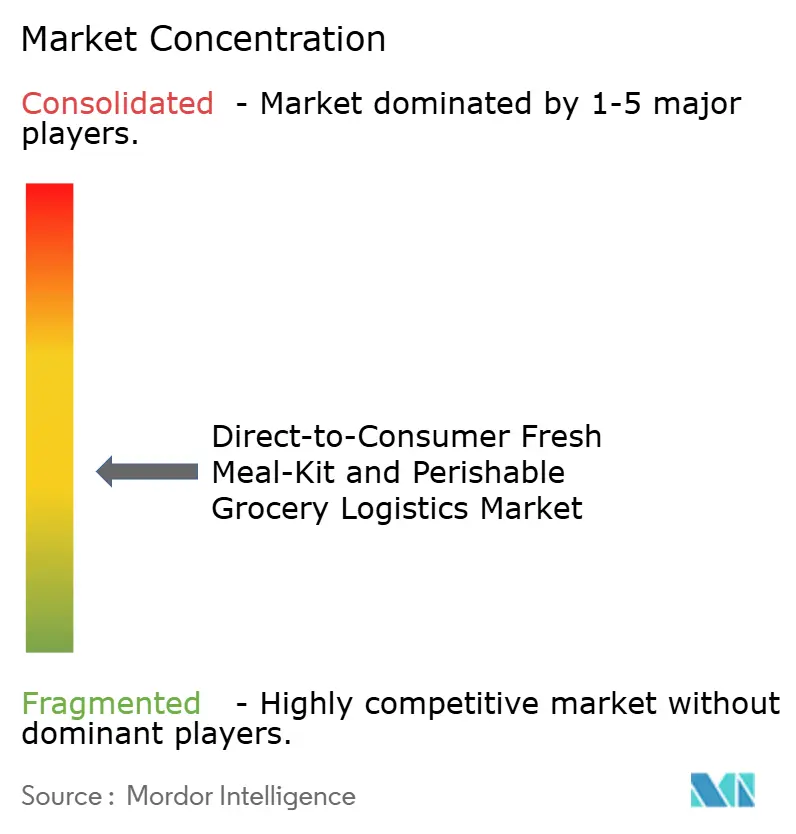
The direct-to-consumer fresh meal-kit and perishable grocery logistics market is moderately fragmented, and no single participant holds more than 15% of global revenue. Competition is divided between vertically integrated meal-kit providers that control menus and fulfillment, and platforms that manage customer access through retailer partnerships and third-party logistics. HelloFresh and Hungryroot link menu development, food sourcing, fulfillment, and delivery, while Amazon Fresh, Instacart, and DoorDash extend grocery delivery through broader consumer platforms. DoorDash expanded its Kroger relationship to nearly 2,700 stores in September 2025. Delivery coverage and retail partnerships are, therefore, central to competition in the direct-to-consumer fresh meal-kit and perishable grocery logistics market.
DoorDash extended same-day delivery from all the United States Costco warehouses in 2026. Instacart acquired Instaleap in April 2026 to add retailer relationships in approximately 30 countries and support the international growth of its enterprise platform. Americold stated that its SmarTrakr platform provides direct-to-consumer brands with inventory visibility and fulfillment information. These moves show that scale is being built through retailer access, cold-chain capability, and dependable digital coordination.
Specialized fulfillment companies serve brands that do not own temperature-controlled infrastructure. Grip Shipping reported cumulative shipment of more than USD 3 billion of perishable goods since its launch. Dependence on a single production and delivery partner can create disruption, so resilient capacity and contingency planning are increasingly important. Real-time spoilage prediction, multi-temperature route batching, and consumer-level tracking are relevant operating capabilities, but no company has established all of them at global scale. The direct-to-consumer fresh meal-kit logistics industry remains open to firms that connect technology, food safety, and physical delivery without weakening service consistency.
Direct-to-Consumer Fresh Meal-Kit and Perishable Grocery Logistics Industry Leaders
-
Instacart
-
Walmart, Inc.
-
Blue Apron Holdings, Inc.
-
HelloFresh SE
-
The Kroger Co.
- *Disclaimer: Major Players sorted in no particular order
Direct-to-Consumer Fresh Meal-Kit and Perishable Grocery Logistics Market Companies Covered in this Report
- HelloFresh SE
- Blue Apron Holdings, Inc.
- The Kroger Co.
- Marley Spoon Group SE
- Gousto Group Ltd.
- Purple Carrot, Inc.
- Hungryroot, Inc.
- Daily Harvest, Inc.
- Fresh Direct LLC
- Instacart
- Amazon Fresh
- Walmart Inc.
- DoorDash, Inc.
- Misfits Market
- Americold Realty Trust
- Grip Shipping
- Gordon Delivery
- Ocado Group plc
- Tesco PLC
Recent Industry Developments in Direct-to-Consumer Fresh Meal-Kit and Perishable Grocery Logistics Market
- September 2026: DoorDash and Costco expanded their United States delivery partnership to cover all Costco warehouses in the United States for same-day service. The expansion broadened DoorDash’s coverage among 8 of the 10 largest food retailers in North America.
- September 2026: Walmart entered a restaurant delivery agreement with Inspire Brands. Dunkin’ will first launch through 150 Walmart in-store locations before expanding to the majority of its approximately 10,000 locations in the United States.
- August 2026: Americold closed its USD 1.3 billion North American cold-storage joint venture with EQT. The venture added 12 facilities in the United States, totaling approximately 124 million cubic feet of temperature-controlled capacity and more than 400,000 pallet positions.
- May 2026: Ocado and Asda entered a partnership to deploy the Ocado Smart Platform across Asda stores and dark stores from early 2027.
Global Direct-to-Consumer Fresh Meal-Kit and Perishable Grocery Logistics Market Report Scope
Segmentation Overview
| Transportation |
| Warehousing & Fulfillment |
| Value-Added Services |
| Meal Kits |
| Fresh Produce |
| Meat, Poultry & Seafood |
| Dairy & Eggs |
| Prepared & Ready-to-Eat Foods |
| Other Perishable Foods |
| Temperature-Controlled | Ambient |
| Chilled | |
| Frozen | |
| Non Temperature-Controlled |
| North America | United States |
| Canada | |
| Mexico | |
| South America | Brazil |
| Argentina | |
| Peru | |
| Chile | |
| Rest of South America | |
| Europe | Germany |
| United Kingdom | |
| France | |
| Italy | |
| Spain | |
| Russia | |
| Nordics (Denmark, Finland, Iceland, Norway, and Sweden) | |
| Rest of Europe | |
| Asia-Pacific | China |
| India | |
| Japan | |
| South Korea | |
| Australia | |
| Southeast Asia (ASEAN) | |
| Rest of Asia-Pacific | |
| Middle East and Africa | Saudi Arabia |
| United Arab Emirates | |
| Qatar | |
| South Africa | |
| Nigeria | |
| Egypt | |
| Rest of Middle East and Africa |
| By Service | Transportation | |
| Warehousing & Fulfillment | ||
| Value-Added Services | ||
| By Product Type | Meal Kits | |
| Fresh Produce | ||
| Meat, Poultry & Seafood | ||
| Dairy & Eggs | ||
| Prepared & Ready-to-Eat Foods | ||
| Other Perishable Foods | ||
| By Temperature | Temperature-Controlled | Ambient |
| Chilled | ||
| Frozen | ||
| Non Temperature-Controlled | ||
| By Geography | North America | United States |
| Canada | ||
| Mexico | ||
| South America | Brazil | |
| Argentina | ||
| Peru | ||
| Chile | ||
| Rest of South America | ||
| Europe | Germany | |
| United Kingdom | ||
| France | ||
| Italy | ||
| Spain | ||
| Russia | ||
| Nordics (Denmark, Finland, Iceland, Norway, and Sweden) | ||
| Rest of Europe | ||
| Asia-Pacific | China | |
| India | ||
| Japan | ||
| South Korea | ||
| Australia | ||
| Southeast Asia (ASEAN) | ||
| Rest of Asia-Pacific | ||
| Middle East and Africa | Saudi Arabia | |
| United Arab Emirates | ||
| Qatar | ||
| South Africa | ||
| Nigeria | ||
| Egypt | ||
| Rest of Middle East and Africa | ||
Key Questions Answered in the Report
What is the value of the direct-to-consumer fresh meal-kit and perishable grocery logistics sector in 2026?
The sector is valued at USD 22.63 billion in 2026 and is forecast to reach USD 35.95 billion by 2032 at an 7.97% CAGR.
Which service has the largest share in direct-to-consumer fresh meal-kit and perishable grocery logistics market?
Transportation led with 48.70% share in 2026 because cold-chain delivery to dispersed households requires substantial route and handling capacity.
Which food category is growing fastest in this sector?
Prepared and ready-to-eat foods is the fastest-growing product category, with a forecast CAGR of 9.67% from 2027 to 2032..
Why is temperature-controlled delivery important for meal kits and perishable groceries?
Temperature-controlled logistics held 83.60% share in 2026 because fresh products and prepared meals need controlled storage and transport.
Which region is expanding fastest for direct-to-consumer fresh meal-kit and perishable grocery logistics market?
Asia-Pacific registered a 9.78% CAGR from 2027 to 2032, supported by urbanization and mobile-first grocery commerce.
What are the main barriers for meal-kit subscriptions?
Premium pricing versus conventional groceries, customer acquisition costs, and subscriber churn can limit wider adoption and pressure unit economics.