
Direct Lithium Extraction Functional Materials Market Size and Share
Market Overview
| Study Period | 2021 - 2031 |
|---|---|
| Market Size (2026) | USD 180.23 Million |
| Market Size (2031) | USD 413.37 Million |
| Growth Rate (2026 - 2031) | 18.06 % |
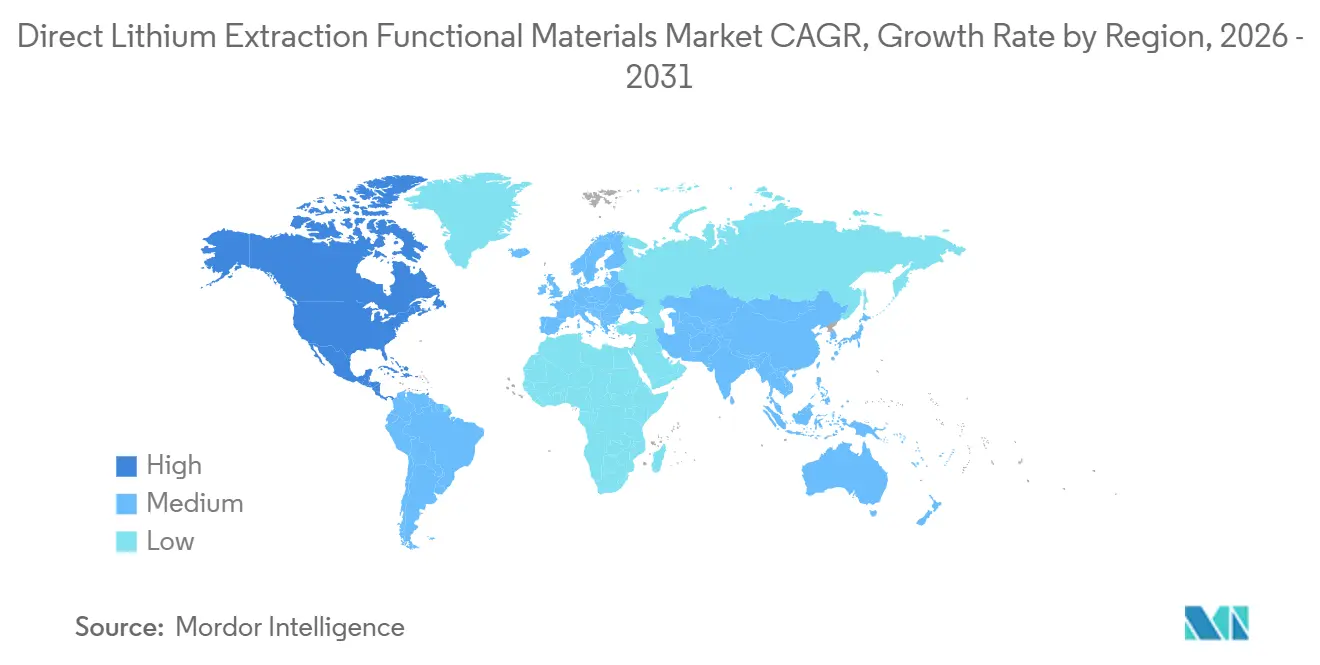
| Fastest Growing Market | North America |
| Largest Market | Asia-Pacific |
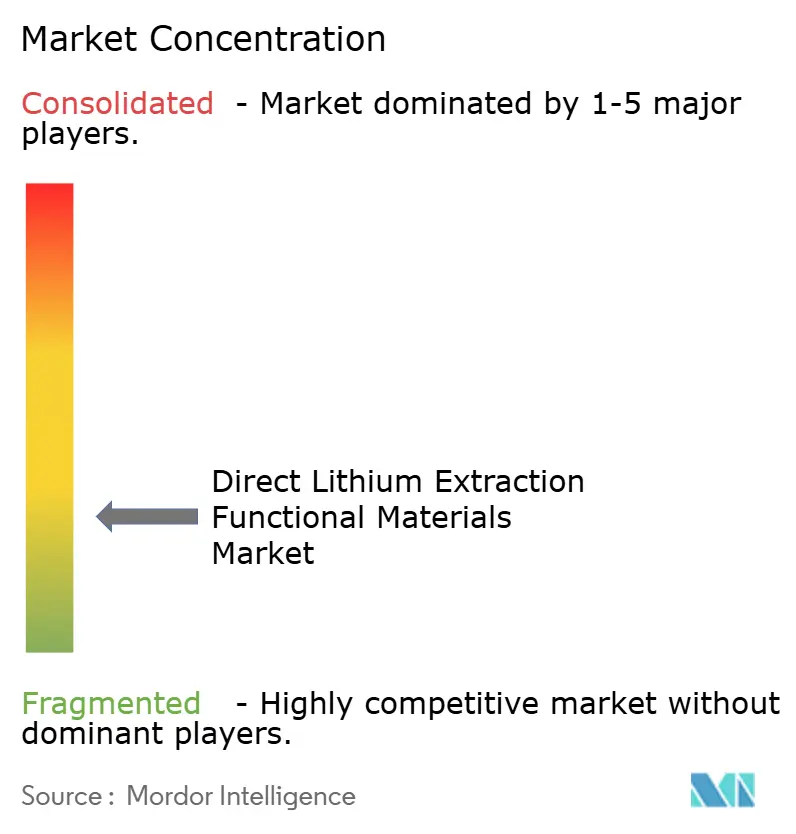
| Market Concentration | Low |
Major Players *Disclaimer: Major Players sorted in no particular order Image © Mordor Intelligence. Reuse requires attribution under CC BY 4.0. | |
Direct Lithium Extraction Functional Materials Market Analysis by Mordor Intelligence
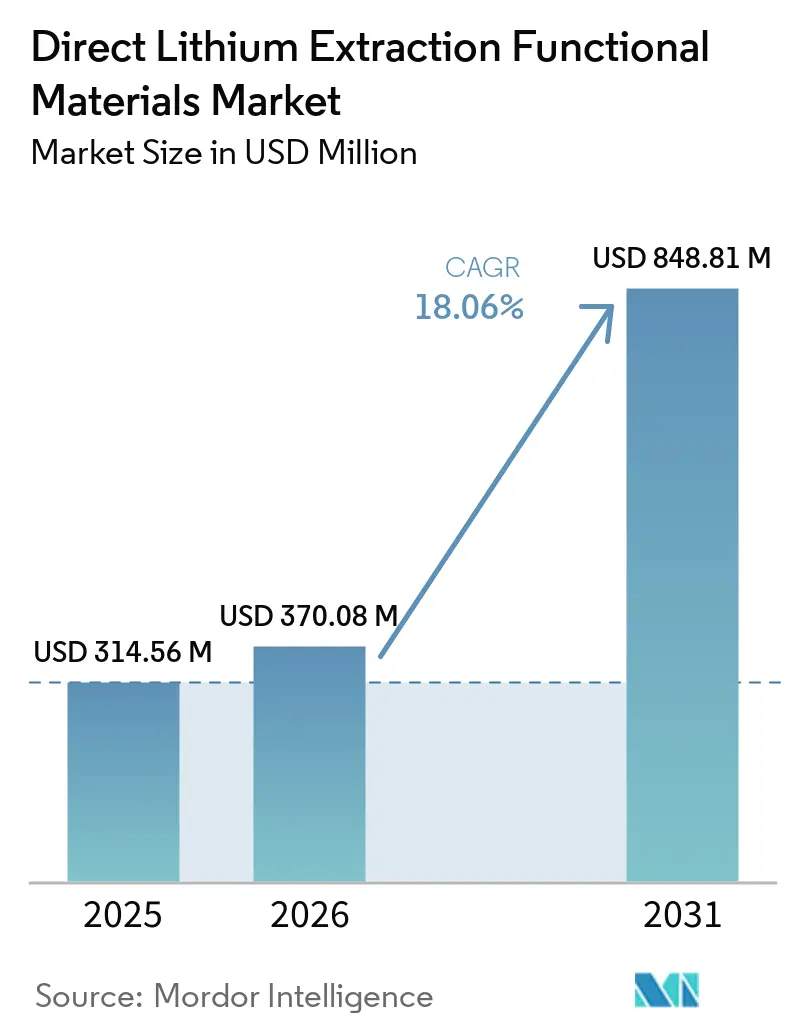
The Direct Lithium Extraction Functional Materials Market size is expected to increase from USD 162.37 million in 2025 to USD 180.23 million in 2026 and reach USD 413.37 million by 2031, at a CAGR of 18.06% over 2026-2031. The direct lithium extraction functional materials market is tied closely to commercial direct lithium extraction (DLE) deployment because sorbents, membranes, ion-exchange resins, and solvent extractants are used throughout the extraction process. Higher lithium prices between January 2025 and April 2026 reflected constrained upstream supply and strong energy-storage demand, which strengthened the case for materials that support higher recovery and product purity. Suppliers that can demonstrate durability across repeated cycles and performance across different brines are likely to receive more attention as procurement becomes more focused on technical specifications. The direct lithium extraction functional materials market also benefits from public financing, as commitments in advanced economies reached USD 65 billion in 2025 and reduced project development risk. Lithium price volatility and the higher capital requirements of commercial projects remain important constraints on purchase timing and project economics.
Key Report Takeaways
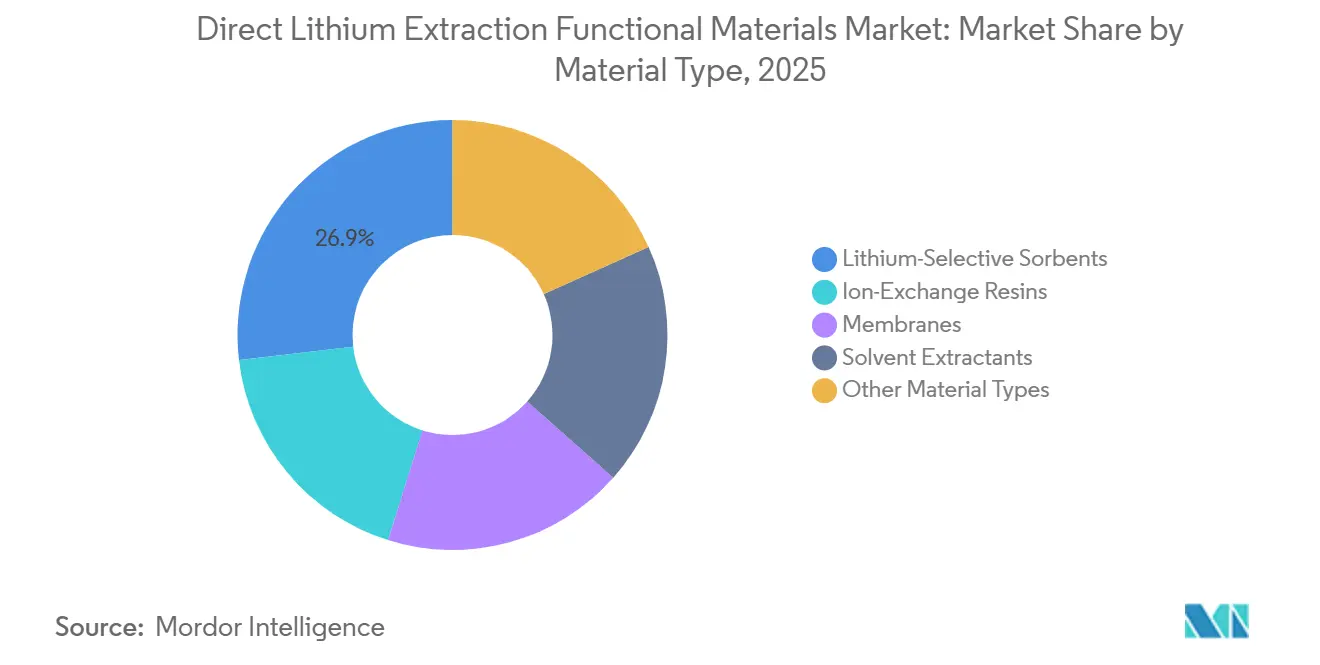
- By material type, lithium-selective sorbents held 26.86% of the direct lithium extraction functional materials market share in 2025, while membranes are forecast to grow at a 20.26% CAGR through 2031.
- By DLE technology, adsorption-based DLE held 38.35% of the direct lithium extraction functional materials market share in 2025, while membrane-based DLE is forecast to grow at a 20.74% CAGR through 2031.
- By brine source, salar brines held 36.52% of the direct lithium extraction functional materials market share in 2025, while oilfield produced water is forecast to grow at a 19.11% CAGR through 2031.
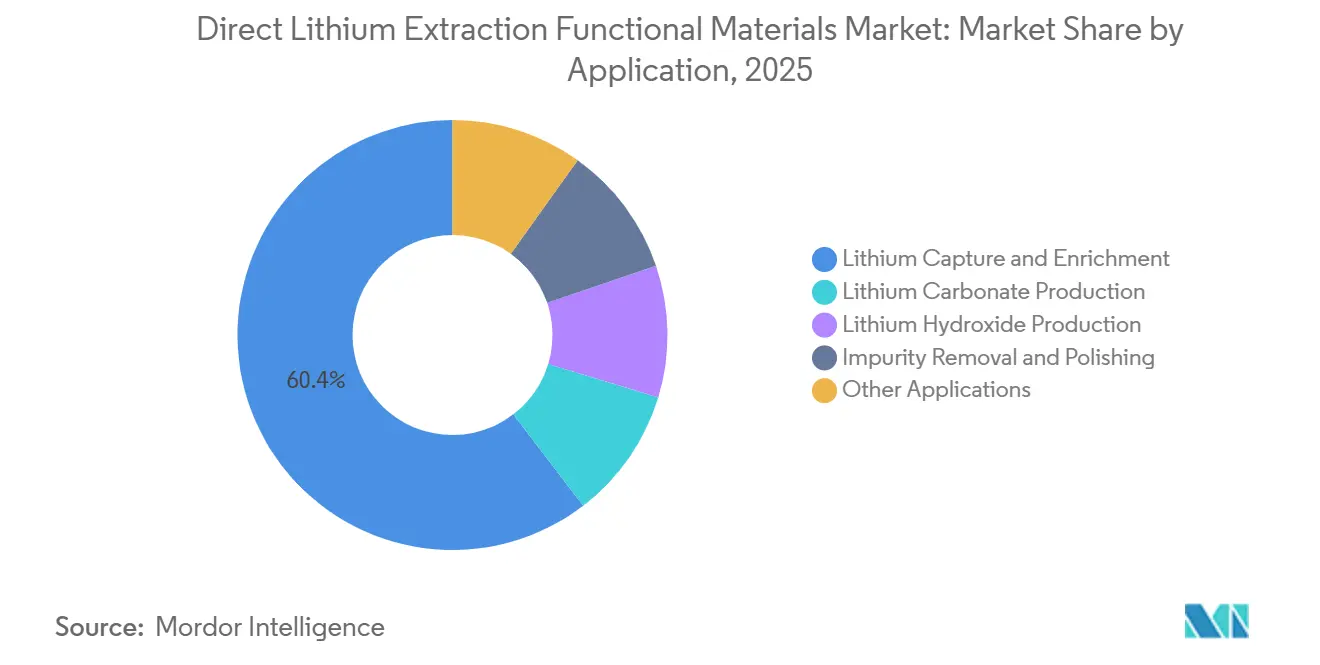
- By application, lithium capture and enrichment held 60.41% of the direct lithium extraction functional materials market share in 2025, while lithium hydroxide production is forecast to grow at a 20.25% CAGR through 2031.
- By geography, Asia-Pacific held 44.49% of the direct lithium extraction functional materials market share in 2025, while North America is forecast to grow at a 20.43% CAGR through 2031.
Note: Market size and forecast figures in this report are generated using Mordor Intelligence’s proprietary estimation framework, updated with the latest available data and insights as of January 2026.
Global Direct Lithium Extraction Functional Materials Market Trends and Insights
Drivers Impact Analysis*
| Driver | (~) % Impact on CAGR Forecast | Geographic Relevance | Impact Timeline |
|---|---|---|---|
| Battery-Grade Lithium Supply Deficit | +3.5% | Global | Short term (≤ 2 years) |
| Domestic Critical-Mineral Policy and Project Financing | +2.8% | North America, Europe, China | Medium term (2–4 years) |
| Low-Grade and Non-Traditional Brine Monetization | +2.2% | North America, South America | Medium term (2–4 years) |
| Faster Production Cycles Than Evaporation Ponds | +1.9% | Global | Short term (≤ 2 years) |
| Sorbent Durability and Regeneration Innovation | +1.5% | Global, with early gains in North America and APAC core | Medium term (2–4 years) |
| Integrated Brine-to-Product Flowsheets | +1.2% | South America, North America | Long term (≥ 4 years) |
| Source: Mordor Intelligence | |||
Battery-Grade Lithium Supply Deficit
Battery cathode manufacturers serving automotive companies under long-term agreements are increasingly requiring battery-grade lithium chloride and lithium hydroxide monohydrate. This requirement supports the demand for functional materials with high selectivity at a commercial scale. The direct lithium extraction functional materials market is affected directly because these materials determine recovery and impurity control before downstream conversion. The International Energy Agency (IEA) projected that lithium supply deficits would continue through 2035, which provides a continuing basis for investment in improved extraction materials. DLE recovery rates exceeded 90% in the Columbia analysis, compared with 40% to 60% for evaporation ponds. Planned cathode production capacity was also near one-third of projected lithium mining capacity, adding pressure to improve processing and product quality. Suppliers that can show reliable 99.9%+ impurity rejection across commercial brine conditions can differentiate their offerings from generic materials.
Domestic Critical-Mineral Policy and Project Financing
On April 7, 2026, the U.S. Department of Energy announced up to USD 69 million in Critical Minerals and Materials Accelerator funding. Topic Area 3 directly targets cost-competitive DLE separation and processing[1]U.S. Department of Energy, “Energy Department Issues Funding Opportunity to Strengthen American Critical Minerals,” U.S. Department of Energy, energy.gov. This funding formed part of a USD 1 billion critical minerals package announced in August 2025, including USD 500 million for commercial facility development. The direct lithium extraction functional materials market gains from these measures because funding reduces barriers to material qualification and commercial procurement. The U.S. Inflation Reduction Act 45X tax credit provides a 10% incentive for domestic mineral extraction and processing, which is shifting procurement interest toward North American materials. Canada’s Clean Technology Investment Tax Credit offers a 30% write-off for mineral extraction and processing, while E3 Lithium’s Clearwater Project received federal support. In Europe, lithium’s designation as a strategic raw material and the EU Battery Regulation’s traceability requirements support procurement of certified, low-carbon materials.
Low-Grade and Non-Traditional Brine Monetization
Oilfield produced water is creating a new source of demand for functional materials that can process low-concentration and variable-composition brines. The direct lithium extraction functional materials market has an additional route to demand where producers can recover lithium from streams historically treated as disposal liabilities. Gradiant’s alkaLi business announced commercial operations at an integrated lithium production facility using Marcellus Shale-produced water in Pennsylvania in 2026. The facility reported 97% lithium recovery and 99.5% purity for battery-grade lithium carbonate. LibertyStream started lithium carbonate production from Permian Basin produced water in late 2025 after processing more than 350,000 barrels of oilfield brine since February 2025. Research on Chinese oilfield brines identified Na+/Li+ ratios up to 274 and Ca²+/Li+ ratios up to 69, which explains why standard materials can underperform in these settings. These brines require tailored pre-treatment and selective materials, creating an opening for multi-chemistry formulations. Resource recovery at existing oil and gas sites can also avoid some greenfield development requirements.
Faster Production Cycles Than Evaporation Ponds
DLE can complete lithium extraction in hours or days, while conventional evaporation ponds may require 12 to 24 months. Shorter cycles can reduce the period between material procurement and initial revenue. This timing can make financing decisions easier for projects that need evidence of operating performance. Rio Tinto secured a USD 1.175 billion financing package in 2026 for its Rincón project in Argentina, which targets 60,000 metric tons per year of battery-grade lithium carbonate. More frequent regeneration cycles also build operating data faster, which can support lender review of material performance. The direct lithium extraction functional materials market can therefore benefit when developers bring material qualification and purchasing decisions forward. This relationship makes cycle time relevant not only to lithium output, but also to the timing of material orders and repeat purchase decisions.
Restraints Impact Analysis*
| Restraint | (~) % Impact on CAGR Forecast | Geographic Relevance | Impact Timeline |
|---|---|---|---|
| Brine-Chemistry Variability and Site-Specific Design | -2.0% | Global, particularly South America and Middle-East and Africa | Medium term (2–4 years) |
| Long-Cycle Material Degradation and Replacement Cost | -1.5% | Global | Long term (≥ 4 years) |
| First-of-a-Kind Scale-Up and Bankability Risk | -1.2% | North America, South America | Short term (≤ 2 years) |
| Lithium-Price Volatility and Uneven Project Economics | -1.0% | Global | Short term (≤ 2 years) |
| Source: Mordor Intelligence | |||
Brine-Chemistry Variability and Site-Specific Design
No single DLE functional material performs best across every brine chemistry. This limitation adds engineering work and extends qualification at each new project site. The direct lithium extraction functional materials market must therefore accommodate site-specific material selection rather than standard procurement. European Association of Geoscientists and Engineers (EAGE) found substantial variation among DLE providers in minimum lithium concentration, recovery, purity, chemical use, water use, and capital and operating cost estimates. South American salar brines can have high magnesium-to-lithium ratios, while oilfield brines in China’s Tsaidam Basin need targeted pre-treatment because of high sodium-to-lithium ratios. Material suppliers can face qualification periods of 6 to 18 months before receiving volume commitments. Permitting differences in Argentina and uncertainty around Chilean brine reinjection rules can further delay final investment decisions.
Long-Cycle Material Degradation and Replacement Cost
Sorbents and membranes can degrade after thousands of adsorption and desorption cycles. Replacement costs may be underrepresented during early feasibility work, then affect returns during commercial ramp-up. The direct lithium extraction functional materials market relies on lifecycle evidence because replacement costs affect the economics of long-running projects. Summit Nanotech reported that its eLivate sorbent showed 5% degradation after 10,000 operating cycles while maintaining more than 98% lithium recovery. Lilac Solutions stated that its Generation 4 ion-exchange technology reduced DLE unit operating expenditure by USD 508 per metric ton Lithium Carbonate Equivalent (LCE) and capital expenditure by USD 98 million versus earlier generations in Lake Resources’ Kachi Project analysis. Import duties, logistics gaps, and limited local specialty-material production can make lifecycle costs different across project locations. Quality systems and standardized durability testing can add a further qualification burden for new suppliers.
*Our forecasts treat driver/restraint impacts as directional, not additive. The impact forecasts reflect baseline growth, mix effects, and variable interactions.
Segment Analysis
By Material Type: Lithium-Selective Sorbents Show Leadership While Membranes Gain Momentum
Lithium-selective sorbents held 26.86% of the material type segment in 2025. This position reflected their commercial use across salar, geothermal, and oilfield brine projects. The direct lithium extraction functional materials market retains sorbents as its most established material class. Adsorption-based sorbents, including lithium manganese oxide and titanium-based ion sieves, achieved recovery rates of 80% to 98% across lithium concentrations of 50 to 2,000 mg/L. Existing commercial references span China, Argentina, and the United States. Ion-exchange resins hold a related role in settings that need high selectivity at low lithium concentrations. Lilac Solutions reported 87% lithium recovery from a 70 mg/L Great Salt Lake brine with its Gen 5 ion-exchange technology in 2025.
Membranes are projected to grow at a 20.26% CAGR through 2031. Research published in Nature Communications reported a thin-film nanocomposite cation-exchange membrane with Li+/Na+ selectivity of 13.58 and energy consumption of 34.83 kWh per kg of lithium recovered. A Nature Water study reported Li+/Mg2+ selectivity up to 485 in electrodialysis and 99.6% purity lithium carbonate from a 189 cm² stack. Solvent extractants remain relevant for specialized high-purity applications, although their addressable base is narrower. Domestic production incentives may shift some procurement toward North American sorbents. The direct lithium extraction functional materials industry is also seeing membrane manufacturing methods improve, which may narrow the scale gap with sorbents over the forecast period.



By DLE Technology: Adsorption-Based DLE Dominates While Membrane-Based DLE Accelerates
Adsorption-based DLE held 38.35% of the market share in 2025. Its Technology Readiness Level 9 status and ability to process a broad range of brines supported this lead. The direct lithium extraction functional materials market is supported by adsorption’s established commercial reference base. Qinghai CITIC Guoan Technology commissioned a 20,000 metric ton desalinated-brine adsorption lithium extraction line in January 2026. The company reported that overall plant lithium recovery increased from 75.38% to 90.41%. Eramet’s Centenario-Ratones project in Argentina reached steady-state commercial production in late 2025 with a target of 24,000 metric tons LCE per year. Ion-exchange DLE is being advanced through parallel commercialization efforts in the United States and Canada.
Membrane-based DLE is projected to grow at a CAGR of 20.74% through 2031. The Columbia analysis placed membrane separation at Technology Readiness Level 4 to 5, with potential recovery above 99.9%. The U.S. Department of Energy described a zwitterionic chromatography method that achieved 79.2% lithium-calcium yield without reagent chemicals. Lower chemical use can help projects during environmental review. LiTHOS Group’s patent activity on a membrane-based process spanning extraction and refining also points to increasing competition around integrated platforms. The direct lithium extraction functional materials market will depend on whether these technical advances can move from pilot-scale results to repeatable industrial performance.
By Brine Source: Salar Brines Dominance Coexists with an Oilfield Produced Water Surge
Salar brines held 36.52% of the brine source segment in 2025. Their concentrated lithium feeds and established extraction infrastructure support the maturity of adsorption and solvent-extraction materials. The direct lithium extraction functional materials market continues to draw on the large installed base of salar-brine projects. Rio Tinto’s USD 1.175 billion Rincón financing package and Albemarle’s March 2026 environmental assessment submission for a Salar de Atacama transition showed continuing investment in salar-focused DLE. Geothermal brines have a smaller but growing role in Europe. Seawater and industrial brines remain at an earlier stage because dilution affects current economics.
Oilfield produced water is forecast to grow at a CAGR of 19.11% through 2031. Select Water Solutions and Mariana Minerals broke ground on a produced-water lithium extraction facility in Texas in October 2025, with commercial production planned for the first half of 2027. EnergyX commissioned its 250-metric-ton Project Lonestar plant in Texas in March 2026. Scientific research indicates that enhanced pre-treatment with DLE can address competing-ion barriers in oilfield brines. High sodium-to-lithium and calcium-to-lithium ratios require specialized sorbents with stronger rejection of divalent ions. These requirements can support premium pricing for materials that perform consistently in oilfield feedstocks.
By Application: Lithium Capture and Enrichment Dominates, Lithium Hydroxide Production Scales Fastest
Lithium capture and enrichment held 60.41% of the application segment in 2025. It is the core demand base because extraction is the first and most material-intensive stage in every DLE process. The direct lithium extraction functional materials market is linked to this application because every process train requires an initial capture step. The segment uses sorbents, membranes, ion-exchange resins, and extractants. Its broad material compatibility also makes it the main commercial testing ground for new formulations. Lithium carbonate production held the next position because of established downstream refining infrastructure. Impurity removal and polishing require advanced materials capable of 99.9%+ impurity rejection for cathode-grade specifications.
Lithium hydroxide production is forecast to grow at a CAGR of 20.25% through 2031. Demand is connected to nickel-rich Nickel Manganese Cobalt (NMC) cathode chemistry, which uses lithium hydroxide monohydrate as a processing input. The direct lithium extraction functional materials market can extend into refining when ion-exchange materials support lithium hydroxide conversion. Rio Tinto’s Nemaska Lithium plant in Bécancour was 60% complete at the end of 2025. Commissioning was planned for 2026, and first production was targeted for 2028, with more than USD 300 million in Rio Tinto equity investment in 2026. Veolia Water Technologies is developing a direct lithium conversion process using resin-based ion exchange in the lithium chloride-to-hydroxide pathway. This approach extends the role of functional materials from extraction to refining.
Geography Analysis
Asia-Pacific held 44.49% of the direct lithium extraction functional materials market in 2025. China’s Salt Lake DLE activity and integrated battery manufacturing base created direct demand for upstream materials. The direct lithium extraction functional materials market is, therefore, anchored by regional material deployment and downstream battery production. Qinghai province held an estimated 50% of China’s lithium reserves, according to the Columbia analysis. CITIC Guoan Technology’s January 2026 line in Qinghai reached 90.41% plant-wide recovery at a 20,000-metric-ton scale. Permitting timelines as short as 40 days in Qinghai concentrate near-term deployment in the region. Japan and South Korea participate through technology development and offshore project financing. Hydro Lithium secured a binding 10-year offtake agreement for 100% of Prairie Lithium’s Saskatchewan Phase 1 production in July 2026, showing South Korea’s interest in upstream DLE supply.
North America is forecast to grow at a CAGR of 20.43% through 2031. Federal funding, oilfield produced-water projects, and Great Salt Lake development support this outlook. The direct lithium extraction functional materials market is benefiting from the region’s combination of policy incentives and emerging commercial projects. The U.S. Department of Energy’s USD 69 million accelerator funding specifically includes cost-competitive DLE separation and processing. Lilac Solutions completed a commercial-scale ion-exchange media manufacturing line in Fernley, Nevada, in January 2026. Its initial capacity of 200 metric tons per year was designed to support up to 100,000 metric tons LCE of global production. E3 Lithium’s Clearwater project received up to CAD 36.5 million in federal support, while Prairie Lithium targeted first production in the fourth quarter of 2026. Utah’s 2024 HB 453 removed a water-use barrier for Great Salt Lake brine mineral extraction and supported the advancement of Lilac’s 5,000-metric tons-LCE-per-year facility.
Europe, South America, and Middle-East and Africa have distinct conditions in the direct lithium extraction functional materials market. Europe’s 27-month permitting mandate under the Critical Raw Materials Act and the EUR 500 million European Investment Bank loan for VULCAN ENERGY RESOURCES support geothermal DLE development. Chile, Argentina, and Bolivia produced 25% of global lithium in 2025, and IEA projections indicated nearly 50% output growth by 2030[2]International Energy Agency, “Global Critical Minerals Outlook 2026, Executive Summary,” International Energy Agency, iea.org. The direct lithium extraction functional materials market is exposed to South American project timing because the region has a large salar resource base. Rio Tinto’s Maricunga and Salares Altoandinos projects are advancing in Chile, with investments of USD 900 million and USD 425 million, respectively. Chile’s lack of DLE-specific reinjection provisions and provincial differences in Argentina add near-term adoption risk. The Middle-East and Africa remain at an early stage, although Saudi oil-associated brines are attracting feasibility-level interest.

Competitive Landscape
The direct lithium extraction functional materials market is highly fragmented, with the top five players including Rio Tinto, Eramet, Sunresin New Materials Co. Ltd., Lilac Solutions, and DuPont. Vertically integrated miners are moving from technology users toward technology ownership. Rio Tinto completed its USD 6.7 billion acquisition of Arcadium Lithium in March 2025, bringing DLE sorbent and resin capabilities into its portfolio. Albemarle submitted an environmental assessment in March 2026 for its Salar de Atacama DLE transition. These moves can shift demand away from generic suppliers and toward materials supported by operating data and project integration.
Specialty chemical companies, including Evonik Industries and DuPont, compete through performance per cycle and cross-brine adaptability. Their licensing model allows them to serve multiple operators rather than rely on a single owned project. Pure-play firms such as Lilac Solutions, EnergyX, and Sunresin New Materials compete with integrated systems and field-validation records. Lilac’s Nevada manufacturing line marked a move from technology licensing toward material production with commercial volumes. EnergyX secured a USD 225 million strategic investment from Eni in July 2026 for Project Black Giant in Chile, which targets 52,500 metric tons LCE per year across its first 2 phases. These examples show how commercial references and capital commitments can support material manufacturing scale.
Intellectual property, durability, and traceability are becoming more important competitive factors. A World Intellectual Property Organization (WIPO) patent publication described a layered double-hydroxide sorbent regeneration method using escalating anionic displacement. The process seeks to extend sorbent life and reduce lifecycle cost. EU Battery Regulation requirements also favor suppliers able to document provenance and carbon intensity. White space remains in brine-agnostic membrane formulations that can treat lithium concentrations below 100 mg/L. This gap is particularly relevant for low-grade and oilfield brines. The direct lithium extraction functional materials market is likely to reward companies that combine material performance with credible commercial qualification.
Direct Lithium Extraction Functional Materials Industry Leaders
Rio Tinto
Eramet
Sunresin New Materials Co.Ltd.
Lilac Solutions
DuPont
- *Disclaimer: Major Players sorted in no particular order

Recent Industry Developments
- July 2026: Energy Exploration Technologies (EnergyX) secured a USD 225 million strategic investment from Eni to advance Project Black Giant in Chile, a direct lithium extraction (DLE) facility targeting up to 52,500 metric tons of lithium carbonate equivalent (LCE) per year across its first two phases. This positions EnergyX as one of the largest DLE producers globally, utilizing its proprietary GET-Lit material platform.
- November 2025: Saint-Gobain Ceramics and Eurodia Industrie, a process engineering specialist in liquid purification technologies, announced a strategic partnership to provide integrated solutions for the direct lithium extraction market. The collaboration combines Saint-Gobain Ceramics' lithium-selective adsorbent materials with Eurodia's system engineering and process expertise, offering an enhanced solution to DLE operators worldwide.


Global Direct Lithium Extraction Functional Materials Market Report Scope
Direct lithium extraction (DLE) functional materials are specialized materials designed to selectively capture and recover lithium ions from brine resources with high efficiency and purity. These materials enable faster lithium extraction, lower water consumption, and improved resource utilization compared with conventional evaporation-based methods, supporting the growing demand for battery-grade lithium.
The Direct Lithium Extraction Functional Materials Market is segmented by material type, DLE technology, brine source, application, and geography. By material type, the market is segmented into lithium-selective sorbents, ion-exchange resins, membranes, solvent extractants, and other material types. By DLE technology, the market is segmented into adsorption-based DLE, ion-exchange DLE, membrane-based DLE, solvent extraction DLE, and other DLE technologies. By brine source, the market is segmented into salar brines, geothermal brines, oilfield produced water, seawater and industrial brines, and other brine sources. By application, the market is segmented into lithium capture and enrichment, lithium carbonate production, lithium hydroxide production, impurity removal and polishing, and other applications. The report also covers the market size and forecasts for direct lithium extraction functional materials in 15 countries across major regions. For each segment, the market sizing and forecasts have been done on the basis of value (USD).
| Lithium-Selective Sorbents |
| Ion-Exchange Resins |
| Membranes |
| Solvent Extractants |
| Other Material Types |
| Adsorption-Based DLE |
| Ion-Exchange DLE |
| Membrane-Based DLE |
| Solvent Extraction DLE |
| Other DLE Technologies |
| Salar Brines |
| Geothermal Brines |
| Oilfield Produced Water |
| Seawater and Industrial Brines |
| Other Brine Sources |
| Lithium Capture and Enrichment |
| Lithium Carbonate Production |
| Lithium Hydroxide Production |
| Impurity Removal and Polishing |
| Other Applications |
| Asia-Pacific | China |
| India | |
| Japan | |
| South Korea | |
| ASEAN Countries | |
| Rest of Asia-Pacific | |
| North America | United States |
| Canada | |
| Mexico | |
| Europe | Germany |
| United Kingdom | |
| France | |
| Italy | |
| NORDIC Countries | |
| Rest of Europe | |
| South America | Brazil |
| Argentina | |
| Rest of South America | |
| Middle-East and Africa | Saudi Arabia |
| South Africa | |
| Rest of Middle-East and Africa |
| By Material Type | Lithium-Selective Sorbents | |
| Ion-Exchange Resins | ||
| Membranes | ||
| Solvent Extractants | ||
| Other Material Types | ||
| By DLE Technology | Adsorption-Based DLE | |
| Ion-Exchange DLE | ||
| Membrane-Based DLE | ||
| Solvent Extraction DLE | ||
| Other DLE Technologies | ||
| By Brine Source | Salar Brines | |
| Geothermal Brines | ||
| Oilfield Produced Water | ||
| Seawater and Industrial Brines | ||
| Other Brine Sources | ||
| By Application | Lithium Capture and Enrichment | |
| Lithium Carbonate Production | ||
| Lithium Hydroxide Production | ||
| Impurity Removal and Polishing | ||
| Other Applications | ||
| By Geography | Asia-Pacific | China |
| India | ||
| Japan | ||
| South Korea | ||
| ASEAN Countries | ||
| Rest of Asia-Pacific | ||
| North America | United States | |
| Canada | ||
| Mexico | ||
| Europe | Germany | |
| United Kingdom | ||
| France | ||
| Italy | ||
| NORDIC Countries | ||
| Rest of Europe | ||
| South America | Brazil | |
| Argentina | ||
| Rest of South America | ||
| Middle-East and Africa | Saudi Arabia | |
| South Africa | ||
| Rest of Middle-East and Africa | ||


Key Questions Answered in the Report
What is the size of the direct lithium extraction functional materials market?
The Direct Lithium Extraction Functional Materials Market size is expected to increase from USD 162.37 million in 2025 to USD 180.23 million in 2026 and reach USD 413.37 million by 2031, at a CAGR of 18.06% over 2026-2031.
Which material type is expected to grow fastest through 2031?
Membranes are forecast to grow at a 20.26% CAGR through 2031, supported by advances in lithium selectivity and lower energy use.
Why are oilfield brines important for lithium recovery?
Oilfield produced water can turn a disposal stream into a lithium source, although its high competing-ion content requires specialized materials.
Which DLE technology led demand in 2025?
Adsorption-based DLE held 38.35% of the market share in 2025 because it had commercial readiness and broad brine compatibility.
Page last updated on:


 Your data is secure and never sold or shared.


