
DevSecOps Orchestration Market Size and Share
Market Overview
| Study Period | 2020 - 2031 |
|---|---|
| Market Size (2026) | USD 1.43 Billion |
| Market Size (2031) | USD 4.19 Billion |
| Growth Rate (2026 - 2031) | 23.99 % |
| Fastest Growing Market | Asia-Pacific |
| Largest Market | North America |
| Market Concentration | Medium |
Major Players *Disclaimer: Major Players sorted in no particular order Image © Mordor Intelligence. Reuse requires attribution under CC BY 4.0. | |
DevSecOps Orchestration Market Analysis by Mordor Intelligence
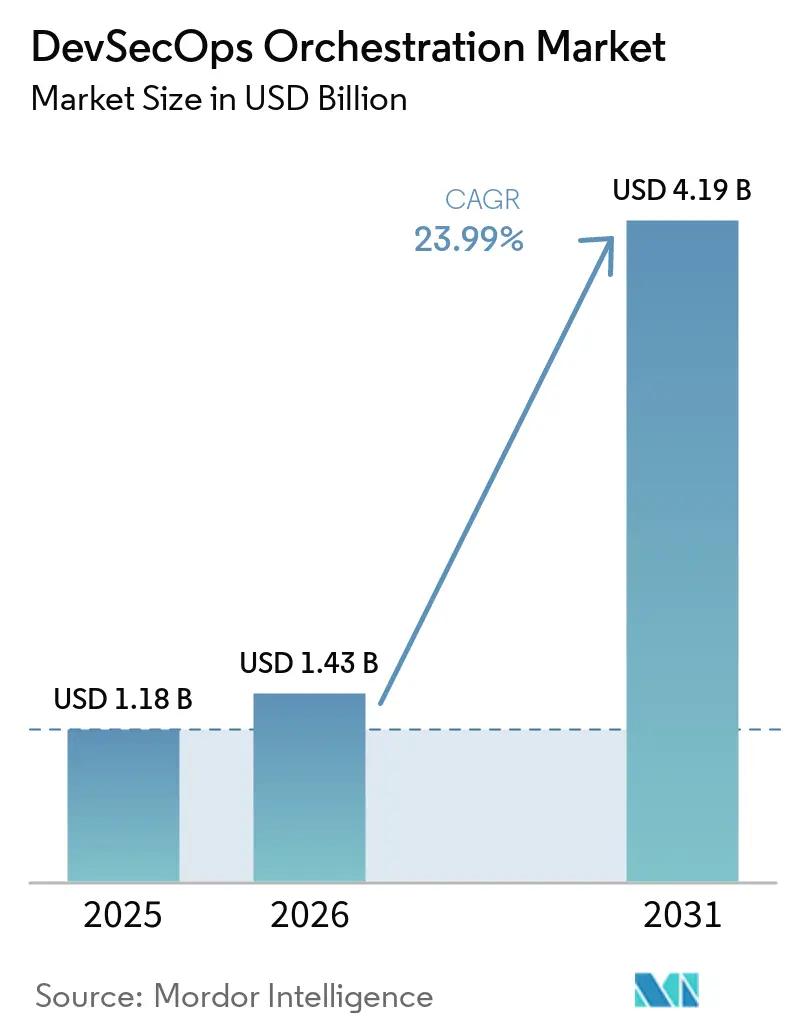
The DevSecOps orchestration market size was valued at USD 1.18 billion in 2025 and is estimated to grow from USD 1.43 billion in 2026 to reach USD 4.19 billion by 2031, at a CAGR of 23.99% during the forecast period (2026-2031). Faster release schedules are making periodic security reviews difficult to sustain across modern delivery pipelines. Organizations are therefore moving security testing, policy checks, and artifact controls into automated development workflows. Regulatory obligations are adding urgency because software suppliers increasingly need to show reliable evidence of how they manage vulnerabilities and component risk. This change makes the DevSecOps orchestration market relevant to both engineering teams and senior risk leaders. Suppliers are responding by combining application security testing, compliance automation, and AI-supported analysis in broader platforms.
Key Report Takeaways
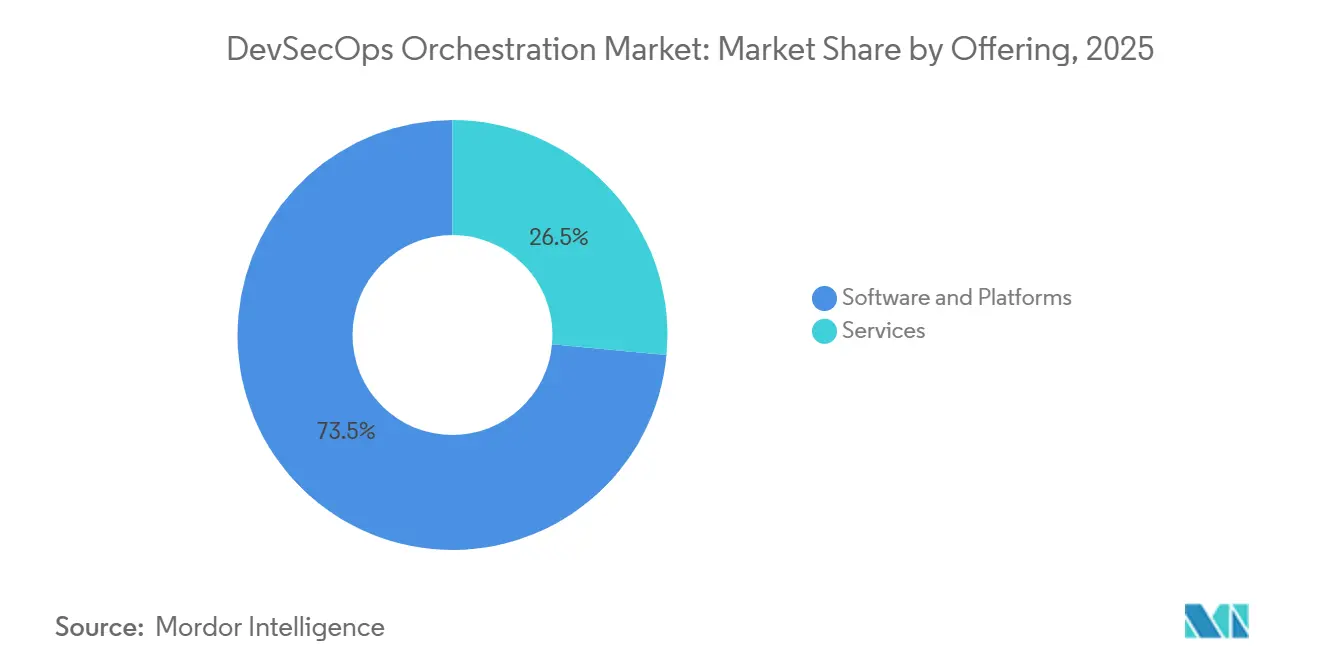
- By offering, software and platforms accounted 73.51% revenue share in the DevSecOps orchestration market in 2025, while services are projected to expand at a 26.37% CAGR through 2031.
- By deployment model, cloud-based deployment held 61.39% of the DevSecOps orchestration market share in 2025, while hybrid deployment is projected to grow at a 26.84% CAGR through 2031.
- By organization size, large enterprises held 63.78% revenue share in the DevSecOps orchestration market in 2025, while SMEs are projected to expand at a 27.56% CAGR through 2031.
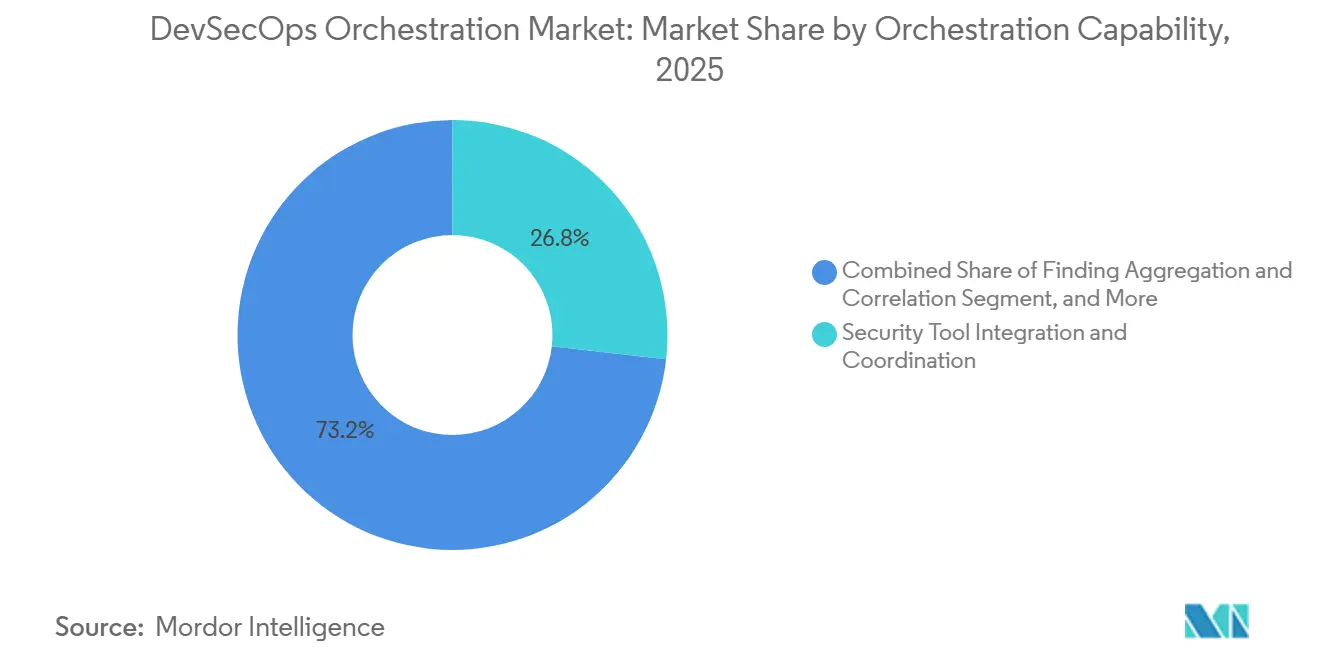
- By orchestration capability, security tool integration and coordination held 26.79% revenue share in 2025, while risk prioritization and contextualization is projected to expand at a 28.39% CAGR through 2031.
- By industry vertical, IT and telecommunication held 27.32% revenue share in 2025, while BFSI is projected to expand at a 27.11% CAGR through 2031.
- By geography, North America held a 38.26% revenue share in the DevSecOps orchestration market in 2025, while Asia-Pacific is projected to expand at a 26.43% CAGR through 2031.
Note: Market size and forecast figures in this report are generated using Mordor Intelligence’s proprietary estimation framework, updated with the latest available data and insights as of January 2026.
Market Trends and Insights
Drivers Impact Analysis of DevSecOps Orchestration Market*
| DRIVER | (~) % IMPACT ON CAGR FORECAST | GEOGRAPHIC RELEVANCE | IMPACT TIMELINE |
|---|---|---|---|
| Regulatory Mandates for Continuous Software Supply-Chain Security | +5.2% | Global, with early enforcement in North America and Europe, with spillover to Asia-Pacific and Middle East and Africa | Medium term (2-4 years) |
| AI-Generated Code and Automated Security Remediation | +4.8% | Global, led by North America, with rapid uptake across Asia-Pacific cloud-native ecosystems | Short term (≤ 2 years) |
| Cloud-Native and Microservices Expansion | +4.3% | Global, concentrated in Asia-Pacific and North America, and emerging in Middle East and Africa sovereign cloud zones | Short term (≤ 2 years) |
| Machine-Readable Compliance Evidence and SBOM Traceability | +3.5% | North America and Europe core, expanding to India and South Korea through CERT-In and K-Cloud mandates | Medium term (2-4 years) |
| Accelerating Software Release Cycles | +3.1% | Global, with the highest velocity in IT and telecommunication and BFSI | Short term (≤ 2 years) |
| Ephemeral Build-Environment Risk Visibility | +2.4% | North America, Europe, and Asia-Pacific cloud-native deployments | Long term (≥ 4 years) |
| Source: Mordor Intelligence | |||
Regulatory Mandates for Continuous Software Supply-Chain Security
Regulatory frameworks are shifting from voluntary guidance toward enforceable software-security obligations. The DevSecOps orchestration market benefits because buyers need repeatable controls that operate inside delivery pipelines. OMB Memorandum M-26-05, issued on January 23, 2026, replaced a standardized self-attestation approach with a risk-based software-assurance model. The memorandum directs agencies to request SBOMs when appropriate and reduces the scope for unverified software in federal supply chains. CISA and international partners released updated SBOM Minimum Elements guidance in July 2026 that includes AI software and SaaS components.[1] The Cyber Resilience Act also creates vulnerability-handling and reporting requirements that software manufacturers cannot defer.
AI-Generated Code and Automated Security Remediation
AI-assisted development is increasing the volume of code that security teams need to assess. This development supports the DevSecOps orchestration market because manual remediation queues cannot match rapid deployment schedules. Stack Overflow reported in 2025 that 84% of developers use or plan to use AI tools in development.[2] Microsoft showed a practical model for automated remediation through its MDASH system. The system coordinated more than 100 specialized AI agents across the frontier and distilled models. Microsoft reported that the system recovered 96% and 100% of confirmed vulnerabilities in 2 heavily audited Windows components. Vendors that can generate, validate, and submit a code fix through an orchestrated workflow can reduce post-release remediation work.
Cloud-Native and Microservices Expansion
Microservices architectures create security requirements that differ from those in monolithic applications. Each container image, Helm chart, and infrastructure-as-code module becomes a separate artifact for testing and attestation. This expands the need for coordinated controls across distributed build graphs. NIST identifies DevSecOps CI/CD pipelines as the enabling paradigm for microservices security. Microsoft uses centrally governed Azure DevOps YAML templates to standardize security controls across its commercial cloud pipelines. The company stated that, in 2026, 92% of its commercial cloud production pipelines were centrally managed through this architecture. The DevSecOps orchestration market is consequently favoring platforms that can enforce policies across containers, runtimes, and infrastructure providers.
Machine-Readable Compliance Evidence and SBOM Traceability
SBOMs are becoming a procurement and compliance requirement rather than an optional practice. The DevSecOps orchestration market gains when organizations need to generate, attest, and use software component data at build cadence. The Cyber Resilience Act requires manufacturers of products with digital elements to include an SBOM in the technical documentation. CISA guidance identifies SPDX and CycloneDX as key SBOM formats for different use cases. SPDX is commonly applied to licensing and government use cases, while CycloneDX supports vulnerability correlation and CI/CD integration. Pipeline templates increasingly include SBOM generation, license checks, and provenance attestations as standard controls.
Restraints Impact Analysis of DevSecOps Orchestration Market*
| RESTRAINT | (~) % IMPACT ON CAGR FORECAST | GEOGRAPHIC RELEVANCE | IMPACT TIMELINE |
|---|---|---|---|
| DevSecOps Skills Shortage and Ownership Ambiguity | -1.8% | Global, most acute in Asia-Pacific and Middle East and Africa where talent pools lag deployment velocity | Medium term (2-4 years) |
| Toolchain Fragmentation and Integration Complexity | -1.5% | Global, amplified in large enterprises operating multi-cloud, multi-region stacks | Medium term (2-4 years) |
| Security-Gate Latency in High-Velocity Pipelines | -1.2% | North America and Asia-Pacific, prevalent in IT and telecommunication and fintech with daily releases | Short term (≤ 2 years) |
| Data Residency and Cross-Border Telemetry Restrictions | -0.9% | Europe, Asia-Pacific including China and India, and Middle East and Africa | Long term (≥ 4 years) |
| Source: Mordor Intelligence | |||
DevSecOps Skills Shortage and Ownership Ambiguity
The shortage of professionals who understand security architecture and software delivery remains a practical barrier. The DevSecOps orchestration market can face slower adoption when teams cannot configure or maintain pipeline controls. Security testing, vulnerability scanning, and policy enforcement require continuing toolchain management and configuration skills. Ownership can be fragmented among developers, platform engineers, and application security teams. Pilot projects may work well, but broader deployments can stall without a team authorized to set quality-gate policies. Managed services and SaaS delivery can reduce this burden by moving specialist work to a provider.
Toolchain Fragmentation and Integration Complexity
Large organizations often use separate tools for SAST, DAST, software composition analysis, secrets detection, infrastructure scanning, and container security. The resulting integration work can limit the automation benefits expected from the DevSecOps orchestration market. Different tools may produce inconsistent finding formats and severity ratings. SPDX and CycloneDX differences can also require normalization when suppliers and internal teams use different schemas. CISA recognizes both formats in its SBOM guidance, which confirms the need for interoperability across enterprise environments. Vendors with unified APIs, prebuilt integrations, and normalized findings can turn this constraint into a platform advantage. The restraint is likely to encourage consolidation as buyers seek fewer disconnected controls.
*Our forecasts treat driver/restraint impacts as directional, not additive. The impact forecasts reflect baseline growth, mix effects, and variable interactions.
DevSecOps Orchestration Market Segment Analysis
By Offering:
Software Dominates, While Services Reflect Talent GapsSoftware and platforms accounted for 73.51% of the DevSecOps orchestration market share in 2025. This result reflected enterprise preference for integrated platforms over separate scanning tools. These platforms can apply policies from pre-commit activity through artifact signing. They also give teams a single view of findings across the delivery process. They can normalize inputs from different security tools before a release decision is made. Integrated suites reduce the need to negotiate separate interfaces and policies for each point product. The DevSecOps orchestration market size for services is projected to grow at a 26.37% CAGR through 2031. Services demand covers implementation consulting, managed detection and response, and continuing policy tuning. This demand is strongest where internal DevSecOps expertise remains limited.
Services growth also indicates that purchasing software does not remove the need for operating support. Teams may still struggle to set quality gates that balance security requirements with release speed. Advisory and managed-service providers can supply policy templates and implementation guidance. Subscription-based managed DevSecOps is especially relevant for SMEs and mid-sized organizations. GitLab reported that developers spent 11 hours per month remediating vulnerabilities after release in its 2025 DevSecOps Report.[3] This work can increase when controls are added without clear tuning and ownership. Shift-left controls can address it when they are properly configured within pipelines. Compliance-as-code requirements can create recurring engagements as security policies change. The DevSecOps orchestration industry therefore includes a continuing services need alongside platform demand.
By Deployment Model:
Cloud Leads, While Hybrid Gains Ground in Regulated SectorsCloud-based deployment held 61.39% of the DevSecOps orchestration market share in 2025. Pay-as-you-go pricing and integrations with GitHub, GitLab SaaS, and AWS CodePipeline supported its use. Cloud delivery also reduces infrastructure maintenance for scanning agents. It offers a practical route for teams that need rapid access to new features and integrations. On-premises deployment remains important for defense, financial services, and government users. These users may need to retain telemetry within controlled environments. Hybrid deployment is projected to grow at a 26.84% CAGR through 2031. This model combines centralized orchestration with local control of scan results and attestations. It can preserve policy consistency while respecting local operating requirements.
DORA has reinforced this architecture in European financial services. The regulation has been applied since January 2025 and requires relevant entities to manage ICT risk under documented arrangements.[4] SaaS providers also face a need to demonstrate secure development practices to customers. That requirement raises the entry barrier for cloud-only providers without auditable processes. Hybrid platforms can be harder to configure when workloads use cloud runners and on-premises agents. Secrets management, runner provisioning, and SBOM storage may follow different local rules. Those differences can make implementation support more important for regulated deployments. The DevSecOps orchestration market is thus creating a practical need for flexible deployment designs.
By Organization Size:
Large Enterprises Anchor Revenue, While SMEs Drive Volume GrowthLarge enterprises held 63.78% of the DevSecOps orchestration market size in 2025. Complex multi-cloud environments and compliance budgets supported early adoption by these organizations. Many also manage several development platforms and software portfolios. They require a consolidated view of SAST, DAST, SCA, and container-security findings. Centralized policy enforcement is valuable when teams use different delivery tools. Mergers can add further software portfolios that need consistent controls. SMEs are projected to expand at a 27.56% CAGR through 2031. Cloud marketplaces and consumption-based pricing lower initial procurement barriers for smaller teams. Per-repository deployment can allow these users to expand controls as projects develop.
The SME opportunity depends on a different purchasing approach from enterprise sales. Self-service onboarding and preconfigured policies often matter more than a broad feature set. Teams also need to see value within a short development cycle. Vendor portals, guided integrations, and remediation playbooks can make adoption easier. Lean engineering teams are less able to absorb extended configuration or specialist administration work. As compliance needs grow, these customers may adopt additional compliance mapping and runtime-protection functions. This creates a path from basic pipeline controls to broader security use cases. The DevSecOps orchestration industry can use this segment to expand its user base.
By Orchestration Capability:
Risk Prioritization Outpaces Other FunctionsSecurity tool integration and coordination held 26.79% of the DevSecOps orchestration market share in 2025. Enterprise programs often begin by connecting existing scanners rather than replacing them. SAST, DAST, SCA, and secrets detection can then operate through a shared orchestration layer. Test scheduling and finding aggregation provide other foundational functions. They help teams reduce duplicate alerts and normalize severity ratings. Shared findings can also support more consistent decisions across development groups. Policy and quality-gate enforcement turn normalized findings into decisions about production release. Container signing, SBOM generation, and infrastructure validation are also becoming relevant capabilities. These functions extend security control beyond code scanning alone.
Risk prioritization and contextualization is projected to grow at a 28.39% CAGR through 2031. Security teams can receive a high volume of findings from automated scanners. Many findings may not be exploitable in a specific application context. Reachability analysis can determine whether vulnerable code is loaded and exposed to untrusted input. Microsoft described MDASH as a system that uses AI-agent debate and triggering-input proofs during vulnerability analysis. This approach adds a validation step before a finding is sent for developer action. Runtime context can improve build-time finding quality when it is linked to static code analysis. It can help security teams focus scarce remediation capacity on relevant issues. The DevSecOps orchestration market is therefore placing greater value on tools that reduce false positives.

By Industry Vertical:
IT and Telecommunication Leads, While BFSI AcceleratesIT and telecommunication accounted for 27.32% of the DevSecOps orchestration market share in 2025. The sector has extensive experience with CI/CD processes and large application portfolios. Software-defined 5G infrastructure has also increased the need for secure development workflows. Telecom operators need to assess network-function virtualization code against relevant security specifications. Their deployment environment combines network infrastructure and applications that require consistent controls. Manufacturing, retail and e-commerce, transportation and logistics, and energy and utilities also contribute to demand. Operational technology and information technology convergence can increase the need for infrastructure-as-code security. Government demand is supported by software supply-chain requirements in federal procurement. These verticals have different compliance needs but share a requirement for traceable delivery controls.
BFSI is projected to grow at a 27.11% CAGR through 2031. DORA, PCI DSS v4.0, and SOX IT General Controls create demand for reliable change-management evidence. DORA requires covered European financial entities to implement ICT-risk management frameworks. Healthcare and life sciences also need secure development practices and SBOM documentation for cyber devices. These requirements place software delivery within wider operational risk processes. Media and entertainment users face open-source dependency complexity and rapid release cycles. Education and research institutions represent an emerging user group with similar deployment needs. The DevSecOps orchestration market can support these verticals through controls designed for their compliance requirements.
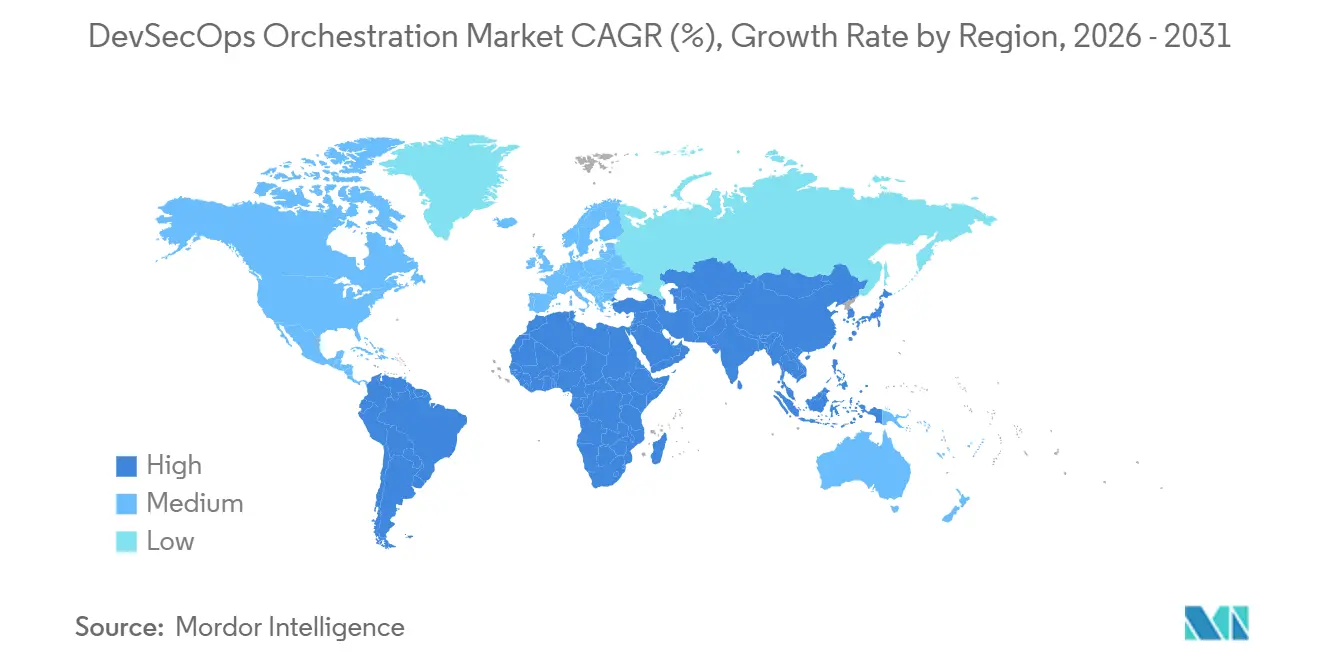
Geography Analysis
North America DevSecOps Orchestration Market
North America held 38.26% of the DevSecOps orchestration market share in 2025. Technology vendors, hyperscale cloud ecosystems, and federal requirements supported this position. U.S. procurement rules increasingly require suppliers to demonstrate SBOMs, signed artifacts, and secure-development processes. OMB Memorandum M-26-05 established a risk-based software-assurance approach in January 2026. Large organizations with multi-cloud application portfolios continue to need standardized controls across environments.
Europe DevSecOps Orchestration Market
Europe is the second-largest regional market within the DevSecOps orchestration market. Its adoption pattern is led by regulation rather than federal procurement. NIS2 expanded cybersecurity risk-management requirements for essential and important entities. DORA has been applied since January 2025 and created a supervisory framework for ICT third-party providers.[5] Germany, the United Kingdom, and France accounted for the largest national shares in Europe.
APAC and MEA DevSecOps Orchestration Market
Asia-Pacific is projected to grow at a 26.43% CAGR through 2031. India’s CERT-In guidelines and the Reserve Bank of India’s SBOM procurement requirement supported a stronger regulatory push. China, Japan, South Korea, and Australia are also increasing security requirements for cloud-native and digital-banking environments. The DevSecOps orchestration market size in Middle East and Africa remains at an early stage, while smart-city programs, sovereign-cloud strategies, and public-sector digitalization are creating initial demand. Adoption is concentrated in BFSI and government where national cybersecurity requirements are most significant.
Competitive Landscape
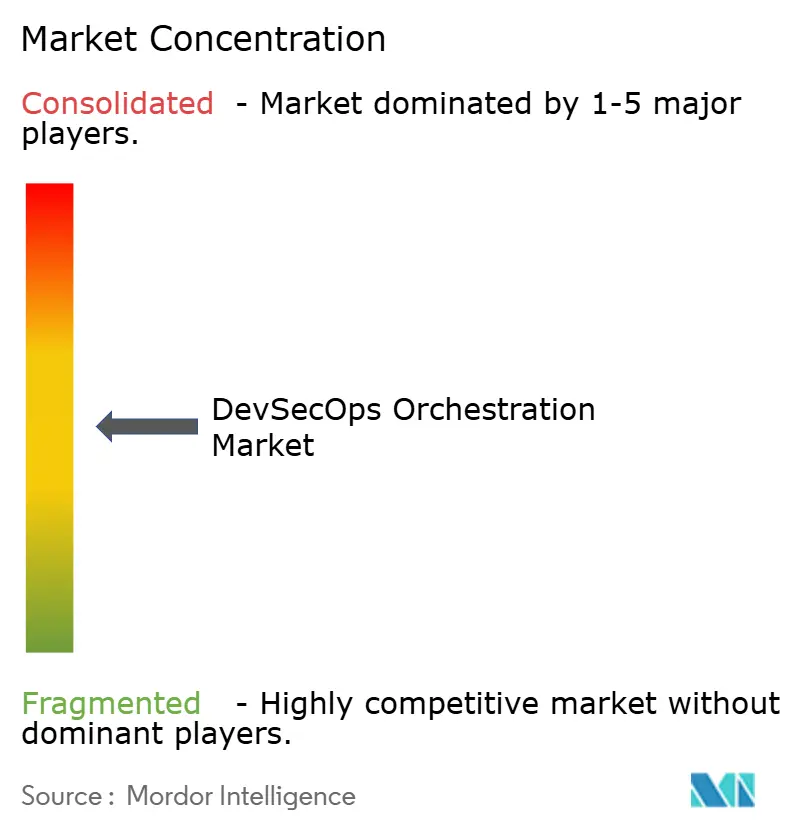
The DevSecOps orchestration market is moderately concentrated, with leading platform providers competing by offering integrated capabilities spanning code security, CI/CD workflows, cloud-native protection, and automated remediation. Microsoft, GitLab, and Palo Alto Networks hold strong positions due to their broad product portfolios, enterprise customer bases, and ability to support security throughout the software development lifecycle. However, the market remains fragmented among specialist providers that address specific orchestration functions, including application security testing, dependency and artifact management, secrets management, vulnerability remediation, and compliance automation. Competition increasingly focuses on embedding security controls into developer workflows without disrupting software delivery timelines.
Vendors are differentiating their offerings through AI-assisted detection and remediation, software bill of materials (SBOM)-based dependency scanning, automated policy enforcement, and the ability to connect build-time security findings with runtime telemetry. Palo Alto Networks is extending its position from cloud protection into code-to-cloud security workflows. In June 2026, the company expanded Project Lightwell with IBM and Red Hat. The collaboration combined virtual patching with an open-source security remediation commitment. Checkmarx launched Fusion in July 2026 with a hybrid scanning approach using its application-security engines and Anthropic models.
Specialist suppliers are using AI-assisted remediation to challenge broader platform providers. JFrog introduced Zero-Touch Remediation in September 2026, in partnership with providers across dependency and artifact management. Checkmarx also expanded its Assist Agent family for detection, remediation, and verification during development. These initiatives reflect the growing emphasis on reducing remediation cycles, improving developer productivity, and securing software supply chains. Opportunities remain in linking runtime telemetry with build-time findings, configuring compliance templates for regulated sectors, and improving the prioritization and verification of remediation actions across complex development environments.
DevSecOps Orchestration Industry Leaders
-
Microsoft Corporation
-
Palo Alto Networks, Inc.
-
GitLab Inc.
-
Synopsys, Inc.
-
Checkmarx Ltd.
- *Disclaimer: Major Players sorted in no particular order
DevSecOps Orchestration Market Companies Covered in this Report
- Microsoft Corporation
- Palo Alto Networks, Inc.
- GitLab Inc.
- Synopsys, Inc.
- Checkmarx Ltd.
- Aqua Security Software Ltd.
- Armory, Inc.
- ArmorCode Inc.
- Black Duck Software, Inc.
- C2A Security Ltd.
- Circle Internet Services, Inc.
- Contrast Security, Inc.
- Cycode Ltd.
- Harness, Inc.
- HashiCorp, Inc.
- JFrog Ltd.
- Mend.io Ltd.
- Qualys, Inc.
- Rapid7, Inc.
- Snyk Limited
- SonarSource SA
- Sonatype, Inc.
- Spacelift, Inc.
- Veracode, Inc.
- Wabbi Software, Inc.
- GitHub, Inc.
Recent Industry Developments in DevSecOps Orchestration Market
- August 2026: GitLab 19.3 expanded agentic DevSecOps capabilities with Secrets Manager, a Flow Creator Agent for custom agentic workflows, and Bulk SAST False Positive Detection. GitLab Dedicated customers can now run the Duo Agent Platform inside their single-tenant environment with Bring-Your-Own-Model inference, keeping AI-processed data within existing security boundaries.
- August 2026: Snyk released Evo Continuous Offensive Security to general availability, delivering AI-powered automated penetration testing and agent red teaming that attacks applications continuously as they change and returns validated proof of exploitable vulnerabilities. Snyk also announced the general availability of Snyk Secrets, built on the ML-powered BitPatrol detection engine acquired in 2025.
- July 2026: Checkmarx launched Fusion, a hybrid scanning architecture combining its proprietary AppSec engines with frontier models from Anthropic to deliver the highest available SAST fidelity across every language and every stage of the software development lifecycle. Checkmarx simultaneously unveiled self-healing application security through its Assist Agent family, featuring Developer Assist's autonomous mode for detecting, fixing, and verifying vulnerabilities as developers write code.
- June 2026: IBM, Red Hat, and Palo Alto Networks expanded Project Lightwell, integrating Palo Alto Networks' virtual patching capability with IBM and Red Hat's USD 5 billion open-source security commitment, creating a dual-action defense that combines network-layer exploit blocking with software-level open-source remediation across OT, healthcare, and commercial applications.
- June 2026: Checkmarx launched AI Inventory as part of its AI Supply Chain Security module, delivering continuous visibility into AI components, models, agents, MCP servers, AI libraries, and SDKs, and generating AI-Bills of Materials with audit-ready documentation for every AI component discovered in enterprise applications.
Global DevSecOps Orchestration Market Report Scope
The DevSecOps orchestration market comprises integrated platforms that automate and coordinate security activities across the entire DevOps workflow, embedding security controls, testing, and compliance checks into every stage of the software development lifecycle from code commit through production deployment. These solutions unify security toolchains (including SAST, DAST, SCA, container scanning, infrastructure-as-code validation, and secrets management), automate security policy enforcement, provide centralized visibility into security posture across development teams, and enable automated remediation workflows that integrate with issue tracking and collaboration tools, allowing organizations to shift security left, reduce manual security overhead, accelerate secure software delivery, and maintain consistent security governance while supporting agile development practices and rapid release cycles.
The DevSecOps Orchestration Market Report is Segmented by Offering (Software and Platforms, and Services), Deployment Mode (Cloud-Based, On-Premises, and Hybrid), Organization Size (Large Enterprises, and Small and Medium-Sized Enterprises), Orchestration Capability (Security Tool Integration and Coordination, Security Test Execution and Scheduling, Finding Aggregation and Correlation, Risk Prioritization and Contextualization, Security Policy and Quality-Gate Enforcement, and Other Orchestration Capabilities), Industry Vertical (Government and Public Administration, Industrial Manufacturing, Retail and E-Commerce, Transportation and Logistics, Energy and Utilities, Oil and Gas, IT and Telecommunication, Media and Entertainment, Education and Research Institutions, Healthcare and Life Sciences, Banking, Financial Services, and Insurance (BFSI), and Other Industry Verticals), and Geography (North America, South America, Europe, Asia-Pacific, and Middle East and Africa). The Market Forecasts are Provided in Terms of Value (USD).
Segmentation Overview
| Software and Platforms |
| Services |
| Cloud-Based |
| On-Premises |
| Hybrid |
| Large Enterprises |
| Small and Medium-Sized Enterprises |
| Security Tool Integration and Coordination |
| Security Test Execution and Scheduling |
| Finding Aggregation and Correlation |
| Risk Prioritization and Contextualization |
| Security Policy and Quality-Gate Enforcement |
| Other Orchestration Capabilities |
| Government and Public Administration |
| Industrial Manufacturing |
| Retail and E-Commerce |
| Transportation and Logistics |
| Energy and Utilities |
| Oil and Gas |
| IT and Telecommunication |
| Media and Entertainment |
| Education and Research Institutions |
| Healthcare and Life Sciences |
| Banking, Financial Services, and Insurance (BFSI) |
| Other Industry Verticals |
| North America | United States | |
| Canada | ||
| Mexico | ||
| South America | Brazil | |
| Argentina | ||
| Rest of South America | ||
| Europe | Germany | |
| United Kingdom | ||
| France | ||
| Italy | ||
| BENELUX | ||
| Rest of Europe | ||
| Asia-Pacific | China | |
| Japan | ||
| India | ||
| South Korea | ||
| Australia | ||
| Rest of Asia-Pacific | ||
| Middle East and Africa | Middle East | United Arab Emirates |
| Saudi Arabia | ||
| Rest of Middle East | ||
| Africa | South Africa | |
| Nigeria | ||
| Egypt | ||
| Rest of Africa | ||
| By Offering | Software and Platforms | ||
| Services | |||
| By Deployment Model | Cloud-Based | ||
| On-Premises | |||
| Hybrid | |||
| By Organization Size | Large Enterprises | ||
| Small and Medium-Sized Enterprises | |||
| By Orchestration Capability | Security Tool Integration and Coordination | ||
| Security Test Execution and Scheduling | |||
| Finding Aggregation and Correlation | |||
| Risk Prioritization and Contextualization | |||
| Security Policy and Quality-Gate Enforcement | |||
| Other Orchestration Capabilities | |||
| By Industry Vertical | Government and Public Administration | ||
| Industrial Manufacturing | |||
| Retail and E-Commerce | |||
| Transportation and Logistics | |||
| Energy and Utilities | |||
| Oil and Gas | |||
| IT and Telecommunication | |||
| Media and Entertainment | |||
| Education and Research Institutions | |||
| Healthcare and Life Sciences | |||
| Banking, Financial Services, and Insurance (BFSI) | |||
| Other Industry Verticals | |||
| By Geography | North America | United States | |
| Canada | |||
| Mexico | |||
| South America | Brazil | ||
| Argentina | |||
| Rest of South America | |||
| Europe | Germany | ||
| United Kingdom | |||
| France | |||
| Italy | |||
| BENELUX | |||
| Rest of Europe | |||
| Asia-Pacific | China | ||
| Japan | |||
| India | |||
| South Korea | |||
| Australia | |||
| Rest of Asia-Pacific | |||
| Middle East and Africa | Middle East | United Arab Emirates | |
| Saudi Arabia | |||
| Rest of Middle East | |||
| Africa | South Africa | ||
| Nigeria | |||
| Egypt | |||
| Rest of Africa | |||
Key Questions Answered in the Report
What is the size of the DevSecOps orchestration market?
The DevSecOps orchestration market size was valued at USD 1.18 billion in 2025 and is estimated to grow from USD 1.43 billion in 2026 to reach USD 4.19 billion by 2031, at a CAGR of 23.99% during the forecast period (2026-2031).
What is driving DevSecOps orchestration adoption?
Regulatory software-assurance obligations, AI-assisted code development, cloud-native architectures, and SBOM traceability are driving adoption.
Which offering leads DevSecOps orchestration spending?
Software and platforms led with 73.51% of revenue in 2025 because enterprises prefer integrated policy and security controls.
Which deployment approach is growing fastest?
Hybrid deployment is projected to grow at a 26.84% CAGR through 2031 as regulated users combine cloud orchestration with local data controls.
Which organizations are adopting these platforms fastest?
SMEs are projected to grow at a 27.56% CAGR through 2031 because consumption-based pricing and guided onboarding reduce adoption barriers.
Which region is expected to grow fastest?
Asia-Pacific is projected to grow at a 26.43% CAGR through 2031, supported by cloud-native development and expanding cybersecurity requirements.