
Detox Tea Market Size and Share
Market Overview
| Study Period | 2022 - 2032 |
|---|---|
| Market Size (2027) | USD 1.32 Billion |
| Market Size (2032) | USD 1.96 Billion |
| Growth Rate (2027 - 2032) | 8.18 % |
| Fastest Growing Market | Asia-Pacific |
| Largest Market | North America |
| Market Concentration | Low |
Major Players *Disclaimer: Major Players sorted in no particular order Image © Mordor Intelligence. Reuse requires attribution under CC BY 4.0. | |
Detox Tea Market Analysis by Mordor Intelligence
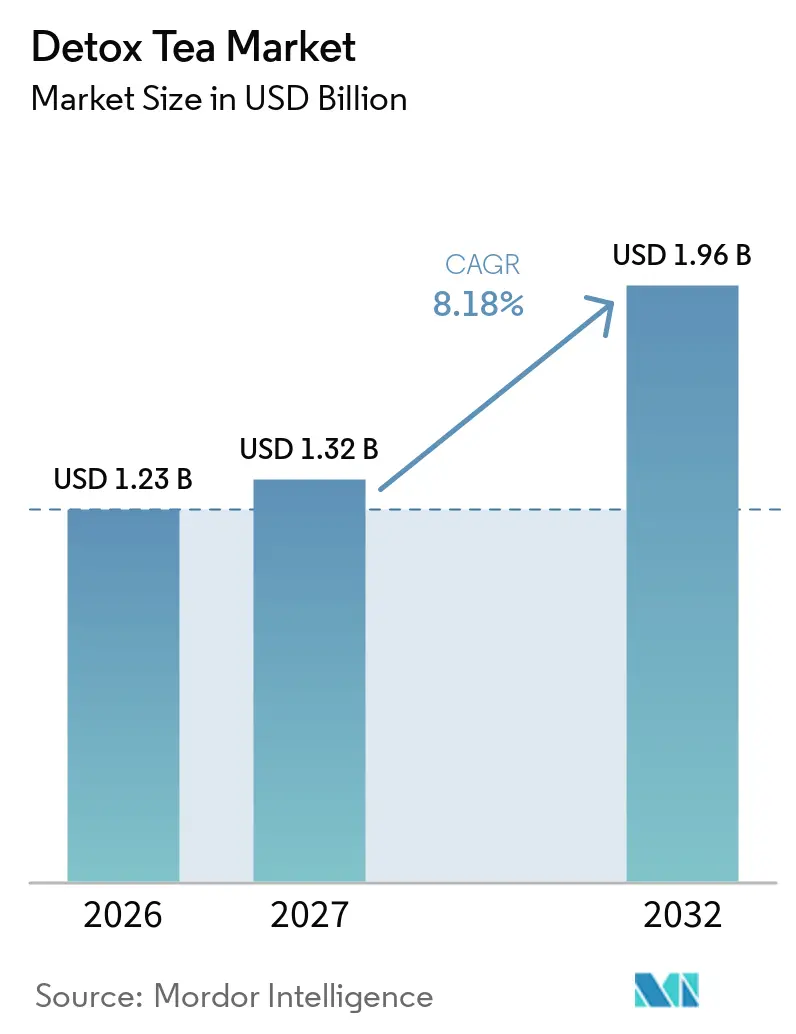
The Detox tea market size was valued at USD 1.23 billion in 2026 and estimated to grow from USD 1.32 billion in 2027 to reach USD 1.96 billion by 2031, at a CAGR of 8.18% during the forecast period 2027-2032. The detox tea market is supported by demand for beverages associated with digestive wellness, natural ingredients, and convenient daily routines. Certified organic products, new flavors, and formats suited to online retail and hospitality are broadening the category’s appeal. Companies are focusing on credible ingredient information, certification, and distribution reach because broad detox claims face closer scrutiny. North America remains the largest regional market, while Asia-Pacific is expected to expand fastest as traditional herbal tea use combines with online purchasing. The opportunity is strongest for brands that connect botanical products with transparent sourcing and claims that can be supported by evidence.
Key Report Takeaways
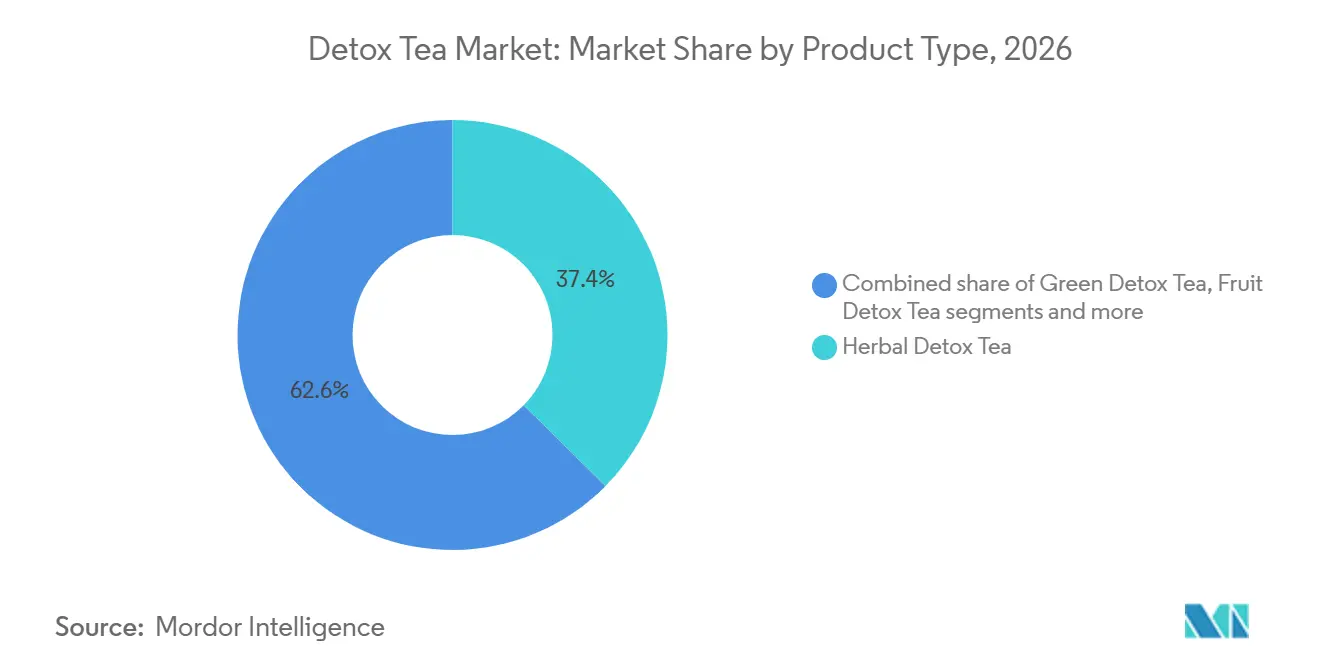
- By product type, Herbal Detox Tea held 37.4% of the detox tea market share in 2026, while Oolong and Black Detox Blends are projected to grow at a 9.4% CAGR through 2032.
- By category, Conventional held 72.5% of the category in 2026, while Organic is projected to grow at a 10.2% CAGR through 2032.
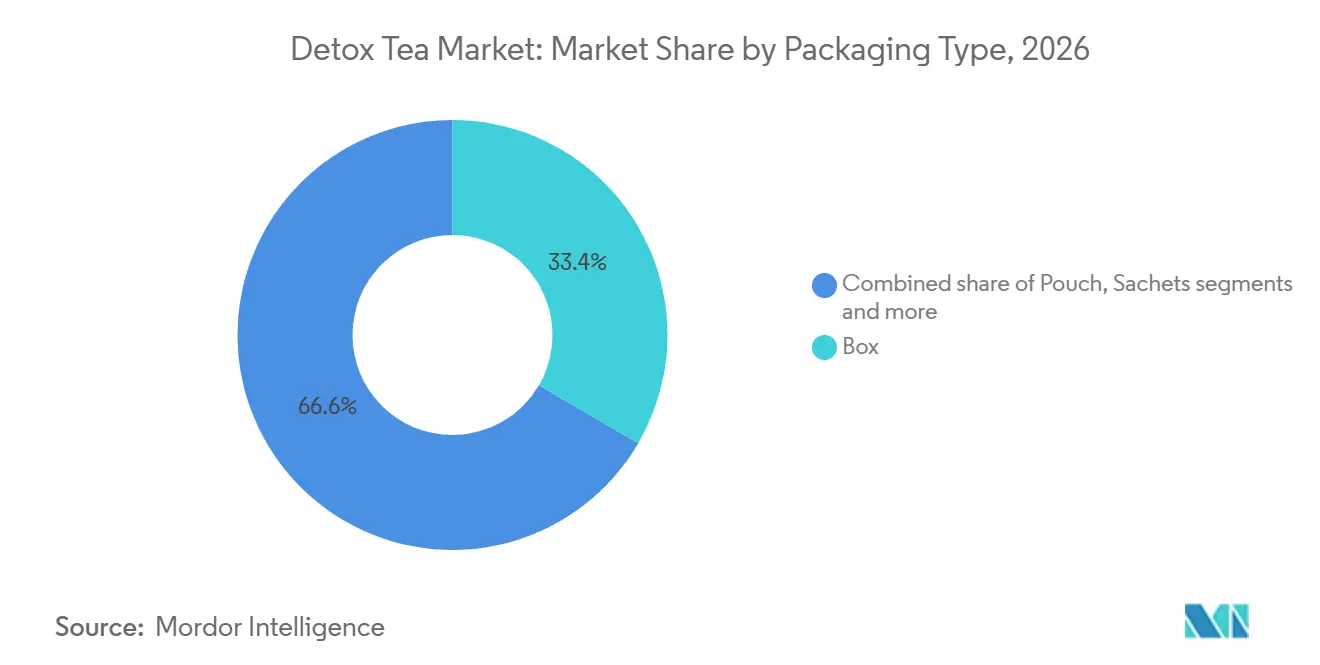
- By packaging type, Box packaging accounted for 33.4% of the detox tea market size in 2026, while Sachets are projected to grow at a 10.5% CAGR through 2032.
- By distribution channel, Off-Trade held 73.8% of category sales in 2026, while On-Trade is projected to grow at a 9.5% CAGR through 2032.
- By geography, North America held 35.2% of the detox tea market size in 2026, while Asia-Pacific is projected to grow at a 9.8% CAGR through 2032.
Note: Market numbers in this report are based on Mordor Intelligence's proprietary estimation framework, which combines nine months of actuals with Q4 projections for base year 2026.
Market Trends and Insights
Drivers Impact Analysis of Detox Tea Market*
| Driver | (~) % Impact on CAGR Forecast | Geographic Relevance | Impact Timeline |
|---|---|---|---|
| Perceived digestive and gut-health benefits | +2.6% | Global; peak intensity in North America, Europe, and urbanized Asia-Pacific | Medium term (2-4 years) |
| Expansion of functional beverage trends | +1.5% | Global | Short term (≤ 2 years) |
| Product innovation and flavor variety | +1.0% | Global, led by North America and Europe | Short term (≤ 2 years) |
| Shift toward natural and plant-based remedies | +1.8% | Global, concentrated in North America and Northern Europe | Long term (≥ 4 years) |
| Urbanization and busy lifestyles | +0.7% | Asia-Pacific core, spill-over to South America and MEA | Long term (≥ 4 years) |
| Growth of e-commerce and direct-to-consumer channels | +1.2% | Asia-Pacific core (China, South Korea, India), North America & EU | Short term (≤ 2 years) |
| Source: Mordor Intelligence | |||
Perceived Digestive and Gut-Health Benefits
Digestive wellness is a central reason consumers consider herbal and tea-based products. A 2025 systematic review of 5 randomized controlled trials found that green tea consumption affected gut microbiota, including increased Bifidobacterium and reduced Fusobacterium. A separate review reported that black tea polyphenols were associated with endothelial benefits and changes in butyrate-producing Flavonifractor plautii in a 12-week trial involving 72 Japanese adults. These findings give the detox tea market a basis for discussing specific tea and botanical properties rather than broad cleansing claims[1]. The evidence does not establish systemic toxin removal, so products positioned around digestive support require careful wording. This distinction favors brands that link formulations to disclosed ingredients and supported health-related attributes.
Expansion of Functional Beverage Trends
The broader functional beverage trend is changing what many buyers expect from tea. The U.S. Food and Drug Administration has finalized an updated definition for the voluntary “healthy” claim, with compliance required by February 25, 2028. Qualifying teas can use the claim when they meet the applicable criteria, which include limits on calories and added caffeine. The rule gives brands a clearer reference point for product design and package communication[2]. Herbal products that are naturally low in calories and caffeine may be easier to formulate within these requirements than many prepared functional drinks. The detox tea market can therefore benefit when companies focus on compliant product attributes instead of claims that overstate efficacy.
Shift Toward Natural and Plant-Based Remedies
Demand for natural and plant-based products supports interest in herbal infusions and organic tea. The Organic Trade Association reported that organic tea was among the faster-growing beverage categories in its 2025 report on the U.S. organic marketplace. In China, plant beverages that include drug-food homologous tea products have also gained consumer attention. These preferences make ingredient origin, organic certification, and fair-trade sourcing more visible parts of brand choice. The detox tea market benefits when suppliers can document herb quality and provide clear sourcing information. The same conditions may support premium pricing for products that have recognized certifications and consistent ingredient specifications.
Growth of E-Commerce and Direct-to-Consumer Channels
Online retail is changing how consumers find, compare, and reorder tea products. In China, online channels account for more than 70% of detox tea sales, according to the supplied source material. Digital channels help smaller brands present specialized formulations without first securing broad grocery distribution. Direct sales can also provide information on repeat purchases, preferred flavors, and product bundles. This allows companies to adjust messaging and replenish popular products more quickly than in traditional retail. The detox tea market is likely to remain accessible to new niche brands as online discovery reduces the importance of physical shelf access. Established brands must respond with strong digital product pages, subscription options, and reliable fulfillment.
Restraints Impact Analysis of Detox Tea Market*
| Restraint | (~) % Impact on CAGR Forecast | Geographic Relevance | Impact Timeline |
|---|---|---|---|
| Regulatory scrutiny over health claims | -1.6% | North America & EU; emerging application in Asia-Pacific | Medium term (2-4 years) |
| Counterfeit and adulterated products | -0.9% | Asia-Pacific core, spill-over to MEA and South America | Short term (≤ 2 years) |
| Lack of scientific evidence for efficacy | -1.0% | Global | Long term (≥ 4 years) |
| Safety concerns and restrictions for certain consumer groups | -0.6% | Global, particularly North America and EU | Medium term (2-4 years) |
| Source: Mordor Intelligence | |||
Regulatory Scrutiny Over Health Claims
Regulatory oversight is a material constraint because tea products are often promoted with wellness language. The FDA states that dietary supplement firms are responsible for ensuring that claims are truthful and not misleading, and that structure-function claims require substantiation. The European Union also limits nutrition and health claims to those supported by approved evidence under its health-claims framework. Products using the word detox may face greater attention when package language implies disease treatment, weight loss, or toxin removal. This increases the cost of label review, claims governance, and product adaptation across markets. It also makes well-defined ingredient claims, quality testing, and legal review important parts of competitive execution.
Lack of Scientific Evidence for Efficacy
The gap between consumer expectations and clinical evidence remains a long-term challenge for the category. Harvard Health Publishing states that scientific support for colon cleansing is limited, while MD Anderson Cancer Center cautions that some products may carry health risks. Some herbal laxative ingredients, including senna, can cause dehydration, electrolyte imbalance, or gastrointestinal discomfort for certain users. The detox tea market therefore cannot rely on sweeping cleansing claims to build durable trust. Evidence on specific botanical ingredients may be more useful for brands than category-wide claims about detoxification. Clear cautions, responsible use instructions, and compliant product communication can reduce the risk of consumer disappointment and regulatory action.
*Our forecasts treat driver/restraint impacts as directional, not additive. The impact forecasts reflect baseline growth, mix effects, and variable interactions.
Detox Tea Market Segment Analysis
By Product Type:
Herbal Formulations Lead Demand While Oolong and Black Blends Grow FastestHerbal Detox Tea held 37.4% of category sales in 2026, making it the leading product type. Its position reflects the established role of botanical ingredients in everyday wellness routines. Herbal blends can serve consumers who value taste, ritual, and a product association with digestive support. Traditional Medicinals expanded its portfolio in September 2025 with Rosy Mood and Stress Ease Calm, its first Fair for Life certified organic teas using ashwagandha, shatavari, butterfly pea flower, and cinnamon. The launch shows how a brand with herbal tea expertise can extend beyond detox-focused uses while preserving a botanical identity. Green Detox Tea and Fruit Detox Tea also address consumers looking for recognizable tea formats and more approachable flavor profiles.
Oolong and Black Detox Blends are expected to grow at a 9.4% CAGR through 2032. The Detox tea market for these blends is supported by growing interest in black tea polyphenols and their potential relationship with gut health. Their stronger tea character can help brands offer premium alternatives to purely herbal products. Bigelow Tea Company expanded its Butterfly Pea Flower line to national U.S. retailers in August 2025 after an initial exclusive period. That expansion reflects continued experimentation with color, sensory appeal, and caffeine-free formulations in the wider tea aisle. The segment’s prospects depend on pairing familiar black or oolong tea profiles with flavors and benefits that remain easy for consumers to understand.

By Category:
Conventional Products Retain Volume While Organic Products Gain MomentumConventional products held 72.5% of category sales in 2026. Their scale is tied to accessible prices and broad availability through grocery, drug, and club channels. Large consumer brands can use established procurement, manufacturing, and retail relationships to support consistent supply. Conventional offerings also appeal to shoppers who want familiar tea formats without paying a premium for certification. The detox tea market continues to rely on this segment for volume because mainstream retailers remain important for category visibility. Ingredient lists and flavor variety can help conventional products respond to consumers who are increasingly attentive to product composition.
Organic products are projected to grow at a 10.2% CAGR through 2032. The Organic Trade Association’s 2025 report identified continued momentum for organic tea in the United States. Certification gives buyers a recognizable way to assess ingredient sourcing and product standards. USDA Organic remains important in North America, while EU organic certification is a relevant signal for European buyers. East West Tea Company introduced USDA Organic Herbal Tea Concentrates in September 2025 in Hibiscus Ginger Digestive Health and Elderberry Lemon Balm Immune Health varieties. Such launches show how organic brands are moving beyond conventional tea bags and entering ready-to-use formats. This supports the role of convenience in the organic segment’s future demand.
By Packaging Type:
Box Packaging Leads Retail Displays While Sachets Serve Convenience NeedsBox packaging accounted for 33.4% of the detox tea market size in 2026. Within the Detox tea market, boxes offer a visible front panel for branding, ingredient explanations, and certification marks. They also fit established shelf layouts in supermarkets and specialty stores. Retailers can display boxed products in a way that makes format, price, and flavor easy to compare. This gives the format an advantage where physical shelf facings influence buying decisions. In mature grocery markets, box packaging also supports price ladders that extend from conventional blends to premium organic products.
Sachets are forecast to grow at a 10.5% CAGR through 2032. Individually portioned formats are useful for online fulfillment, travel, workplaces, hotels, and food-service settings. Their convenience can also support sampling and single-serve trial purchases. Skinny Boost introduced premium pyramid sachet canisters in January 2026 in hibiscus berry and ginger peach varieties for HEB Grocery and other U.S. retailers. The launch illustrates how brands are presenting sachets as a premium experience rather than only a basic utility format. Premium design, flavor, and sustainable material choices may become more important as sachet use increases.
By Distribution Channel:
Off-Trade Holds Scale While On-Trade Builds Trial and Premium DemandOff-Trade held 73.8% of category sales in 2026. Supermarkets and hypermarkets generate broad volume through price-competitive conventional products and accessible herbal blends. Specialty and health stores provide a more suitable setting for organic, certified, and premium products. Online retail is also part of Off-Trade and is gaining importance where subscription buying supports repeat orders. The channel allows brands to serve distinct needs across mass retail, specialist outlets, and digital storefronts. Its breadth means the detox tea market will continue to depend on a strong off-trade presence even as consumer discovery changes.
On-Trade is projected to grow at a 9.5% CAGR through 2032. Wellness hospitality, upscale cafés, and hotel food and beverage programs create settings where consumers can sample premium herbal products. Tea-house culture is particularly relevant in Asia-Pacific because out-of-home tea drinking is already familiar to many consumers. Health-focused cafés in Tokyo, Singapore, and Seoul can introduce blends to buyers who might not choose them in a grocery store. China Tea Marketing Association material highlighted rapid growth in health-concept ready-made tea products in 2025. These settings can support brand education, flavor discovery, and a higher-value tea experience. Companies entering the channel need consistent preparation standards and formats that are practical for food-service operations.
Geography Analysis
North America Detox Tea Market
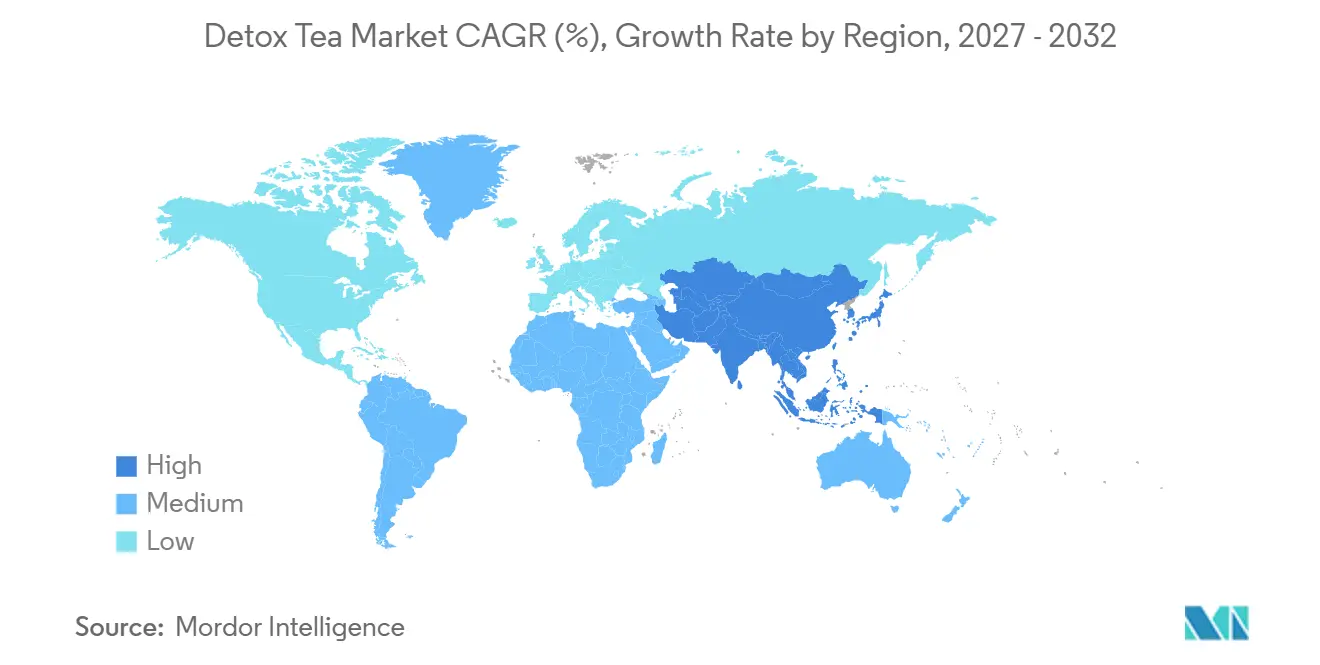
North America held 35.2% of the detox tea market share in 2026. The region has established health-food retail, specialty tea stores, and consumer familiarity with herbal wellness products. Qualifying teas can benefit from the FDA’s updated definition for the voluntary “healthy” claim, subject to relevant product criteria and the 2028 compliance date. Traditional Medicinals is scheduled to begin operations at its 125,000-square-foot Virginia facility in fall 2026, expanding capacity for its herbal tea range in the eastern United States. The investment shows continued producer commitment to the region’s herbal tea demand.
EMEA and South America Detox Tea Market
Europe remains a mature region for the detox tea market, where herbal tea is part of daily routines in Germany, the United Kingdom, France, the Netherlands, and Poland. Buyers in Germany, Scandinavia, and the Netherlands show interest in certified organic and sustainably sourced teas. Regulatory requirements for health claims make product labels and evidence especially important in the region. Twinings introduced cold-water-dissolving Twinings Refreshers in August 2025, extending its range into a cold functional beverage occasion. South America is seeing growing interest in herbal wellness tea, while traditional hibiscus and rooibos use gives the Middle East and Africa a base for premium product positioning.
APAC Detox Tea Market
Asia-Pacific is expected to grow at a 9.8% CAGR through 2032, the highest regional rate in the detox tea market. The region combines established herbal tea traditions with strong online retail use and interest in health-oriented beverages. Japanese consumer research released by Japan Green Tea Co. in 2025 found that tea-bag drinkers chose herbal tea frequently, with expected health effects and aroma among the cited purchase reasons. China’s online sales structure and wellness flower tea supply base support rapid product discovery and fulfillment. Brands entering Asia-Pacific need to balance local botanical preferences, digital retail execution, and country-specific claims requirements.
Competitive Landscape
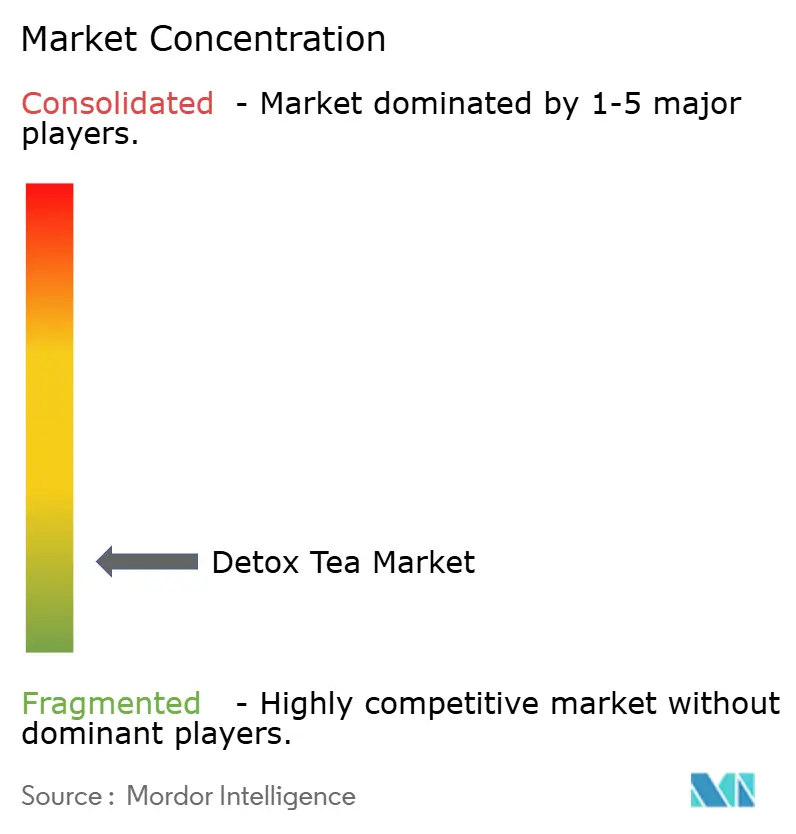
The detox tea market is fragmented in nature and includes large consumer goods companies, specialty tea companies, and digitally native brands. Unilever and Hain Celestial Group leverage procurement scale, logistics, and retail relationships to serve broad consumer segments. Traditional Medicinals, Twinings, Bigelow Tea Company, Numi Organic Tea, and Organic India compete through botanical expertise and certification portfolios, while Teami Blends, SkinnyFit, and Rishi Tea and Botanicals rely on direct sales and social commerce to reach buyers outside traditional grocery channels. No single producer controls category pricing or shelf access, so companies compete through product credibility, packaging, certification, and channel selection.
Recent product launches reflect how brands are broadening their positioning. Celestial Seasonings expanded its wellness platform in July 2025 with Detox Blend Dandelion, She-Well Raspberry Leaf, and Good Vibes Lemon Mint, placing detox blends within a wider wellness range. Traditional Medicinals introduced Fair for Life certified organic products in September 2025, extending into mood and stress positioning. Bigelow Tea Company's national expansion of Butterfly Pea Flower teas in August 2025 showed how visual appeal and new ingredients can refresh shelf offerings. These moves confirm that portfolio extensions work best when they stay close to a brand's existing strengths.
The market offers room for companies that develop formulations with well-supported botanical properties and clear claims. Sustainable formats such as compostable sachets and refillable canisters can differentiate products where packaging waste matters to buyers. On-trade tea programs in wellness hospitality remain largely open, with no single company holding a clear position. Companies with transparent sourcing and strong quality controls are better placed to address concerns over counterfeit or adulterated products. The market remains fragmented, requiring brands to build relevance through focused positioning rather than scale alone.
Detox Tea Industry Leaders
-
Traditional Medicinals, Inc.
-
East West Tea Company, LLC
-
Unilever plc
-
Associated British Foods (Twinings)
-
Rishi Tea and Botanicals
- *Disclaimer: Major Players sorted in no particular order
Detox Tea Market Companies Covered in this Report
- Traditional Medicinals, Inc.
- East West Tea Company, LLC
- Unilever plc
- Twinings
- Rishi Tea and Botanicals
- The Republic of Tea, Inc.
- Triple Leaf Tea, Inc.
- Numi Organic Tea
- Buddha Teas, LLC
- Gaia Herbs, Inc.
- Hain Celestial Group, Inc.
- Celestial Seasonings, Inc.
- Bigelow Tea Company
- Teami Blends, LLC
- SkinnyFit, LLC
- Art of Tea, Inc.
- Kusmi Tea
- Organic India Pvt. Ltd.
- Harney and Sons Fine Teas
- Davidson’s Organics
Recent Industry Developments in Detox Tea Market
- May 2026: Traditional Medicinals confirmed its 125,000-square-foot Franklin County, Virginia facility is slated to begin operations in fall 2026, producing the company's full herbal tea range for Eastern US distribution under renewable energy sourcing and sustainable water management. Workforce development is supported through the Virginia Talent Accelerator Program.
- February 2026: Kung Fu Tea partnered with ADVANCED to launch HYDRATION+ Immunity, a functional tea line in Peach Oolong, Sunshine Pineapple Tea, and Passionfruit Green Tea profiles, delivering 100% DV Vitamin D, 278% DV Vitamin C, and zinc per serving in caffeine-free, zero-sugar formats.
- September 2025: Traditional Medicinals launched Rosy Mood and Stress Ease Calm, its first Fair for Life certified organic herbal teas using ashwagandha, shatavari, butterfly pea flower, and cinnamon, expanding into mood-and-stress positioning from its core detox and digestive range.
- August 2025: Bigelow Tea Company expanded its Butterfly Pea Flower line, Sapphire Bay™ and Vanilla Midnight, to major national US retailers after a successful year-long exclusive launch, broadening its premium caffeine-free herbal positioning into mainstream grocery.
Global Detox Tea Market Report Scope
The Detox Tea Market refers to the market for tea and herbal infusions formulated or marketed to support wellness and digestive health, typically containing herbs, green tea, fruits, or other botanical ingredients. By product type, the market is segmented into herbal detox tea, green detox tea, fruit detox tea, oolong and black detox blends, and other product types. By category, the market is divided into conventional and organic products. By packaging type, the market is segmented into boxes, tea bags/filter bags, pouches, sachets, and other packaging types. By distribution channel, the market is divided into off-trade and on-trade channels, with off-trade further segmented into supermarkets/hypermarkets, convenience/grocery stores, online retail stores, specialty/health stores, and other distribution channels. Geographically, the market covers North America, Europe, Asia-Pacific, South America, and the Middle East and Africa. Market forecasts are presented in terms of value (USD).
Segmentation Overview
| Herbal Detox Tea |
| Green Detox Tea |
| Fruit Detox Tea |
| Oolong and Black Detox Blends |
| Other Product Types |
| Conventional |
| Organic |
| Box |
| Tea Bags / Filter Bags |
| Pouch |
| Sachets |
| Other Packaging Type |
| Off-Trade | Supermarkets/Hypermarkets |
| Convenience/Grocery Stores | |
| Online Retail Stores | |
| Specialty/Health Stores | |
| Other Distribution Channels | |
| On-Trade |
| North America | United States |
| Canada | |
| Mexico | |
| Rest of North America | |
| Europe | Germany |
| United Kingdom | |
| Italy | |
| France | |
| Spain | |
| Netherlands | |
| Poland | |
| Belgium | |
| Sweden | |
| Rest of Europe | |
| Asia-Pacific | China |
| India | |
| Japan | |
| Australia | |
| Indonesia | |
| South Korea | |
| Thailand | |
| Singapore | |
| Rest of Asia-Pacific | |
| South America | Brazil |
| Argentina | |
| Colombia | |
| Chile | |
| Peru | |
| Rest of South America | |
| Middle East and Africa | South Africa |
| Saudi Arabia | |
| United Arab Emirates | |
| Nigeria | |
| Egypt | |
| Morocco | |
| Turkey | |
| Rest of Middle East and Africa |
| By Product Type | Herbal Detox Tea | |
| Green Detox Tea | ||
| Fruit Detox Tea | ||
| Oolong and Black Detox Blends | ||
| Other Product Types | ||
| By Category | Conventional | |
| Organic | ||
| By Packaging Type | Box | |
| Tea Bags / Filter Bags | ||
| Pouch | ||
| Sachets | ||
| Other Packaging Type | ||
| By Distribution Channel | Off-Trade | Supermarkets/Hypermarkets |
| Convenience/Grocery Stores | ||
| Online Retail Stores | ||
| Specialty/Health Stores | ||
| Other Distribution Channels | ||
| On-Trade | ||
| By Geography | North America | United States |
| Canada | ||
| Mexico | ||
| Rest of North America | ||
| Europe | Germany | |
| United Kingdom | ||
| Italy | ||
| France | ||
| Spain | ||
| Netherlands | ||
| Poland | ||
| Belgium | ||
| Sweden | ||
| Rest of Europe | ||
| Asia-Pacific | China | |
| India | ||
| Japan | ||
| Australia | ||
| Indonesia | ||
| South Korea | ||
| Thailand | ||
| Singapore | ||
| Rest of Asia-Pacific | ||
| South America | Brazil | |
| Argentina | ||
| Colombia | ||
| Chile | ||
| Peru | ||
| Rest of South America | ||
| Middle East and Africa | South Africa | |
| Saudi Arabia | ||
| United Arab Emirates | ||
| Nigeria | ||
| Egypt | ||
| Morocco | ||
| Turkey | ||
| Rest of Middle East and Africa | ||
Key Questions Answered in the Report
What is the projected growth rate for detox tea through 2032?
The category is forecast to grow at an 8.18% CAGR from 2027 to 2032, rising from USD 1.23 billion in 2026 to USD 1.96 billion by 2032.
Which product type leads demand?
Herbal Detox Tea leads with a 37.4% share in 2026, supported by consumer interest in botanical ingredients and wellness routines.
Which category is growing fastest?
Organic products are forecast to grow at a 10.2% CAGR through 2032, supported by demand for certified ingredients and clear sourcing information.
Which region has the strongest outlook?
Asia-Pacific is forecast to grow at a 9.8% CAGR through 2032, supported by established herbal tea habits and strong online retail use.