
Deep Eutectic Solvents Market Size and Share
Market Overview
| Study Period | 2022 - 2032 |
|---|---|
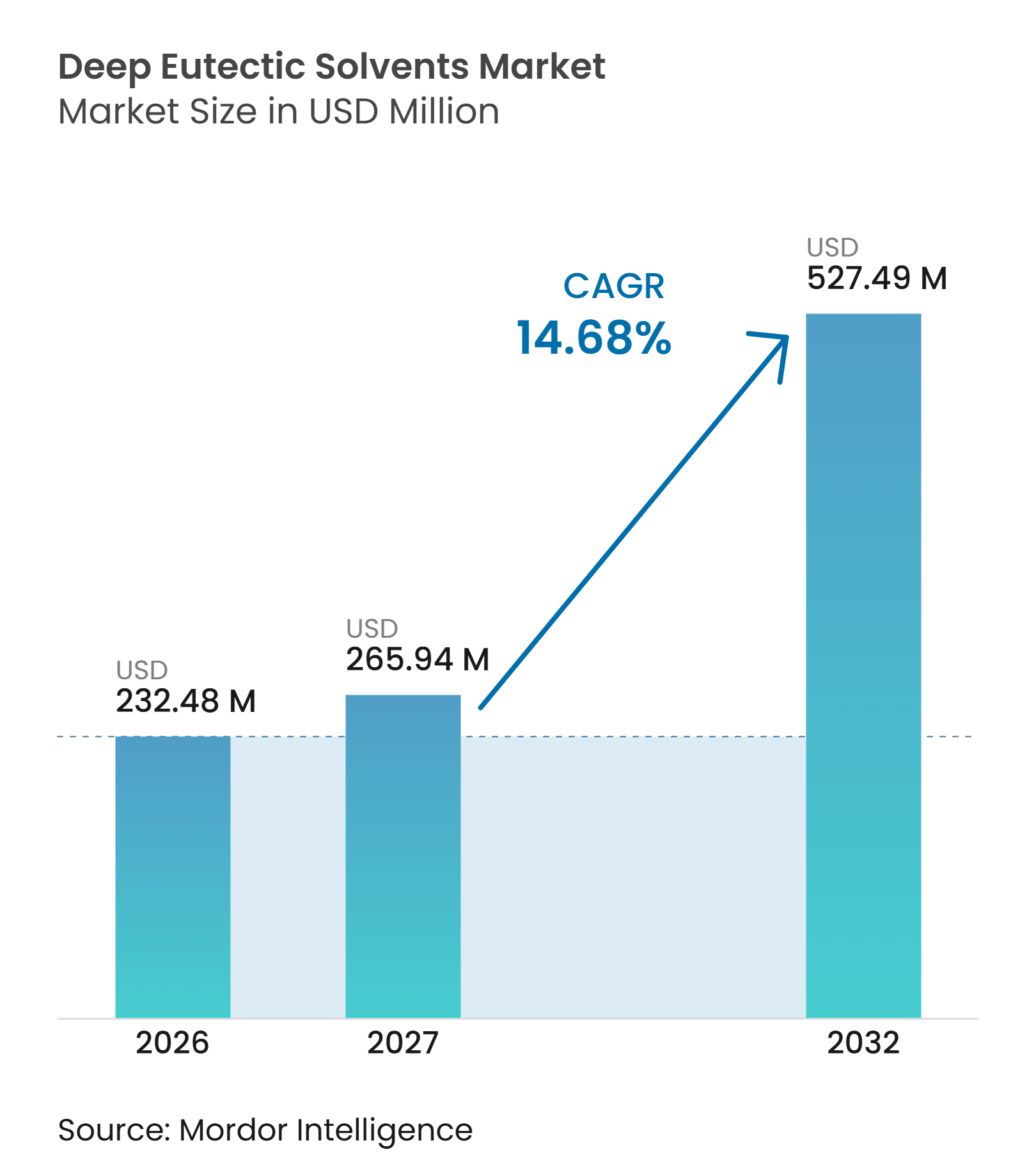
| Market Size (2027) | USD 265.94 Million |
| Market Size (2032) | USD 527.49 Million |
| Growth Rate (2027 - 2032) | 14.68 % |
| Fastest Growing Market | Asia-Pacific |
| Largest Market | Asia-Pacific |
| Market Concentration | Low |
Major Players *Disclaimer: Major Players sorted in no particular order Image © Mordor Intelligence. Reuse requires attribution under CC BY 4.0. | |
Deep Eutectic Solvents Market Analysis by Mordor Intelligence
The deep eutectic solvents market size was valued at USD 232.48 million in 2026 and is estimated to grow from USD 265.94 million in 2027 to USD 527.49 million by 2032, at a CAGR of 14.68% during the forecast period (2027-2032). The deep eutectic solvents market is being shaped by tighter controls on hazardous solvents and by the ability of these formulations to serve as low-volatility, tunable alternatives in extraction, electrochemistry, biocatalysis, and pharmaceutical formulation. Regulation (EU) 2025/1090 restricts the use of dimethylacetamide (DMAC) and N-ethyl-2-pyrrolidone (NEP) as of December 2026 and directs users to safer substitutes where feasible, establishing a defined qualification timetable for European formulators. The US federal position is less certain following the Fifth Circuit's September 2026 vacatur of the EPA's methylene chloride rule. However, workplace standards, state action, and voluntary green chemistry programs continue to support solvent replacement. The deep eutectic solvents market also benefits from increasing quantities of electronic waste, as discarded hardware provides feedstock for critical-metal recovery. At the same time, incomplete toxicology and environmental-fate data remain a barrier to broader industrial adoption.
Key Report Takeaways
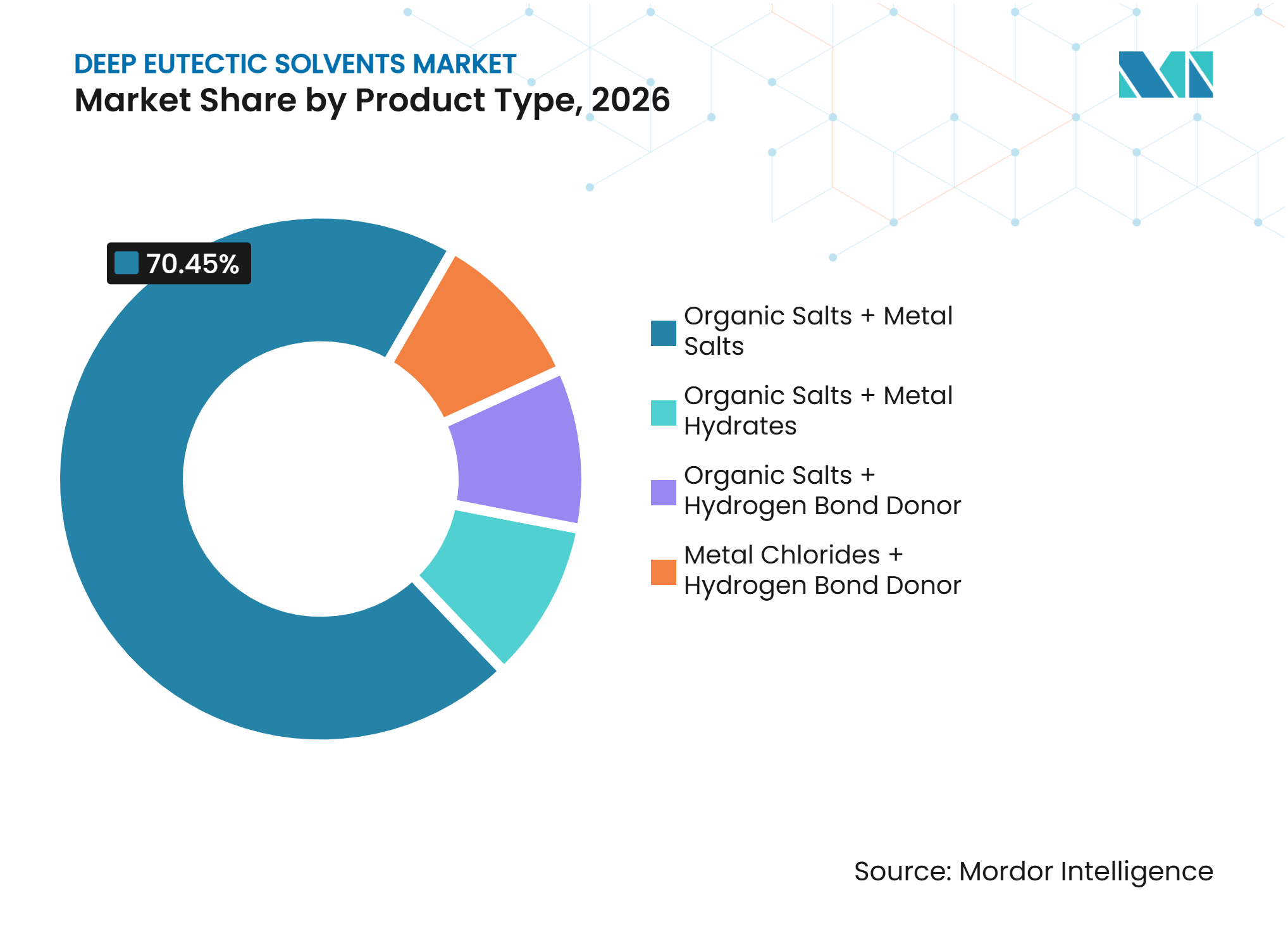
- By product type, Organic Salts + Metal Salts held 70.45% of the deep eutectic solvents market share in 2026, while Metal Chlorides + Hydrogen-Bond Donor is forecast to grow at a 15.24% CAGR through 2032.
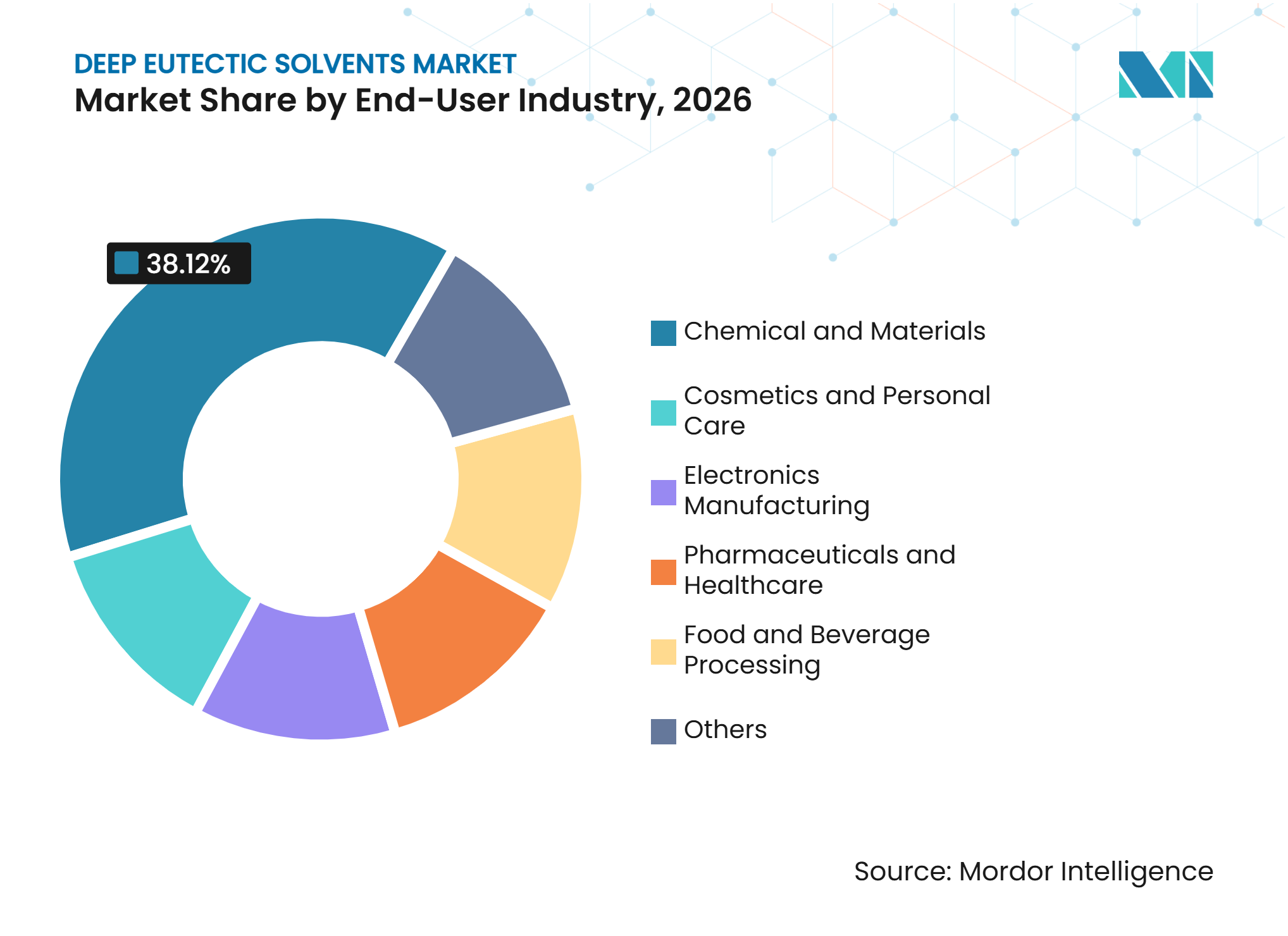
- By end-user industry, Chemical and Materials accounted for 38.12% of the deep eutectic solvents market share in 2026, while Food and Beverage Processing is forecast to grow at a CAGR of 15.89% through 2032.
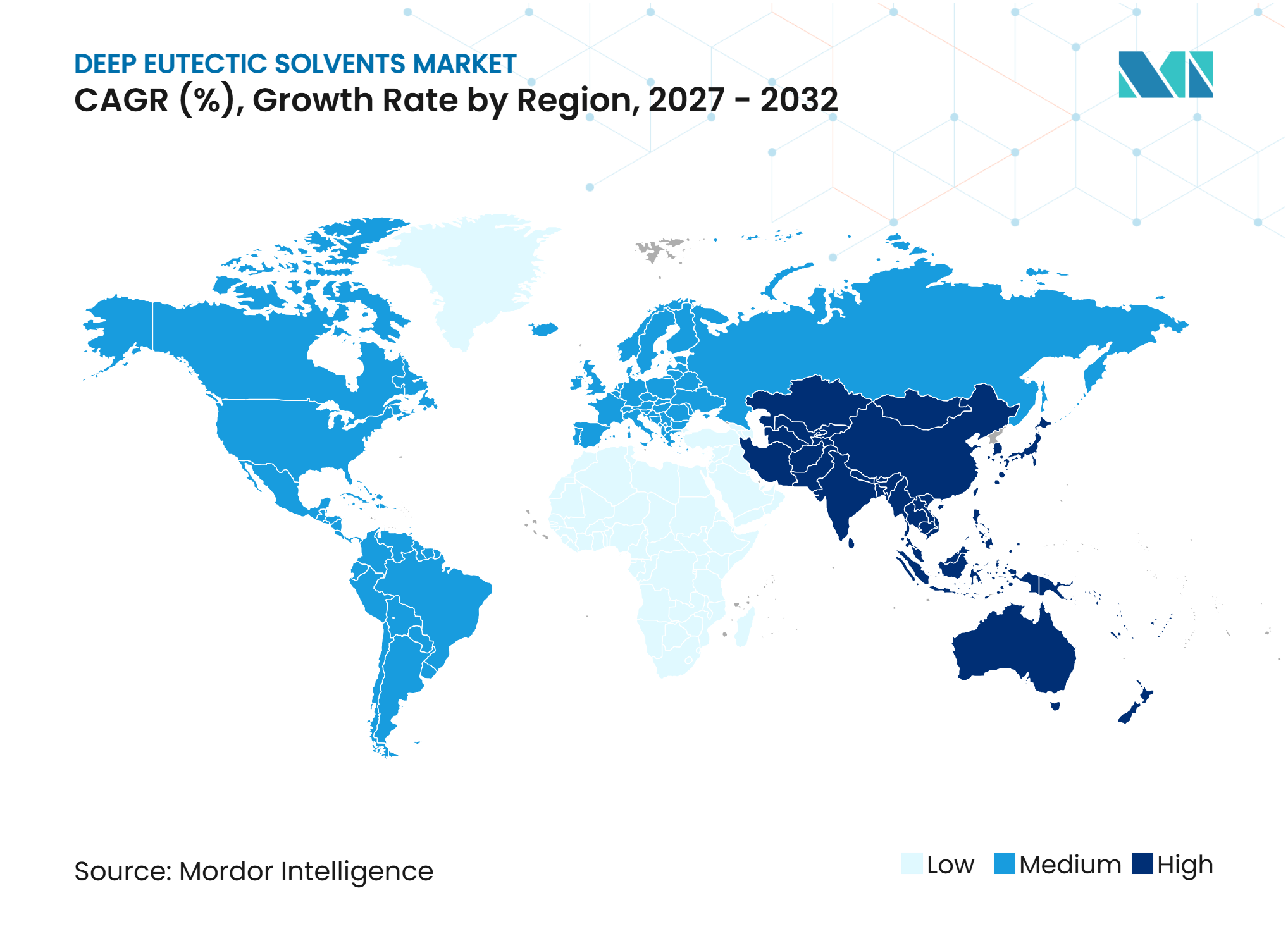
- By geography, Asia-Pacific accounted for 42.67% of the deep eutectic solvents market share in 2026 and is forecast to grow at a 15.67% CAGR through 2032.
Note: Market numbers in this report are based on Mordor Intelligence's proprietary estimation framework, which combines nine months of actuals with Q4 projections for base year 2026.
Market Trends and Insights
Drivers Impact Analysis of Deep Eutectic Solvents Market*
| Drivers | (~) % Impact on CAGR Forecast | Geographic Relevance | Impact Timeline |
|---|---|---|---|
| Regulatory Pressure to Reduce Volatile Organic Compounds (VOCs) and Hazardous Solvents | +3.5% | EU, North America | Short term (≤ 2 years) |
| Sustainable Metal Extraction and Critical-Mineral Recovery | +2.8% | Asia-Pacific, North America, Europe | Medium term (2-4 years) |
| Expansion of Pharmaceutical Formulation and Biocatalysis Applications | +2.4% | Global, led by North America, Europe, and India | Medium term (2-4 years) |
| Growth of Green Extraction in Food, Cosmetics, and Natural Products | +2.0% | Europe, North America, Asia-Pacific | Short term (≤ 2 years) and medium term (2-4 years) |
| Deep Eutectic Solvent (DES)-Assisted Continuous Processing and Process Intensification | +1.5% | Europe and North America | Long term (≥ 4 years) |
| Source: Mordor Intelligence | |||
Regulatory Pressure to Reduce Volatile Organic Compounds (VOCs) and Hazardous Solvents
The 2025 restrictions on specific solvents moved chemical regulation from broad policy direction toward fixed compliance dates. Regulation (EU) 2025/1090 restricts the manufacture and use of dimethylacetamide (DMAC) and N-ethyl-2-pyrrolidone (NEP) at concentrations above 0.3% as of December 2026, subject to the conditions set out in the measure. This schedule gives European process owners a reason to qualify alternatives before their existing solvent systems become noncompliant. The deep eutectic solvents market can benefit where its formulations meet the required process, safety, and performance criteria. In the United States, the September 2026 court decision removed the federal prohibition on methylene chloride that had applied to consumer and many commercial uses, leaving OSHA exposure standards and other requirements as the principal federal reference points. This uneven regulatory landscape means that Europe offers a clearer near-term adoption path, while U.S. demand relies more on individual qualification decisions and state-level requirements.
Sustainable Metal Extraction and Critical-Mineral Recovery
Metal recovery has become one of the more advanced commercial applications for the deep eutectic solvents market. DEScycle reported recovery rates above 99% for copper, gold, silver, and palladium during a continuous pilot program, which operated at 50-80°C and reached Technology Readiness Level 6. Mitsubishi Corporation made a strategic investment in DEScycle in June 2025, reflecting interest from a large materials trading participant in the company's ionometallurgy platform. China's 2025 copper development plan calls for green and low-carbon upgrades across the copper chain through 2027, supporting the case for lower-temperature processing methods. DES routes can operate at room temperature or with mild heat, which may improve their energy position relative to high-temperature processing in locations with costly industrial power. Retired AI server hardware further expands the potential e-scrap feedstock available for solvent-based metal recovery.
Expansion of Pharmaceutical Formulation and Biocatalysis Applications
Natural deep eutectic solvents can function as solvents, excipients, stabilizers, and, in selected systems, active pharmaceutical ingredients. This range of functions gives the deep eutectic solvents market a role beyond direct replacement of conventional process solvents. A 2025 research review reported 3-fold gains in specific activity for carbonyl reduction in hydrophobic DES compared with pure buffer systems, with full conversion at 800 mM cinnamaldehyde loading[1]. The FDA endorsed the draft ICH Q3E guidance on extractables and leachables in August 2025, and the related notice invited comments through January 2026. Manufacturers therefore have reason to favor process materials with documented safety and extractables profiles. Each successful qualification of a solvent or excipient also expands the evidence base available for future pharmaceutical applications.
Growth of Green Extraction in Food, Cosmetics, and Natural Products
EFSA called for data to support the re-evaluation of technical hexane used in food extraction in 2025, underscoring the importance of alternative extraction systems for food ingredients and natural products. Research published in 2025 found that designed natural deep eutectic solvent formulations could provide 1.5- to 5-fold greater phytosterol extraction capacity than conventional hexane-based systems. Lower volatility and an improved toxicity profile add to their relevance for botanical ingredient processing. In cosmetics, natural deep eutectic solvents can preserve sensitive bioactives and act as both an extraction medium and a carrier in the finished formulation. This combined function can support premium botanical products where yield, retained activity, and product claims all matter.
Restraints Impact Analysis of Deep Eutectic Solvents Market*
| Restraints | (~) % Impact on CAGR Forecast | Geographic Relevance | Impact Timeline |
|---|---|---|---|
| Limited Industrial-Scale Manufacturing Infrastructure | -2.1% | Global, especially North America and South America | Medium term (2-4 years) |
| Viscosity, Mass-Transfer, and Solute-Separation Limitations | -1.8% | Global | Short term (≤ 2 years) and medium term (2-4 years) |
| Incomplete Toxicological, Environmental-Fate, and Regulatory Data | -1.2% | Global, especially Europe and North America | Long-term (≥ 4 years) |
| Source: Mordor Intelligence | |||
Limited Industrial-Scale Manufacturing Infrastructure
Commercial supply of deep eutectic solvents remains far less developed than the amount of laboratory research in this market. As of 2025, specialist suppliers could provide materials from gram quantities through limited hundred-kilogram quantities, while industrial users required reliable kilogram-to-ton supply. A 2025 pilot study on zinc-nickel electroplating cited a DES cost of approximately USD 40,000 per ton, compared with USD 2,000-4,000 per ton for phosphoric or sulfuric acid equivalents, as a reason not to advance the process[2]. This cost gap illustrates how supply scale and unit economics can limit broader industrial adoption. These materials also require dedicated storage, handling, and dosing systems due to their high viscosity. Until continuous-flow, multi-ton production is established, demand is likely to remain concentrated in higher-value pharmaceutical, extraction, and recovery applications.
Viscosity, Mass-Transfer, and Solute-Separation Limitations
High viscosity is a practical constraint affecting many deep eutectic solvents market applications. Conventional formulations can be significantly more viscous than aqueous solvents at room temperature, thereby slowing mass transfer in liquid-liquid extraction and complicating solid-liquid separation. A 2025 study on rare-earth recovery identified process challenges associated with the use of DES in primary ores and tailings. In continuous systems, pressure drop can require specialized pumps and larger heat-exchange surfaces. Water addition, heating, and co-solvent dilution can reduce viscosity but may weaken the closed-loop recyclability that supports the environmental case for these solvents. Process engineers therefore require application-specific solutions rather than a single standard formulation.
*Our forecasts treat driver/restraint impacts as directional, not additive. The impact forecasts reflect baseline growth, mix effects, and variable interactions.
Deep Eutectic Solvents Market Segment Analysis
By Product Type:
Organic Salt Systems Lead Current Demand While Metal Chloride Systems Expand Electrochemical UseOrganic Salts + Metal Salts accounted for 70.45% of the deep eutectic solvents market share in 2026. The segment draws on the established use of choline chloride as a low-cost hydrogen bond acceptor. Commercial systems include choline chloride-urea, choline chloride-ethylene glycol, and choline chloride-oxalic acid formulations. These systems have been used across catalysis, extraction, and pharmaceutical formulation studies. Organic Salts + Metal Hydrates play a smaller, more stable role in electrochemical and thermal energy storage, as water content can affect ionic conductivity. Organic Salts + Hydrogen-Bond Donor systems are also gaining relevance in natural product extraction and biocatalysis, where food and cosmetics buyers value natural-origin claims.
The product leadership of these combinations reflects market maturity rather than the absence of supply risk. Choline chloride remains the most widely used hydrogen-bond acceptor, and its supply is linked to geographically concentrated quaternary-ammonium chemical chains. This exposure is relevant for producers planning larger deployments in the deep eutectic solvents market. Metal Chlorides + Hydrogen Bond Donor is forecast to grow at a 15.24% CAGR through 2032. AlCl3-urea and ZnCl2 systems provide electrochemical windows of 3-6 volts, enabling the deposition of reactive metals that cannot be plated from water-based electrolytes. A 2025 study found that modifying sodium chloride improved aluminum plating quality in an AlCl3-urea DES while maintaining the essential electrochemical window. A separate 2025 study reported 99% lithium and 98% nickel leaching from NMC cathode materials at 70°C, reinforcing the segment's relevance to battery material recovery.



By End-User Industry:
Chemicals and Materials Has the Broadest Base While Food and Beverage Processing Grows FastestChemicals and Materials accounted for 38.12% of the deep eutectic solvents market share in 2026. Demand comes from process chemistry, catalysis, polymer synthesis, and hydrometallurgy, where these formulations function as reaction media, selective extraction phases, or ligand carriers. Electronics manufacturing is a developing use case for chrome-free electropolishing and metal deposition, which may become more relevant as restrictions on hexavalent chromium increase the need for alternative surface-finishing routes. Pharmaceuticals and Healthcare constitute the second demand tier, driven by improvements in active pharmaceutical ingredient solubility, excipient substitution, and enzyme-supported synthesis. The 2025 American Chemical Society (ACS) Symposium Series on deep eutectic solvents also documented uses in supercapacitor electrolytes, electropolishing, and battery electrode synthesis.
Food and Beverage Processing is forecast to advance at a 15.89% CAGR through 2032. The segment benefits from the European Food Safety Authority (EFSA) review of technical hexane and from food producers' need for clean-label extraction approaches. Natural DES formulations can use food-grade metabolites such as citric acid, lactic acid, sugars, and amino acids. Their extraction performance supports the use of plant-derived bioactives in food and beverage applications. EU Directive 2009/32/EC remains relevant as it governs the use of authorized extraction solvents in food and food ingredients. Cosmetics and Personal Care provide another expansion route, as a formulation can retain the solvent as part of its functional ingredient system. Other applications, including agrochemicals and textile processing, remain earlier-stage opportunities within the deep eutectic solvents market.

Geography Analysis
Asia-Pacific: Scale in Mineral Processing Supports Both Demand and Supply Development
Asia-Pacific held 42.67% of the deep eutectic solvents market share in 2026 and is projected to grow at a 15.67% CAGR through 2032. China supports regional demand through its large critical-mineral processing base and its policy focus on green industrial upgrades. The Ministry of Industry and Information Technology issued its copper industry development plan in February 2025, setting out green and low-carbon upgrading priorities through 2027. China also issued interim measures in July 2025 for total-quantity control in rare-earth mining and smelting separation, strengthening focus on more controlled mineral-processing routes. India adds a distinct source of demand through pharmaceutical active-ingredient production and the development of bio-derived chemicals. Tata Chemicals and The Energy and Resources Institute (TERI) opened a biochemicals Center of Excellence in September 2025, reflecting continued interest in bio-based platform chemicals adjacent to DES feedstocks. The regional opportunity also includes South Korea, where advanced electronics manufacturing can adopt metal chloride DES systems for electrodeposition and coating applications.
Europe: Regulation and a Dense Producer Base Shorten Qualification Pathways
Europe has a dense base of DES producers and academic-to-industrial transition companies across the United Kingdom, Germany, France, Austria, and Croatia. Regulation (EU) 2025/1090 creates a clear compliance driver for European users of DMAC and NEP. Local supply and specialist knowledge can help reduce the time required to move from testing to qualification. Relevant suppliers include Scionix Ltd., Iolitec, proionic GmbH, Solvionic SA, Gattefossé, and NADES Design. DEScycle opened its first critical-minerals recovery demonstration plant in the United Kingdom earlier in 2026 and is working toward a 5,000-ton commercial facility at Gateshead with GAP Group. Mitsubishi Corporation is the commercial offtake partner for the Japanese market, linking European recovery development with Asian materials demand. The European Chemicals Agency (ECHA)'s Safe and Sustainable by Design approach also places greater weight on the toxicology and sustainability evidence that suppliers will need for broad adoption.
Regional Diversity: North America, South America, and Emerging Mineral Regions Follow Different Adoption Paths
North America faces a less defined federal replacement signal following the September 2026 court decision on the methylene chloride rule. OSHA workplace standards, voluntary green chemistry commitments, and state chemical rules continue to encourage solvent substitution. This creates a market environment in which qualification decisions are likely to be driven by individual process economics and customer requirements. South America has an early green-solvent base through Syensqo's Coatis complex in Paulinia, Brazil, which develops bio-based Augeo solvents and includes a renewable-chemicals research center. South Africa and Saudi Arabia represent earlier-stage opportunities for mineral recovery applications, particularly where water constraints make conventional energy- and water-intensive hydrometallurgy less attractive. These locations may benefit from lower-temperature DES routes, but deployment depends on local technical validation and infrastructure. Across these geographies, the deep eutectic solvents market is likely to develop first in high-value extraction, recovery, and specialty formulation applications rather than broad commodity uses.
Competitive Landscape
Market Concentration
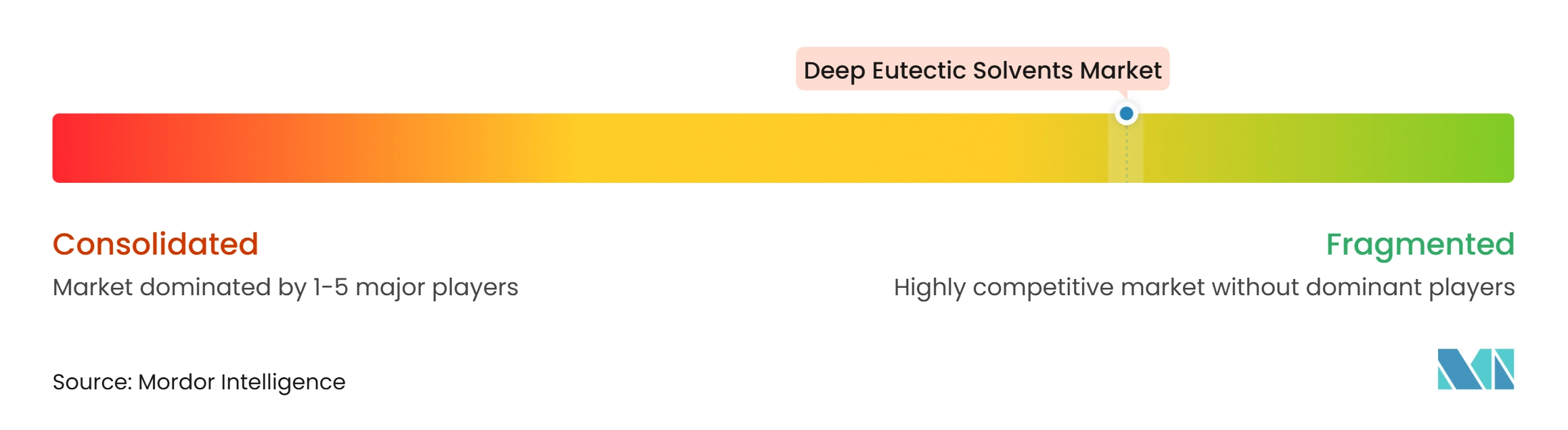
The deep eutectic solvents market is fragmented, with concentration strongest among specialist ionic liquid and DES suppliers serving research and pilot-scale customers. Notable suppliers in this tier include Scionix Ltd., Iolitec, proionic GmbH, and Solvionic SA. Larger chemical companies take a different approach by integrating related technologies into broader process portfolios. BASF's BASIL ionic liquid process is an example of proprietary process integration in the broader ionic liquid field. DEScycle uses a vertically integrated model that treats solvent use and metal recovery as parts of one process, rather than selling only a solvent product.
Intellectual property is becoming more important as commercial applications move closer to scale. Chemical & Engineering News reported accelerated patent activity in 2026, indicating that companies are seeking positions before many applications reach broad commercialization. The ability to document life-cycle performance and eco-toxicological data is also becoming a competitive factor under the European Chemicals Agency (ECHA) Safe and Sustainable by Design (SSbD) framework. DEScycle opened a United Kingdom demonstration plant in June 2026, marking a move from laboratory validation toward commercial recovery capacity. Its March 2026 preferred-partner agreement with Mitsubishi Corporation connects the recovery platform with a Japanese commercial network. Tokyo Chemical Industry's January 2026 international product launch indicates more proactive distribution development for DES materials.
The main commercial gap remains the reliable supply of ton-scale quantities with consistent purity and batch quality. Smaller producers generally operate at the gram-to-hundred-kilogram level, which limits their ability to serve large process owners. Continuous-flow processing, regeneration systems, and sodium-ion battery electrolytes remain areas where research activity has outpaced commercial supply. Machine learning methods are being studied for property screening and metal-extraction selectivity, which could shorten early-stage formulation work. The market may consolidate as the first suppliers establish scalable production and verified application performance.
Deep Eutectic Solvents Industry Leaders
-
proionic GmbH
-
Iolitec Ionic Liquids Technologies GmbH
-
DES Solutio
-
BASF
-
Thermo Fisher Scientific Inc.
- *Disclaimer: Major Players sorted in no particular order
Deep Eutectic Solvents Market Companies Covered in this Report
- BASF
- DES Solutio
- DEScycle
- Eutectix LLC
- Gattefossé
- Intertek Group plc
- Iolitec Ionic Liquids Technologies GmbH
- Nades Design
- proionic GmbH
- Scionix Ltd.
- Solvay
- Solvionic SA
- Tata Chemicals Ltd.
- Thermo Fisher Scientific Inc.
- Tokyo Chemical Industry Co., Ltd.
Recent Industry Developments in Deep Eutectic Solvents Market
- June 2026: DEScycle opened its first critical minerals recovery demonstration plant in the United Kingdom and secured more than EUR 10 million in confirmed non-dilutive grant funding over the preceding 10 months, spanning Horizon Europe, Germany's SPRIND, the European Innovation Council (EIC) Accelerator, Innovate UK Investor Partnerships, and a UK Research and Innovation (UKRI) Future Leaders Fellowship. Total capital secured stands at GBP 30 million, supporting operations through 2027 as it advances toward the 5,000-ton Gateshead facility, developed in a joint venture with GAP Group.
- March 2026: DEScycle and Mitsubishi Corporation signed a preferred-partner agreement for the Japanese market, following Mitsubishi's June 2025 strategic investment. The agreement applies DEScycle's deep eutectic solvent-based metal recovery process through Mitsubishi's trading network, targeting the recovery of critical and precious metals from Japan's electronic waste stream.
Global Deep Eutectic Solvents Market Report Scope
A deep eutectic solvent (DES) is a fluid formed by mixing two or more solid or liquid components that combine to produce a mixture with a significantly lower melting point than any of the individual components. DES is typically prepared by combining a hydrogen-bond acceptor (HBA), such as a quaternary ammonium salt, with a hydrogen-bond donor (HBD), such as an alcohol, amine, or carboxylic acid.
The deep eutectic solvents market is segmented by product type, end-user industry, and geography. By product type, the market is segmented into organic salts + metal salts, organic salts + metal hydrates, organic salts + hydrogen-bond donors, and metal chlorides + hydrogen-bond donors. By end-user industry, the market is segmented into chemical and materials, pharmaceuticals and healthcare, food and beverage processing, cosmetics and personal care, electronics manufacturing, and others. The report also covers market sizes and forecasts for deep eutectic solvents across 15 countries in major regions. The market sizes and forecasts are provided in terms of value (USD).
Segmentation Overview
| Organic Salts + Metal Salts |
| Organic Salts + Metal Hydrates |
| Organic Salts + Hydrogen Bond Donor |
| Metal Chlorides + Hydrogen Bond Donor |
| Chemical and Materials |
| Pharmaceuticals and Healthcare |
| Food and Beverage Processing |
| Cosmetics and Personal Care |
| Electronics Manufacturing |
| Others |
| Asia-Pacific | China |
| India | |
| Japan | |
| South Korea | |
| ASEAN Countries | |
| Rest of Asia-Pacific | |
| North America | United States |
| Canada | |
| Mexico | |
| Europe | Germany |
| United Kingdom | |
| France | |
| Italy | |
| NORDIC Countries | |
| Rest of Europe | |
| South America | Brazil |
| Argentina | |
| Rest of South America | |
| Middle East and Africa | Saudi Arabia |
| South Africa | |
| Rest of Middle East and Africa |
| By Product Type | Organic Salts + Metal Salts | |
| Organic Salts + Metal Hydrates | ||
| Organic Salts + Hydrogen Bond Donor | ||
| Metal Chlorides + Hydrogen Bond Donor | ||
| By End-User Industry | Chemical and Materials | |
| Pharmaceuticals and Healthcare | ||
| Food and Beverage Processing | ||
| Cosmetics and Personal Care | ||
| Electronics Manufacturing | ||
| Others | ||
| By Geography | Asia-Pacific | China |
| India | ||
| Japan | ||
| South Korea | ||
| ASEAN Countries | ||
| Rest of Asia-Pacific | ||
| North America | United States | |
| Canada | ||
| Mexico | ||
| Europe | Germany | |
| United Kingdom | ||
| France | ||
| Italy | ||
| NORDIC Countries | ||
| Rest of Europe | ||
| South America | Brazil | |
| Argentina | ||
| Rest of South America | ||
| Middle East and Africa | Saudi Arabia | |
| South Africa | ||
| Rest of Middle East and Africa | ||
Key Questions Answered in the Report
What is current market size of Deep Eutectic Solvents Market?
The deep eutectic solvents market size was valued at USD 232.48 million in 2026 and is estimated to grow from USD 265.94 million in 2027 to USD 527.49 million by 2032, at a CAGR of 14.68% during the forecast period (2027-2032).
Which product type leads demand for deep eutectic solvents?
Organic Salts + Metal Salts lead with a 70.45% share in 2026, supported by established choline chloride-based systems.
Which end-user application is growing fastest?
Food and Beverage Processing is expected to record a 15.89% CAGR through 2032, supported by demand for alternative extraction approaches.
Which region has the strongest position in deep eutectic solvents?
Asia-Pacific leads with a 42.67% share in 2026 and is also the fastest-growing region at a 15.67% CAGR through 2032.