
Decorative Foils Market Size and Share
Market Overview
| Study Period | 2022 - 2032 |
|---|---|
| Market Size (2027) | USD 2.82 Billion |
| Market Size (2032) | USD 3.57 Billion |
| Growth Rate (2027 - 2032) | 4.83 % |
| Fastest Growing Market | Asia-Pacific |
| Largest Market | Asia-Pacific |
| Market Concentration | Low |
Major Players *Disclaimer: Major Players sorted in no particular order Image © Mordor Intelligence. Reuse requires attribution under CC BY 4.0. | |
Decorative Foils Market Analysis by Mordor Intelligence
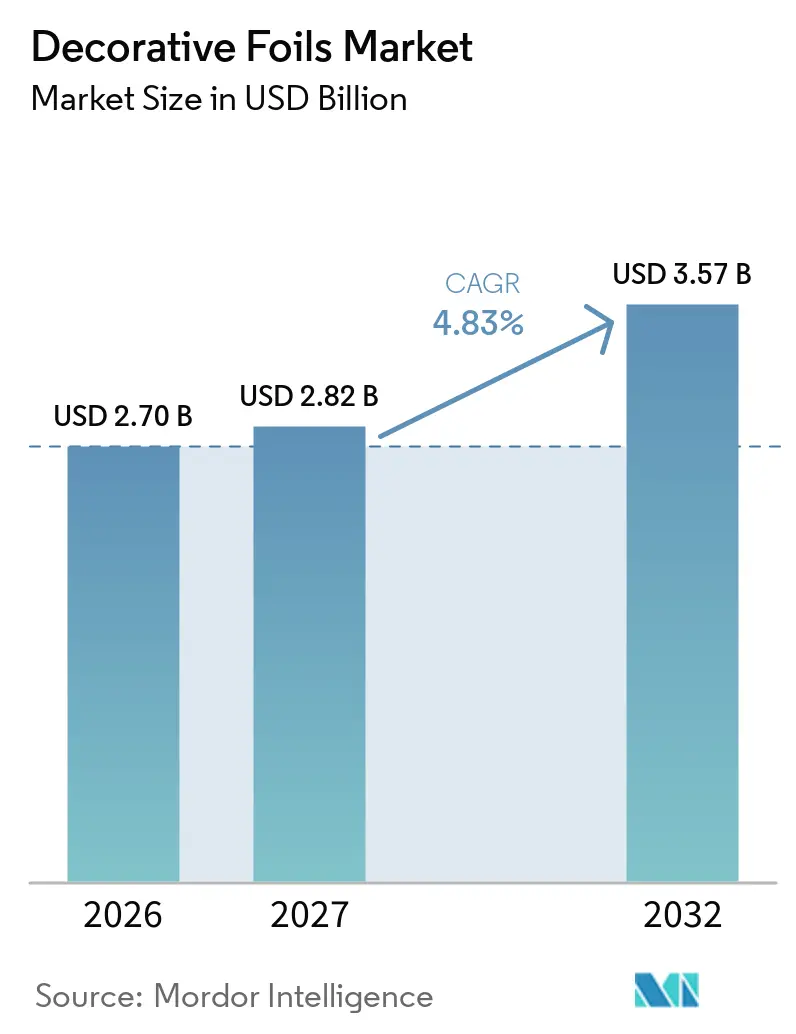
The decorative foils market size was valued at USD 2.70 billion in 2026 and is estimated to grow from USD 2.82 billion in 2027 to USD 3.57 billion by 2032, at a CAGR of 4.83% during the forecast period (2027-2032). Renovation spending in mature economies supports the decorative foils market, as high financing costs make improving an existing home more practical than purchasing a new one. New housing activity and furniture demand in urbanizing parts of Asia-Pacific and South America provide an additional source of demand for the decorative foils market. Foil-wrapped boards suit renovation work because they offer faster installation, consistent patterns, and less disruption than solid wood or stone in visible interior applications. Producers are expanding recyclable polypropylene and polyester formats as sustainability requirements from European furniture brands increasingly shape material selection within the decorative foils market. Competition centers on design capability, substrate performance, dependable supply, and proximity to furniture manufacturing clusters, which can influence lead times and the ability to support frequent decor changes.
Key Report Takeaways
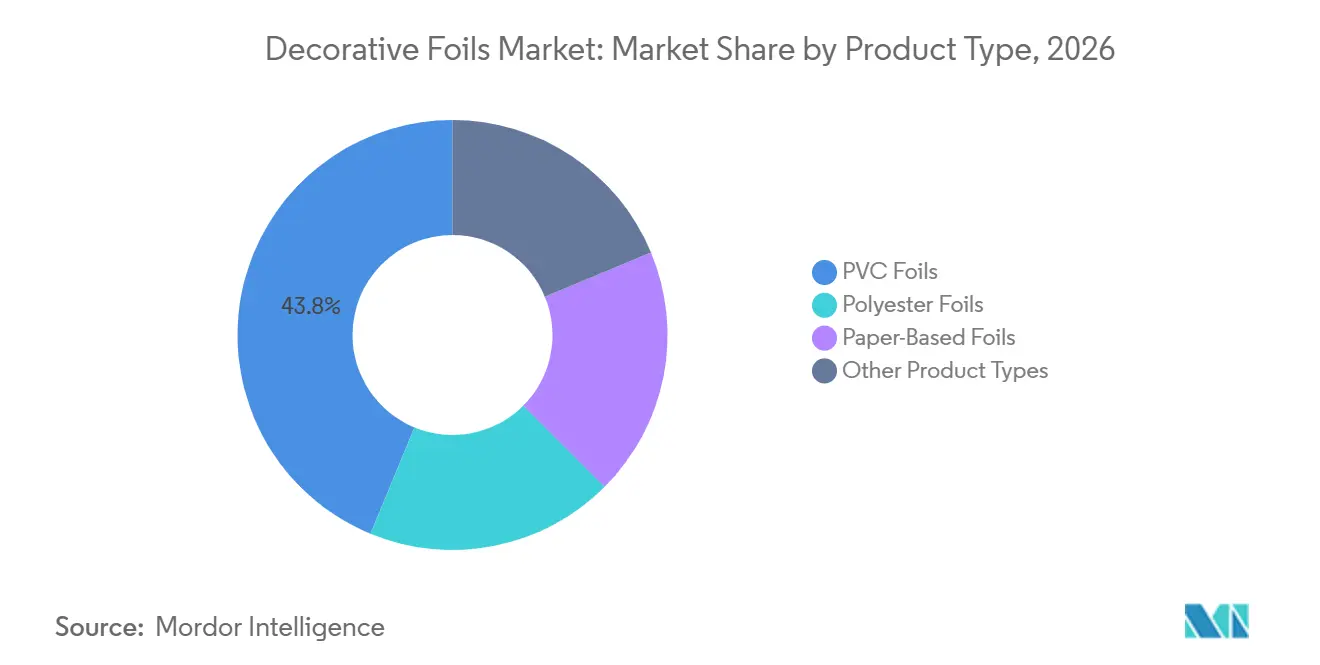
- By product type, polyvinyl chloride (PVC) foils held 43.78% market share in 2026, while polyester foils are forecast to grow at a 5.34% CAGR through 2032.
- By application, furniture and cabinetry accounted for 50.12% of the market share in 2026, while flooring is projected to advance at a 5.56% CAGR through 2032.
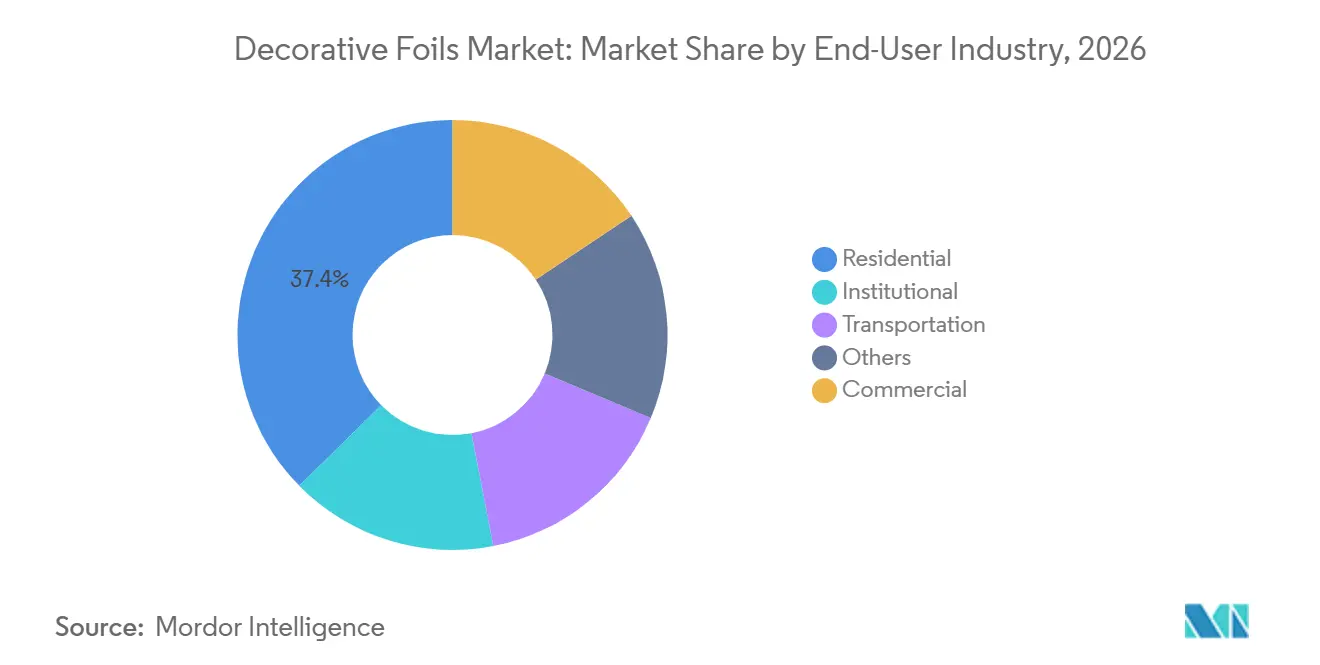
- By end-user industry, residential accounted for 37.37% of the market share in 2026 and is forecast to record the highest CAGR of 5.82% through 2032.
- By geography, Asia-Pacific accounted for 35.06% of the market share in 2026 and is projected to expand at a 5.71% CAGR through 2032.
Note: Market numbers in this report are based on Mordor Intelligence's proprietary estimation framework, which combines nine months of actuals with Q4 projections for base year 2026.
Market Trends and Insights
Drivers Impact Analysis of Decorative Foils Market*
| Drivers | (~) % Impact on CAGR Forecast | Geographic Relevance | Impact Timeline |
|---|---|---|---|
| Construction and Renovation Activity | +1.5% | Global, particularly Asia-Pacific and South America | Medium term (2-4 years) |
| Demand for Personalized Interior Surfaces | +1.1% | Global, with pronounced demand in North America and Europe | Long term (≥ 4 years) |
| Modular Furniture and Cabinet Manufacturing Growth | +0.9% | Asia-Pacific core, with spillover to Middle East and Africa | Medium term (2-4 years) |
| Digital Printing and Short-Run Customization | +0.7% | Europe and North America primarily | Long term (≥ 4 years) |
| Polyvinyl Chloride (PVC)-Free and Lower-Emission Product Innovation | +0.5% | Europe and North America, with adoption extending to the Asia-Pacific | Medium term (2-4 years) |
| Source: Mordor Intelligence | |||
Construction and Renovation Activity: Renovation Cycle, Not New Build, Anchors Demand
Renovation activity provides a more dependable source of demand for decorative foils than new construction in markets where borrowing costs have made home purchases less attractive. Homeowners can update kitchens, wardrobes, wall panels, countertops, and doors without undertaking full structural work, enabling visible interior changes within the existing footprint. This favors materials that can refresh an interior with shorter lead times, consistent decorative results, and less on-site disruption than traditional surface alternatives. Commercial refurbishment also supports the decorative foils market, as office, retail, and hospitality projects often require durable surfaces that can be installed efficiently while maintaining normal building operations. Renovation spending can support premium interior finishes when property owners seek materials that combine visual change with practical maintenance and processing benefits. The resulting demand pattern ties foil consumption more closely to interior improvement budgets than to housing starts alone, making replacement and retrofit work a steadier source of demand.
Demand for Personalized Interior Surfaces: Individualization Displaces Standard Stock Keeping Units (SKUs)
Personalized interiors have moved beyond a limited premium category and now shape purchasing decisions for decorative surfaces. Product developers must offer stone-look, plaster-effect, embossed wood-grain, and other effects that match changing interior preferences. The need for more frequent design refreshes is growing as buyers seek finishes that distinguish furniture and interior surfaces. Roland DG expanded its DIMENSE interior decoration solution in April 2025 to include 8 printable substrates, 13 paint colors, and 4 decoration kits for textured, three-dimensional surfaces[1]. These additions demonstrate that digital tools can extend the range of decorative surfaces considered during design selection. Suppliers that build printing capability or work closely with design studios can address shorter design cycles, while suppliers committed only to large gravure runs face greater inventory exposure.
Modular Furniture and Cabinet Manufacturing Growth: Asia-Pacific’s Production Engine Expands the Foil Addressable Market
Modular furniture manufacturing creates a large and repeatable demand base for decorative foils because panels are surfaced before furniture is assembled, rather than after the finished item reaches the installation stage. A 2025 peer-reviewed study of mass-customized cabinet systems found that modular cabinet structures support standardized production while accommodating customization. This production model depends on consistent surface materials that can move through high-throughput panel lines without disrupting production schedules or creating visible differences across units. LG Chem, Hansem, and Jinyoung completed a project in April 2025 to develop a decorative furniture sheet using bio-circular-balanced Acrylonitrile Styrene Acrylate (ASA) for Hansem's e'clat architectural material brand. The project shows that furniture original equipment manufacturers took a more direct role in surface-material specifications, particularly where sustainability standards influence a finished product's market position. For suppliers in Asia-Pacific, relationships with panel manufacturers can therefore be as important as direct relationships with finished-furniture brands, as panel-level decisions determine recurring quantity requirements.
Digital Printing and Short-Run Customization: Gravure's Position in High-Run Printing Is Declining
Digital printing remains less established than gravure for large quantities of decorative foil, but it is becoming more relevant for short runs, design-led orders, and collections that require frequent pattern changes. Hymmen's Digital Lacquer Embossing technology aligns embossed structures with the printed decor, eliminating the need for a separate physical embossing roll for each pattern. The process retains surface properties such as hardness, scratch resistance, and chemical durability while allowing manufacturers to reduce setup constraints associated with creating new surface designs. Agfa has stated that digital processes support immediate design changes and just-in-time production for highly customized interiors. These capabilities reduce the minimum order quantity for developing a new decor and lower the inventory risk associated with designs that quickly fall out of favor. They also allow smaller regional producers to pursue design-focused businesses that once required substantial capital investment, adding a new source of competition within the decorative foils market.
Restraints Impact Analysis of Decorative Foils Market*
| Restraints | (~) % Impact on CAGR Forecast | Geographic Relevance | Impact Timeline |
|---|---|---|---|
| Volatility in PVC Resin, PET, Adhesive, Coating, and Aluminum Input Costs | -0.9% | Global | Short term (≤ 2 years) |
| Substitution by Decorative Laminates, Engineered Veneers, and Solid Surfaces | -0.7% | Europe and North America | Medium term (2-4 years) |
| Limited Recyclability of Multilayer Foils and Adhesive-Bonded Composites | -0.4% | Europe, with a regulatory focus | Long term (≥ 4 years) |
| Source: Mordor Intelligence | |||
Input Cost Volatility: Geopolitically Sensitive Supply Chains Amplify Price Swings
Polyvinyl chloride (PVC) resin, polyethylene terephthalate (PET), adhesives, coatings, and aluminum are central cost inputs for many decorative foil converters, and sudden price movements can affect margins across the decorative foils market. These price movements can compress margins when customer contracts set finished-product prices well before material purchases are made, particularly when customers request fixed pricing over extended supply periods. The exposure is greatest for producers that buy on spot terms, carry narrow inventory buffers, or have limited supply coverage for their principal raw materials. Furniture original equipment manufacturers often lock in supply prices for 12 to 18 months, which can limit a converter's ability to pass through sudden increases in input costs once a contract is set. This constraint is especially difficult in competitive tenders, where suppliers may have little room to revise prices without risking a customer relationship or a planned order. The decorative foils market, therefore, benefits from supply contracts, material flexibility, and product mixes that reduce dependence on a single volatile input and provide more options when costs change.
Substitution Pressure from Laminates and Engineered Veneers: Premium Segments Are Vulnerable
Decorative laminates, engineered veneers, and solid surfaces present the greatest substitution risk in high-specification residential, hospitality, and commercial projects where tactile quality and premium appearance are part of the selection process. Wilsonart launched its Woodgrains collection for commercial environments in 2025, stating that it offers wear resistance three times higher than standard laminates and 16 times higher than veneer, with an average of 23% post-consumer recycled content. These alternatives can appeal to buyers who place a premium on natural-material appearance, surface durability, or recycled content that supports project material declarations. Their presence does not eliminate the role of foil-based surfaces in mass-market furniture, where processing speed, dimensional consistency, and a wide range of printed designs remain important. The greater concern is margin pressure from specifications that demand stronger perceived quality and sustainability credentials, even when decorative foils remain technically suitable. Foil suppliers that cannot meet these expectations may be excluded from premium project tenders, narrowing their participation in the most demanding applications of the decorative foils market.
*Our forecasts treat driver/restraint impacts as directional, not additive. The impact forecasts reflect baseline growth, mix effects, and variable interactions.
Decorative Foils Market Segment Analysis
By Product Type:
Established PVC Base Supports Accelerating Polyester TransitionPVC foils accounted for 43.78% of the decorative foils market share in 2026, supported by established processing infrastructure, familiar furniture production workflows, and competitive unit costs for comparable gauges and print quality. The installed base gives the format a durable role in high-volume panel applications, even as buyers consider newer substrate options. Taghleef Industries presented SynDECOR PP embossed foils at Interzum 2025 as PVC replacements for cabinet interiors, drawer sides, and profile wrapping. The launch indicates that material selection now reflects carbon footprint, recyclability, regulatory compliance, processing behavior, and cost. Paper-based foils remain relevant for cost-sensitive furniture, door, and profile-wrapping applications, where accessible supply and design flexibility support their continued use.
Polyester foils are forecast to grow at a 5.34% CAGR from 2027 to 2032, the fastest rate among product types in the decorative foils market. Their UV stability, dimensional performance under heat and humidity, and printability support high-resolution decorative applications and digital inkjet workflows for shorter decor runs. Schattdecor's Smartfoil finish foils are still available in single-roll quantities for furniture, doors, and profile wrapping, giving selected buyers more flexible procurement options. Specialty metallic and textured formats serve narrower applications where visual effects and surface feel are more important than output quantity. European requirements related to the Registration, Evaluation, Authorization and Restriction of Chemicals (REACH) and Substances of Very High Concern (SVHC) are also encouraging producers to assess PVC displacement in suitable product lines.

By Application:
Furniture’s Commanding Share Masks a Flooring Growth InflectionFurniture and cabinetry accounted for 50.12% of the decorative foils market size in 2026, making them the largest application segment and the main entry point into residential and commercial surface supply chains. This share reflects the use of foil surfaces in modular furniture, factory-built panels, and cabinet systems that require a consistent appearance across large production runs. Furniture producers value these materials for efficient panel processing, dimensional consistency, and a broad range of printed decors. This concentration means that shifts in cabinet and flat-pack furniture production directly affect purchasing in the decorative foils market. High-volume furniture will remain structurally important even as manufacturers develop products for flooring, wall panel, and specialty interior applications.
Flooring is projected to grow at a 5.56% CAGR from 2027 to 2032, the fastest rate among application segments, as project teams seek boards that offer moisture resistance, design consistency, and competitive cost. Architects and interior designers are specifying engineered flooring with high-definition decoration in high-traffic residential and commercial spaces that previously relied more heavily on solid hardwood or ceramic tile. Hymmen has identified flooring as an early application for Digital Lacquer Embossing ahead of its wider use in furniture. Doors and windows remain a stable application for thermoforming-grade 3D foils, while wall panels benefit from demand for coordinated interior surfaces. Countertops and other applications represent a smaller but technically demanding portion of demand, where scratch resistance, surface hardness, and chemical resistance are key requirements.
By End-User Industry:
Residential’s Dual-Lead Position Reflects Structural DemandResidential users held a 37.37% revenue share in 2026 and are projected to grow at a 5.82% CAGR through 2032, combining the largest end-user base with the strongest forecast growth rate. Demand is supported by household formation in emerging markets, renovation activity in mature economies, and the need for affordable interiors with broader design options. Homeowners are upgrading kitchens, wardrobes, and other visible surfaces when major structural projects or home purchases are less attractive. Self-installation products can extend the use of decorative foil beyond professional trades, while premium formats can meet more design-focused residential specifications. These factors make housing-related demand relevant for both high-output products and selected higher-value surface options.
LG Chem, Hanssem, and Jinyoung developed a bio-circular balanced Acrylonitrile Styrene Acrylate (ASA) decorative sheet for residential furniture applications in April 2025. The collaboration indicates that household-facing furniture brands are actively shaping sustainability specifications for surface materials, rather than leaving these decisions solely to material suppliers. Commercial users remain important for office fit-outs, retail, and hospitality projects, where maintenance, durability, and visual consistency influence material selection. Institutional users support demand for fire-rated and antimicrobial formats in healthcare, education, and public facilities. Transportation interiors, including rail, marine, and caravan applications, represent smaller but technically demanding uses in which surface specifications can influence requirements throughout the decorative foil supply chain.
Geography Analysis
APAC Decorative Foils Market
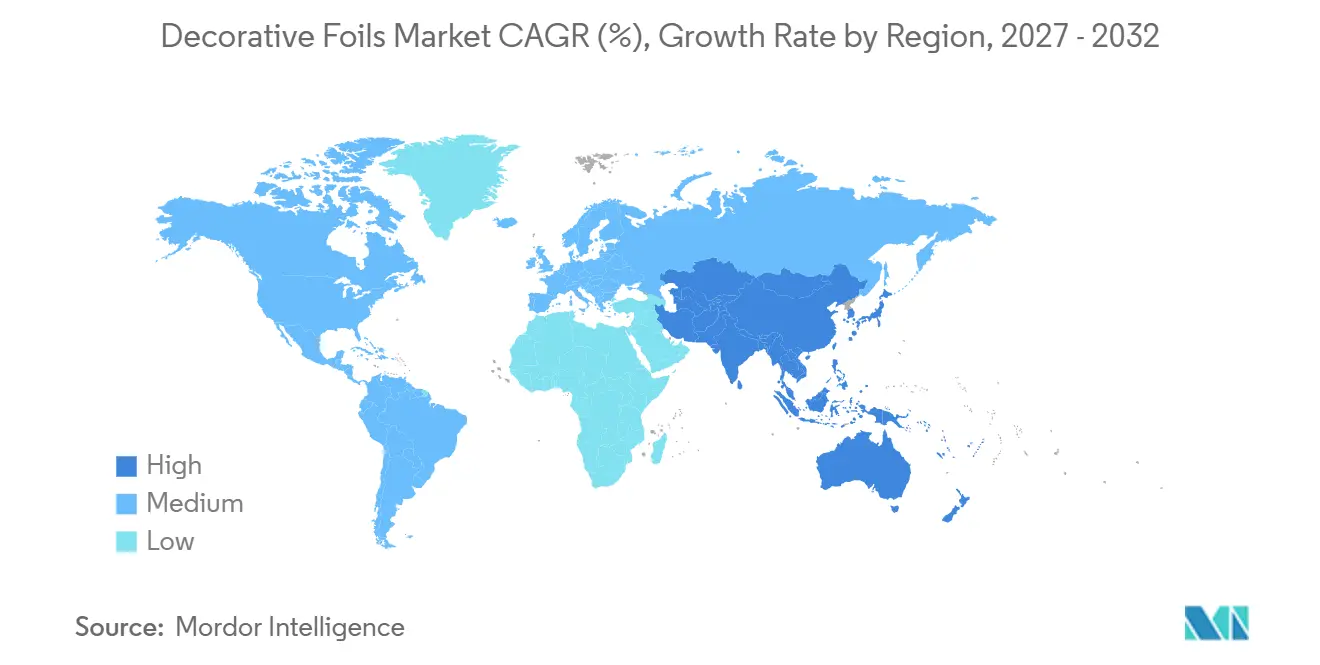
Asia-Pacific accounted for 35.06% of the decorative foils market share in 2026 and is forecast to grow at a 5.71% CAGR through 2032, representing the largest regional base with the strongest growth rate. The region has a large furniture manufacturing base, rising household formation, and broader adoption of modular furniture, which support both high-scale and design-led requirements. China benefits from customization-oriented cabinet production and a large base of furniture original equipment manufacturers that use decorative surface materials at scale. India is experiencing wider adoption of modular furniture as organized home-interior retail expands, while Vietnam, Indonesia, Thailand, and Malaysia continue to attract furniture production capacity. This production and consumption base makes Asia-Pacific central to demand, supplier location choices, and competitive supply decisions in the decorative foils market.
Europe and North America Decorative Foils Market
Europe remains strategically important, as chemical compliance and environmental requirements increasingly influence material procurement, creating demand for PVC-free and lower-emission decorative foils. These conditions make the region a significant destination for advanced formats that combine decorative performance with improved material declarations. European furniture buyers assess sustainable materials closely, particularly when sourcing products for customers who require chemical and environmental documentation. This supports demand for polyurethane, polypropylene, polyester, and other formats that address requirements beyond visual design. North America also supports demand for personalized interior surfaces and formats suited to renovation activity, where design choice and efficient installation remain relevant.
MEA and South America Decorative Foils Market
South America is led by Brazil and Argentina, where urbanization and rising disposable incomes support first-time furniture purchases and demand for cost-accessible PVC foil formats. The Middle East and Africa remain less penetrated but benefit from construction investment in Saudi Arabia and South Africa, including hospitality and commercial real estate projects. These regional patterns offer suppliers several avenues for growth, ranging from mature renovation demand to new furniture purchases. They also highlight the value of localized supply, product flexibility, and application-specific designs that align with regional furniture production needs.
Competitive Landscape
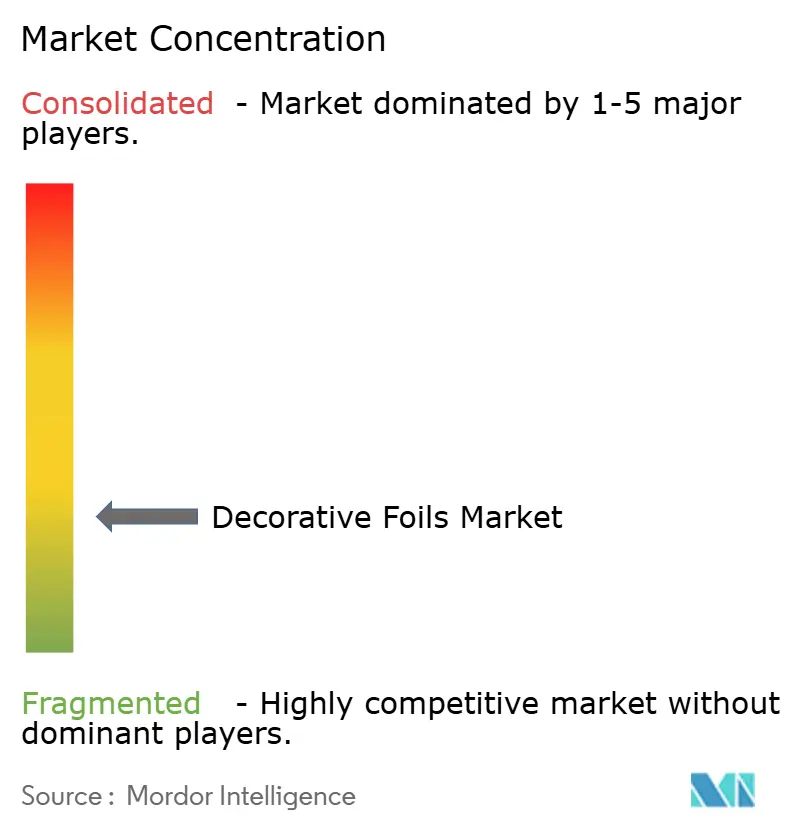
The decorative foils market is fragmented, with key players including TOPPAN Holdings, Schattdecor, SURTECO GmbH, Taghleef Industries, and Kronoplus. Established firms compete through design services, material performance, manufacturing scale, and access to furniture-production clusters that require consistent product availability. Their portfolios must support cost-sensitive applications while addressing higher-value requirements for sustainability, customization, and surface performance. This structure allows specialists to compete by responding quickly to local design trends, substrate compatibility needs, and customer lead-time expectations.
In October 2025, Schattdecor and RENOLIT Interior Products formalized a decor coordination partnership, making Schattdecor's decor range available as RENOLIT premium 3D thermolaminates. The shared color system is intended to reduce appearance differences across material categories and simplify surface specification for furniture manufacturers that combine foil, laminate, and edge-band products. Taghleef Industries has taken a material-platform approach through its synDECOR Polypropylene (PP) and Polyethylene Terephthalate (PET) foil range, positioning it against High-Pressure Laminate (HPL), Continuous Pressure Laminate (CPL), Thermally Fused Laminate (TFL), and Polyvinyl Chloride (PVC) alternatives. Impress Surfaces introduced 40 decors across 6 categories at Interzum 2025, demonstrating how design collection renewal can serve as a competitive tool alongside technical performance[2]. These developments indicate that design coordination, substrate development, and collection speed influence supplier selection as directly as production scale in many customer decisions.
Opportunities are emerging where recycled-content foils meet institutional requirements for fire ratings and material declarations. Smaller suppliers with verified environmental management systems and recycled-content products can pursue these applications without competing solely on price against larger firms. South Korean film producers could also enter European private-label supply through digital-printing flexibility and competitive production costs, placing additional pressure on mid-market European finish-foil producers. Incumbent firms are likely to respond through integrated design, consistent color systems, and broader sustainable-material portfolios, keeping competition active across the decorative foils market.
Decorative Foils Industry Leaders
-
TOPPAN Holdings Inc.
-
Schattdecor
-
SURTECO GmbH
-
Taghleef Industries
-
Kronoplus Limited
- *Disclaimer: Major Players sorted in no particular order
Decorative Foils Market Companies Covered in this Report
- 3M
- Ahlstrom
- Avery Dennison Corporation
- Eastman Chemical Company
- Ergis Group
- impress Surfaces GmbH
- INTERPRINT GmbH
- Klöckner Pentaplast
- Kronoplus Limited
- LX Hausys
- RENOLIT SE
- Schattdecor
- SURTECO GmbH
- Taghleef Industries
- TOPPAN Holdings Inc.
Recent Industry Developments in Decorative Foils Market
- February 2026: Schattdecor launched its Prime Collection 2026/27 at Meble Polska in Poznan, offering paper-based Smartfoil films and single-color PP Smartflex Mat+ films. The collection is orderable in 1-roll quantities and dispatched within 7 working days, reducing furniture manufacturers' inventory requirements and catering to demand for decorative foils in monochromatic and muted-tone finishes, including Sage Green and cashmere beige.
- October 2025: RENOLIT Interior Products and Schattdecor formalized a decor coordination partnership at SICAM 2025 in Fiera di Pordenone, Italy. Schattdecor's decor portfolio, from wood to fantasy finishes, was made available as RENOLIT premium 3D Thermolaminates, addressing metamerism across decorative foil, laminate, and edge-band categories for furniture manufacturers.
Global Decorative Foils Market Report Scope
Decorative foil is a thin metallic or holographic material used in crafts, art projects, interior accents, and product packaging. It is available in a wide range of finishes, including matte, glossy, and textured surfaces, and is applied to various substrates such as paper, fabric, plastic, and wood.
The decorative foils market is segmented by product type, application, end-user industry, and geography. By product type, the market is segmented into PVC foils, polyester foils, paper-based foils, and other product types. By application, the market is segmented into furniture and cabinetry, flooring, doors and windows, wall panels, countertops, and other applications. By end-user industry, the market is segmented into residential, commercial, institutional, transportation, and others. The report also covers market sizes and forecasts for decorative foils across 15 countries in major regions. The market sizes and forecasts are provided in terms of value (USD).
Segmentation Overview
| PVC Foils |
| Polyester Foils |
| Paper-Based Foils |
| Other Product Types |
| Furniture and Cabinetry |
| Flooring |
| Doors and Windows |
| Wall Panels |
| Countertops |
| Other Applications |
| Residential |
| Commercial |
| Institutional |
| Transportation |
| Others |
| Asia-Pacific | China |
| India | |
| Japan | |
| South Korea | |
| ASEAN Countries | |
| Rest of Asia-Pacific | |
| North America | United States |
| Canada | |
| Mexico | |
| Europe | Germany |
| United Kingdom | |
| France | |
| Italy | |
| NORDIC Countries | |
| Rest of Europe | |
| South America | Brazil |
| Argentina | |
| Rest of South America | |
| Middle East and Africa | Saudi Arabia |
| South Africa | |
| Rest of Middle East and Africa |
| By Product Type | PVC Foils | |
| Polyester Foils | ||
| Paper-Based Foils | ||
| Other Product Types | ||
| By Application | Furniture and Cabinetry | |
| Flooring | ||
| Doors and Windows | ||
| Wall Panels | ||
| Countertops | ||
| Other Applications | ||
| By End-User Industry | Residential | |
| Commercial | ||
| Institutional | ||
| Transportation | ||
| Others | ||
| By Geography | Asia-Pacific | China |
| India | ||
| Japan | ||
| South Korea | ||
| ASEAN Countries | ||
| Rest of Asia-Pacific | ||
| North America | United States | |
| Canada | ||
| Mexico | ||
| Europe | Germany | |
| United Kingdom | ||
| France | ||
| Italy | ||
| NORDIC Countries | ||
| Rest of Europe | ||
| South America | Brazil | |
| Argentina | ||
| Rest of South America | ||
| Middle East and Africa | Saudi Arabia | |
| South Africa | ||
| Rest of Middle East and Africa | ||
Key Questions Answered in the Report
What is current market size of Decorative Foils Market?
The decorative foils market size was valued at USD 2.70 billion in 2026 and is estimated to grow from USD 2.82 billion in 2027 to USD 3.57 billion by 2032, at a CAGR of 4.83% during the forecast period (2027-2032).
Which decorative foil product type leads global revenue?
PVC foils lead with a 43.78% revenue share in 2026, supported by established furniture-processing infrastructure, familiar production workflows, and cost competitiveness in high-volume applications.
Which application is growing fastest for decorative foils?
Flooring is the fastest-growing application, with a projected CAGR of 5.56% through 2032. Engineered boards with high-definition decoration can support projects that need moisture resistance, design consistency, and durable surfaces.
Why is residential demand important for decorative foils?
Residential users hold 37.37% share in 2026 and are forecast to grow at the highest CAGR of 5.82% through 2032. Renovation, household formation, and demand for accessible interior upgrades support this position.