
DDR5 Memory Module PMIC Market Size and Share
Market Overview
| Study Period | 2020 - 2031 |
|---|---|
| Market Size (2026) | USD 0.65 Billion |
| Market Size (2031) | USD 1.02 Billion |
| Growth Rate (2026 - 2031) | 9.43 % |
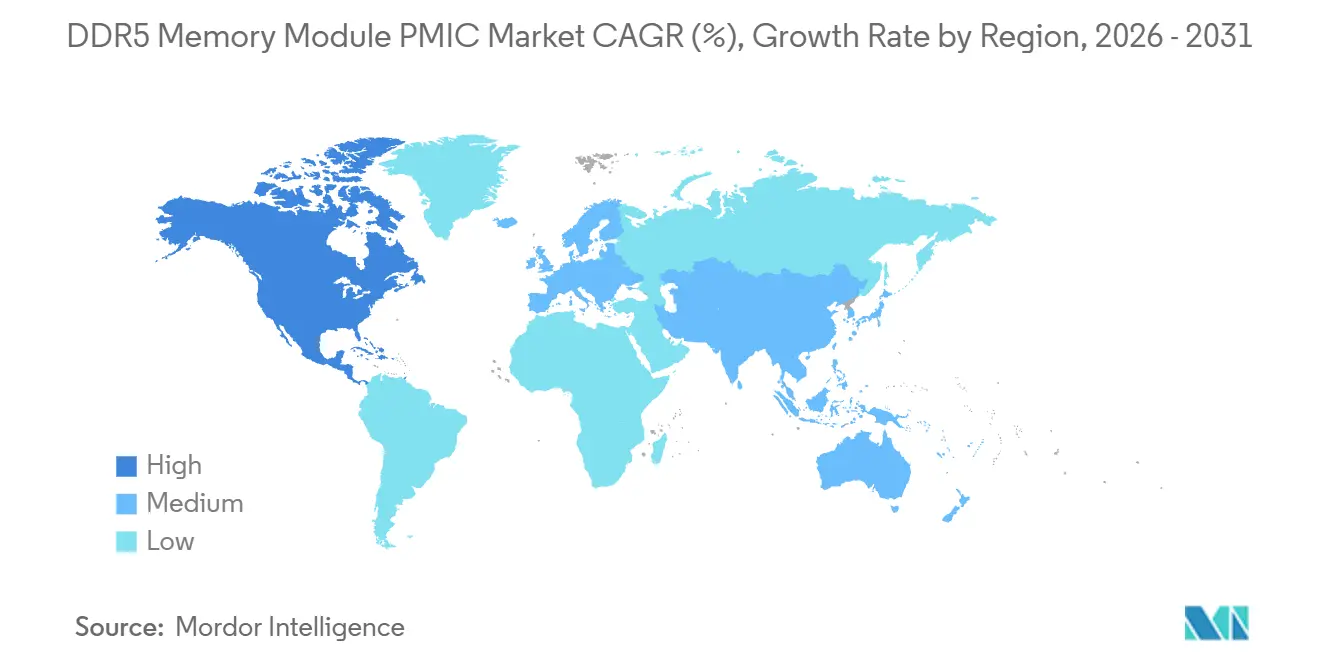
| Fastest Growing Market | North America |
| Largest Market | Asia-Pacific |
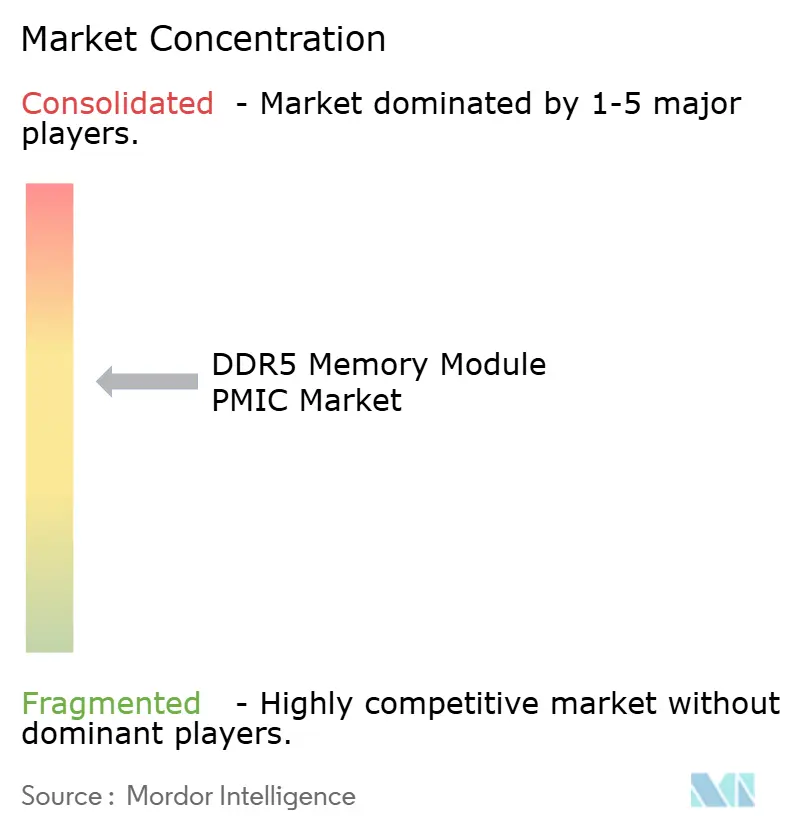
| Market Concentration | Medium |
Major Players *Disclaimer: Major Players sorted in no particular order Image © Mordor Intelligence. Reuse requires attribution under CC BY 4.0. | |
DDR5 Memory Module PMIC Market Analysis by Mordor Intelligence
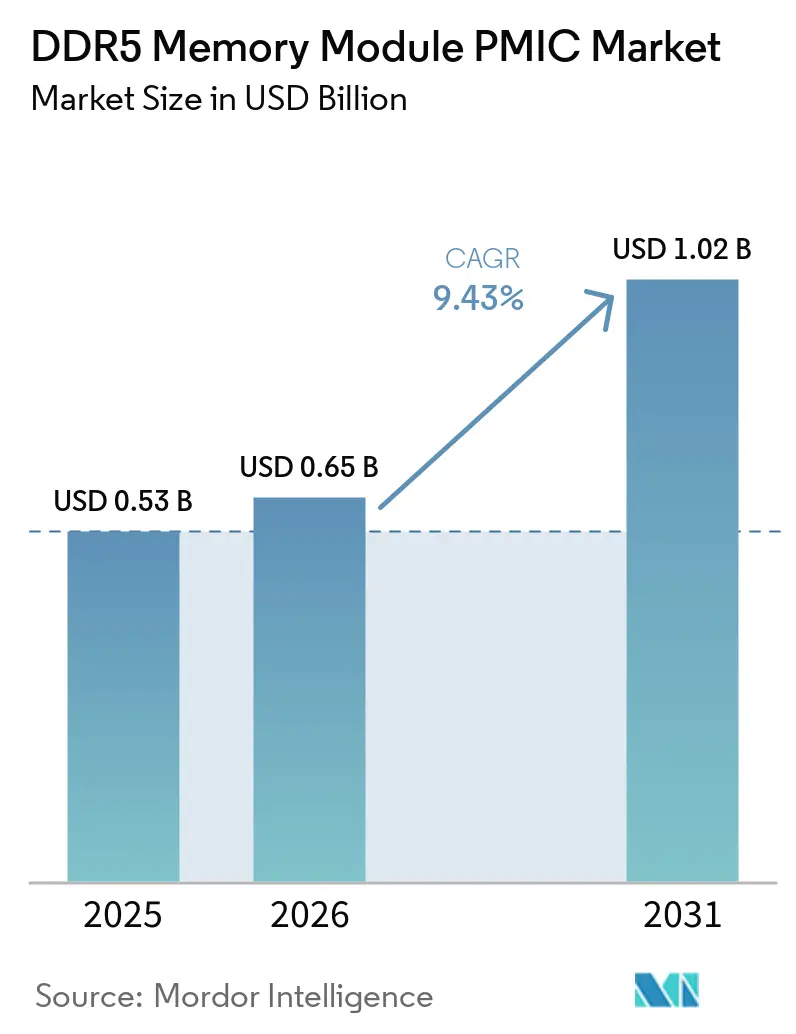
The DDR5 memory module PMIC market size was USD 0.53 billion in 2025 and is estimated to grow from USD 0.65 billion in 2026 to reach USD 1.02 billion by 2031, at a CAGR of 9.43% during the forecast period (2026-2031). Every DDR5 DIMM requires a discrete on-module PMIC under the JEDEC PMIC5000 through PMIC5030 specifications, which ties PMIC unit demand directly to DDR5 module shipments. Data center investment is supporting demand for denser, higher-capacity memory modules, particularly in server platforms used for AI workloads. The DDR5 memory module PMIC market benefits from rising speeds because each new memory generation needs a more capable power device and a new qualification cycle. Suppliers are competing for early design wins with DRAM makers and server platform providers, rather than relying only on stand-alone component sales. Qualification requirements, cyclical memory pricing, and the need for sustained engineering investment keep the addressable supplier base limited.
Key Report Takeaways
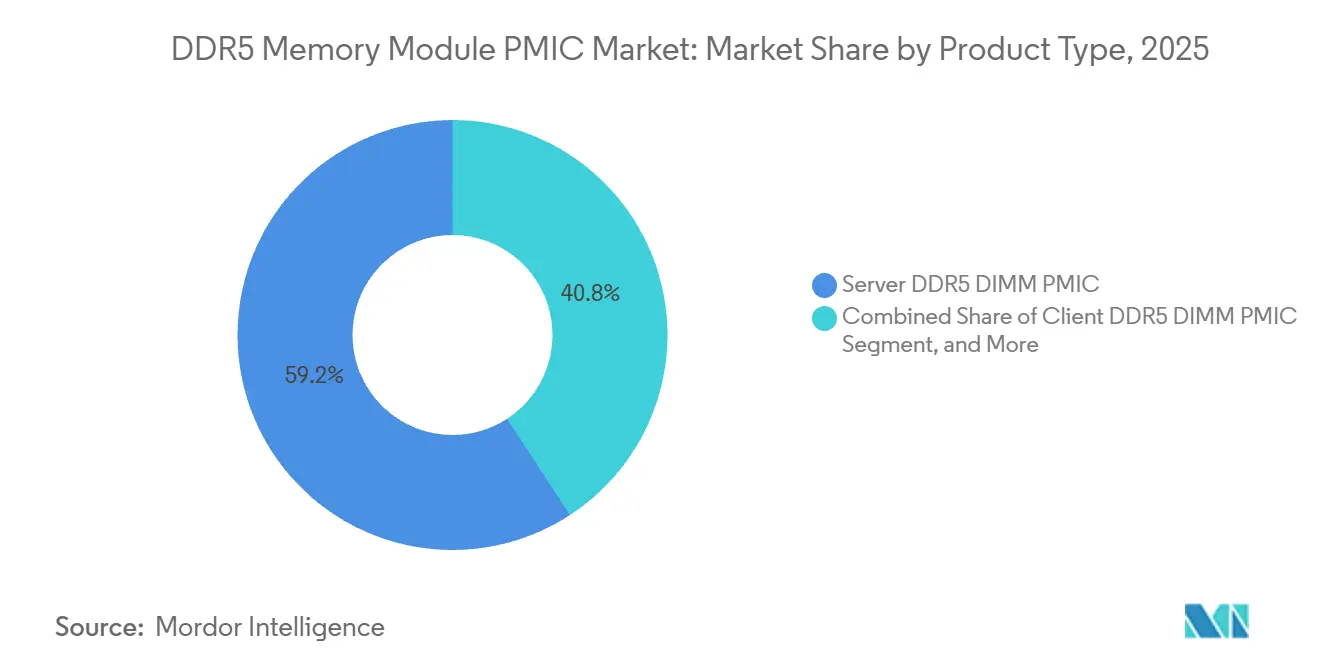
- By product type, Server DDR5 DIMM PMIC held 59.20% revenue share in 2025, while Gen2/High-Speed DDR5 PMIC is forecast to grow at a 10.58% CAGR through 2031 in the DDR5 Memory Module PMIC Market.
- By module type, RDIMM held 56.70% revenue share in 2025, while MRDIMM/MCRDIMM is forecast to grow at a 10.31% CAGR through 2031 in the DDR5 Memory Module PMIC Market.
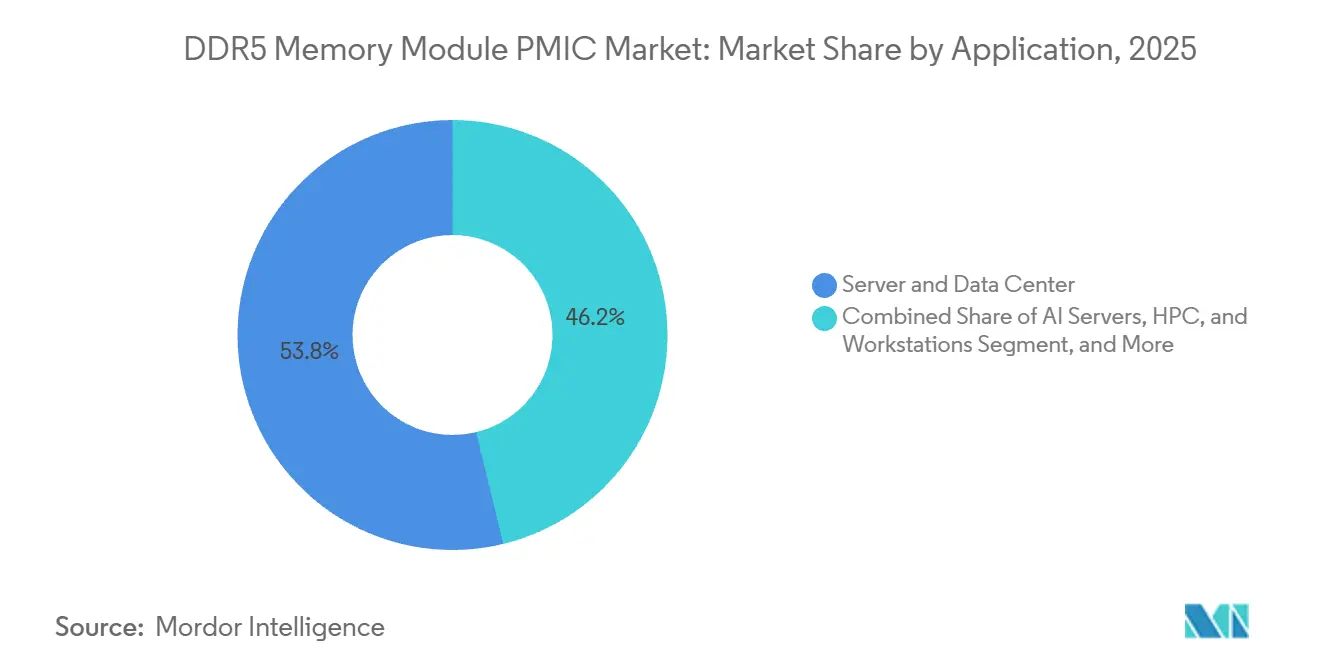
- By application, Server and Data Center held 53.80% revenue share in 2025, while AI Servers, HPC, and Workstations are forecast to grow at a 10.72% CAGR through 2031 in the DDR5 Memory Module PMIC Market.
- By end user, DRAM IDMs and in-house module makers held 44.10% of procurement in 2025, while third-party module integrators and assemblers are forecast to grow at a 10.18% CAGR through 2031 in the DDR5 Memory Module PMIC Market.
- By geography, the Asia Pacific held 80.40% revenue share in 2025, while North America is forecast to grow at a 10.43% CAGR through 2031 in the DDR5 Memory Module PMIC Market.
Note: Market size and forecast figures in this report are generated using Mordor Intelligence’s proprietary estimation framework, updated with the latest available data and insights as of January 2026.
Global DDR5 Memory Module PMIC Market Trends and Insights
Drivers Impact Analysis*
| Driver | (~) % Impact on CAGR Forecast | Geographic Relevance | Impact Timeline |
|---|---|---|---|
| On-Module PMIC Requirement for DDR5 DIMMs | +2.8% | Global | Short term (≤ 2 years) |
| AI Server and High-Performance Compute Memory Density | +2.2% | North America and Asia Pacific | Medium term (2-4 years) |
| Transition to Higher-Speed RDIMM and MRDIMM Designs | +1.5% | North America and Europe for deployments, Asia Pacific for manufacturing | Medium term (2-4 years) |
| Data Center Power Efficiency Requirements | +0.9% | Global, with strongest intensity in North America and Europe | Medium term (2-4 years) |
| Multi-Sourced PMIC Architectures | +0.5% | North America and Asia Pacific core | Short term (≤ 2 years) |
| PMIC Telemetry and Protection Features | +0.4% | Global | Long term (≥ 4 years) |
| Source: Mordor Intelligence | |||
On-Module PMIC Requirement for DDR5 DIMMs
JEDEC requirements make a discrete PMIC a standard part of every DDR5 DIMM, including server and client modules. The PMIC5000 through PMIC5030 family defined the required interface, control, and protection functions for these devices. This requirement gives the DDR5 memory module PMIC market a direct hardware link to each DDR5 module shipped. The relationship differs from DDR4 designs, where voltage regulation could remain on the motherboard. Higher speed grades also call for higher-current PMIC variants, which can raise component value per module. Samsung has entered this area because supplying both DRAM and PMICs can reduce its customers' module qualification work.[1]
AI Server and High-Performance Compute Memory Density
AI server racks increasingly use 96 GB and 128 GB RDIMMs, which require current levels suited to PMIC5020 or PMIC5030 devices. This shift supports higher-value PMIC content as memory capacity rises across the DDR5 memory module PMIC market. Global data center electricity use increased by 17% in 2025, and the IEA expects consumption to reach 945 TWh by 2030, up from 415 TWh in 2024.[2]The U.S. Department of Energy reported that U.S. data centers could account for 11.8% of national electricity consumption by 2030. AI inference also retains large model KV caches in memory, which increases demand for high-capacity server configurations. The DDR5 memory module PMIC market, therefore, gains from both growing server memory capacity and the move toward faster memory designs.
Higher-Speed RDIMM and MRDIMM Platform Transition
Server platform roadmaps are moving from RDIMM-7200 and MRDIMM-8800 toward faster DDR5 designs. JEDEC published PMIC5030 in January 2026 for the next performance tiers, including RDIMM-8000 and MRDIMM-12800 applications. Renesas introduced its Gen 3 MRDIMM chipset solutions in July 2026, with a stated speed of 16,000 MT/s and production availability targeted for the second half of 2027. This roadmap creates repeated PMIC replacement opportunities across the DDR5 memory module PMIC market, rather than a single gradual upgrade. Server OEM-approved vendor lists are platform-specific, so a new Intel or AMD platform can require another qualification cycle. Suppliers with current relationships with DRAM makers are better placed to meet the narrower launch windows.
Data Center Power Efficiency Requirements
Data center operators are treating power density and thermal performance as procurement considerations for memory subsystems. The IEA stated that data centers were expected to contribute nearly half of incremental U.S. electricity demand growth through 2030. DDR5 operates at a lower voltage than DDR4, but PMIC switching losses still add to module heat and cooling requirements. Richtek stated that its RTQ5153 PMIC5030 device was validated by multiple DRAM manufacturers and complied with Intel platform-approved vendor list requirements. Operators with large DIMM fleets can benefit from efficiency gains because small losses are repeated across thousands of installed modules. The DDR5 memory module PMIC market is consequently placing more weight on electrical efficiency, thermal behavior, and protection functions alongside formal compliance.
Restraints Impact Analysis*
| Restraint | (~) % Impact on CAGR Forecast | Geographic Relevance | Impact Timeline |
|---|---|---|---|
| Strict JEDEC Compliance and Long Qualification Cycles | -1.8% | Global | Short term (≤ 2 years) |
| High Complexity in Low-Voltage, High-Current Designs | -1.2% | Global | Medium term (2-4 years) |
| Customer Concentration in Server DIMM Supply Chains | -0.8% | Asia Pacific core, with spillover to North America | Medium term (2-4 years) |
| Memory Cycle Price Pressure and Platform Delays | -0.5% | Global | Short term (≤ 2 years) |
| Source: Mordor Intelligence | |||
Strict JEDEC Compliance and Long Qualification Cycles
DDR5 PMIC approval covers interface behavior, signaling accuracy, protection circuits, current limiting, and I3C bus performance. JEDEC defines these requirements in the PMIC5030 standard, which was published in January 2026. DRAM maker module validation and OEM platform approval can extend the full process to 12-24 months. Each PMIC5030 launch required suppliers targeting RDIMM-8000 to repeat qualification, including vendors with earlier PMIC5020 products. DRAM makers also apply proprietary criteria beyond the published JEDEC baseline. This process favors suppliers in the DDR5 memory module PMIC market that can finance parallel programs and maintain established customer relationships.
Complex Low-Voltage and High-Current Design Requirements
PMIC5030-class devices accept VIN_Bulk inputs from 4.25 V to 15.0 V and can provide up to 6 regulated output rails. The devices must maintain tight voltage control during demanding load changes at higher data rates and with more DRAM dies per module. Renesas lists I3C telemetry up to 12.5 MHz, secure-mode features, multiphase switching, and output protection in its device design. MRDIMMs add active MRCD and MDB buffers that must also be powered without expanding the module footprint. Rambus responded with a DDR5 9600 server RDIMM chipset that combined the PMIC5030, an RCD06 clock driver, and thermal sensing into a single validated design. The DDR5 memory module PMIC market has a high technical barrier to entry because device makers must meet both precise power requirements and system-level validation requirements.
*Our forecasts treat driver/restraint impacts as directional, not additive. The impact forecasts reflect baseline growth, mix effects, and variable interactions.
Segment Analysis
By Product Type: Server PMICs Hold the Revenue Base as Gen2 Designs Gain Momentum
Server DDR5 DIMM PMICs accounted for 59.20% of the DDR5 memory module PMIC market share in 2025. The category benefited from the higher average selling prices and larger module volumes associated with server-grade DIMMs. Client DDR5 DIMM PMICs serve SODIMM and UDIMM platforms in notebooks and desktop computers. These products have meaningful unit volumes from PC refresh activity, but their revenue per unit is lower because the power designs are simpler. High- and extreme-current server PMICs support RDIMM-4800 through RDIMM-7200 and MRDIMM-8800 applications. JEDEC updated PMIC5020 through JESD301-4A in March 2025 for this product range.
Gen2 and high-speed DDR5 PMIC is projected to expand at a 10.58% CAGR through 2031. Its growth follows Intel and AMD transitions toward PMIC5030-compliant devices for RDIMM-8000 and MRDIMM-12800 operation. Rambus introduced a DDR5 9600 Server RDIMM chipset in July 2026 that included PMIC5030 with its sixth-generation registering clock driver. RAMBUS.COM Rambus also introduced a DDR5 9600 client module chipset in May 2026 for CUDIMM, CQDIMM, and CSODIMM modules with PMIC5120.[3] These chipset offerings link PMIC demand to broader platform design wins. JEDEC qualification remains a required gate for new entrants to this part of the DDR5 memory module PMIC industry.

By Module Type: RDIMMs Support Current Volumes While MRDIMMs Raise Speed Requirements
RDIMM commanded 56.7% revenue share in 2025. It remains the standard module architecture for mainstream dual-socket server platforms. Registered modules buffer command and address signals, which support multi-rank and high-capacity configurations. Configurations of up to 128 GB per DIMM serve database, virtualization, and general-purpose computing workloads. UDIMM and SODIMM products provide capacity in desktop and notebook systems while offering lower PMIC complexity. LRDIMM, 3DS RDIMM, and CQDIMM formats serve specialized capacity and performance requirements.
MRDIMM and MCRDIMM are forecast to grow at a 10.3% CAGR through 2031. The format is shifting from sampling and qualification to commercial use across Intel Xeon 6 and AMD EPYC Venice-class platforms, driving demand in the DDR5 memory module PMIC market. A 2025 production-server study reported that first-generation MRDIMM at 8,800 MT/s delivered 40% higher peak bandwidth than RDIMM-6400 for relevant workloads. Renesas stated that its Gen 3 MRDIMM chipset was sampling with major DRAM suppliers in July 2026 and targets 16,000 MT/s.[4] MRDIMMs combine PMIC, MRCD, and MDB components, which increases semiconductor content per module. The DDR5 memory module PMIC industry can benefit when suppliers provide validated chipset solutions rather than separate power devices.
By Application: Server and Data Center Demand Leads While AI Workloads Grow Faster
Server and Data Center applications accounted for 53.80% of the DDR5 memory module PMIC market size in 2025. The position reflected the overlap between DDR5 RDIMM deployment and hyperscale or enterprise server refresh cycles. General-purpose cloud and enterprise servers often use more than 1 TB of DRAM in dual-socket configurations. Every occupied DIMM slot needs a qualified PMIC. Client PCs and notebooks generate lower PMIC revenue per unit because SODIMM and UDIMM power designs are less demanding. Telecom, networking, industrial, and embedded applications require specialized modules with lower volumes and, in some cases, higher unit prices due to qualification requirements.
AI Servers, HPC, and Workstations are forecast to grow at a 10.72% CAGR through 2031. The IEA reported that capital expenditure by 5 large technology companies exceeded USD 400 billion in 2025 and was set to increase 75% in 2026. AI inference requires large model KV caches to remain in memory, which can bring higher-capacity DIMMs into consideration. This condition supports earlier use of MRDIMM configurations than conventional compute deployments might require. Hyperscaler infrastructure teams are increasingly involved in setting memory configurations and approved component choices in the DDR5 memory module PMIC market. The DDR5 memory module PMIC market is therefore exposed to both server build volumes and the qualification preferences of major data center operators.
By End User: DRAM IDMs Lead Procurement While Integrators Expand
DRAM IDMs and in-house module makers held 44.10% of PMIC procurement in 2025. Samsung Electronics, SK hynix, and Micron Technology can qualify PMICs together with their DRAM dies during module development. This integrated process permits compatibility checks at the die-attach stage rather than only after module completion. It can shorten development timelines and strengthen supplier relationships. Independent memory module manufacturers, including Kingston and Innodisk, buy qualified PMICs for branded modules sold to retailers, system integrators, and regional cloud customers. Server, PC, and workstation OEMs and ODMs influence component choice through the requirements set in their reference designs.
Third-party module integrators and assemblers are forecast to expand at a 10.18% CAGR through 2031. The group serves white-label server memory needs within the DDR5 memory module PMIC market for regional cloud providers and ODM server builders in the Asia Pacific. Contract assemblers can source PMIC-integrated modules for customers that need tailored specifications. Large DRAM IDMs remain central to this supply model because they control much of the qualified DRAM supply. Industrial and embedded system OEMs are the smallest end-user group in the supplied segmentation. Their extended temperature requirements, long product lifecycles, and reliability specifications can support premium PMIC pricing. This part of the DDR5 memory module PMIC industry offers a different mix of volume, qualification rigor, and margin potential.
Geography Analysis
Asia Pacific accounted for 80.40% of the DDR5 memory module PMIC market share in 2025. South Korea, Taiwan, and China concentrate DRAM fabrication, module assembly, and relevant chipset production. South Korea hosts major DRAM fabrication operations for Samsung Electronics and SK Hynix. Taiwan supports the contract module assembly ecosystem and is home to Richtek Technology. SK hynix announced a KRW 54 trillion investment in its Yongin Y2 DRAM and Cheongju M17 NAND facilities in 2026. The stated investment underlines the region’s continued role in advanced memory production.
North America is forecast to grow at a 10.43% CAGR through 2031. U.S. hyperscaler data center investment is increasing demand for DDR5 server memory at scale. The IEA reported USD 320 billion of AI and data center infrastructure spending by Amazon, Microsoft, Meta, Alphabet, and peers in 2025. Micron stated in July 2026 that its U.S. manufacturing commitment reached USD 250 billion through 2035. This plan targets 40% domestic DRAM production from facilities in New York, Idaho, and Virginia. The regional production base can expand local module assembly and, in turn, the corresponding DDR5 memory module PMIC market demand.
Europe contributes through enterprise server deployments and design operations associated with Renesas, Infineon Technologies, and STMicroelectronics. Manufacturing remains more concentrated in Asia Pacific. The Rest of the World includes the Middle East and Africa and South America, where demand remains at an earlier stage. Gulf Cooperation Council investment in sovereign AI infrastructure supports regional data center activity. The DDR5 memory module PMIC market remains tied to Asian supply capacity even as demand growth is becoming more geographically distributed.
Competitive Landscape
The DDR5 memory module PMIC market is moderately concentrated, with a limited group of suppliers offering JEDEC-qualified products across the PMIC50xx range. Renesas Electronics has PMIC5010, PMIC5020, and PMIC5030-compliant products for server modules, including higher-current MRDIMM applications. Renesas identifies the RRG5322 as a PMIC5030 product for RDIMM and MRDIMM designs. DRAM IDMs also act as captive suppliers for their own memory module production. Their internal PMIC development can combine DRAM and power optimization within a single module program. JEDEC compliance and platform-specific approved vendor lists narrow the commercially active vendor pool for each server generation.
Rambus has expanded from intellectual property into silicon solutions for server and client DDR5 modules. It's a July 2026 DDR5 9600 Server RDIMM chipset bundled with a PMIC5030, an RCD06, an SPD hub, and a temperature sensor. The company’s May 2026 client chipset extended the same approach to AI PC module formats. Richtek offers another qualified supply option through its RTQ5153 PMIC for PMIC5030 applications. These offerings reduce single-source risk for OEMs in the DDR5 memory-module PMIC market while maintaining a high technical and qualification bar.
Monolithic Power Systems had confirmed initial orders for high-speed DDR5 memory components in 2026. In September 2026, it entered a long-term manufacturing agreement with GlobalFoundries for power solutions, with volume production targeted for early 2027. Samsung’s LSI division serves as an internal PMIC supplier for Samsung DDR5 module lines. Areas of opportunity include extreme-current PMICs for MRDIMM Gen2 and Gen3 modules above 12,800 MT/s. CXL memory modules and industrial or rugged designs also offer specialized opportunities because they require tailored power and reliability capabilities. The DDR5 memory module PMIC market continues to favor suppliers that combine power design capability, memory interface knowledge, and established qualification relationships.
DDR5 Memory Module PMIC Industry Leaders
-
Rambus Inc.
-
Renesas Electronics Corporation
-
Monolithic Power Systems, Inc.
-
Samsung Electronics Co., Ltd.
-
Richtek Technology Corporation
- *Disclaimer: Major Players sorted in no particular order
Recent Industry Developments
- September 2026: GlobalFoundries and Monolithic Power Systems announced a long-term manufacturing agreement to deploy MPS’s proprietary process technology at GF’s advanced 300 mm semiconductor facility in Singapore. Volume production is targeted for early 2027, expanding capacity for power management solutions serving AI and cloud infrastructure markets, a supply chain development that increases MPS’s capacity to compete for DDR5 PMIC design wins at scale.
- July 2026: Renesas Electronics announced its third-generation DDR5 MRDIMM chipset solutions, advancing server memory performance to 16,000 MT/s, 25% higher bandwidth than Gen 2, with MRCD (RRG5013x) and MDB (RRG5103x) components sampling to all major DRAM suppliers. Production availability is expected in the second half of 2027, and the platform includes PMIC, SPD Hub, and temperature sensor components.
- July 2026: Rambus announced its DDR5 9600 Server RDIMM chipset, integrating its sixth-generation registering clock driver (RCD06), PMIC5030, SPD Hub, and temperature sensor ICs into a unified solution supporting RDIMMs up to 9,600 MT/s, a 20% bandwidth increase over its prior-generation chipset, targeting agentic AI, HPC, and other data-intensive server workloads.
- May 2026: Rambus announced its complete DDR5 9600 Client Memory Module Chipset for CUDIMM, CQDIMM, and CSODIMM modules in next-generation AI PCs, featuring the Gen2 Client Clock Driver (CKD02), PMIC5120, and SPD Hub, supporting PC memory module operation from 8,000 to 9,600 MT/s.
- January 2026: JEDEC published the PMIC5030 Power Management IC Standard (JESD301-5, version 1.00), formalizing interface parameters, signaling protocols, and protection features for PMIC5030 devices used in RDIMM-8000 and MRDIMM-12800 memory module applications. The standard’s publication triggered mandatory re-qualification cycles for all DDR5 PMIC vendors seeking to participate in the next server platform generation.
Global DDR5 Memory Module PMIC Market Report Scope
The DDR5 Memory Module PMIC Market Report is Segmented by Product Type (Client DDR5, DIMM PMIC, Server DDR5 DIMM PMIC, High / Extreme Current Server PMIC, and Gen2 / High-Speed DDR5 PMIC), Module Type (UDIMM, SODIMM / SO-DIMM, RDIMM, MRDIMM / MCRDIMM, CUDIMM, CSODIMM, and Others (LRDIMM, 3DS RDIMM, CQDIMM)), Application (Server and Data Center, Client PCs and Notebooks, AI Servers, HPC, and Workstations, Industrial and Embedded Systems, Telecom and Networking Infrastructure, Others, including Automotive and Rugged Systems), End User (Memory Module Manufacturers, DRAM IDMs / In-house Module Makers, Third-party Module Integrators and Assemblers, Server, PC, and Workstation OEMs / ODMs, and Industrial and Embedded System OEMs), and Geography (North America, Europe, Asia Pacific (China, Japan, South Korea, Taiwan, Rest of Asia Pacific), Rest of the World). The Market Forecasts are Provided in Terms of Value (USD).
| Client DDR5 DIMM PMIC |
| Server DDR5 DIMM PMIC |
| High / Extreme Current Server PMIC |
| Gen2 / High-Speed DDR5 PMIC |
| UDIMM |
| SODIMM / SO-DIMM |
| RDIMM |
| MRDIMM / MCRDIMM |
| CUDIMM |
| CSODIMM |
| Others (LRDIMM, 3DS RDIMM, CQDIMM) |
| Server and Data Center |
| Client PCs and Notebooks |
| AI Servers, HPC, and Workstations |
| Industrial and Embedded Systems |
| Telecom and Networking Infrastructure |
| Others, including Automotive and Rugged Systems |
| Memory Module Manufacturers |
| DRAM IDMs / In-house Module Makers |
| Third-party Module Integrators and Assemblers |
| Server, PC, and Workstation OEMs / ODMs |
| Industrial and Embedded System OEMs |
| North America | |
| Europe | |
| Asia-Pacific | China |
| Japan | |
| South Korea | |
| Taiwan | |
| Rest of Asia-Pacific | |
| Rest of the World |
| By Product Type | Client DDR5 DIMM PMIC | |
| Server DDR5 DIMM PMIC | ||
| High / Extreme Current Server PMIC | ||
| Gen2 / High-Speed DDR5 PMIC | ||
| By Module Type | UDIMM | |
| SODIMM / SO-DIMM | ||
| RDIMM | ||
| MRDIMM / MCRDIMM | ||
| CUDIMM | ||
| CSODIMM | ||
| Others (LRDIMM, 3DS RDIMM, CQDIMM) | ||
| By Application | Server and Data Center | |
| Client PCs and Notebooks | ||
| AI Servers, HPC, and Workstations | ||
| Industrial and Embedded Systems | ||
| Telecom and Networking Infrastructure | ||
| Others, including Automotive and Rugged Systems | ||
| By End User | Memory Module Manufacturers | |
| DRAM IDMs / In-house Module Makers | ||
| Third-party Module Integrators and Assemblers | ||
| Server, PC, and Workstation OEMs / ODMs | ||
| Industrial and Embedded System OEMs | ||
| By Geography | North America | |
| Europe | ||
| Asia-Pacific | China | |
| Japan | ||
| South Korea | ||
| Taiwan | ||
| Rest of Asia-Pacific | ||
| Rest of the World | ||
Key Questions Answered in the Report
What is the forecast growth rate for DDR5 memory module PMICs?
The sector is forecast to grow at a 9.43% CAGR from 2026 to 2031, reaching USD 1.02 billion by 2031. Demand follows DDR5 module shipments and the shift to higher-current server memory designs.
Why do DDR5 DIMMs need a PMIC?
JEDEC specifications require a discrete on-module PMIC for DDR5 DIMMs. The requirement moves power regulation onto the module and creates a direct component need for every qualifying DDR5 DIMM shipped.
Which DDR5 PMIC product type led revenue in 2025?
Server DDR5 DIMM PMIC led with 59.02% revenue share in 2025. Server-grade modules carry higher power requirements and typically have greater revenue per unit than client DIMM applications.
Which memory module format is growing the fastest?
MRDIMM and MCRDIMM is forecast to grow at a 10.31% CAGR through 2031. Its higher bandwidth supports AI and analytics workloads that need greater memory capacity and data throughput.
Which application is expanding fastest for DDR5 PMIC suppliers?
AI Servers, HPC, and Workstations is forecast to grow at a 10.72% CAGR through 2031. These systems use dense memory configurations and can accelerate demand for advanced PMIC generations.