
Data Lineage Security Market Size and Share
Market Overview
| Study Period | 2020 - 2031 |
|---|---|
| Market Size (2026) | USD 1.49 Billion |
| Market Size (2031) | USD 3.79 Billion |
| Growth Rate (2026 - 2031) | 20.53 % |
| Fastest Growing Market | Asia-Pacific |
| Largest Market | North America |
| Market Concentration | Medium |
Major Players *Disclaimer: Major Players sorted in no particular order Image © Mordor Intelligence. Reuse requires attribution under CC BY 4.0. | |
Data Lineage Security Market Analysis by Mordor Intelligence
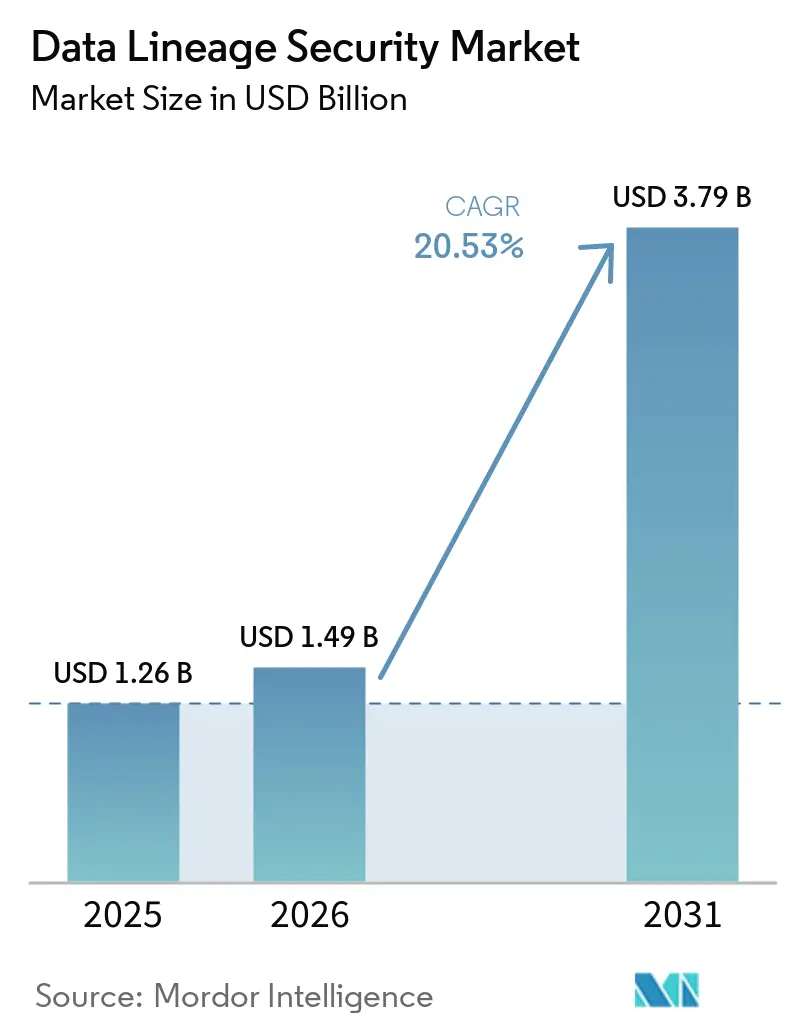
The data lineage security market size is projected to expand from USD 1.26 billion in 2025 to USD 1.49 billion in 2026, and to USD 3.79 billion by 2031, registering a CAGR of 20.53% between 2026 and 2031. Enterprise AI programs are making reliable records of data origin, movement, and use, a practical security requirement. Privacy rules, resilience obligations, and AI governance requirements are also increasing the demand for traceable data pipelines. Cloud adoption is moving more data across platforms, which increases the need for controls that work across cloud and on-premises environments. Vendors are responding by combining lineage, classification, access controls, and monitoring functions within broader platforms. Implementation complexity remains a constraint, especially where legacy systems have incomplete metadata or limited connectivity.
Key Report Takeaways
- By component, software held 68.39% of the data lineage security market revenue in 2025, while services are projected to expand at a 24.69% CAGR through 2031.
- By deployment mode, cloud-based deployment accounted for 64.83% of revenue in 2025 and is projected to grow at a 25.28% CAGR through 2031.
- By organization size, large enterprises held 71.74% of revenue in the data lineage security market in 2025, while SMEs are projected to expand at a 24.57% CAGR through 2031.
- By data type, structured data accounted for 46.97% of revenue in 2025, while semi-structured data is projected to grow at a 26.32% CAGR through 2031.
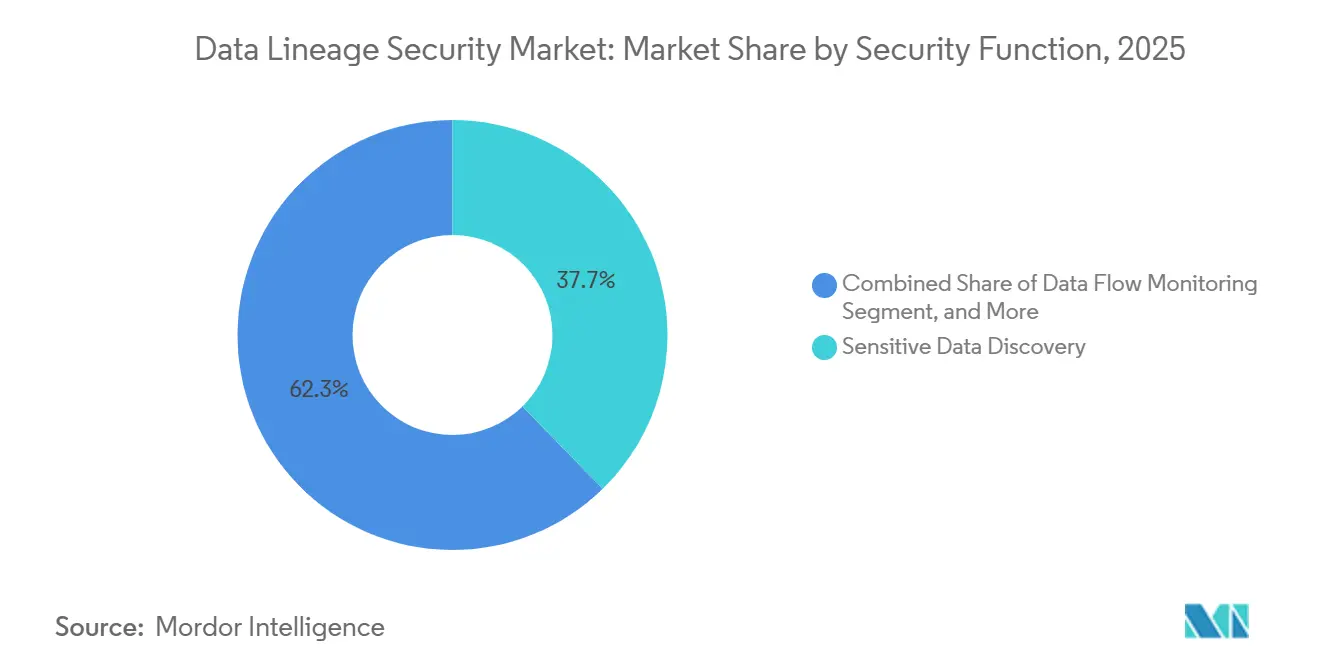
- By security function, sensitive data discovery held 37.68% of revenue in 2025, while data flow monitoring is projected to expand at a 26.51% CAGR through 2031 in the data lineage security market.
- By industry vertical, BFSI held 29.18% of revenue in 2025, while the government and public administration industry is projected to expand at a 26.26% CAGR through 2031.
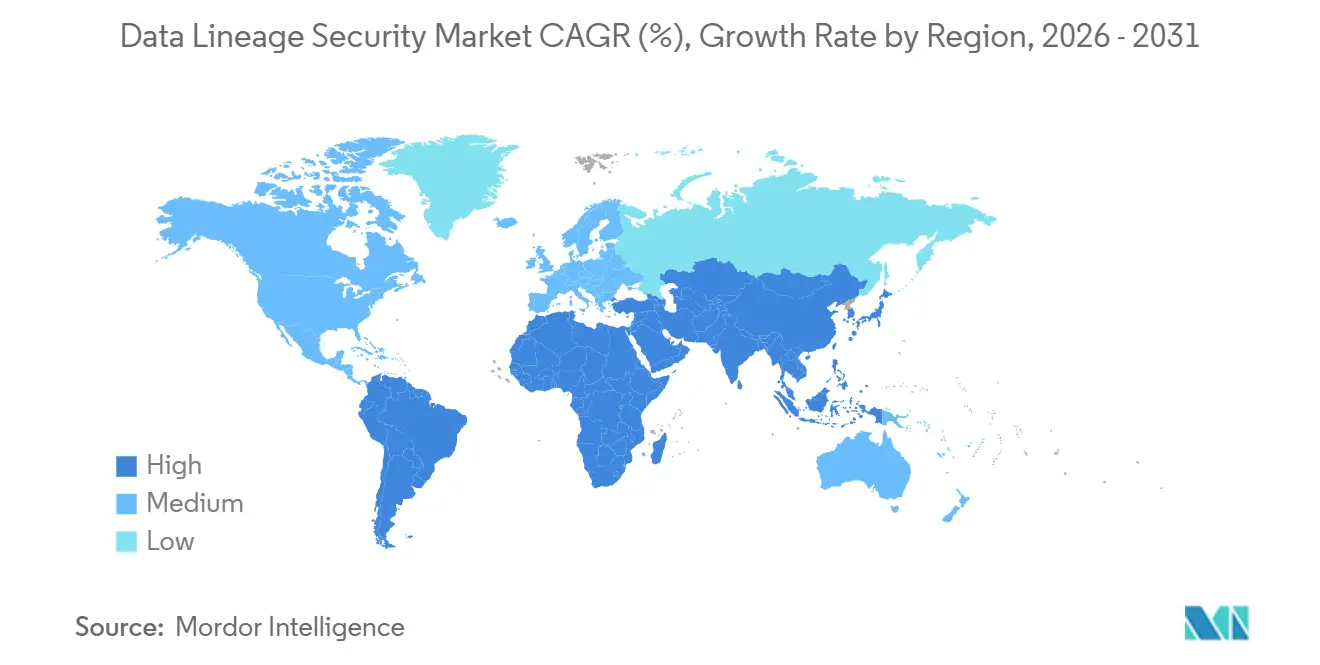
- By geography, North America held 42.59% of the data lineage security market in 2025, while Asia-Pacific is projected to expand at a 27.36% CAGR through 2031.
Note: Market size and forecast figures in this report are generated using Mordor Intelligence’s proprietary estimation framework, updated with the latest available data and insights as of January 2026.
Global Data Lineage Security Market Trends and Insights
Drivers Impact Analysis*
| DRIVER | (~) % IMPACT ON CAGR FORECAST | GEOGRAPHIC RELEVANCE | IMPACT TIMELINE |
|---|---|---|---|
| AI and Machine Learning Lineage Requirements | +4.2% | Global | Medium term (2-4 years) |
| Privacy and Data Sovereignty Regulations | +3.6% | Global | Short term (≤ 2 years) |
| Hybrid and Multicloud Environment Complexity | +3.1% | Global | Medium term (2-4 years) |
| Data Breaches and Unauthorized Data Propagation | +2.7% | Global | Short term (≤ 2 years) |
| Demand for Audit-Grade Data Traceability | +2.3% | North America and EU | Long term (≥ 4 years) |
| Lineage-Aware Controls for Real-Time Data and AI Agents | +1.8% | Global | Medium term (2-4 years) |
| Source: Mordor Intelligence | |||
Accelerating AI and Machine Learning Data Lineage Requirements
Enterprise AI deployment has made data provenance an operational and legal requirement rather than a governance objective for the Data lineage security market. EU AI Act Article 12 requires automatic logging for high-risk AI systems, including records of inputs used at inference time. The requirement became enforceable in August 2026 and increases the need for records that can be reviewed during an audit. Agentic systems also create changing data flows that static maps built for batch pipelines cannot fully capture. The Data lineage security market therefore favors platforms that record lineage continuously across generative AI, retrieval-augmented generation, and multi-agent workflows. Documentation of training-data origin and handling has also become part of a defensible board-level control framework.[1]
Expansion of Privacy and Data Sovereignty Regulations
Several privacy, operational resilience, and AI rules entered into force across 2025 and 2026, expanding the data lineage security market. DORA entered into force in January 2025, while EU AI Act obligations for general-purpose AI became applicable in August 2025. These requirements add to GDPR and NIS2 obligations that already affect security and data management practices. India notified its Digital Personal Data Protection Rules in November 2025, extending data protection requirements across a large domestic database. The Reserve Bank of India also requires regulated entities to maintain end-to-end lineage within their data governance frameworks. These overlapping obligations make cross-border documentation important when systems use data across different jurisdictions and infrastructures.
Rising Complexity of Hybrid and Multicloud Data Environments
The growing adoption of hybrid and multicloud operating models is driving growth in the data lineage security market. Fortinet reported that 88% of surveyed organizations operated hybrid or multicloud environments in 2026, and 81% used 2 or more providers for critical workloads.[2] Separate cloud platforms can create inconsistent monitoring, identity, and compliance practices across the same business. NIST identified gaps involving telemetry, logging, identity and access, data protection, and compliance authorization in multicloud architectures. Data lineage security tools can preserve evidence of data movement across these control boundaries. The need is strongest where non-human identities transfer data between cloud services without clear records of each handoff.
Increasing Frequency of Data Breaches and Unauthorized Data Propagation
The Data lineage security market also benefits from the rising volume and cost of data incidents. The Identity Theft Resource Center recorded 1,803 data compromises during the first half of 2026, a 3.3% increase from the first half of 2025. Financial services recorded 387 incidents during that period, reflecting its concentration of sensitive customer and transaction information. Verizon found ransomware in 44% of confirmed breaches in 2025, compared with 32% in 2024. The ITRC also found that 76% of 2026 breach notices did not explain how the incident occurred. Pre-existing lineage records can shorten investigations by showing where affected data moved and which systems handled it.
Restraints Impact Analysis*
| RESTRAINT | (~) % IMPACT ON CAGR FORECAST | GEOGRAPHIC RELEVANCE | IMPACT TIMELINE |
|---|---|---|---|
| Implementation and Integration Costs | -1.8% | Global | Short term (≤ 2 years) |
| Legacy Connectivity and Metadata Quality Gaps | -1.5% | North America and Europe | Medium term (2-4 years) |
| Interoperability and Lineage Standardization Gaps | -1.2% | Global | Medium term (2-4 years) |
| Performance Constraints in Distributed Environments | -0.9% | APAC core, spill-over to MEA | Long term (≥ 4 years) |
| Source: Mordor Intelligence | |||
High Implementation and Integration Costs
Enterprise lineage deployments require metadata harvesting, schema reconciliation, policy mapping, and monitoring integration across different systems. These activities need time from data owners, security teams, and technical specialists working across the data lineage security market. The resulting cost can prevent smaller organizations from moving beyond limited projects. OECD reported that 46% of SMEs had no or minimal security measures in 2026.[3] A peer-reviewed study found that continuous lineage and policy orchestration reduced audit preparation time by 90% after implementation. Vendors can address this constraint through templates, implementation accelerators, and cloud-based provisioning that reduces manual work.
Legacy-System Connectivity and Metadata Quality Gaps
Legacy core systems, on-premises warehouses, and proprietary ETL layers often lack interfaces that expose transformation logic. Lineage tools may need to interpret stored procedures, proprietary code, and informal data flows. This process introduces uncertainty before controls can be applied in the Data lineage security market. Incomplete metadata also makes it difficult to identify field owners and validate automated lineage results. The data lineage security market faces a particular challenge in banking, healthcare, and manufacturing, where older systems remain central to operations. Regulators increasingly expect column-level lineage, which is more detailed than the table-level records that many legacy systems can produce.
*Our forecasts treat driver/restraint impacts as directional, not additive. The impact forecasts reflect baseline growth, mix effects, and variable interactions.
Segment Analysis
By Component: Software Leads While Services Support Production Deployments
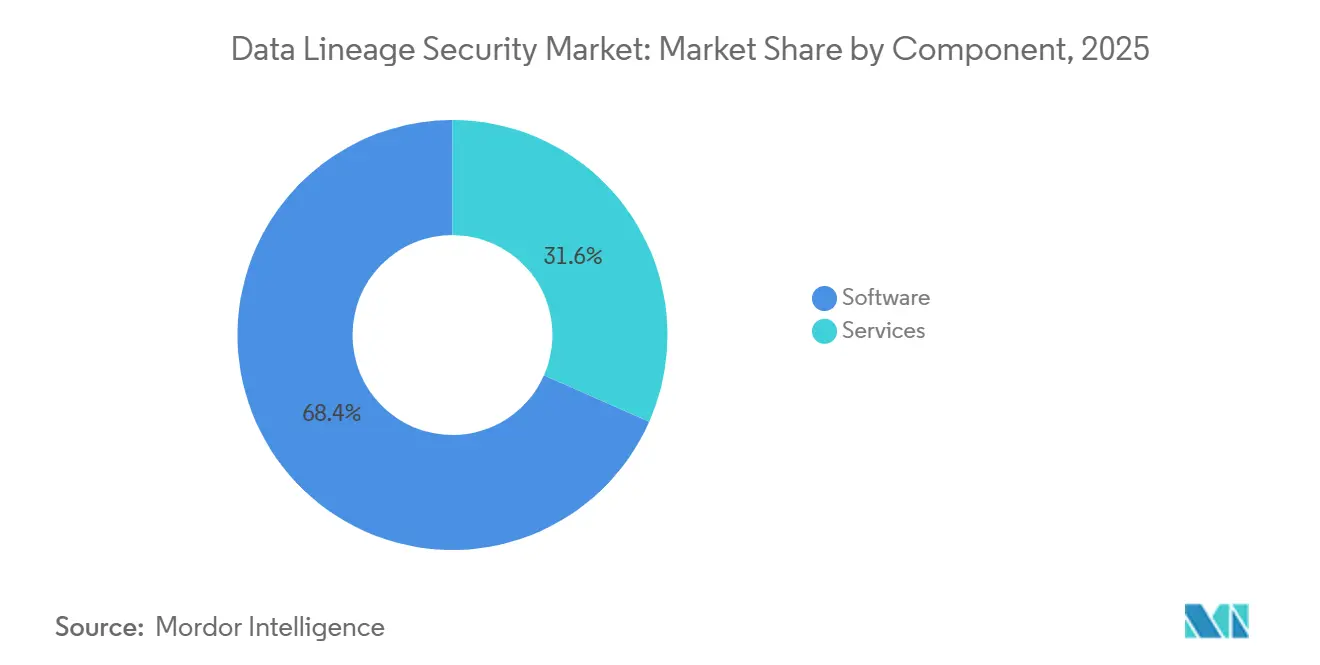
Software held 68.39% of revenue in 2025, reflecting a preference for platforms that bring discovery, classification, lineage tracking, and policy enforcement together. Large enterprises often select integrated software because it supports a shared view across multiple data sources. Subscription delivery has also made cloud-native data lineage security market platforms easier to procure and update. These platforms can provide the core records needed for compliance reviews and security investigations. Software's leading position reflected established spending on enterprise governance platforms.
Services is projected to grow at a 24.69% CAGR through 2031, which shows the level of work needed after a platform is purchased. Deployments require integration, configuration, workflow design, and continuing tuning across data and security functions. A peer-reviewed DevSecOps study found that continuous compliance requires coordination between data engineering, security operations, and compliance teams. Managed services can maintain harvesters, connectors, and compliance mappings for customers with limited internal capabilities. This support is particularly relevant as organizations move from pilot projects to production deployments across a wider number of systems.
By Deployment Mode: Cloud-Based Deployment Leads Across Connected Data Environments
Cloud-based deployment held 64.83% of revenue in 2025 and remains the leading delivery model for connected data environments. Cloud data platforms produce lineage events in environments where native extraction can be simpler than on-premises alternatives. This architecture supports frequent updates to lineage records and security policies. The data lineage security market size for Cloud-Based deployment is projected to expand at a 25.28% CAGR through 2031. The growth rate reflects the broader shift of data, analytics, and AI workloads into the data lineage security market via cloud-based services.
On-premises deployment remains necessary for air-gapped government and highly regulated environments. These users cannot move classified or controlled data through shared cloud control planes. Collibra released end-to-end lineage for self-hosted, air-gapped deployments in 2026.[4] Hybrid configurations are also important because many organizations still retain both cloud and on-premises workloads. OpenLineage support can help connect these environments by sharing technical lineage through a common format.
By Organization Size: Large Enterprises Retain Scale While SMEs Gain Access
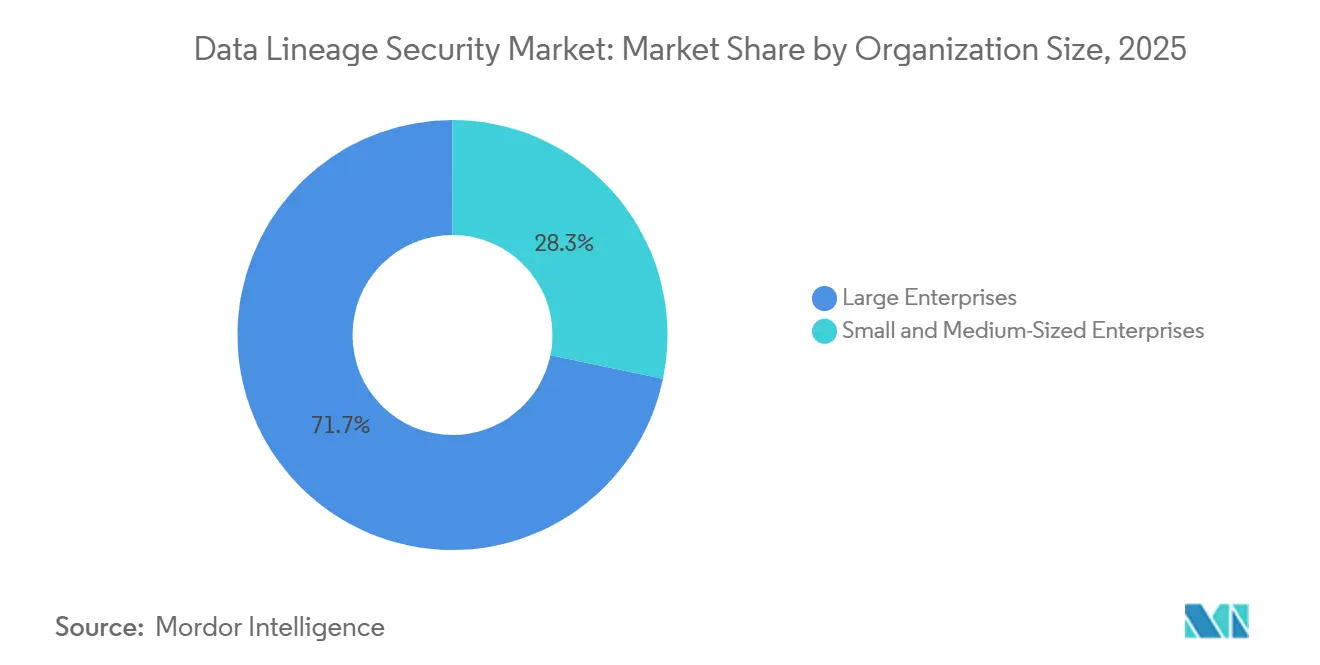
Large enterprises held 71.74% of revenue in 2025 because they have complex estates and established governance investments. Their environments can include hundreds of data pipelines, multiple business units, and several compliance obligations. That complexity creates both greater exposure and greater capacity to fund broad lineage programs. Large organizations also need records that support internal control testing and external regulatory reviews. The data lineage security market share held by large enterprises was supported by their ability to manage complex multi-system integrations.
SMEs are projected to grow at a 24.57% CAGR through 2031 as compliance obligations extend beyond large regulated institutions. OECD found that 22% of SMEs had experienced a digital security breach by 2026. Newer SMEs may also use cloud-native systems that connect through existing application interfaces. This can reduce the integration burden associated with older enterprise estates. Vendors that package lineage capabilities as lightweight cloud services can address this group without assuming large internal data engineering teams.
By Data Type: Structured Data Leads While Semi-Structured Data Expands
Structured data accounted for 46.97% of revenue in 2025 because lineage tools were originally developed for relational databases and SQL-based warehouses. This data type also aligns with regulatory requirements that specify detailed reporting and traceability. Financial institutions use structured lineage to follow risk and reporting data from source systems to final reports. The established base of structured systems supports continued demand for related capabilities. Unstructured data also remains important as AI systems process documents, emails, calls, and contracts that lack fixed schemas.
Semi-structured data is projected to grow at a 26.32% CAGR through 2031. JSON logs, XML feeds, Parquet files, and API event streams are common within event-driven applications and AI workflows. These formats can carry sensitive data across system boundaries without matching the fields used by traditional controls. IBM released column-level lineage export for Informatica Intelligent Cloud Services integration with Collibra in March 2026.[5] The release highlights the need to connect structured repositories to the intermediate formats used across modern data pipelines.
By Security Function: Discovery Provides the Base While Monitoring Gains Priority
Sensitive data discovery held 37.68% of revenue in 2025 because organizations must first identify sensitive information before applying other controls. Discovery helps locate regulated information across databases, cloud storage, applications, and data pipelines. It provides the input for classification, access decisions, and lineage mapping. The function also supports foundational compliance work, as businesses need evidence of where protected data is stored. Its position reflects the practical sequence used by many security and governance programs.
Data flow monitoring is projected to grow at a 26.51% CAGR through 2031. Classification turns discovery findings into categories usable in security policies. Flow monitoring then follows classified data as it moves between systems in near real time. This function is becoming more important where AI and resilience rules require more than periodic audit evidence. BigID introduced Agentic Access Control in August 2026, which evaluates AI agent actions using data context, intent, and identity. The capability illustrates the movement from passive observation toward active enforcement during data use.

By Industry Vertical: BFSI Leads While Government and Public Administration Accelerates
BFSI held 29.18% of revenue in 2025, making it the largest industry vertical. Banks and insurers face detailed requirements for risk data, customer information, regulatory reporting, and operational resilience. BCBS 239 expects systemically important banks to demonstrate traceability from source data through transformations to regulatory reports. This need makes lineage security a risk-management requirement rather than merely a compliance task. Healthcare and Life Sciences also require traceability as AI-supported diagnostic applications and the use of protected health information become more widespread.
The government and public administration industry is projected to grow at a 26.26% CAGR through 2031. Government AI programs need records that show data provenance, quality, sensitivity, and use across the model lifecycle. The General Services Administration requires AI projects to register data assets in enterprise catalogs with this documentation. Industrial Manufacturing, Retail and E-Commerce, and IT and Telecommunication are building related capabilities for supply chain data integrity and customer data governance. This broader adoption reduces the data lineage security market's reliance on the most regulated sectors for future demand.
Geography Analysis
North America held 42.59% of the data lineage security market share in 2025. CCPA enforcement, SEC disclosure requirements, HIPAA audit trails, and SOX financial integrity obligations support demand for traceable data pipelines. The United States also has a high concentration of regulated financial institutions and major cloud providers. This combination encourages integrated platform procurement and supports continued investment in data controls. Canada and Mexico add demand as cross-border data flows require traceability across parent companies and operating entities.
Europe contributed a substantial share of 2025 revenue because GDPR, DORA, NIS2, and the EU AI Act create a demanding regulatory environment. DORA entered into force in January 2025, while NIS2 enforcement began in October 2024. Germany, the United Kingdom, France, and the BENELUX cluster remain important because of their financial services presence and mature governance programs. European Commission guidance issued in July 2026 clarified the relationship between AI Act obligations and GDPR requirements for AI data teams, requiring documentation that addresses training-data records and purpose limitation requirements together.[6]
Asia-Pacific is projected to expand at a 27.36% CAGR through 2031 and is the fastest-growing region. India notified its Digital Personal Data Protection Rules in November 2025, while Indonesia enacted Government Regulation No. 33 of 2026 in July 2026. These actions increase formal data protection obligations in markets where compliance infrastructure is still developing. China, Japan, South Korea, and Australia also combine AI governance efforts with established privacy requirements. The Middle East and Africa remains at an earlier stage, although UAE, Saudi Arabia, and GCC financial centers are creating new demand in the data lineage security market.
Competitive Landscape
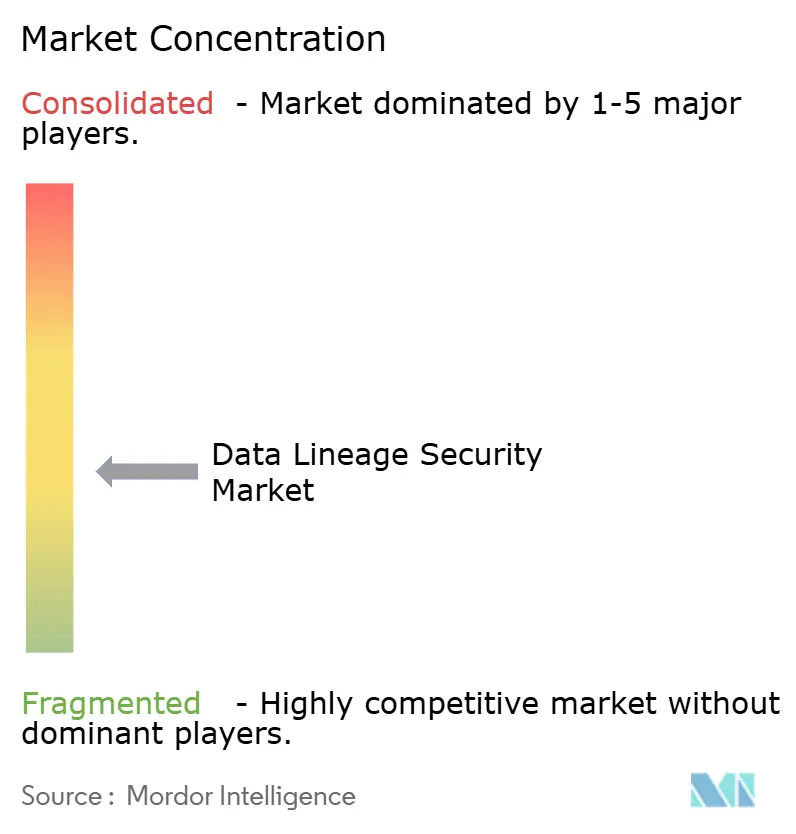
The data lineage security market is moderately fragmented, with no single provider holding a dominant revenue position. Collibra, Varonis, BigID, IBM, and Informatica have meaningful positions through platform coverage, enterprise accounts, and regulatory credibility. DSPM-focused vendors are extending upstream into governance, lineage, and catalog functions. Data catalog vendors are also expanding into classification, access enforcement, and data flow monitoring, and buyers increasingly compare both groups against a single set of requirements that combines governance depth with security enforcement.
AI capabilities are becoming an important area of differentiation in the data lineage security market. Providers need to map data used by generative AI systems, model training processes, and inference responses. Varonis launched its Atlas AI Security Platform in May 2026 with AI inventory discovery, posture management, runtime guardrails, and compliance mapping. In August 2026, Varonis added Claude Inference Hooks integration to support prompt inspection and real-time decisions before inference. BigID introduced controls for AI agent actions that use the context, stated intent, and identity associated with each request.
Opportunities remain in services for SMEs and in interoperability across AWS, Azure, Google Cloud, and on-premises systems. IBM introduced OpenLineage export in watsonx.data intelligence in May 2026 to support data sharing across governance and observability tools. Collibra expanded self-hosted lineage support for air-gapped customers in 2026. Emerging providers focus on real-time AI monitoring, cryptographic audit trails, and knowledge graph approaches for unstructured data. ISO/IEC 27001 and SOC 2 requirements also strengthen procurement barriers for newer vendors that lack established audit records.
Data Lineage Security Industry Leaders
-
Informatica Inc.
-
Collibra, Inc.
-
IBM Corporation
-
Microsoft Corporation
-
Securiti, Inc.
- *Disclaimer: Major Players sorted in no particular order
Recent Industry Developments
- August 2026: Varonis extended its Atlas AI Security Platform with an integration for Claude Inference Hooks on August 7, 2026, enabling real-time allow-or-deny verdicts for prompt inspection before inference runs, supporting organizations deploying Claude Enterprise, Claude Platform, and Claude Code with inline enforcement and compliance audit trails.
- July 2026: Varonis Systems announced an integration with Cursor, the AI-native coding tool, on July 8, 2026, adding session forensics, threat detection, and sensitive data and secrets protection across the full agentic development lifecycle, extending data lineage enforcement into the code-generation pipeline.
- May 2026: IBM introduced OpenLineage export capability in watsonx.data intelligence on May 27, 2026, enabling organizations to share unified data lineage across governance and observability tools in open format without custom integrations, supporting both OpenLineage import and export for complete interoperability.
- March 2026: IBM's watsonx.data intelligence released automated lineage export to Collibra in March 2026, enabling organizations using Collibra as their governance system of record to enrich existing catalogs with continuously refreshed end-to-end technical lineage without manual overhead or re-architecture.
Global Data Lineage Security Market Report Scope
The data lineage security market comprises tools that track, visualize, and secure data flow from origin through transformations, movements, and consumption across the data lifecycle. This market addresses security and compliance needs by providing end-to-end visibility into data provenance, showing where data originates, how it is transformed, which systems and processes touch it, and where it ultimately resides or is exposed. Solutions enable security teams to audit data flows for compliance (GDPR data subject rights, CCPA deletion requests), detect unauthorized data movement, trace data breaches to their source, validate data integrity across pipelines, and enforce security policies based on lineage metadata to ensure sensitive data does not flow to unapproved destinations or undergo unauthorized transformations.
The Data Lineage Security Market Report is Segmented by Component (Software, and Services), Deployment Mode (Cloud-Based, On-Premises, and Hybrid), Organization Size (Large Enterprises, and Small and Medium-Sized Enterprises), Data Type (Structured Data, Unstructured Data, and Semi-Structured Data), Security Function (Sensitive Data Discovery, Data Classification, Data Flow Monitoring, and Other Security Functions), Industry Vertical (Government and Public Administration, Industrial Manufacturing, Retail and E-Commerce, Transportation and Logistics, Energy and Utilities, Oil and Gas, IT and Telecommunication, Media and Entertainment, Education and Research Institutions, Healthcare and Life Sciences, Banking, Financial Services, and Insurance (BFSI), and Other Industry Verticals), and Geography (North America, South America, Europe, Asia-Pacific, and Middle East and Africa). The Market Forecasts are Provided in Terms of Value (USD).
| Software |
| Services |
| Cloud-Based |
| On-Premises |
| Hybrid |
| Large Enterprises |
| Small and Medium-Sized Enterprises |
| Structured Data |
| Unstructured Data |
| Semi-Structured Data |
| Sensitive Data Discovery |
| Data Classification |
| Data Flow Monitoring |
| Other Security Functions |
| Government and Public Administration |
| Industrial Manufacturing |
| Retail and E-Commerce |
| Transportation and Logistics |
| Energy and Utilities |
| Oil and Gas |
| IT and Telecommunication |
| Media and Entertainment |
| Education and Research Institutions |
| Healthcare and Life Sciences |
| Banking, Financial Services, and Insurance (BFSI) |
| Other Industry Verticals |
| North America | United States | |
| Canada | ||
| South America | Brazil | |
| Argentina | ||
| Mexico | ||
| Rest of South America | ||
| Europe | Germany | |
| United Kingdom | ||
| France | ||
| Italy | ||
| BENELUX | ||
| Rest of Europe | ||
| Asia-Pacific | China | |
| Japan | ||
| India | ||
| South Korea | ||
| Australia | ||
| Rest of Asia-Pacific | ||
| Middle East and Africa | Middle East | United Arab Emirates |
| Saudi Arabia | ||
| Rest of Middle East | ||
| Africa | South Africa | |
| Nigeria | ||
| Egypt | ||
| Rest of Africa | ||
| By Component | Software | ||
| Services | |||
| By Deployment | Cloud-Based | ||
| On-Premises | |||
| Hybrid | |||
| By Organization Size | Large Enterprises | ||
| Small and Medium-Sized Enterprises | |||
| By Data Type | Structured Data | ||
| Unstructured Data | |||
| Semi-Structured Data | |||
| By Security Function | Sensitive Data Discovery | ||
| Data Classification | |||
| Data Flow Monitoring | |||
| Other Security Functions | |||
| By Industry Vertical | Government and Public Administration | ||
| Industrial Manufacturing | |||
| Retail and E-Commerce | |||
| Transportation and Logistics | |||
| Energy and Utilities | |||
| Oil and Gas | |||
| IT and Telecommunication | |||
| Media and Entertainment | |||
| Education and Research Institutions | |||
| Healthcare and Life Sciences | |||
| Banking, Financial Services, and Insurance (BFSI) | |||
| Other Industry Verticals | |||
| By Geography | North America | United States | |
| Canada | |||
| South America | Brazil | ||
| Argentina | |||
| Mexico | |||
| Rest of South America | |||
| Europe | Germany | ||
| United Kingdom | |||
| France | |||
| Italy | |||
| BENELUX | |||
| Rest of Europe | |||
| Asia-Pacific | China | ||
| Japan | |||
| India | |||
| South Korea | |||
| Australia | |||
| Rest of Asia-Pacific | |||
| Middle East and Africa | Middle East | United Arab Emirates | |
| Saudi Arabia | |||
| Rest of Middle East | |||
| Africa | South Africa | ||
| Nigeria | |||
| Egypt | |||
| Rest of Africa | |||
Key Questions Answered in the Report
What is the size of the data lineage security market?
The data lineage security market size is projected to expand from USD 1.26 billion in 2025 to USD 1.49 billion in 2026, and to USD 3.79 billion by 2031, registering a CAGR of 20.53% between 2026 and 2031.
What is driving demand for data lineage security tools?
AI governance, privacy obligations, multicloud complexity, and data breach investigations are increasing the need for records of data origin and movement.
Which deployment model is growing fastest for data lineage security?
Cloud-Based deployment held 64.83% of revenue in 2025 and is projected to grow at a 25.28% CAGR through 2031.
Which organizations are adopting lineage security most quickly?
SMEs are projected to grow at a 24.57% CAGR as cloud-native tools and expanding regulatory obligations improve the case for adoption.
Why is data flow monitoring becoming more important?
Data Flow Monitoring is projected to grow at a 26.51% CAGR because organizations need more current evidence of how sensitive data moves through AI and cloud systems.
Which region is expected to grow fastest through 2031?
Asia-Pacific is projected to grow at a 27.36% CAGR, supported by new and developing privacy and AI governance requirements.