
Data Center Interconnect Route Intelligence Market Size and Share
Market Overview
| Study Period | 2020 - 2031 |
|---|---|
| Market Size (2026) | USD 0.72 Billion |
| Market Size (2031) | USD 1.81 Billion |
| Growth Rate (2026 - 2031) | 20.25 % |
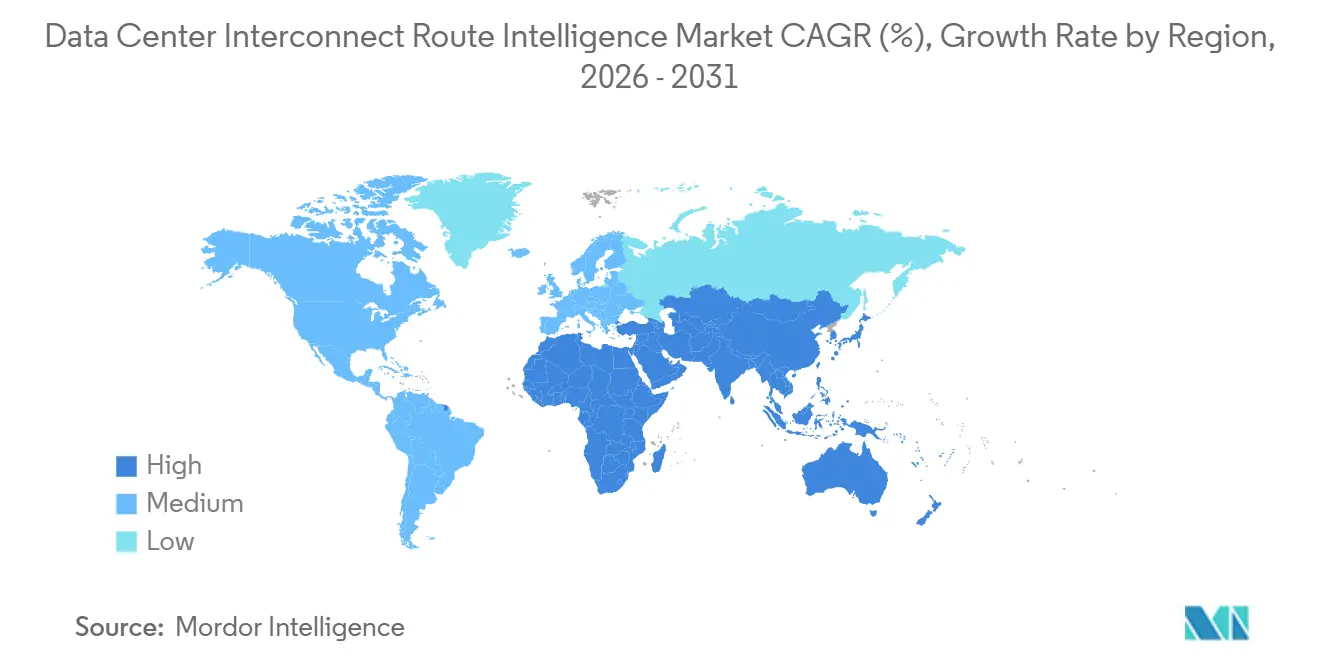
| Fastest Growing Market | Middle East |
| Largest Market | North America |
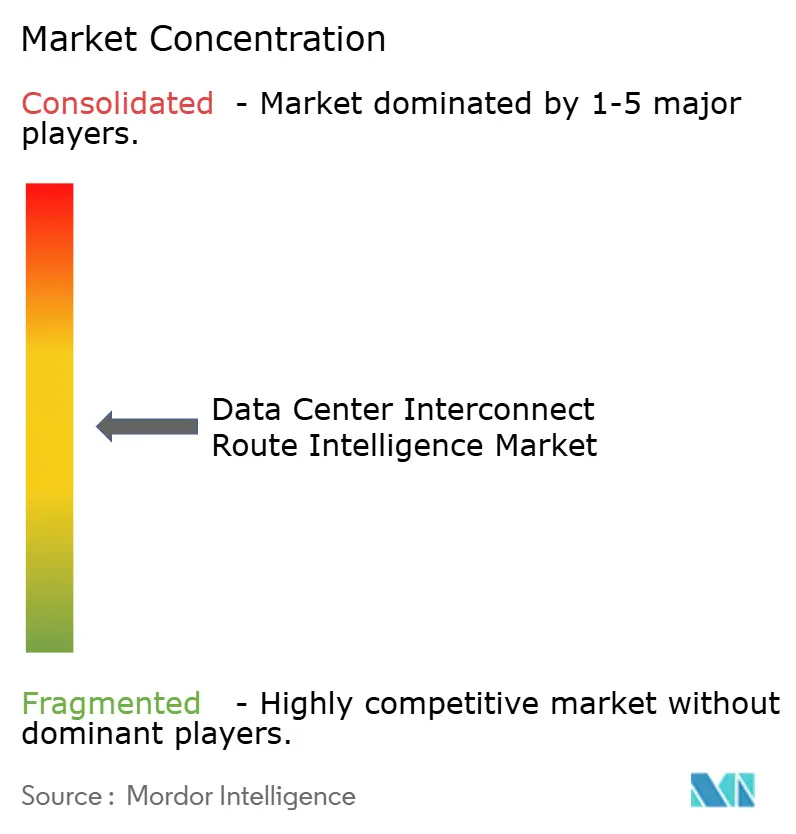
| Market Concentration | Medium |
Major Players *Disclaimer: Major Players sorted in no particular order Image © Mordor Intelligence. Reuse requires attribution under CC BY 4.0. | |
Data Center Interconnect Route Intelligence Market Analysis by Mordor Intelligence
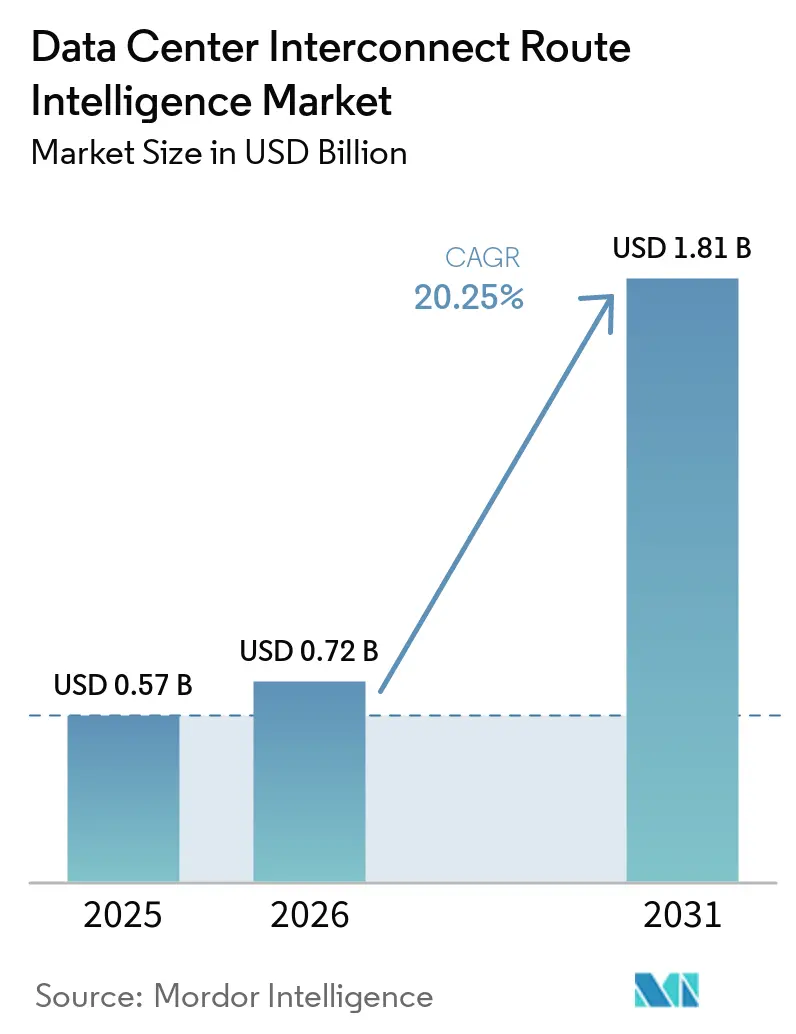
The data center interconnect route intelligence market size is projected to expand from USD 0.57 billion in 2025 and USD 0.72 billion in 2026 to USD 1.81 billion by 2031, registering a CAGR of 20.25% between 2026 and 2031. Growth reflects the move from single-site computing clusters to distributed AI facilities that need predictable, low-latency links between data centers. Buyers are placing greater value on routing policies, traffic visibility, and rapid recovery because performance depends on how workloads move across sites, not only on available bandwidth. Higher optical speeds are also changing purchasing decisions, since 400G, 800G, and 1.6T links require closer coordination between the optical layer and network control software. Open optical specifications are reducing dependence on proprietary hardware and are making orchestration software more relevant in multi-vendor networks. Capital costs, access to fiber, power availability, and interoperability issues will continue to shape whether organizations build private routes or use managed services.
Key Report Takeaways
- By solution layer, Hardware and Optical Transport held 54.73% of the data center interconnect route intelligence market share in 2025, while Route-Intelligence Software is projected to grow at a 21.46% CAGR through 2031.
- By connectivity medium, Wavelength Services held 30.45% revenue share in 2025, while IPoDWDM and Routed Optical Networking are expected to expand at a 22.69% CAGR through 2031.
- By data rate, 400G accounted for 28.64% revenue share in 2025, while the 1.6T and Above segment is projected to grow at a 21.68% CAGR through 2031.
- By application, Real-Time Disaster Recovery and Business Continuity accounted for 31.27% of revenue in 2025, while AI Cluster Federation and GPU Scale-Across are expected to expand at a 22.08% CAGR through 2031.
- By deployment model, Provider-Managed DCI held 37.91% revenue share in 2025, while Hybrid and Multi-Cloud DCI is projected to grow at a 21.86% CAGR through 2031.
- By geography, North America held 36.42% share in 2025, while Middle East is projected to expand at a 21.74% CAGR through 2031.
Note: Market size and forecast figures in this report are generated using Mordor Intelligence’s proprietary estimation framework, updated with the latest available data and insights as of January 2026.
Market Trends and Insights
Drivers Impact Analysis of Data Center Interconnect Route Intelligence Market*
| Driver | (~) % Impact on CAGR Forecast | Geographic Relevance | Impact Timeline |
|---|---|---|---|
| AI and HPC Scale-Across Deployments | +6.2% | Global | Short term (≤ 2 years) |
| Hyperscaler and Neocloud Expansion | +4.8% | North America, Asia-Pacific, Middle East | Short term (≤ 2 years) |
| Migration to 400G, 800G, and 1.6T Coherent Interconnects | +3.5% | North America, Europe, Asia-Pacific | Medium term (2-4 years) |
| Cloud Availability-Zone Replication and Business Continuity | +2.9% | Global | Medium term (2-4 years) |
| Edge, 5G, and Distributed Data Center Growth | +2.1% | Asia-Pacific core, spill-over to Middle East and Africa | Medium term (2-4 years) |
| Route-Aware Resilience and Sovereign Infrastructure Planning | +1.5% | Europe, Middle East, Asia-Pacific | Long term (≥ 4 years) |
| Source: Mordor Intelligence | |||
AI and HPC Scale-Across Deployments
AI training systems now extend across more than 1 data center because individual facilities cannot always provide the required power, land, or compute capacity. NVIDIA reported that Spectrum-XGS Ethernet delivered up to 1.9 times higher NCCL all-reduce bandwidth than standard Ethernet across separated sites. Meta designed its Prometheus cluster for 1 GW of planned capacity and used backend aggregation with 16-48 Pbps of inter-cluster backbone capacity for each regional pair. Its design used MACsec-secured BGP, link-bandwidth attributes, and unequal-cost multipath routing to place route decisions within the cluster fabric. KDDI also reported that distributed GPU training across 30 km achieved completion times comparable to those of a single-site deployment. The data center interconnect route intelligence market, therefore, benefits when operators prioritize GPU use and job completion over raw optical throughput.
Hyperscaler and Neocloud Expansion
Large cloud and AI infrastructure programs are creating concentrated orders for optical links and route-control platforms. Sovereign AI projects add a different buying pattern because their capacity plans are large and their procurement is often centralized. Saudi Arabia’s Humain targeted 6.6 GW of data-center capacity by 2034, with initial construction of a 200 MW campus underway. Stargate UAE targeted 5 GW of capacity across a 19.2-square-kilometer site, with project cost exceeding USD 30 billion. These developments increase the need for capacity planning across campuses, routes, and service providers. The data center interconnect route intelligence market gains from multi-year supplier relationships because providers must deliver equipment, software, and integration services within short implementation windows.
Migration to 400G, 800G, and 1.6T Coherent Interconnects
Coherent pluggables are changing the cost and design choices for data center interconnects. Marvell stated that its 1.6T Ara platform was in mass-volume production for hyperscalers and introduced Ara X, Ara T, Petra, and Aquila M optical DSPs in 3 nm. Ciena introduced the Vesta 200 6.4T CPX engine and claimed it uses up to 70% less power than traditional retimed solutions.[1]Ciena Corporation, “Ciena Unveils the Industry’s Highest-Density, Lowest-Power Pluggable Optical Engine to Meet Data Center AI Demands,” Ciena Corporation, businesswire.com STMicroelectronics began high-volume production of PIC100 800G and 1.6T silicon-photonics transceivers in 2025 and planned to increase production capacity more than 4 times by 2027. As physical-layer options become more widely available, operators need software that can assess route quality, capacity, and policy across mixed equipment. That transition supports demand for the data center interconnect route intelligence market beyond individual hardware refresh cycles.
Cloud Availability-Zone Replication and Business Continuity
Cloud providers and regulated organizations require routes that can support replication and failover between availability zones. Real-Time Disaster Recovery and Business Continuity accounted for 31.27% of application revenue in 2025, underscoring the continued importance of resilience workloads. Financial services, health care, and public-sector users increasingly need recovery objectives below 15 seconds. Oracle launched OCI Zettascale10 in October 2025 to connect hundreds of thousands of NVIDIA GPUs across multiple data centers, forming multi-gigawatt clusters. The International Energy Agency projected that global data-center electricity demand could exceed 1,000 TWh by 2030 under high-growth conditions. Route selection can consequently consider latency, resilience, and energy use simultaneously.
Restraints Impact Analysis of Data Center Interconnect Route Intelligence Market*
| Restraint | (~) % Impact on CAGR Forecast | Geographic Relevance | Impact Timeline |
|---|---|---|---|
| High Capital Intensity of Optical and Route Infrastructure | -1.8% | Global | Short term (≤ 2 years) |
| Fiber, Power, and Permitting Constraints | -1.3% | North America, Europe | Medium term (2-4 years) |
| Multi-Vendor Interoperability and Operational Complexity | -0.9% | Global | Medium term (2-4 years) |
| Route-Level Security, Sovereignty, and Data-Residency Exposure | -0.7% | Europe, Middle East, Asia-Pacific | Long term (≥ 4 years) |
| Source: Mordor Intelligence | |||
High Capital Intensity of Optical and Route Infrastructure
Private DCI networks require significant upfront investment in civil works, optical equipment, route design, and operations. The International Energy Agency stated that infrastructure projects can take 20% longer than planned and can exceed budgets by up to 80%. These conditions can delay plans for dedicated optical routes and make smaller operators more cautious. Large-load grid interconnections can also require substantial network upgrades before new facilities can operate. The restraint is strongest for enterprises and regional carriers that lack the scale to spread costs across many sites. This has supported provider-managed and colocation-based options in the data center interconnect route intelligence market, as these models shift some infrastructure costs to specialized providers.
Fiber, Power, and Permitting Constraints
Access to fiber routes, grid capacity, and permits can delay projects even when funding is available. Operators may find that established dark-fiber corridors offer greater immediate value than constructing new routes. This condition encourages wavelength services, capacity leasing, and route designs that use existing paths more efficiently. It also increases the value of software that can move traffic among available physical routes when capacity or power conditions change. Regional constraints are more acute in North America and Europe, where large data-center clusters compete for grid access and rights-of-way. The data center interconnect route intelligence market can therefore expand through optimization tools, although infrastructure shortages still restrict the pace of underlying site development.
*Our forecasts treat driver/restraint impacts as directional, not additive. The impact forecasts reflect baseline growth, mix effects, and variable interactions.
Data Center Interconnect Route Intelligence Market Segment Analysis
By Solution Layer:
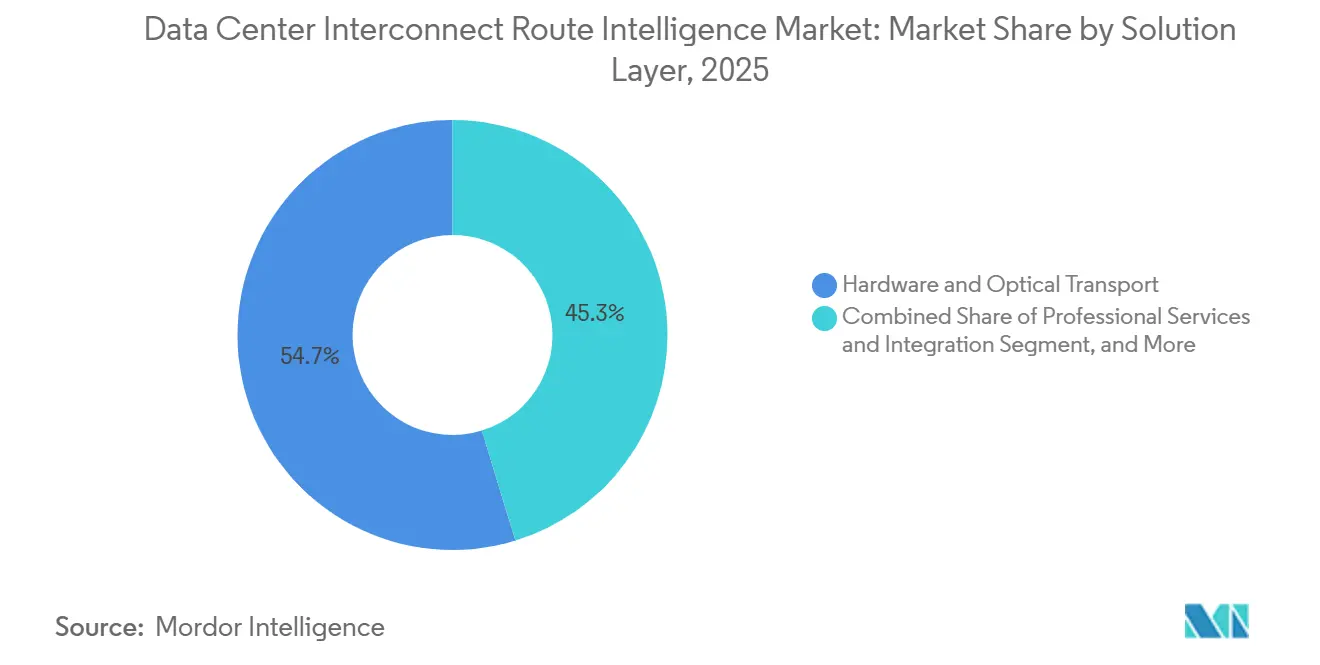
Hardware Leads While Software Expands FasterHardware and Optical Transport accounted for 54.73% of solution-layer revenue in 2025, making it the largest share of the data center interconnect route intelligence market. The segment remained central to ROADM deployments, coherent line-system upgrades, optical amplifier refreshes, and continued wavelength additions. Ciena Corporation, Nokia Oyj, and Coherent Corp. served the chassis-based and pluggable hardware requirements of hyperscalers, carriers, and colocation providers. Hardware demand followed multiyear investment programs because physical capacity additions require planning, installation, and testing across sites. Managed Connectivity Services also benefited when enterprises and neocloud operators chose to outsource day-to-day route management.
Route-Intelligence Software is projected to grow at a 21.46% CAGR through 2031, the fastest rate in this segmentation. Buyers are increasingly treating policy-aware routing, network digital twins, and AI-supported telemetry as purchases that are separate from hardware upgrades. Smartoptics added Fiber Route Analysis and improved capacity planning to its SoSmart platform in January 2026, giving operators span-level loss information and route views across their networks. Ciena also presented agentic AI capabilities for assurance, routing, and network-digital-twin validation at OFC 2026. The open optical roadmap advanced by the OCI MSA further supports a separation between physical interfaces and the software used to control traffic.



By Connectivity Medium:
Wavelength Services Hold the Base While Routed Optical Networking GrowsWavelength Services held 30.45% of connectivity-medium revenue in 2025, the largest share within this segmentation of the data center interconnect route intelligence market. Operators used managed optical paths when disaster recovery and availability-zone connections required service-level commitments for latency and uptime. Dark Fiber remained important for hyperscalers that built private optical networks and wanted direct control over capacity. Carrier Ethernet continued to serve enterprise deployments at lower bandwidth thresholds. Submarine Cable Systems remained a smaller but strategically important medium for intercontinental cloud connectivity. Microsoft’s planned 15,000 km deployment of hollow-core fiber illustrated the long-cycle nature of such infrastructure programs.
IPoDWDM and Routed Optical Networking are expected to expand at a 22.69% CAGR through 2031, the highest rate among connectivity mediums. The architecture combines IP routing and DWDM transmission on 1 platform, reducing reliance on separate transponder layers. IP Infusion released OcNOS 7.0 with native 400G and 800G ZR and ZR+ optics, along with segment-routing features for service-aware paths on open hardware. 1Finity updated Virtuora in July 2026 to provide cloud-native, multi-domain and multi-vendor management from L0 through L3. These tools allow operators to apply route policies across equipment from more than 1 vendor.
By Data Rate:
400G Holds Revenue While 1.6T Drives the Next Upgrade Cycle400G accounted for 28.64% of data-rate revenue in 2025 and was the largest current revenue base in the data center interconnect route intelligence market. Its position reflected mature 400ZR and ZR+ pluggable ecosystems, established OIF interoperability work, and broad multi-vendor availability. Many metropolitan and campus DCI deployments continued to use 400G because the technology balanced capacity, interoperability, and deployment readiness. The 200G and 300G categories still served selected metropolitan and campus applications. Up to 100G systems became less relevant as operators upgraded older capacity layers.
The 1.6T and Above category is projected to grow at a 21.68% CAGR through 2031, making it the fastest-growing data-rate segment. AI scale-across designs require higher spectral efficiency per fiber pair and support the rollout of 1.6T coherent DSPs. Marvell’s Ara platform had entered mass production for this requirement, while STMicroelectronics had begun high-volume production of 800G and 1.6T silicon-photonics transceivers. The 800G category served as a practical bridge between current 400G networks and later 1.6T deployments. The expanding range of physical options increases the need for route-management software that can operate across different link types and distances.
By Application:
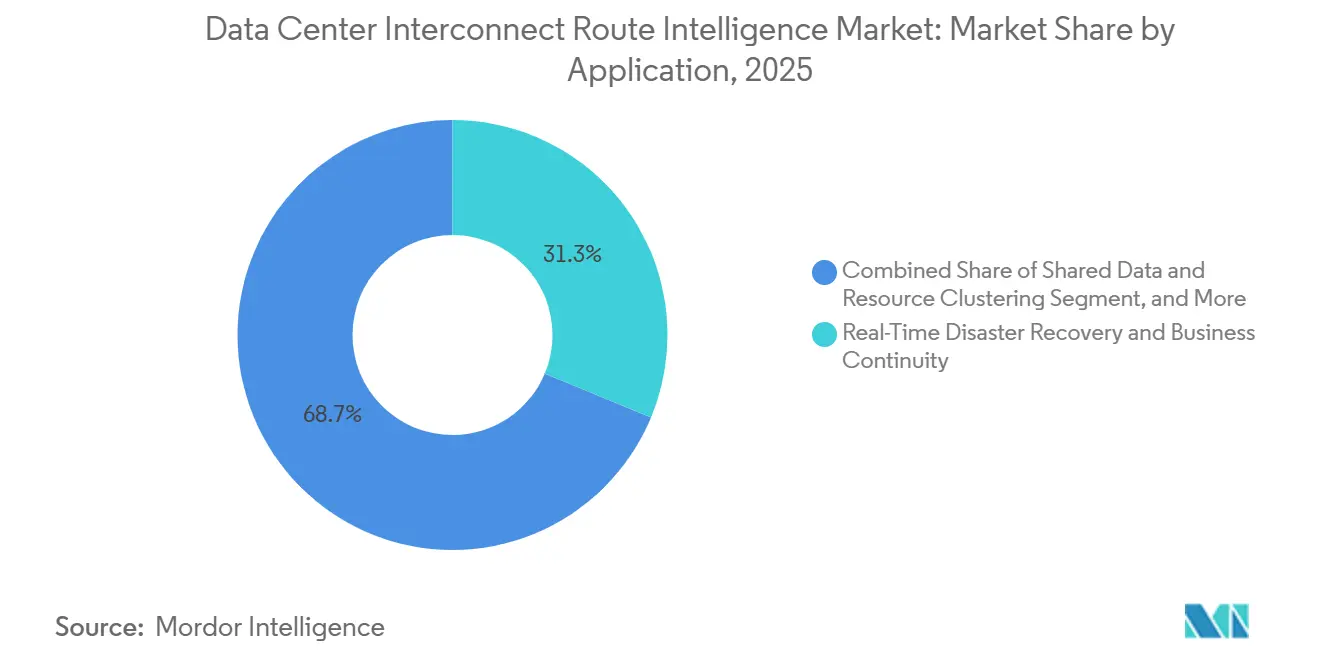
Disaster Recovery Holds Share While AI Cluster Federation Grows FasterReal-Time Disaster Recovery and Business Continuity accounted for 31.27% of application revenue in 2025, representing the largest share of the data center interconnect route intelligence market by application. The segment remained important for enterprise, financial services, and public-sector operations that need active standby replication. Shared Data and Resource Clustering supported organizations that distribute processing and storage across sites. Workload and Data Mobility contributed to demand as cloud users moved applications between facilities. Cloud Availability-Zone Interconnection also expanded as providers added sites for latency-sensitive workloads. These use cases required defined paths, visibility into performance, and reliable failover procedures.
AI Cluster Federation and GPU Scale-Across are expected to grow at a 22.08% CAGR through 2031, the fastest rate among applications. China Mobile introduced its GSE-DCI system at MWC 2026, including a 115.2 Tbps DCI router prototype that supported distributed AI training at 98% of single-node efficiency over more than 100 km. NTT East reported the same 98% efficiency threshold in a trial across the Tokyo-Fukuoka corridor. The two developments showed that distributed AI environments are being considered beyond North American hyperscaler designs. Providers that manage federation rules across differing cluster environments can address this requirement. The application also gives mid-market users a reason to consider managed route-control platforms before infrastructure choices become fixed.
By Deployment Model:
Provider-Managed DCI Leads While Hybrid and Multi-Cloud DCI AcceleratesProvider-Managed DCI held 37.91% of deployment-model revenue in 2025, the largest share in the data center interconnect route intelligence market. Enterprises and mid-market operators chose the model for service-level agreements, managed failover, and external route operations. The approach reduced the need to operate every part of the optical network internally. Enterprise-Owned DCI remained relevant for buyers who retained direct ownership of their infrastructure. Colocation-Based DCI offered another option for organizations seeking cross-connect access near cloud and carrier facilities. Each of these models continued to depend on hardware refresh cycles and available colocation capacity.
Hybrid and Multi-Cloud DCI is projected to grow at a 21.86% CAGR through 2031, the highest rate among deployment models. Organizations are operating workloads across several public clouds while retaining some on-premises AI capacity. ADTRAN launched its AI Network Cloud solution in May 2025 to adjust optical capacity for real-time AI workloads and to support sovereign AI and multi-domain compliance needs.[2]ADTRAN Holdings, “Adtran Boosts DCI Capabilities with Dynamic AI Network Cloud Solution,” ADTRAN Holdings Newsroom, adtran.com Ribbon Communications used its Muse multilayer automation platform to provide customer portals, real-time performance visibility, and optical-layer encryption in managed fiber networks. These capabilities are relevant where customers need private-network control features without building a fully private route. The model relies on software that can coordinate traffic across private and public domains.
Geography Analysis
North America Data Center Interconnect Route Intelligence Market
North America accounted for 36.42% of global revenue in 2025 and held the largest regional share of the data center interconnect route intelligence market. The United States supported most of this position through data-center activity in Northern Virginia, Dallas, Phoenix, and Silicon Valley. AI clusters and multi-campus architectures increased demand for route-management platforms in these locations. Canada added demand through expansion in Ontario and Quebec. Mexico extended routes southward through early hyperscaler-adjacent projects. FERC’s RM26-4 order affected private infrastructure decisions by assigning the costs of network upgrades to large-load interconnections.
Europe and APAC Data Center Interconnect Route Intelligence Market
Europe and Asia-Pacific showed different demand patterns, although both had significant DCI requirements. Germany, France, and the Netherlands relied on dense colocation fabrics and cross-border routes shaped by data-sovereignty requirements. Ekinops secured a 10-year framework agreement with Proximus for the NEURON network across more than 600 Belgian sites, with initial deployment planned for the second half of 2026. NTT-ME launched Japan Premium Direct Connect All-Photonics Connect in January 2026 for low-latency, bandwidth-guaranteed links between major Tokyo data centers.[3]NTT East, “Tokyo-Fukuoka Distributed AI Infrastructure Trial Confirms Practical Performance by Workload Characteristics Using IOWN APN,” NTT East Press Release, ntt-east.co.jp China adopted a sovereign and vertically integrated approach to AI-grade DCI infrastructure, while India, Singapore, and Australia added demand through cloud expansion.
MEA Data Center Interconnect Route Intelligence Market
The Middle East is projected to grow at a 21.74% CAGR through 2031 and is the fastest-growing geography in the data center interconnect route intelligence market size. Stargate UAE targeted 5 GW of data-center capacity in Abu Dhabi, and Microsoft planned total UAE investment of USD 15.2 billion through 2029. Saudi Arabia’s Humain targeted 6.6 GW by 2034 and began work on 200 MW campuses. These projects require large volumes of DCI capacity and coordinated route planning across new facilities. Africa remained an early-stage DCI region, with South Africa, Egypt, Kenya, and Nigeria supported by cable landing stations and enterprise cloud adoption. Route-intelligence use in Africa remained concentrated in tier-1 carrier deployments.

Competitive Landscape
The data center interconnect route intelligence market included 2 main competitive groups with different priorities. Ciena Corporation, Nokia Oyj, Cisco Systems, Huawei Technologies, and Coherent Corp. provided integrated optical hardware and software stacks. Their positions relied on DSP development, coherent line systems, manufacturing capabilities, and embedded route-control features. Nokia’s acquisition of Infinera for USD 2.3 billion added optical-network capabilities to its portfolio. Nokia stated that its optical network sales grew 17% in 2025 and raised its AI and cloud revenue CAGR outlook to 27% in April 2026. Arista’s 2025 annual report identified scale-across DCI as a strategic growth area and cited the 7800R4 spine chassis and HyperPort line card for routed DCI applications.
A second group included Arista Networks, Smartoptics Group AS, PacketLight Networks, Ribbon Communications, Ekinops S.A., and ADTRAN Holdings. These companies focused on open architectures for customers building multi-vendor networks. Ekinops planned to recruit 30 engineers at its Lannion facility and launched its Photonic Transport Modular product line for DCI.[4]Ekinops, “FY 2025 Results, 105 m€ in Revenue, 10.0% EBITDA Margin,” Ekinops Newsroom, ekinops.com Smartoptics expanded SoSmart with Fiber Route Analysis and capacity-planning features in January 2026. Ciena introduced agentic AI functions for assurance, routing, and digital-twin validation at OFC 2026. These moves showed that route optimization and network validation are becoming more important areas of competition.
The OCI MSA was formed by AMD, Broadcom, Meta, Microsoft, NVIDIA, and OpenAI in March 2026 to develop an open optical scale-up specification from 200 Gbps GEN1 to 3.2 Tbps per fiber. The specification supported plug-and-play optical infrastructure and reduced dependence on proprietary physical-layer interfaces. This shifts attention toward traffic orchestration, telemetry, and policy control across varied hardware. Marvell expanded its 1.6T DSP portfolio in March 2026, supporting the transition from 800G to 1.6T connectivity. Ciena introduced 800 Gbps coherent pluggables and routing automation for scale-across DCI applications. The resulting competition centers on the ability to operate heterogeneous networks with reliable policy control and route visibility.
Data Center Interconnect Route Intelligence Industry Leaders
Ciena Corporation
Nokia Oyj
Huawei Technologies Co., Ltd.
ZTE Corporation
Cisco Systems, Inc.
- *Disclaimer: Major Players sorted in no particular order
Data Center Interconnect Route Intelligence Market Companies Covered in this Report
- Ciena Corporation
- Nokia Oyj
- Huawei Technologies Co., Ltd.
- ZTE Corporation
- Cisco Systems, Inc.
- Juniper Networks, Inc.
- Ekinops S.A.
- ADTRAN Holdings, Inc.
- Ribbon Communications Inc.
- Smartoptics Group AS
- PacketLight Networks Ltd.
- Lumentum Holdings Inc.
- Coherent Corp.
- Fujitsu Limited
- Arista Networks, Inc.
- Broadcom Inc.
- NVIDIA Corporation

Recent Industry Developments in Data Center Interconnect Route Intelligence Market
- July 2026: 1Finity released an update to its Virtuora Optical Orchestration platform, providing cloud-native, multidomain and multi-vendor end-to-end L0-L3 management for AI and cloud networking environments.
- March 2026: Marvell Technology announced an expanded 1.6T optical DSP platform portfolio, including the Ara X, Ara T, Petra, and Aquila M DSPs, all in 3nm, targeting next-generation AI data-center connectivity and the industry’s transition from 800G to 1.6T. The portfolio already ships in mass volume to hyperscalers and cloud providers globally.
- March 2026: The OCI Multi-Source Agreement group was formed by AMD, Broadcom, Meta, Microsoft, NVIDIA, and OpenAI to develop an open specification for optical scale-up interconnects, with a roadmap scaling from 200 Gbps GEN1 to 3.2 Tbps per fiber, targeting a plug-and-play, multi-vendor AI infrastructure ecosystem.
- March 2026: Ciena Corporation announced 800 Gbps C-band and L-band coherent pluggables optimized for scale-across DCI applications, alongside agentic AI capabilities for autonomous assurance, routing, and network digital-twin validation at OFC 2026, solidifying its position in AI-era interconnect architectures.


Global Data Center Interconnect Route Intelligence Market Report Scope
The Data Center Interconnect Route Intelligence Market covers solutions and services that enable organizations to plan, optimize, monitor, and manage network routes between geographically distributed data centers. The report examines market trends, growth drivers, challenges, competitive dynamics, technology developments, and demand across deployment models, organization sizes, end-user industries, and regions during the study and forecast periods.
The Data Center Interconnect Route Intelligence Market Report is Segmented by Solution Layer (Hardware and Optical Transport, Route-Intelligence Software, Managed Connectivity Services, and Professional Services and Integration), Connectivity Medium (Dark Fiber, Wavelength Services, Carrier Ethernet, IPoDWDM and Routed Optical Networking, and Submarine Cable Systems), Data Rate (Up to 100G, 200G and 300G, 400G, 800G, and 1.6T and Above), Application (Real-Time Disaster Recovery and Business Continuity, Shared Data and Resource Clustering, Workload and Data Mobility, AI Cluster Federation and GPU Scale-Across, and Cloud Availability-Zone Interconnection), Deployment Model (Enterprise-Owned DCI, Provider-Managed DCI, Colocation-Based DCI, and Hybrid and Multi-Cloud DCI), and Geography (North America, South America, Europe, Asia-Pacific, Middle East, and Africa). The Market Forecasts are Provided in Terms of Value (USD).
| Hardware and Optical Transport |
| Route-Intelligence Software |
| Managed Connectivity Services |
| Professional Services and Integration |
| Dark Fiber |
| Wavelength Services |
| Carrier Ethernet |
| IPoDWDM and Routed Optical Networking |
| Submarine Cable Systems |
| Up to 100G |
| 200G and 300G |
| 400G |
| 800G |
| 1.6T and Above |
| Real-Time Disaster Recovery and Business Continuity |
| Shared Data and Resource Clustering |
| Workload and Data Mobility |
| AI Cluster Federation and GPU Scale-Across |
| Cloud Availability-Zone Interconnection |
| Enterprise-Owned DCI |
| Provider-Managed DCI |
| Colocation-Based DCI |
| Hybrid and Multi-Cloud DCI |
| North America | United States |
| Canada | |
| Mexico | |
| South America | Brazil |
| Chile | |
| Argentina | |
| Rest of South America | |
| Europe | Germany |
| United Kingdom | |
| France | |
| Netherlands | |
| Russia | |
| Rest of Europe | |
| Asia-Pacific | China |
| India | |
| Japan | |
| Singapore | |
| Australia | |
| Rest of Asia-Pacific | |
| Middle East | United Arab Emirates |
| Saudi Arabia | |
| Qatar | |
| Turkey | |
| Rest of Middle East | |
| Africa | South Africa |
| Egypt | |
| Kenya | |
| Nigeria | |
| Rest of Africa |
| By Solution Layer | Hardware and Optical Transport | |
| Route-Intelligence Software | ||
| Managed Connectivity Services | ||
| Professional Services and Integration | ||
| By Connectivity Medium | Dark Fiber | |
| Wavelength Services | ||
| Carrier Ethernet | ||
| IPoDWDM and Routed Optical Networking | ||
| Submarine Cable Systems | ||
| By Data Rate | Up to 100G | |
| 200G and 300G | ||
| 400G | ||
| 800G | ||
| 1.6T and Above | ||
| By Application | Real-Time Disaster Recovery and Business Continuity | |
| Shared Data and Resource Clustering | ||
| Workload and Data Mobility | ||
| AI Cluster Federation and GPU Scale-Across | ||
| Cloud Availability-Zone Interconnection | ||
| By Deployment Model | Enterprise-Owned DCI | |
| Provider-Managed DCI | ||
| Colocation-Based DCI | ||
| Hybrid and Multi-Cloud DCI | ||
| By Geography | North America | United States |
| Canada | ||
| Mexico | ||
| South America | Brazil | |
| Chile | ||
| Argentina | ||
| Rest of South America | ||
| Europe | Germany | |
| United Kingdom | ||
| France | ||
| Netherlands | ||
| Russia | ||
| Rest of Europe | ||
| Asia-Pacific | China | |
| India | ||
| Japan | ||
| Singapore | ||
| Australia | ||
| Rest of Asia-Pacific | ||
| Middle East | United Arab Emirates | |
| Saudi Arabia | ||
| Qatar | ||
| Turkey | ||
| Rest of Middle East | ||
| Africa | South Africa | |
| Egypt | ||
| Kenya | ||
| Nigeria | ||
| Rest of Africa | ||


Key Questions Answered in the Report
What is the data center interconnect route intelligence market size?
The data center interconnect route intelligence market is projected to grow from USD 0.72 billion in 2026 to USD 1.81 billion by 2031 at a 20.25% CAGR, driven by distributed AI connectivity needs, wider multi-site infrastructure programs, and increasing requirements for predictable traffic paths.
What is driving demand for data center interconnect route intelligence?
Distributed AI clusters, faster coherent optical links, availability-zone replication, and multi-cloud traffic management are increasing demand for routing systems that control paths across several locations and support defined performance objectives, rapid failover, and consistent operational visibility.
Which solution layer is growing fastest?
Route-Intelligence Software is projected to expand at a 21.46% CAGR through 2031 as operators need policy control, telemetry, and validation tools across mixed vendor networks without replacing every hardware platform, allowing network teams to adapt operations as capacity needs change.
Which connectivity approach is growing fastest?
IPoDWDM and Routed Optical Networking is expected to grow at a 22.69% CAGR through 2031 because it combines routing and optical transport while reducing reliance on discrete transponder layers and simplifying network design.
Which region is growing fastest for route-intelligence platforms?
The Middle East is projected to grow at a 21.74% CAGR through 2031, supported by state-backed AI infrastructure programs, new data-center capacity, and route coordination requirements between rapidly expanding facilities.
Page last updated on:


 Your data is secure and never sold or shared.


