
Cryogenic Insulation Market Size and Share
Market Overview
| Study Period | 2021 - 2031 |
|---|---|
| Market Size (2026) | USD 3.91 Billion |
| Market Size (2031) | USD 5.44 Billion |
| Growth Rate (2026 - 2031) | 6.83 % |
| Fastest Growing Market | Asia-Pacific |
| Largest Market | Asia-Pacific |
| Market Concentration | Medium |
Major Players *Disclaimer: Major Players sorted in no particular order Image © Mordor Intelligence. Reuse requires attribution under CC BY 4.0. | |
Cryogenic Insulation Market Analysis by Mordor Intelligence
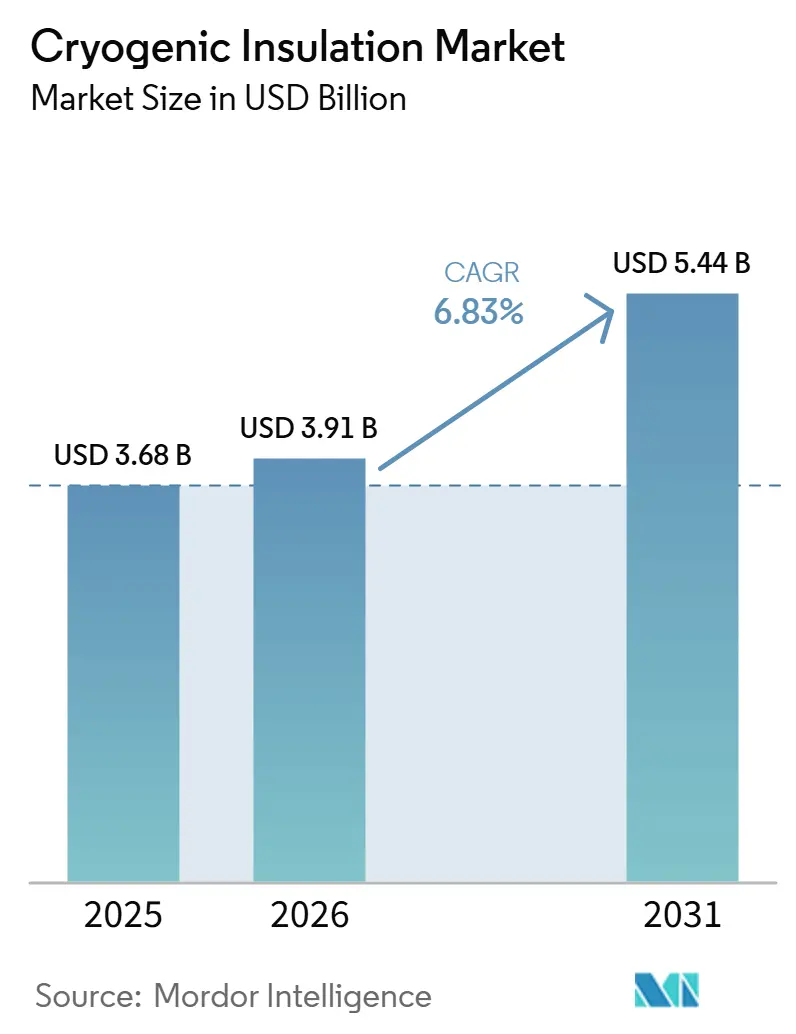
The Cryogenic Insulation Market size reached USD 3.68 billion in 2025 and is estimated to grow from USD 3.91 billion in 2026 to USD 5.44 billion by 2031, registering a CAGR of 6.83% from 2026 to 2031. A strong LNG project cycle supports the cryogenic insulation market, with global liquefaction capacity expected to expand by more than 7% in 2026, the fastest pace since 2019. North America is expected to contribute more than 85% of the incremental supply. This project pipeline is significant because buyers commonly place insulation packages for tanks, transfer lines, and long process piping well before first gas, giving the cryogenic insulation market stronger forward order visibility than many adjacent industrial materials categories. Hydrogen investments are also reshaping the cryogenic insulation market. Low-emissions hydrogen investment is expected to reach USD 8 billion in 2025, up 80% from 2024, shifting part of the demand toward higher-value vacuum-based insulation systems. In addition, a parallel replacement cycle in older tanks and pipelines across parts of Asia and Europe is adding refurbishment demand alongside greenfield construction, broadening the cryogenic insulation market’s revenue base beyond new LNG assets. Competition remains active in terms of performance, installation speed, and installed cost. However, labor shortages in specialist insulation work could delay revenue recognition on some projects without materially affecting the underlying demand pool.
Key Report Takeaways
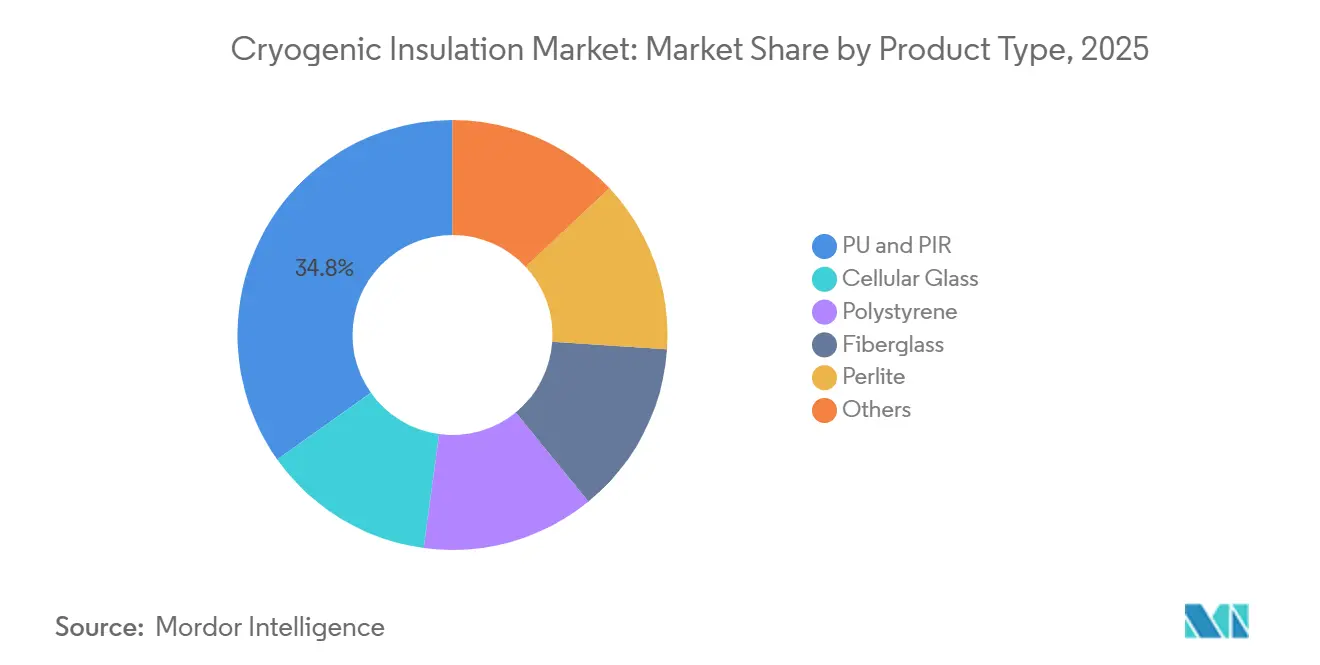
- By product type, PU and PIR led with 34.82% revenue share in 2025 and the highest projected CAGR at 7.41% through 2031.
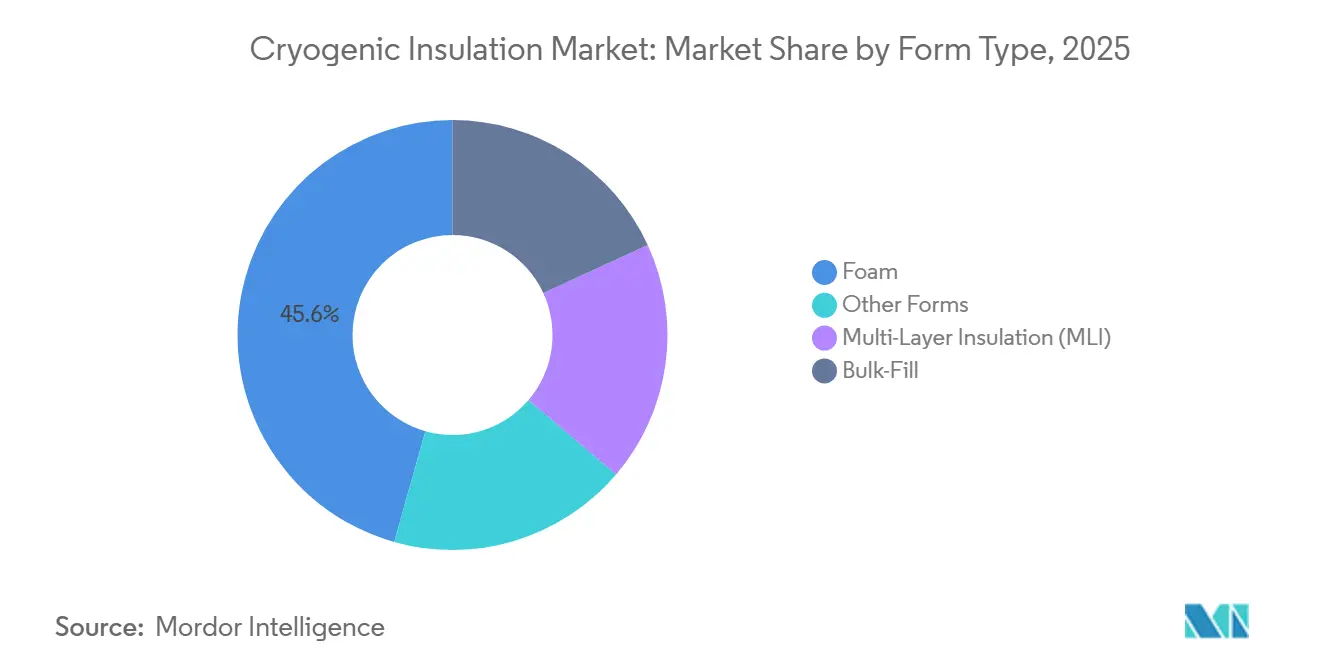
- By form type, foam held 45.63% share in 2025, while Multi-Layer Insulation recorded the fastest expected growth at 7.68% through 2031.
- By application, LNG Storage and Transport accounted for 39.42% of revenue in 2025, while Cryogenic Processing Equipment is forecast to expand at a 7.52% CAGR through 2031.
- By end-use industry, Energy and Power captured 41.75% share in 2025 and also recorded the highest projected CAGR at 7.36% through 2031.
- By geography, Asia-Pacific held 39.81% share in 2025 and is forecast to grow at the fastest regional CAGR of 7.58% through 2031.
Note: Market size and forecast figures in this report are generated using Mordor Intelligence’s proprietary estimation framework, updated with the latest available data and insights as of January 2026.
Global Cryogenic Insulation Market Trends and Insights
Drivers Impact Analysis*
| Driver | (~) % Impact on CAGR Forecast | Geographic Relevance | Impact Timeline |
|---|---|---|---|
| Expansion Of LNG Liquefaction, Storage, And Transportation Infrastructure | +2.8% | Global, with concentrated gains in North America, Asia-Pacific, and Middle East and Africa | Short term (≤ 2 years) |
| Increasing Demand For Energy-Efficient Cryogenic Storage And Processing Systems | +1.4% | Global, with higher uptake in Europe and Asia-Pacific industrial hubs | Medium term (2-4 years) |
| Growing Investments In Hydrogen Production, Storage, And Distribution Infrastructure | +1.1% | North America, Europe, Japan, and Australia, with early spillover into Middle East corridors | Medium term (2-4 years) |
| Rising Adoption Of Advanced Cryogenic Insulation Materials For Industrial Gas Applications | +0.9% | Global, with early adoption in the United States, Germany, South Korea, and Japan | Long term (≥ 4 years) |
| Replacement And Modernization Of Aging Cryogenic Assets | +0.4% | Japan, Southeast Asia, Europe, and selective parts of North America | Short term (≤ 2 years) to Medium term (2-4 years) |
| Source: Mordor Intelligence | |||
Expansion of LNG Liquefaction, Storage, and Transportation Infrastructure
The cryogenic insulation market remains closely tied to the LNG investment cycle, as each new liquefaction train requires significant volumes of insulated piping, storage systems, and transfer infrastructure. The United States is expected to sanction more than 80 bcm per year of new LNG liquefaction capacity in 2025, which would mark a national record and provide one of the strongest signals for near-term cryogenic project activity [1]International Energy Agency, “Gas Market Report, Q1-2026, Executive Summary,” IEA, iea.org. This project wave is already influencing procurement, as insulation packages are specified during engineering and ordered well before plant startup. The impact on the cryogenic insulation market extends beyond material volumes, as project developers increasingly select higher-performance systems for long process lines and improved operating reliability. EPC-led preferred supplier lists are also raising entry barriers, favoring manufacturers that already hold the product certifications and project references required for major LNG projects. A positive final investment decision for the Commonwealth LNG project in May 2026 would add another large project to the forward pipeline and support visibility for future insulation demand.
Increasing Demand for Energy-Efficient Cryogenic Storage and Processing Systems
Operators are placing greater emphasis on full installed cost and operating efficiency rather than assessing insulation systems based only on upfront material prices. This shift is increasing scrutiny of boil-off management, thermal losses, labor intensity, and service reliability across LNG terminals and industrial gas assets. The IEA stated that energy-efficiency spending outpaced overall energy investment growth in 2025, supporting the broader push to reduce energy losses in thermal systems. In the cryogenic insulation market, this trend is driving demand for products that demonstrate stable in-service performance, not just strong laboratory results. Buyers are also becoming more selective about performance guarantees, increasing the value of documented field history and warranty support. This shift strengthens the position of suppliers that combine thermal performance with faster installation and more predictable lifecycle economics.
Growing Investments in Hydrogen Production, Storage, and Distribution Infrastructure
Hydrogen is creating a distinct demand layer for the cryogenic insulation market, as liquid hydrogen storage requires much tighter thermal control than LNG. Low-emissions hydrogen investment is projected to rise to USD 8 billion in 2025, and projects with approved final investment decisions could increase global electrolyzer capacity from less than 5 GW currently to 26 GW by 2030. These conditions are shifting material demand toward high-vacuum multi-layer insulation and vacuum-insulated panel systems, as conventional foam solutions do not meet the same boil-off limits. This shift is commercially significant because the higher-performance material mix generates a stronger revenue profile per installed unit. It is also strategically important because projects now entering front-end engineering are locking in material choices for decades of operation. As hydrogen import and marine terminal plans advance in Europe and other regions, the cryogenic insulation market is likely to see greater specification overlap between energy transition projects and established LNG applications.
Rising Adoption of Advanced Cryogenic Insulation Materials for Industrial Gas Applications
The cryogenic insulation market is gradually shifting toward thinner, higher-performance materials in applications where space optimization, corrosion control, and long service life are critical. Aerogel-based systems are benefiting from this shift, as they deliver strong performance in thin profiles and help limit corrosion under insulation in demanding environments. Armacell is expected to open its new aerogel insulation plant in Pune in June 2025 and stated that the investment would double its global aerogel blanket manufacturing capacity to more than 1 million square meters per year. This expansion will strengthen the company’s local supply base for Asia-Pacific LNG and industrial gas projects, where lead times and delivery reliability remain key procurement concerns. Regional manufacturing will also help reduce the risk of project schedule disruptions caused by long international supply chains. Over time, this development is expected to support broader adoption of advanced materials across industrial gas projects, even as buyers continue to compare them closely with cellular glass and other established options.
Restraints Impact Analysis*
| Restraint | (~) % Impact on CAGR Forecast | Geographic Relevance | Impact Timeline |
|---|---|---|---|
| High Installation and Lifecycle Costs of Cryogenic Insulation Systems | -0.8% | Global; most acute in South America and MEA where project economics are tighter | Long term (≥ 4 years) |
| Complex Installation and Maintenance Requiring Skilled Workforce | -0.6% | North America, Western Europe; emerging in MEA and South Asia LNG corridors | Medium term (2–4 years) |
| Performance Degradation Due to Moisture Ingress, Mechanical Damage, and Aging | -0.5% | Global, concentrated in humid tropical climates (Southeast Asia, West Africa) | Medium term (2–4 years) |
| Source: Mordor Intelligence | |||
High Installation and Lifecycle Costs of Cryogenic Insulation Systems
The cryogenic insulation market continues to face a cost barrier, as advanced systems, such as aerogel blankets and vacuum-insulated panels, are priced significantly higher than conventional options. This factor has the strongest impact on material selection in smaller LNG projects and among industrial gas operators working with tighter capital budgets. The challenge extends beyond the initial installation cost, as some legacy systems can also generate substantial maintenance expenses over long asset lifecycles. In lower-cost markets, this trade-off continues to support demand for cellular glass, polystyrene, and other familiar options over premium aerogel grades. Financing constraints in parts of the Middle East, Africa, Southeast Asia, and South America are also slowing some upgrade decisions. As a result, the cryogenic insulation market is expanding, but it remains divided between high-performance specifications and more cost-driven purchasing behavior.
Complex Installation and Maintenance Requiring Skilled Workforce
Cryogenic insulation requires specialized installation, as errors in vapor barriers, joint spacing, or cleanliness can affect system performance throughout the asset’s lifecycle. This makes the labor base a key bottleneck for the cryogenic insulation market, particularly when several large LNG projects advance simultaneously. North America faces significant pressure, as multiple export facilities compete for the same pool of qualified contractors. The shortage increases schedule risks, labor cost pressures, and quality control requirements during project execution. Some markets are reducing labor dependence through more standardized and automated installation methods, especially for repetitive pipe sizes and modular sections. However, complex field-fabricated shapes still rely heavily on skilled crews, which means labor constraints are likely to remain a practical limitation in the near term.
*Our forecasts treat driver/restraint impacts as directional, not additive. The impact forecasts reflect baseline growth, mix effects, and variable interactions.
Segment Analysis
By Product Type: PU and PIR Dominance Tested by Aerogel Inroads
PU and PIR accounted for 34.82% of the cryogenic insulation market share in 2025 and is projected to grow at a CAGR of 7.41% through 2031, maintaining a strong leadership position in the cryogenic insulation market. Their leading position reflects a practical balance between cost and performance, which suits LNG carrier cargo-hold construction and onshore liquefaction piping. This balance makes them suitable for a large share of the project base, where buyers require dependable thermal performance without moving into the highest-cost material tier. The product family also benefits from contractor familiarity with installation, which supports adoption in large projects with tight construction schedules. In the cryogenic insulation market, this combination of proven use, scale economics, and broad application coverage explains why PU and PIR remain the largest product group.
The strength of PU and PIR does not indicate stagnation across the rest of the product mix, as higher-performance materials continue to gain ground where project conditions justify their use. Cellular glass remains important in storage tanks and process piping, where fire resistance, compressive strength, and moisture control are critical. Owens Corning announced a 50% capacity expansion at its FOAMGLAS plant in the Czech Republic, with commissioning scheduled for Q2 2026, indicating continued confidence in demand from European industrial and energy applications. Polystyrene and fiberglass continue to serve cost-sensitive applications where extreme ultra-low-temperature requirements are less central to purchasing decisions. Perlite maintains a role in annular spaces for large LNG storage tanks and in retrofit work, although its lower thermal efficiency is driving interest in higher-performing alternatives. In this part of the cryogenic insulation industry, project type increasingly defines product competition rather than a single universal material choice.
Regional manufacturing trends are also shaping product competition within the cryogenic insulation market. Armacell’s Pune investment strengthened Asia-Pacific supply for advanced aerogel products and reduced dependence on long-haul shipments into one of the most active LNG and industrial gas regions. This is significant because project buyers often weigh supply reliability as heavily as thermal performance when placing large insulation orders. It also increases competitive pressure on established product groups in projects where shorter lead times had previously favored legacy materials. As hydrogen and high-specification industrial gas applications expand, the product mix is likely to continue shifting toward thinner and more specialized solutions.
The product landscape remains broad, but it is becoming more segmented by technical requirements and service environments. PU and PIR continue to lead because they address the largest volume of current demand. Cellular glass maintains a firm position in applications where structural performance and moisture control are central to the specification. Aerogel products are gaining traction due to stronger local capacity, tighter performance requirements, and wider buyer acceptance. As a result, the cryogenic insulation market remains anchored by cost-efficient foam systems while premium materials gain influence in high-value niches.



By Form Type: Foam's Scale Meets MLI's Acceleration
Foam was the largest form segment in 2025, accounting for 45.63% of the cryogenic insulation market size. Its leading position reflects its wide use across LNG infrastructure, industrial gas storage, and cold utility piping. Foam maintains this scale because it suits a broad range of operating conditions and remains familiar to project designers, fabricators, and installation crews. In the cryogenic insulation market, this familiarity reduces specification risk and helps contractors manage schedules and labor efficiency across large sites. Foam also benefits from volume economics, which keeps it competitive in projects where cost discipline remains a priority. These advantages explain why foam continues to be the default form choice across much of the current installed base and a large share of new demand.
Multi-layer insulation is expected to be the fastest-growing form segment, registering a 7.68% CAGR through 2031. Liquid hydrogen storage, aerospace propellant systems, and other high-vacuum cryogenic applications are driving its growth, as these applications require much stricter heat ingress limits. The rise of hydrogen is especially important because it is driving improvements in reflective layer design, vacuum envelope quality, and system reliability. These advances are likely to broaden the usable range of multi-layer insulation over time and support greater adoption in adjacent LNG and industrial gas applications. In the cryogenic insulation market, multi-layer insulation is not yet a mass-volume form, but it is becoming one of the most important indicators of the direction of technical standards.
Bulk-fill perlite remains relevant in refurbishment programs and tank applications where existing design architecture already supports its use. Its continued role shows that replacement cycles do not always shift directly to the newest material system, especially when operators must manage cost or retrofit complexity. However, the broader direction of the cryogenic insulation market continues to move toward solutions that offer better boil-off control and stronger thermal efficiency within tighter space limits. This shift is gradually widening the performance gap between traditional bulk-fill systems and advanced high-vacuum formats. As more buyers prioritize lower losses and more predictable long-term operation, premium forms are likely to gain a larger share of the highest-specification projects.
The main commercial pattern in form type is a stable, large-volume base combined with a faster-growing, high-performance tier. Foam remains essential because it serves the broadest range of practical applications with accepted installation methods. Multi-layer insulation is expanding because hydrogen and advanced cryogenic systems are increasing performance requirements. Bulk-fill systems continue to support specific applications, especially in existing tank fleets and some retrofit environments. This dynamic keeps the cryogenic insulation market balanced between mature volume demand and a smaller but faster-expanding advanced segment.
By Application: LNG Storage and Transport Anchors Demand, Processing Equipment Accelerates
LNG storage and transport accounted for 39.42% of application revenue in 2025, confirming that LNG infrastructure continues to anchor the cryogenic insulation market. This application leads because LNG tanks, loading systems, transfer lines, and transportation assets require insulation as a functional component, not as an optional efficiency upgrade. The high capital intensity of LNG projects means insulation demand scales with engineering complexity, operational reliability, and safety requirements. Current construction activity and pre-final investment decision activity suggest that this application will remain the core revenue pool through 2031. In the cryogenic insulation market, LNG infrastructure continues to set the pace for total demand and for many procurement standards used across other cryogenic applications.
Cryogenic processing equipment is the fastest-growing application segment and is projected to expand at a CAGR of 7.52% through 2031. Mid-scale and small-scale LNG plants, industrial gas processing systems, and hydrogen conditioning equipment are driving demand in this segment. These assets often include heat exchanger cold boxes, separators, and dense piping layouts that require customized insulation work. This requirement increases the installed value of insulation, as project teams need more fabrication detail and specialized site execution. It also expands opportunities for contractors and suppliers that can handle complex geometries, rather than only long linear pipe runs.
Industrial gas storage and cryogenic pipelines provide steady support to the cryogenic insulation market, although they are not the fastest-growing applications. Demand comes from energy, chemicals, healthcare, and manufacturing users that rely on oxygen, nitrogen, argon, and other cryogenic gases for continuous operations. In these settings, buyers often prioritize operational stability, maintenance access, and long service life over aggressive cost reduction. This preference sustains demand for proven insulation systems across a wide installed base. Standards such as ISO 21009 also help maintain a clear minimum performance threshold for specification quality in cryogenic vessels and related systems.
The application mix shows that the cryogenic insulation market is broadening within its core technical base rather than shifting away from LNG. LNG storage and transport still dominates because it carries the largest project values and the highest insulation intensity. Processing equipment is growing faster because newer gas and hydrogen systems require more specialized design and installation work. Mature applications remain important because they create recurring baseload demand across several end markets. As a result, the cryogenic insulation industry remains energy-led, with a more diverse application structure than in the previous project cycle.
By End-Use Industry: Energy and Power Leads, Life-Science Sectors Gain Ground
Energy and Power held a 41.75% share in 2025 and is projected to grow at a CAGR of 7.36% through 2031, giving it the strongest position among end-use industries in the cryogenic insulation market. This leadership reflects the scale of investments in LNG, hydrogen, and industrial gas infrastructure across major regions. The segment also strongly influences technical standards, as its projects are typically large, highly engineered, and closely linked to operating guarantees. Material selection, installer qualification, and procurement rules in this segment often shape expectations across the broader cryogenic insulation market. As a result, changes in energy project design tend to influence other cryogenic applications over time.
Chemicals and Petrochemicals remain an important volume base, as air separation units and process gas systems require dependable insulation in continuous operating environments. Metallurgy and metal processing further support demand through oxygen, nitrogen, and argon handling systems that require stable thermal performance and predictable maintenance planning. These end uses may not grow at the same pace as LNG or hydrogen, but they provide durable demand across industrial production cycles. Their requirements also support product families that offer moisture resistance, structural stability, and long service life under constant use. This keeps the cryogenic insulation market connected not only to energy investment but also to the broader industrial economy.
Electronics and semiconductors are emerging as stronger sources of demand as fabs expand high-purity gas infrastructure in East Asia and the United States. This expansion increases the need for cryogenic-grade insulation in liquid nitrogen and argon systems, where reliability and contamination control are critical. Healthcare and biotechnology are also contributing more demand, supported by liquid nitrogen storage for biorepositories, advanced therapies, and medical cryogenic systems. In these end uses, buyers often prioritize quality systems, compliance, and verified performance over the lowest upfront cost. This shift gradually increases the share of demand from segments that buy based on control and reliability, not only on scale.
The end-use landscape therefore shows both concentration and widening opportunity. Energy and Power remains the largest and fastest-growing segment and continues to define the center of gravity for the cryogenic insulation market. Industrial process sectors provide a stable installed base and help smooth demand across project cycles. Electronics, healthcare, and biotechnology remain smaller but are expanding the number of commercial pathways into the cryogenic insulation market. This broader end-use spread reduces dependence on a single build cycle, even as energy continues to lead overall demand.
Geography Analysis
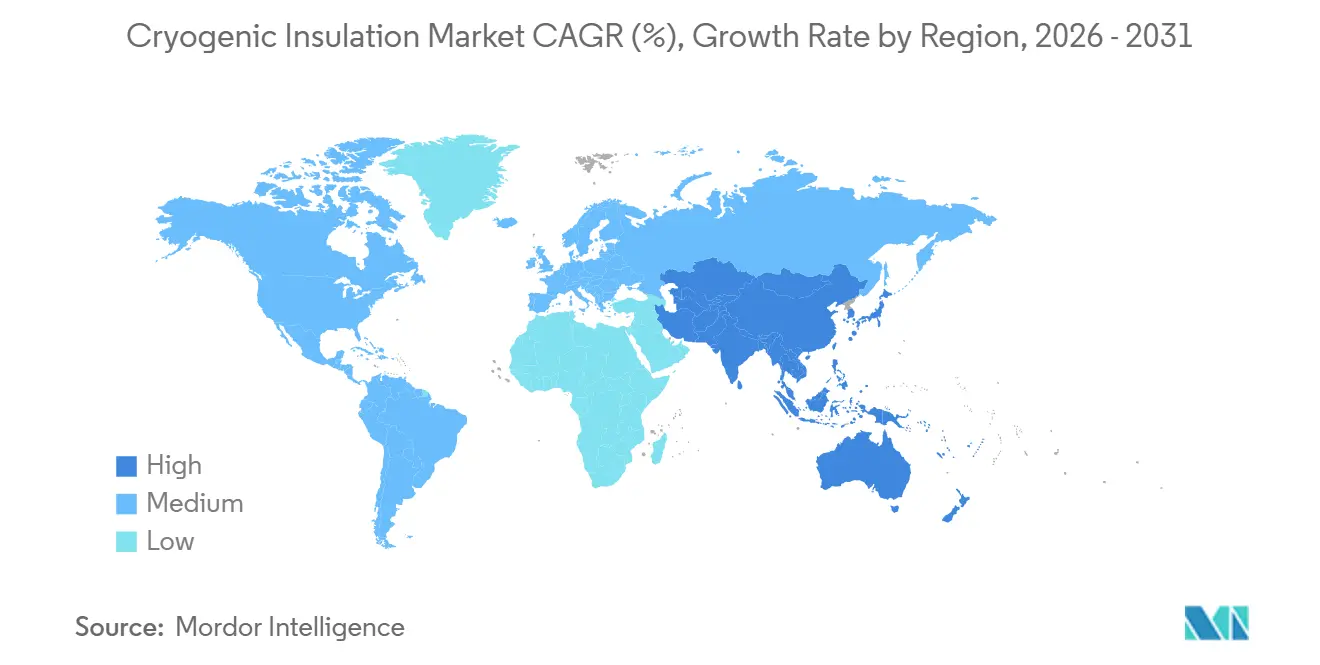
Asia-Pacific is expected to account for 39.81% of the cryogenic insulation market share in 2025 and is projected to register a CAGR of 7.58% through 2031, making it the largest and fastest-growing regional market in the cryogenic insulation market. China’s LNG terminal buildout, India’s regasification expansion, and South Korea’s role in LNG carrier manufacturing support regional growth. China commissioned the Tangshan LNG Terminal Phase II in September 2024. The project used prefabricated cryogenic insulation technology and achieved a boil-off gas rate of not more than 0.05% per year. This project provides a clear benchmark for high-performance insulation execution in a major LNG-importing market. Japan is also supporting regional demand through energy-efficiency regulations and replacement activity in older cryogenic systems.
South Korea remains a major strategic demand hub for the cryogenic insulation market, as LNG carrier construction drives significant demand for cryogenic panels and containment-related insulation. The concentration of specialist manufacturers and shipbuilding capabilities gives the region both strong local demand and export relevance. Asia-Pacific is also likely to see new hydrogen and industrial gas investments intersect most directly with existing LNG infrastructure over time. This trend increases the likelihood that premium material systems will move from niche projects into a broader regional installed base. For the cryogenic insulation market, Asia-Pacific offers the strongest combination of near-term project volume, replacement demand, and long-term application diversity.
North America is the second-largest region and currently has one of the strongest near-term project pipelines in the cryogenic insulation market. The United States is expected to approve more than 80 bcm per year of new LNG liquefaction capacity in 2025, setting a record and confirming the scale of export infrastructure under development[2]International Energy Agency, “Gas Market Report, Q1-2026, Executive Summary,” IEA, iea.org. The region is also developing hydrogen infrastructure, supported by a USD 7 billion U.S. Department of Energy commitment to regional clean hydrogen hubs, which strengthens future demand for high-vacuum insulation systems as projects advance. Canada and Mexico add further LNG and industrial gas activity, although their absolute scale remains lower than that of the United States.
Europe is a mature but repositioning region in the cryogenic insulation market, supported by stronger LNG import activity and a greater focus on lower-carbon industrial capacity. European buyers are expected to contract nearly 25 bcm per year of LNG from post-final investment decision U.S. projects in 2025, more than double the 2024 level, supporting terminal and regasification investment across major countries. Saint-Gobain announced a new low-carbon stone wool production line in Spain in 2025, reflecting how European manufacturers are aligning capacity decisions with energy and emissions goals. South America, the Middle East, and Africa remain smaller in current market size, but they present future opportunities through gas processing, industrial gas development, and selective LNG-linked infrastructure. Financing constraints and execution risks continue to moderate growth in these regions, keeping their contribution below the pace seen in Asia-Pacific and North America. Even so, these regions continue to broaden the geographic base of the cryogenic insulation market and support longer-term project optionality.

Competitive Landscape
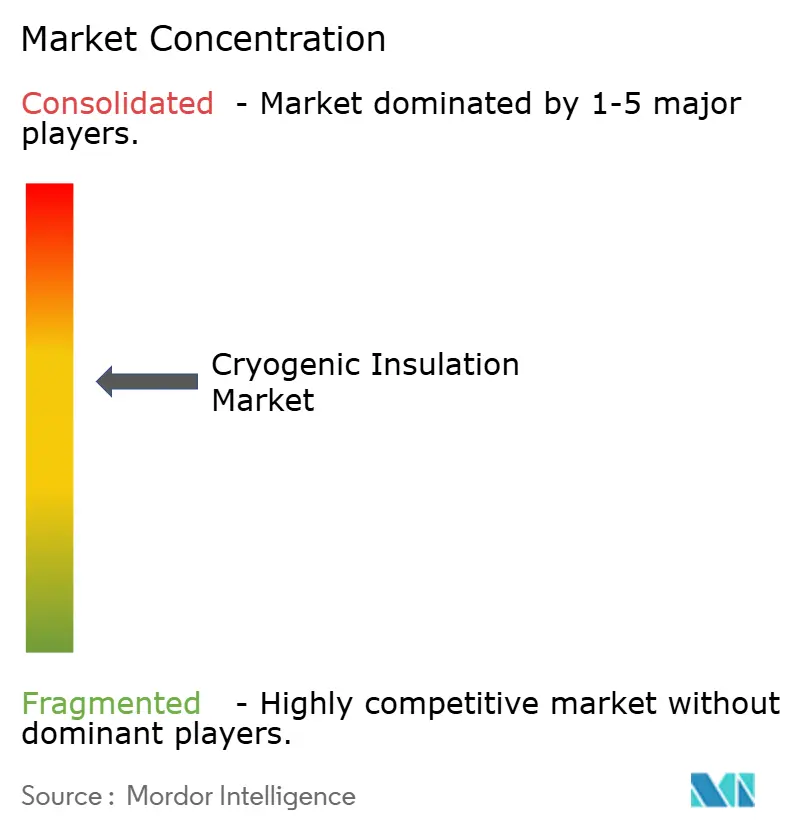
The cryogenic insulation market is moderately consolidated at the top, but a small group of global suppliers does not tightly control it. Large international companies, such as ARMACELL, Aspen Aerogels, Owens Corning, Cabot Corporation, and Saint-Gobain, hold differentiated positions across aerogel, cellular glass, and foam systems. At the same time, regional specialists in Japan, South Korea, and India remain relevant, as domestic projects often favor familiarity with local standards, installed references, and established procurement relationships. This balance gives the cryogenic insulation market a mix of global technology leadership and sustained local competitive strength. As a result, buyers evaluate suppliers based on performance, execution capability, and regional fit, in addition to product category.
Capacity localization and portfolio specialization have emerged as major strategic patterns. Armacell doubled its global aerogel manufacturing capacity through its Pune facility, strengthening its ability to serve Asia-Pacific projects with locally produced cryogenic products. Owens Corning moved to expand FOAMGLAS production in Europe, supporting its position in applications where cellular glass remains the preferred material. Aspen Aerogels is expected to begin a formal strategic review in February 2026 after lower LNG-linked revenue in 2025, highlighting how project timing can affect even specialized leaders. These developments show that the cryogenic insulation market is not static, as leading participants continue to adjust manufacturing capacity, portfolio structure, and regional exposure in response to shifting project flows.
Upstream alignment with project developers and process technology owners represents another important competitive pattern. Chart Industries is expected to sign a global master goods and services agreement with ExxonMobil in January 2025, supporting a design standardization approach across future LNG projects. Chart is also expected to be selected by LNG Alliance in July 2025 to supply IPSMR technology and a modular liquefaction solution for the Amigo LNG export facility in Mexico. These examples are important because process technology influence can shape downstream equipment and insulation specifications early in the project cycle. The cryogenic insulation market also continues to offer opportunities in modular pre-insulated spool fabrication, where off-site fabrication is attractive for small-scale LNG and hydrogen developments. This area remains less consolidated than core material supply, creating room for newer competitors and specialist fabricators. Buyers increasingly treat compliance with standards such as ASTM C1728 and EN ISO 12241 as a minimum requirement, so suppliers need more than basic certification to differentiate themselves. This dynamic keeps competition focused on execution credibility, local service capability, and consistent performance on real projects rather than price alone.
Cryogenic Insulation Industry Leaders
ARMACELL
Owens Corning
Saint-Gobain
Johns Manville
Aspen Aerogels, Inc.
- *Disclaimer: Major Players sorted in no particular order

Recent Industry Developments
- May 2026: Caturus LLC reached a positive final investment decision (FID) for the Commonwealth LNG export facility (9.5 MTPA, Cameron Parish, Louisiana), securing USD 21.25 billion in total commitments, including USD 9.75 billion in project financing. The company signed offtake agreements with EQT, Glencore, Mercuria, PETRONAS, and Aramco Trading. Phase 1 operations are targeted for 2030, creating a substantial forward procurement pipeline for cryogenic insulation across storage tanks, transfer lines, and cryogenic piping.
- February 2026: Aspen Aerogels initiated a formal strategic review of its corporate structure and engaged Piper Sandler & Co. as its financial advisor after reporting a full-year 2025 revenue decline to USD 271.1 million from USD 452.7 million in 2024. The company also confirmed a new EV award with Volvo Cars and a North Sea subsea pipeline project, signaling continued commercial activity in the Energy Industrial segment.


Global Cryogenic Insulation Market Report Scope
Cryogenic insulation refers to specialized materials and techniques used to prevent heat transfer into equipment, tanks, and piping that operate at extremely low temperatures, typically below -150°C. It minimizes boil-off and maintains the liquid state of cryogenic gases such as LNG, liquid hydrogen, and nitrogen.
The cryogenic insulation market is segmented by product type, form type, application, end-use industry, and geography. By product type, the market is segmented into PU and PIR, cellular glass, polystyrene, fiberglass, perlite, and others. By form type, the market is segmented into Multi-Layer Insulation (MLI), foam, bulk-fill, and other forms. By application, the market is segmented into LNG storage & transport, industrial gas storage, cryogenic pipelines, cryogenic processing equipment. and other applications. By end-use industry, the market is segmented into energy and power, chemicals & petrochemicals, metallurgy & metal processing, electronics & semiconductors, food & beverage, healthcare & biotechnology, and other end-use industries. The report also covers the cryogenic insulation market size and forecasts for the cryogenic insulation market in 16 countries across major regions. For each segment, the market sizing and forecasts have been done on the basis of revenue (USD).
| PU and PIR |
| Cellular Glass |
| Polystyrene |
| Fiberglass |
| Perlite |
| Others |
| Multi-Layer Insulation (MLI) |
| Foam |
| Bulk-Fill |
| Other Forms |
| LNG Storage & Transport |
| Industrial Gas Storage |
| Cryogenic Pipelines |
| Cryogenic Processing Equipment |
| Other Applications |
| Energy & Power |
| Chemicals & Petrochemicals |
| Metallurgy & Metal Processing |
| Electronics & Semiconductors |
| Food & Beverage |
| Healthcare & Biotechnology |
| Other End-Use Industry |
| Asia Pacific | China |
| India | |
| Japan | |
| South Korea | |
| Rest of Asia Pacific | |
| North America | United States |
| Canada | |
| Mexico | |
| Europe | Germany |
| United Kingdom | |
| France | |
| Italy | |
| Russia | |
| Rest of Europe | |
| South America | Brazil |
| Argentina | |
| Rest of South America | |
| Middle East and Africa | Saudi Arabia |
| South Africa | |
| Rest of Middle East and Africa |
| Product Type | PU and PIR | |
| Cellular Glass | ||
| Polystyrene | ||
| Fiberglass | ||
| Perlite | ||
| Others | ||
| Form Type | Multi-Layer Insulation (MLI) | |
| Foam | ||
| Bulk-Fill | ||
| Other Forms | ||
| Application | LNG Storage & Transport | |
| Industrial Gas Storage | ||
| Cryogenic Pipelines | ||
| Cryogenic Processing Equipment | ||
| Other Applications | ||
| End-Use Industry | Energy & Power | |
| Chemicals & Petrochemicals | ||
| Metallurgy & Metal Processing | ||
| Electronics & Semiconductors | ||
| Food & Beverage | ||
| Healthcare & Biotechnology | ||
| Other End-Use Industry | ||
| By Geography | Asia Pacific | China |
| India | ||
| Japan | ||
| South Korea | ||
| Rest of Asia Pacific | ||
| North America | United States | |
| Canada | ||
| Mexico | ||
| Europe | Germany | |
| United Kingdom | ||
| France | ||
| Italy | ||
| Russia | ||
| Rest of Europe | ||
| South America | Brazil | |
| Argentina | ||
| Rest of South America | ||
| Middle East and Africa | Saudi Arabia | |
| South Africa | ||
| Rest of Middle East and Africa | ||


Key Questions Answered in the Report
What is the market size of the Cryogenic Insulation Market?
The Cryogenic Insulation Market reached USD 3.91 billion in 2026 and is projected to reach USD 5.44 billion by 2031, growing at a 6.83% CAGR over 2026 to 2031.
Which product type and form type lead the Cryogenic Insulation Market?
PU and PIR lead product demand with 34.82% share, while Multi-Layer Insulation is the fastest-growing form type at 7.68% CAGR due to hydrogen and other high-vacuum cryogenic uses.
Which region leads global demand today?
Asia-Pacific led with 39.81% share in 2025 and also posts the fastest regional growth at 7.58% through 2031.
Which application generates the most revenue?
LNG Storage and Transport is the largest application, contributing 39.42% of 2025 revenue because insulation is essential across tanks, transfer lines, and transportation systems.
Page last updated on:





