
Copper Sulfate Market Size and Share
Market Overview
| Study Period | 2021 - 2031 |
|---|---|
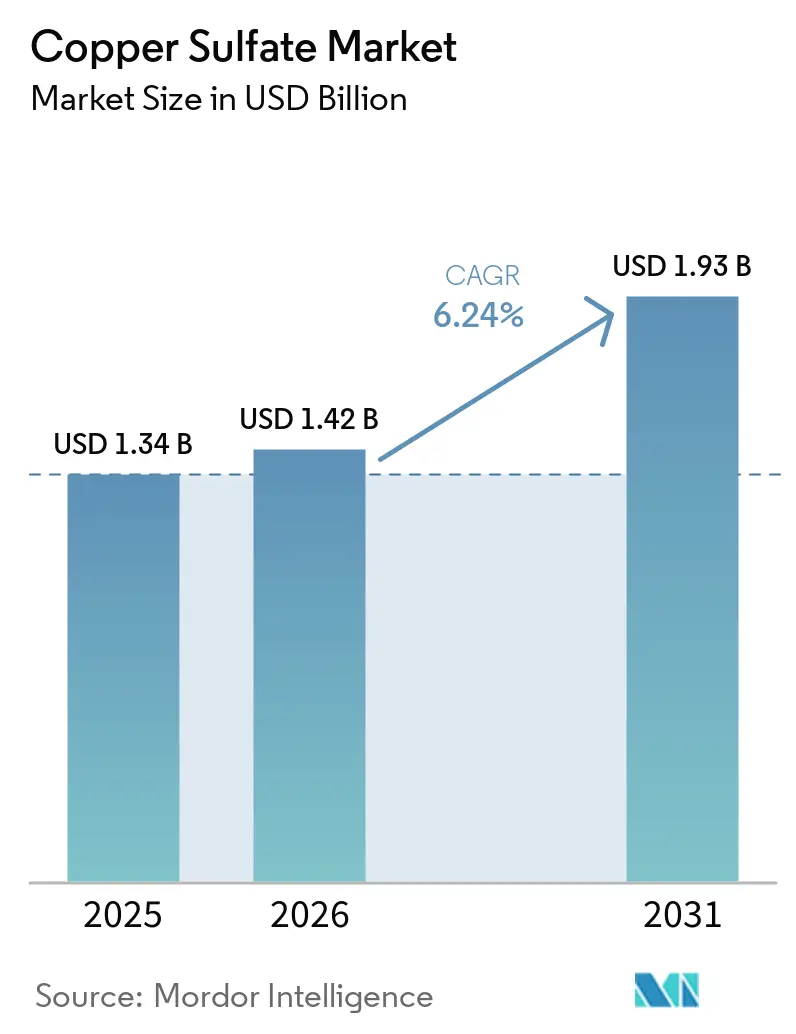
| Market Size (2026) | USD 1.42 Billion |
| Market Size (2031) | USD 1.93 Billion |
| Growth Rate (2026 - 2031) | 6.24 % |
| Fastest Growing Market | Asia-Pacific |
| Largest Market | Asia-Pacific |
| Market Concentration | Medium |
Major Players *Disclaimer: Major Players sorted in no particular order Image © Mordor Intelligence. Reuse requires attribution under CC BY 4.0. | |
Copper Sulfate Market Analysis by Mordor Intelligence
The Copper Sulfate Market size was valued at USD 1.34 billion in 2025 and is estimated to grow from USD 1.42 billion in 2026 to reach USD 1.93 billion by 2031, at a CAGR of 6.24% during the forecast period (2026-2031). The copper sulfate market serves agriculture, mining, animal nutrition, water treatment, and printed circuit board manufacturing, which gives demand several end-use foundations. Demand for high-purity material is rising with 5G networks, artificial intelligence data centers, and electric vehicle electronics, while crop protection remains an important outlet. Copper prices and tight concentrate availability are raising feedstock uncertainty, which favors producers with integrated mining and smelting operations. European rules on copper residues and environmental classification are increasing compliance demands for formulators, while specialty suppliers can benefit from traceability and purity requirements. The copper sulfate market, therefore, has opportunities in premium electronics grades, precision agricultural formulations, and supply arrangements that reduce exposure to input price changes.
Key Report Takeaways
- By product type, pentahydrate held 82.78% of the copper sulfate market share in 2025 and is projected to advance at a 6.87% CAGR through 2031.
- By application, agriculture held 44.05% of the copper sulfate market share in 2025, while mining and metallurgy is projected to advance at a 7.13% CAGR through 2031.
- By geography, Asia-Pacific held 45.23% of the copper sulfate market share in 2025 and is projected to advance at a 7.24% CAGR through 2031.
Note: Market size and forecast figures in this report are generated using Mordor Intelligence’s proprietary estimation framework, updated with the latest available data and insights as of January 2026.
Global Copper Sulfate Market Trends and Insights
Drivers Impact Analysis*
| Driver | (~) % Impact on CAGR Forecast | Geographic Relevance | Impact Timeline |
|---|---|---|---|
| Agricultural Fungicide and Micronutrient Demand | +2.1% | Global, led by Asia-Pacific (China, India), South America (Brazil, Argentina), and Mediterranean Europe | Long term (≥ 4 years) |
| Mining and Mineral-Processing Expansion | +1.4% | APAC core (China, Indonesia), South America (Chile, Peru), MEA (DRC, South Africa) | Medium term (2–4 years) |
| High-Purity Copper Sulfate for Printed Circuit Boards and Semiconductors | +1.0% | East Asia (China, Taiwan, South Korea, Japan), Southeast Asia, early gains in North America | Short term (≤ 2 years) |
| Animal Nutrition and Feed-Premix Demand | +0.7% | Asia-Pacific (China, Vietnam, Indonesia), North America, spillover to MEA | Medium term (2–4 years) |
| Water Treatment and Aquaculture Algae Control | +0.5% | Global, concentrated in North America, Southeast Asia, and North Africa | Long term (≥ 4 years) |
| Source: Mordor Intelligence | |||
Agricultural Fungicide and Micronutrient Demand
Agriculture remained the main application, with copper sulfate used in fungicide formulations and to correct copper-deficient soils. Bordeaux mixture combines copper sulfate with lime and continues to support organic viticulture where its use is permitted. The French Agency for Food, Environmental and Occupational Health and Safety assessed lower-copper scenarios for grapes, apples, and potatoes, and noted that alternatives can be limited in availability and costly to adopt. China and India support demand through intensive crop production, soil treatment, and fertigation networks. The European Food Safety Authority reviewed 81,730 residue results in 2025 and stated that dietary exposure from current agricultural uses did not create a health concern for any consumer age group[1]European Food Safety Authority, “Statement on the Update of Maximum Residue Levels for Copper Compounds in Light of the EFSA Scientific Opinion on the Re-Evaluation of Health-Based Guidance Values and Exposure Assessment from All Sources,” EFSA Journal, efsa.europa.eu. These conditions sustain a broad agricultural base for the copper sulfate market, even as product selection becomes more regulated.
Mining and Mineral-Processing Expansion
Copper sulfate is used as a flotation activator in lead, zinc, cobalt, and gold beneficiation. Mine development and higher processing needs support demand from flotation and electrowinning operations. Jiangxi Copper Corporation Limited brought the Wutong Phase III project to a daily processing capacity of 10,000 metric tons in 2025. KGHM Wszelkie prawa zastrzeżone has an integrated smelting position that links its copper operations with downstream chemical supply. The copper sulfate market benefits when new mining capacity requires flotation chemicals and continuous electrolyte management. Mine operators also use dosing systems that support controlled chemical use under environmental management requirements.
Animal Nutrition and Feed-Premix Demand
Copper is an essential trace element in livestock nutrition, making certified feed additives an established demand source. Commission Implementing Regulation (EU) 2018/2039 authorizes copper sulfate for feed use in premix form, which places emphasis on certified supply chains. Manica S.p.A. identifies copper sulfate as a feed additive and provides material for this application. The European Food Safety Authority issued 2025 assessments for copper lysinate sulfate and copper(II)-betaine complex as feed additives, showing continued review of alternative copper forms. These products seek authorization as organic-chelated forms and do not remove the nutritional need for copper. Lower maximum copper levels for some animal species are directing purchasing toward traceable, higher-purity grades in the copper sulfate market.
High-Purity Copper Sulfate for Printed Circuit Boards and Semiconductors
High-purity copper sulfate is used in electroplating for printed circuit boards and semiconductor packaging. More compact devices, higher board layer counts, and finer line widths increase copper deposition needs per board. JX Advanced Metals Corporation markets its UPINORG copper sulfate solution for semiconductor packaging and printed circuit board applications. This specialty use depends on purity, batch traceability, and qualification practices that commodity suppliers may not meet. The copper sulfate market is therefore gaining a higher-value demand stream from electronics manufacturing clusters in East Asia. Specialty producers with smelting links can better manage input security and the quality requirements of these customers. Their relationships with electronics buyers commonly depend on consistent specifications across repeated deliveries. That operating discipline differs from the high-volume procurement model used for many agricultural grades. It supports a distinct commercial position for companies that can document purity, traceability, and reliable supply.
Restraints Impact Analysis*
| Restraint | (~) % Impact on CAGR Forecast | Geographic Relevance | Impact Timeline |
|---|---|---|---|
| Copper-Load Limits and Environmental Toxicity Controls | -1.2% | EU core (France, Italy, Spain, Germany), with spillover to UK and NORDIC Countries | Long term (≥ 4 years) |
| Copper Feedstock Price Volatility | -0.9% | Global, most acute in Asia-Pacific and South America smelter clusters | Short term (≤ 2 years) |
| Substitution by Biological and Lower-Copper Formulations | -0.6% | Western Europe, North America; spillover emerging to Mediterranean and APAC organic sectors | Medium term (2–4 years) |
| Source: Mordor Intelligence | |||
Copper-Load Limits and Environmental Toxicity Controls
Copper compounds have been classified as substitution candidates under Regulation (EC) No 1107/2009 since 2025. This treatment can limit new agricultural uses where a safer option with similar efficacy is available. The French authority noted that the need to reduce copper use must be weighed against the limited scale and transition costs of alternatives. European product requirements also require careful classification, labeling, packaging, and documentation for copper compounds. These obligations raise the cost of serving regulated horticulture and viticulture markets. The copper sulfate market faces a narrower path for agricultural expansion in areas with strict copper-load controls.
Copper Feedstock Price Volatility
Copper sulfate producers depend on refined copper and smelter-linked feedstock, exposing them to copper price and processing conditions. London Metal Exchange (LME) cash copper reached USD 14,424.50 per metric ton in August 2026, while the cash-to-three-month spread reached USD 207.50 per metric ton. The same material reported that LME warehouse stocks fell more than 14% in 1 month, tightening physical availability. JX Advanced Metals announced primary copper production cuts and a medium-term reduction in smelting capacity in 2025 as processing margins deteriorated. Producers without captive supply face more difficulty setting multi-quarter contract terms when feedstock costs change quickly. This volatility increases the advantage of integrated companies in the copper sulfate market. Integrated businesses can align procurement, smelting, and chemical output within a single supply chain. Independent producers must instead manage changing input prices through contracts and inventory decisions. This can make supply planning more complex when availability becomes constrained.
*Our forecasts treat driver/restraint impacts as directional, not additive. The impact forecasts reflect baseline growth, mix effects, and variable interactions.
Segment Analysis
By Product Type: Pentahydrate Leads Both Share and Growth Rate
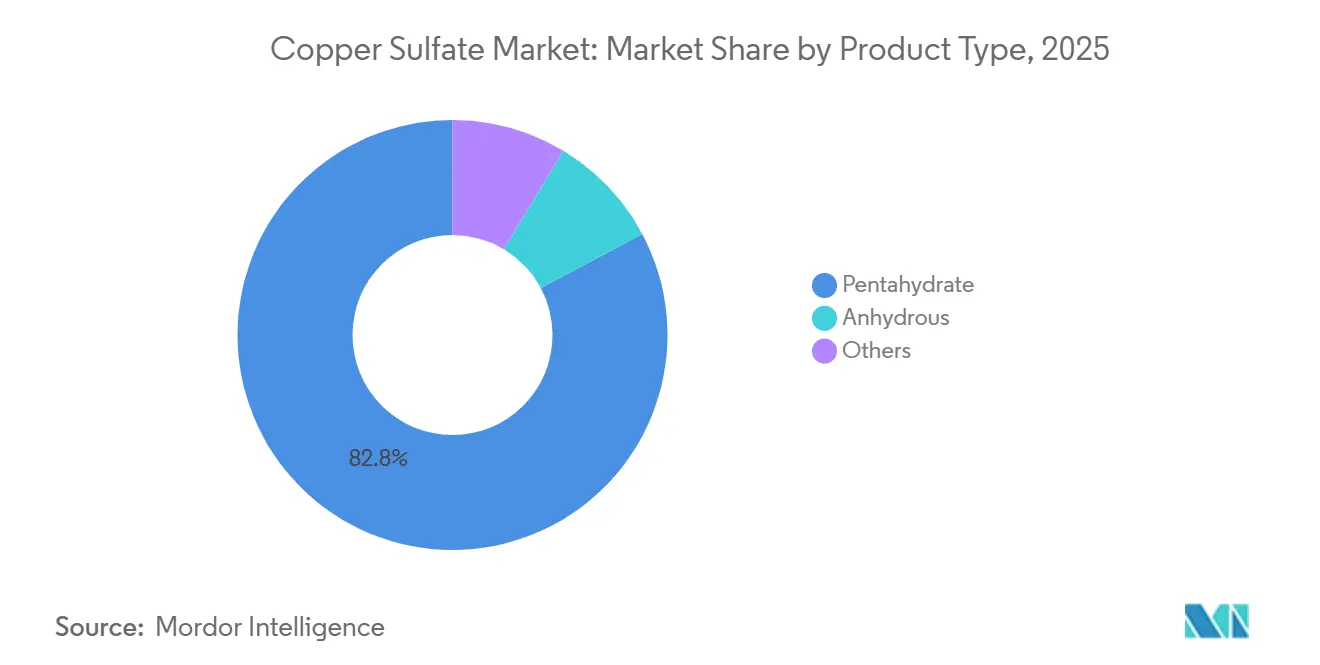
Pentahydrate accounted for 82.78% of the copper sulfate market size in 2025 and is projected to advance at a 6.87% CAGR through 2031. Its position reflects established use across agriculture, electroplating, animal nutrition, and water treatment, which gives producers access to several recurring customer groups. The same crystal form serves commodity agricultural requirements and high-purity electronics specifications. Commodity-grade pentahydrate at 98% purity is used in fungicide blending and feed premixes. Electronic-grade pentahydrate at 99.9% purity serves printed circuit board and semiconductor electroplating, where it earns a higher price. The copper sulfate industry is increasingly shaped by the different requirements of these two grades.
Anhydrous copper sulfate is used where precise dosing is required in analytical and specialty applications. Its production complexity and sensitivity to moisture during storage limit broader use outside applications that need these product characteristics. Other forms include basic copper sulfate and monohydrate products that serve specific fungicide needs. These products can support lower copper loads per applied dose in regulated markets. Classification, labeling, and packaging requirements in Europe add to the cost of entry for exporters. Suppliers with documented quality systems are better placed to serve specialized parts of the copper sulfate market. The distinction between grades also affects how producers manage inventory and customer qualification. Agricultural buyers prioritize reliable supply and compliance with formulation needs. Electronics buyers require higher control over impurities and batch consistency. These separate requirements support differentiated pricing and supply strategies across product forms.



By Application: Agriculture Leads While Mining and Metallurgy Expands Faster
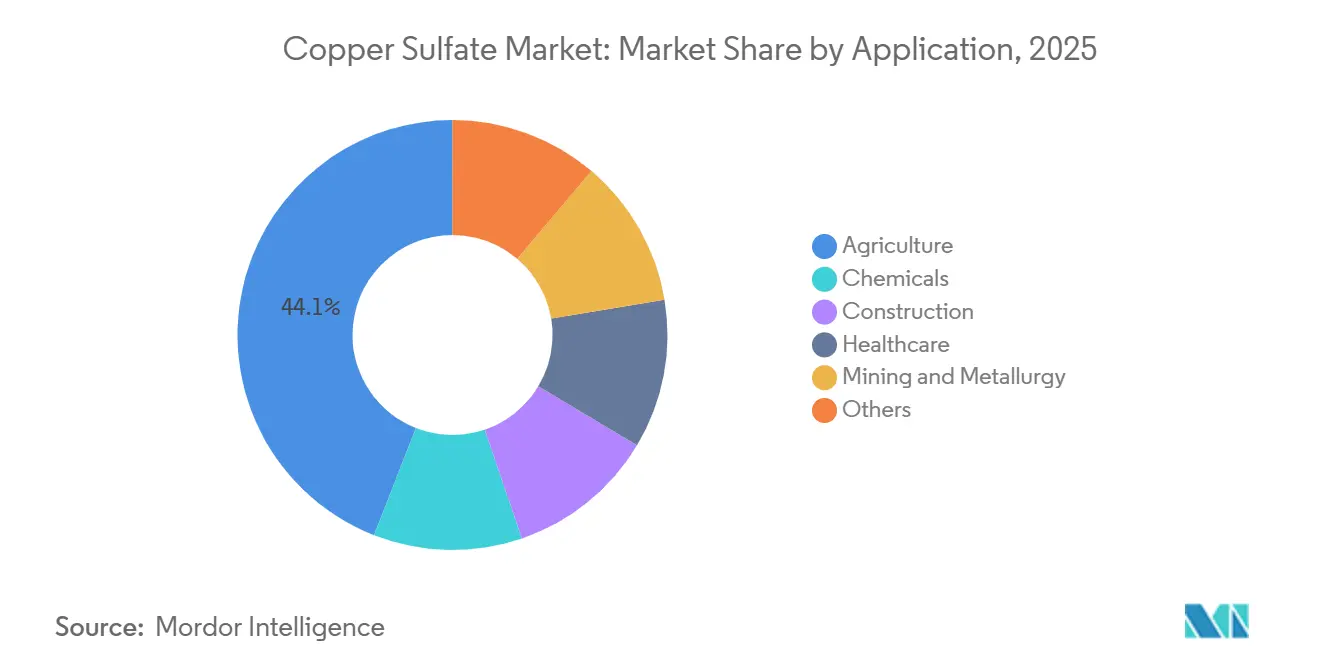
Agriculture held 44.05% of the copper sulfate market size in 2025. Copper sulfate serves as a fungicide ingredient, soil micronutrient supplement, animal feed premix component, and aquaculture treatment chemical within agricultural supply chains. Fertigation and soluble micronutrient systems use technical-grade pentahydrate because of its consistent solubility. Chemicals applications include electroplating baths, pigment production, and chemical synthesis. Construction uses include wood preservation and copper-based cementitious admixtures, although these applications represent a more specialized outlet than crop protection or mining.
Mining and metallurgy is projected to advance at a 7.13% CAGR through 2031 within the copper sulfate market. Growth is associated with higher processing activity in copper, zinc, cobalt, and gold operations. Complex ore bodies can require intensive flotation activation in mixed sulfide systems, which keeps the reagent relevant as processing circuits become more demanding. Jinchuan Group Co., Ltd. is among the integrated producers serving copper-related chemical supply chains. Agriculture remains important because several uses are connected to crop and livestock systems. Mining demand is driven by process requirements rather than consumer-facing product cycles. Chemicals applications link demand to electronics activity and industrial production. This range of applications reduces dependence on a single purchasing channel.
Geography Analysis
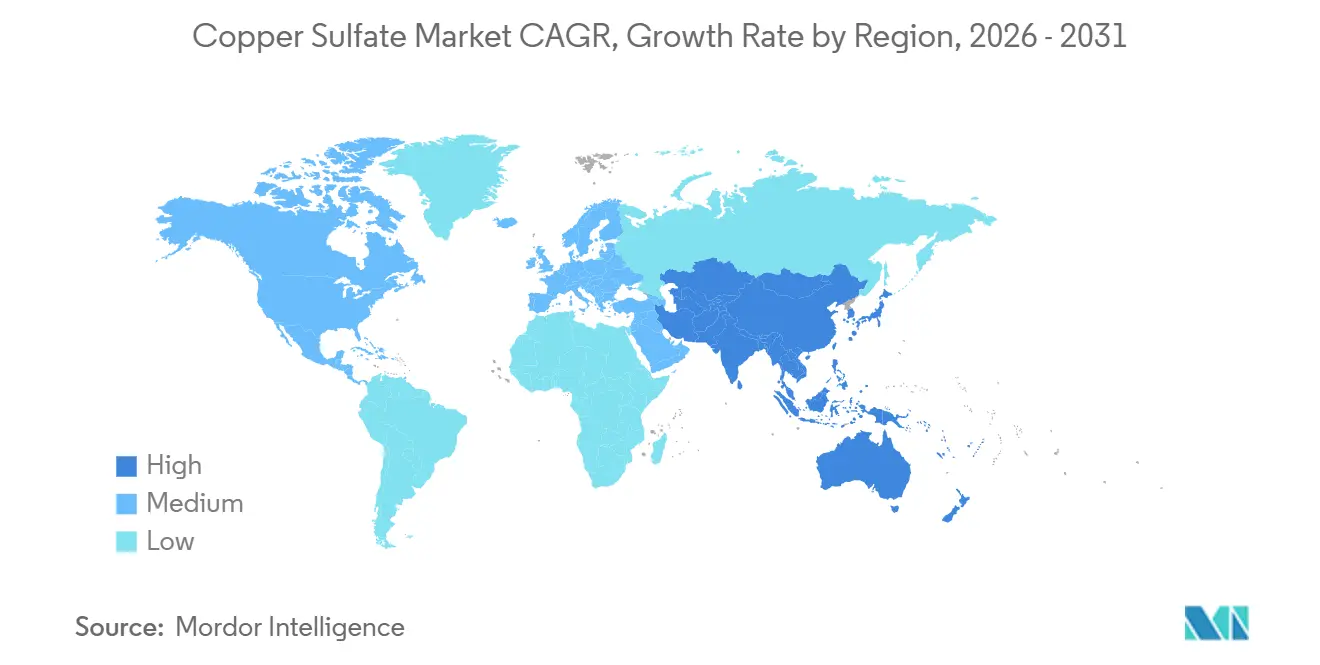
Asia-Pacific held 45.23% of the copper sulfate market share in 2025 and is projected to advance at a 7.24% CAGR through 2031. China combines copper smelting, extensive crop production, livestock activity, and electronics manufacturing. Jiangxi Copper Corporation Limited's Guixi Smelter has exceeded 1 million metric tons of annual electrolytic copper capacity. India has copper-deficient soils across wheat, rice, and cotton areas and uses more fertigation and foliar applications. Its livestock and mining activities also support feed premix and flotation demand. Chinese supply chains link smelting outputs with agricultural and industrial chemical distribution. This integration supports both bulk pentahydrate availability and specialty material development. Regional producers can spread fixed compliance and logistics costs across several end-use markets. These conditions help explain why Asia-Pacific combines a large installed base with the fastest projected growth. Japan and South Korea provide specialized demand for high-purity material from semiconductor and printed circuit board manufacturing, where qualification standards are more demanding than in bulk applications.
Indonesia, Vietnam, and the Philippines are emerging demand locations in Southeast Asia. Agricultural intensification, aquaculture, and electronics investments support this development. North America and Europe are established areas where product formulation and compliance affect demand patterns. North American consumption includes row-crop agriculture, industrial electroplating, mining flotation, and animal feed. Feed suppliers in the region use specifications that support reliable premium-grade procurement. Industrial customers also value consistency when copper sulfate is used in electroplating processes. European suppliers and formulators must adapt products to more demanding compliance conditions. The result is a greater focus on qualified products than on undifferentiated volume alone. Europe retains demand from organic farming because copper fungicides remain important in certified viticulture, particularly where viable alternatives have not reached the required operating scale. The copper sulfate market size in Europe is also shaped by residue rules and substitution-candidate requirements.
South America combines copper supply with demand from agriculture and mining, connecting production economics with a regional base of chemical users. Chile and Peru account for more than 40% of global copper mine production, supporting access to sulfuric acid and refined copper inputs. Sulcona S.A. de C.V. has manufactured and exported copper sulfate pentahydrate since 1954 for agricultural, galvanoplating, mining, and water-treatment uses[2]Sulcona S.A. de C.V., “Sulfato de Cobre, Fabricantes y Exportadores desde 1954,” Sulcona S.A. de C.V., guiaquimica.mx. Middle East and Africa demand is emerging through greenhouse agriculture, irrigation, mining, aquaculture, and municipal water treatment. The region has a smaller established base than Asia-Pacific, but its applications are broad. Greenhouse operations require inputs that can support crop health under intensive cultivation. Mining operations add an industrial source of demand where flotation circuits are expanded. Municipal water systems create additional use cases for algae control. Saudi Arabia and the United Arab Emirates use copper sulfate in food-security-related agricultural systems. South African mining and East African aquaculture create further consumption points for the copper sulfate market.

Competitive Landscape
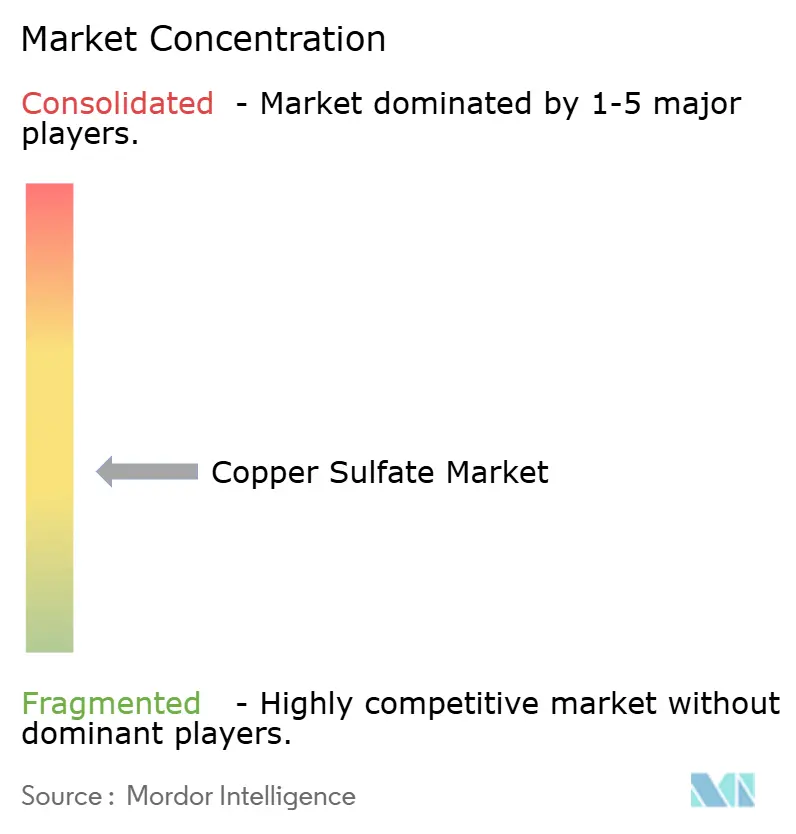
The copper sulfate market is moderately concentrated, with the top five players including OLD BRIDGE MINERALS, Sumitomo Metal Mining Co., Ltd., JX Advanced Metals Corporation, Beneut Enterprise, and Manica S.p.A. Jiangxi Copper Corporation Limited, Jinchuan Group Co., Ltd., and Highnic Group use Chinese smelting scale in commodity pentahydrate markets. JX Advanced Metals Corporation, Sumitomo Metal Mining Co., Ltd., Boliden Group, and KGHM Wszelkie prawa zastrzeżone compete through certification, supply security, and traceability in premium applications. This division places feedstock cost control and purity qualification at the center of competition. Standalone suppliers face greater pressure when copper input costs rise. Commodity competition is therefore closely linked to access to copper feedstock and smelting capacity. Premium competition depends more heavily on consistent purity and supporting documentation. The two models can coexist because their customer requirements differ materially. This structure keeps the copper sulfate market competitive while rewarding operational integration.
Jiangxi Copper Corporation Limited launched a formal cash offer for SolGold in December 2025 to pursue the Cascabel copper mine in Ecuador. The move was intended to strengthen ore self-sufficiency in a low treatment-charge environment and reduce dependence on external concentrate availability. JX Advanced Metals Corporation, Mitsui Kinzoku, Marubeni, and Mitsubishi Materials signed a final agreement in May 2026 to integrate concentrate purchasing and related cathode sales within Pan Pacific Copper. This action strengthens smelting-to-specialty integration among Japanese producers. It also brings concentrate purchasing and cathode sales closer to downstream chemical planning. Such coordination can improve visibility over raw material availability for qualified products. It raises the barrier for suppliers that must source material on the open market. The copper sulfate market continues to reflect this difference between integrated and independent business models.
Opportunities remain in precision-dose agricultural formulations that meet lower copper-use requirements. Closed-loop electroplating bath management is another area because recovery and longer bath life can lower chemical costs for semiconductor facilities. Manica S.p.A. has a position in feed premix supply through certification and application knowledge. Sulcona S.A. de C.V. supports regional agricultural and industrial customers in Latin America. Univertical supplies semiconductor-grade copper sulfate solution and emphasizes impurity control for electronic applications. Quality documentation and traceability continue to determine supplier access to demanding sections of the copper sulfate market, especially when buyers require consistent production records over extended supply periods. These requirements are particularly relevant where electronic components require tightly controlled inputs. Regional specialists can remain competitive when they understand application-specific purchasing needs. Their positions depend on maintaining certifications, reliable product performance, and customer support. This leaves room for focused suppliers despite the scale advantage of integrated mining and smelting groups.
Copper Sulfate Industry Leaders
OLD BRIDGE MINERALS
Sumitomo Metal Mining Co., Ltd.
JX Advanced Metals Corporation
Beneut Enterprise
Manica S.p.A.
- *Disclaimer: Major Players sorted in no particular order

Recent Industry Developments
- May 2026: JX Advanced Metals Corporation, Mitsui Kinzoku, Marubeni, and Mitsubishi Materials agreed to integrate Mitsubishi Materials’ copper concentrate purchasing and copper cathode sales activities into the Pan Pacific Copper joint venture. The consolidation strengthens the copper supply chain and supports downstream availability of copper feedstock used in copper sulfate production for semiconductor and printed circuit board applications.
- October 2025: Amoéba reported vineyard trials of AXPERA that achieved results comparable with a standard 3 kg/ha copper program while using only 1–2 kg/ha of copper alongside AXPERA. The results support the development of copper-efficient crop protection solutions and may influence demand patterns for copper-based agricultural products, including copper sulfate.


Global Copper Sulfate Market Report Scope
Copper sulfate is an inorganic copper compound available in different hydration states and valued for its chemical reactivity and water solubility. It is used as a source of copper and as a functional chemical in processes involving agriculture, mineral processing, chemical production, and other industrial applications.
The Copper Sulfate Market is segmented by product type, application, and geography. By product type, the market is segmented into pentahydrate, anhydrous, and others. By application, the market is segmented into agriculture, chemicals, construction, healthcare, mining and metallurgy, and others. The report also covers the market size and forecasts for copper sulfate in 15 countries across major regions. For each segment, the market sizing and forecasts have been done on the basis of value (USD).
| Pentahydrate |
| Anhydrous |
| Others |
| Agriculture |
| Chemicals |
| Construction |
| Healthcare |
| Mining and Metallurgy |
| Others |
| Asia-Pacific | China |
| India | |
| Japan | |
| South Korea | |
| ASEAN Countries | |
| Rest of Asia-Pacific | |
| North America | United States |
| Canada | |
| Mexico | |
| Europe | Germany |
| United Kingdom | |
| France | |
| Italy | |
| NORDIC Countries | |
| Rest of Europe | |
| South America | Brazil |
| Argentina | |
| Rest of South America | |
| Middle East and Africa | Saudi Arabia |
| South Africa | |
| Rest of Middle East and Africa |
| By Product Type | Pentahydrate | |
| Anhydrous | ||
| Others | ||
| By Application | Agriculture | |
| Chemicals | ||
| Construction | ||
| Healthcare | ||
| Mining and Metallurgy | ||
| Others | ||
| By Geography | Asia-Pacific | China |
| India | ||
| Japan | ||
| South Korea | ||
| ASEAN Countries | ||
| Rest of Asia-Pacific | ||
| North America | United States | |
| Canada | ||
| Mexico | ||
| Europe | Germany | |
| United Kingdom | ||
| France | ||
| Italy | ||
| NORDIC Countries | ||
| Rest of Europe | ||
| South America | Brazil | |
| Argentina | ||
| Rest of South America | ||
| Middle East and Africa | Saudi Arabia | |
| South Africa | ||
| Rest of Middle East and Africa | ||


Key Questions Answered in the Report
What is the size of the copper sulfate market?
The copper sulfate market stands at USD 1.42 billion in 2026 and is projected to reach USD 1.93 billion by 2031.
Which application led the market demand in 2025?
Agriculture held 44.05% of the market revenue in 2025.
Which product type is projected to advance through 2031?
Pentahydrate is projected to advance at a 6.87% CAGR through 2031.
Which region is projected to advance through 2031?
Asia-Pacific is projected to advance at a 7.24% CAGR through 2031.
Page last updated on:





