
Cookie-less Advertising Services Market Size and Share
Market Overview
| Study Period | 2020 - 2031 |
|---|---|
| Market Size (2026) | USD 6.41 Billion |
| Market Size (2031) | USD 11.78 Billion |
| Growth Rate (2026 - 2031) | 12.95 % |
| Fastest Growing Market | Asia-Pacific |
| Largest Market | North America |
| Market Concentration | Medium |
Major Players *Disclaimer: Major Players sorted in no particular order Image © Mordor Intelligence. Reuse requires attribution under CC BY 4.0. | |
Cookie-less Advertising Services Market Analysis by Mordor Intelligence
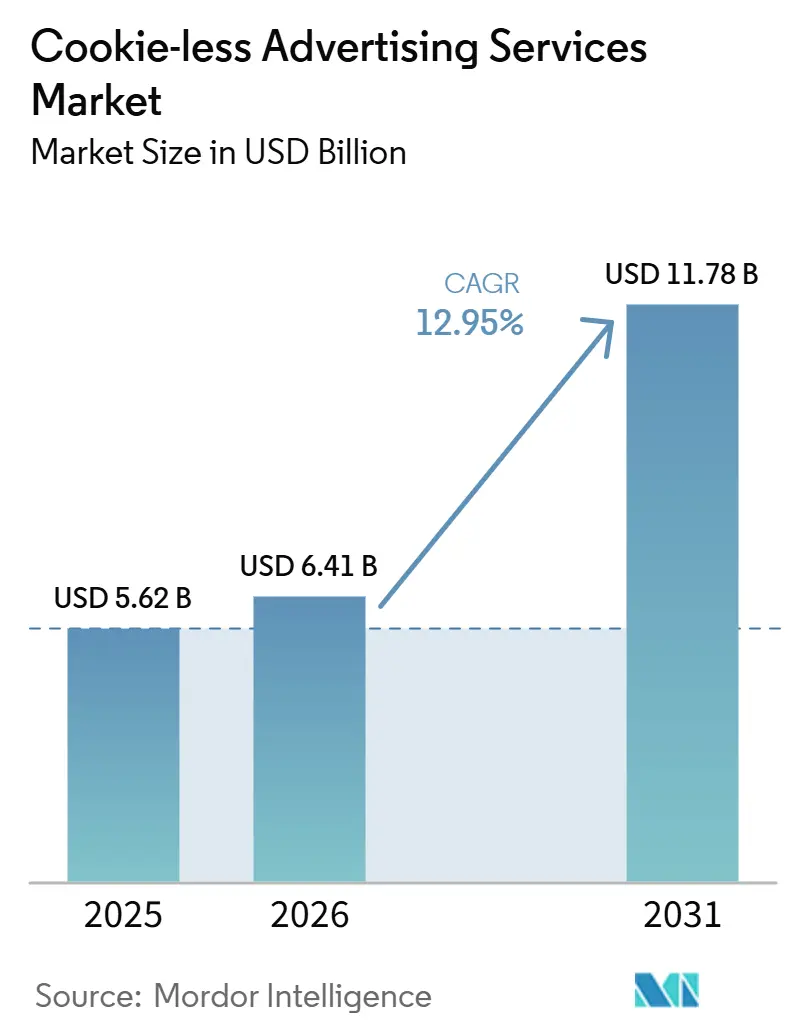
The cookie-less advertising services market size is projected to expand from USD 5.62 billion in 2025 and USD 6.41 billion in 2026 to USD 11.78 billion by 2031, registering a CAGR of 12.95% between 2026 to 2031. The cookie-less advertising services market is being shaped by the loss of third-party signals, which has made first-party data collection, consent management, and server-side measurement more central to advertising operations. Browser choices and mobile privacy controls have reduced the reliability of older forms of tracking, while contextual targeting, retailer data, and data clean rooms have become more important alternatives. Competition is also changing as agency groups, cloud platforms, and specialized providers invest in identity, data collaboration, and connected TV capabilities. Privacy rules add implementation costs, but they also create demand for services that can support consent-based activation and measurement. The resulting opportunity favors providers that can combine technical interoperability with dependable governance across advertisers, publishers, and retail media networks.
Key Report Takeaways
- By service type, First-Party Data Activation Services held 33.71% of the cookie-less advertising services market share in 2025, while Data Clean Room Services are projected to expand at a 13.74% CAGR through 2031.
- By end-user industry, Retail and E-commerce accounted for 25.63% of the cookie-less advertising services market size in 2025, while Healthcare and Life Sciences are expected to record the highest CAGR of 13.88% through 2031.
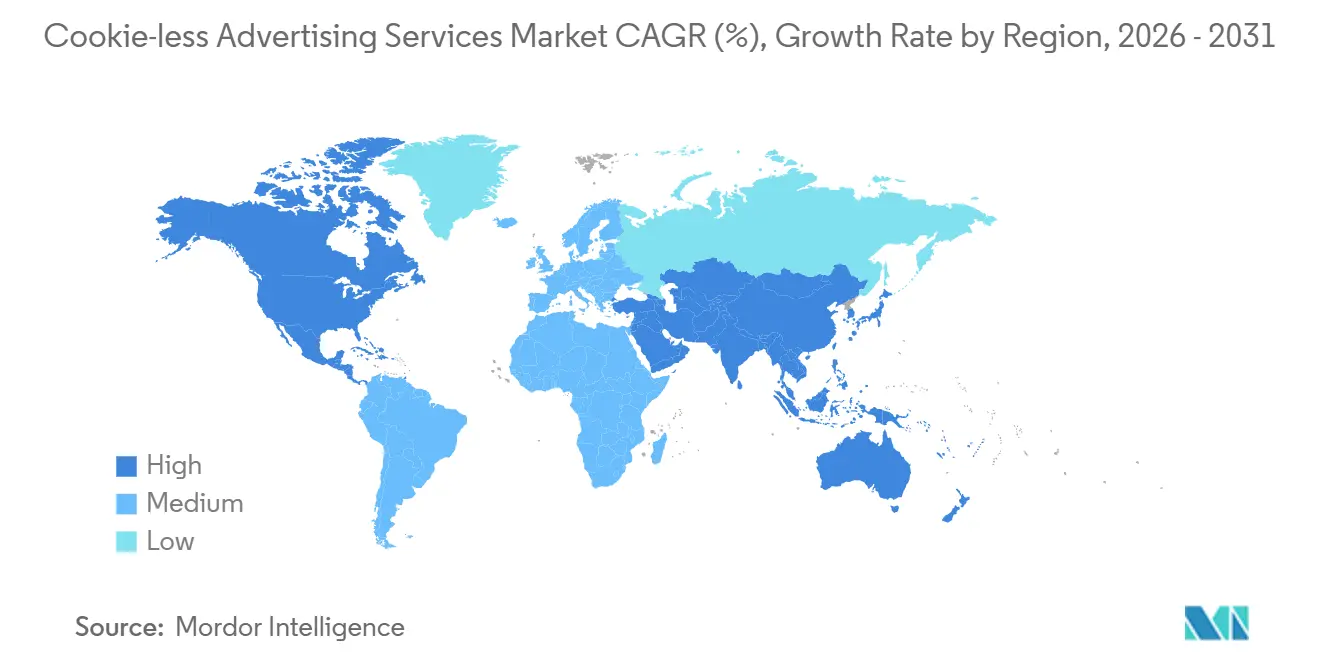
- By geography, North America held 51.28% of the cookie-less advertising services market share in 2025, while the Middle East is projected to expand at a 13.81% CAGR through 2031.
Note: Market size and forecast figures in this report are generated using Mordor Intelligence’s proprietary estimation framework, updated with the latest available data and insights as of January 2026.
Market Trends and Insights
Drivers Impact Analysis of Cookie-less Advertising Services Market*
| Driver | (~) % Impact on CAGR Forecast | Geographic Relevance | Impact Timeline |
|---|---|---|---|
| Third-Party Signal Loss Across Browsers and Mobile IDs | +3.8% | Global, with amplified effects in Asia-Pacific mobile-first markets and iOS-heavy regions | Short term (≤ 2 years) |
| Rising Spend on Privacy-Safe Contextual Targeting | +2.7% | North America and Europe, with faster adoption in Asia-Pacific and the Middle East | Medium term (2-4 years) |
| Growth of First-Party Data Activation and Retail Media Partnerships | +2.3% | North America and Europe, with spillover to Asia-Pacific and the Middle East | Medium term (2-4 years) |
| Expansion of AI-Led Semantic, Video, and CTV Contextual Analysis | +1.8% | North America and Western Europe, with early gains in Asia-Pacific streaming markets | Medium term (2-4 years) |
| Standardization of Clean Room Interoperability | +1.2% | Global, with early traction in North America and Western Europe | Long term (≥ 4 years) |
| Supply-Side Curation and Seller-Defined Audiences | +0.8% | North America and Europe, with selective adoption in Asia-Pacific publisher ecosystems | Long term (≥ 4 years) |
| Source: Mordor Intelligence | |||
Third-Party Signal Loss Drives Structural Reallocation of Advertising Infrastructure
The cookie-less advertising services market is responding to the erosion of third-party identifiers across major browsers and mobile environments. Safari and Firefox have blocked third-party cookies by default for years, while Chrome uses a user-choice approach that leaves advertisers with less predictable access to traditional identifiers. Apple’s App Tracking Transparency framework has also limited cross-app tracking, so mobile advertisers need other ways to collect and activate consented signals. These changes shift spending toward first-party data pipelines, server-side event collection, identity alternatives, contextual services, and measurement tools. Brands that established these capabilities earlier can continue using their own customer and event data across campaign planning and reporting. Brands that delayed the transition face a more extensive redesign of their data collection, consent flows, and activation processes.
The effect extends beyond media buying because campaign reporting depends on stable links between exposure, engagement, and conversion events. Cookie-based measurement was designed for a browser environment where a third party could observe more of the consumer journey. That approach is less reliable when identifiers are unavailable, restricted, or separated by browser and app policies. The cookie-less advertising services industry therefore supports a broader operational change that connects tag management, customer relationship management systems, consent tools, and advertising platforms. The need is especially clear for advertisers that operate across web, mobile, retail media, and connected TV channels. Consent obligations under the ePrivacy Directive and state privacy laws also remain relevant even when a cookie is technically available, which makes governance part of the operating model rather than a separate legal task.
Privacy-Safe Contextual Targeting Gains Measurable Performance Parity With Behavioral Advertising
Contextual targeting is taking on a larger role because it can use the content surrounding an advertisement instead of relying on an individual’s browsing history. The cookie-less advertising services market increasingly uses semantic systems that assess language, images, video, and content themes rather than simple keyword matching. U.S. digital advertising revenue reached USD 294.6 billion in 2025, and commerce media generated USD 63.4 billion, reflecting the expanding importance of first-party purchase and contextual signals in digital media activity.[1] The cookie-less advertising services market is also moving into connected TV, where content can be assessed at the program, episode, or scene level. This allows buyers to select suitable content settings and reduce mismatches between a message and the viewing environment. It gives publishers another way to describe premium inventory without transferring audience-level data.
The change is important because contextual signals can be used without processing personal data in the same manner as behavioral targeting. That can reduce exposure to changes in consent rates and make campaign delivery less dependent on authenticated audiences. The cookie-less advertising services market is also benefiting from supply-side standards that make contextual segments easier to communicate in programmatic transactions. IAB Tech Lab renamed Seller-Defined Audiences as Curated Audiences in December 2024, providing publishers with a framework to expose standardized audience and contextual signals in the bid stream. Publishers can use those signals to package content, while buyers can apply brand suitability requirements without receiving raw user data. This model does not eliminate the need for measurement, but it creates a workable alternative when behavioral signals are incomplete or unavailable.
First-Party Data Activation and Retail Media Partnerships Reconfigure the Programmatic Value Chain
Retail media is becoming more closely connected to programmatic advertising because retailers hold transaction data that can support audience planning and closed-loop measurement. The cookie-less advertising services market supports the systems that prepare these records for use, including customer data onboarding, secure matching, clean room collaboration, and conversion reporting. IAB reported that retail media spending in the United States approaches USD 70 billion in 2026, which strengthens the demand for infrastructure that can connect advertiser budgets with retailer data. Retailers can activate signals based on actual purchase behavior rather than inferred browsing activity. That supports more relevant campaign planning while retaining controls over the underlying data. It also makes retail media a more important source of addressable signals as open-web tracking becomes less dependable.
The commercial model depends on secure collaboration between brands, retailers, publishers, and advertising platforms. Instacart and The Trade Desk expanded their partnership in June 2025 to provide real-time access to first-party grocery audience segments and closed-loop measurement within The Trade Desk platform.[2] The IAB Tech Lab released PAIR protocol version 1.0 in January 2025 to support encrypted matching of first-party audience data without requiring raw personal information to leave either party’s environment. These developments show why this service sector includes both data activation tools and standards for safe data collaboration. They also point to a larger role for clean rooms where brands need to compare campaign results with retailer or publisher records. Vendors that simplify these workflows can address a gap between the technical value of first-party data and the operational difficulty of using it across separate organizations.
AI-Led Semantic, Video, and CTV Contextual Analysis Creates a New Buying Category
Artificial intelligence is expanding contextual analysis from broad content categories into more detailed assessments of text, images, objects, sentiment, and scene characteristics. The cookie-less advertising services market can use these systems to provide targeting and brand suitability signals without relying on a persistent user identifier. In June 2025, Magnite integrated Anoki ContextIQ into its SpringServe ad server to bring scene-level connected TV targeting and AI-based brand safety analysis to buyers.[3] This creates more detailed options than choosing an entire channel, show, or genre. Advertisers can align creative with the immediate viewing context, while publishers can better describe the value of specific inventory. The approach can also support suitability controls when a brand needs to avoid certain themes or scenes.
Omnicom Media and NBCUniversal launched Dynamic Contextual Content in June 2026, combining Acxiom identity data with NBCUniversal episode-level contextual metadata for in-flight creative optimization in connected TV. The launch illustrates how identity and contextual information can be used together rather than treated as competing approaches. The cookie-less advertising services market therefore includes services that evaluate content, distribute contextual signals, and adjust creative or buying decisions using those signals. This capability is particularly relevant in premium streaming, where ad breaks can be linked to distinct content settings. It may also help buyers maintain relevance when authenticated identity coverage is limited. Providers still need to demonstrate that their classifications are consistent, transparent, and suitable for real-time advertising decisions.
Restraints Impact Analysis of Cookie-less Advertising Services Market*
| Restraint | (~) % Impact on CAGR Forecast | Geographic Relevance | Impact Timeline |
|---|---|---|---|
| Fragmented Privacy Regulations and Consent Governance Costs | -2.1% | Global, with the greatest impact in Europe and United States multi-state compliance zones | Medium term (2-4 years) |
| Limited Scale and Match Rates for Authenticated Identity | -1.4% | Global, with the greatest constraint outside logged-in and walled-garden environments | Medium term (2-4 years) |
| Browser Storage Caps and Cookie Partitioning Weaken Persistence | -0.9% | Global, with the strongest effect in Safari-heavy iOS markets in Asia-Pacific and Europe | Short term (≤ 2 years) |
| Publisher Yield Compression in Privacy-Safe Testing Environments | -0.6% | North America and Europe, with a lower effect in high-growth emerging markets | Short term (≤ 2 years) |
| Source: Mordor Intelligence | |||
Fragmented Privacy Regulations Impose Compounding Compliance Costs Across Markets
Privacy regulation is a restraint because global advertising systems must operate under rules that differ by jurisdiction. The cookie-less advertising services market must support consent collection, data use controls, contractual requirements, and auditability across a wide range of workflows. In 2025, France’s CNIL imposed a EUR 325 million fine on Google for advertising cookie consent failures. The case shows that consent design and user choice remain material issues even when advertisers are moving away from third-party cookies. GDPR uses an opt-in approach, while U.S. state rules can use opt-out rights and other requirements. Platforms serving several markets may need parallel technical controls, which increases the cost of managing campaigns and data flows.
The challenge is more significant for independent publishers and smaller technology providers because consent governance introduces costs that do not decline easily with lower transaction volume. The IAB’s Fifth Amended Multi-State Privacy Agreement became effective in June 2026 and provides a common U.S. contracting framework for digital advertising privacy obligations. The framework can reduce variation in commercial agreements, but deployment still requires legal review and technical integration across platforms and partners. The cookie-less advertising services industry must therefore make compliance functions usable within daily campaign operations. Providers with established engineering, policy, and implementation resources have an advantage over smaller firms that must absorb the same requirements with fewer resources. This can strengthen the position of scaled platforms even where demand for independent solutions remains high.
Limited Match Rates for Authenticated Identity Constrain Open-Web Addressability
Authenticated identity solutions can offer useful targeting precision when consumers sign in or provide consented contact information. Their reach is more limited in anonymous open-web environments, where a user may not be logged in or willing to provide an identifier. The cookie-less advertising services market contains several identity systems, including UID2, RampID, ID5, and other alternatives, but no system has universal support across every browser, platform, and publisher. Browser restrictions can also limit token passing and other technical methods used to recognize an authenticated user. These constraints are particularly relevant in iOS-heavy markets and in premium mobile or connected TV inventory where addressability is valuable. The result is a need to combine identity with contextual, first-party, and modeled approaches instead of depending on a single identifier.
The operating burden increases when buyers must manage several identity frameworks across campaigns and channels. Each framework may have different consent conditions, technical integrations, reach profiles, and reporting methods. The cookie-less advertising services market must help advertisers use these tools without creating disconnected measurement or overlapping data processes. The Trade Desk launched the OpenTTD developer portal in March 2026 to bring UID2, EUID, and OpenPass technical resources into a unified developer environment. This type of infrastructure can make integration easier, but it does not remove the underlying gap between logged-in and anonymous traffic. Consent requirements for hashed email and other identifiers also limit the pool of users available for authenticated targeting. Providers that can clearly communicate coverage, governance, and measurement limits will be better placed to support buyers across mixed identity environments.
*Our forecasts treat driver/restraint impacts as directional, not additive. The impact forecasts reflect baseline growth, mix effects, and variable interactions.
Cookie-less Advertising Services Market Segment Analysis
By Service Type:
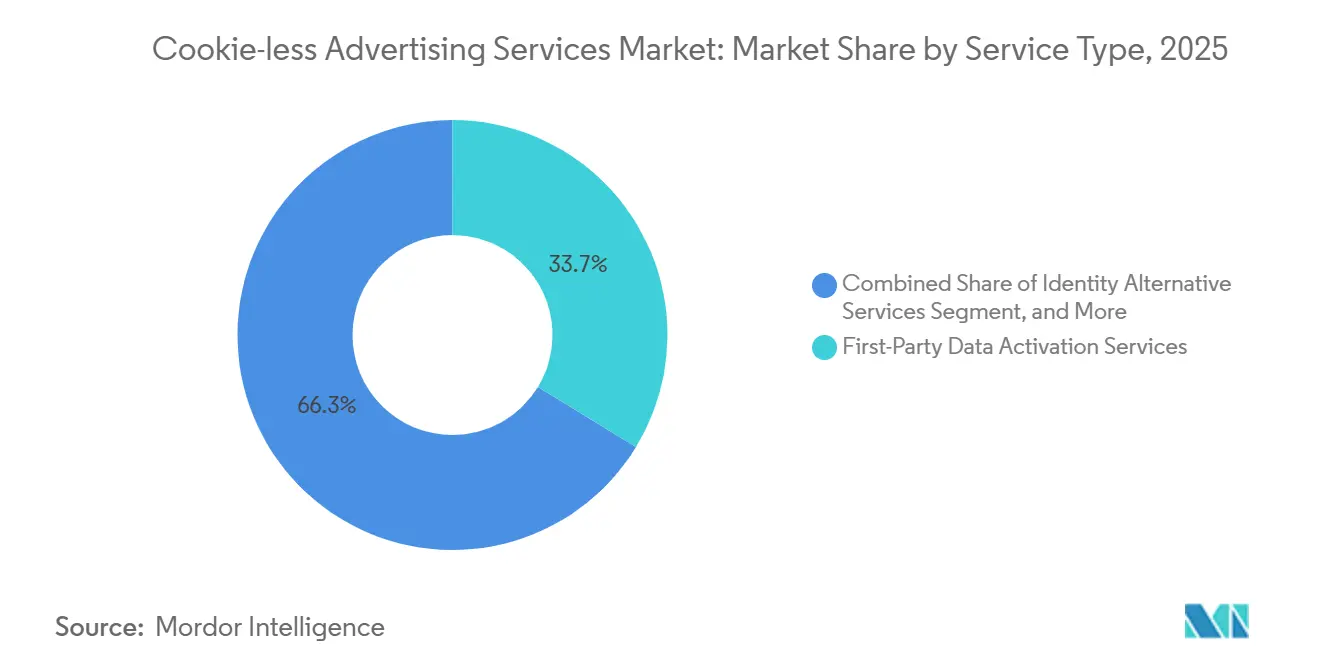
First-Party Data Activation Leads While Clean Rooms Expand FastestFirst-Party Data Activation Services held a 33.71% share of the cookie-less advertising services market size in 2025, making them the largest service category. The segment covers consented data collection, enrichment, customer relationship management onboarding, server-side event pipelines, conversion interfaces, and audience activation. These capabilities are now central to campaign operations because advertisers need dependable signals that can be used across planning, delivery, and reporting. IAB and PwC reported that U.S. commerce media expanded 18.0% in 2025, reinforcing demand for first-party activation in retail data environments. Contextual Targeting Services, Identity Alternative Services, and Measurement and Attribution Adaptation Services benefit from the same signal-loss pressure, though identity and attribution tools face reach and integration limits.
Data Clean Room Services are projected to expand at a 13.74% CAGR from 2026 to 2031, the highest rate among service types in the cookie-less ad services market. IAB stated that companies planned to invest 29% more in clean rooms in 2025 than in 2024 because they need privacy-safe collaboration across retailer, publisher, brand, and platform data. The Federal Trade Commission stated that clean rooms are not inherently privacy-preserving, making governance, output controls, and monitoring important parts of an implementation. Publicis Groupe’s May 2026 agreement to acquire LiveRamp for USD 2.167 billion increased attention on independent and cloud-based alternatives for data collaboration. The segment will depend on providers that can deliver practical interoperability, clear governance, and costs suited to a wider group of advertisers in the cookie-less advertising services industry.

By End-User Industry:
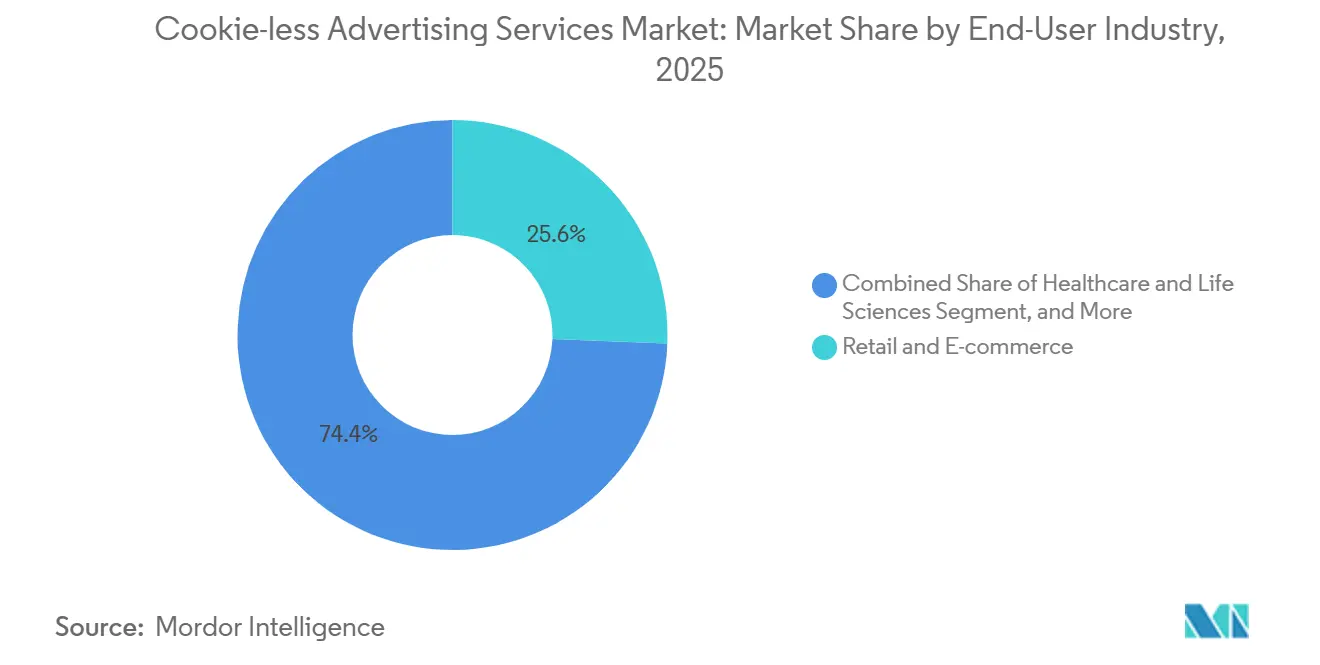
Retail and E-Commerce Lead While Healthcare and Life Sciences AccelerateRetail and E-commerce held a 25.63% revenue share in 2025, the largest among end-user industries in the cookie-less advertising services market. Retailers can use transaction and loyalty records to support audience creation, campaign activation, and closed-loop sales measurement, which gives them an advantage as buyers seek signals tied to purchase behavior. U.S. retail media spending approaches USD 70 billion in 2026, supporting the use of clean rooms and secure matching between retailer and brand data. Media and Entertainment also needs contextual tools for connected TV, while Telecom and Technology can support identity, connectivity, and data activation requirements. Instacart’s October 2025 TikTok solution and Perion’s September 2025 Albertsons Media Collective partnership show how first-party purchase signals are being used across additional media formats.
Healthcare and Life Sciences are projected to record a 13.88% CAGR from 2026 to 2031, the highest among the cookie-less advertising services industry end-users. Strict requirements around patient-related information make broad pixel-based tracking less suitable for many use cases, increasing the importance of server-side first-party data, contextual signals, and consented activation. Health systems, telehealth platforms, and pharmaceutical brands need measurement approaches that align campaign execution with privacy controls. Banking, Financial Services, and Insurance organizations face related consent and governance requirements, while Travel and Hospitality and Automotive brands can use loyalty, configurator, and test-drive signals. Gaming, consumer packaged goods, education, and other sectors are adopting retail media and connected TV services through their own combination of owned data, partner data, contextual signals, and measurement tools.
Geography Analysis
North America Cookie-less Advertising Services Market
North America held 51.28% of the cookie-less advertising services market size in 2025, supported by a concentration of programmatic infrastructure, retail media networks, customer data platforms, and clean room deployments. The United States is central to regional demand because it has a large digital advertising base and active investment in retail media, connected TV, and privacy-oriented data infrastructure. U.S. digital advertising revenue reached USD 294.6 billion in 2025, while commerce media generated USD 63.4 billion. These categories rely increasingly on first-party purchase, contextual, and consented data signals. Canada contributes demand through publisher and advertiser adoption of privacy-aware data practices, while Mexico is building first-party data capabilities alongside e-commerce development. The region is also affected by the practical cost of clean room implementation, which can keep some independent buyers outside the most advanced collaboration environments. The IAB’s multi-state privacy agreement gives national platforms a common contracting baseline, though implementation still requires operational changes across partners.
Europe Cookie-less Advertising Services Market
Europe is the second-largest regional block and operates under a regulatory environment shaped by GDPR and national privacy oversight. The region has a strong need for consent-compatible identity, contextual targeting, and measurement infrastructure because data use controls are embedded in digital advertising operations. IAB Europe’s Transparency and Consent Framework version 2.3 became mandatory for publishers and consent management platforms on March 1, 2026, creating an updated compliance baseline for programmatic activity. Germany, the United Kingdom, and France lead enterprise adoption of clean rooms and curated audiences, while the Netherlands remains an important programmatic infrastructure hub. The United Kingdom continues to operate its own privacy framework after leaving the European Union, which sustains demand for privacy-safe targeting options. Spain and Italy are adopting these capabilities as e-commerce activity expands and consent requirements remain relevant for cookie storage. European providers must balance mature demand with detailed compliance expectations and fragmented local implementation needs.
MEA, APAC and South America Cookie-less Advertising Services Market
The Middle East is projected to expand at a 13.81% CAGR from 2026 to 2031, the highest regional rate in the cookie-less advertising services market. E-commerce growth in Saudi Arabia and the United Arab Emirates, together with broader digital advertising adoption, supports demand for targeting and measurement tools that can operate under emerging governance frameworks. Asia-Pacific is also a major growth area because large mobile-first audiences and different national data rules increase the need for locally suitable identity and data activation options. China’s data localization requirements and privacy rules across Association of Southeast Asian Nations markets encourage services that can respect national data sovereignty conditions. Japan and Australia have adopted international standards-based cookie-less technologies earlier than many regional markets. South America and Africa have lower absolute volumes but show demand in Brazil and South Africa, where privacy compliance investments encourage brands to build first-party data infrastructure. The cookie-less advertising services market offers longer-term opportunities in these regions for providers that can adapt their services to local consent practices, publisher ecosystems, and advertiser resources.
Competitive Landscape
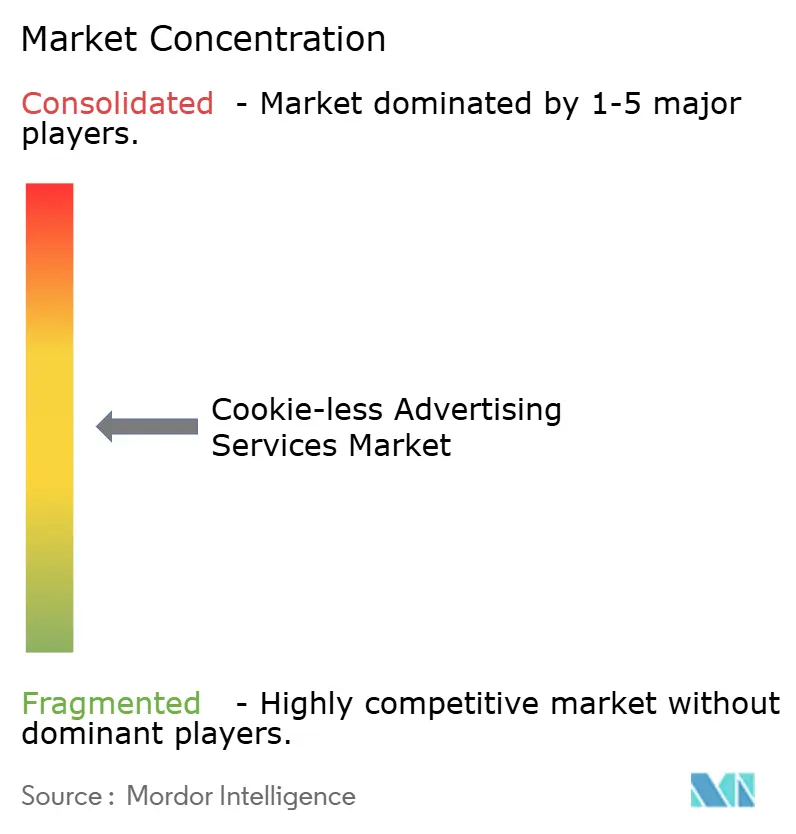
The cookie-less advertising services market has a moderately fragmented structure because large platforms have extensive first-party data, advertising infrastructure, and cloud resources, while specialized providers compete on neutrality and technical depth. Google, Amazon, The Trade Desk, and Microsoft have substantial influence through their respective advertising environments, data assets, and infrastructure capabilities. Specialized firms focus on identity resolution, clean rooms, publisher-side activation, contextual intelligence, and cross-border data collaboration. Competition is not based on a single technology because buyers often need several tools to manage data collection, consent, audience activation, contextual buying, and measurement. This creates room for providers that can integrate well with existing systems rather than replace them entirely. The cookie-less advertising services industry is also affected by agency ownership of data assets, which can change how buyers assess vendor neutrality. As a result, interoperability and governance have become important competitive criteria alongside reach and technical performance.
Publicis Groupe announced an agreement in May 2026 to acquire LiveRamp for a total enterprise value of USD 2.167 billion, bringing identity resolution, data clean room, and first-party activation capabilities closer to its Epsilon platform. The move may lead rival agencies and advertisers to consider unaffiliated data collaboration options. The Trade Desk has continued to develop open identity infrastructure through UID2, EUID, and OpenPass, and its March 2026 OpenTTD developer portal brought technical resources for these products into one location. Magnite’s June 2025 integration of Anoki ContextIQ expanded scene-level contextual and brand safety capabilities for connected TV buyers. These moves reflect three competitive paths, infrastructure consolidation, platform extension, and focused specialization. Each path responds to the need for privacy-safe activation, but each also addresses different parts of the advertising workflow.
Publicis Groupe announced an agreement in May 2026 to acquire LiveRamp for a total enterprise value of USD 2.167 billion, bringing identity resolution, data clean room, and first-party activation capabilities closer to its Epsilon platform. The move may lead rival agencies and advertisers to consider unaffiliated data collaboration options. The Trade Desk has continued to develop open identity infrastructure through UID2, EUID, and OpenPass, and its March 2026 OpenTTD developer portal brought technical resources for these products into one location. Magnite’s June 2025 integration of Anoki ContextIQ expanded scene-level contextual and brand safety capabilities for connected TV buyers. These moves reflect three competitive paths, infrastructure consolidation, platform extension, and focused specialization. The cookie-less advertising services market needs each path to address a different part of the advertising workflow.
Cookie-less Advertising Services Industry Leaders
-
Google LLC
-
Amazon.com, Inc.
-
The Trade Desk, Inc.
-
LiveRamp Holdings, Inc.
-
Criteo S.A.
- *Disclaimer: Major Players sorted in no particular order
Cookie-less Advertising Services Market Companies Covered in this Report
- Google LLC
- Amazon.com, Inc.
- The Trade Desk, Inc.
- LiveRamp Holdings, Inc.
- Criteo S.A.
- Adobe Inc.
- PubMatic, Inc.
- Integral Ad Science Holding Corp.
- Lotame Solutions, Inc.
- Quantcast Corporation
- Snowflake Inc.
- Acxiom LLC
- InfoSum Ltd.
- InMobi Pte. Ltd.
- Microsoft Corporation
- Oracle Corporation
- Nexxen International Ltd.
- Permutive, Inc.
- ID5 Technology Limited
- OpenX Software Ltd.
Recent Industry Developments in Cookie-less Advertising Services Market
- June 2026: Omnicom Media and NBCUniversal launched Dynamic Contextual Content (DCC), a CTV advertising solution combining Acxiom identity data with NBCUniversal episode-level contextual metadata to power in-flight creative optimization. The initiative, in beta, is expected to be commercially live in the United States by year-end 2026 and signals the convergence of identity and contextual intelligence as a new premium CTV buying category.
- May 2026: Publicis Groupe announced the acquisition of LiveRamp Holdings for a total enterprise value of USD 2.167 billion in an all-cash transaction at USD 38.50 per share, a 29.8% premium to LiveRamp’s May 15 closing price. The deal integrates LiveRamp’s identity resolution, data clean room, and first-party activation capabilities into Publicis’s Epsilon identity platform and is pending regulatory approval with an expected close date before year-end 2026.
- May 2026: Truthset integrated with UID2, enabling media buyers to validate audience segments against independently verified data on a 1:1 basis across CTV and mobile inventory. Truthset estimates that 30-60% of current programmatic ad waste is attributable to mistargeting caused by identity data inaccuracies, giving the integration material relevance to campaign ROI for UID2 buyers.
- April 2026: LiveRamp integrated NVIDIA GPU infrastructure into its clean room environments, increasing AI model training speed by up to 15 times compared to previous CPU-based systems. The upgrade materially reduces time-to-insight for large-scale first-party data collaboration and lookalike modeling within the LiveRamp Safe Haven platform.
Global Cookie-less Advertising Services Market Report Scope
The Global Cookie-less Advertising Services Market comprises professional services, platforms, and technologies that enable advertisers, publishers, agencies, and brands to plan, target, deliver, measure, and optimize digital advertising campaigns without relying on third-party cookies or traditional cross-site tracking identifiers.
The Cookie-less Advertising Services Market Report is Segmented by Service Type (Contextual Targeting Services, First-Party Data Activation Services, Data Clean Room Services, Identity Alternative Services, and Measurement and Attribution Adaptation Services), End-user Industry (Retail and E-commerce, Media and Entertainment, Banking, Financial Services, and Insurance, Healthcare and Life Sciences, Travel and Hospitality, Automotive, Telecom and Technology, and Others), and Geography (North America, South America, Europe, Asia-Pacific, Middle East, and Africa). The Market Forecasts are Provided in Terms of Value (USD).
Segmentation Overview
| Contextual Targeting Services |
| First-Party Data Activation Services |
| Data Clean Room Services |
| Identity Alternative Services |
| Measurement and Attribution Adaptation Services |
| Retail and E-commerce |
| Media and Entertainment |
| Banking, Financial Services, and Insurance |
| Healthcare and Life Sciences |
| Travel and Hospitality |
| Automotive |
| Telecom and Technology |
| Other End-user Industries |
| North America | United States |
| Canada | |
| Mexico | |
| South America | Brazil |
| Argentina | |
| Chile | |
| Rest of South America | |
| Europe | Germany |
| United Kingdom | |
| France | |
| Italy | |
| Spain | |
| Netherlands | |
| Russia | |
| Rest of Europe | |
| Asia-Pacific | China |
| Japan | |
| India | |
| South Korea | |
| Australia | |
| Singapore | |
| Indonesia | |
| Rest of Asia-Pacific | |
| Middle East | Saudi Arabia |
| United Arab Emirates | |
| Turkey | |
| Rest of Middle East | |
| Africa | South Africa |
| Nigeria | |
| Kenya | |
| Rest of Africa |
| By Service Type | Contextual Targeting Services | |
| First-Party Data Activation Services | ||
| Data Clean Room Services | ||
| Identity Alternative Services | ||
| Measurement and Attribution Adaptation Services | ||
| By End-user Industry | Retail and E-commerce | |
| Media and Entertainment | ||
| Banking, Financial Services, and Insurance | ||
| Healthcare and Life Sciences | ||
| Travel and Hospitality | ||
| Automotive | ||
| Telecom and Technology | ||
| Other End-user Industries | ||
| By Geography | North America | United States |
| Canada | ||
| Mexico | ||
| South America | Brazil | |
| Argentina | ||
| Chile | ||
| Rest of South America | ||
| Europe | Germany | |
| United Kingdom | ||
| France | ||
| Italy | ||
| Spain | ||
| Netherlands | ||
| Russia | ||
| Rest of Europe | ||
| Asia-Pacific | China | |
| Japan | ||
| India | ||
| South Korea | ||
| Australia | ||
| Singapore | ||
| Indonesia | ||
| Rest of Asia-Pacific | ||
| Middle East | Saudi Arabia | |
| United Arab Emirates | ||
| Turkey | ||
| Rest of Middle East | ||
| Africa | South Africa | |
| Nigeria | ||
| Kenya | ||
| Rest of Africa | ||
Key Questions Answered in the Report
What is the size of cookie-less advertising services?
The sector is projected to increase from USD 6.41 billion in 2026 to USD 11.78 billion by 2031, growing at a 12.95% CAGR.
What is driving demand for cookie-less advertising services?
Demand is being driven by third-party signal loss, privacy requirements, first-party data activation, retail media growth, contextual targeting adoption, and connected TV (CTV) expansion.
Which service type leads cookie-less advertising services?
First-Party Data Activation Services led the market with a 33.71% revenue share in 2025, supported by growing demand for consented data collection, identity resolution, and activation.
Which service type is expected to expand fastest?
Data Clean Room Services are projected to grow at a 13.74% CAGR through 2031, driven by increasing demand for privacy-safe data collaboration, audience insights, and measurement.
Which end-user industry is expanding fastest?
Healthcare and Life Sciences are expected to register the fastest growth, with a 13.88% CAGR through 2031, as organizations adopt privacy-aware measurement strategies and first-party data infrastructures.
Which region has the largest share of cookie-less advertising services?
North America accounted for 51.28% of market revenue in 2025, supported by mature programmatic advertising infrastructure, expanding retail media networks, and widespread enterprise data platform adoption.