
Content Strategy Services Market Size and Share
Market Overview
| Study Period | 2020 - 2031 |
|---|---|
| Market Size (2026) | USD 11.85 Billion |
| Market Size (2031) | USD 20.83 Billion |
| Growth Rate (2026 - 2031) | 11.94 % |
| Fastest Growing Market | Asia-Pacific |
| Largest Market | North America |
| Market Concentration | Medium |
Major Players *Disclaimer: Major Players sorted in no particular order Image © Mordor Intelligence. Reuse requires attribution under CC BY 4.0. | |
Content Strategy Services Market Analysis by Mordor Intelligence
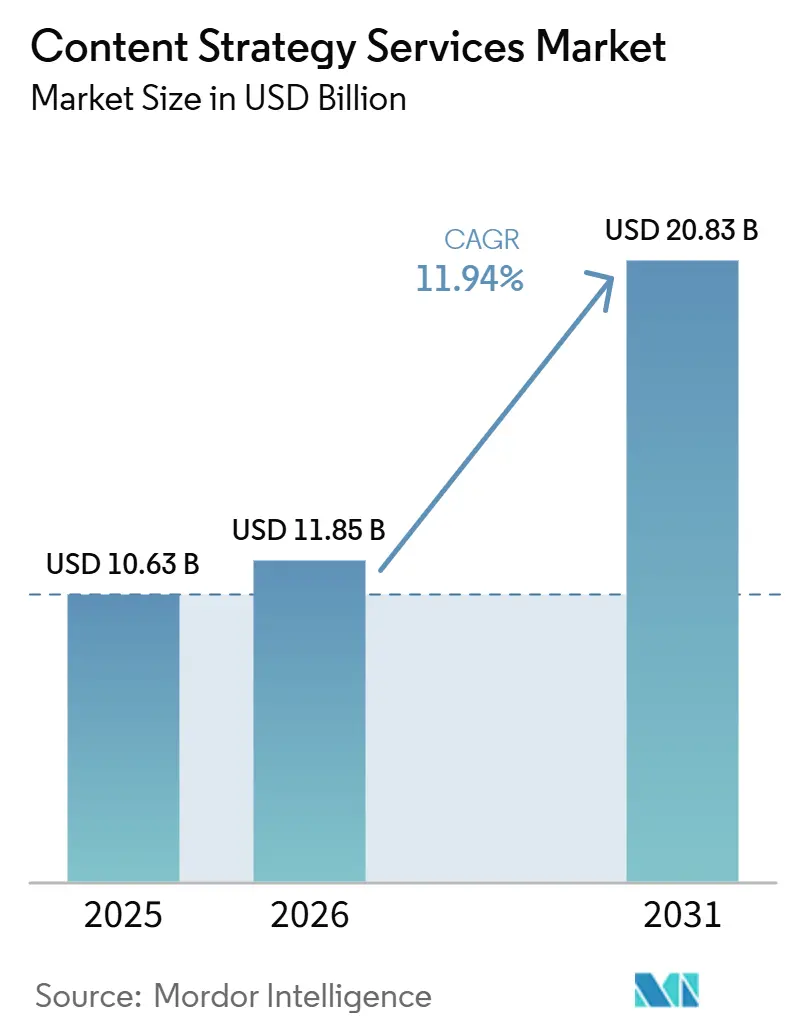
The content strategy services market size is projected to expand from USD 10.63 billion in 2025 and USD 11.85 billion in 2026 to USD 20.83 billion by 2031, registering a CAGR of 11.94% between 2026 and 2031. Demand is moving toward systems that connect planning, production, governance, distribution, and measurement rather than isolated content projects. Enterprises are adapting content operations for AI-mediated discovery, where structured material and reliable brand controls can affect how audiences find information. This favors providers that combine platform capabilities with implementation, measurement, and ongoing optimization support. Cloud delivery, personalization, and omnichannel activation remain central to purchasing decisions, while integration work and unclear AI attribution can slow adoption. The content strategy services market is also being shaped by acquisitions and product development focused on composable content and AI search visibility.
Key Report Takeaways
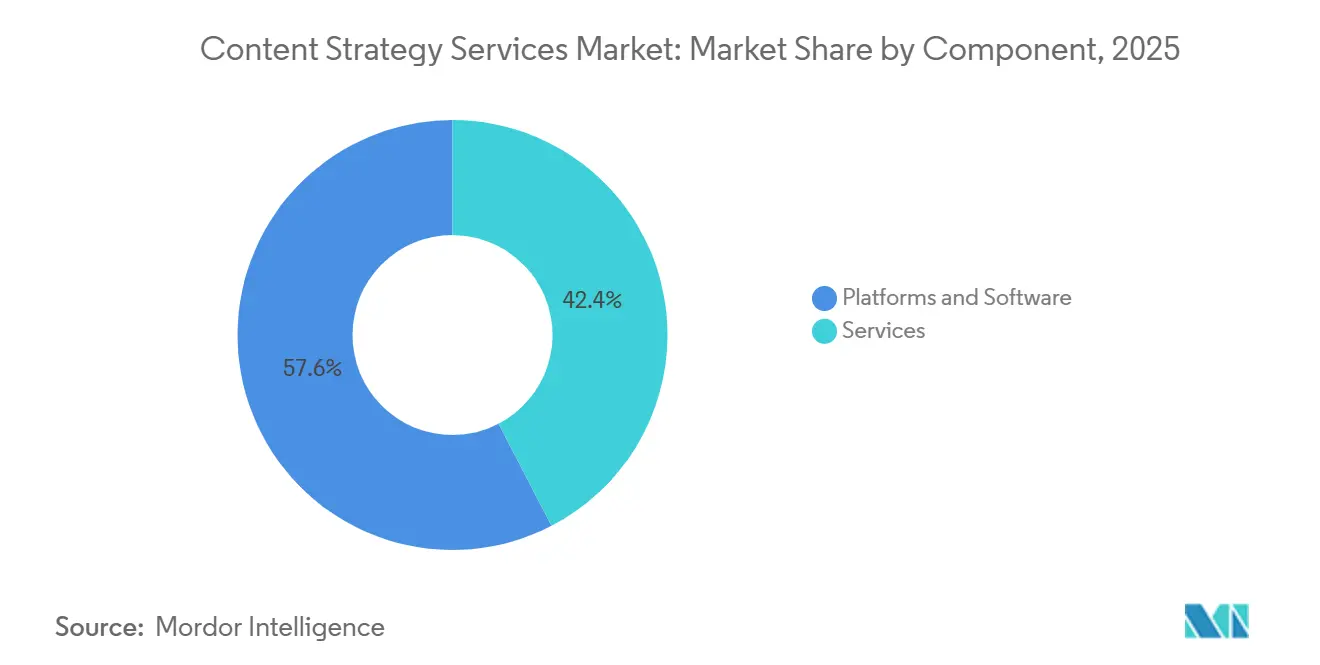
- By component, platforms and software held 57.62% of the content strategy services market share in 2025, while services are projected to expand at a 12.54% CAGR through 2031.
- By deployment model, cloud commanded 61.72% of the content strategy services market share in 2025 and is expected to record the highest CAGR of 12.63% through 2031.
- By organization size, large enterprises held 68.73% of the content strategy services market share in 2025, while small and medium-sized enterprises are projected to grow at a 12.56% CAGR through 2031.
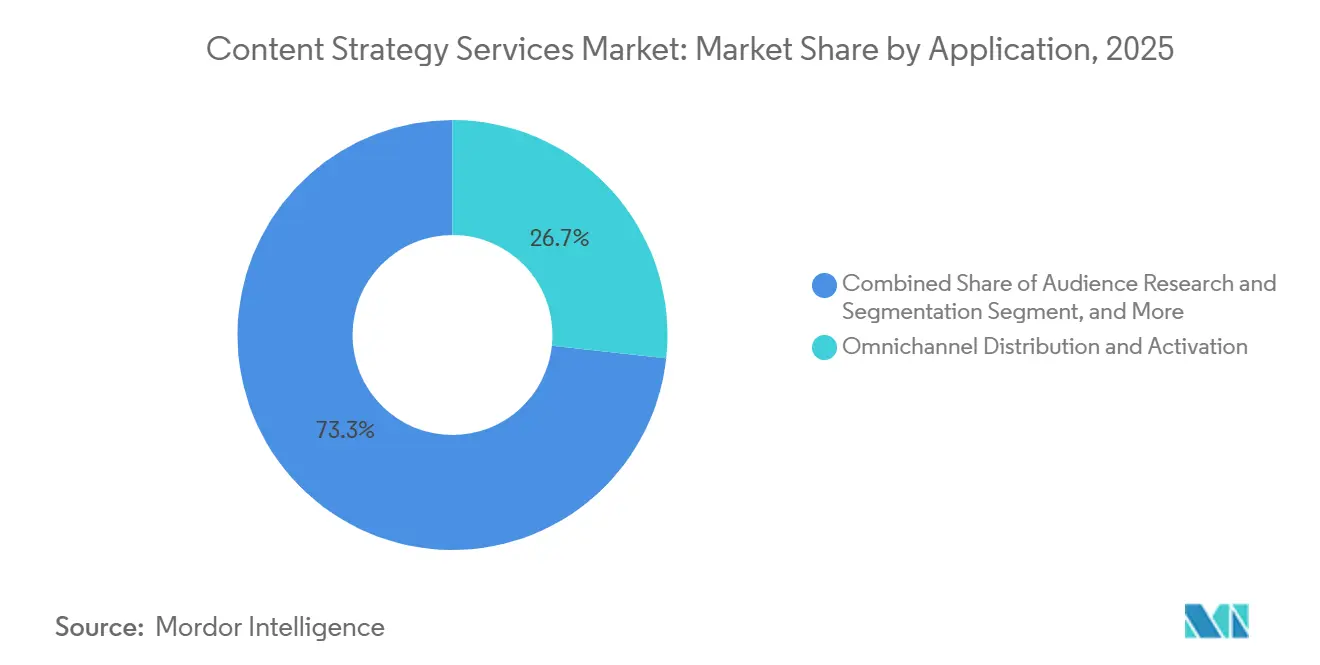
- By application, omnichannel distribution and activation accounted for 26.72% of the content strategy services market size in 2025, while personalization and performance optimization are projected to advance at a 13.01% CAGR through 2031.
- By industry vertical, retail and e-commerce accounted for 25.74% of the content strategy services market size in 2025, while healthcare and life sciences is projected to grow at a 13.11% CAGR through 2031.
- By geography, North America held 37.62% of the content strategy services market in 2025, while Asia-Pacific is projected to expand at a 13.54% CAGR through 2031.
Note: Market size and forecast figures in this report are generated using Mordor Intelligence’s proprietary estimation framework, updated with the latest available data and insights as of January 2026.
Market Trends and Insights
Drivers Impact Analysis of Content Strategy Services Market*
| Driver | (~) % Impact on CAGR Forecast | Geographic Relevance | Impact Timeline |
|---|---|---|---|
| Rising Demand for Personalized Omnichannel Content | +3.2% | Global, peak intensity in North America and Asia-Pacific | Short term (≤ 2 years) |
| Generative AI for Content Planning and Optimization | +2.8% | Global; early enterprise gains in North America and Europe | Short term (≤ 2 years) |
| Need for Measurable Content ROI and Attribution | +2.1% | North America and Europe | Medium term (2-4 years) |
| Expansion of Structured and Modular Content Operations | +1.6% | Global; strongest adoption in enterprise-heavy North America and EU | Medium term (2-4 years) |
| Answer Engine Optimization and LLM Citation Readiness | +1.2% | Global; early-mover advantage in North America, EU, and APAC core | Short term (≤ 2 years) |
| First-Party Data-Led Audience Research Workflows | +0.9% | North America and Europe (cookieless transition most advanced) | Medium term (2-4 years) |
| Source: Mordor Intelligence | |||
Rising Demand for Personalized Omnichannel Content
Organizations can reach more channels than before, but many cannot produce enough audience-specific material for each channel at the needed pace. Salesforce reported that 75% of marketing organizations used at least 1 form of AI for content personalization in 2025. Coordinating personalized messages across 5 or more channels remains a limited capability, leaving service providers with an operational gap. The Content Marketing Institute found that the average B2B buyer consumed 13.4 pieces of content before contacting sales.[1]Content Marketing Institute, “B2B Content and Marketing Trends: Insights for 2026,” Content Marketing Institute, contentmarketinginstitute.com That requirement supports demand for connected production, distribution, and performance workflows in the content strategy services market. Brands that cannot maintain channel-specific content may lose visibility before a prospect begins a direct vendor conversation. The requirement is not simply more material. It is a repeatable method for adapting approved information to each audience and channel without creating conflicting messages. That requirement raises the importance of content planning, workflow design, and shared performance data. It also creates opportunities for providers that can coordinate campaign speed with brand consistency.
Generative AI for Content Planning and Optimization
Salesforce reported that enterprise generative AI adoption in marketing reached 94% in 2026. Broad use does not guarantee better outcomes when content processes lack review and governance controls. Adobe introduced Brand Intelligence in April 2026 to use approval history and feedback within AI-assisted content generation. This approach shows why vendors are adding governance functions alongside generation tools. Ungoverned material can create brand risk in regulated sectors and can make content less distinct in crowded categories. The EU AI Act's Article 50 transparency obligations take effect on August 2, 2026, which increases the need for compliant AI content processes in Europe.
Need for Measurable Content ROI and Attribution
The Content Marketing Institute found that 63% of surveyed B2B marketing leaders could not attribute revenue to specific content assets. Only 19% reported a reliable multi-touch revenue attribution model in the same research. HubSpot reported in April 2026 that organic traffic for its customers had fallen 27% year over year while AI referral traffic had tripled. This channel change is not fully visible through conventional GA4 and UTM-based measurement. Organizations can therefore favor visible assets over material that shortens pipeline cycles. Providers that connect content activity with commercial measurement address a growing procurement requirement in the content strategy services market.
Expansion of Structured and Modular Content Operations
Modular content treats material as metadata-rich components rather than as single pages or campaigns. This model enables systems to retrieve, reuse, and personalize approved components without rebuilding assets from scratch. Optimizely identifies unified digital asset management and connected CMS-to-personalization workflows as important parts of a modern content operating model. Component-level governance also makes review more practical across large content programs. Kontent.ai launched AI Connectors in July 2026 to extend content operations across systems such as Asana, Atlassian, and Notion. These developments position structured content as a wider operational capability rather than a function contained within a CMS. Reusable components can help teams avoid recreating the same information for every campaign or market. They can also give analytics teams a more consistent view of how content elements perform. The operating value comes from connecting assets, metadata, governance, and distribution in a single process. This makes structured content relevant to both efficiency and control.
Restraints Impact Analysis of Content Strategy Services Market*
| Restraint | (~) % Impact on CAGR Forecast | Geographic Relevance | Impact Timeline |
|---|---|---|---|
| High Implementation and Workflow Redesign Costs | -2.4% | Global, most acute among SMEs and mid-market enterprises | Short term (≤ 2 years) |
| Integration Complexity Across Fragmented Martech Stacks | -1.9% | Global, with enterprise organizations in North America and Europe most affected | Medium term (2-4 years) |
| AI Search Measurement Gaps and Attribution Blind Spots | -1.3% | North America and Europe, the largest digital advertising markets | Short term (≤ 2 years) |
| Brand-Liability Risks from Ungoverned AI Content | -0.8% | Global, with regulatory pressure strongest in Europe and regulated sectors | Medium term (2-4 years) |
| Source: Mordor Intelligence | |||
High Implementation and Workflow Redesign Costs
Enterprise deployment costs include workflow redesign, change management, integration work, and employee training in addition to licensing. These activities can exceed the direct platform investment and can delay visible operating gains. LeanData reported that 51% of go-to-market leaders identified integration complexity and workflow transformation as primary limits on technology maturity. Organizations without a dedicated content operations team can face a 12-18-month productivity trough during changes to editorial processes. This burden is heavier for mid-market and smaller organizations, even though they are a growth area for the content strategy services market. Vendors can reduce friction by bundling implementation support with software and offering tested workflow templates. A phased implementation can help an organization prioritize the processes with the clearest business need before expanding to more teams. Training and internal sponsorship also matter because content roles and review paths often change during deployment. These practical issues can determine whether a new system becomes part of daily work. They are especially important for buyers with limited specialist resources.
Integration Complexity Across Fragmented Martech Stacks
Large organizations still use many marketing technologies, even as they try to consolidate their stacks. Chiefmartec reported an average of 87 martech tools among enterprise marketing organizations in 2026. Content intelligence is most valuable when performance data connects with CRM, CDP, and analytics systems without manual transfers. Consent, privacy, and governance requirements make it harder to design and maintain those connections. GDPR and North American state privacy laws add requirements to cross-system data handling. Providers with native integrations and connector libraries can avoid costly custom work for buyers in the content strategy services market. Even when a platform has strong standalone features, poor integration can limit the practical value of content performance data. Buyers, therefore, need to assess data flow, permissions, and ownership before committing to a technology change. This requirement can lengthen procurement and implementation timelines. It also favors providers that can show tested connections to the systems buyers already use.
*Our forecasts treat driver/restraint impacts as directional, not additive. The impact forecasts reflect baseline growth, mix effects, and variable interactions.
Content Strategy Services Market Segment Analysis
By Component:
Platforms Anchor Strategy and Services Scale AI DeliveryPlatforms and software held 57.62% of the content strategy services market in 2025. Their position reflected the role of technology in controlling creation, governance, distribution, and measurement across channels. A platform can act as the system of record for teams that manage large volumes of approved material. It also provides the shared workflows needed when many groups contribute to a content program. Services are projected to record the fastest component growth at a 12.54% CAGR through 2031. This shows that software capability alone does not produce results without implementation, governance, and continuous optimization. Bloomreach made Loomi marketing agent generally available in June 2026, enabling a single brief to be turned into a personalized campaign workflow.
The release illustrates how vendors are adding functions that sit close to traditional service work. These tools can reduce manual effort, but they do not remove the need to set content rules or interpret performance. Organizations still need support to connect a platform to their operating model. Platform-only engagements can leave gaps in measurement and governance. The component mix therefore supports both recurring software spending and specialist service demand in the content strategy services market. Service teams can translate broad platform functions into editorial rules, measurement plans, and operating routines that fit a buyer’s priorities. They can also resolve process gaps that emerge after implementation, rather than treating deployment as a single completed project. This continued support is particularly relevant where AI tools create new review, training, and governance requirements.


By Deployment Model:
Cloud Consolidates and Hybrid Serves Regulated NeedsCloud deployment accounted for 61.72% of the content strategy services market size in 2025. It is also projected to grow at the highest rate of 12.63% through 2031. This combination indicates that migration from legacy content systems remains incomplete. Cloud-native systems support continuous delivery, distributed collaboration, and AI functions that are harder to run in monolithic environments. These capabilities are important for teams that require current data and shared access across regions. Cloud adoption, therefore, remains central to platform decisions. On-premises deployments continue in sectors that have strict data sovereignty requirements. European financial services and public organizations can keep sensitive assets in controlled environments to meet privacy and data-residency requirements.
Hybrid deployment can keep sensitive content under internal control while using cloud services for analytics and AI processing. The EU AI Act and GDPR strengthen the importance of clear data controls for European buyers. Buyers must assess where content, audience data, and AI outputs are stored and processed. These constraints preserve a role for hybrid configurations in the content strategy services market. A hybrid model can give teams access to cloud-based orchestration without requiring all information to move outside established controls. It can also support phased modernization when organizations cannot replace legacy systems at once. This is relevant to buyers that must maintain business continuity while improving content capabilities. Deployment selection consequently depends on process, governance, and data requirements as much as on technical preference. Providers that offer clear integration and security options can better address these requirements.
By Organization Size:
Large Enterprises Hold Revenue and SMEs Build MomentumLarge enterprises held 68.73% of the content strategy services market in 2025. Their spending reflected multi-brand portfolios, global distribution needs, and the capacity to fund full-stack systems. Adobe made CX Enterprise Coworker generally available in June 2026 for more than 20,000 global brands.[2]Adobe, “Adobe Unveils CX Enterprise Coworker to Build Agentic-Enabled Workflows,” Adobe Newsroom, adobe.com The product coordinates AI agents across analytics, content creation, and customer journeys. Such integrated systems fit the scale and complexity of large enterprise content programs. Large organizations also have greater resources for governance, implementation, and data integration. Small and medium-sized enterprises are projected to grow at a 12.56% CAGR through 2031. AI-native tools are making some enterprise-style content capabilities available without equivalent implementation overhead.
HubSpot introduced AEO in April 2026 with tracking for brand visibility in ChatGPT, Gemini, and Perplexity. The product illustrates how providers are introducing new discovery capabilities to smaller teams. Access to technology is becoming less exclusive, while measurement and governance remain important differentiators. This pattern supports wider adoption across the content strategy services market. Smaller teams can use AI tools to produce and adapt material more efficiently, which can lower barriers to adopting structured workflows. However, greater access also increases the importance of clear brand rules and performance measurement. Larger organizations retain advantages in data depth, global coordination, and specialist talent. The competitive gap is therefore shifting toward operating discipline rather than access to a particular tool. Vendors that offer simple implementation paths may benefit as smaller buyers move beyond basic content automation.
By Application:
Omnichannel Distribution Anchors Volume and Personalization Scales FastestOmnichannel distribution and activation accounted for 26.72% of the content strategy services market in 2025. It covered the need to publish, syndicate, and activate content across expanding channel sets. Teams must also maintain channel-specific formatting, compliance checks, and performance feedback. These demands can grow rapidly as distribution expands across owned, paid, social, and partner environments. The need is no longer only to publish in several places. It is to maintain a connected process without matching increases in manual work. Personalization and performance optimization are projected to grow at a 13.01% CAGR through 2031. The application is moving from broad audience segments toward more individual and timely content adaptation.
Optimizely introduced limitless 1:1 personalization in June 2026 through its Opal AI orchestration layer. The release connects CMS, content marketing, data, and experimentation workflows. Planning, audience research, and brand governance also benefit from automation. Governance becomes increasingly important as organizations seek to limit liability arising from unreviewed AI-generated content in the content strategy services market. Teams need clear controls over which content can be varied, which claims require review, and which data can guide personalization. These controls become harder to manage as organizations add channels and increase publishing frequency. A connected workflow can help teams apply the same standards from planning through measurement. The application therefore combines a need for speed with a need for accountable decision-making. This balance supports continued demand for platforms and services that bring personalisation into governed processes.

By Industry Verticals:
Retail Commands Share and Healthcare Drives Structural InnovationRetail and e-commerce accounted for 25.74% of the content strategy services market in 2025. The vertical depends on product content, dynamic messaging, and channel-specific creative, all of which can affect conversion. Its content programs face direct revenue accountability, which supports continued platform investment. Retail teams need to coordinate merchandising, campaigns, and customer communications at scale. This requirement creates demand for systems that manage personalized assets and delivery across digital commerce channels. It also makes performance feedback an important part of content operations. Healthcare and life sciences are projected to expand at a 13.11% CAGR through 2031. Growth is tied to the need for credentialed content architecture rather than content volume alone.
Health information benefits from named clinical authors, verifiable credentials, and HIPAA-aligned data handling. Content without clear credentials can be less likely to appear in AI-generated health answers. That increases the importance of platforms with governance embedded in production workflows. Media and entertainment, travel and hospitality, and consumer goods also use these services for audience engagement, while travel and hospitality is seeing investment as digital booking paths become more content-led. Each vertical needs content operations that reflect its customer journey and regulatory exposure. Retail prioritizes conversion and merchandising, while healthcare places more weight on accuracy and documented credentials. These differences limit the value of a single generic workflow across all buyers. They also create openings for providers with vertical templates and governance features. The result is a broad demand base with different operational requirements rather than a uniform purchasing pattern.
Geography Analysis
North America Content Strategy Services Market
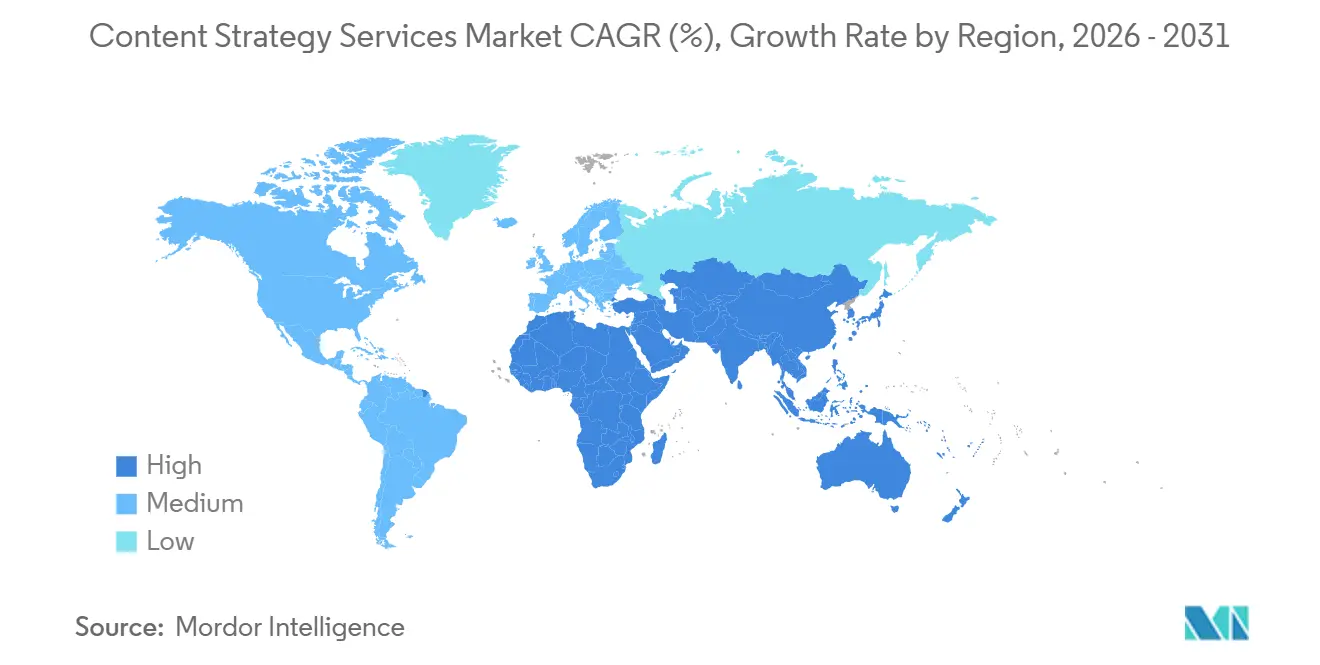
North America held 37.62% of the content strategy services market share in 2025. The region has a high concentration of enterprise technology adopters, platform vendors, and mature content operations teams. HubSpot reported that its customers saw a 27% year-over-year decline in organic traffic while AI referral traffic tripled in April 2026. This change is shifting attention toward answer engine optimization and generative engine optimization. First-party data governance is important because of CCPA enforcement and the decline of third-party tracking. Mexico is an emerging demand area as digital commerce grows and cross-border localization needs increase. Organizations serving the region may need to adapt language, product information, and campaign assets for each market. This raises the value of reusable content components and centrally managed brand standards. North American buyers are also responding to the growing importance of AI discovery, which favors structured information and clearer performance data. The regional opportunity, therefore, includes both mature enterprise transformation and localized mid-market adoption. These two patterns sustain demand for a range of content operating capabilities.
APAC Content Strategy Services Market
Asia-Pacific is projected to grow at a 13.54% CAGR through 2031. Its development is supported by creator commerce, mobile-first consumption, and expanding digital retail. The region has content-commerce models that combine short video, live streaming, and social shopping in single-platform environments. Localized, mobile-first content operations are therefore a major need across the content strategy services market in the region. Content teams must adapt material for different languages, platforms, shopping behaviors, and creator formats. A program designed for a desktop-led Western channel mix may not transfer directly to these markets. Providers must therefore combine reusable central standards with flexibility for local activation. The strongest opportunity lies in helping organizations coordinate these differences without losing control over brand and performance. This helps explain why the region is forecast to outpace other geographic segments. Regional growth also depends on whether providers can support local teams without forcing every market into the same production process.
EMEA and South America Content Strategy Services Market
Consistent metadata, approval rules, and measurement definitions can provide shared control while allowing market-specific execution. This is particularly relevant in creator-led environments where content moves rapidly across commerce and social platforms. Services that help teams build those operating rules can support software adoption as the regional buyer base develops. Europe held the second-largest position in the content strategy services market. GDPR and the EU AI Act can slow AI deployment, while also increasing demand for governed content platforms. The EU AI Act's Article 50 transparency obligations took effect on August 2, 2026. This supports procurement in financial services, healthcare, and public administration.[3]European Union, “Regulation (EU) 2016/679,” EUR-Lex, europa.eu South America, led by Brazil and Argentina, is an earlier-stage demand area. Middle East markets aligned with Saudi Arabia's Vision 2030 program and Africa's developing enterprise digital infrastructure also show early adoption, primarily in retail, financial services, and government digitization.

Competitive Landscape
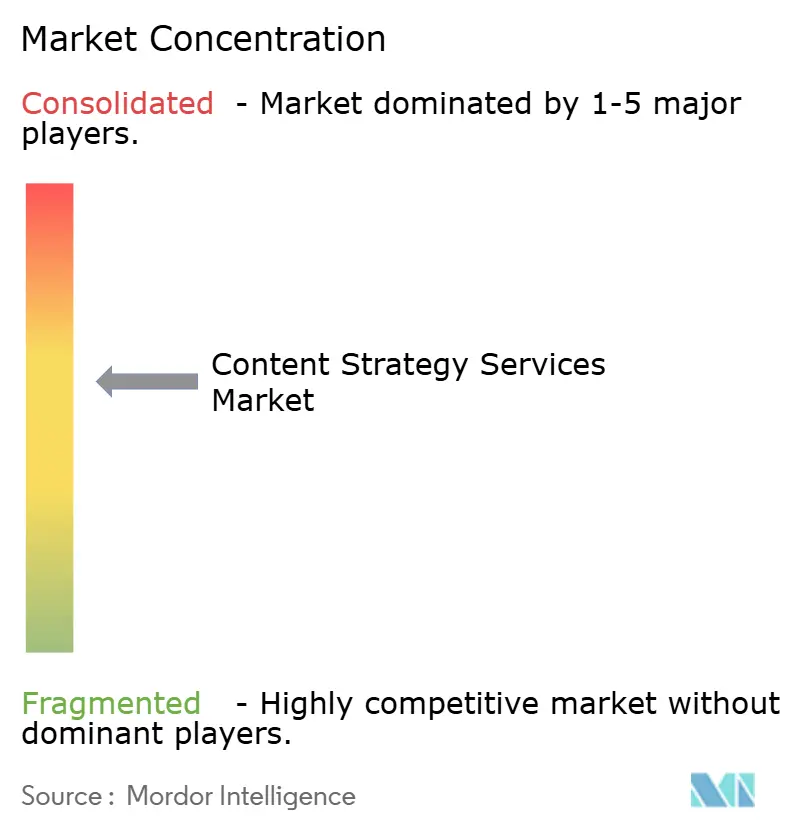
The content strategy services market is moderately concentrated. Adobe, Salesforce, HubSpot, Optimizely, and Oracle Corporation compete through broad platform ecosystems. Specialized providers address narrower requirements in governance, marketing operations, and production. Leading vendors are adding AI agents that coordinate planning, creation, governance, and distribution within a single workflow. This reduces manual handoffs that can create attribution and governance gaps. The strategy also increases the value of integrated platform suites. Adobe reported that Adobe Experience Platform ARR and GenStudio ARR each grew by more than 30% in fiscal 2025. It also reported that AI-influenced ARR exceeded 1-third of bookings and that agentic customer experience suite trials rose 13 times. Sitecore acquired Scrunch in June 2026 to strengthen AI search visibility capabilities.
Salesforce signed an agreement in April 2026 to acquire Contentful, adding a composable content layer to its Customer 360 and Agentforce offerings.[4]Salesforce, “Salesforce Signs Definitive Agreement to Acquire Contentful,” Salesforce Newsroom, salesforce.com These moves show a focus on content retrieval, AI discovery, and composable architecture. They also show why large vendors are seeking greater control over the content-to-conversion workflow. Acquiring specialist capabilities can reduce the time needed to bring new functions to established customers. It can also bring AI discovery, composable content, and workflow orchestration under a single commercial relationship. For buyers, this may simplify procurement, although it can increase the importance of reviewing interoperability and roadmap alignment. The strategic moves do not remove the role of smaller vendors, but they raise the standard for independent products that compete with larger suites. The competitive focus is consequently moving beyond content creation toward the ability to govern, distribute, and measure content across connected systems.
Smaller vendors compete through specialization in governance, measurement, and compliance. Acrolinx focuses on linguistic governance, Aprimo on marketing operations intelligence, and Papirfly on brand template management. These functions address inconsistent brand voice, unclear spend attribution, and off-brand content across distributed teams. The EU AI Act is increasing the value of governance-focused capabilities in European regulated sectors. HubSpot's AEO launch, Optimizely's GEO-ready CMS, and Adobe's AEO tools show that AI search visibility is becoming a standard enterprise capability. Organizations are likely to assess vendors on the ability to connect content performance, AI citation analytics, and first-party audience intelligence. Large suites benefit from installed customer bases and the ability to connect several marketing functions. Specialist vendors retain relevance where buyers require deeper governance, operations, or template capabilities. This balance limits the ability of any one vendor to control the wider field. It also encourages acquisitions where a broad platform seeks a capability that is difficult to build internally. Competition will continue to center on how well vendors join AI functions with trusted content processes.
Content Strategy Services Industry Leaders
Adobe Inc.
HubSpot, Inc.
Optimizely, Inc.
Salesforce, Inc.
Oracle Corporation
- *Disclaimer: Major Players sorted in no particular order
Content Strategy Services Market Companies Covered in this Report
- Adobe Inc.
- HubSpot, Inc.
- Optimizely, Inc.
- Salesforce, Inc.
- Oracle Corporation
- Acquia, Inc.
- Sitecore Corporation A/S
- Contentful GmbH
- Bloomreach, Inc.
- Progress Software Corporation
- Sprinklr, Inc.
- Acrolinx GmbH
- Aprimo US LLC
- Contently, Inc.
- CoSchedule LLC
- Automattic Inc.
- Open Text Corporation
- Papirfly AS

Recent Industry Developments in Content Strategy Services Market
- July 2026: Sprinklr announced its Summer '26 Release on July 15, 2026, introducing 16 AI features to its Unified Customer Experience Management platform, including agentic AI for autonomous issue resolution and new integrations with Adobe, Microsoft, and TikTok. The release extended Sprinklr's positioning from social content management into enterprise-wide real-time content intelligence across 30+ digital channels.
- June 2026: Adobe announced general availability of CX Enterprise Coworker on June 10, 2026, coordinating AI agents across analytics, content creation, and customer journey orchestration for more than 20,000 global brands. The product represented Adobe's move to unified content-to-journey automation embedded in Adobe Experience Platform.
- June 2026: Sitecore acquired Scrunch on June 3, 2026. Scrunch's Agent Experience Platform enabled organizations to optimize brand retrieval in LLM-generated answers.
- June 2026: Optimizely launched limitless 1:1 personalization on June 15, 2026, through its Opal AI orchestration layer, integrating CMS, Content Marketing Platform, data platform, and experimentation in 1 workflow from audience strategy to published experience.


Global Content Strategy Services Market Report Scope
The content strategy services market covers services that help organizations plan, develop, manage, and optimize content to achieve business, marketing, and communication objectives. The scope of the study includes content audits, content planning, editorial strategy, content governance, search engine optimization (SEO) strategy, content performance measurement, and related consulting services delivered to enterprises across end-user industries.
The Content Strategy Services Market Report is Segmented by Component (Platforms and Software, and Services), Deployment Model (Cloud, On-Premises, and Hybrid), Organization Size (Large Enterprises, and Small and Medium-Sized Enterprises), Application (Content Planning and Editorial Workflow, Audience Research and Segmentation, Messaging and Brand Governance, Omnichannel Distribution and Activation, and Personalization and Performance Optimization), Industry Verticals (Retail and E-commerce, Media and Entertainment, Healthcare and Life Sciences, Travel and Hospitality, Consumer Goods, and Other Industry Verticals), and Geography (North America, South America, Europe, Asia-Pacific, Middle East, and Africa). The Market Forecasts are Provided in Terms of Value (USD).
| Platforms and Software |
| Services |
| Cloud |
| On-Premises |
| Hybrid |
| Large Enterprises |
| Small and Medium-Sized Enterprises |
| Content Planning and Editorial Workflow |
| Audience Research and Segmentation |
| Messaging and Brand Governance |
| Omnichannel Distribution and Activation |
| Personalization and Performance Optimization |
| Retail and E-commerce |
| Media and Entertainment |
| Healthcare and Life Sciences |
| Travel and Hospitality |
| Consumer Goods |
| Other Industry Verticals |
| North America | United States |
| Canada | |
| Mexico | |
| South America | Brazil |
| Argentina | |
| Rest of South America | |
| Europe | Germany |
| United Kingdom | |
| France | |
| Italy | |
| Spain | |
| Russia | |
| Rest of Europe | |
| Asia-Pacific | China |
| Japan | |
| India | |
| South Korea | |
| Australia and New Zealand | |
| Rest of Asia-Pacific | |
| Middle East | Saudi Arabia |
| United Arab Emirates | |
| Turkey | |
| Rest of Middle East | |
| Africa | South Africa |
| Nigeria | |
| Egypt | |
| Rest of Africa |
| By Component | Platforms and Software | |
| Services | ||
| By Deployment Model | Cloud | |
| On-Premises | ||
| Hybrid | ||
| By Organization Size | Large Enterprises | |
| Small and Medium-Sized Enterprises | ||
| By Application | Content Planning and Editorial Workflow | |
| Audience Research and Segmentation | ||
| Messaging and Brand Governance | ||
| Omnichannel Distribution and Activation | ||
| Personalization and Performance Optimization | ||
| By Industry Verticals | Retail and E-commerce | |
| Media and Entertainment | ||
| Healthcare and Life Sciences | ||
| Travel and Hospitality | ||
| Consumer Goods | ||
| Other Industry Verticals | ||
| By Geography | North America | United States |
| Canada | ||
| Mexico | ||
| South America | Brazil | |
| Argentina | ||
| Rest of South America | ||
| Europe | Germany | |
| United Kingdom | ||
| France | ||
| Italy | ||
| Spain | ||
| Russia | ||
| Rest of Europe | ||
| Asia-Pacific | China | |
| Japan | ||
| India | ||
| South Korea | ||
| Australia and New Zealand | ||
| Rest of Asia-Pacific | ||
| Middle East | Saudi Arabia | |
| United Arab Emirates | ||
| Turkey | ||
| Rest of Middle East | ||
| Africa | South Africa | |
| Nigeria | ||
| Egypt | ||
| Rest of Africa | ||


Key Questions Answered in the Report
What is the content strategy services market size?
The content strategy services market size is USD 11.85 billion in 2026 and is projected to reach USD 20.83 billion by 2031 at an 11.94% CAGR.
What is driving demand for content strategy services?
Demand is supported by omnichannel delivery, AI-assisted planning, structured content operations, and the need to measure content-related revenue.
Which component has the largest share?
Platforms and software held the largest component share at 57.62% in 2025, while services are projected to grow fastest at a 12.54% CAGR.
Why are cloud content platforms growing?
Cloud deployment held 61.72% in 2025 and is projected to grow at 12.63% CAGR because it supports collaboration, continuous delivery, and AI capabilities.
Which region is growing fastest?
Asia-Pacific is projected to expand at a 13.54% CAGR through 2031, supported by mobile-first content consumption, creator commerce, and digital retail.
Which vertical is projected to grow fastest?
Healthcare and life sciences is projected to grow at a 13.11% CAGR through 2031 as credentialed and governed content becomes more important.
Page last updated on:





