
Construction Lubricants Market Size and Share
Market Overview
| Study Period | 2021 - 2031 |
|---|---|
| Market Size (2026) | USD 9.53 Billion |
| Market Size (2031) | USD 12.44 Billion |
| Growth Rate (2026 - 2031) | 5.47 % |
| Fastest Growing Market | Asia-Pacific |
| Largest Market | Asia-Pacific |
| Market Concentration | Low |
Major Players *Disclaimer: Major Players sorted in no particular order Image © Mordor Intelligence. Reuse requires attribution under CC BY 4.0. | |
Construction Lubricants Market Analysis by Mordor Intelligence
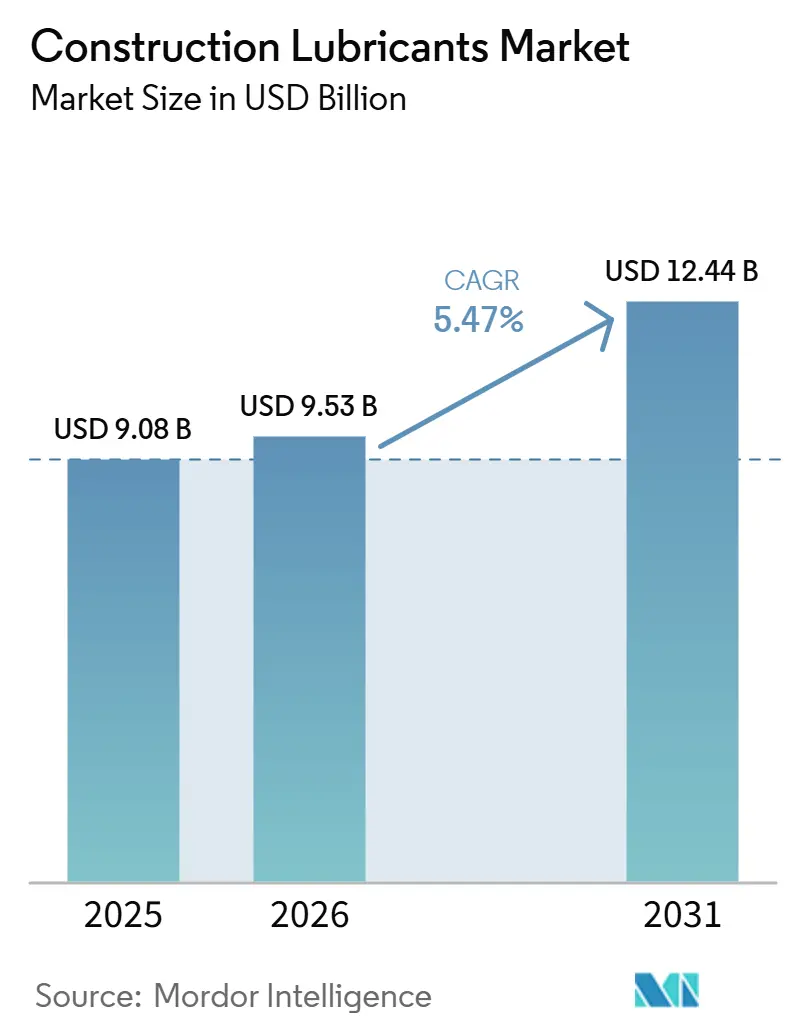
The construction lubricants market size was estimated at USD 9.08 billion in 2025 and is estimated to grow from USD 9.53 billion in 2026 to USD 12.44 billion by 2031, at a CAGR of 5.47% during the forecast period (2026-2031). Infrastructure-led construction is driving recurring demand for hydraulic fluids, engine oils, and greases as equipment use increases with project activity. Publicly funded civil works provide a steadier source of machine hours than credit-sensitive building projects. Suppliers are responding through longer supply contracts, products that meet equipment manufacturer requirements, and maintenance services connected to fleet data. The construction lubricants market also presents opportunities in rental fleets and biodegradable formulations, while volatile feedstock costs and counterfeit products remain key constraints.
Key Report Takeaways
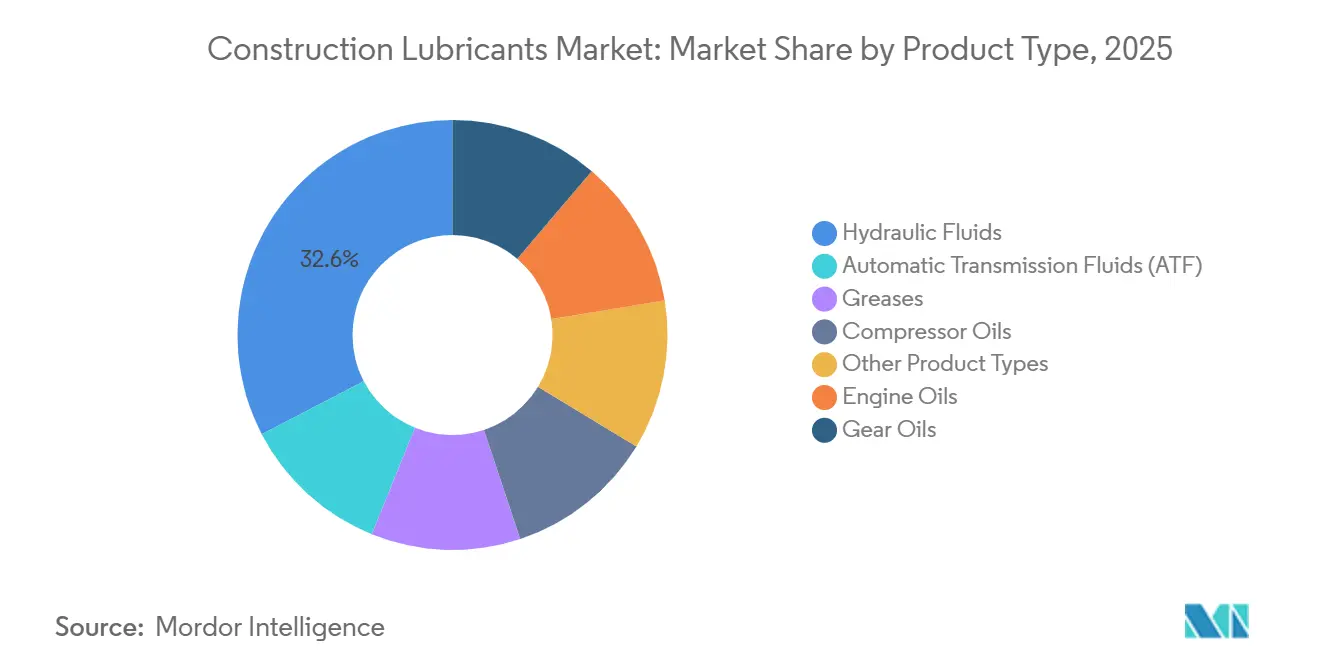
- By product type, hydraulic fluids held 32.64% revenue share in 2025, while greases are forecast to grow at a 6.13% CAGR through 2031.
- By engine oil type, mineral oil accounted for 66.41% revenue share in 2025, while bio-based oil is projected to expand at an 8.36% CAGR through 2031.
- By application, infrastructure and civil works represented 39.63% of the construction lubricants market size in 2025 and are forecast to grow at a 5.92% CAGR through 2031.
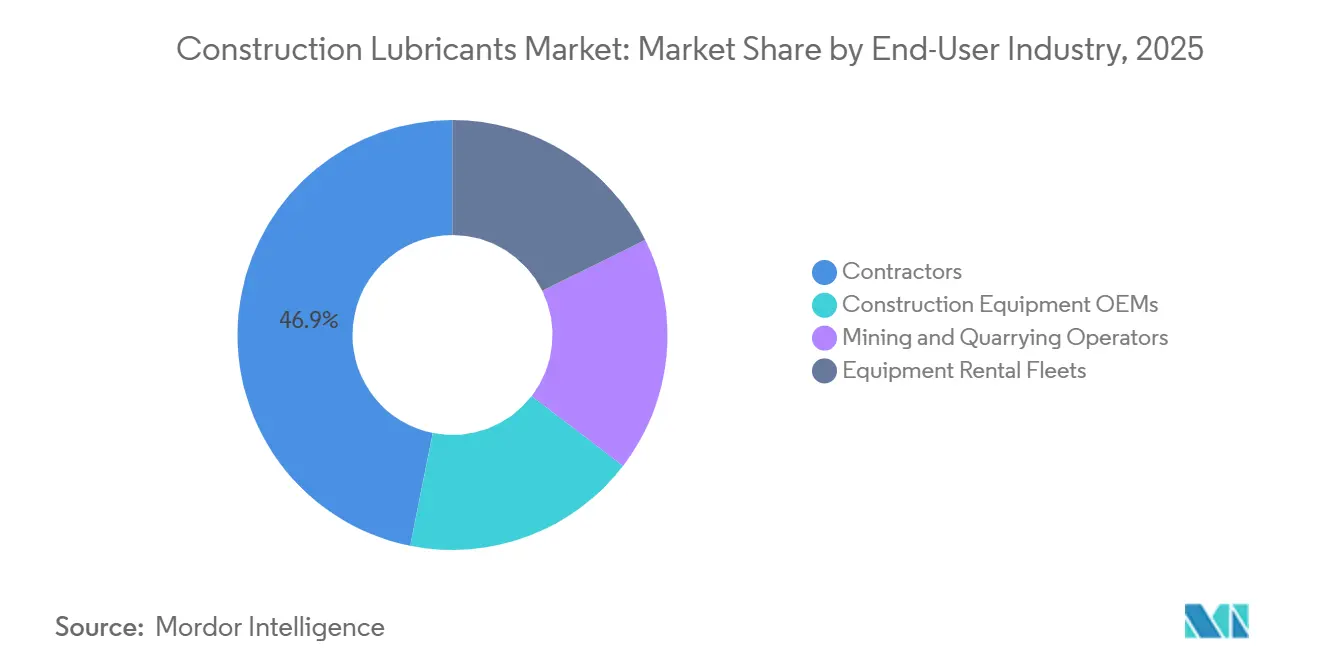
- By end-user industry, contractors held 46.85% share in 2025, while equipment rental fleets are forecast to grow at a 6.35% CAGR through 2031.
- By geography, Asia-Pacific held 43.95% share in 2025 and is forecast to expand at a 6.27% CAGR through 2031.
Note: Market size and forecast figures in this report are generated using Mordor Intelligence’s proprietary estimation framework, updated with the latest available data and insights as of January 2026.
Global Construction Lubricants Market Trends and Insights
Drivers Impact Analysis*
| Drivers | (~) % Impact on CAGR Forecast | Geographic Relevance | Impact Timeline |
|---|---|---|---|
| Infrastructure Development and Large-Scale Projects | +2.2% | Global | Long term (≥ 4 years) |
| Construction Fleet Mechanization | +1.5% | Asia-Pacific, Middle-East and Africa, and South America | Medium term (2-4 years) |
| Extended Drain Intervals and Equipment Uptime | +0.7% | Global, with early gains in North America and Europe | Medium term (2-4 years) |
| Telematics, Automation, and Condition-Based Monitoring | +0.5% | North America and Europe, with spillover to the Asia-Pacific | Long term (≥ 4 years) |
| Original Equipment Manufacturer (OEM) Requirements for Hydraulic Systems and Low-Emission Engines | +0.3% | North America, Europe, and the core Asia-Pacific markets | Short term (≤ 2 years) |
| Source: Mordor Intelligence | |||
Expansion of Infrastructure Development and Large-Scale Construction Projects
Civil engineering activity supports construction lubricant demand because large projects require heavy equipment for extended periods. Roads, rail systems, bridges, ports, tunnels, and utility networks use excavators, cranes, loaders, haul trucks, and related machinery. These equipment fleets require scheduled oil changes, grease application, and fluid monitoring throughout the project cycle. Government funding makes civil works less exposed to changes in private building finance. The construction lubricants market benefits as project pipelines shift toward long-duration public infrastructure. India's January 2026 high-speed rail package and the December 2025 Texas High-Speed Rail joint venture illustrate the geographic range of major construction programs cited in the supplied research.
Infrastructure projects also tend to create supply arrangements that span multiple construction phases. Contractors need a reliable supply of approved lubricants to keep machinery operational and to maintain equipment warranties. This can favor suppliers that serve multiple locations and maintain consistent product quality. Work is often spread across earthmoving, lifting, paving, drilling, and material-handling equipment. Each equipment category creates a different mix of hydraulic fluid, engine oil, gear oil, and grease demand. As a result, infrastructure spending can support a broader segment of the construction lubricants market rather than just one product category.
Increasing Mechanization of Construction Equipment Fleets
Mechanization increases lubricant consumption because more construction work is completed by powered equipment rather than manual labor. India's machinery demand was cited at USD 5 per USD 1,000 of construction spending, compared with a global average of USD 12 per USD 1,000. This gap indicates that equipment deployment could rise as the country moves toward peer levels. The supplied material also cited rising Indian capital expenditure in mining and construction equipment-linked sectors. Greater fleet deployment would increase engine, hydraulic, transmission, and grease requirements during normal service cycles.
Mechanization gaps also exist in parts of sub-Saharan Africa and Southeast Asia. New equipment placed in these regions adds lubricant requirements alongside existing demand rather than replacing it. India's construction equipment exports rose 32% in FY2025-26, even while domestic dispatches declined marginally. This export pattern indicates equipment manufacturers were serving regional demand and building a future installed base. Each machine requires lubricant service upon entering operation, creating a recurring need for authorized products. This broad equipment expansion supports the construction lubricants market in high-growth developing regions.
Growing Demand for Extended Drain Intervals and Enhanced Equipment Uptime
Remote sites make unplanned maintenance costly because equipment stoppages can delay multiple work activities simultaneously. Projects such as NEOM and Indonesia's Nusantara relocation require equipment to operate over large areas with complex logistics. Fleet operators consequently place greater value on longer drain intervals and stable fluid performance. Synthetic and semi-synthetic formulations can reduce oil change frequency where equipment requirements permit their use. Fewer maintenance stops can reduce disruptions and improve equipment availability. These operating needs can raise the value placed on premium formulations in the construction lubricants market.
Extended drain practices can reduce lubricant volume used per machine hour, but they can also increase the value of each product sold. Suppliers with approved higher-performance products can therefore benefit from a stronger product mix. Condition-based replenishment helps operators determine when a fluid needs replacement based on its actual condition. Vendor-managed inventory programs can also help a site avoid shortages and manage bulk lubricant purchases. This approach shifts the supplier relationship from spot purchasing toward ongoing service, and is especially relevant for fleet owners who need predictable maintenance planning across many machines.
Rising Adoption of Telematics, Automation, and Condition-Based Lubrication Monitoring
Telematics can give fleet managers information on machine use, operating conditions, and maintenance needs. Oil condition alerts allow maintenance teams to replace fluids based on degradation rather than a fixed calendar schedule. This can improve planning when equipment operates under varying loads, temperatures, or dust exposure. Connected systems also make it easier to document the use of approved fluids. The construction lubricants market can benefit when monitoring tools link product performance to equipment maintenance records, which may strengthen the position of suppliers whose products are already recognized by equipment makers.
Castrol received the Internet of Things (IoT) Emerging Technology Award in July 2025 for its SmartOil and SmartMonitor platforms. The platforms are described as tools for tracking oil condition and viscosity changes in real time. Castrol also launched SmartCoolant in September 2025 to monitor coolant concentration and pH. These examples show that connected fluid management can cover more than one maintenance product and that digital services can become part of a supplier's wider equipment support offering. The construction lubricants market may increasingly reward providers that combine products, monitoring, and technical support.
Restraints Impact Analysis*
| Restraints | (~) % Impact on CAGR Forecast | Geographic Relevance | Impact Timeline |
|---|---|---|---|
| Crude Oil and Base Oil Price Volatility | -1.2% | Global | Short term (≤ 2 years) |
| High Cost of Synthetic and Bio-Based Formulations | -0.8% | North America, Europe, and the core Asia-Pacific markets | Medium term (2-4 years) |
| Inconsistent Maintenance and Counterfeit Lubricants | -0.6% | Middle-East and Africa, South Asia, and spillover to Southeast Asia | Medium term (2-4 years) |
| Source: Mordor Intelligence | |||
Volatility in Crude Oil and Base Oil Prices Affects Lubricant Production Costs
Crude oil and base oil costs can change rapidly, creating pressure on lubricant production costs. A 2026 Middle-East supply disruption drove Brent crude to nearly USD 128 per barrel in early April before it retreated to USD 76 per barrel by mid-June. Over 91 days, 19 lubricant companies implemented 37 pricing actions. Price increases reached 35% for synthetic grades and 25-26% for conventional grades. Rapid cost movements make it harder for suppliers to price long-term contracts and for contractors to forecast maintenance spending. This volatility can slow purchases when buyers defer nonessential fluid orders.
Base oil availability can remain tight even after crude prices stabilize. Group III supply is particularly important for many synthetic construction lubricants. Suppliers that depend on these inputs can face margin pressure when costs rise faster than finished-product prices. Construction contractors may seek relief from fixed-price supply terms when lubricant prices move sharply. Some buyers reduce inventories while waiting for prices to stabilize. These responses affect buying patterns and can disrupt normal order timing in the construction lubricants market.
High Cost of Synthetic and Bio-Based Lubricant Formulations
Synthetic and bio-based products can offer operational, maintenance, or environmental advantages, but their higher purchase prices can limit adoption. Smaller contractors may focus on the immediate cost of a lubricant rather than the broader cost of downtime. This issue is most significant in price-sensitive markets with older equipment fleets. As a result, mineral oils continue to serve a large share of engine oil demand. Buyers need clear evidence that longer drain intervals, improved component protection, or regulatory compliance justify the higher product price. The cost gap can slow the transition toward premium products in the construction lubricants market.
The value case is strongest where machine downtime is costly or environmental standards are strict. Rental fleets and advanced equipment operators can capture more value from long-drain products because maintenance scheduling is central to their business model. Public-sector projects may also specify biodegradable formulations for environmentally sensitive work areas. These requirements can create a defined sales channel for higher-priced products. However, procurement teams still need products that fit project budgets and equipment specifications. The cost of advanced formulations will remain a practical constraint where those conditions do not apply.
*Our forecasts treat driver/restraint impacts as directional, not additive. The impact forecasts reflect baseline growth, mix effects, and variable interactions.
Segment Analysis
By Product Type: Hydraulic Fluids Anchor Demand as Greases Set the Growth Pace
Hydraulic fluids held 32.64% of the construction lubricants market share in 2025, making them the largest product category. They transfer power in excavators, cranes, loaders, dump trucks, and other machinery used on infrastructure sites. These machines often operate under heavy loads and for sustained periods. Their hydraulic systems require fluids with stable viscosity, wear protection, and oxidation resistance. The shift toward high-pressure systems increases the need for formulations that perform reliably under tighter operating tolerances. Hydraulic fluid demand follows the deployment of major earthmoving and lifting fleets. The category remains central to the construction lubricants market because these equipment types are widely used across civil works. Shell's Tellus S4 VE is positioned for this application and is stated to support energy efficiency and longer drain intervals under relevant conditions.
Greases are forecast to grow at a 6.13% CAGR through 2031, the fastest rate among product types. Large excavators used in urban tunneling place repeated loads on pin-and-bush joints. Those applications require greases that remain effective under pressure, in motion, and in the presence of contamination. Frequent duty cycles make grease quality an important maintenance consideration. CITGO launched Mystik JT-6 HD SynBlend 460 Moly Plus 2 in March 2026 for severe construction and mining applications. The product was designed for equipment including excavators, wheel loaders, articulated dump trucks, and track dozers[1]CITGO Petroleum Corporation, “CITGO Launches Advanced Moly Grease for Construction and Mining Industries,” CITGO, citgo.com. This reflects continued formulation work for demanding off-highway conditions.
Compressor oils remain a smaller category, although they are relevant to drilling and tunneling projects. Their performance is tied to pneumatic systems that may work continuously in dust-intensive environments. Chevron introduced its Rykon calcium sulfonate complex grease line in Asia-Pacific in October 2024. The product range was described as a response to lithium thickener cost pressure and heavy-duty equipment requirements. Product changes of this type indicate that suppliers are addressing both performance needs and raw-material constraints. Construction lubricant buyers may select products based on lifecycle cost rather than initial purchase price alone. The construction lubricants market will continue to require specialized products as equipment designs and operating conditions change.



By Engine Oil: Mineral Oil Dominates but Bio-Based Oil Is Reshaping Procurement Norms
Mineral oil accounted for 66.41% of engine oil revenue in 2025, reflecting its broad use in cost-sensitive construction fleets. Contractors in emerging markets often prioritize products that meet equipment requirements at a manageable cost. Older Tier 3 and similar engines also support continued use of mineral oil across Asia, Africa, and South America. Mineral formulations remain familiar to maintenance teams and are widely available through local distribution networks. These factors reinforce mineral oil's position in the construction lubricants market. The category also serves the large installed base of equipment that does not require advanced oil specifications. Its lead is therefore linked to both price and fleet age.
Bio-based oil is forecast to expand at an 8.36% CAGR through 2031, the strongest rate among engine oil types. Public procurement requirements are bringing biodegradability into equipment decisions in Europe and North America. USDA BioPreferred requirements and EU Ecolabel criteria were identified in the supplied research as factors influencing contract specifications. California and New York were also cited as locations where public infrastructure specifications encourage the use of biodegradable fluids. These policies can shift purchasing decisions before wider regulatory requirements become mandatory. Bio-based products are relevant around waterways, protected land, and other sensitive construction settings, supporting the fastest-growing portion of the construction lubricants market.
Bio-based oils represent a limited share of total engine oil. Their growth depends on product cost, equipment approval, and consistent supply availability. TotalEnergies' acquisition of used-oil regeneration company Tecoil reflects an effort to integrate circular base oil supply into its lubricant portfolio. European equipment manufacturers are also beginning to factory-fill certain new machines with biodegradable fluids, according to the supplied research. Factory fill can influence the product selected throughout a machine's service life, creating a sustained channel for approved sustainable formulations. The shift is gradual but is changing the procurement framework for selected construction fleets.
By Application: Infrastructure and Civil Works Command Scale and Speed
Infrastructure and civil works accounted for 39.63% of the construction lubricants market in 2025 and are forecast to grow at a 5.92% CAGR through 2031, making it the largest and fastest-growing application segment. Roads, rail corridors, airports, utility grids, tunnels, and port projects require a wide range of heavy machinery. Machine availability is critical because delays can affect multiple subcontractors and project schedules. Publicly funded work can offer more stable demand than privately financed construction. These conditions make infrastructure and civil works a primary focus for lubricant suppliers. The application's scale supports demand for hydraulic fluids, engine oils, gear oils, and greases.
Commercial construction is the second-largest application area, covering office, retail, and industrial building projects. Its lubricant demand is more closely linked to private investment conditions and the availability of construction finance. Higher financing costs affected commercial activity in 2025, making the segment less resilient than infrastructure and civil works during that period. Even so, commercial projects require earthmoving, lifting, concrete, and materials-handling equipment, sustaining demand for standard maintenance products across urban building sites.
Mining and quarrying support is the fourth application area. Equipment used near mine sites and quarries requires lubricants that manage heavy loads and abrasive conditions. High-load gear oils and greases are particularly important for this work. Blasting support equipment, conveyors, and associated earthmoving machinery are included in the product requirement. These applications can favor suppliers with specialty product lines and technical support. Civil engineering output is a major driver of lubricant demand across applications. As civil projects increase, the construction lubricants market can gain demand from both direct infrastructure activity and adjacent materials extraction.
By End-User Industry: Contractors Led as Rental Fleets Accelerate
Contractors accounted for 46.85% of end-user revenue in 2025, making them the largest buying group. Large engineering, procurement, and construction firms manage multi-year projects with regular machinery servicing needs. Their framework supply agreements can provide dependable purchase volumes for lubricant suppliers. Contractors operate mixed fleets that may include excavators, cranes, loaders, haul trucks, and specialized machinery, requiring access to multiple lubricant categories and consistent delivery to active sites. Product selection is often shaped by equipment warranties, operating conditions, and maintenance schedules. Contractors therefore remain a core customer group in the construction lubricants market.
Large project contractors can also use supply contracts to improve control over fluid quality and inventory. Centralized procurement helps them standardize lubricants across multiple sites, reducing the risk of incorrect fluid use and supporting technician training. It may also help contractors document compliance with equipment-maker requirements. The duration of major civil projects creates an opportunity for suppliers to build longer customer relationships, favoring companies that can deliver consistent products and technical service over the life of a project.
Equipment rental fleets are forecast to grow at a 6.35% CAGR through 2031. Developers increasingly use rental equipment to preserve financial flexibility when financing costs are elevated. Rental operators depend on machine availability because idle units do not generate revenue, giving them a strong reason to follow scheduled maintenance and condition-based lubrication practices. The supplied research cited unplanned downtime costs of USD 1,800 to USD 4,000 per incident for rental operators. This cost supports the adoption of premium long-drain formulations and monitoring practices. Rental fleets are becoming a significant growth channel for the construction lubricants market.
Geography Analysis
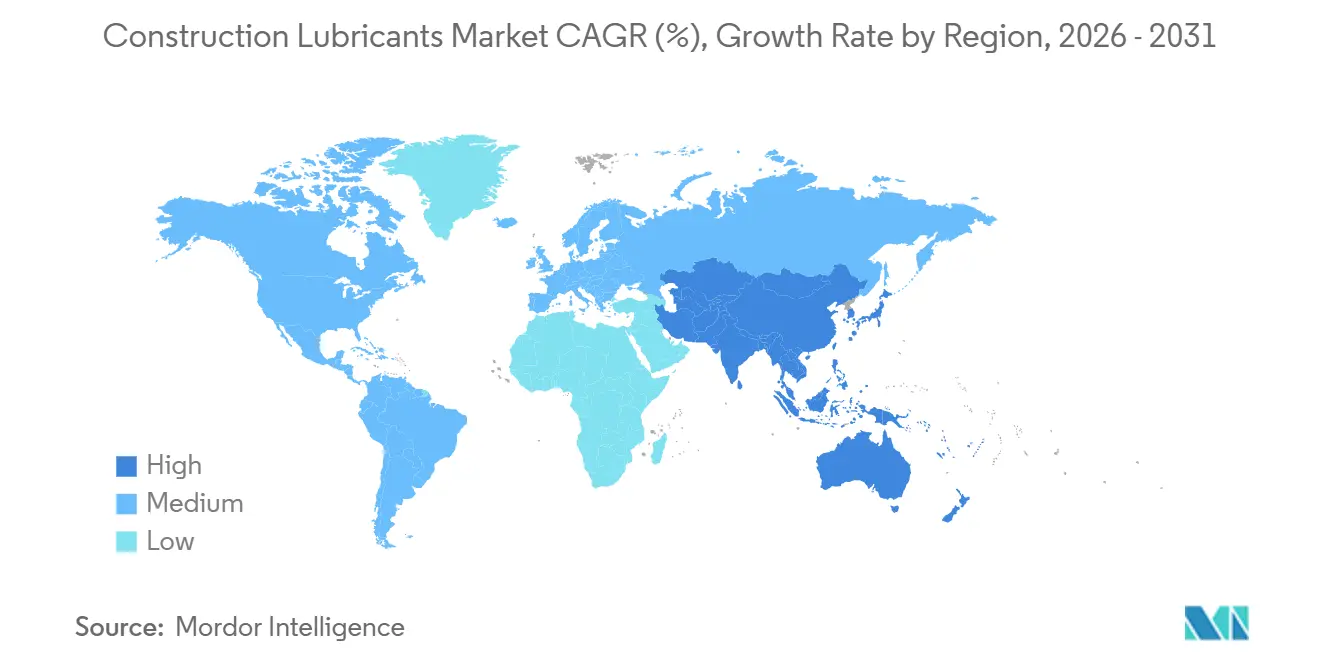
Asia-Pacific accounted for 43.95% of the construction lubricants market share in 2025 and is projected to expand at a CAGR of 6.27% through 2031. The region benefits from large infrastructure programs and increasing mechanization of equipment. China supports regional growth through its 15th Five-Year Plan priorities, including metro expansion and the Sichuan-Tibet Railway.
Shell expanded its grease manufacturing capacity in Thailand from 5,000 tons to 15,000 tons per year to serve more than 40 countries. The company also announced a grease plant in Indonesia with a capacity of 12,000 tons per year[2]Shell Indonesia, “Shell to Build Grease Manufacturing Plant in Indonesia,” Shell, shell.com. These investments reflect the importance of regional supply and distribution. Japan and South Korea drive demand for high-precision synthetic products that meet advanced equipment standards. Indonesia and Vietnam are high-growth markets in civil and industrial construction. Regional suppliers compete on price in cost-sensitive locations, creating a varied market environment across Asia-Pacific.
North America and Europe are markets for premium products, where equipment standards and telematics use are more established. USD 550 billion in new U.S. infrastructure spending through 2028 and Canada's USD 133 billion infrastructure plan are expected to support heavy equipment activity and related lubricant demand. North American fleet operators prioritize products that help manage maintenance budgets and machine availability. European demand is also influenced by environmental requirements and the adoption of bio-based products. These regions offer significant value opportunities in the construction lubricants market, even though Asia-Pacific remains the largest by revenue share.
Shell began construction of a Group III base oil unit at its Wesseling refinery in Germany in 2024. The facility is planned to have a capacity of 300,000 tons per year, with commissioning targeted for 2028. This investment supports the regional supply base for synthetic lubricant production. South America, the Middle-East, and Africa present a more varied demand profile.

Competitive Landscape
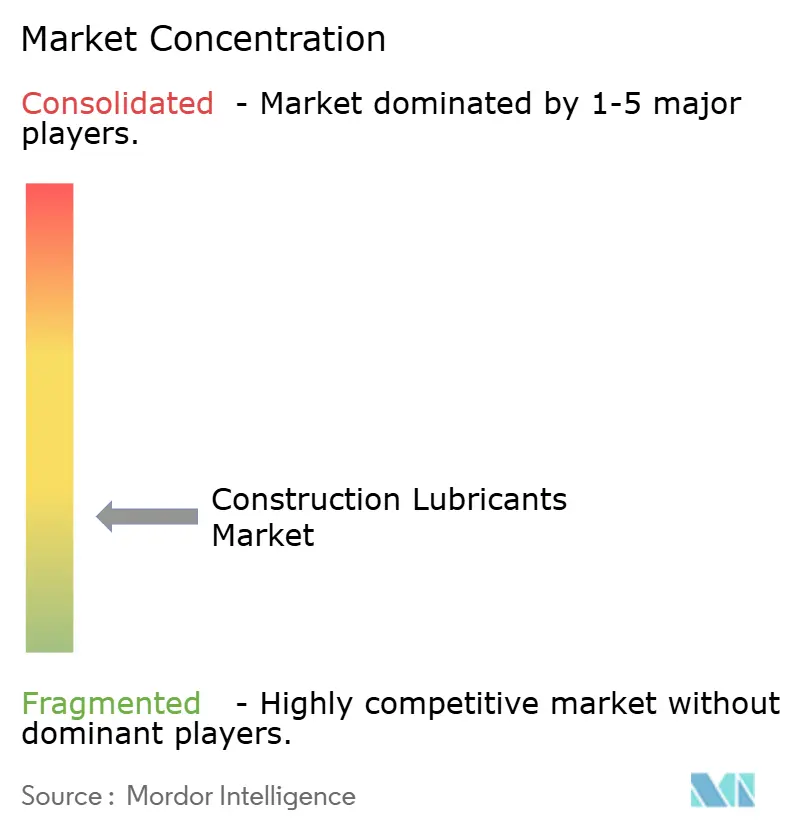
The construction lubricants market is fragmented, with global brands and regional suppliers competing on product quality, approvals, service, and price. Shell and ExxonMobil together held a majority of the revenue share in 2025, reflecting broad product portfolios and equipment manufacturer qualifications. Key requirements include Caterpillar ECF-3, Komatsu KES, Cummins CES 20086, and Allison TES 781 specifications. These qualifications help suppliers meet the needs of equipment fleets that require approved products. Digital maintenance platforms can further strengthen the relationship between lubricant suppliers and fleet operators. The competitive structure therefore favors companies that can combine technical products with service capabilities.
FUCHS is pursuing its FUCHS100 strategy, presented in April 2026. It completed the full acquisition of OPET FUCHS in Turkey in April 2026, gaining ownership of the Aliaga, Izmir production plant. This strengthened its position in industrial, mining, and construction lubricants in an important regional market. Chevron Oronite introduced its PC-12 additive platform in 2025 for the upcoming API Category 12 heavy-duty engine oil specification. This platform demonstrates how product formulation and approvals can create barriers for smaller blenders.
Digital lubrication-as-a-service is an active area of competition. It links certified lubricants to telematics, condition monitoring, inventory management, and predictive maintenance support. This model makes a supplier more difficult to replace once its products and operating data are integrated into fleet processes. Bio-based and biodegradable products form another area of focus, as EU Ecolabel and USDA BioPreferred requirements can create procurement channels for suppliers with certified products. The construction lubricants market also includes regional competitors such as Indian Oil Corporation, PetroChina, ENEOS, Idemitsu, and Petronas Lubricants, which are strengthening domestic positions through supply agreements and original equipment manufacturer co-branding.
Product authentication has become a competitive priority in markets exposed to counterfeits. Established brands are investing in tamper-evident packaging and digital verification to protect customer confidence and warranty relationships. Regional suppliers can apply price pressure, particularly in sensitive categories, while global suppliers counter this through advanced formulations, approvals, and service networks. BP's strategic review of Castrol has been identified as a possible consolidation factor. Castrol's Optigear and Hyspin ranges carry equipment qualifications that could be valuable to a buyer seeking a broader construction equipment portfolio.
Construction Lubricants Industry Leaders
Shell plc
ExxonMobil Corporation
Chevron Corporation
TotalEnergies
FUCHS
- *Disclaimer: Major Players sorted in no particular order

Recent Industry Developments
- June 2026: BPCL, Shell Gas B.V., and Tiki Tar Industries signed a joint venture and share subscription agreement forming TTSIPL, targeting polymer-modified bitumen, crumb rubber-modified bitumen, and bitumen emulsions for India's Bharatmala highway program and airport runway projects, supporting lubricant demand in road construction and maintenance equipment.
- April 2026: FUCHS completed the full acquisition of the OPET FUCHS joint venture in Turkey, gaining 100% ownership of the production plant in Aliaga, Izmir, and strengthening its industrial, mining, and construction lubricant supply in a market with growing lubricant consumption.


Global Construction Lubricants Market Report Scope
Construction lubricants are specialized fluids and greases, including engine oils, hydraulic oils, and heavy-duty greases, designed to protect heavy off-road machinery from extreme loads, friction, and harsh environments.
The construction lubricants market is segmented by product type, engine oil, application, end-user industry, and geography. By product type, the market is segmented into hydraulic fluids, engine oils, gear oils, automatic transmission fluids (ATF), greases, compressor oils, and other product types. By engine oil, the market is segmented into mineral oil, synthetic oil, and bio-based oil. By application, the market is segmented into commercial construction, personal and small-contractor construction, mining and quarrying support, and infrastructure and civil works. By end-user industry, the market is segmented into contractors, equipment rental fleets, construction equipment OEMs, and mining and quarrying operators. The report also covers market size and forecasts for construction lubricants across 16 countries in major regions. The market sizes and forecasts are provided in terms of value (USD).
| Hydraulic Fluids |
| Engine Oils |
| Gear Oils |
| Automatic Transmission Fluids (ATF) |
| Greases |
| Compressor Oils |
| Other Product Types |
| Mineral Oil |
| Synthetic Oil |
| Bio-Based Oil |
| Commercial Construction |
| Personal and Small-Contractor Construction |
| Mining and Quarrying Support |
| Infrastructure and Civil Works |
| Contractors |
| Equipment Rental Fleets |
| Construction Equipment OEMs |
| Mining and Quarrying Operators |
| Asia-Pacific | China |
| India | |
| Japan | |
| South Korea | |
| Rest of Asia-Pacific | |
| North America | United States |
| Canada | |
| Mexico | |
| Europe | Germany |
| United Kingdom | |
| France | |
| Italy | |
| Russia | |
| Rest of Europe | |
| South America | Brazil |
| Argentina | |
| Rest of South America | |
| Middle-East and Africa | Saudi Arabia |
| South Africa | |
| Rest of Middle-East and Africa |
| By Product Type | Hydraulic Fluids | |
| Engine Oils | ||
| Gear Oils | ||
| Automatic Transmission Fluids (ATF) | ||
| Greases | ||
| Compressor Oils | ||
| Other Product Types | ||
| By Engine Oil | Mineral Oil | |
| Synthetic Oil | ||
| Bio-Based Oil | ||
| By Application | Commercial Construction | |
| Personal and Small-Contractor Construction | ||
| Mining and Quarrying Support | ||
| Infrastructure and Civil Works | ||
| By End-User Industry | Contractors | |
| Equipment Rental Fleets | ||
| Construction Equipment OEMs | ||
| Mining and Quarrying Operators | ||
| By Geography | Asia-Pacific | China |
| India | ||
| Japan | ||
| South Korea | ||
| Rest of Asia-Pacific | ||
| North America | United States | |
| Canada | ||
| Mexico | ||
| Europe | Germany | |
| United Kingdom | ||
| France | ||
| Italy | ||
| Russia | ||
| Rest of Europe | ||
| South America | Brazil | |
| Argentina | ||
| Rest of South America | ||
| Middle-East and Africa | Saudi Arabia | |
| South Africa | ||
| Rest of Middle-East and Africa | ||


Key Questions Answered in the Report
What is current market size of Construction Lubricants Market?
The construction lubricants market size was estimated at USD 9.08 billion in 2025 and is estimated to grow from USD 9.53 billion in 2026 to USD 12.44 billion by 2031, at a CAGR of 5.47% during the forecast period (2026-2031).
Which product type leads construction lubricant demand?
Hydraulic fluids accounted for 32.64% of revenue share in 2025 because they are required across excavators, cranes, loaders, and other heavy equipment.
Which construction lubricant product is growing the fastest?
Greases are projected to grow at a 6.13% CAGR through 2031, supported by severe-duty excavator and tunneling applications.
Why is infrastructure work important for lubricant suppliers?
Infrastructure and civil works accounted for 39.63% in 2025 and are forecast to grow at a 5.92% CAGR, supporting steady use of heavy equipment.
Page last updated on:





