
Connected Product Security Management Market Size and Share
Market Overview
| Study Period | 2021 - 2032 |
|---|---|
| Market Size (2027) | USD 1.58 Billion |
| Market Size (2032) | USD 2.63 Billion |
| Growth Rate (2027 - 2032) | 10.73 % |
| Fastest Growing Market | Asia-Pacific |
| Largest Market | North America |
| Market Concentration | Medium |
Major Players *Disclaimer: Major Players sorted in no particular order Image © Mordor Intelligence. Reuse requires attribution under CC BY 4.0. | |
Connected Product Security Management Market Analysis by Mordor Intelligence
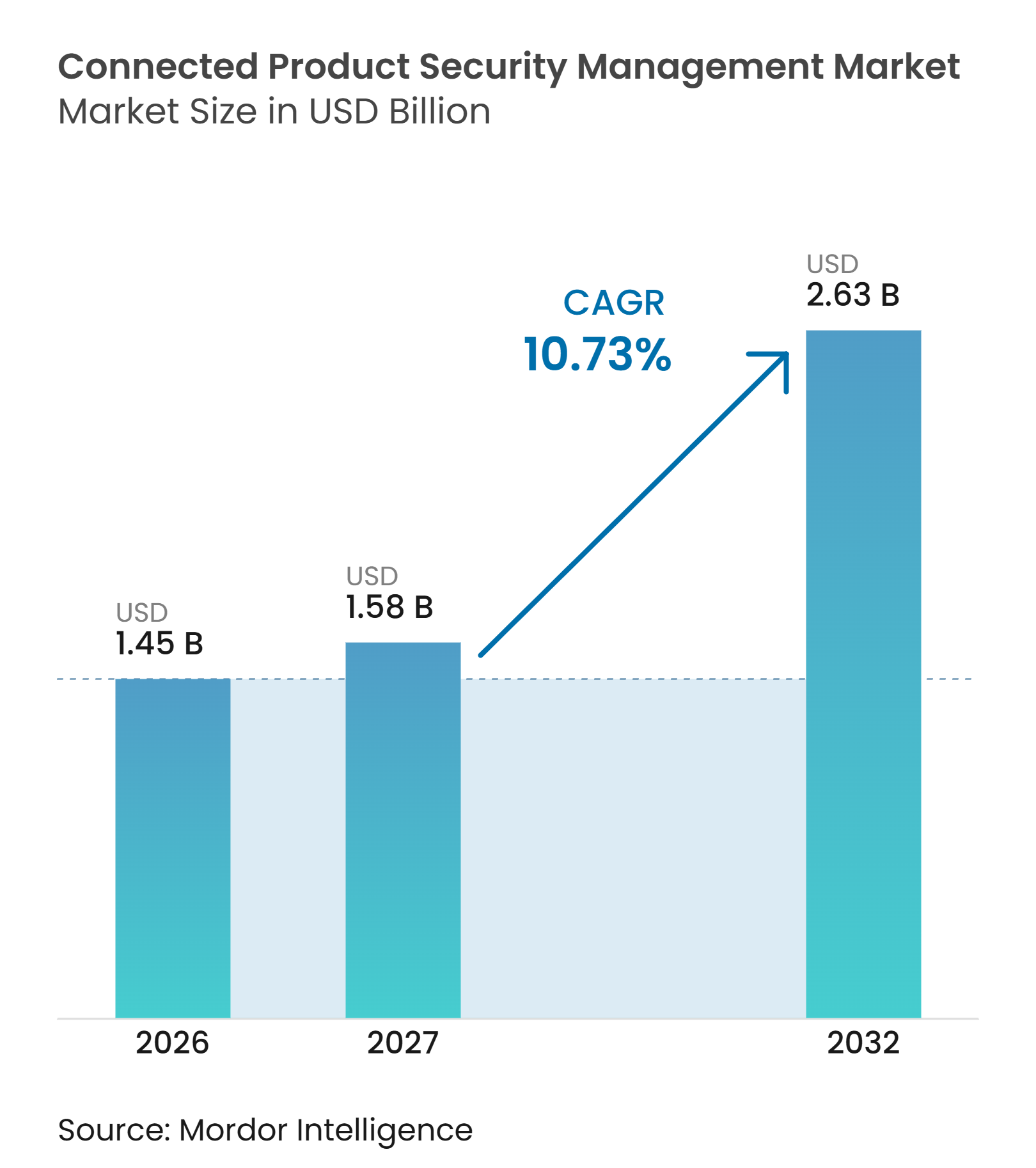
The Connected product security management market size was valued at USD 1.45 billion in 2026 and is estimated to grow from USD 1.58 billion in 2027 to reach USD 2.63 billion by 2032, at a CAGR of 10.73% during the forecast period 2027-2032. Growth reflects the widening use of connected and embedded systems in critical infrastructure, industrial equipment, vehicles, and medical devices. Regulatory requirements are shifting security from a product-launch check to a continuing obligation spanning development, release, disclosure, and support. Manufacturers are increasingly expected to maintain software bills of materials, track vulnerabilities, and show evidence that remediation decisions are controlled. This changes vendor selection because buyers need tools that combine technical analysis with records suitable for compliance and customer review. The Connected product security management market also benefits as suppliers seek managed support when their own teams cannot sustain these activities.
Key Report Takeaways
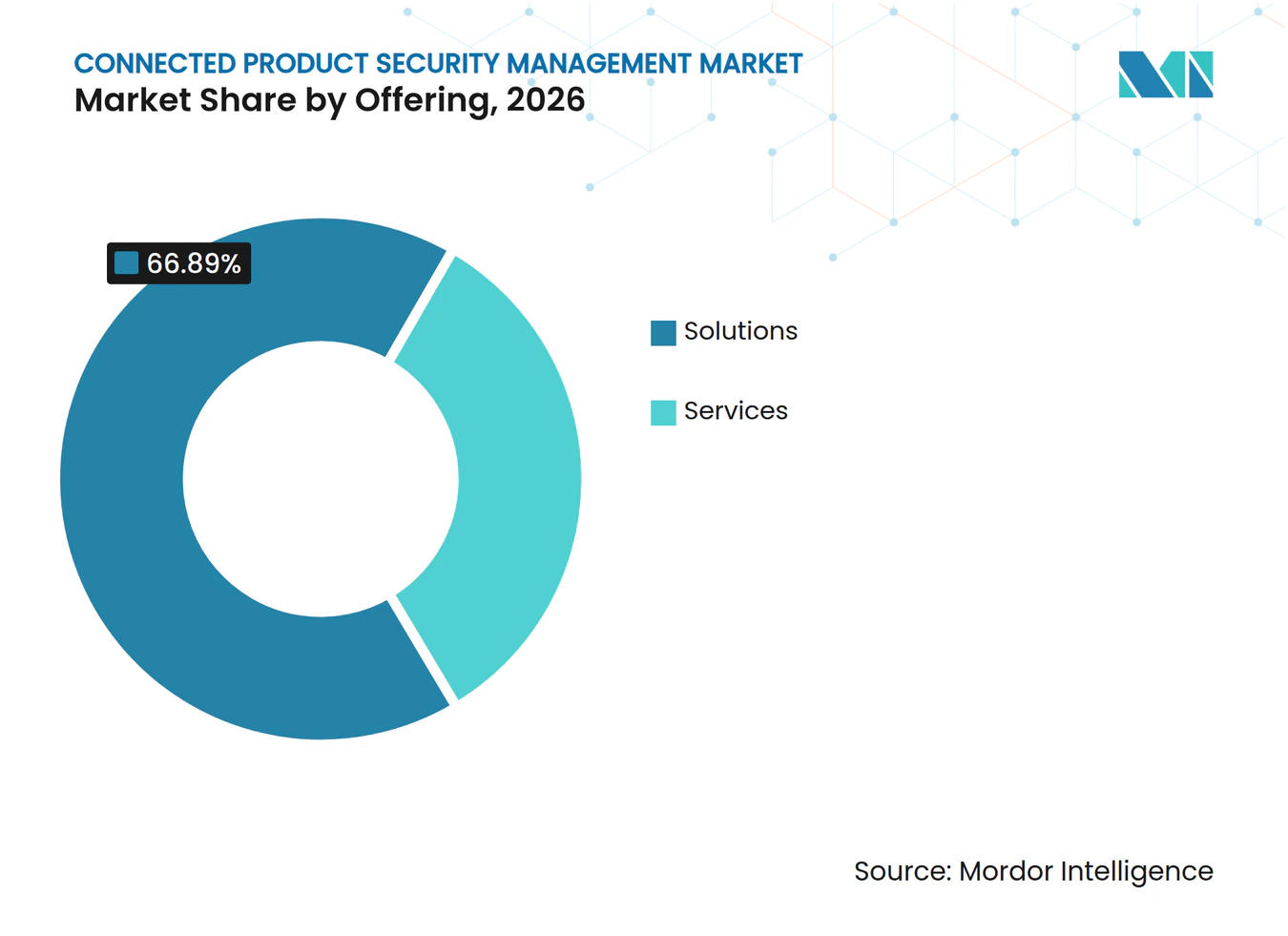
- By offering solutions, the company held 66.89% of the Connected product security management market revenue in 2026, while services are projected to expand at a 12.67% CAGR through 2032.
- By security function, vulnerability management and prioritization accounted for 35.78% of the Connected product security management market revenue in 2026, while software bills of materials and software supply chain management are projected to expand at an 11.76% CAGR through 2032.
- By deployment, cloud held 57.14% of the Connected product security management market in 2026, while hybrid deployment is projected to expand at a 12.36% CAGR through 2032.
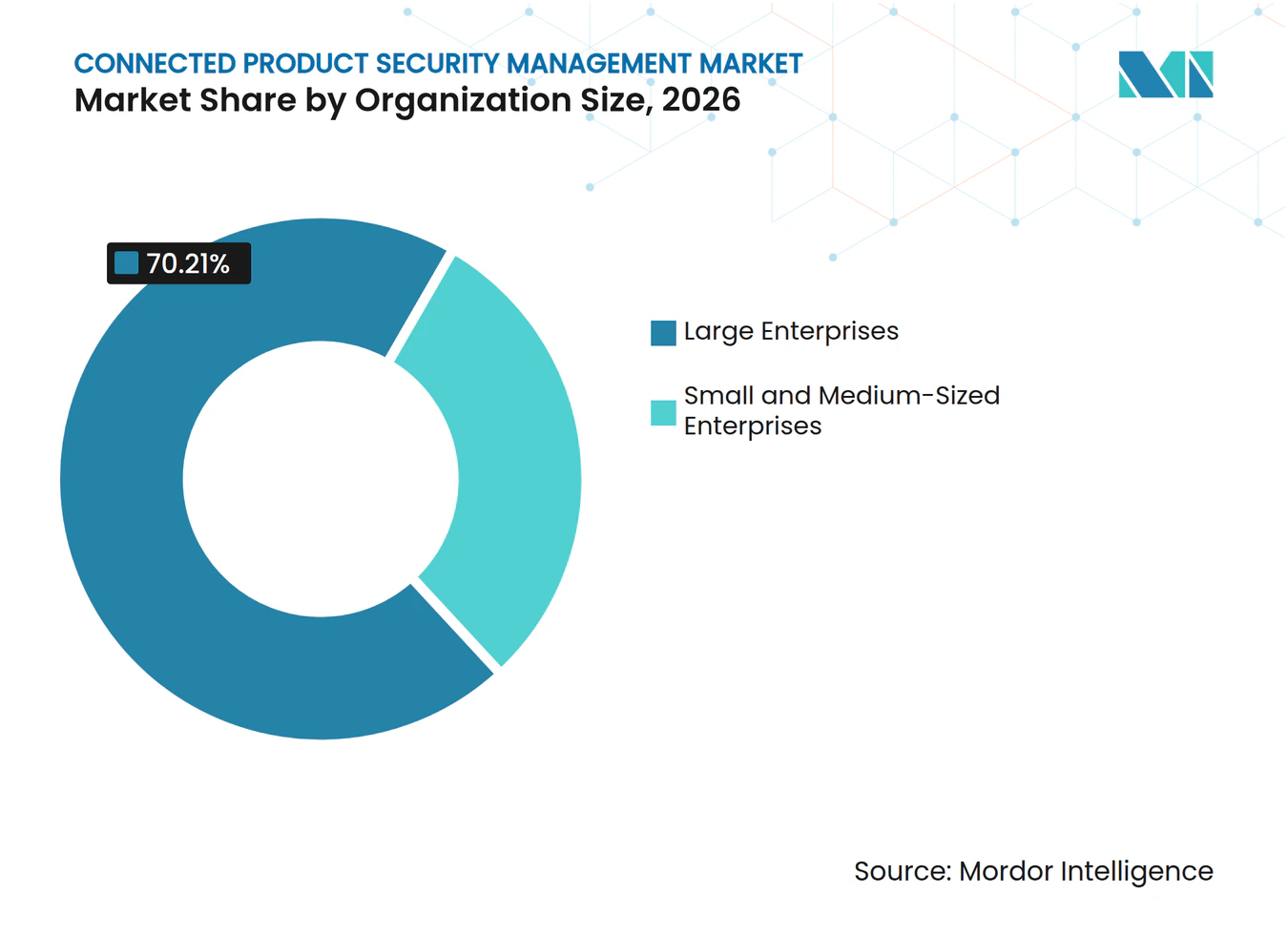
- By organization size, large enterprises accounted for 70.21% of the Connected product security management market revenue in 2026, while SMEs are projected to grow at a 12.89% CAGR through 2032.
- By end-user industry, industrial manufacturing held 29.30% of the Connected product security management market revenue in 2026, while healthcare and medical devices are projected to expand at an 11.43% CAGR through 2032.
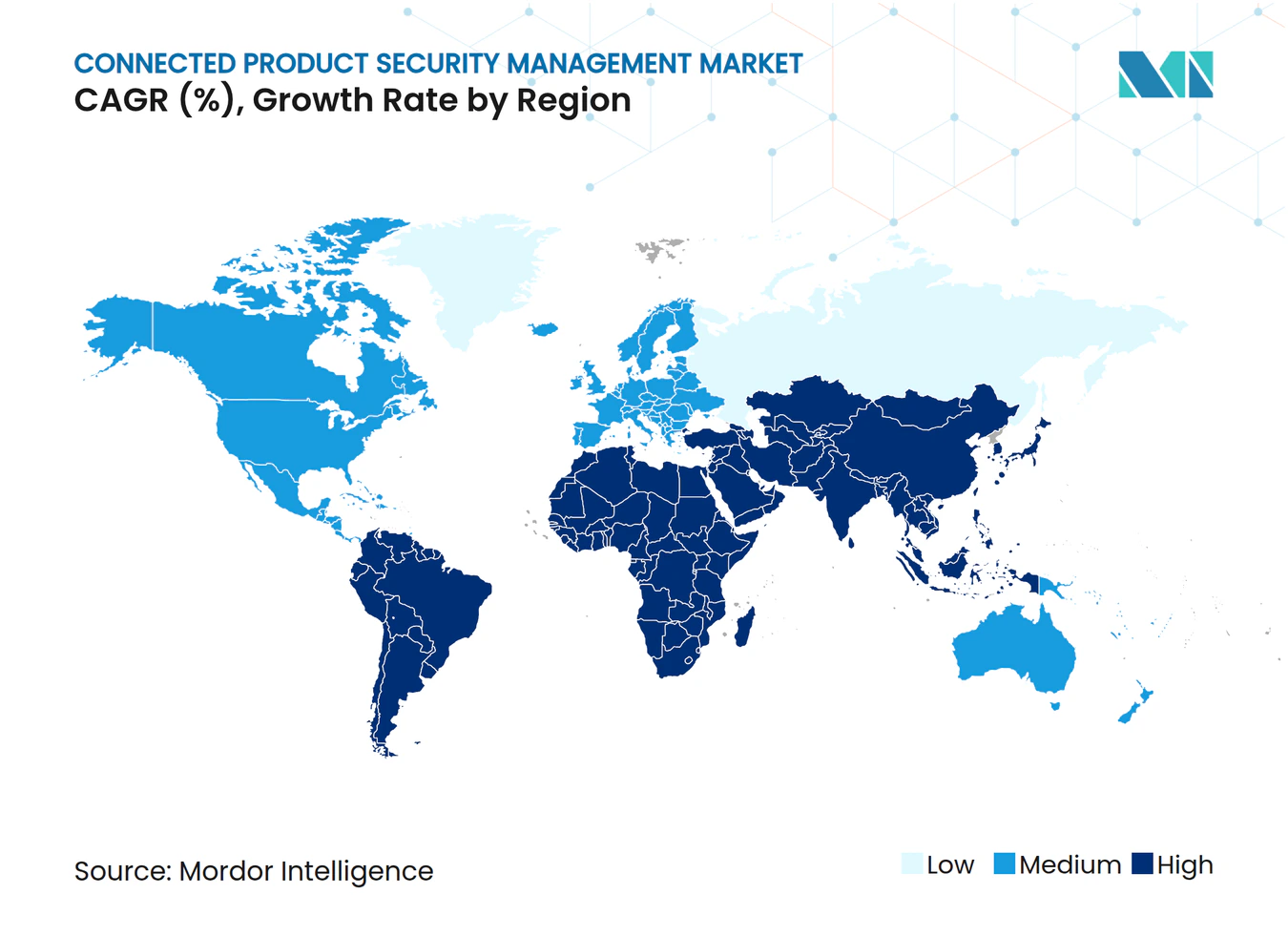
- By geography, North America held 37.44% of the Connected product security management market revenue in 2026, while Asia-Pacific is projected to expand at a 12.10% CAGR through 2032.
Note: Market numbers in this report are based on Mordor Intelligence's proprietary estimation framework, which combines nine months of actuals with Q4 projections for base year 2026.
Market Trends and Insights
Drivers Impact Analysis of Connected Product Security Management Market*
| Driver | (~) % Impact on CAGR Forecast | Geographic Relevance | Impact Timeline |
|---|---|---|---|
| Regulatory-Led Product Security Evidence Requirements | +3.0% | Global, with early concentration in North America and Europe | Short term (≤ 2 years) |
| Expanding Connected-Device Attack Surface | +2.2% | Global, particularly acute in Asia-Pacific and North America | Short term (≤ 2 years) |
| Shift From Periodic Testing to Continuous Product Security | +1.6% | North America and Europe, with Asia-Pacific spillover | Medium term (2-4 years) |
| Growth of Software-Defined and Updateable Products | +1.2% | Global, concentrated in automotive and consumer electronics hubs | Medium term (2-4 years) |
| Security Operations Demand for Unmanaged Device Visibility | +0.9% | North America and Europe | Short term (≤ 2 years) |
| Machine-Scale Device Identity and Certificate Lifecycle Automation | +0.7% | Global, with early adoption in North America and Germany | Long term (≥ 4 years) |
| Source: Mordor Intelligence | |||
Regulatory-Led Product Security Evidence Requirements
The EU Cyber Resilience Act made its incident reporting obligations applicable on September 11, 2026. Manufacturers must report actively exploited vulnerabilities to ENISA and the relevant national CSIRTs within 24 hours, while the broader conformity requirements apply from December 11, 2027. The requirements apply to products with digital elements and make product security evidence a requirement for access to the European market. The FDA’s February 2026 guidance reinforced the requirement to provide software bills of materials for cyber devices under Section 524B of the FD&C Act. Manufacturers that cannot obtain component information from suppliers must document the gap, apply risk controls, and provide a remediation plan. This brings smaller suppliers into the Connected product security management market, as their information now affects the finished product manufacturer's compliance position.
Expanding Connected-Device Attack Surface
Connected products place software, firmware, identities, and network interfaces inside equipment that was once isolated. This is most significant in industrial plants, healthcare facilities, vehicles, and other environments where a device failure can interrupt physical operations. Forescout reported an 84% increase in attacks using operational technology protocols during 2025 and said IoT device exploits rose from 16% to 19% of observed exploits. The change increases demand for complete asset inventories, firmware analysis, and clear vulnerability priorities. Product teams must also know whether a disclosed vulnerability is present in a released product and whether it is exposed in the customer environment. These requirements support the Connected product security management market because network monitoring alone cannot supply product-level component and release information.
Shift From Periodic Testing to Continuous Product Security
A security scan before a product release cannot remain sufficient when components, vulnerabilities, and regulatory duties change throughout the product’s operating life. Manufacturers now need to retain current inventories, monitor vulnerability disclosures, assess affected releases, and maintain an auditable response record. Finite State launched its Product Security OS in February 2026 to combine firmware analysis, source intelligence, and design documentation in a continuously updated record. This operating approach can produce software bills of materials and vulnerability exploitability exchange statements as releases change. It can also reduce the manual work needed to respond to customer questionnaires and regulator requests. The Connected product security management market, therefore, increasingly rewards platforms that connect engineering evidence with security operations and governance teams.
Growth of Software-Defined and Updateable Products
Software-defined vehicles, smart industrial controllers, and connected medical devices remain exposed after they leave the factory. An update mechanism allows manufacturers to address a weakness in the field, but it also adds an interface that requires identity controls, software integrity checks, and ongoing monitoring. In 2026, Finite State stated that automotive security workflows increasingly use software bills of materials, vulnerability exploitability exchange statements, and traceability records across supplier code contributions. IEC PAS 62443-1-6, published in 2025, addresses IIoT device security for smart sensors, actuators, and devices connected to cloud and edge platforms. The Connected product security management market is gaining relevance as device makers must reassess products when software dependencies or deployment conditions change. Automation becomes important because manual maintenance cannot keep pace with software changes across broad device portfolios.
Restraints Impact Analysis of Connected Product Security Management Market*
| Restraint | (~) % Impact on CAGR Forecast | Geographic Relevance | Impact Timeline |
|---|---|---|---|
| Fragmented Legacy Firmware and SBOM Data | -1.2% | Global, most severe in Asia-Pacific manufacturing and European industrial sectors | Medium term (2-4 years) |
| Scarcity of Embedded Product Security Engineering Talent | -0.9% | Global, disproportionately acute in SME and emerging-market segments | Long term (≥ 4 years) |
| Long Hardware Lifecycles and Limited Patchability | -0.7% | Global, concentrated in healthcare, energy, and defense sectors | Long term (≥ 4 years) |
| Supplier Transparency and Liability Boundaries | -0.5% | Global, with highest impact on European and U.S. regulatory regions | Medium term (2-4 years) |
| Source: Mordor Intelligence | |||
Fragmented Legacy Firmware and SBOM Data
Many products released before 2020 were developed without modern build tools, component manifests, or complete third-party dependency records. Their manufacturers may need binary analysis, reverse engineering, and manual reconciliation before they can generate a reliable software bill of materials. The work delays compliance programs and lengthens buying decisions for the Connected product security management market. The FDA recognizes that a manufacturer may not be able to obtain software bill-of-materials information from every supplier, but it requires justification and compensating risk controls in such cases.[1] This limitation is especially difficult in healthcare and industrial estates where products from multiple hardware generations remain in service. The resulting need for remediation plans can sustain service demand, even when it slows the immediate return from a platform deployment.
Scarcity of Embedded Product Security Engineering Talent
Connected-product security requires expertise in firmware, embedded systems, cryptography, threat modeling, and sector-specific compliance practices. These skills are different from those required for enterprise IT security or conventional application security. A customer may buy a platform but still lack the people to configure analysis pipelines, validate software bills of materials, and interpret findings in a product-risk context. RunSafe Security reported that 56% of surveyed healthcare organizations rejected a device during procurement in 2026 due to cybersecurity concerns, up from 46% in 2025. The combination of higher buyer expectations and limited internal capability supports advisory and managed offerings in the Connected product security management market. It also constrains deployments where smaller manufacturers cannot retain specialized engineers or service partners.
*Our forecasts treat driver/restraint impacts as directional, not additive. The impact forecasts reflect baseline growth, mix effects, and variable interactions.
Connected Product Security Management Market Segment Analysis
By Offering:
Solutions Lead While Services ExpandSolutions accounted for 66.89% of the connected product security management market revenue in 2026. Large manufacturers commonly prefer a platform that combines firmware analysis, vulnerability management, and compliance evidence into a single operating environment. This preference reflects the profile of early adopters in industrial manufacturing, automotive, and medical devices. These organizations often have security and engineering teams that can manage enterprise software deployments. A platform can connect product releases with the vulnerabilities and supplier components that affect them. It also gives security, engineering, and compliance functions a shared record of remediation activity. The solutions segment is therefore central to procurement programs that cover many product lines and complex supplier relationships. Its position also reflects a need to integrate product security with wider risk and workflow systems. This arrangement supports repeatable security decisions across product lines, supplier programs, and future releases.
Services are projected to expand at a 12.67% CAGR through 2032. Smaller suppliers often need assistance with establishing an inventory, preparing software bills of materials, interpreting technical findings, and maintaining disclosure processes. Managed software bill-of-materials services and outsourced vulnerability tracking are relevant to medical device makers that must keep documentation current after market entry. FDA guidance continues to emphasize the importance of cybersecurity documentation in premarket submissions and product maintenance. Services can help a supplier meet requirements without building a large internal team. This helps platform providers serve companies with limited in-house capability. It also supports hybrid commercial models that combine a subscription platform with managed technical work. The Connected product security management market can therefore reach suppliers that require ongoing guidance rather than standalone software.


By Security Function:
Vulnerability Management Leads as Software Bill of Materials Use RisesVulnerability management and prioritization held 35.78% of the Connected product security management market share in 2026. A current asset inventory and an accurate mapping of vulnerabilities to software components are necessary before a manufacturer can prioritize remediation. Product teams use this information to determine which releases are affected and whether the product is exposed in a customer environment. The segment benefits from familiarity with comparable processes in enterprise security. It becomes more complex for connected products because components may be embedded in firmware and shipped across long product life cycles. A current view supports internal risk reporting and customer communications. It also enables a manufacturer to make decisions based on the actual device configuration rather than generic vulnerability alerts. It gives engineering teams a consistent basis for security decisions across supported device versions.
Software bills of materials and software supply chain management are projected to grow at an 11.76% CAGR through 2032. The FDA and the EU Cyber Resilience Act have made machine-readable component information important for regulated product categories and market access.[2] A maintained software bill of materials can support rapid correlation when a new Common Vulnerabilities and Exposures notice is published. This enables manufacturers to identify affected products more quickly than a manual investigation across product records. Asset discovery and inventory, product risk and security governance, and compliance evidence management support the other stages of the lifecycle. The Connectivity Standards Alliance documented increasing use of cybersecurity standards, policies, and certification schemes for consumer IoT devices in 2025. These functions make security evidence a usable operational record instead of a static release document. They also help the Connected product security management market support procurement, engineering, and compliance teams from the same evidence base.
By Deployment:
Cloud Leads While Hybrid Use IncreasesCloud deployment accounted for 57.14% of the connected product security management market revenue in 2026. Software as a service supports centrally managed vulnerability feeds, shared firmware ingestion processes, and software bill-of-materials updates without requiring each customer to operate a separate infrastructure stack. It also gives distributed product and security teams access to the same findings and compliance evidence. This is useful when an organization supports a product portfolio across several engineering locations. Cloud platforms can shorten the process of correlating an exposure across device versions and product families. They can also provide a common place for vulnerability tracking and management reporting. These benefits explain the strong position of cloud deployment for continuous security workflows. This model also helps internal teams keep product security records aligned across locations and releases.
Hybrid deployment is projected to expand at a 12.36% CAGR through 2032. Some organizations keep firmware ingestion and binary analysis inside engineering environments or isolated private cloud zones. They then use a central cloud service for software bill-of-materials management, vulnerability tracking, and reporting. This approach reduces the need to transfer pre-release firmware across public networks. It also addresses data sovereignty, air-gapping, and supply chain concerns in defense, government technology, and regulated industrial environments. IEC PAS 62443-1-6 provides security considerations for IIoT devices that operate across cloud and edge environments. The configuration lets organizations use centralized security intelligence while protecting sensitive development materials. It is suited to buyers who need both continuous security operations and bounded data flows. It gives the Connected product security management market a practical option for organizations with isolated engineering environments.
By Organization Size:
Large Enterprises Lead While SMEs Adopt Managed ModelsLarge enterprises held 70.21% of the Connected product security management market share in 2026. Their connected-device volumes, broader product portfolios, and earlier exposure to regulatory requirements support larger security programs. U.S. defense contractors and medical device manufacturers began formalizing product security processes before the wider compliance deadlines now in place. Larger organizations can recruit embedded security specialists and negotiate platform agreements across thousands of stock-keeping units. They are also more likely to integrate product findings into existing governance, remediation, and workflow systems. ServiceNow completed the acquisition of Armis in April 2026, linking cyber asset intelligence to ServiceNow’s workflow and risk capabilities. This type of integration aligns with enterprise demand for connected-device data within broader risk management processes. It can reduce the separation between product-security findings and the systems used to manage enterprise risk.
SMEs are projected to expand at a 12.89% CAGR through 2032. The EU Cyber Resilience Act applies to manufacturers of products with digital elements, regardless of company size. Many Tier 2 and Tier 3 suppliers in automotive, industrial, and consumer electronics supply chains are smaller companies. They must support vulnerability management, software bill-of-materials maintenance, and security updates when their components enter regulated markets. Their spending is less discretionary because customer procurement requirements can flow through the supply chain. However, these firms may not have sufficient staff to implement a broad platform. The Connected product security management market can address this group through managed services and lower-friction offerings that focus on their immediate compliance work. This creates a path to adoption that does not require a large internal product security team.

By End-User Industry:
Industrial Manufacturing Leads While Healthcare GrowsIndustrial manufacturing accounted for 29.30% of the connected product security management market revenue in 2026. Manufacturers face connected fleets of controllers, sensors, edge systems, and production assets that link information technology with operational technology. Forescout reported that attacks using operational technology protocols increased 84% during 2025. This environment makes product-level firmware security an operational issue rather than a narrow engineering task. IEC PAS 62443-1-6 applies IIoT security considerations to smart sensors, actuators, and devices that connect to cloud and edge environments. Manufacturers can use product security evidence to qualify suppliers and respond to customer risk reviews. The need to preserve production uptime also raises the value of clear vulnerability priorities and reliable patch decisions. These needs keep the Connected product security management market tied to plant resilience and supplier qualification.
Healthcare and medical devices are projected to expand at an 11.43% CAGR through 2032. Connected clinical devices require manufacturers to consider the effects on patient care when assessing vulnerabilities and planning updates. The FDA’s current guidance links cybersecurity information and software bills of materials to the premarket process for cyber devices. RunSafe Security found that 24% of surveyed healthcare organizations experienced a cyberattack involving medical devices in 2026, compared with 22% in 2025. The company also reported that 80% of affected organizations experienced moderate or significant disruption to patient care. These conditions make security evidence material to procurement decisions, product support, and clinical risk management. Automotive and mobility, consumer electronics and smart devices, energy and utilities, and aerospace, defense, and government technology also require product security programs tailored to their respective incident exposure and regulations. Healthcare demand also reinforces the Connected product security management market as manufacturers need lasting evidence after product release.
Geography Analysis
North America accounted for 37.44% of the connected product security management market revenue in 2026. FDA requirements for cyber devices place software bill-of-materials documentation within the premarket submission process, while federal procurement policy strengthens the business case for connected-device security. NIST published IR 8259 Rev. 1 in April 2026 and described foundational cybersecurity activities for IoT product manufacturers. Demand is concentrated among defense contractors, medical device manufacturers, and industrial original equipment manufacturers, while smaller suppliers increasingly respond to customer requirements.
Europe represented the second-largest revenue share in 2026. The EU Cyber Resilience Act creates a clear timetable for incident reporting and future conformity requirements for products with digital elements. Germany, France, and the United Kingdom are important markets because they combine connected-device manufacturing with export activity. The reporting requirements that took effect in September 2026 created immediate demand for processes that identify, assess, and report actively exploited vulnerabilities. The December 2027 conformity deadline increases the importance of software bill-of-materials management, controlled vulnerability handling, and evidence that works across supply networks.
Asia-Pacific is projected to expand at a 12.10% CAGR through 2032. The region’s high device production volumes increase the number of manufacturers that need product security processes. Japan’s Ministry of Economy, Trade, and Industry guidance influences automotive and electronics manufacturers, while Singapore’s Cybersecurity Labeling Scheme has a mutual recognition arrangement with South Korea’s KISA certification program.[3] India’s Digital Personal Data Protection Act and China’s Data Security Law support investment in manufacturing and industrial IoT applications. Export exposure is decisive because regional producers must meet European and U.S. product-security requirements to sell into those destination markets.
Competitive Landscape
Market Concentration
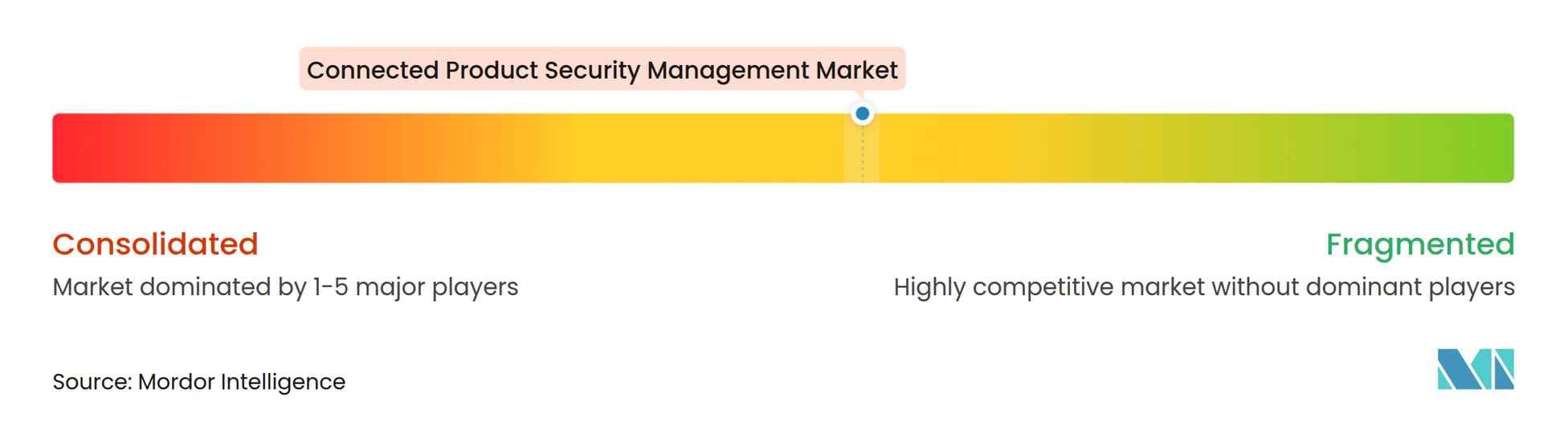
The Connected product security management market has moderate-to-high competitive intensity. Platform-scale vendors compete with specialists, while acquisitions are bringing asset visibility, exposure management, and product security capabilities together. ServiceNow completed the acquisition of Armis for USD 7.75 billion in April 2026, integrating cyber asset intelligence with its workflow and risk capabilities.[4] Accenture announced in June 2026 that it would acquire a majority stake in Dragos and full ownership of runZero and NetRise for a combined enterprise value of USD 4.175 billion. Dragos completed the acquisitions of runZero and NetRise in September 2026, adding asset discovery and software supply-chain security to its operational technology threat intelligence capabilities.
Consolidation reflects buyer demand for a workflow that can identify devices, assess exposure, prepare compliance evidence, and support remediation. Claroty raised USD 150 million in a Series F round in January 2026 at a valuation above USD 3 billion. Cybellum, Finite State, ONEKEY, Karamba Security, and Sternum compete through firmware analysis, binary intelligence, and compliance automation. Finite State launched its autonomous Product Security OS in February 2026, with capabilities for firmware analysis, software bill-of-materials generation, and vulnerability exploitability exchange statement production. ONEKEY launched its AI Agent in September 2026 to enable teams to query firmware analysis data using natural-language prompts.
Keyfactor launched Trust Control Plane in June 2026 to combine public key infrastructure management, certificate lifecycle automation, and post-quantum readiness planning. Competition centers on technical depth, accessible workflows, integration, and managed support. This is relevant for SMEs in Asia-Pacific and South America, where specialized internal teams may be limited. Large platforms have broader integration and sales capacity, while specialists can differentiate with product-specific analysis and evidence automation.
Connected Product Security Management Industry Leaders
-
Armis, Inc.
-
Claroty Ltd.
-
Forescout Technologies, Inc.
-
Nozomi Networks, Inc.
-
Dragos, Inc.
- *Disclaimer: Major Players sorted in no particular order
Connected Product Security Management Market Companies Covered in this Report
- Armis, Inc.
- Claroty Ltd.
- Forescout Technologies, Inc.
- Nozomi Networks, Inc.
- Dragos, Inc.
- Ordr, Inc.
- Phosphorus Cybersecurity Inc.
- Cybellum Technologies Ltd.
- Finite State, Inc.
- ONEKEY GmbH
- Karamba Security Ltd.
- Secure-IC S.A.S.
- Sternum Ltd.
- Mocana Corporation
- Keyfactor, Inc.
- MagicCube, Inc.
- Particle Industries, Inc.
- Secure Elements Private Limited
- RIoT Secure AB
- ArgusEye, Inc.
Recent Industry Developments in Connected Product Security Management Market
- September 2026: Dragos officially completed the acquisitions of runZero and NetRise following the close of Accenture's majority investment, creating a unified extended operational technology platform that integrates asset discovery, software supply-chain security, and OT threat intelligence. CEO Robert Lee was named Chairman in addition to his CEO role, and the combined business was positioned as the largest OT cybersecurity entity in history by enterprise value.
- September 2026: ONEKEY, a product cybersecurity specialist headquartered in Düsseldorf, launched the ONEKEY AI Agent, enabling security teams to query firmware analysis results and platform data in natural language through large language models trained on the platform's actual findings. The release marked the first milestone in ONEKEY's 4-stage AI roadmap toward a comprehensive product security assistant platform.
- September 2026: EU Cyber Resilience Act incident reporting obligations took effect on September 11, 2026, under Regulation (EU) 2024/2847, requiring manufacturers of connected products to notify actively exploited vulnerabilities to ENISA and national CSIRTs within 24 hours and to submit a full incident report within 1 month. This marked the first major enforcement milestone under the Act ahead of the December 11, 2027 conformity deadline.
- June 2026: Accenture announced agreements to acquire a majority stake in Dragos and 100% stakes in runZero and NetRise, with a combined enterprise value of USD 4.175 billion. The deal extended Accenture's USD 10 billion cybersecurity services business into end-to-end OT security for critical infrastructure and industrial operations.
Global Connected Product Security Management Market Report Scope
The Connected Product Security Management Market comprises software solutions and professional services that enable organizations to identify, monitor, secure, govern, and maintain the cybersecurity posture of connected products throughout their lifecycle. These solutions support product asset discovery, software bill of materials (SBOM) management, software supply-chain security, vulnerability management, regulatory compliance, risk governance, and security evidence management for connected devices and embedded systems deployed across industrial, automotive, healthcare, consumer, energy, aerospace, defense, and other sectors.
The Connected Product Security Management Market Report is Segmented by Offering (Solutions, and Services), Security Function (Product Asset Discovery and Inventory, SBOM and Software Supply-Chain Management, Vulnerability Management and Prioritization, Product Risk and Security Governance, Regulatory Compliance and Evidence Management, and Other Security Functions), Deployment (Cloud, On-Premises, and Hybrid), Organization Size (Large Enterprises, and Small and Medium-Sized Enterprises), End-User Industry (Industrial Manufacturing, Automotive and Mobility, Healthcare and Medical Devices, Consumer Electronics and Smart Devices, Energy and Utilities, Aerospace, Defense and Government Technology, and Other End-User Industries), and Geography (North America, South America, Europe, Asia-Pacific, Middle East, and Africa). The Market Forecasts are Provided in Terms of Value (USD).
Segmentation Overview
| Solutions |
| Services |
| Product Asset Discovery and Inventory |
| SBOM and Software Supply-Chain Management |
| Vulnerability Management and Prioritization |
| Product Risk and Security Governance |
| Regulatory Compliance and Evidence Management |
| Other Security Functions |
| Cloud |
| On-Premises |
| Hybrid |
| Large Enterprises |
| Small and Medium-Sized Enterprises |
| Industrial Manufacturing |
| Automotive and Mobility |
| Healthcare and Medical Devices |
| Consumer Electronics and Smart Devices |
| Energy and Utilities |
| Aerospace, Defense and Government Technology |
| Other End-User Industries |
| North America | United States |
| Canada | |
| Mexico | |
| South America | Brazil |
| Argentina | |
| Rest of South America | |
| Europe | Germany |
| United Kingdom | |
| France | |
| Italy | |
| Russia | |
| Rest of Europe | |
| Asia-Pacific | China |
| Japan | |
| India | |
| South Korea | |
| Rest of Asia-Pacific | |
| Middle East | Saudi Arabia |
| United Arab Emirates | |
| Rest of Middle East | |
| Africa | South Africa |
| Nigeria | |
| Rest of Africa |
| By Offering | Solutions | |
| Services | ||
| By Security Function | Product Asset Discovery and Inventory | |
| SBOM and Software Supply-Chain Management | ||
| Vulnerability Management and Prioritization | ||
| Product Risk and Security Governance | ||
| Regulatory Compliance and Evidence Management | ||
| Other Security Functions | ||
| By Deployment | Cloud | |
| On-Premises | ||
| Hybrid | ||
| By Organization Size | Large Enterprises | |
| Small and Medium-Sized Enterprises | ||
| By End-User Industry | Industrial Manufacturing | |
| Automotive and Mobility | ||
| Healthcare and Medical Devices | ||
| Consumer Electronics and Smart Devices | ||
| Energy and Utilities | ||
| Aerospace, Defense and Government Technology | ||
| Other End-User Industries | ||
| By Geography | North America | United States |
| Canada | ||
| Mexico | ||
| South America | Brazil | |
| Argentina | ||
| Rest of South America | ||
| Europe | Germany | |
| United Kingdom | ||
| France | ||
| Italy | ||
| Russia | ||
| Rest of Europe | ||
| Asia-Pacific | China | |
| Japan | ||
| India | ||
| South Korea | ||
| Rest of Asia-Pacific | ||
| Middle East | Saudi Arabia | |
| United Arab Emirates | ||
| Rest of Middle East | ||
| Africa | South Africa | |
| Nigeria | ||
| Rest of Africa | ||
Key Questions Answered in the Report
What is the size of the connected product security management market?
The connected product security management market was valued at USD 1.45 billion in 2026 and is projected to reach USD 2.63 billion by 2032 at a 10.73% CAGR. The forecast reflects continuing regulatory and lifecycle security requirements that shape product development, documentation, supplier engagement, and post-release support.
What is driving demand for connected product security management?
Regulatory requirements, broader connected-device exposure, and continuous software and firmware security obligations are increasing demand. The Connected product security management market expands as manufacturers need evidence that suppliers and product releases are managed consistently.
Which deployment model leads connected product security management?
Cloud deployment led with 57.14% of revenue in 2026 because it supports centralized vulnerability feeds, software bill of materials updates, and reporting. It gives distributed security and engineering teams a shared record.
Which end-user sector is expanding most quickly?
Healthcare and medical devices are projected to expand at an 11.43% CAGR through 2032 as product evidence becomes important for regulation and procurement. Patient care risks reinforce the need for reliable vulnerability handling.
Why are software bills of materials important for connected products?
They help manufacturers identify affected components, assess vulnerability exposure, and meet product-security documentation requirements. They also support faster decisions when vulnerabilities are disclosed.
How are smaller device manufacturers adopting product security tools?
SMEs are projected to expand at a 12.89% CAGR through 2032 and often use managed services to meet supply-chain and regulatory obligations. This model reduces the need for extensive specialized internal resources.