
Compute In Memory (CIM) and Processing In Memory (PIM) Market Size and Share
Market Overview
| Study Period | 2020 - 2031 |
|---|---|
| Market Size (2026) | USD 1.16 Billion |
| Market Size (2031) | USD 6.54 Billion |
| Growth Rate (2026 - 2031) | 41.33 % |
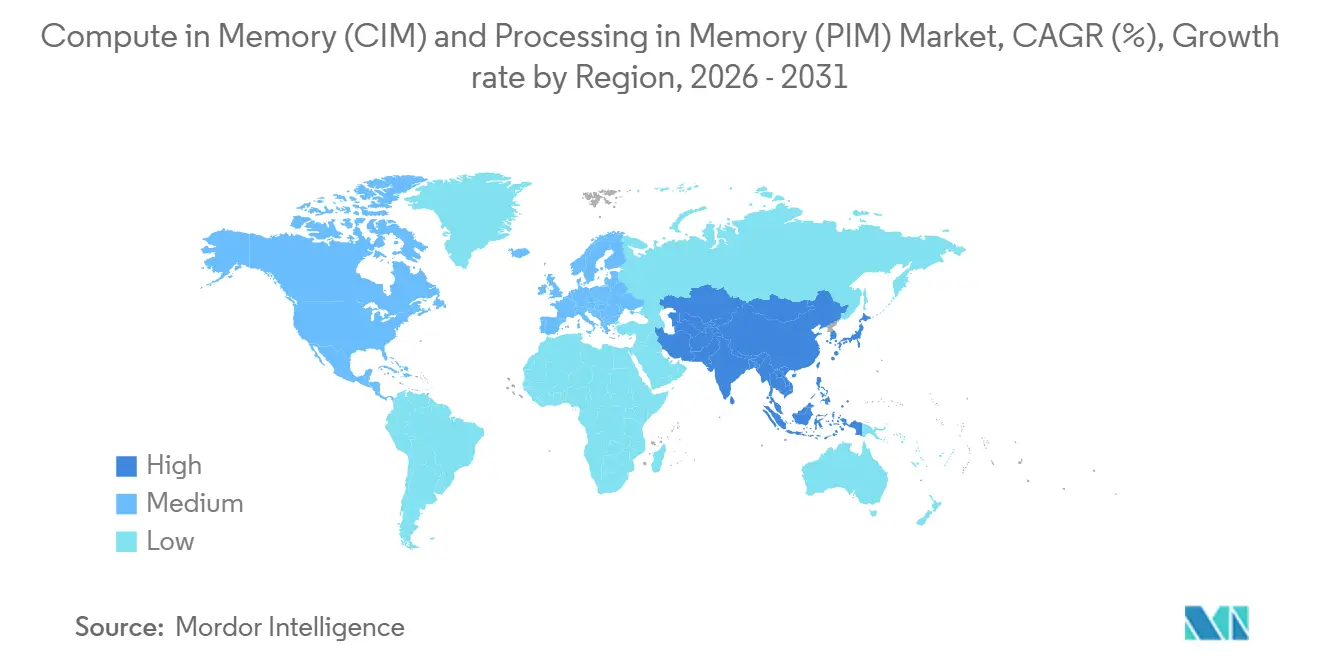
| Fastest Growing Market | Asia-Pacific |
| Largest Market | North America |
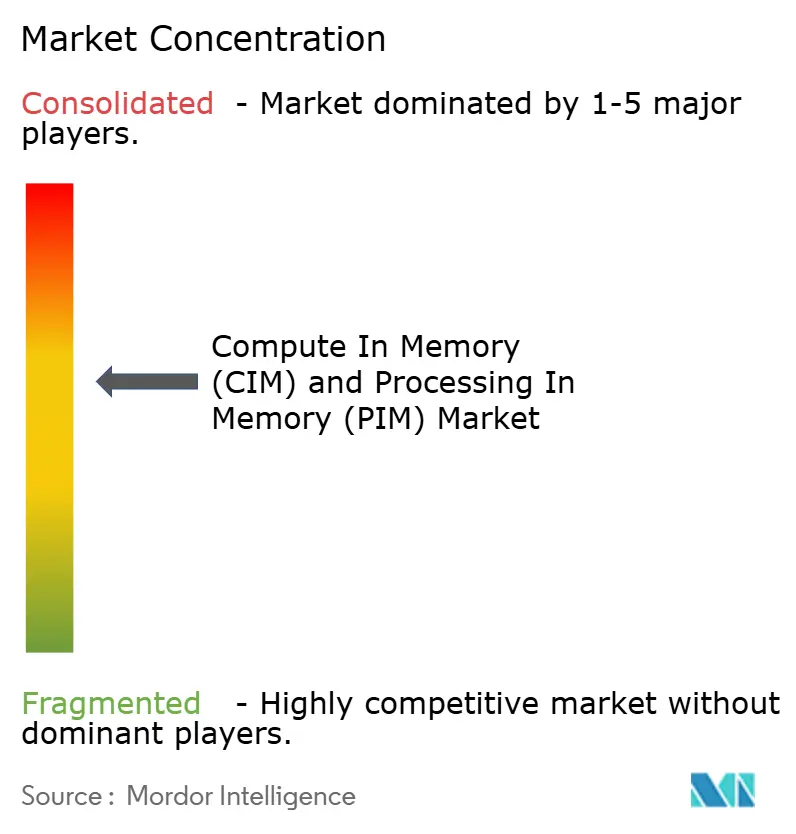
| Market Concentration | Medium |
Major Players *Disclaimer: Major Players sorted in no particular order Image © Mordor Intelligence. Reuse requires attribution under CC BY 4.0. | |
Compute In Memory (CIM) and Processing In Memory (PIM) Market Analysis by Mordor Intelligence
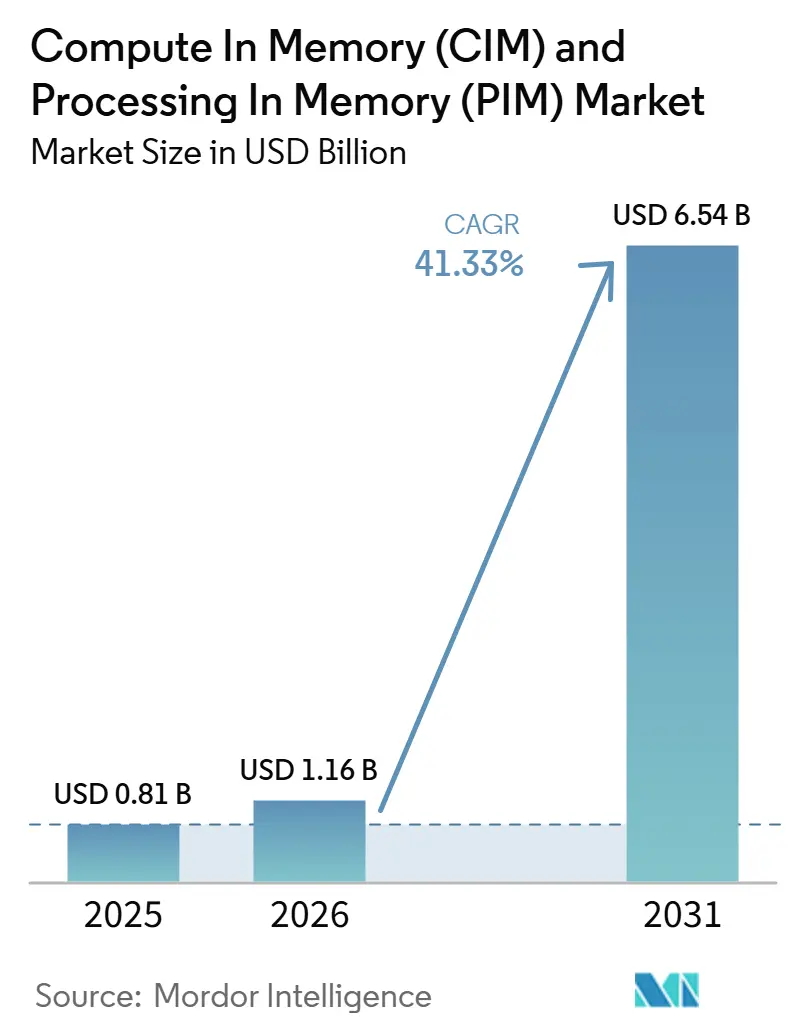
The compute in memory (CIM) and processing in memory (PIM) market size is projected to be USD 0.81 billion in 2025, USD 1.16 billion in 2026, and reach USD 6.54 billion by 2031, growing at a CAGR of 41.33% from 2026 to 2031. The compute-in-memory (CIM) and processing-in-memory (PIM) market is gaining momentum as AI inference and training workloads continue to raise the cost of moving data between memory and processors. Demand is also broadening beyond early data center programs, as edge devices, industrial systems, and automotive platforms need lower latency and better energy efficiency from memory-centric designs. Competition is shifting from isolated chip demonstrations toward full platforms that combine memory technology, packaging, software support, and system integration. Leading companies are using advanced packaging, high-bandwidth memory, and strategic partnerships to move closer to production-scale deployment. The compute in memory (CIM) and processing in memory (PIM) market still faces friction from fragmented software tools, qualification cycles, and manufacturing complexity, yet these issues are shaping the pace of commercialization rather than weakening the long-term opportunity.
Key Report Takeaways
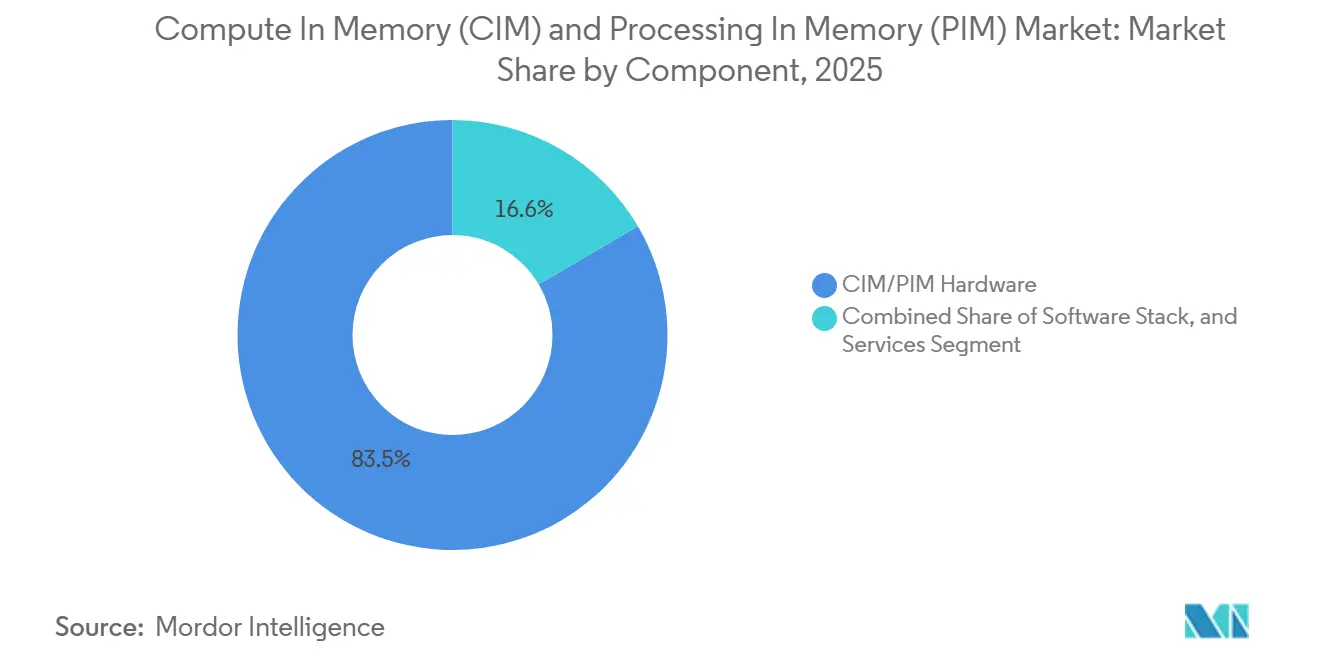
- By component, CIM and PIM hardware accounted for 83.45% of revenue in 2025, while the software stack recorded the highest projected CAGR of 41.56% through 2031 in the compute in memory (CIM) and processing in memory (PIM) market.
- By memory technology, SRAM-based CIM led with 62.73% share in 2025, while HBM-based PIM is forecast to expand at 41.73% CAGR through 2031 in the compute in memory (CIM) and processing in memory (PIM) market.
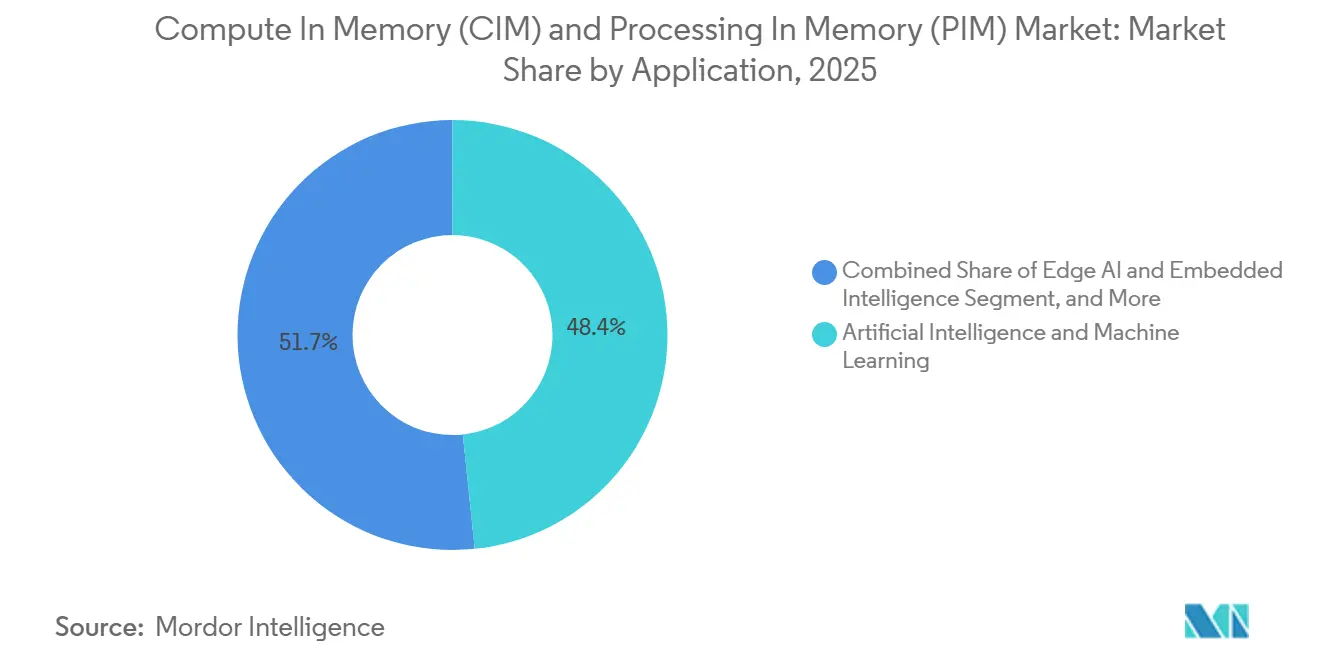
- By application, AI and ML accounted for 48.35% of the market in 2025, while data centers and hyperscale AI infrastructure are advancing at a 41.83% CAGR through 2031 in the compute in memory (CIM) and processing in memory (PIM) market.
- By geography, North America captured 42.77% share in 2025, while Asia-Pacific posted the fastest CAGR at 42.14% through 2031 in the compute in memory (CIM) and processing in memory (PIM) market.
Note: Market size and forecast figures in this report are generated using Mordor Intelligence’s proprietary estimation framework, updated with the latest available data and insights as of January 2026.
Market Trends and Insights
Drivers Impact Analysis of Compute In Memory (CIM) and Processing In Memory (PIM) Market*
| Driver | (~) % Impact on CAGR Forecast | Geographic Relevance | Impact Timeline |
|---|---|---|---|
| AI workloads are hitting the memory wall | +9.5% | Global, with highest intensity in North America and East Asia AI data centers | Short term (≤ 2 years) |
| Cloud-native analytics is pushing compute closer to data | +7.8% | North America and Europe, with spill-over to APAC hyperscale markets | Medium term (2-4 years) |
| Edge inference is raising the value of localized compute | +6.2% | APAC (Japan, South Korea, Taiwan), with spill-over to North America and Europe | Medium term (2-4 years) |
| Sub-10nm and 3D-stacked memory roadmaps are improving CIM feasibility | +5.5% | Taiwan and South Korea foundry ecosystem, benefiting global system OEMs | Medium term (2-4 years) |
| Power efficiency pressure in data centers and edge devices | +4.8% | Global, with early adoption in North America and Europe | Short term (≤ 2 years) |
| Neuromorphic and sparse computing use cases are expanding the TAM beyond conventional analytics | +3.2% | North America, APAC, and Europe | Long term (≥ 4 years) |
| Source: Mordor Intelligence | |||
AI Workloads Are Hitting the Memory Wall
The compute in memory (CIM) and processing in memory (PIM) market is driven by a growing mismatch between processor throughput and memory bandwidth in AI systems. Energy use now depends heavily on data movement, not just arithmetic throughput, making memory proximity a practical design priority for AI infrastructure.[1]NVIDIA, “Maximize AI Factory Energy Efficiency Through Full-Stack Inference and Training Optimizations,” NVIDIA Developer Blog, nvidia.com This matters most in large inference environments, where repeated memory access can limit performance even when accelerator capacity is available. The compute in memory (CIM) and processing in memory (PIM) market, therefore, benefits from a lower adoption hurdle, as these architectures do not need to replace every accelerator in the stack to gain traction. They can instead take on memory-bound operations that conventional architectures handle less efficiently. That creates room for earlier deployment in AI servers, enterprise inference systems, and future mixed-architecture platforms.
Cloud-Native Analytics Is Pushing Compute Closer To Data
The compute in memory (CIM) and processing in memory (PIM) market is also being driven by cloud operators seeking better performance per watt from real-time inference infrastructure. NVIDIA stated that full-stack optimization is becoming central to AI factory efficiency, which supports the case for architectures that reduce repeated traffic across the memory interface. Research presented at IEEE ASICON 2025 showed that a hybrid DRAM-PIM and SRAM-CIM design for transformer inference delivered a 1.51x speedup and 1.24x energy reduction compared to a DRAM-PIM-only baseline for Llama2-7B at 28nm. That result is important because it shows that complementary memory technologies can be mapped to different model functions rather than forced into a single architecture. In June 2026, Micron and Anthropic announced a strategic agreement that combined a multi-year memory and storage supply commitment with a strategic investment, showing that memory roadmaps are now being tied directly to future AI infrastructure planning. This kind of alignment supports faster commercialization of the compute in memory (CIM) and processing in memory (PIM) market because infrastructure buyers and memory suppliers share common deployment timelines.
Edge Inference Is Raising The Value Of Localized Compute
The compute in memory (CIM) and processing in memory (PIM) market is expanding beyond centralized infrastructure as AI inference moves into devices with tight power and area constraints. Edge systems often operate with limited connectivity and strict energy budgets, which makes local memory-centric compute more attractive than general-purpose accelerator designs. In March 2026, Microchip Technology said Mythic selected memBrain technology from its Silicon Storage Technology unit for next-generation analog processing units targeting 120 TOPS/W. In September 2025, the University of Tokyo and Nuvoton reported a ReRAM-based CiM that combined multi-level storage with 10-year data retention, directly addressing one of the long-standing durability concerns in non-volatile edge deployments. These developments show that the compute in memory (CIM) and processing in memory (PIM) market is not one uniform edge opportunity, because automotive, industrial, robotics, and compact IoT systems require different memory substrates and precision trade-offs. As a result, commercial adoption is likely to spread through several smaller use cases before consolidating into broader edge platforms.
Sub-10nm And 3D-Stacked Memory Roadmaps Are Improving CIM Feasibility
The compute in memory (CIM) and processing in memory (PIM) market is benefiting from manufacturing roadmaps that support denser interconnects and tighter memory-logic integration. TSMC stated in June 2026 that its SoIC roadmap is moving toward finer die-to-die bonding pitch and higher I/O density, which directly supports chiplet-style architectures that place compute closer to memory. Samsung Semiconductor also announced in May 2026 that it had shipped 12-layer HBM4E samples with 3.6 TB/s bandwidth per stack, 16% better energy efficiency, and more than 14% better thermal resistance than the prior generation. These advances matter because many CIM and PIM designs now depend on packaging and stacking choices as much as on transistor-level design. They also strengthen the case for programmable, memory-centric platforms rather than fixed-function arrays. The result is a stronger technical foundation for the compute in memory (CIM) and processing in memory (PIM) market to move from narrow demonstrations toward commercially manufacturable products.
Restraints Impact Analysis of Compute In Memory (CIM) and Processing In Memory (PIM) Market*
| Restraint | (~) % Impact on CAGR Forecast | Geographic Relevance | Impact Timeline |
|---|---|---|---|
| Limited toolchains and compiler support for PIM adoption | -2.8% | Global, most acute in North America and Europe enterprise environments | Short term (≤ 2 years) |
| Yield, test, and packaging complexity in heterogeneous memory-logic integration | -2.2% | Taiwan, South Korea, and US advanced packaging hubs | Medium term (2-4 years) |
| Fragmented standards across memory, interconnect, and software stacks | -1.8% | Global, with particular impact on cross-vendor interoperability | Medium term (2-4 years) |
| High qualification risk for mission-critical enterprise and automotive use cases | -1.4% | North America, Europe, and Japan | Long term (≥ 4 years) |
| Source: Mordor Intelligence | |||
Limited Toolchains And Compiler Support For PIM Adoption
The compute in memory (CIM) and processing in memory (PIM) market still faces a major software constraint because application porting requires different programming models from conventional accelerator environments. ETH Zurich and the SAFARI Research Group described the need for new tools, programming models, and system support for processing-in-memory architectures, which shows that the software layer is still catching up with the hardware opportunity. A 2026 compiler study from Politecnico di Milano also found that performance gains can vary strongly by workload and that general-purpose ports may deliver limited benefit without deeper code adaptation. This means adoption is not only about buying new silicon; enterprises also need compilers, APIs, runtime layers, and validated mapping flows. The compute in memory (CIM) and processing in memory (PIM) market could still grow quickly under these conditions, but commercial scale will remain easier in tightly controlled environments than in broad open software ecosystems. That is why software maturity is becoming one of the clearest dividing lines between promising hardware and deployable platforms.
Yield, Test, And Packaging Complexity In Heterogeneous Memory-Logic Integration
The compute in memory (CIM) and processing in memory (PIM) market also remains constrained by manufacturing complexity. When logic, memory, and stacked interconnect layers are integrated into one system, yield management becomes more difficult than in standard logic-only or DRAM-only production. IBM Research reported at IEDM 2025 that disc-type PCM devices for analog in-memory computing reached low programming current and a wide resistance window, while still treating process variation and yield methodology as active engineering issues. Samsung Semiconductor’s May 2026 HBM4E sample update also showed that advanced memory products now combine a memory stack with a 4nm logic base die, adding process and qualification complexity to commercialization. These factors can lengthen ramp schedules, tighten supply, and preserve premium pricing during the early growth phase. For the compute in memory (CIM) and processing in memory (PIM) market, manufacturing progress is therefore as important as architectural progress.
*Our forecasts treat driver/restraint impacts as directional, not additive. The impact forecasts reflect baseline growth, mix effects, and variable interactions.
Compute In Memory (CIM) and Processing In Memory (PIM) Market Segment Analysis
By Component:
Hardware Dominates Revenue As Software Accelerates FastestCIM and PIM hardware accounted for 83.45% of revenue in 2025, indicating that early spending in the compute in memory (CIM) and processing in memory (PIM) market remained focused on silicon and platform buildout. This pattern reflects the capital intensity of chip design, packaging, and memory integration, especially when demand still comes largely from AI infrastructure programs and specialist system developers. The hardware lead also aligns with the current stage of commercialization, where customers are validating core architectures before large-scale software standardization becomes feasible. At the same time, the revenue mix points to a market that is still building out its installed base rather than one that has already matured into a broad recurring software model. That installed base is important because it creates the technical footprint on which later software and service revenue can expand.
The software stack segment is forecast to grow at 41.56% through 2031, making it the fastest-growing component of the compute in memory (CIM) and processing in memory (PIM) market. That growth reflects rising demand for compilers, model mapping tools, hardware abstraction layers, and deployment frameworks that can connect specialized memory-centric hardware to production AI workloads. The same trend is visible in research activity, where software support is becoming necessary for analog and digital platforms to move beyond laboratory configurations.[2]IEEE A-SSCC, “A 28 nm 68.6TOPS/W Folded-Differential Switched-Capacitor FIA-Based SRAM CIM Macro With Scalable MAC Sizes for Tiny-ML Inference,” IEEE A-SSCC 2025, doi.org Services remain smaller, yet they carry real strategic value because many enterprises lack the internal expertise needed to integrate new memory architectures into automotive, industrial, and safety-sensitive systems. Over time, the compute in memory (CIM) and processing in memory (PIM) industry is likely to shift from hardware-led revenue to a fuller platform economics model, but the current mix shows that silicon still anchors commercial demand.



By Memory Technology:
SRAM Leads But HBM Is Resetting Growth PrioritiesSRAM-based CIM held 62.73% of the 2025 compute in memory (CIM) and processing in memory (PIM) market share within memory technology, supported by strong CMOS compatibility and a more mature digital design base. That lead reflects the practical advantages of SRAM for deterministic operation, known bitcell behavior, and easier alignment with conventional semiconductor processes. IEEE A-SSCC 2025 reported a 28nm SRAM CIM macro achieving 68.6 TOPS/W for tiny-ML inference, supporting the case for SRAM in energy-sensitive inference applications. Nature also published IBM’s mixed-precision memristor and SRAM compute-in-memory AI processor in 2025, showing how hybrid approaches can extend beyond the limits of pure SRAM designs. Together, these results explain why SRAM remains the leading base technology in the compute in memory (CIM) and processing in memory (PIM) market even as other substrates gain momentum.
HBM-based PIM is projected to grow at 41.73% through 2031, making it the fastest-growing memory technology in the compute in memory (CIM) and processing in memory (PIM) market size mix. This growth path is tied to hyperscale demand for bandwidth-dense memory that can handle more compute-like functions within AI accelerator environments. Samsung Semiconductor’s HBM4E shipment in May 2026, with 3.6 TB/s bandwidth per stack and a 4nm logic base die, demonstrated how the commercial roadmap is moving toward tighter memory-logic coupling. Other memory types continue to define specialized paths: MRAM supports non-volatile edge storage, and ReRAM or PCM supports analog matrix operations when low-power inference is a priority. This leaves the compute in memory (CIM) and processing in memory (PIM) industry with a layered technology landscape rather than a single winning substrate.
By Application:
AI And ML Holds The Largest Base While Data Centers Expand FastestAI and ML accounted for 48.35% of application demand in 2025, making this segment the largest contributor to the compute in memory (CIM) and processing in memory (PIM) market. That position reflects where most current design work and infrastructure spending remain concentrated, because neural network workloads directly expose the cost of repeated weight movement between memory and compute blocks. Memory-centric architectures fit this need well because matrix-heavy AI tasks often benefit from lower movement overhead and better energy efficiency. As a result, AI and ML continue to anchor both commercial demand and technical roadmaps across the compute in memory (CIM) and processing in memory (PIM) market. It also provides the clearest path for vendors to demonstrate performance advantages before expanding into broader use cases.
Data centers and hyperscale AI infrastructure are forecast to grow at 41.83% through 2031, making it the fastest-growing application area in the compute in memory (CIM) and processing in memory (PIM) market. This reflects rising pressure on operators to increase inference throughput within fixed power envelopes and limited rack-level thermal budgets. The diversification path is also becoming clearer, as edge AI, automotive, industrial automation, robotics, and IoT continue to drive the adoption of memory-centric designs for varying latency and energy targets. BrainChip announced in June 2026 that it had reached commercial availability and begun initial production shipments of its Akida AKD1500 neuromorphic processors, demonstrating that event-based, low-power architectures are moving into real deployments. Renesas also announced in February 2026 that its R-Car V4H ADAS SoC was selected for the control unit of Toyota’s new RAV4 model, supplied by Denso, which supports memory-intensive AI processing in volume automotive systems.
Geography Analysis
North America Compute in Memory (CIM) and Processing in Memory (PIM) Market
North America held 42.77% of the compute in memory (CIM) and processing in memory (PIM) market share in 2025, making it the largest regional base. This position is tied to the concentration of hyperscale AI infrastructure, advanced memory investment, and close links between model developers and semiconductor suppliers. In July 2026, Micron announced that it had accelerated planned U.S. investments to more than USD 250 billion through 2035 and that it had completed the first concrete pour at its Clay, New York, site more than a quarter ahead of schedule. North American operators are also placing greater emphasis on performance per watt, which strengthens the commercial case for architectures that reduce repeated movement across the memory interface. The compute in memory (CIM) and processing in memory (PIM) market in this region, therefore, benefits from both capital depth and a direct infrastructure need.
APAC Compute in Memory (CIM) and Processing in Memory (PIM) Market
Asia-Pacific is projected to grow at 42.14% through 2031, making it the fastest-growing geography in the compute in memory (CIM) and processing in memory (PIM) market. The region combines foundry leadership, advanced packaging capability, high-bandwidth memory production, and active public support for semiconductor research. TSMC’s June 2026 technology update outlined a CoWoS roadmap extending to larger integration footprints and a SoIC path toward tighter die stackingboth of, both of which are important for chiplet-based memory-centric designs.[3]TSMC, “TSMC Debuts A13 Technology at 2026 North America Technology Symposium,” TSMC, tsmc.com Samsung Semiconductor’s HBM4E sample shipment further reinforced Asia-Pacific’s central role in the execution of the n commercial memory roadmap. Japan adds a distinct automotive and edge dimension through public research backing, including NEDO-funded CMOS and spintronics MRAM work and University of Tokyo research on durable ReRAM-based CiM.
Europe Compute in Memory (CIM) and Processing in Memory (PIM) Market
Europe and the rest of the world remain smaller in current revenue, but they still matter to the compute in memory (CIM) and processing in memory (PIM) market because they add important automotive, industrial, and defense-oriented demand paths. Europe’s activity is concentrated in edge AI, automotive electronics, and research-linked commercialization. Mythic announced in May 2026 that it had acquired Videantis, a German digital processor IP company with broad automotive penetration, to combine analog compute-in-memory with digital processing in a hybrid platform. That move gives the compute in memory (CIM) and processing in memory (PIM) market a clearer route into European automotive and robotics programs through an existing processor IP footprint.

Competitive Landscape
The compute in memory (CIM) and processing in memory (PIM) market remains moderately concentrated at the hardware layer, as a small group of memory suppliers controls the most commercially advanced HBM-based and DRAM-based platforms. At the same time, the field is far more open in analog CIM, neuromorphic processing, and edge inference, where specialized companies are still shaping product direction. This creates a two-track structure in the compute in memory (CIM) and processing in memory (PIM) market, with large incumbents pushing manufacturable memory roadmaps and smaller firms pursuing architectural experimentation. Samsung Semiconductor’s HBM4E rollout in May 2026 showed how incumbents are using bandwidth, thermals, and energy efficiency to strengthen their position in memory-centric AI systems.[4]Samsung Semiconductor, “Samsung Electronics Begins Shipment of Industry-First HBM4E Samples,” Samsung Semiconductor Global Newsroom, samsungsemiconductor.com TSMC’s packaging and stacking roadmap plays a similar role by enabling the system designs that many memory-centric vendors need to reach commercial scale.
Competitive strategy is increasingly defined by platform control rather than by chip performance alone. Micron’s June 2026 strategic agreement with Anthropic is a strong example because it tied future memory and storage supply to next-generation AI infrastructure planning. Mythic’s acquisition of Videantis in May 2026 is another example, because it expanded beyond analog CIM into a hybrid compute platform with established automotive reach. BrainChip’s production shipments of Akida AKD1500 in June 2026 showed a different route to market, where low-power neuromorphic products target commercial adoption through edge use cases. These moves show that the compute in memory (CIM) and processing in memory (PIM) market is no longer defined only by research credibility, because vendors are now building product portfolios, channel access, and supply relationships.
The strongest white space still sits between hardware capability and deployable software support. Vendors that can combine memory-centric acceleration with stable toolchains, workload mapping, and qualification support will have an advantage as customers move from pilots to scaled deployment. Research from ETH Zurich and Politecnico di Milano supports this point by showing that software maturity still limits broader adoption even when hardware gains are real. For that reason, the compute in memory (CIM) and processing in memory (PIM) market is likely to reward companies that can offer integrated stacks instead of stand-alone devices.
Compute In Memory (CIM) and Processing In Memory (PIM) Industry Leaders
SK hynix Inc.
Samsung Electronics Co., Ltd.
Micron Technology, Inc.
Mythic Inc.
SynSense AG
- *Disclaimer: Major Players sorted in no particular order
Compute In Memory (CIM) and Processing In Memory (PIM) Market Companies Covered in this Report
- Samsung Electronics Co., Ltd.
- SK hynix Inc.
- Micron Technology, Inc.
- IBM Corporation
- Intel Corporation
- TSMC
- Qualcomm Incorporated
- NVIDIA Corporation
- Analog Devices, Inc.
- Renesas Electronics Corporation
- GSI Technology, Inc.
- Mythic Inc.
- TetraMem Inc.
- SynSense AG
- BrainChip Holdings Ltd
- SAP SE
- Oracle Corporation
- Microsoft Corporation
- Amazon Web Services, Inc.
- Redis Ltd.
- GridGain Systems, Inc.
- GigaSpaces Technologies Ltd.
- Fujitsu Limited
- Hewlett Packard Enterprise Company

Recent Industry Developments in Compute In Memory (CIM) and Processing In Memory (PIM) Market
- July 2026: Micron Technology announced an acceleration of its planned US investments to more than USD 250 billion through 2035, completing the first concrete pour at its Clay, New York, semiconductor site more than a quarter ahead of schedule. The facility, expected to become the largest semiconductor manufacturing complex in US history, is primarily focused on HBM and advanced DRAM for AI infrastructure.
- June 2026: BrainChip Holdings announced commercial availability and initial production shipments of its Akida AKD1500 neuromorphic processors, the world's first commercial ultra-low-power fully digital event-based neuromorphic AI chips, following an initial order from Nex Novus in December 2025.
- June 2026: Micron and Anthropic announced a strategic agreement that combines a multi-year memory and storage supply commitment with a strategic investment by Micron in Anthropic's Series H funding round, embedding CIM and PIM-capable memory roadmaps into frontier AI infrastructure planning.
- June 2026: TSMC announced its A13, A12, and N2U advanced process nodes at its 2026 North America Technology Symposium, alongside an updated CoWoS roadmap scaling to beyond 14-reticle size by 2029, capable of integrating 24 HBM5E stacks, a packaging advance directly enabling chiplet-based CIM architectures in active commercial development.
- May 2026: Mythic acquired Videantis GmbH, one of Europe's leading digital processor IP companies, to combine analog CIM with digital processing for a hybrid AI compute platform targeting automotive, robotics, and data center applications. The acquisition followed an oversubscribed USD 125 million funding round and a Honda co-development agreement for next-generation automotive AI chips.


Global Compute In Memory (CIM) and Processing In Memory (PIM) Market Report Scope
The Compute in Memory (CIM) and Processing in Memory (PIM) Market Report is Segmented by Component (CIM/PIM Hardware, Software Stack, and Services), Memory Technology (SRAM-Based CIM, DRAM-Based PIM, HBM-Based PIM, MRAM-Based CIM, RRAM/ReRAM-Based CIM, and PCM-Based CIM), Application (Artificial Intelligence and Machine Learning, Edge AI and Embedded Intelligence, Data Centers and Hyperscale AI Infrastructure, Automotive and ADAS, Industrial Automation and Robotics, Internet of Things (IoT), and Other Applications), and Geography (North America, Europe, Asia-Pacific, and Rest of the World). The Market Forecasts are Provided in Terms of Value (USD).
| CIM/PIM Hardware |
| Software Stack |
| Services |
| SRAM-Based CIM |
| DRAM-Based PIM |
| HBM-Based PIM |
| MRAM-Based CIM |
| RRAM/ReRAM-Based CIM |
| PCM-Based CIM |
| Artificial Intelligence and Machine Learning |
| Edge AI and Embedded Intelligence |
| Data Centers and Hyperscale AI Infrastructure |
| Automotive and ADAS |
| Industrial Automation and Robotics |
| Internet of Things (IoT) |
| Other Applications |
| North America | |
| Europe | |
| Asia Pacific | China |
| Japan | |
| South Korea | |
| Taiwan | |
| Rest of Asia Pacific | |
| Rest of the World |
| By Component | CIM/PIM Hardware | |
| Software Stack | ||
| Services | ||
| By Memory Technology | SRAM-Based CIM | |
| DRAM-Based PIM | ||
| HBM-Based PIM | ||
| MRAM-Based CIM | ||
| RRAM/ReRAM-Based CIM | ||
| PCM-Based CIM | ||
| By Application | Artificial Intelligence and Machine Learning | |
| Edge AI and Embedded Intelligence | ||
| Data Centers and Hyperscale AI Infrastructure | ||
| Automotive and ADAS | ||
| Industrial Automation and Robotics | ||
| Internet of Things (IoT) | ||
| Other Applications | ||
| By Geography | North America | |
| Europe | ||
| Asia Pacific | China | |
| Japan | ||
| South Korea | ||
| Taiwan | ||
| Rest of Asia Pacific | ||
| Rest of the World | ||


Key Questions Answered in the Report
What is driving growth in compute in memory and processing in memory?
Growth is being led by rising AI workload intensity, the cost of data movement, and the need for better performance per watt across data centers and edge devices. The market is projected to grow from USD 1.16 billion in 2026 to USD 6.54 billion by 2031 at a 41.33% CAGR.
Which region leads current demand for memory-centric compute architectures?
North America led in 2025 with 42.77% share, supported by hyperscale AI infrastructure buildout and large semiconductor investment programs.
Which region is expanding the fastest through 2031?
Asia-Pacific is the fastest-growing region, with a projected CAGR of 42.14% through 2031, supported by foundry scale, HBM production, advanced packaging, and public research and development support.
Which component category generates the most revenue today?
CIM/PIM hardware remains the largest component segment, with 83.45% share in 2025, because the current commercialization phase is still centered on silicon, packaging, and platform deployment.
Which memory technology is growing the fastest?
HBM-based PIM is the fastest-growing memory technology at 41.73% CAGR through 2031, as AI infrastructure buyers seek higher bandwidth and tighter memory-logic integration.
What is the main adoption barrier for enterprise buyers?
Software immaturity remains the main barrier. Limited toolchains, workload-specific compiler gains, and the need for repeated software qualification still slow broad deployment.
Page last updated on:





