
Compressed Air Treatment Equipment Market Size and Share
Market Overview
| Study Period | 2022 - 2032 |
|---|---|
| Market Size (2027) | USD 11.41 Billion |
| Market Size (2032) | USD 15.86 Billion |
| Growth Rate (2027 - 2032) | 6.56 % |
| Fastest Growing Market | Asia-Pacific |
| Largest Market | Asia-Pacific |
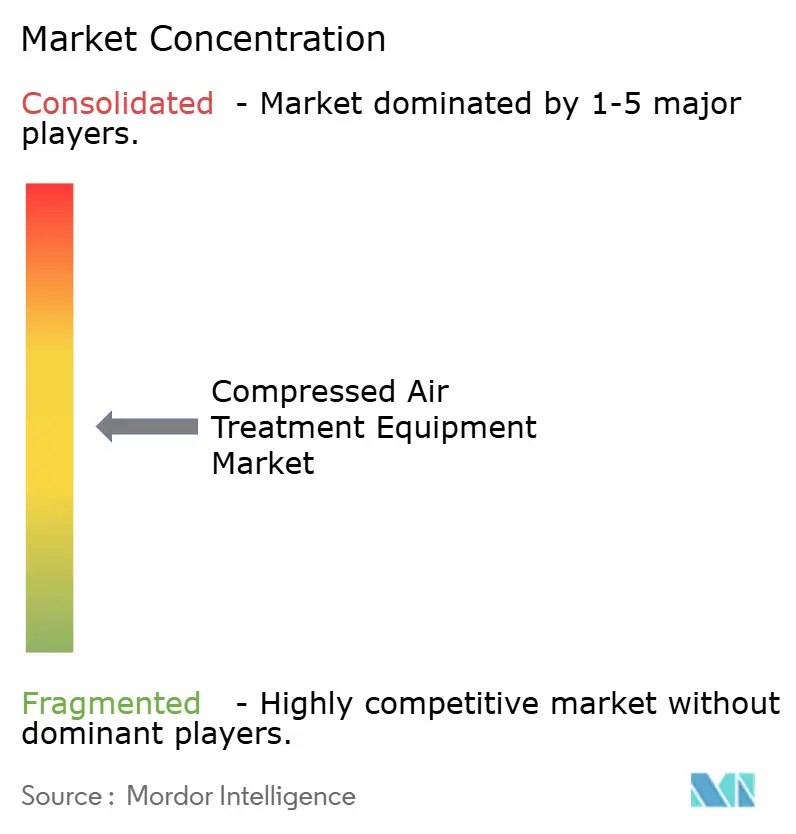
| Market Concentration | Medium |
Major Players *Disclaimer: Major Players sorted in no particular order Image © Mordor Intelligence. Reuse requires attribution under CC BY 4.0. | |
Compressed Air Treatment Equipment Market Analysis by Mordor Intelligence
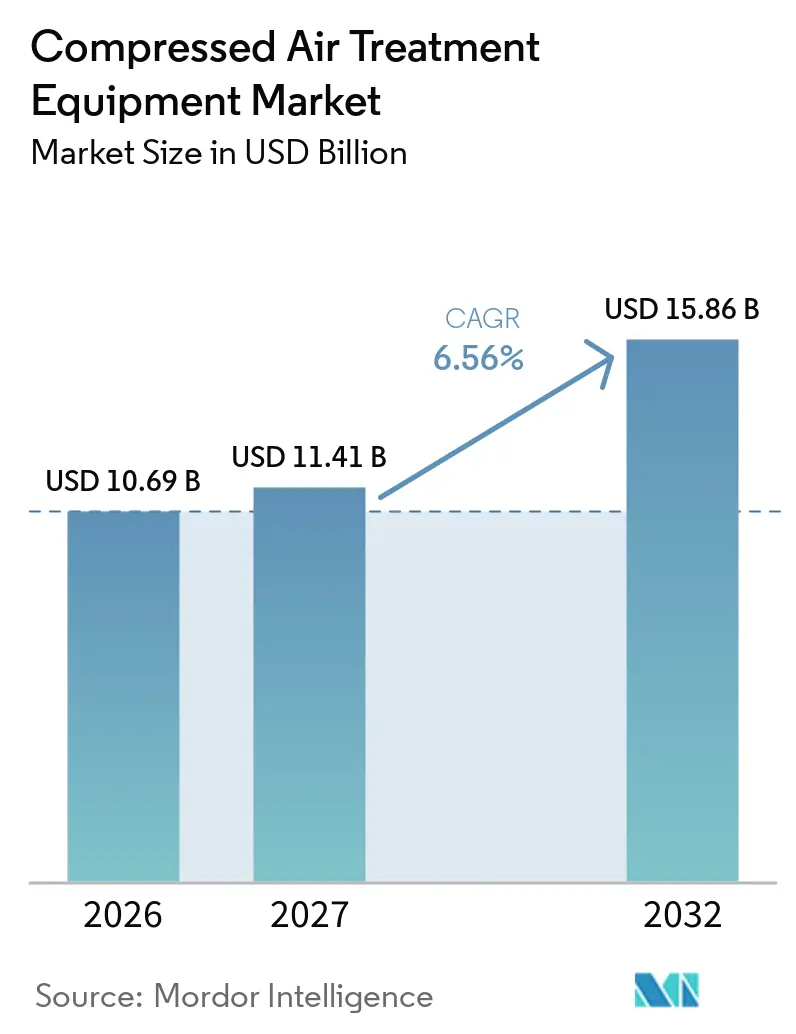
The Compressed Air Treatment Equipment Market size is projected to be USD 10.69 billion in 2026, USD 11.41 billion in 2027, and reach USD 15.86 billion by 2032, growing at a CAGR of 6.56% from 2027 to 2032. The compressed air treatment equipment market is supported by higher requirements for clean, dry, and documented compressed air in process manufacturing. ISO 8573-5:2025 updated the method for measuring oil vapor content, while ISO 8573-1:2010 entered revision status in December 2025, which places greater attention on air-purity specifications in regulated production.[1] This change may lead food, pharmaceutical, and semiconductor producers to review existing treatment systems and replace equipment that no longer meets their operating requirements. Suppliers are also competing through integrated systems that combine compressors, dryers, filters, drains, monitoring, and service support. Digital monitoring, including dew-point measurement and predictive drain replacement, is becoming more relevant as users seek stronger documentation and lower operating costs.
Key Report Takeaways
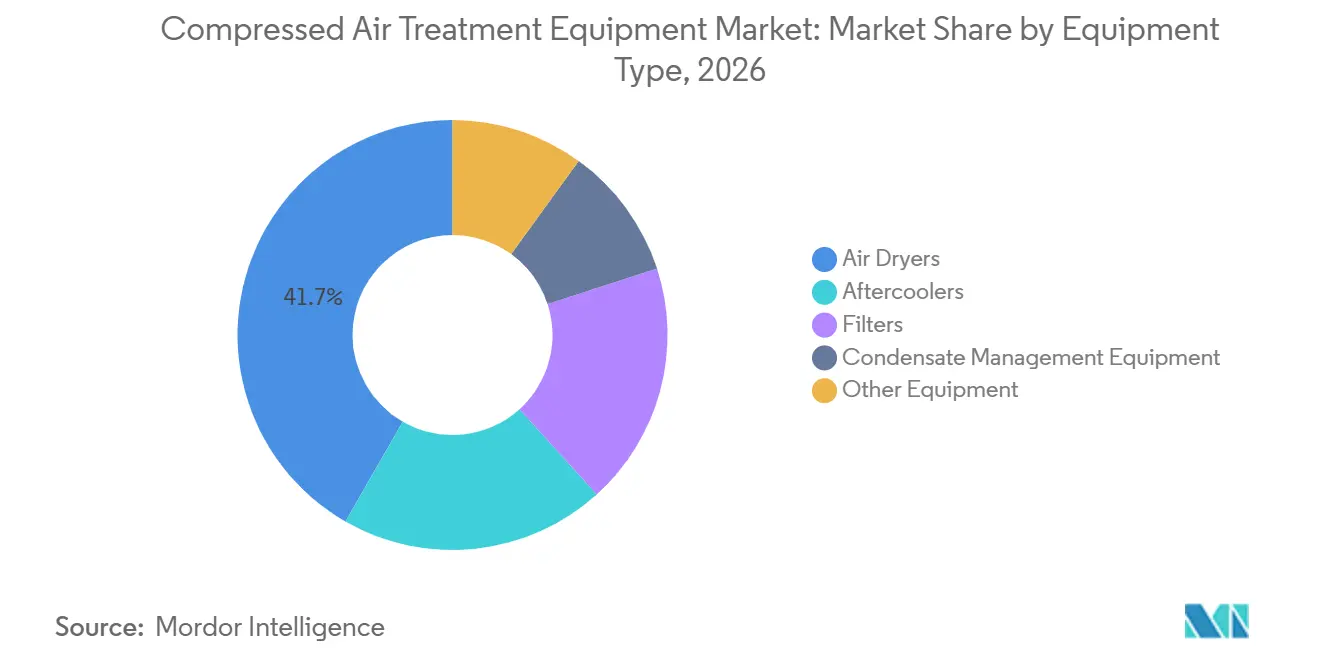
- By equipment type, air dryers held 41.7% of revenue in 2026, while condensate management equipment is forecast to grow at a 7.1% CAGR through 2032.
- By end-use industry, food and beverage held 22.1% of revenue in 2026, while pharmaceuticals and healthcare are forecast to grow at a 7.7% CAGR through 2032.
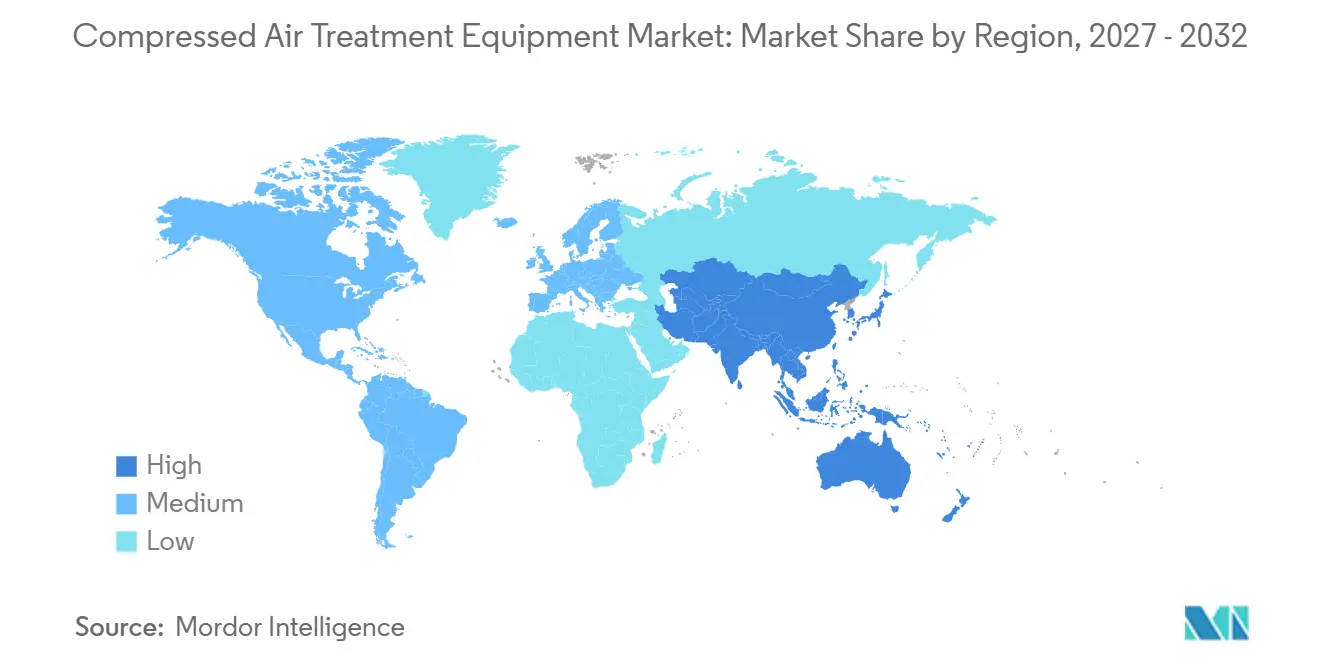
- By geography, Asia-Pacific held 35.6% of revenue in 2026 and is forecast to grow at a 6.7% CAGR through 2032.
Note: Market numbers in this report are based on Mordor Intelligence's proprietary estimation framework, which combines nine months of actuals with Q4 projections for base year 2026.
Market Trends and Insights
Drivers Impact Analysis of Compressed Air Treatment Equipment Market*
| Driver | (~) % Impact on CAGR Forecast | Geographic Relevance | Impact Timeline |
|---|---|---|---|
| Industrial Automation and Smart Manufacturing | +1.5% | Global, concentrated in China, Germany, South Korea, and the United States | Medium term (2-4 years) |
| Validated Air Quality Requirements in Regulated Production | +1.2% | Global, with highest intensity in North America and Europe | Short term (≤ 2 years) |
| Semiconductor Cleanroom and Ultra-Pure Air Expansion | +0.9% | Asia-Pacific core, with demand in the United States and Europe | Long term (≥ 4 years) |
| Energy-Efficiency Retrofits and Lifecycle Cost Reduction | +0.8% | Global, strongest in Europe and energy-sensitive Asia-Pacific markets | Medium term (2-4 years) |
| Digital Monitoring and Predictive Maintenance Adoption | +0.7% | North America and Europe lead adoption, while Asia-Pacific follows quickly | Medium term (2-4 years) |
| Replacement of Timer-Based Condensate Drains | +0.5% | Global, with the greatest effect in retrofit-heavy mature industrial markets | Short term (≤ 2 years) |
| Source: Mordor Intelligence | |||
Industrial Automation and Smart Manufacturing
Manufacturers are using more servo-pneumatic systems, collaborative robots, and high-cycle packaging equipment. These systems require cleaner and drier compressed air than older pneumatic equipment because particles, moisture, and oil can impair reliability. A valve that cycles 30 million times a year cannot tolerate the contamination levels accepted in a conventional press shop. This pushes users to upgrade filters and dryers before they replace larger production assets, which supports replacement demand in the compressed air treatment equipment market. Atlas Copco identified higher demand for optimized total cost of ownership in automation-focused sectors in its 2025 capital markets materials. SMC opened its Japan Technical Center in 2025 to support energy-saving compressed air solutions for next-generation manufacturing lines.[2]
Validated Air Quality Requirements in Regulated Production
Food and pharmaceutical operations use compressed air where product quality and patient safety can depend on dependable air treatment. The U.S. Food and Drug Administration published draft guidance on medical gas current good manufacturing practice in November 2025. The related requirements under 21 Code of Federal Regulations (CFR) Part 213 became effective on December 18, 2025, creating specific current good manufacturing practice requirements for medical gases.[3] This raises the importance of calibration certificates, dew-point records, and oil-content testing. The compressed air treatment equipment market therefore benefits from demand for monitoring instruments as well as filters, dryers, and separators. Regulatory compliance and quality assurance requirements favor suppliers that can support testing, recordkeeping, and validated maintenance activities throughout the compressed air treatment equipment market.
Semiconductor Cleanroom and Ultra-Pure Air Expansion
Semiconductor production needs tightly controlled, clean, dry air to protect sensitive manufacturing tools and processes. New fab and capacity additions need central treatment systems, point-of-use dryers, filters, and purification panels. The compressed air treatment equipment market gains from this demand because semiconductor applications require more equipment value per unit of compressed air than many general industrial applications. Standardized filter qualification practices also increase the importance of traceable testing and supplier documentation. Atlas Copco opened its Wuxi campus in May 2025 with USD 0.45 billion (CNY 3 billion) in investment, bringing production, research, and an Asia-Pacific logistics center together. The continued expansion of chip capacity in Asia-Pacific, the United States, and Europe supports a multiyear demand base for high-purity treatment equipment across the compressed air treatment equipment market.
Energy-Efficiency Retrofits and Lifecycle Cost Reduction
Compressed air can account for 10% to 30% of industrial electricity use, making system efficiency an important purchasing issue.[4] Filters and dryers can add pressure loss, so users increasingly assess treatment equipment as part of the full compressed air system. Federal energy conservation standards for air compressors became mandatory on January 10, 2025, increasing attention on equipment efficiency. KAESER reported that its CSD and CSDX series reduced refrigerant charge by 25% and delivered 14% more compressed air per kilowatt than earlier models. BOGE reported up to 8% lower energy use and 9% higher air delivery for its S-4 series compared with its predecessor. These product approaches reward suppliers that combine low-loss equipment, remote diagnostics, and measurable operating savings in the compressed air treatment equipment market.
Restraints Impact Analysis of Compressed Air Treatment Equipment Market*
| Restraint | (~) % Impact on CAGR Forecast | Geographic Relevance | Impact Timeline |
|---|---|---|---|
| Treatment Pressure Drop and Parasitic Energy Consumption | -0.5% | Global, with highest sensitivity in Europe and energy-intensive Asia-Pacific markets | Short term (≤ 2 years) |
| High Upfront and Lifecycle Cost for Advanced Systems | -0.8% | Emerging markets in South America, Middle East and Africa, and small and medium enterprises globally | Medium term (2-4 years) |
| Refrigerant Transition and Product Requalification Risk | -0.6% | Europe, with spillover to the United Kingdom and Asia-Pacific export markets | Medium term (2-4 years) |
| Air Quality Specification Complexity and Over-Treatment Risk | -0.3% | Global, with higher risk in markets with limited specification expertise | Long term (≥ 4 years) |
| Source: Mordor Intelligence | |||
Treatment Pressure Drop and Parasitic Energy Consumption
Each filtration stage and drying cycle can add pressure drop to a compressed air system. A coalescing filter operating at a 0.2 bar differential can consume the equivalent of 1% of upstream compressor rated power over time. This ongoing cost can encourage users in energy-intensive operations to choose fewer treatment stages. It can also lead buyers to select lower-specification alternatives even when more complete treatment would improve air quality. SMC launched its AMH Series micro mist separators in July 2025, reporting pressure-drop reductions of up to 50% compared with the earlier series. The compressed air treatment equipment market must address this cost concern with designs that quantify energy savings across the treatment train and show users the cost of each treatment stage.
High Upfront and Lifecycle Cost for Advanced Systems
Desiccant dryers that achieve pressure dew points below minus 40 degrees Celsius cost more than refrigerated dryers and require periodic desiccant replacement. This cost can limit adoption in smaller businesses and price-sensitive regions. Some users install refrigerated dryers in applications that need desiccant performance, which can create higher maintenance needs further down the production line. BEKO Technologies introduced the DRYPOINT ACC in October 2025 as a compact cold-regenerating desiccant dryer in 9 sizes for flows from 5 to 100 cubic meters per hour. The product is designed to lower the entry cost for advanced drying systems. Where payback periods exceed 36 months, financing limits and competing capital needs can still delay purchases in the compressed air treatment equipment market.
*Our forecasts treat driver/restraint impacts as directional, not additive. The impact forecasts reflect baseline growth, mix effects, and variable interactions.
Compressed Air Treatment Equipment Market Segment Analysis
By Equipment Type:
Air Dryers Lead Revenue While Condensate Management Gains PaceAir dryers commanded 41.7% of the compressed air treatment equipment market share in 2026, making them the largest equipment category. Their position reflects the need to control moisture across most compressed air applications, including manufacturing lines that cannot operate reliably in ambient dew-point conditions. Refrigerated dryers account for much of the installed base because they meet requirements in many general industrial settings and are familiar to maintenance teams. The European refrigerant transition is prompting refrigerated dryer manufacturers to consider low-global-warming-potential refrigerants and to reassess their product platforms. Commission Implementing Regulation (EU) 2026/1975 allows the use of specified fluorinated greenhouse gases in certain compressed air refrigerated dryers from January 2027 through December 2030. The transition period gives manufacturers time to complete reformulation, testing, certification, and customer qualification work. The equipment choice remains tied to the required dew point, pressure conditions, energy use, and the practical cost of maintaining the dryer. Higher-purity applications create a stronger role for desiccant systems, while general manufacturing continues to rely heavily on refrigerated drying within the compressed air treatment equipment market.
Desiccant dryers are important in pharmaceutical and semiconductor settings where refrigerated systems cannot deliver sufficiently low dew points. SMC launched its IDFB refrigerated dryer line for the Americas in June 2025 with low-global-warming-potential refrigerants and Underwriters Laboratories (UL) and CSA Group (CSA) certification. Condensate management equipment is forecast to expand at a 7.1% CAGR through 2032, the fastest rate among equipment types. Timer-based drains may waste compressed air because they open on a schedule regardless of actual condensate levels. Demand-actuated electronic drains and oil-water separators reduce air loss and lower the risk of condensate backup, which supports their use in retrofit projects. These systems can also make drain performance easier to document where users need stronger operating records. Filters benefit from tighter measurement practices and replacement demand, while aftercoolers retain a stable role in oil and gas and power-generation installations. Together, these equipment categories allow suppliers to offer treatment trains that address moisture, oil, particle control, and condensate handling at different purity levels across the compressed air treatment equipment market.

By End-Use Industry:
Regulated Production Strengthens Demand for Higher-Value TreatmentFood and beverage represented 22.1% of revenue in 2026, making it the largest end-use sector. Production lines need dependable treatment because compressed air can contact products, packaging, and processing equipment. Food producers also need records that show filtration performance, moisture control, and drain operation. These needs support demand for oil-free generation and complete treatment systems that provide a traceable air-quality approach. The breadth of food processing activity also creates a large installed base for replacement filters, dryer servicing, condensate management, and monitoring. Chemical and petrochemical, automotive and transportation, and oil and gas operations provide substantial secondary demand for aftercoolers and high-flow filtration. Pulp and paper, metal and general manufacturing, and construction remain volume-driven areas where buyers are more sensitive to equipment prices. In these applications, suppliers in the compressed air treatment equipment market must balance the required purity class against pressure loss, operating cost, and maintenance needs.
Pharmaceuticals and healthcare are forecast to grow at a 7.7% CAGR through 2032, the fastest rate among end-use industries. The FDA medical-gas framework is raising expectations for documentation and validated compressed-air systems. This requirement raises the value of equipment that can support records for calibration, dew point, oil content, and routine maintenance. Electronics and semiconductors also require high-purity air and can generate high equipment value per unit of air consumed. Aerospace and defense need certification-grade breathing and instrument air systems, while textile plants use moisture control to help reduce fabric defects. The compressed air treatment equipment industry serves these applications through treatment configurations that match purity, reliability, and documentation requirements. Suppliers with broad technical support can benefit because the purchasing decision often depends on application design rather than hardware alone. This mix of requirements makes regulated and high-precision production a key source of demand for advanced systems in the compressed air treatment equipment market.
Geography Analysis
Asia-Pacific held 35.6% of the compressed air treatment equipment market share in 2026 and is forecast to grow at a 6.7% CAGR through 2032. China, Japan, South Korea, and India lead regional demand through electronics, semiconductor, pharmaceutical, and food-processing investment. Export production also brings greater scrutiny of quality standards and compressed-air specifications. Atlas Copco’s Wuxi campus adds regional production, training, logistics, and research capacity for air and gas treatment products. BEKO Technologies acquired a majority interest in Wuxi Gas Purification Solutions in 2025, extending its dryer range and China presence. India has a visible opportunity through pharmaceutical investment and a need for suppliers that combine local service with credible quality support.
North America is supported by semiconductor construction, pharmaceutical compliance, and food-safety modernization. Energy standards also encourage users to examine system pressure loss and the condition of existing treatment equipment. Europe has a mature aftermarket for filter elements and desiccant media, but its equipment suppliers face the cost of adjusting refrigerated dryer designs to the F-gas transition. The compressed air treatment equipment market in Europe benefits from this replacement need, even as the transition requires new product qualification. Germany, France, and Italy remain major demand centers because of their automotive and chemical installed bases.
South America, the Middle East, and Africa account for a smaller combined revenue base, but they carry growth potential where industrial investment expands. Brazil is supported by food processing and oil and gas activity. Saudi Arabia and the United Arab Emirates are expanding downstream petrochemical and pharmaceutical capacity. Indonesia, Malaysia, Thailand, and Vietnam are growing from lower installed bases, with export-oriented buyers often specifying higher-quality equipment. These conditions create opportunities for the compressed air treatment equipment market where industrial investment, technical expertise, and local service capability develop together.
Competitive Landscape
The compressed air treatment equipment market is moderately consolidated. Atlas Copco, Ingersoll Rand, and Parker-Hannifin have broad product portfolios and distribution networks. Their compressor-to-treatment offerings can reduce selling costs when customers buy complete systems, and they support service contracts that cover equipment, replacement elements, drains, and maintenance. Atlas Copco completed 22 acquisitions in 2025 and introduced the CDR and CDR+ portable dryer line for remote industrial work. These integrated portfolios give large suppliers an advantage where users want system responsibility and a single point of service.
Specialists including BEKO Technologies, Mikropor, and Omega Air compete through treatment depth, product design, and ownership cost. They have opportunities in digital monitoring, demand-based condensate management, and high-purity systems for semiconductor and medical-gas applications. Parker Hannifin supports gas filtration and generation through its Parker Airtek, Parker Finite, Parker Balston, and Parker domnick hunter brands. Compliance documentation under ISO 8573 can favor suppliers with proven testing capabilities in regulated applications. MANN+HUMMEL reported high single-digit growth in its Original Equipment (OE) Industrial revenue in 2025 and continued investment in U.S. air-oil separator capacity.
Mikropor worked with Danfoss on AXV Series expansion and hot gas bypass valves for refrigerated dryers in December 2025. BEKO Technologies also expanded its portfolio with the DRYPOINT ACC and digital flow-sensing products during 2025. Aftermarket sales are important because filter elements, desiccant, drain actuators, and service contracts generate recurring revenue. Product performance, local service, compliance records, and energy savings are likely to remain key competitive factors in the compressed air treatment equipment market.
Compressed Air Treatment Equipment Industry Leaders
-
Atlas Copco AB
-
Parker Hannifin Corporation
-
Ingersoll Rand Inc.
-
BEKO TECHNOLOGIES GmbH
-
Donaldson Company, Inc.
- *Disclaimer: Major Players sorted in no particular order
Compressed Air Treatment Equipment Market Companies Covered in this Report
- Airfilter Engineering
- Airtek
- ANEST IWATA Corporation
- Atlas Copco AB
- BEKO TECHNOLOGIES GmbH
- BOGE KOMPRESSOREN Otto Boge GmbH & Co. KG
- Chicago Pneumatic
- Donaldson Company, Inc.
- Ingersoll Rand Inc.
- KAESER KOMPRESSOREN SE
- MANN+HUMMEL
- Mikropor
- Omega Air d.o.o.
- Parker-Hannifin Corporation
- Pentair plc
- Pneumatech
- SMC Corporation
- SPX FLOW, Inc.
- Van Air Systems, Inc.
- ZEKS Compressed Air Solutions
Recent Industry Developments in Compressed Air Treatment Equipment Market
- September 2026: Commission Implementing Regulation (EU) 2026/1975 was published, authorizing the use of fluorinated greenhouse gases in compressed air refrigerated dryers with rated capacity up to 50 kW from January 2027 to December 2030. The derogation gives European manufacturers a defined reformulation window while continuity of industrial operations is maintained.
- December 2025: Mikropor and Danfoss completed development of the AXV Series automatic expansion and hot gas bypass valves, optimized for integration in Mikropor’s refrigerated compressed air dryers. The collaboration introduces near-zero hysteresis dew-point control and higher energy efficiency, positioning Mikropor in the premium tier of refrigerated dryer performance.
- October 2025: BEKO Technologies launched the DRYPOINT ACC, a compact cold-regenerating desiccant dryer series available in 9 sizes for flow rates from 5 to 100 cubic meters per hour. The product targets industrial applications requiring technically oil-free, low-dew-point air and is designed to lower the cost threshold for desiccant technology adoption.
- July 2025: ISO 8573-5:2025 was officially published, replacing the 2001 edition and establishing an updated, gas-chromatography-based method for measuring oil vapor content in compressed air. The new standard strengthens the measurement foundation for purity compliance under ISO 8573-1, particularly relevant for food, pharmaceutical, and semiconductor applications.
Global Compressed Air Treatment Equipment Market Report Scope
Compressed air treatment equipment refers to pneumatic devices and systems used to clean, cool, and dehumidify compressed air by removing water, oil, dirt, and other contaminants before it reaches tools or processes.
The compressed air treatment equipment market is segmented into equipment type, end-use industry, and geography. By equipment type, the market is segmented into filters, air dryers, aftercoolers, condensate management equipment, and other equipment. By end-use industry, the market is divided into food and beverage, pharmaceuticals and healthcare, chemical and petrochemical, automotive and transportation, electronics and semiconductors, oil and gas, power generation, pulp and paper, metal and general manufacturing, construction, aerospace and defense, textiles, and other industries. The report also covers the market size and forecasts for the global compressed air treatment equipment market across 28 countries in key regions. For each segment, the market sizing and forecasts have been provided on the basis of value (USD).
Segmentation Overview
| Filters |
| Air Dryers |
| Aftercoolers |
| Condensate Management Equipment |
| Other Equipment |
| Food and Beverage |
| Pharmaceuticals and Healthcare |
| Chemical and Petrochemical |
| Automotive and Transportation |
| Electronics and Semiconductors |
| Oil and Gas |
| Power Generation |
| Pulp and Paper |
| Metal and General Manufacturing |
| Construction |
| Aerospace and Defense |
| Textiles |
| Other Industries |
| North America | United States |
| Canada | |
| Mexico | |
| Europe | Germany |
| France | |
| Italy | |
| Spain | |
| United Kingdom | |
| Poland | |
| Netherlands | |
| Russia | |
| Rest of Europe | |
| Asia-Pacific | China |
| India | |
| Japan | |
| South Korea | |
| Australia | |
| Indonesia | |
| Malaysia | |
| Thailand | |
| Philippines | |
| Rest of Asia-Pacific | |
| South America | Brazil |
| Argentina | |
| Colombia | |
| Rest of South America | |
| Middle East and Africa | Saudi Arabia |
| United Arab Emirates | |
| South Africa | |
| Egypt | |
| Nigeria | |
| Rest of Middle East and Africa |
| By Equipment Type | Filters | |
| Air Dryers | ||
| Aftercoolers | ||
| Condensate Management Equipment | ||
| Other Equipment | ||
| By End-Use Industry | Food and Beverage | |
| Pharmaceuticals and Healthcare | ||
| Chemical and Petrochemical | ||
| Automotive and Transportation | ||
| Electronics and Semiconductors | ||
| Oil and Gas | ||
| Power Generation | ||
| Pulp and Paper | ||
| Metal and General Manufacturing | ||
| Construction | ||
| Aerospace and Defense | ||
| Textiles | ||
| Other Industries | ||
| By Geography | North America | United States |
| Canada | ||
| Mexico | ||
| Europe | Germany | |
| France | ||
| Italy | ||
| Spain | ||
| United Kingdom | ||
| Poland | ||
| Netherlands | ||
| Russia | ||
| Rest of Europe | ||
| Asia-Pacific | China | |
| India | ||
| Japan | ||
| South Korea | ||
| Australia | ||
| Indonesia | ||
| Malaysia | ||
| Thailand | ||
| Philippines | ||
| Rest of Asia-Pacific | ||
| South America | Brazil | |
| Argentina | ||
| Colombia | ||
| Rest of South America | ||
| Middle East and Africa | Saudi Arabia | |
| United Arab Emirates | ||
| South Africa | ||
| Egypt | ||
| Nigeria | ||
| Rest of Middle East and Africa | ||
Key Questions Answered in the Report
What is driving the compressed air treatment equipment market?
The compressed air treatment equipment market is supported by automation, stricter air-quality controls, semiconductor investment, food production, and pharmaceutical compliance needs. These applications require dependable moisture, particle, oil, and condensate control, while users also seek records that demonstrate system performance.
What is the projected growth rate through 2032?
The compressed air treatment equipment market is projected to grow at a 6.56% CAGR from 2027 to 2032 and reach USD 15.86 billion by 2032. The forecast reflects rising investment in air purity infrastructure and replacement demand for equipment that can meet more demanding operating and documentation requirements.
Which equipment category has the largest revenue share?
Air dryers lead equipment categories with a 41.7% share in 2026 because moisture control is needed across most compressed-air applications. Within the compressed air treatment equipment market, their installed base remains broad because refrigerated dryers serve many general industrial requirements.
Which end-use segment is growing fastest?
Pharmaceuticals and healthcare is forecast to expand at a 7.7% CAGR through 2032. The segment benefits from validated system requirements and stronger needs for calibration, dew-point, oil-content, and maintenance records in the compressed air treatment equipment market.
Which region leads global demand?
Asia-Pacific leads with a 35.6% share in 2026 and is also forecast to record the fastest regional growth at a 6.7% CAGR through 2032. Electronics, semiconductors, pharmaceuticals, food processing, and export manufacturing support demand for the compressed air treatment equipment market in the region.
Why do pressure losses matter when selecting treatment equipment?
Pressure losses increase compressor power use, so buyers increasingly favor filters and dryers that deliver the required purity with lower energy consumption. This balance between air quality and running cost is important when equipment is selected for the compressed air treatment equipment market.