
Collaborative Robot Vision Systems Market Size and Share
Market Overview
| Study Period | 2020 - 2031 |
|---|---|
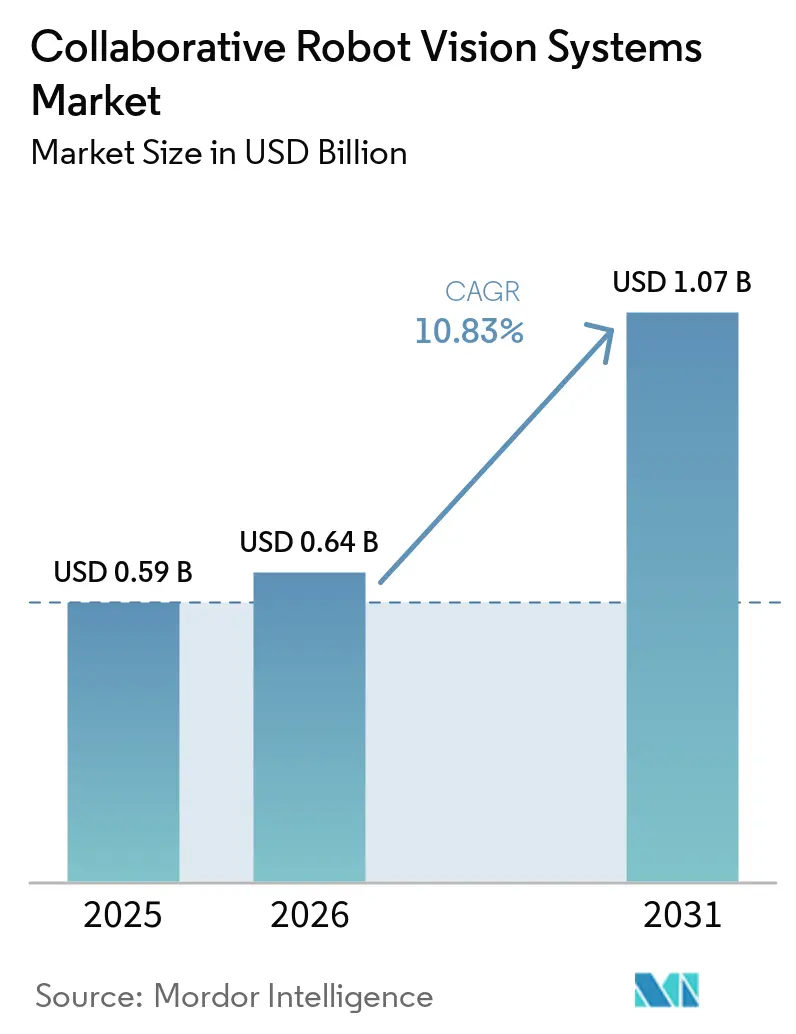
| Market Size (2026) | USD 0.64 Billion |
| Market Size (2031) | USD 1.07 Billion |
| Growth Rate (2026 - 2031) | 10.83 % |
| Fastest Growing Market | Middle East and Africa |
| Largest Market | Asia-Pacific |
| Market Concentration | Medium |
Major Players *Disclaimer: Major Players sorted in no particular order Image © Mordor Intelligence. Reuse requires attribution under CC BY 4.0. | |
Collaborative Robot Vision Systems Market Analysis by Mordor Intelligence
The collaborative robot vision systems market size is projected to be USD 0.59 billion in 2025, USD 0.64 billion in 2026, and reach USD 1.07 billion by 2031, growing at a CAGR of 10.83% from 2026 to 2031. Demand is supported by persistent manufacturing labor gaps, lower edge-AI computing costs, and clearer requirements for safe human-robot collaboration. These conditions make vision-equipped cobots more practical for inspection, handling, and adaptable production tasks. Suppliers are responding by combining cameras, AI software, and robot controls into more integrated offerings. The collaborative robot vision systems market also benefits when manufacturers can deploy systems across mixed product lines without extensive reprogramming.
Key Report Takeaways
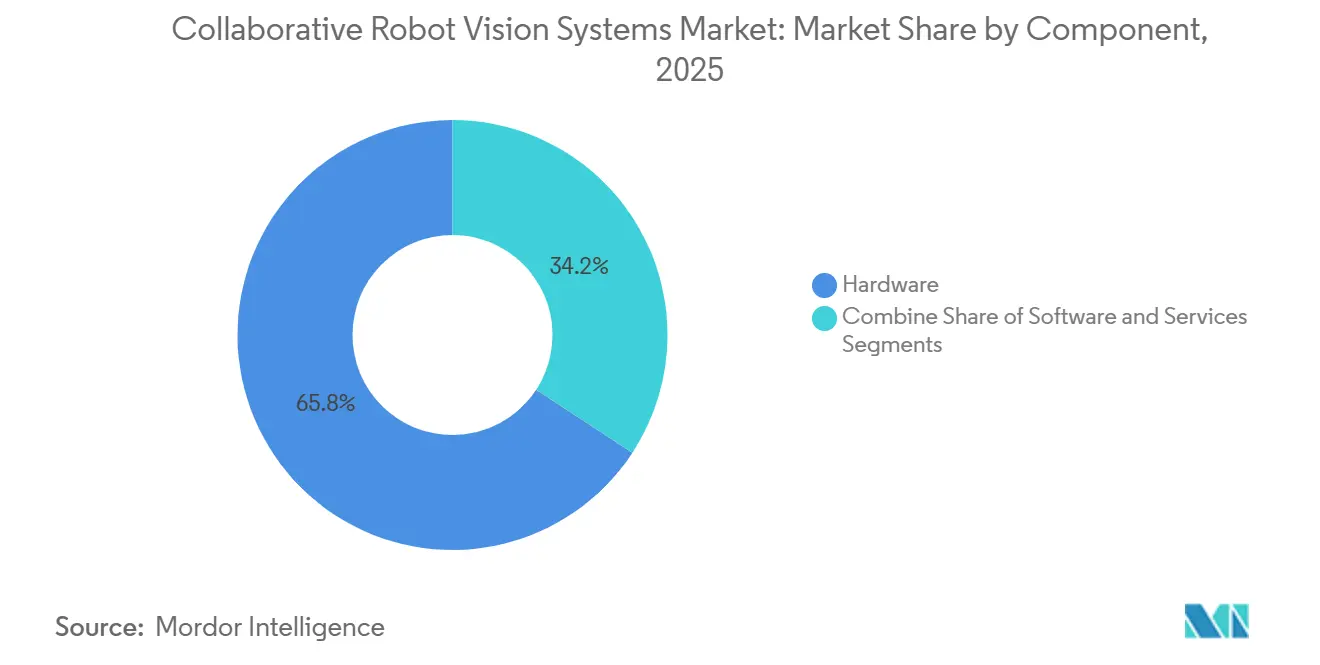
- By component, hardware held 65.78% of collaborative robot vision systems market revenue in 2025, while software is projected to expand at a 11.41% CAGR through 2031.
- By vision technology, 2D vision systems held 48.76% of revenue in 2025, while AI-powered vision is projected to expand at a 11.67% CAGR through 2031.
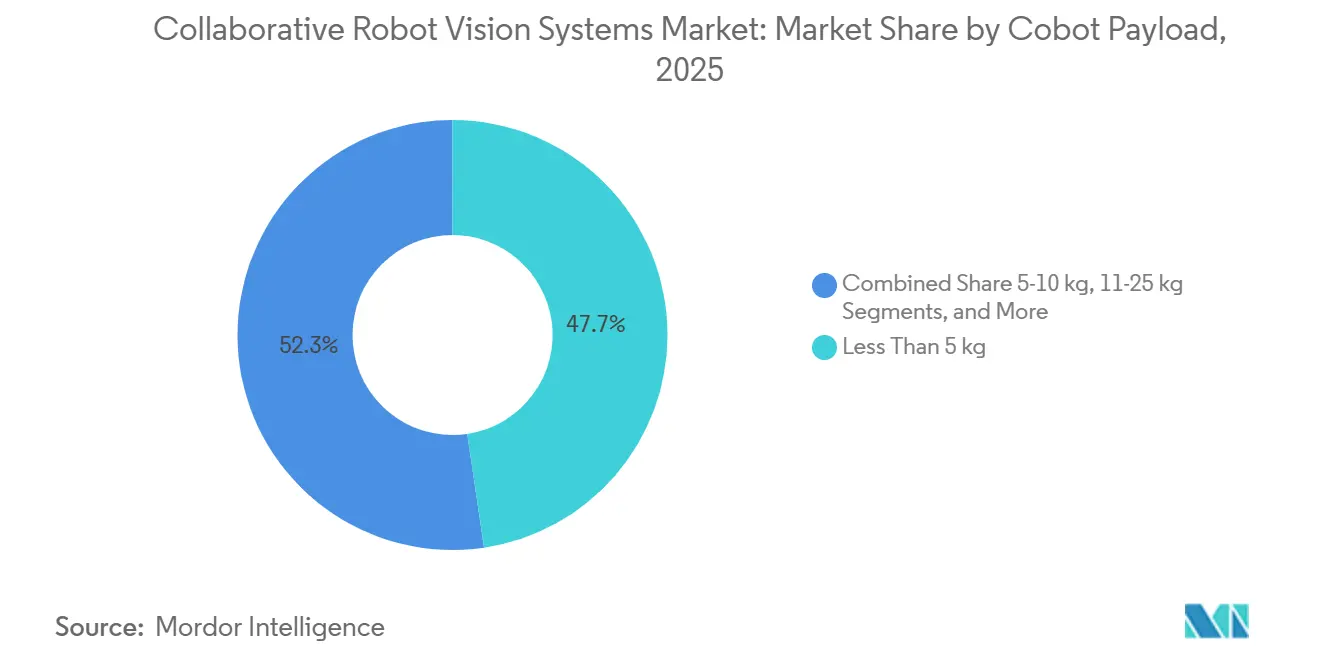
- By cobot payload, the less-than-5-kg category held 47.66% of revenue in 2025, while the more-than-25-kg category is projected to expand at a 11.59% CAGR through 2031 in the collaborative robot vision systems market.
- By application, inspection and quality assurance held 23.45% of revenue in 2025, while guidance and navigation is projected to expand at a 11.21% CAGR through 2031.
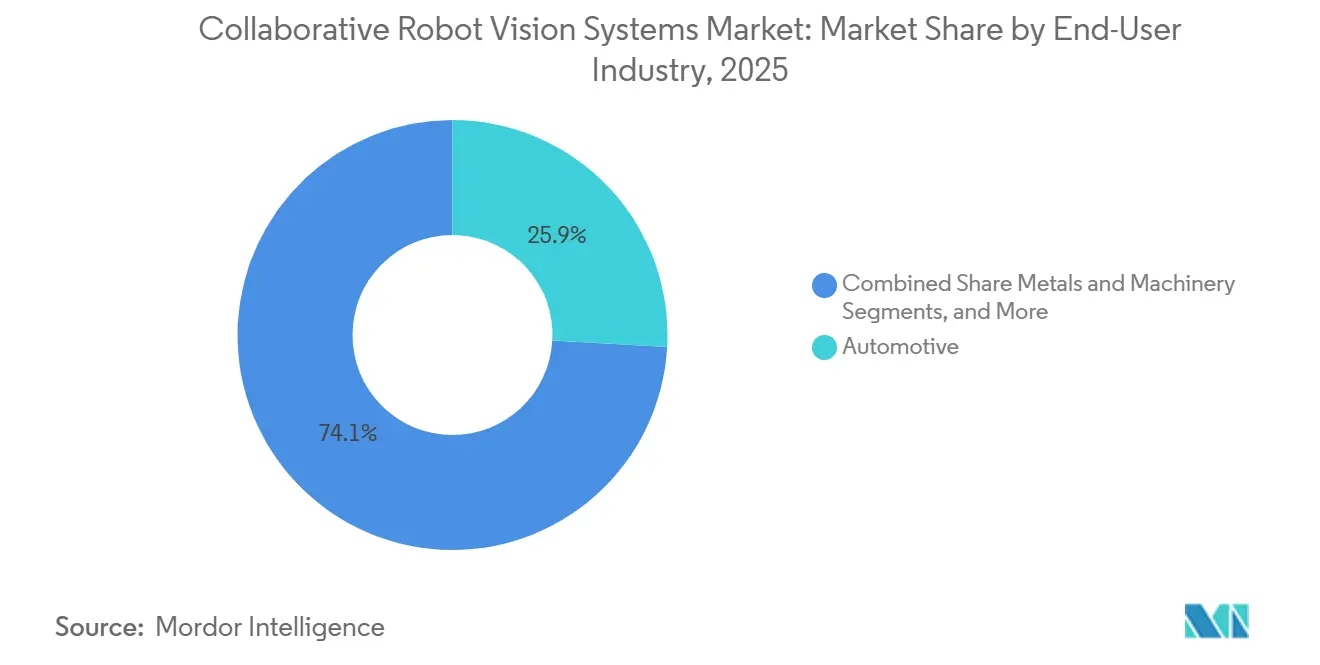
- By end-user industry, automotive held 25.89% of revenue in 2025, while logistics and warehousing is projected to expand at a 11.45% CAGR through 2031 in the collaborative robot vision systems market.
- By geography, Asia-Pacific held 38.76% of collaborative robot vision systems market revenue in 2025, while the Middle East and Africa is projected to expand at a 11.21% CAGR through 2031.
Note: Market size and forecast figures in this report are generated using Mordor Intelligence’s proprietary estimation framework, updated with the latest available data and insights as of January 2026.
Global Collaborative Robot Vision Systems Market Trends and Insights
Drivers Impact Analysis*
| Driver | (~) % Impact on CAGR Forecast | Geographic Relevance | Impact Timeline |
|---|---|---|---|
| Manufacturing Labor Scarcity and Wage Inflation | +3.2% | Global, most concentrated in North America, Northern Europe, and East Asia | Short term (≤ 2 years) |
| Flexible Automation for High-Mix, Low-Volume Production | +2.1% | Global, with concentrated adoption in Asia-Pacific electronics and European automotive supply chains | Medium term (2-4 years) |
| AI-Enabled 3D Perception for Unstructured Tasks | +1.8% | Global, led by North America and Asia-Pacific, with spillover to Europe and the Middle East and Africa | Medium term (2-4 years) |
| Expansion of Vision-Guided Fulfillment and Bin Picking | +1.4% | North America and Europe, with early gains in Asia-Pacific logistics hubs | Medium term (2-4 years) |
| Falling Edge-AI Compute Cost and Latency | +1.1% | Global | Short term (≤ 2 years) |
| Built-In Vision Reducing Integration Steps for Tier-2 Manufacturers | +0.8% | Global, with early gains in European and North American small and midsize manufacturing clusters | Long term (≥ 4 years) |
| Source: Mordor Intelligence | |||
Manufacturing Labor Scarcity and Wage Inflation
Manufacturing labor scarcity is encouraging producers to consider vision-equipped cobots for recurring inspection and handling work. NYU Stern found that a 10% increase in minimum wages increased the probability of robot adoption by 8% among manufacturing plants.[1]NYU Stern School of Business, “Minimum Wage Hikes Accelerate the Robot Revolution,” NYU Stern School of Business, stern.nyu.edu. The relationship matters because higher labor costs can shorten the investment case for systems that perform repeatable work. The collaborative robot vision systems market is therefore relevant to plants that need automation without removing human operators from the workcell. Collaborative operation can preserve staffing flexibility because workers can continue to manage tasks that require judgment or manual intervention. This approach is particularly useful where workforce attrition has reduced available capacity rather than eliminated the need for human oversight.
Flexible Automation for High-Mix, Low-Volume Production
High-mix, low-volume facilities often face frequent changeovers, short production runs, and mixed-SKU handling. Fixed systems can be difficult to justify in these settings because they depend on stable workflows and dedicated programming. Vision-guided cobots can adapt to new part geometries through few-shot learning and can support mixed robot fleets through robot-agnostic software. Festo introduced GripperAI in 2025 to let fulfillment robots pick varied items without programming or template loading for each SKU.[2]Festo, “Festo Introduces GripperAI, an AI-Based Software for Mixed-Product Robotic Picking,” Robotics 24/7, robotics247.com. KUKA's iiQKA.AI Vision combines image processing, AI algorithms, and robot control in one configurable platform. These capabilities support the collaborative robot vision systems market where battery cells, modules, and other parts vary across production runs.
AI-Enabled 3D Perception for Unstructured Tasks
AI-enabled computer vision is extending cobot use beyond fixed and rule-based tasks. A 2025 review of 138 studies found that combining computer vision with AI supported more adaptive collaboration across manufacturing, healthcare, and logistics.[3]Yuval Cohen, Amir Biton, and Shraga Shoval, “Fusion of Computer Vision and AI in Collaborative Robotics,” Applied Sciences, mdpi.com. Doosan Robotics' Scan and Go 2.0 uses Physics-Informed AI and laser-based 3D vision to create tool paths from point-cloud data. Photoneo released Bin Picking Studio 1.12 in July 2026 with AI-based object classification and 3D model creation from sensor scans. These tools can reduce the need for CAD models, manual code, and extensive labeling when new parts enter a workflow. The collaborative robot vision systems market can consequently reach smaller manufacturers that previously found integration requirements too demanding.
Expansion of Vision-Guided Fulfillment and Bin Picking
Mixed-SKU bins and randomly oriented items require vision systems that can identify objects and plan reliable grasps. Structured-light cameras, stereo vision, and AI grasp planning are expanding the range of tasks that cobots can perform in fulfillment settings. Vention introduced Rapid Operator AI for deep bin picking in March 2026, including handling of transparent and translucent materials in containers up to 60.9 centimeters deep. The system is designed for autonomous multishift operation in factory environments. E-commerce, grocery, and third-party logistics operations face continuing SKU variation and mixed case dimensions. The collaborative robot vision systems market benefits when suppliers embed bin-picking software into their platforms because recurring software relationships can continue after the hardware sale.
Restraints Impact Analysis*
| Restraint | (~) % Impact on CAGR Forecast | Geographic Relevance | Impact Timeline |
|---|---|---|---|
| Brownfield Integration and Calibration Costs | -2.1% | Global, most acute in North America and Europe where legacy plant infrastructure is extensive | Short term (≤ 2 years) |
| Limited Vision-Integration and Robot-Programming Talent | -1.6% | Global, most severe in North America and Europe, partly mitigated in Asia-Pacific by greater availability of lower-cost technical talent | Medium term (2-4 years) |
| Liability and Insurance Ambiguity for Adaptive Human-Robot Workcells | -1.0% | North America and Europe, with early regulatory influence from the EU AI Act and ANSI/RIA standards revision | Medium term (2-4 years) |
| Dataset Drift Across Lighting, Materials, and Product Variants | -0.7% | Global | Long term (≥ 4 years) |
| Source: Mordor Intelligence | |||
Brownfield Integration and Calibration Costs
Retrofitting cobots into established facilities can require more work than an initial project plan suggests. Older layouts may need new lighting fixtures, communication gateways, safety documentation, and infrastructure changes. Vision systems also depend on repeatable lighting and calibration, which can be difficult to maintain through product changes and shift patterns. ISO 10218-2:2025 sets safety requirements for industrial robot applications and robot cells. Siemens has described virtual commissioning as a way to test automation integration before physical trials begin. The collaborative robot vision systems market faces slower adoption when smaller manufacturers cannot absorb the engineering and licensing expense of these steps.
Limited Vision-Integration and Robot-Programming Talent
Deployments require people who understand vision configuration, hand-eye calibration, and collaborative robot safety validation. Simplified interfaces can help with routine jobs, but complex multi-camera systems still need specialist skills. KUKA and Universal Robots have introduced AI-assisted and simplified programming tools to reduce the learning burden for users. A shortage of experienced integration staff can delay deployments across multisite manufacturing networks. Early configuration problems can also make plant managers postpone further phases even when the underlying use case remains sound. These constraints can limit the realized conversion of demand in the collaborative robot vision systems market.
*Our forecasts treat driver/restraint impacts as directional, not additive. The impact forecasts reflect baseline growth, mix effects, and variable interactions.
Segment Analysis
By Component: Software Value Accrues Faster Than the Hardware Baseline
Hardware held 65.78% of collaborative robot vision systems market share in 2025, reflecting the physical requirements of cameras, compute boards, and depth sensors in every new cell. The installed base needs sensing equipment before a vision application can operate. This supports hardware revenue during the early stages of deployment. Lower-priced camera modules from Chinese suppliers are creating pressure on hardware selling prices. The effect is likely to shift more attention toward software and service value over the life of a system.
Software is projected to expand at a 11.41% CAGR through 2031, the highest rate within the component split. Cognex launched the In-Sight 3900 in May 2026 with centralized model training and distributed edge execution through its OneVision ecosystem. This model allows software revenue to extend across devices and sites after the initial installation. Services can also expand through calibration, remote monitoring, and model-drift correction. The collaborative robot vision systems industry is therefore placing more importance on recurring software and service offerings as hardware becomes more standardized.



By Vision Technology: AI Perception Increasingly Challenges the 2D Installed Base
2D vision systems held 48.76% of collaborative robot vision systems market revenue in 2025, supported by barcode reading, optical character recognition, and planar inspection. These applications do not always need depth information. Their lower cost helps maintain adoption among manufacturers with straightforward pick-and-place requirements. The large installed base also gives suppliers a familiar starting point for upgrades. This position remains important even as more advanced systems enter the field.
AI-powered vision is projected to expand at a 11.67% CAGR through 2031, making it the fastest-growing vision technology. It supports tasks where parts are varied, unstructured, or difficult to program with rules alone. LMI Technologies integrates its Gocator 3D line profilers with Universal Robots cobots through URCap plugins for production-speed measurement. Hybrid systems can combine color and depth data in a single pass for automotive inspection. Multispectral and infrared vision remain more focused on pharmaceutical blister packs and food-processing foreign-body detection.
By Cobot Payload: Light-Payload Segments Lead, Heavy Lifters Gain Strategic Momentum
The less-than-5-kg category held 47.66% of revenue in 2025. It is used in consumer electronics assembly, PCB inspection, and laboratory automation where space is limited and cycle rates are high. FANUC America introduced the CRX-3iA in April 2026 with an 11-kilogram arm weight for redeployment across welding, inspection, screwdriving, and small assembly. Portable systems fit the needs of temporary and high-mix workspaces. This keeps the light-payload category central to the collaborative robot vision systems market.
The more-than-25-kg category is projected to expand at a 11.59% CAGR through 2031. Automotive battery packs, heavy castings, and palletizing jobs give this category a distinct operating role. Vision-guided positioning can improve the handling of heavy and variable components. The 5-10 kg range serves electronics testing and light manufacturing. The 11-25 kg range is used in food-and-beverage machine tending, metalworking, screwdriving, and dispensing. ABB's PoWa family illustrates the move toward dedicated cobot products for heavier, faster-cycle applications.
By Application: Inspection Anchors the Market, Navigation Defines the Next Frontier
Inspection and quality assurance held 23.45% of collaborative robot vision systems market revenue in 2025. Automotive and electronics producers use these systems for in-line defect detection and repeatable checks. A 2025 review of more than 50 studies reported defect detection accuracy above 95% for machine-learning-powered robotic inspection. Controlled systems in the review reached 98-100% accuracy. The same review noted that 77% of implementations remained at the pilot stage, which indicates a meaningful gap between validation and full-scale operation.
Guidance and navigation is projected to expand at a 11.21% CAGR through 2031. Autonomous mobile cobots use these functions to operate in fulfillment sites that need flexible routing rather than fixed conveyors. Pick-and-place, bin picking, packaging, palletizing, and machine tending remain important application areas. AI-guided welding, soldering, and dispensing can also support smaller production batches. Assembly and disassembly can use adaptive vision for fastening and EV battery remanufacturing. These use cases broaden the collaborative robot vision systems market beyond conventional inspection.
By End-User Industry: Automotive Commands Revenue While Logistics Commands Growth
Automotive held 25.89% of collaborative robot vision systems market revenue in 2025. EV battery inspection, electronic control unit assembly, and structural component checks require speed, accuracy, and traceability. Techman Robot deployed an AI cobot at Quanta Computer's German automotive facility for 360-degree inspection of automotive-grade circuit boards for EV and ADAS applications. These requirements support the sector's leading revenue position. Automotive production also gives suppliers opportunities to standardize systems across related tasks.
Logistics and warehousing is projected to expand at a 11.45% CAGR through 2031. Fulfillment operations face rising SKU counts and persistent demand for reliable material movement. Electronics and semiconductor manufacturing also needs vision accuracy for sub-millimeter assembly work, while pharmaceutical and healthcare sites use systems for serialization, blister-pack inspection, and precision dispensing. Pharmaceutical and healthcare users apply these systems to serialization, blister-pack inspection, and precision dispensing. Food and beverage, metals, plastics, and aerospace are adopting systems as ownership costs decline and integration becomes more standardized. This range of use cases gives the collaborative robot vision systems industry a broad end-user base.
Geography Analysis
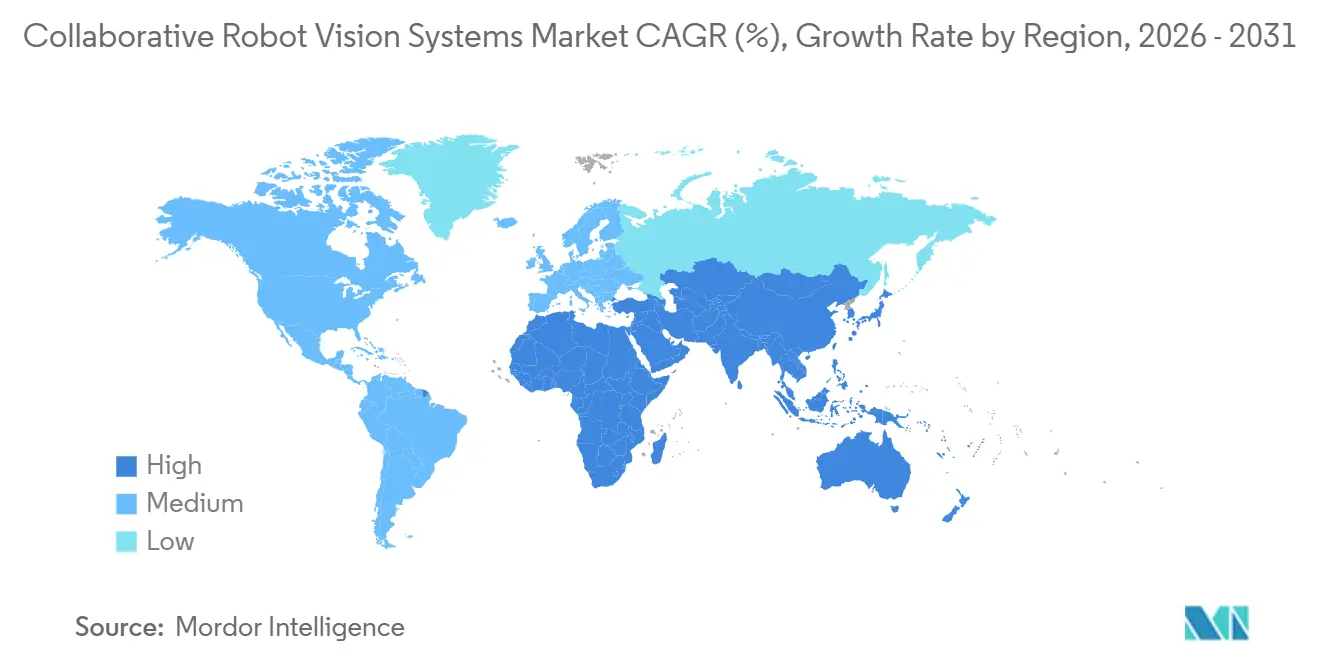
Asia-Pacific held 38.76% of global revenue in 2025 and is expected to retain a leading position through 2031. China accounted for more than half of global industrial robot installations by 2025. National policy, domestic supplier pricing, and large electronics and automotive production bases support regional demand. South Korea requires cleanroom-compatible systems for semiconductor and display production. Japan applies vision-equipped cobots to quality-critical work that needs repeatable processes and human dexterity.
North America remains a significant revenue contributor because manufacturers are addressing labor constraints and reshoring activity. Europe is anchored by German automotive and precision machinery production. KUKA launched the LBR iisy on iiQKA.OS2 in July 2026 for scalable integration across collaborative and industrial settings. The United Kingdom, France, and Italy also support demand through food and beverage, pharmaceutical, and automotive supplier activity.
The Middle East and Africa is projected to expand at a 11.21% CAGR through 2031, the fastest regional rate in the collaborative robot vision systems market. Saudi Arabia's Vision 2030 and the UAE's Operation 300bn are supporting industrial diversification and greenfield factory development. This environment can make it easier to deploy modern automation without the constraints of older plant systems. South America remains at an earlier stage of adoption. Brazil and Argentina are focusing deployments on food processing, automotive components, and agro-processing where export standards create demand for inspection automation.

Competitive Landscape
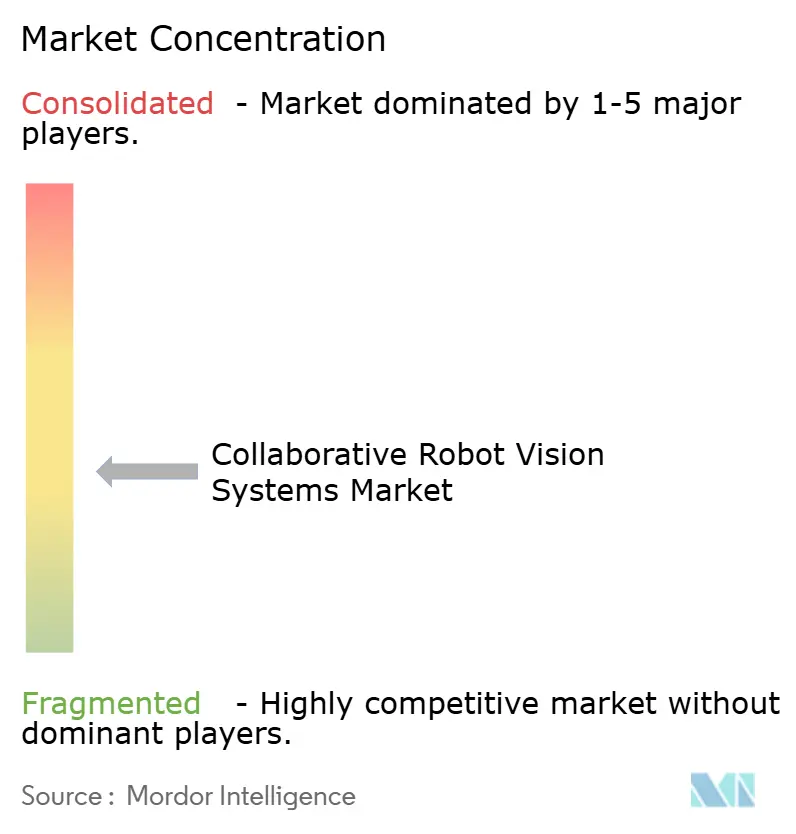
The collaborative robot vision systems market has a fragmented supply structure. Cobot OEMs combine robots with vision hardware and software, while machine-vision vendors supply platform-agnostic sensing systems. Edge-AI semiconductor providers are also moving inference closer to the robot. Universal Robots remains a leading collaborative robot platform by installed base. Chinese suppliers, including JAKA, AUBO, and TECHMAN ROBOT, compete through pricing and bundled AI vision products in Asia-Pacific and export markets.
Cognex, KEYENCE, SICK, and Teledyne Vision Solutions compete on inference speed, deployment simplicity, and vertical training data. LMI Technologies and Basler focus on high-precision 3D sensing for measurement and guidance. ABB announced a 2026 collaboration with NVIDIA that integrates Omniverse libraries into RobotStudio HyperReality. ABB stated that the approach targets up to 99% simulation accuracy, up to 80% less setup and commissioning time, and up to 40% lower costs through less physical prototyping. The program is planned for rollout to 60,000 RobotStudio customers during the second half of 2026.
KUKA introduced the KUKA AMP platform in March 2026 to link deterministic automation with AI-native operation. ISO 10218-1:2025 and ISO 10218-2:2025 provide a compliance requirement for industrial robot applications and robot cells. Established suppliers with certified portfolios may benefit when buyers prioritize safety compliance. Opportunities remain in multispectral pharmaceutical inspection and flexible micro-factory applications for apparel and consumer goods.
Collaborative Robot Vision Systems Industry Leaders
Cognex Corporation
ABB Ltd.
Omron Corporation
Keyence Corporation
FANUC Corporation
- *Disclaimer: Major Players sorted in no particular order

Recent Industry Developments
- August 2026: ABB Robotics announces RobotStudio HyperReality, integrating NVIDIA Omniverse libraries for synthetic-data-based robot training, with full release to 60,000 global RobotStudio customers planned for H2 2026. Foxconn pilots the technology for consumer electronics assembly, targeting 99% simulation-to-real accuracy, up to 80% reduction in setup time, and up to 40% cost reduction by eliminating physical prototyping and testing cycles.
- July 2026: KUKA launches the LBR iisy on iiQKA.OS2, a new-generation industrial cobot built on KUKA's unified operating system enabling scalable integration from collaborative to demanding industrial environments. The product complies with ISO 10218:2025 and integrates with KUKA's broader automation portfolio, providing customers with a single technology foundation across robot types.
- July 2026: Photoneo releases Bin Picking Studio 1.12 and Locator Studio 1.5, introducing direct 3D model creation from sensor scans without CAD input, on-demand AI-based object classification, and a fast-scan feature for CAD MultiView configurations. The update directly reduces new-part onboarding effort and expands robust picking performance across variable material and lighting conditions.
- June 2026: Doosan Robotics unveils PalletizHD+, an AI-powered palletizing solution built on its proprietary PalletizOS, at Automate 2026 in Chicago. Doosan also showcases Scan and Go 2.0, powered by Physics-Informed AI and advanced 3D vision, for sanding and welding, extending its AI vision portfolio into multi-domain unstructured industrial tasks.


Global Collaborative Robot Vision Systems Market Report Scope
The Collaborative Robot Vision Systems Market comprises hardware, software, and integrated machine vision solutions designed to enable collaborative robots (cobots) to perceive, identify, inspect, locate, and interact with objects and environments while safely operating alongside human workers.
The Collaborative Robot Vision Systems Market Report is Segmented by Component (Hardware, Software, and Services), Vision Technology (2D Vision Systems, 3D Vision Systems, AI-Powered Vision, Multispectral and Infrared Vision, and Hybrid Vision Architectures), Cobot Payload (Less Than 5 kg, 5-10 kg, 11-25 kg, and More Than 25 kg), Application (Inspection and Quality Assurance, Guidance and Navigation, Pick and Place and Bin Picking, Assembly and Disassembly, Machine Tending, Packaging and Palletizing, Welding, Soldering, and Dispensing, and Other Applications), End-User Industry (Automotive, Electronics and Semiconductor, Food and Beverage, Pharmaceutical and Healthcare, Logistics and Warehousing, Metals and Machinery, Plastics and Polymers, Aerospace and Defense, and Other End-User Industries), and Geography (North America, South America, Europe, Asia-Pacific, and Middle East and Africa). The Market Forecasts are Provided in Terms of Value (USD).
| Hardware |
| Software |
| Services |
| 2D Vision Systems |
| 3D Vision Systems |
| AI-Powered Vision |
| Multispectral and Infrared Vision |
| Hybrid Vision Architectures |
| Less Than 5 kg |
| 5-10 kg |
| 11-25 kg |
| More Than 25 kg |
| Inspection and Quality Assurance |
| Guidance and Navigation |
| Pick and Place and Bin Picking |
| Assembly and Disassembly |
| Machine Tending |
| Packaging and Palletizing |
| Welding, Soldering, and Dispensing |
| Other Applications |
| Automotive |
| Electronics and Semiconductor |
| Food and Beverage |
| Pharmaceutical and Healthcare |
| Logistics and Warehousing |
| Metals and Machinery |
| Plastics and Polymers |
| Aerospace and Defense |
| Other End-User Industries |
| North America | United States | |
| Canada | ||
| Mexico | ||
| South America | Brazil | |
| Argentina | ||
| Rest of South America | ||
| Europe | Germany | |
| United Kingdom | ||
| France | ||
| Italy | ||
| Spain | ||
| Rest of Europe | ||
| Asia-Pacific | China | |
| Japan | ||
| India | ||
| South Korea | ||
| ASEAN | ||
| Rest of Asia-Pacific | ||
| Middle East and Africa | Middle East | Saudi Arabia |
| United Arab Emirates | ||
| Rest of the Middle East | ||
| Africa | Egypt | |
| South Africa | ||
| Rest of Africa | ||
| By Component | Hardware | ||
| Software | |||
| Services | |||
| By Vision Technology | 2D Vision Systems | ||
| 3D Vision Systems | |||
| AI-Powered Vision | |||
| Multispectral and Infrared Vision | |||
| Hybrid Vision Architectures | |||
| By Cobot Payload | Less Than 5 kg | ||
| 5-10 kg | |||
| 11-25 kg | |||
| More Than 25 kg | |||
| By Application | Inspection and Quality Assurance | ||
| Guidance and Navigation | |||
| Pick and Place and Bin Picking | |||
| Assembly and Disassembly | |||
| Machine Tending | |||
| Packaging and Palletizing | |||
| Welding, Soldering, and Dispensing | |||
| Other Applications | |||
| By End-User Industry | Automotive | ||
| Electronics and Semiconductor | |||
| Food and Beverage | |||
| Pharmaceutical and Healthcare | |||
| Logistics and Warehousing | |||
| Metals and Machinery | |||
| Plastics and Polymers | |||
| Aerospace and Defense | |||
| Other End-User Industries | |||
| By Geography | North America | United States | |
| Canada | |||
| Mexico | |||
| South America | Brazil | ||
| Argentina | |||
| Rest of South America | |||
| Europe | Germany | ||
| United Kingdom | |||
| France | |||
| Italy | |||
| Spain | |||
| Rest of Europe | |||
| Asia-Pacific | China | ||
| Japan | |||
| India | |||
| South Korea | |||
| ASEAN | |||
| Rest of Asia-Pacific | |||
| Middle East and Africa | Middle East | Saudi Arabia | |
| United Arab Emirates | |||
| Rest of the Middle East | |||
| Africa | Egypt | ||
| South Africa | |||
| Rest of Africa | |||


Key Questions Answered in the Report
What is the size of the collaborative robot vision systems market?
The collaborative robot vision systems market size is USD 0.64 billion in 2026 and is projected to reach USD 1.07 billion by 2031 at a CAGR of 10.83%.
Which component leads collaborative robot vision systems revenue?
Hardware led with 65.78% of revenue in 2025 because each deployment requires cameras, compute boards, and depth-sensing equipment before a vision application can operate in a new cell.
Which vision technology is expanding fastest?
AI-powered vision is projected to expand at a CAGR of 11.67% through 2031, supported by applications involving variable and unstructured objects, including bin picking, assembly guidance, and dimensional inspection.
Why do manufacturers use vision-equipped cobots?
They support inspection, guidance, handling, and adaptable production tasks while allowing people to work alongside automated systems in shared production areas where staffing flexibility remains important.
Which end-user sector has the highest revenue?
Automotive held 25.89% of revenue in 2025, supported by EV battery inspection, electronic control unit assembly, and quality assurance, where manufacturers need repeatable checks at production speed.
Which region is expanding fastest?
The Middle East and Africa is projected to expand at a CAGR of 11.21% through 2031, supported by industrial diversification and greenfield automation projects.
Page last updated on:





