
Coffee Grounds Market Size and Share
Market Overview
| Study Period | 2022 - 2032 |
|---|---|
| Market Size (2027) | USD 62.89 Billion |
| Market Size (2032) | USD 83.34 Billion |
| Growth Rate (2027 - 2032) | 5.46 % |
| Fastest Growing Market | Asia-Pacific |
| Largest Market | Europe |
| Market Concentration | Low |
Major Players *Disclaimer: Major Players sorted in no particular order Image © Mordor Intelligence. Reuse requires attribution under CC BY 4.0. | |
Coffee Grounds Market Analysis by Mordor Intelligence
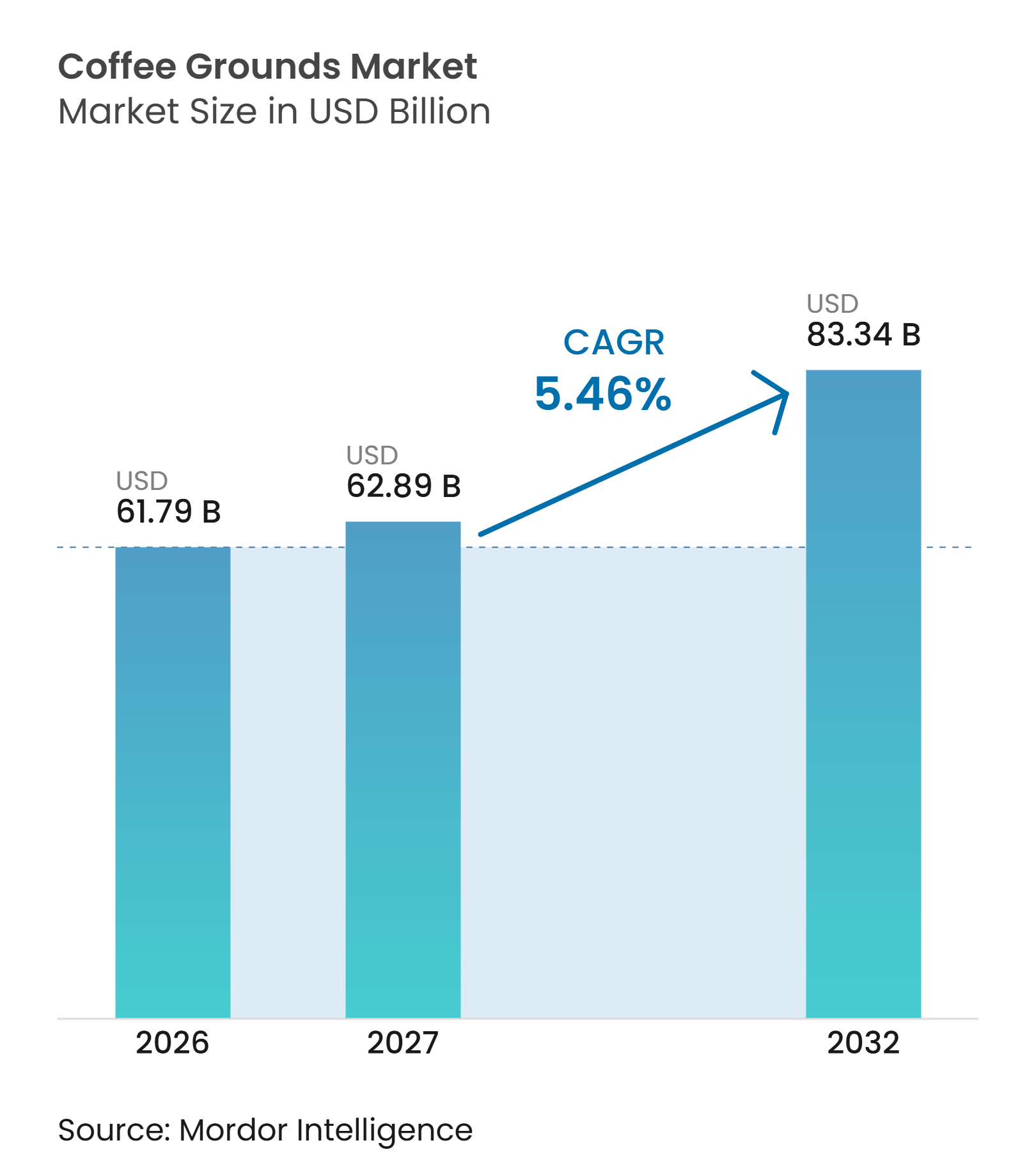
The coffee grounds market size is expected to grow from USD 61.79 billion in 2026 to USD 62.89 billion in 2027 and is forecast to reach USD 83.34 billion by 2032 at a 5.46% CAGR over 2027-2032. Regular caffeinated ground coffee remains the foundation of market demand, while decaffeinated products, single-origin offerings, and foodservice formats present opportunities for product diversification and value growth. Growing consumer interest in coffee origin, product quality, and distinct flavor profiles is encouraging roasters to expand premium offerings and develop flexible blends. Increasing emphasis on supply chain transparency in Europe is creating opportunities for traceable coffee sourcing and responsible procurement practices. Established companies benefit from strong procurement and distribution networks, while specialty brands strengthen their positions through direct sourcing relationships, product freshness, and transparent origin information.
Key Report Takeaways
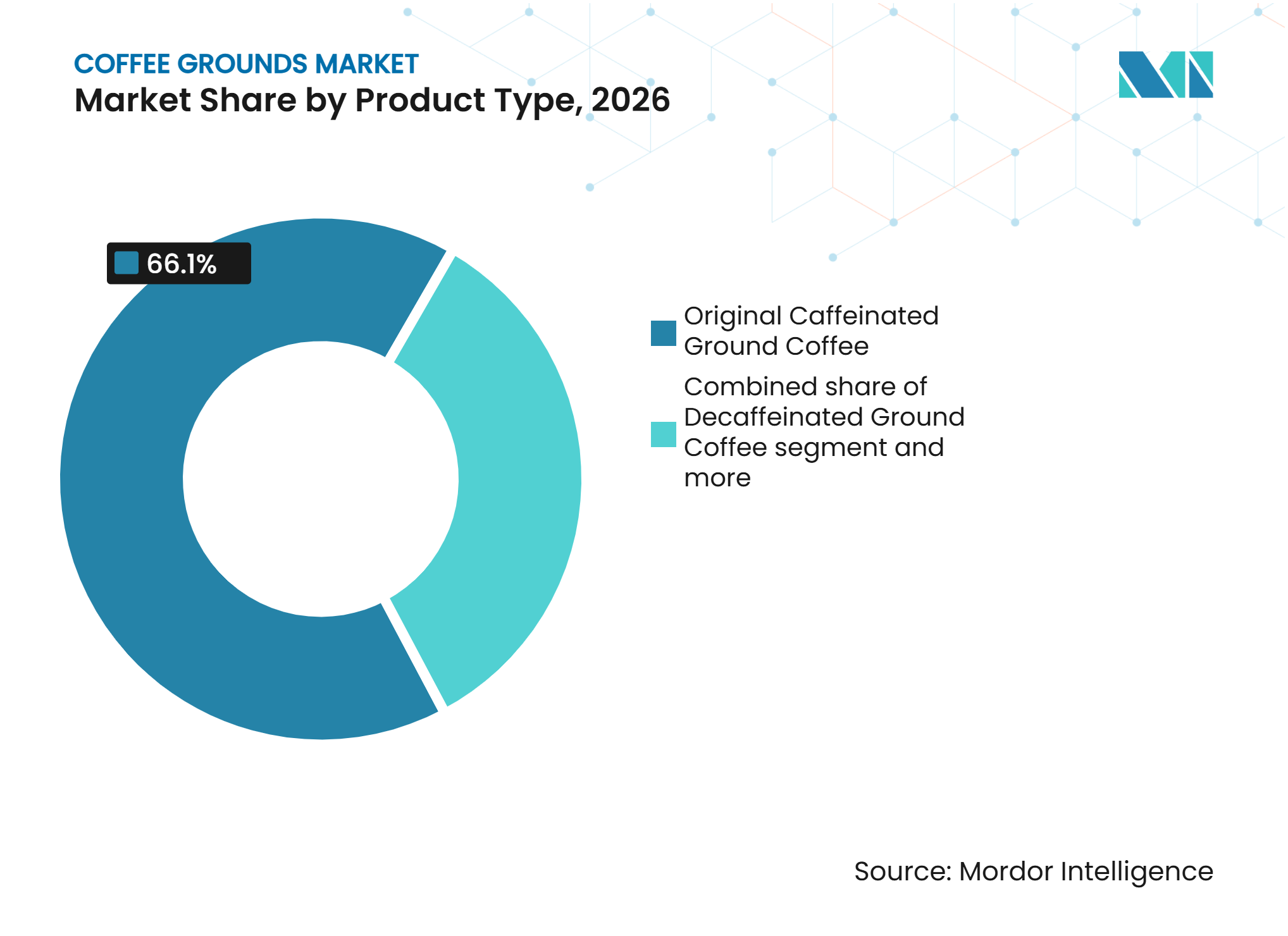
• By product type, original caffeinated ground coffee held 66.12% of the coffee grounds market share in 2026, while decaffeinated ground coffee is forecast to expand at a CAGR of 6.61% through 2032.
• By coffee bean type, Arabica held 55.23% of the coffee grounds market share in 2026, while Robusta is forecast to expand at a CAGR of 6.21% through 2032.
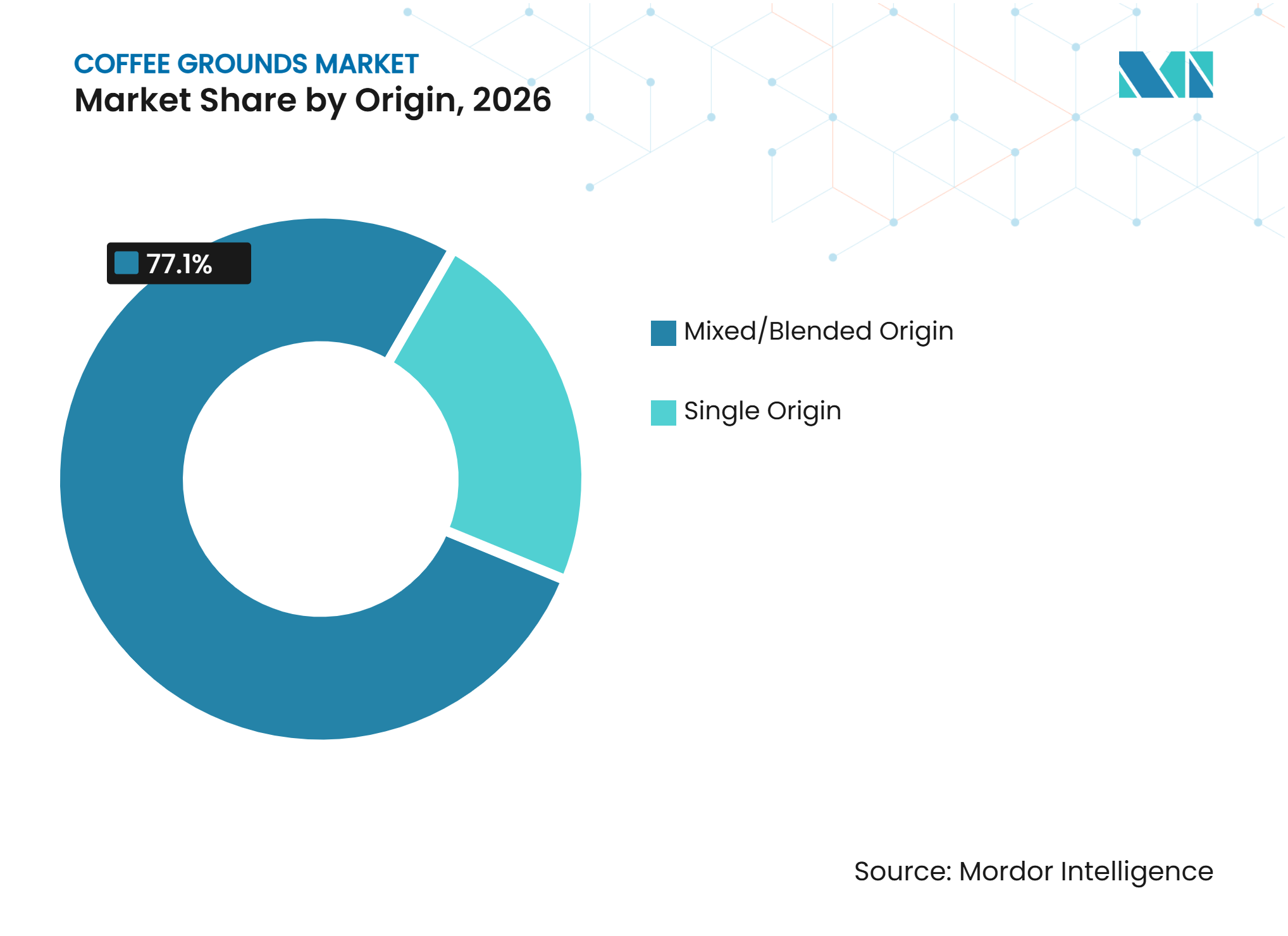
• By origin, mixed/blended held 77.12% of the coffee grounds market share in 2026, while single is forecast to expand at a CAGR of 8.12% through 2032.
• By distribution channel, off-trade held 65.17% of the coffee grounds market share in 2026, while on-trade is forecast to expand at a CAGR of 6.42% through 2032.
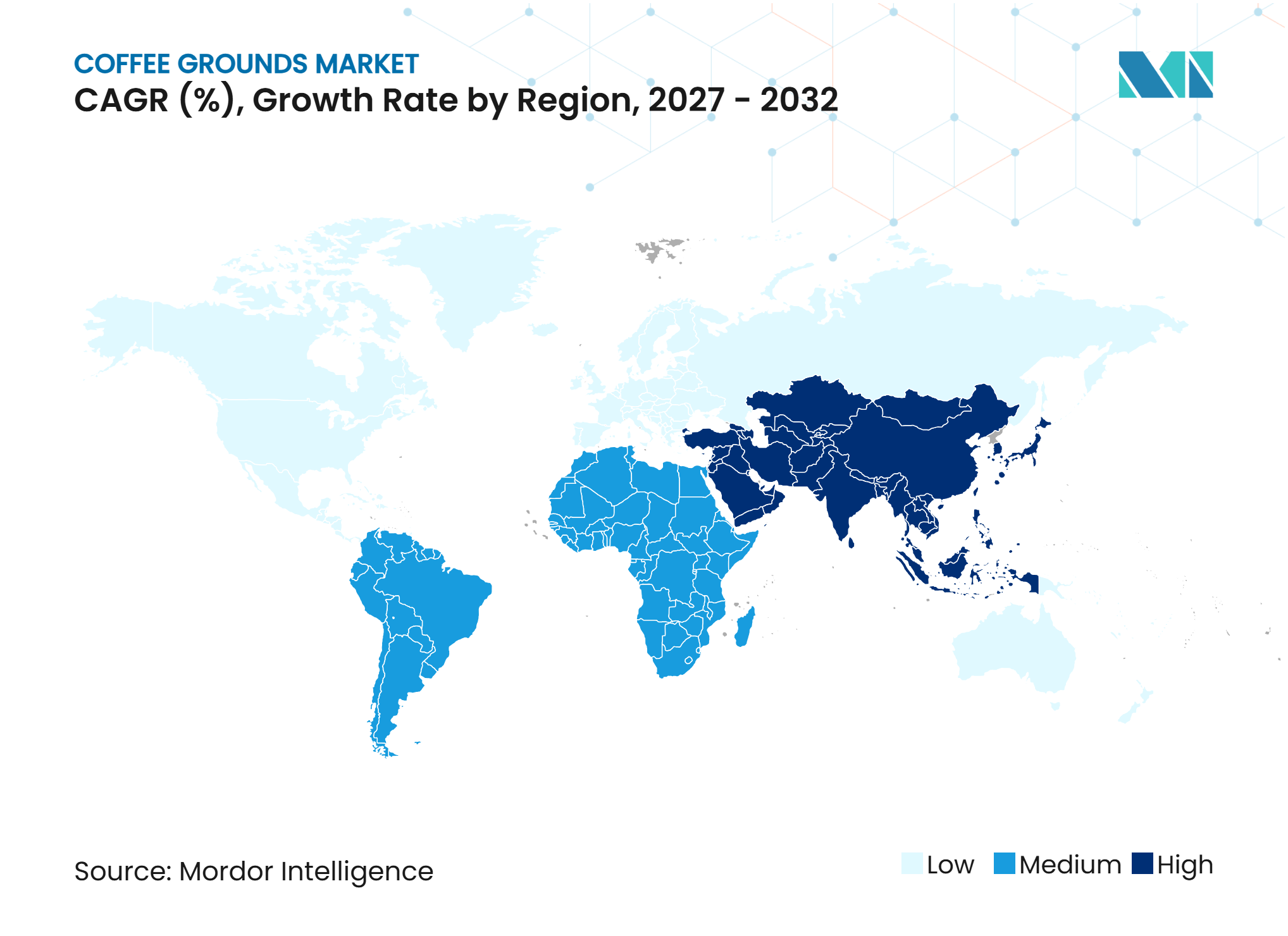
• By geography, Europe held 41.21% of the coffee grounds market share in 2026, while Asia-Pacific is forecast to expand at a CAGR of 7.22% through 2032.
Note: Market numbers in this report are based on Mordor Intelligence's proprietary estimation framework, which combines nine months of actuals with Q4 projections for base year 2026.
Market Trends and Insights
Drivers Impact Analysis of Coffee Grounds Market*
| Driver | (~) % impact on CAGR forecast | Geographic relevance | Impact timeline |
|---|---|---|---|
| Premiumization and single-origin discovery | +0.9% | Global, led by Europe and North America | Medium term (2–4 years) |
| Café-quality brewing at home | +0.8% | North America, Europe, and Asia-Pacific | Short term (≤ 2 years) |
| Growth of online coffee purchasing and subscription-based replenishment | +0.6% | North America, Europe, and Asia-Pacific | Short term (≤ 2 years) |
| Specialty café culture and consumer awareness of coffee quality | +0.8% | Global, with growing opportunities in China, India, and South Korea | Medium term (2–4 years) |
| Growing demand for brewing-specific ground coffee formats | +0.7% | North America, Europe, and Asia-Pacific | Short to medium term (1–4 years) |
| Premium coffee offerings and consistency requirements in foodservice | +0.7% | Global, particularly North America and Europe | Medium term (2–4 years) |
| Source: Mordor Intelligence | |||
Premiumization and Single-Origin Discovery
Consumers are increasingly exploring specialty coffee offerings that emphasize premium quality, distinctive flavor profiles, and differentiated brewing experiences. For instance, in June 2025, according to the National Coffee Association (NCA), 46% of American adults consumed specialty coffee in the past day, exceeding the share of those who consumed traditional coffee. Additionally, 64% of consumers aged 25–39 consumed specialty coffee in the past week, highlighting growing interest among younger consumers [1]. The NCA defines specialty coffee as including espresso-based beverages such as lattes and cappuccinos, non-espresso beverages such as frozen blends, cold brew, and nitro coffee, as well as traditional coffee perceived by consumers to be brewed from premium coffee beans or grounds.
Café-Quality Brewing at Home
The growing preference for café-quality coffee experiences at home is encouraging consumers to explore diverse brewing methods and ground coffee formats. For instance, in June 2025, according to the Coffee Association of Canada (CAC), 83% of past-day coffee drinkers prepared coffee at home. Espresso machine usage increased from 13% in 2024 to 14%, while bean-to-cup brewer usage rose from 7% to 8%. Single-cup brewer usage also reached 27% in June 2025, up from 26% the previous year, demonstrating sustained interest in convenient and diverse coffee preparation methods and creating opportunities for ground coffee manufacturers to develop products compatible with espresso machines, single-cup brewers, drip coffee makers, and other brewing formats [2]. Pre-ground coffee further enhances convenience by eliminating the need for separate grinding equipment.
Growth of Online Coffee Purchasing and Subscription-Based Replenishment
Subscription-based purchasing is creating opportunities for coffee manufacturers and roasters to establish recurring sales channels and strengthen customer retention. The growing adoption of subscription services reflects consumer interest in convenient purchasing, regular product replenishment, and personalized coffee selections. These models allow customers to receive their preferred coffee products at scheduled intervals, reducing the need for repeated orders and supporting consistent access to their preferred brands. For ground coffee manufacturers, subscription-based services provide opportunities to offer customized product selections, flexible delivery schedules, and convenient replenishment options, potentially encouraging repeat purchases and strengthening long-term customer relationships.
Specialty Café Culture and Consumer Awareness of Coffee Quality
Specialty coffee culture is encouraging consumers to develop greater awareness of coffee quality and product differentiation. As consumers become more familiar with sensory characteristics, roast profiles, coffee origins, and quality certifications, they are increasingly able to distinguish between conventional and specialty coffee offerings. For instance, in December 2025, according to the National Library of Medicine, 105 regular specialty coffee consumers were examined to assess the influence of product-label information on consumer attention and purchasing intentions, highlighting the importance of sensory claims, origin, traceability, and cupping scores in specialty coffee selection [3]. This growing focus on product quality is creating opportunities for coffee manufacturers and roasters to introduce premium ground coffee varieties with distinctive flavor profiles, traceable origins, and clearly communicated quality attributes.
Restraints Impact Analysis of Coffee Grounds Market*
| Restraint | ~% Impact on CAGR Forecast | Geographic Relevance | Impact Timeline |
|---|---|---|---|
| Green coffee price and supply volatility | -0.8% | Global, particularly Brazil, Vietnam and Colombia | Short term (≤ 2 years) |
| Climate risk to Arabica supply and quality | -0.9% | Brazil, Central America and East Africa, with global spillover | Long term (≥ 4 years) |
| Freshness loss and packaging-barrier dependence | -0.5% | Global, particularly premium roasted and ground coffee markets | Medium term (2–4 years) |
| Intense competition from whole bean coffee, instant coffee and coffee pod alternatives | -0.6% | Global, particularly Europe and North America | Medium term (2–4 years) |
| Source: Mordor Intelligence | |||
Green Coffee Price and Supply Volatility
Fluctuations in green coffee bean prices and supply availability create uncertainty in raw material procurement for ground coffee manufacturers and roasters. Changes in sourcing costs increase production expenses and make cost planning more challenging. Supply disruptions can also affect the consistency of raw material quality and production schedules. Manufacturers may face pressure to adjust product prices to maintain profitability, potentially affecting consumer affordability and purchasing decisions. These factors can restrict market growth by increasing operating costs and creating uncertainty in product pricing.
Climate Risk to Arabica Supply and Quality
Climate change poses significant risks to Arabica coffee production by affecting growing conditions, crop yields, and bean quality. Rising temperatures, irregular rainfall, prolonged droughts, and changing weather patterns can disrupt cultivation and increase crop vulnerability. These conditions may reduce the availability of high-quality Arabica beans and create inconsistencies in raw material sourcing for ground coffee manufacturers and roasters. Variations in bean quality can also affect the flavor, aroma, acidity, and consistency of finished coffee products, making it difficult for manufacturers to maintain uniform product standards. Additionally, climate-related supply disruptions may increase procurement costs and intensify competition for suitable coffee beans. These challenges can constrain the production of premium ground coffee and create greater uncertainty in long-term sourcing and pricing strategies.
*Our forecasts treat driver/restraint impacts as directional, not additive. The impact forecasts reflect baseline growth, mix effects, and variable interactions.
Coffee Grounds Market Segment Analysis
By Product Type:
Decaffeinated Ground Coffee Gains Share Through Health-Led DemandOriginal caffeinated held 66.12% of the coffee grounds market share in 2026. Mainstream caffeinated ground coffee forms the primary volume base of the product category, supported by its broad consumer appeal and established daily consumption habits. Its demand is sustained across household, foodservice and workplace consumption occasions, where consumers value familiar taste profiles, convenient preparation and accessible pricing. Conventional blends remain widely preferred because they offer consistent flavor and can be used with commonly available brewing methods. Flavored ground coffee offers consumers seeking variety in taste profiles an additional choice without changing their usual preparation methods. Mainstream caffeinated products are expected to remain central to the market, providing a dependable product range for retailers and roasters across different consumer preferences and price segments.
Decaffeinated coffee is forecast to expand at a CAGR of 6.61% through 2032. Decaffeinated ground coffee is gaining relevance as consumers seek to enjoy coffee throughout the day while managing their caffeine intake. Its demand is driven by shifting consumption preferences and growing interest in alternatives that let consumers maintain familiar coffee-drinking routines without the stimulating effects of regular coffee. Improvements in decaffeination processes have also helped manufacturers retain the characteristic flavor, aroma, and overall quality of coffee after caffeine removal. This has strengthened the appeal of decaffeinated products among consumers who previously perceived them as having inferior taste. Decaffeinated ground coffee is therefore evolving from a niche alternative into a more regular product choice, creating opportunities for roasters to expand their product portfolios and cater to a wider range of consumption preferences.



By Coffee Bean Type:
Robusta Gains Strategic Value as Supply Pressures Change BlendingArabica held 55.23% of the coffee grounds market share in 2026. Arabica remains the leading bean type in the coffee grounds market because of its association with refined flavor, aromatic complexity, and balanced taste profiles. Its versatility allows roasters to use it across conventional blends, premium ground coffee, and origin-specific product offerings. Established consumer familiarity and broad availability across retail and foodservice channels further support its demand. Other bean varieties, including Robusta and Liberica, cater to more specific preferences through their distinctive flavor profiles and suitability for particular blends. Arabica is expected to maintain its importance as consumers continue to favor coffee products with consistent quality, recognizable taste profiles, and premium positioning. Its market significance also makes ground coffee manufacturers dependent on the availability and quality of Arabica beans from major producing regions.
Robusta is forecast to expand at a CAGR of 6.21% through 2032. Robusta is gaining importance in the coffee grounds market as roasters increasingly consider alternative bean varieties to improve sourcing flexibility and manage raw material costs. Its strong flavor, higher caffeine content and suitability for blending make it an important ingredient in both mainstream and premium ground coffee formulations. Improvements in cultivation, processing and post-harvest practices are also supporting the availability of higher-quality Robusta beans. Growing recognition of their flavor characteristics and blending performance is encouraging roasters to move beyond using Robusta solely as a lower-cost alternative to Arabica. This is creating opportunities to incorporate quality-focused Robusta into a wider range of ground coffee products while improving sourcing flexibility and blend consistency.
By Origin:
Single Origin Expands as Traceability Becomes More ImportantMixed/blended coffee grounds held 77.12% of the coffee grounds market share in 2026. Blended ground coffee holds a strong position in the market because it allows roasters to combine beans from different origins and maintain consistent flavor profiles. This flexibility helps manufacturers manage variations in bean quality, seasonal availability, and raw material procurement costs. Blends are particularly suitable for retail and foodservice applications, where consumers and businesses expect a familiar taste across repeated purchases. Roasters can also adjust blend composition based on sourcing conditions without significantly altering the overall product experience. Their versatility across price segments and consumer preferences supports continued demand for ground coffee.
Single-origin ground coffee is forecast to expand at a CAGR of 8.12% through 2032. Single-origin ground coffee is gaining popularity as consumers show greater interest in coffee provenance, distinctive flavor profiles, and product traceability. These products allow roasters to highlight the characteristics of beans sourced from specific growing regions, creating differentiation from conventional blended offerings. Growing awareness of coffee origins and sourcing practices is also encouraging manufacturers to provide clearer information about bean origins and supply chain transparency. Direct sourcing and traceability can further strengthen product positioning by communicating the origin, quality, and distinct characteristics of the coffee. This creates opportunities for roasters to expand their premium product portfolios and cater to consumers seeking more distinctive, origin-focused coffee experiences.

By Distribution Channel:
On-Trade Formats Gain as Foodservice Upgrades Coffee QualityOff-trade held 65.17% of the coffee grounds market share in 2026. Off-trade channels remain the primary distribution route for ground coffee, supported by widespread retail availability and regular household purchasing habits. Supermarkets and hypermarkets play an important role by offering a broad selection of brands, blends, pack sizes, and price points. Online stores provide additional convenience, allowing consumers to compare products, access specialty offerings, and purchase directly from coffee roasters. Specialist retailers also support demand for premium and origin-specific ground coffee by offering differentiated product ranges. The availability of ground coffee across these channels supports routine replenishment and makes off-trade distribution central to the market's overall sales volume.
On-trade is forecast to expand at a CAGR of 6.42% through 2032. Foodservice demand for ground coffee is supported by cafés, restaurants and other hospitality businesses seeking consistent coffee quality and reliable product supply. The growing focus on premium coffee offerings is encouraging foodservice operators to expand their coffee selections and improve beverage quality. Ground coffee remains relevant in this channel because it can be used across different brewing methods and supports consistent preparation across multiple outlets. Suppliers also play an important role by providing dependable product quality, suitable packaging, and operational support to foodservice customers. Increasing café exposure further familiarizes consumers with different coffee profiles and can influence their preferences for ground coffee purchases at home.
Geography Analysis
Europe
Europe held 41.21% of the coffee grounds market share in 2026. Europe maintains a strong position in the coffee grounds market, supported by mature coffee consumption habits, established roasting capacity, and well-developed retail distribution networks. Ground coffee continues to benefit from consumer familiarity with different coffee origins, roast profiles and preparation methods. Although whole-bean and capsule products are gaining popularity in markets with high coffee machine ownership, ground coffee remains an established format across household and foodservice consumption. The region's developed coffee industry also supports a wide range of product offerings, from mainstream blends to premium and origin-specific ground coffee. In addition, sustainability and sourcing transparency are becoming increasingly important, as regulatory requirements such as the EU Deforestation
Asia-Pacific
Asia-Pacific is forecast to expand at a CAGR of 7.22% through 2032. Asia Pacific represents an evolving opportunity for the coffee grounds market, supported by changing consumption preferences and growing interest in freshly prepared and specialty coffee. The gradual shift toward premium coffee experiences is creating opportunities for ground coffee manufacturers to reach consumers through digital purchasing channels and expanding retail distribution. Differences in coffee consumption habits across the region are also encouraging manufacturers to adapt product offerings to local preferences. The growing presence of independent cafés and domestic coffee brands is strengthening interest in locally sourced and premium coffee products. In addition, changing preferences for decaffeinated coffee are broadening demand beyond conventional caffeinated products
Other Regions
North America benefits from a mature retail structure and established coffee consumption habits, while growing interest in premium home brewing and direct purchasing is creating opportunities for ground coffee manufacturers. The region's market is also influenced by the need to diversify sourcing as supply conditions and availability vary across major coffee-producing countries. In South America, established coffee-producing industries and strong domestic coffee cultures create opportunities to expand local processing and increase the availability of value-added ground coffee products. Growing interest in specialty coffee further supports the development of differentiated offerings. The Middle East and Africa present varied growth opportunities as café culture expands and traditional coffee preferences continue to shape consumption.
Competitive Landscape
Market Concentration
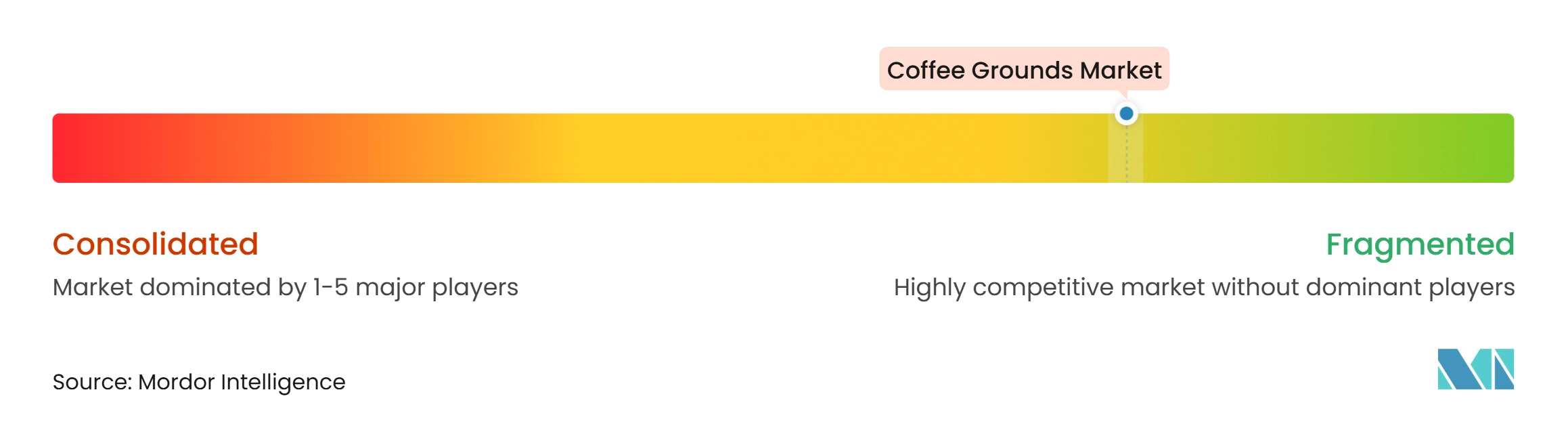
The coffee grounds market demonstrates a fragmented, balanced competitive structure, with established multinational companies and regional specialty roasters contributing to market development. Leading companies benefit from strong brand recognition, extensive distribution networks, sourcing capabilities, and diversified product portfolios. Regional and specialty manufacturers further strengthen the market by offering distinctive flavor profiles, origin-focused products, freshly roasted coffee, and personalized customer experiences. This combination of large-scale operations and specialized offerings supports product variety and caters to a broad range of consumer preferences.
Product innovation is strengthening competition as manufacturers expand their portfolios to address evolving preparation habits and premium coffee preferences. Companies are introducing differentiated ground coffee formats, specialty blends, and convenient at-home solutions to enhance consumer choice. Sustainability and responsible sourcing initiatives are also gaining importance, encouraging manufacturers to improve supply-chain transparency, strengthen producer relationships, and develop more sustainable product offerings. These efforts support brand differentiation and reinforce consumer confidence.
Packaging advancements and direct-to-consumer distribution are creating further opportunities for manufacturers across different market segments. Freshness-preserving packaging, recyclable materials, and improved product presentation help brands enhance product quality and respond to changing consumer expectations. Regional and digitally focused roasters are also expanding their reach through direct customer engagement, flexible product development, and transparent sourcing practices. Overall, the coffee grounds market benefits from the complementary strengths of established companies and emerging specialty players, supporting continued innovation, product diversification, and competitive growth.
Coffee Grounds Industry Leaders
-
Nestlé S.A.
-
Keurig Dr Pepper, Inc. (JDE Peet's N.V.)
-
The J.M. Smucker Company (Folgers)
-
The Kraft Heinz Company (Maxwell House)
-
Starbucks Corporation
- *Disclaimer: Major Players sorted in no particular order
Coffee Grounds Market Companies Covered in this Report
- Nestlé S.A.
- Keurig Dr Pepper, Inc. (JDE Peet's N.V.)
- The J.M. Smucker Company (Folgers)
- The Kraft Heinz Company (Maxwell House)
- Starbucks Corporation
- Luigi Lavazza S.p.A.
- Tata Consumer Products Limited (Tata Coffee Limited)
- UCC Ueshima Coffee Co., Ltd.
- Strauss Group Ltd.
- Melitta Group
- illycaffè S.p.A.
- Coffee Holding Company, Inc. (Harmony Bay)
- Massimo Zanetti Beverage Group S.p.A. (Segafredo Zanetti)
- Trung Nguyen Group Corporation
- Farmer Brothers Co.
- Tchibo GmbH
- Paulig Oy
- Community Coffee Company
- F. Gaviña & Sons, Inc.
- CCL Products (India) Limited (Continental Coffee Private Limited)
Recent Industry Developments in Coffee Grounds Market
- August 2026: Vintage Coffee and Beverages Limited entered the roasted and ground coffee segment as part of its premiumization strategy, adding a new product category to its portfolio and targeting international markets, particularly the United States and Europe.
- April 2026: Keurig Dr Pepper acquired a 96.22% stake in JDE Peet’s, bringing together major coffee brands and capabilities across multiple coffee formats under a larger global coffee business.
- May 2025: Café Bustelo expanded its ground coffee portfolio with new light, medium, and dark roast options, alongside a Dulce de Leche offering, broadening its range of flavor and roast profiles.
Global Coffee Grounds Market Report Scope
The coffee grounds market includes roasted coffee beans that are ground for brewing. The market is segmented by Product Type, Coffee Bean Type, Origin, Distribution Channel, and Geography. Product Type includes Original Caffeinated, Decaffeinated, and Flavored Ground Coffee. Coffee Bean Type includes Arabica, Robusta, Liberica, and Others. Origin includes Single Origin and Mixed/Blended Origin. Distribution Channel includes On-Trade and Off-Trade, with Off-Trade covering Supermarkets and Hypermarkets, Convenience Stores, Specialist Retailers, Online Retail, and Others. Geography includes North America, Europe, Asia-Pacific, South America, and the Middle East and Africa. Market forecasts are provided in value (USD).
Segmentation Overview
| Original Caffeinated Ground Coffee |
| Decaffeinated Ground Coffee |
| Flavoured Ground Coffee |
| Arabica |
| Robusta |
| Liberica |
| Other Coffee Bean Types |
| Single Origin |
| Mixed/Blended Origin |
| On-trade | |
| Off-trade | Supermarkets and Hypermarkets |
| Convenience Stores | |
| Specialist Retailers | |
| Online Retail | |
| Other Distribution Channels |
| North America | United States |
| Canada | |
| Mexico | |
| Rest of North America | |
| Europe | Germany |
| United Kingdom | |
| Italy | |
| France | |
| Spain | |
| Netherlands | |
| Poland | |
| Belgium | |
| Sweden | |
| Rest of Europe | |
| Asia-Pacific | China |
| India | |
| Japan | |
| Australia | |
| Indonesia | |
| South Korea | |
| Thailand | |
| Singapore | |
| Rest of Asia-Pacific | |
| South America | Brazil |
| Argentina | |
| Colombia | |
| Chile | |
| Peru | |
| Rest of South America | |
| Middle East and Africa | South Africa |
| Saudi Arabia | |
| United Arab Emirates | |
| Nigeria | |
| Egypt | |
| Morocco | |
| Turkey | |
| Rest of Middle East and Africa |
| By Product Type | Original Caffeinated Ground Coffee | |
| Decaffeinated Ground Coffee | ||
| Flavoured Ground Coffee | ||
| By Coffee Bean Type | Arabica | |
| Robusta | ||
| Liberica | ||
| Other Coffee Bean Types | ||
| By Origin | Single Origin | |
| Mixed/Blended Origin | ||
| By Distribution Channel | On-trade | |
| Off-trade | Supermarkets and Hypermarkets | |
| Convenience Stores | ||
| Specialist Retailers | ||
| Online Retail | ||
| Other Distribution Channels | ||
| By Geography | North America | United States |
| Canada | ||
| Mexico | ||
| Rest of North America | ||
| Europe | Germany | |
| United Kingdom | ||
| Italy | ||
| France | ||
| Spain | ||
| Netherlands | ||
| Poland | ||
| Belgium | ||
| Sweden | ||
| Rest of Europe | ||
| Asia-Pacific | China | |
| India | ||
| Japan | ||
| Australia | ||
| Indonesia | ||
| South Korea | ||
| Thailand | ||
| Singapore | ||
| Rest of Asia-Pacific | ||
| South America | Brazil | |
| Argentina | ||
| Colombia | ||
| Chile | ||
| Peru | ||
| Rest of South America | ||
| Middle East and Africa | South Africa | |
| Saudi Arabia | ||
| United Arab Emirates | ||
| Nigeria | ||
| Egypt | ||
| Morocco | ||
| Turkey | ||
| Rest of Middle East and Africa | ||
Key Questions Answered in the Report
What is the market size of coffee grounds market?
The coffee grounds market was valued at USD 61.79 billion in 2026 and is projected to reach USD 83.34 billion by 2032, growing at a CAGR of 5.46% during 2027–2032.
Which product category leads coffee grounds sales?
Original caffeinated ground coffee leads by product type with a 66.12% share in 2026. Its position reflects familiar daily consumption and wide access through retail and foodservice outlets.
Why is decaffeinated ground coffee growing faster?
Decaffeinated ground coffee is forecast to expand at a CAGR of 6.61% through 2032 as consumers seek more choices for regular coffee consumption. Improved flavor quality and wider specialty ranges support the category’s acceptance
Which region has the largest share of coffee grounds sales?
Europe leads with a 41.21% of the coffee grounds market share in 2026, supported by mature consumption and roasting infrastructure. EUDR due diligence requirements add importance to traceable supply systems in the region.