
Coconut Milk Powder Market Size and Share
Market Overview
| Study Period | 2022 - 2032 |
|---|---|
| Market Size (2027) | USD 0.87 Billion |
| Market Size (2032) | USD 1.24 Billion |
| Growth Rate (2027 - 2032) | 7.34 % |
| Fastest Growing Market | Europe |
| Largest Market | Asia-Pacific |
| Market Concentration | Low |
Major Players *Disclaimer: Major Players sorted in no particular order Image © Mordor Intelligence. Reuse requires attribution under CC BY 4.0. | |
Coconut Milk Powder Market Analysis by Mordor Intelligence
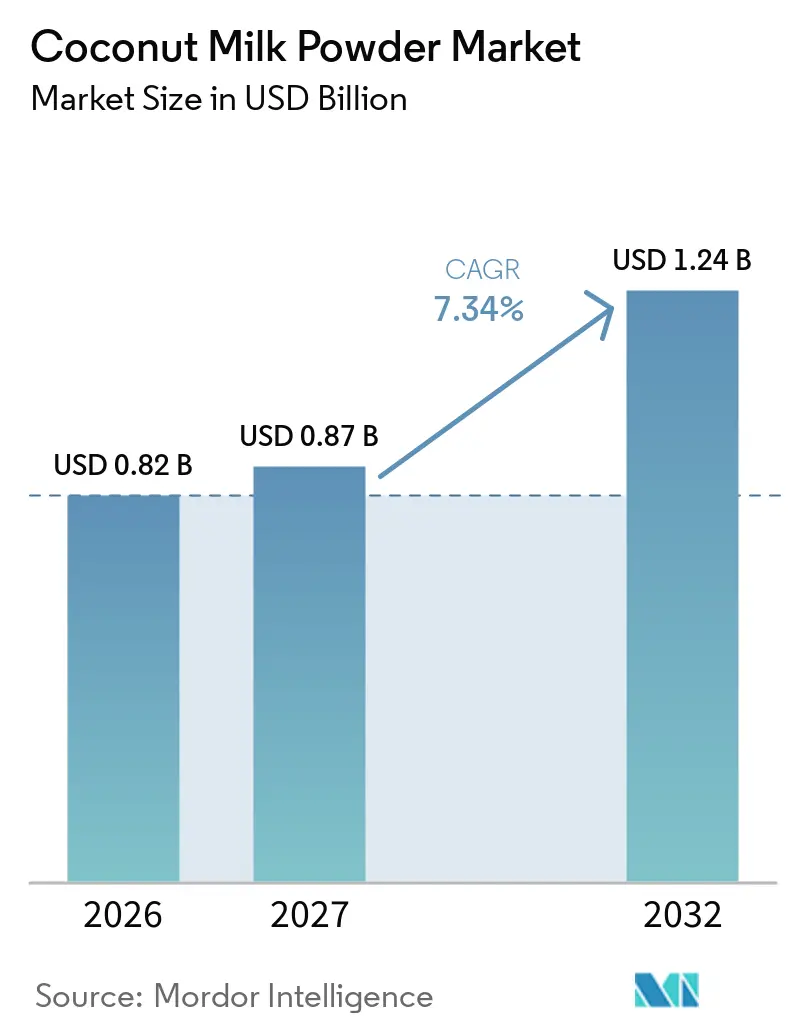
The coconut milk powder market size is projected to be USD 0.82 billion in 2026, USD 0.87 billion in 2027, and reach USD 1.24 billion by 2032, and is projected to grow at a CAGR of 7.34% from 2027 to 2032. The category is moving beyond its earlier concentration in ethnic food applications and into broader food manufacturing, where dairy-free formulation and stable storage are important. Plant-based dairy demand, wider availability of Asian food, and the practical benefits of powder formats support this shift. Powder offers easier transport and storage than fresh or canned coconut milk, which helps manufacturers and foodservice operators manage inventory. Producers with diversified sourcing and long-term supply arrangements are better placed to manage raw material volatility as demand from China raises competition for coconuts. The coconut milk powder market remains fragmented, while certification, product quality, and supply reliability shape competitive positioning.
Key Report Takeaways
- By product type, conventional coconut milk powder held 78.32% of the coconut milk powder market share in 2026, while organic coconut milk powder is forecast to grow at an 8.55% CAGR through 2032.
- By end-user, food processing accounted for 56.37% of the coconut milk powder market size in 2026, while foodservice/HoReCa is forecast to grow at a 9.01% CAGR through 2032.
- By geography, Asia-Pacific held 38.25% of the coconut milk powder market share in 2026, while Europe is forecast to grow at a 9.55% CAGR through 2032.
Note: Market numbers in this report are based on Mordor Intelligence's proprietary estimation framework, which combines nine months of actuals with Q4 projections for base year 2026.
Market Trends and Insights
Drivers Impact Analysis of Coconut Milk Powder Market*
| Driver | (~) % Impact on CAGR Forecasts | Geographic Relevance | Impact Timeline |
|---|---|---|---|
| Growing consumer preference for plant-based dairy alternatives | +1.7% | Global, with intensity in North America, Europe, and APAC urban markets | Medium term (2–4 years) |
| Expansion of instant foods and ready-to-prepare meals | +1.4% | Global; concentrated in Europe, North America, and East Asia | Medium term (2–4 years) |
| Rising demand for convenient and shelf-stable ingredients | +1.2% | Global, with particular relevance in emerging markets and food-processing hubs | Long term (≥ 4 years) |
| Growing demand from foodservice and hospitality operators | +1.1% | APAC core, spill-over to North America and Western Europe | Medium term (2–4 years) |
| Rising popularity of Asian and tropical cuisine | +0.9% | North America, Europe, Middle East; reinforced in APAC domestic markets | Short term (≤ 2 years) |
| Advancements in product innovation and clean-label formulations | +0.7% | Europe, North America; early-stage penetration in APAC premium retail | Long term (≥ 4 years) |
| Source: Mordor Intelligence | |||
Growing Consumer Preference for Plant-Based Dairy Alternatives
The coconut milk powder market benefits from demand for dairy-free ingredients that can work across food and beverage recipes. Food processors can use coconut milk powder in allergen-free and vegan formulations without the refrigeration needs of liquid alternatives. The coconut milk powder market also has room to grow when manufacturers improve taste and pricing, which remain important barriers for plant-based milk consumers. Powder suppliers can respond by supporting recipe development that improves sensory performance without creating additional cold-chain requirements. This work is particularly relevant for manufacturers replacing dairy ingredients in recipes where mouthfeel, stability, and familiar flavor influence repeat purchases. The format also allows producers to prepare concentrated bases and adapt water levels for different finished products without changing the core ingredient.
Rising Popularity of Asian and Tropical Cuisine
The coconut milk powder market is supported by food manufacturers that need ingredients with reliable storage and straightforward handling. Powder can be packed, transported, and held for longer than fresh coconut milk, which reduces the complexity of serving distant food production sites. Its dry format allows formulators to control water addition across soups, sauces, beverages, bakery products, and prepared meals. This flexibility matters for ready-to-prepare and ready-to-heat products, where consistent preparation is important at scale. The coconut milk powder market can therefore gain from the expansion of convenience foods, particularly where chilled logistics are limited or expensive. Manufacturers can also hold powder as a standardized ingredient across several product lines, which supports planning and reduces handling variation. This is useful when a manufacturer produces several flavors or package formats from the same facility. It can also simplify procurement because the ingredient can be purchased in bulk and allocated across bakery, beverage, sauce, and dessert applications.
Growing Demand from Foodservice and Hospitality Operators
The coconut milk powder market is gaining support from restaurants and hospitality operators that use coconut ingredients in several meal occasions. Breakfast was the fastest-growing out-of-home dining occasion at 13.7%, compared with 5.7% for dinner, according to Nestlé Professional in January 2026. This pattern expands use beyond curries and desserts into smoothies, lattes, porridge, and other breakfast products. Powder lets kitchens vary coconut milk concentration by adjusting the amount of water added, supporting menu flexibility. Unopened shelf life of 12-24 months and the ability to blend the powder into dry spice mixes also make the format practical for professional kitchens. The coconut milk powder market is also helped by continuing interest in Asian and tropical dishes, which use coconut ingredients in familiar menu formats. This lets operators use one ingredient across beverage, savory, and dessert menus instead of maintaining separate liquid products. The format is suitable for kitchens that need to adjust output quickly across dayparts and menu cycles. It also reduces the risk of unused liquid inventory when demand for a specific dish changes.
Increasing Product Innovation and Clean-Label Formulations
The coconut milk powder market is supported by process improvements that raise product quality and broaden formulation options. A 2025 study from Central Luzon State University identified an inlet temperature of 170°C, feed solids of 27%, and an atomizer disc speed of 22,000 rpm as conditions that produced powder with 3.2% moisture, 89.4% solubility, and a sensory score of 8.1 out of 10[1]. A separate 2025 study found that infrared-assisted hot-air drying could produce coconut milk powder with a Hausner ratio of 1.10, protein content of 12.43%, and DPPH antioxidant scavenging activity of 79.25%. Manufacturers are also using tapioca-derived maltodextrin carriers and pursuing organic, Halal, Kosher, and food-safety certifications. These steps help suppliers address premium retail and export requirements while maintaining a cleaner ingredient position. The coconut milk powder market gains as suppliers improve solubility, quality consistency, and certification coverage. These capabilities matter because importers and food brands need both technical performance and documentation that supports their product claims. Suppliers that can provide consistent records can be easier to qualify for branded food programs and export supply chains. Product development therefore depends on processing expertise as well as a clear understanding of certification and labeling requirements.
Restraints Impact Analysis of Coconut Milk Powder Market*
| Restraint | (~) % Impact on CAGR Forecasts | Geographic Relevance | Impact t Timeline |
|---|---|---|---|
| Competition from alternative plant-based milk powders | −0.5% | North America, Europe (almond/oat dominant), APAC (rice/soy competition) | Short term (≤ 2 years) |
| High processing and production costs | −0.4% | Global, most acute for processors in Southeast Asia and South Asia | Medium term (2–4 years) |
| Limited consumer awareness in certain markets | −0.3% | Sub-Saharan Africa, Eastern Europe, parts of Latin America | Long term (≥ 4 years) |
| Fluctuations in coconut supply and raw material prices | −0.4% | APAC production hubs (Indonesia, Philippines, Sri Lanka); spill-over to Europe and MEA importing markets | Short to medium term (≤ 4 years) |
| Source: Mordor Intelligence | |||
Competition from Other Plant-Based Milk Powder
The coconut milk powder market competes with oat, almond, rice, and soy powders for attention in dairy-free food and beverage formulations. These alternatives can fit the same broad applications, including bakery products, beverages, and dairy substitutes. Oat powder has an advantage in some temperate markets because locally available crops can reduce raw material freight costs. Coconut powder maintains a distinct position where a richer fat profile and specific flavor are needed, particularly in Southeast Asian recipes and selected functional foods. The coconut milk powder market must continue to demonstrate performance in applications where direct substitution changes taste, texture, or product identity. Suppliers can protect their position by focusing on recipes where coconut flavor is central rather than interchangeable. This includes curries, tropical desserts, coconut beverages, and other products where a different plant base would alter the intended result. The response does not remove price pressure, but it can help suppliers avoid competing only on commodity cost.
High Processing Costs and Coconut Supply Fluctuations
The coconut milk powder market faces cost pressure from raw material supply shifts, weather events, pests, and rising demand for bulk coconuts. Indonesia’s Coordinating Ministry for Food Affairs reported in May 2025 that rising Chinese demand for coconut-blended coffee pushed Indonesian farm-gate prices from IDR 10,000 to IDR 25,000-30,000 per nut within 1 year. Spray drying also requires capital-intensive equipment, which can strain margins for lower-volume processors. The disruption is most severe when domestic processors compete with bulk exports for the same coconuts. Multi-origin procurement, fixed-price contracts, and energy-efficient drying systems can reduce exposure, but they do not remove the underlying supply risk. The risk is more visible for processors that depend on spot purchases and lack direct relationships with growers. Weather disruption and pest outbreaks can further reduce available coconuts at the same time that export demand raises local buying prices. Managing this exposure requires procurement planning alongside investments in processing efficiency.
*Our forecasts treat driver/restraint impacts as directional, not additive. The impact forecasts reflect baseline growth, mix effects, and variable interactions.
Coconut Milk Powder Market Segment Analysis
By Product Type:
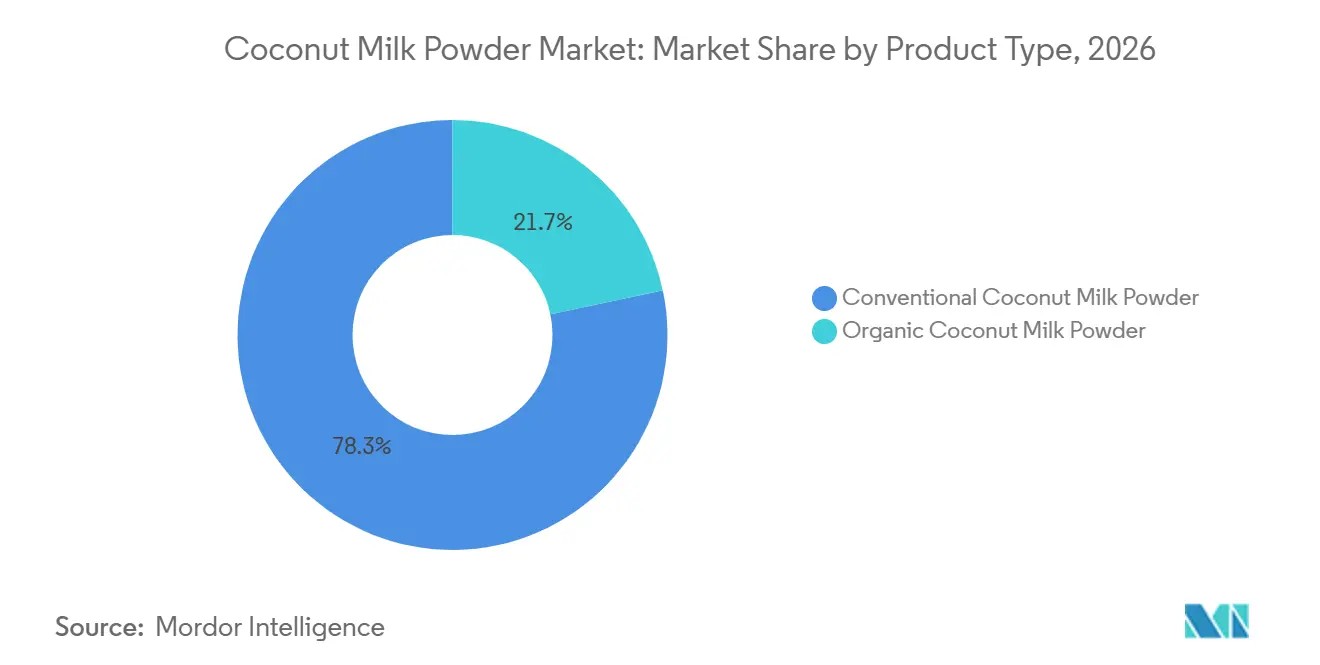
Conventional Products Retain Scale While Organic Products Build Premium DemandConventional coconut milk Powder held 78.32% of the coconut milk Powder market share in 2026. Established supply chains, broad food-safety certification, and pricing that suits cost-sensitive food manufacturers support this position. Bakery manufacturers, soup producers, and beverage companies often prioritize unit cost and reliable batch performance over organic certification. Full-fat grades with 40%-70% fat content remain important for professional kitchens and food factories that need richness and consistent reconstitution. Reduced-fat and reconstitution-optimized grades serve more specialized beverage powder and dairy alternative applications.
Food-safety certification has become an important route to Western European and North American import channels. BRCGS, FSSC 22000, and IFS certification can affect supplier access even when a buyer is purchasing conventional material. Organic coconut milk Powder is projected to grow at an 8.55% CAGR through 2032, above the overall rate for the coconut milk Powder market. Clean-label food brands and health-focused retail buyers are supporting this demand through interest in EU and USDA organic standards. Organic formulations face tighter additive rules because conventional sodium caseinate can disqualify a product from organic certification. This creates demand for tapioca-based or organically certified maltodextrin carriers and gives dual-certified producers a differentiated position.
By End-User:
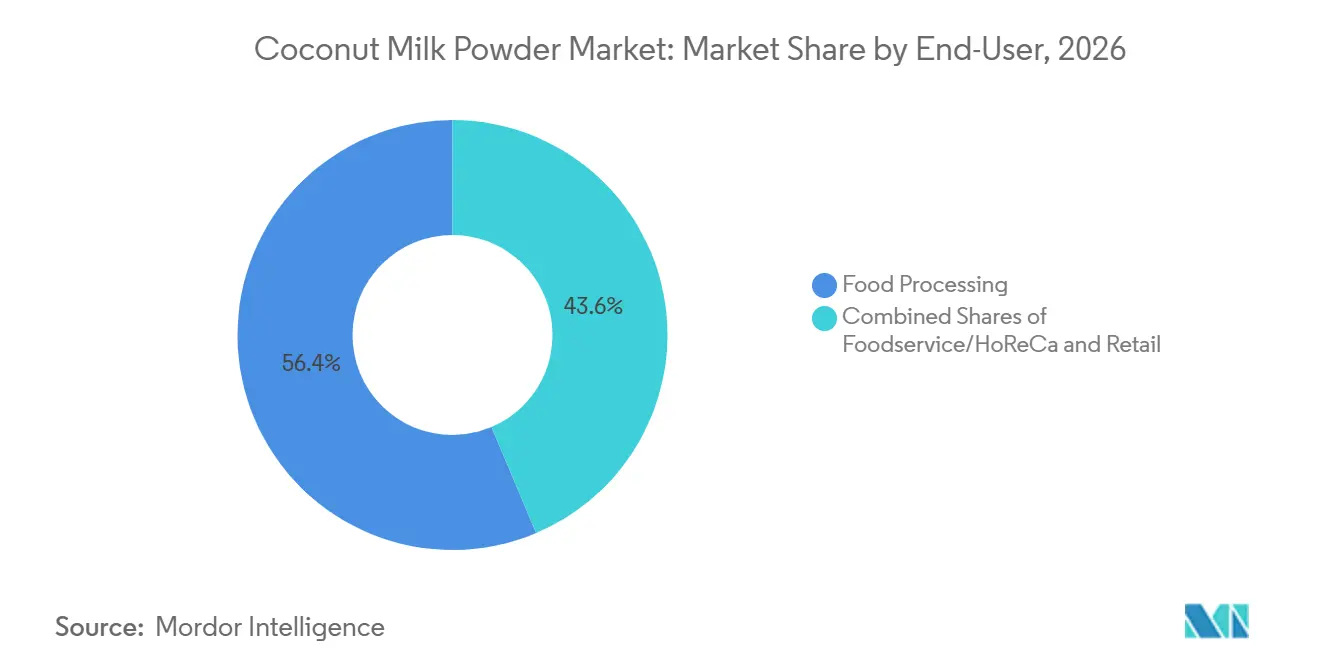
Food Processing Leads While Foodservice Broadens Use CasesFood processing accounted for 56.37% of the coconut milk powder market size in 2026. This position reflects long-standing use across bakery, confectionery, beverages, snack foods, soups, sauces, and dairy alternative products. Bakery and confectionery manufacturers use the powder to add fat richness and coconut flavor without refrigerated handling. Coconut milk coffee and plant-based protein shakes are expanding beverage applications across retail and quick-service menus. Soups, sauces, and gravies remain stable uses, especially in Southeast Asia and Western facilities producing ethnic ready meals.
Foodservice/HoReCa is forecast to grow at a 9.01% CAGR through 2032, making it the fastest-growing end-user segment in the coconut milk powder market. Restaurants use the format for Asian dishes, desserts, breakfast beverages, and tropical smoothies because it allows flexible preparation. Research on fluidized-bed agglomeration with xanthan gum binders indicates that more open particle structures can reduce reconstitution time and improve use in instant food formats[2]. Retail demand includes supermarkets, hypermarkets, convenience stores, and online channels. Online channels are useful for direct-to-consumer organic and clean-label brands that want to reach consumers outside established coconut-food markets.

Geography Analysis
APAC Coconut Milk Powder Market
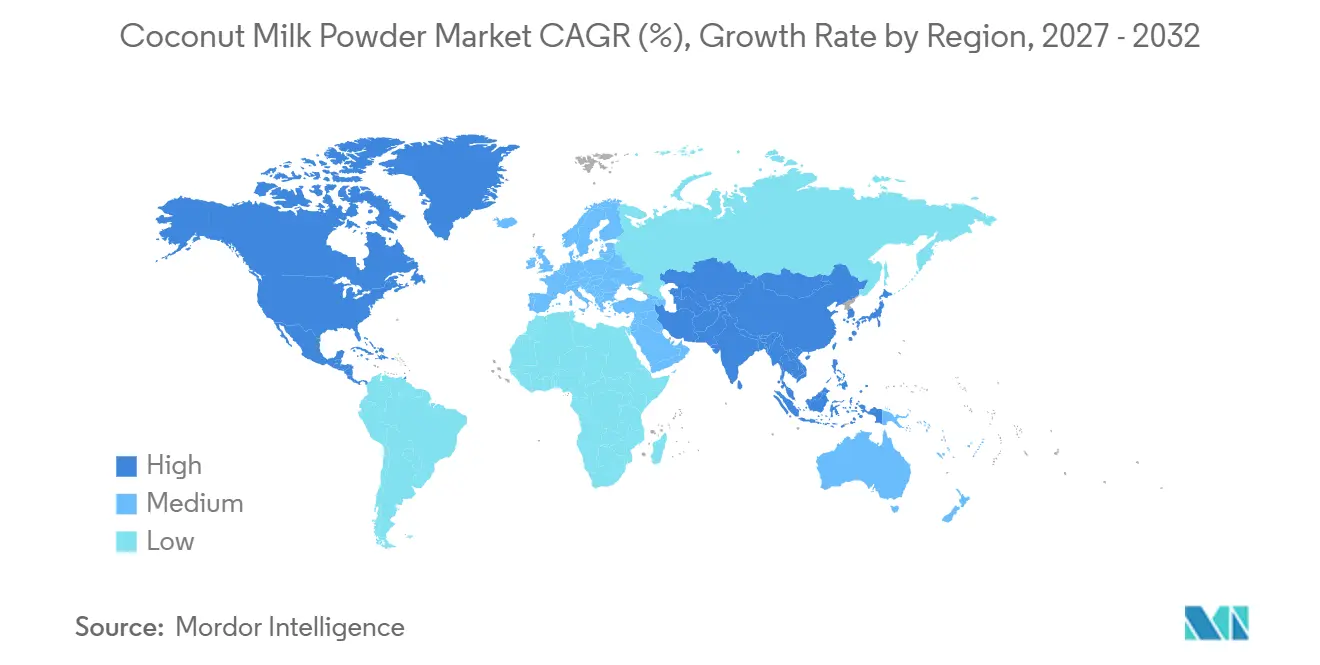
Asia-Pacific held 38.25% of the coconut milk powder market share in 2026. The region combines major raw material supply with substantial domestic culinary consumption. The Philippines, Indonesia, Sri Lanka, Vietnam, and India have established export infrastructure and a growing base of food-safety-certified processing facilities. China is becoming a more important market as coconut milk becomes more common in coffee applications. This demand is also increasing competition for raw coconuts, which can put pressure on local processors.
Japan and Indonesia Coconut Milk Powder Market
Japan’s coconut import volumes rose from 3,000 tonnes in 2001 to 6,000 tonnes in 2023, reflecting continued demand from plant-based and functional food applications. Indonesia illustrates the supply tension in the coconut milk powder market because it is a leading coconut producer while processors still face local shortages. Bulk exports to China can offer higher farm-gate returns than domestic sales to coconut milk manufacturers. This can reduce utilization rates at integrated processing facilities and place smaller operators under pressure. Suppliers with longer-term farmer relationships and diversified sourcing can be more resilient in this environment.
The Americas and EMEA Coconut Milk Powder Market
Europe is forecast to expand at a 9.55% CAGR through 2032, which makes it the fastest-growing geography in the coconut milk powder market. Demand is supported by Asian cuisine, halal food demand, and the storage advantages of powder in import supply chains. Certification requirements covering BRCGS, FSSC 22000, IFS, Halal approval, and electronic certificates of inspection for EU organic imports can favor larger suppliers with established compliance systems. North America remains a mature but active market, supported by dairy-free formulations and retail demand for clean-label and non-GMO products. South America has early-stage demand in Brazil and Colombia, while the Middle East benefits from halal-certified food processing in the United Arab Emirates and Saudi Arabia. Africa has lower current adoption because premium products face income constraints, although wider plant-based awareness creates a longer-term opportunity.
Competitive Landscape
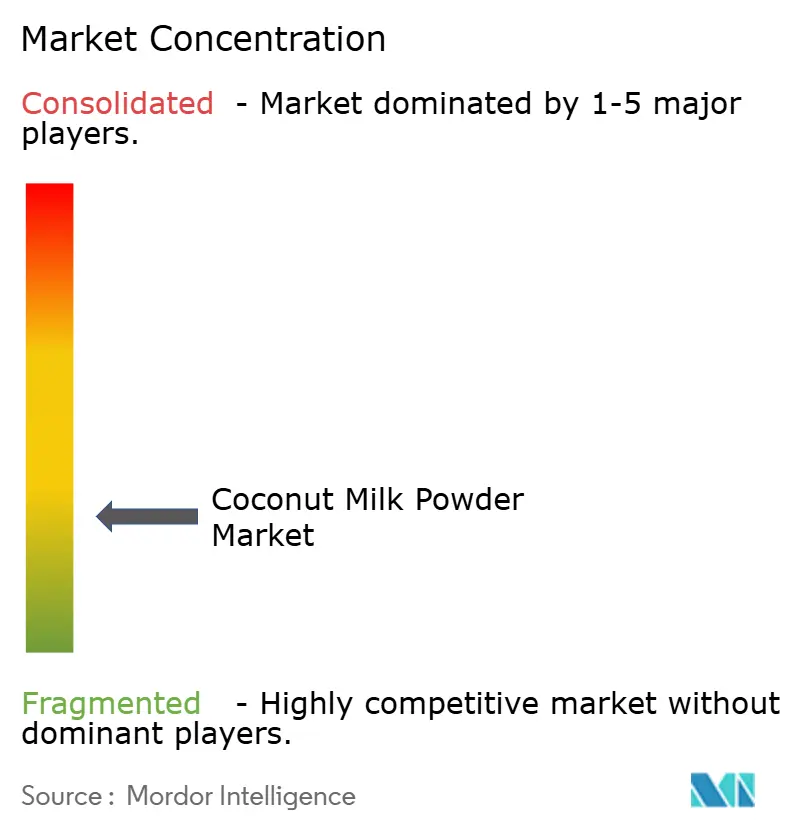
The coconut milk powder market has a fragmented structure that combines multinational food companies with specialized regional processors. Nestlé S.A. competes alongside suppliers in the Philippines, Indonesia, Sri Lanka, Malaysia, Thailand, and Vietnam. Industrial suppliers focus on product specifications, reliable supply, advanced spray-drying capacity, and recognized food-safety certification. Premium retail suppliers compete through organic, Halal, Kosher, and other certification combinations. This split reflects the different needs of high-volume food manufacturers and branded retail buyers.
Nestlé’s application of milk powder processing knowledge to coconut milk supports its product capability in the coconut milk powder market. CBL Group acquired PT Tri Jaya Tangguh in Indonesia in January 2026 for more than USD 25 million, with support from the International Finance Corporation, to secure access to processing capacity and raw materials. The acquisition gives CBL Group a direct position in a major coconut-producing country and supports exports through Indonesia’s trade relationships. Vita Coco completed its acquisition of Copra in July 2026 for USD 175 million upfront, with an earnout floor of USD 45 million and a cap of USD 100 million payable in 2029 based on 2028 performance[3]. This transaction expands Vita Coco’s position across coconut ingredients and indicates an intention to grow Copra outside its core Americas business.
Competitive opportunities remain in private-label supply for European discount and organic retailers. MCT-enriched, fortified, and instant-dissolve products are other areas where suppliers can differentiate. Emerging markets also offer room for suppliers that can establish distribution for premium products. The coconut milk powder market is exposed to raw material costs, so access to supply remains as important as product development. Large companies may gain scale through acquisitions, but regional processors remain relevant because sourcing, local processing knowledge, and export certification are distributed across several countries.
Coconut Milk Powder Industry Leaders
-
Nestlé S.A.
-
Thai Coconut Public Company Limited
-
Primex Coco Products, Inc.
-
Axelum Resources Corp.
-
Renuka Foods PLC
- *Disclaimer: Major Players sorted in no particular order
Coconut Milk Powder Market Companies Covered in this Report
- Nestlé S.A.
- Axelum Resources Corp.
- S & P Industries Sdn Bhd
- Renuka Foods PLC
- Thai Coconut Public Company Limited
- The Coconut Company (UK) Ltd.
- Cocomi Bio Organic
- Sambu Group
- Pulau Sambu Singapore Pte Ltd.
- Celebes Coconut Corporation
- Primex Coco Products, Inc.
- AYAM SARL
- BareOrganics, LLC
- Natural Sourcing, LLC
- Fiesta Ingredients Australia Pty Ltd.
- Enerhealth Botanicals
- Grace Foods Canada Inc.
- Kaira Organic World
- Midira Naturals Private Limited
- Viet Delta Corporation
Recent Industry Developments in Coconut Milk Powder Market
- March 2026: Kalpaka introduced a range comprising coconut milk powder, coconut flour, and coconut chips. The coconut milk powder provides a shelf-stable alternative to fresh and canned coconut milk for household cooking and foodservice applications.
- March 2025: Vietnam-based TTC AgriS and Indonesia's Sungai Budi Group entered into a strategic cooperation arrangement to develop a production and commercial platform for coconut-derived products. The initiative was planned with an initial capacity of 120 million litres/kilograms, with potential expansion to 300 million litres/kilograms in subsequent phases.
- February 2025: Thai Coconut Public Company Limited approved an investment in the Philippines through a subsidiary, NOVOCOCONUT INC., to strengthen raw-material access and expand production capacity for coconut milk and coconut water products.
Global Coconut Milk Powder Market Report Scope
The coconut milk powder market is segmented by product type, end-user, and geography. By product type, the market is segmented into organic coconut milk powder and conventional coconut milk powder. By end-user, the market is segmented into food processing, foodservice/HoReCa, and retail. The food processing segment is further categorized into bakery and confectionery, beverages, snack foods, soups, sauces and gravies, dairy alternatives, and others. The retail segment includes supermarkets/hypermarkets, convenience stores, online retail channels, and others. Geographically, the market is segmented into North America, Europe, Asia-Pacific, South America, and the Middle East and Africa. The market sizing has been done in value terms in USD for all the abovementioned segments.
Segmentation Overview
| Organic Coconut Milk Powder |
| Conventional Coconut Milk Powder |
| Food Processing | Bakery and Confectionery |
| Beverages | |
| Snack Foods | |
| Soups, Sauces, and Gravies | |
| Dairy Alternatives | |
| Others | |
| Foodservice/HoReCa | |
| Retail | Supermarkets/Hypermarkets |
| Convenience Stores | |
| Online Retail Channels | |
| Others |
| North America | United States |
| Canada | |
| Mexico | |
| Rest of North America | |
| Europe | Germany |
| United Kingdom | |
| France | |
| Italy | |
| Spain | |
| Netherlands | |
| Sweden | |
| Poland | |
| Belgium | |
| Rest of Europe | |
| Asia-Pacific | China |
| India | |
| Japan | |
| Australia | |
| South Korea | |
| Vietnam | |
| Indonesia | |
| Rest of Asia-Pacific | |
| South America | Brazil |
| Argentina | |
| Chile | |
| Peru | |
| Colombia | |
| Rest of South America | |
| Middle East and Africa | United Arab Emirates |
| Saudi Arabia | |
| South Africa | |
| Nigeria | |
| Rest of Middle East and Africa |
| Product Type | Organic Coconut Milk Powder | |
| Conventional Coconut Milk Powder | ||
| End-User | Food Processing | Bakery and Confectionery |
| Beverages | ||
| Snack Foods | ||
| Soups, Sauces, and Gravies | ||
| Dairy Alternatives | ||
| Others | ||
| Foodservice/HoReCa | ||
| Retail | Supermarkets/Hypermarkets | |
| Convenience Stores | ||
| Online Retail Channels | ||
| Others | ||
| Geography | North America | United States |
| Canada | ||
| Mexico | ||
| Rest of North America | ||
| Europe | Germany | |
| United Kingdom | ||
| France | ||
| Italy | ||
| Spain | ||
| Netherlands | ||
| Sweden | ||
| Poland | ||
| Belgium | ||
| Rest of Europe | ||
| Asia-Pacific | China | |
| India | ||
| Japan | ||
| Australia | ||
| South Korea | ||
| Vietnam | ||
| Indonesia | ||
| Rest of Asia-Pacific | ||
| South America | Brazil | |
| Argentina | ||
| Chile | ||
| Peru | ||
| Colombia | ||
| Rest of South America | ||
| Middle East and Africa | United Arab Emirates | |
| Saudi Arabia | ||
| South Africa | ||
| Nigeria | ||
| Rest of Middle East and Africa | ||
Key Questions Answered in the Report
What is the coconut milk powder market forecast through 2032?
The category is projected to increase from USD 0.87 billion in 2027 to USD 1.24 billion by 2032, at a 7.34% CAGR.
Which product type has the largest coconut milk powder market share?
Conventional coconut milk powder led with 78.32% in 2026 because it has established supply chains, broad certification, and accessible pricing.
Which coconut milk powder segment is growing the fastest?
Foodservice/HoReCa is forecast to grow at a 9.01% CAGR through 2032, supported by restaurants and hospitality operators.
Which region leads demand for coconut milk powder?
Asia-Pacific held 38.25% in 2026 because it combines major production capacity with strong culinary demand.